Ai Overview
The evolution of blockchain technology has created unprecedented demand for robust, scalable Web3 applications capable of serving millions of users across the USA, UK, UAE, and Canada. For enterprise applications operating across international markets, this stack provides critical advantages in performance optimization and cost management. A portfolio display showing balances for twenty tokens reduces from twenty separate RPC calls to a single multicall request, improving load times by up to 95%.
Key Takeaways
- Combining Ethers.js with Wagmi creates a powerful stack that balances low-level blockchain control with React-optimized state management for enterprise-grade Web3 applications.
- Wagmi’s built-in caching and SWR patterns reduce RPC calls by up to 70%, significantly lowering infrastructure costs while improving application responsiveness across global markets.
- Proper configuration of providers and signers prevents common integration mistakes that cause transaction failures, security vulnerabilities, and poor user experiences in production environments.
- Multi-chain support requires strategic planning of network configurations, RPC endpoint management, and graceful chain-switching UX to serve users across different blockchain ecosystems.
- Security best practices include validating all contract interactions, implementing proper error handling, and never exposing sensitive keys in client-side code or browser storage.
- Scalability optimization through batching, intelligent caching strategies, and reduced polling intervals transforms Web3 applications from prototype to production-ready platforms serving thousands of concurrent users.
- Understanding the distinction between read operations using useReadContract and write operations with useWriteContract is essential for building efficient, cost-effective decentralized applications.
- Transaction lifecycle management from gas estimation through confirmation requires careful orchestration of multiple hooks to provide users with transparent, reliable interaction feedback.
- Modern Web3 integration services leverage this stack to deliver features of cryptocurrency platforms that compete with traditional financial applications in speed and reliability.
- Avoiding common pitfalls like provider misconfiguration, incorrect ABI usage, and poor state handling separates amateur implementations from professional-grade Web3 solutions trusted by users worldwide.
Introduction to Ethers.js and Wagmi
The evolution of blockchain technology has created unprecedented demand for robust, scalable Web3 applications capable of serving millions of users across the USA, UK, UAE, and Canada. As enterprises recognize the transformative potential of decentralized systems, the need for reliable integration frameworks has become paramount. Throughout our eight years of experience building web3 platforms, we’ve witnessed countless projects struggle with the complexity of blockchain integration, often failing due to poor architectural choices in their foundational technology stack.
Ethers.js and Wagmi represent the current gold standard for building production-grade Web3 applications that balance performance, security, and maintainability. This integration combines the comprehensive blockchain interaction capabilities of Ethers.js with Wagmi’s React-optimized patterns, creating a development environment where teams can build sophisticated decentralized applications without sacrificing code quality or user experience. Understanding how to properly leverage both libraries unlocks the full potential of modern Web3 integration services, enabling developers to create features of cryptocurrency platforms that rival centralized alternatives in responsiveness and reliability.
What is Ethers.js and Why it’s widely used?
Ethers.js stands as one of the most trusted JavaScript libraries for Ethereum blockchain interaction, providing developers with a complete toolkit for building decentralized applications. Created by Richard Moore, this library has gained widespread adoption due to its lightweight architecture, extensive documentation, and commitment to security-first design principles. Unlike web3.js, which was the earlier standard, Ethers.js offers a more modular approach with clearer separation between providers, wallets, and contract abstractions, making it easier to reason about blockchain interactions in complex applications.
The library excels in providing low-level control over blockchain operations, allowing developers to customize every aspect of transaction creation, signing, and broadcasting. This granular control becomes essential when building advanced features like multi-signature wallets, custom signing schemes, or complex contract interactions requiring precise gas management. For teams working on how to use wagmi with ethers.js, understanding these foundational capabilities enables them to make informed decisions about when to leverage Ethers.js directly versus relying on Wagmi’s abstractions, ultimately creating more efficient and maintainable codebases.
What is Wagmi and How It Simplifies Web3 Integration?
Wagmi (acronym for “We’re All Gonna Make It”) revolutionizes Web3 integration by providing a collection of React Hooks specifically designed for blockchain applications. Built by the team at Paradigm and now maintained by Wevm, Wagmi addresses the most common pain points developers face when integrating blockchain functionality into React applications. The library handles complex state management, automatic caching, request deduplication, and type-safe contract interactions out of the box, dramatically reducing the boilerplate code required for typical Web3 operations.
What makes wagmi in web3 particularly powerful is its opinionated approach to solving real-world problems that plague blockchain applications. The library implements SWR (stale-while-revalidate) patterns for data fetching, ensuring users see cached data instantly while background updates keep information fresh. This approach eliminates the frustrating loading states common in poorly optimized Web3 applications. Additionally, Wagmi provides standardized hooks for wallet connection supporting MetaMask, WalletConnect, Coinbase Wallet, and dozens of other providers, abstracting away the complexity of managing multiple connector types while maintaining flexibility for custom implementations when needed.
Why This Stack is Ideal For Scalable Web3 Applications?
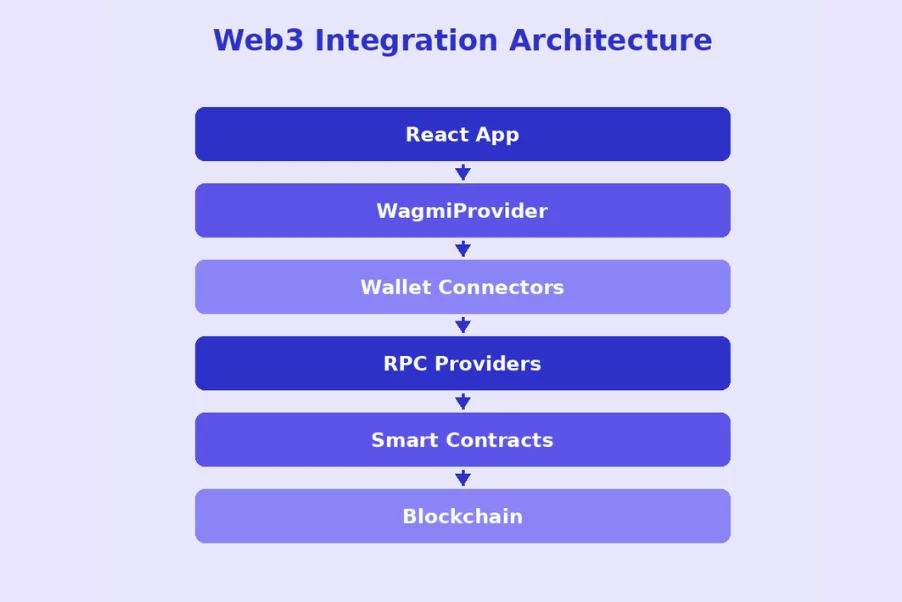
The combination of Ethers.js and Wagmi creates a best Web3 integration stack that addresses both developer experience and application performance. This pairing allows teams to leverage Wagmi’s optimized React patterns for common operations while maintaining the ability to drop down to Ethers.js for specialized blockchain interactions. The architecture naturally encourages separation of concerns, with Wagmi handling UI state synchronization and Ethers.js managing low-level blockchain operations, resulting in cleaner, more testable code that scales from prototypes to production systems serving millions of transactions.
For enterprise applications operating across international markets, this stack provides critical advantages in performance optimization and cost management. Wagmi’s intelligent caching reduces RPC calls by caching contract reads, balance queries, and transaction status checks, directly translating to lower infrastructure costs and faster application responsiveness. The TypeScript-first design of both libraries catches errors at compile time rather than runtime, preventing costly bugs from reaching production. Teams building ethers.js in web3 applications benefit from battle-tested patterns that handle edge cases like network switches, wallet disconnections, and transaction failures gracefully, creating user experiences that inspire confidence and drive adoption in competitive markets.
Key Requirements Before Integration
Successful Web3 integration demands careful preparation and understanding of essential prerequisites. Before writing a single line of code, teams must establish the proper technical foundation, from local tooling to network infrastructure. This preparation phase separates projects that launch smoothly from those that encounter critical blockers during implementation, wasting valuable time and resources on preventable issues.
Essential Tools and Environment Setup
Node.js Runtime Environment
- Install Node.js version 18.x or higher for optimal compatibility with modern Web3 libraries and TypeScript features
- Configure npm or yarn package managers with proper registry settings to avoid dependency resolution conflicts
- Set up environment variables for sensitive configuration data like API keys and RPC endpoints securely
- Implement .nvmrc files for consistent Node versions across team members and deployment environments
React Framework Configuration
- Initialize React projects using Vite or Next.js for optimal build performance and modern JavaScript support
- Configure TypeScript with strict type checking enabled to catch Web3 integration errors during compilation
- Set up TanStack Query (React Query) which Wagmi depends on for state management and caching functionality
- Install essential dependencies including wagmi, viem, and ethers if using the compatibility layer approach
Wallet Extensions for Testing
- Install MetaMask, Coinbase Wallet, and WalletConnect-compatible wallets for comprehensive connector testing across platforms
- Configure test networks and seed test wallets with faucet tokens for Sepolia, Goerli, or Mumbai testnets
- Set up multiple browser profiles to test wallet connection edge cases and multi-account scenarios effectively
- Implement hardware wallet integration testing for production applications requiring enhanced security measures
RPC Provider Basics
RPC (Remote Procedure Call) providers serve as the critical infrastructure layer connecting your application to blockchain networks. Services like Alchemy and Infura offer enterprise-grade RPC endpoints with enhanced reliability, performance monitoring, and generous free tiers suitable for most projects. These providers handle the complexity of running and maintaining blockchain nodes, offering features like automatic failover, load balancing, and detailed analytics that would be prohibitively expensive to implement independently. For applications serving users in the UAE and Canada, choosing providers with geographically distributed infrastructure ensures low latency regardless of user location.
While public RPC endpoints offer zero-cost access to blockchain networks, they come with significant limitations including rate limiting, slower response times, and no guarantees of uptime or data consistency. Production applications should never rely solely on public RPCs, as the unpredictable performance creates poor user experiences and can cause critical failures during high-traffic periods. Best practices include configuring multiple RPC providers as fallbacks, implementing retry logic with exponential backoff, and monitoring RPC call volumes to stay within rate limits. Understanding how wagmi works in react with different RPC configurations allows teams to optimize for both cost efficiency and reliability across various deployment scenarios.
Supported Chains and Network Planning
Strategic network selection requires analyzing target user demographics, transaction cost requirements, and blockchain feature needs. Ethereum mainnet offers the highest security and largest ecosystem but comes with significant transaction costs that can be prohibitive for frequent interactions. Layer 2 solutions like Arbitrum, Optimism, and Polygon provide EVM compatibility with dramatically reduced gas fees, making them ideal for applications requiring high transaction volumes. For specialized use cases, chains like Avalanche, BNB Smart Chain, or emerging networks might offer unique advantages in speed, cost, or ecosystem tooling.
Planning multi-chain support from the beginning prevents costly architectural refactoring later when expanding to new networks. Consider factors like smart contract deployment costs across chains, differences in block times affecting confirmation speeds, and variations in gas token economics when users need to acquire native tokens for transactions. Applications targeting users in the UK and USA should prioritize networks with high liquidity and established fiat on-ramps, while projects focused on emerging markets might benefit from chains with lower entry barriers and active regional communities that facilitate user onboarding and education.
Setting Up Wagmi in a React Application
Proper Wagmi configuration establishes the foundation for all subsequent Web3 interactions in your application. This setup phase determines application architecture, performance characteristics, and long-term maintainability. Understanding the nuances of Wagmi configuration prevents common pitfalls that lead to difficult-to-debug issues in production environments, ensuring your application scales gracefully as user adoption grows.
Installing Wagmi and required dependencies
Begin by installing the core Wagmi package alongside its peer dependencies using your preferred package manager. The installation requires wagmi itself, viem (the underlying Ethereum library), and TanStack Query for state management. Version compatibility matters significantly in the Web3 ecosystem, so always verify that your installed versions align with Wagmi’s documentation recommendations. TypeScript definitions come bundled with these packages, providing immediate type safety and autocomplete functionality that dramatically improves coding efficiency and reduces runtime errors.
Additional dependencies become necessary when implementing specific features like wallet connectors. The @wagmi/connectors package provides pre-built integrations for MetaMask, WalletConnect, Coinbase Wallet, and other popular wallet solutions. For applications requiring Ethers.js compatibility, install ethers v6 separately and use adapter utilities to bridge between Viem and Ethers providers. Keeping dependencies updated ensures access to latest security patches and performance improvements, though major version upgrades should be tested thoroughly in staging environments before production deployment to catch breaking changes that might affect critical user flows.
Creating Wagmi config and defining chains
The Wagmi configuration object centralizes all blockchain connectivity settings, defining supported chains, transport layers, and global options. Use the createConfig function from Wagmi to initialize this configuration, specifying each blockchain network your application supports with corresponding chain objects imported from viem/chains. Each chain definition includes critical parameters like chain ID, RPC URLs, block explorers, and native currency details. For production deployments, configure multiple RPC endpoints per chain with automatic failover to ensure uninterrupted service even when individual providers experience downtime.
Transport configuration determines how your application communicates with blockchain nodes, with options including HTTP transports for standard RPC calls and WebSocket transports for real-time event subscriptions. HTTP transports work well for most use cases and integrate seamlessly with rate-limited RPC providers, while WebSocket connections enable instant transaction notifications and block updates critical for real-time trading interfaces or live auction platforms. Consider implementing custom transport logic that dynamically selects optimal RPC endpoints based on user geography, automatically routing requests from USA users to North American nodes and UK users to European infrastructure for minimized latency.
Wrapping the app with WagmiProvider
After creating your Wagmi configuration, wrap your React application with the WagmiProvider component at the root level, passing the config object as a prop. This provider makes Wagmi’s functionality available throughout your component tree via React Context, enabling any child component to access blockchain data and functionality through Wagmi hooks. Position the WagmiProvider above all components that need Web3 functionality but below any providers that Wagmi itself depends on, such as error boundary components or theme providers that don’t require blockchain access.
Additionally, wrap your application with QueryClientProvider from TanStack Query, as Wagmi leverages this library for advanced caching and state management. Configure the QueryClient with appropriate defaults for cache time, stale time, and retry behavior based on your application’s needs. For example, applications displaying token prices might use shorter stale times (30 seconds) to keep data fresh, while applications showing historical transaction data can use longer cache durations (5 minutes) to reduce unnecessary refetching. This provider hierarchy creates the foundation upon which all Web3 integration services in your application will operate efficiently and reliably.
Wallet Connection Using Wagmi
Wallet connectivity forms the entry point for user interaction with Web3 applications, making it essential to implement this functionality with exceptional user experience and reliability. Wagmi’s connector system abstracts the complexity of supporting multiple wallet types while maintaining flexibility for custom implementations. Proper wallet integration ensures users can seamlessly authenticate and authorize transactions regardless of their preferred wallet solution or device.
Connecting MetaMask Using Connectors
MetaMask integration begins by importing and configuring the injected connector from Wagmi’s connector library, which automatically detects browser wallet extensions. The useConnect hook provides access to available connectors and a connect function that triggers the wallet connection flow. When users click your connect button, call this function with the MetaMask connector, prompting the extension to request user authorization. MetaMask’s dominance in markets like the USA and UK makes it the primary connector most applications prioritize, though modern dApps should never rely exclusively on a single wallet option.
Implement proper loading states and error handling around the connection process, as users might reject the connection request, lack the MetaMask extension, or encounter network connectivity issues. The useAccount hook provides reactive access to connection state, automatically updating your UI when users connect, disconnect, or switch accounts. Display the connected address in a user-friendly format using address truncation and ENS name resolution when available. For enhanced security, never store wallet addresses or connection state in localStorage, as Wagmi handles persistence automatically through secure mechanisms that prevent unauthorized access to sensitive user data.
WalletConnect Integration For Mobile Users
WalletConnect enables mobile wallet connectivity through QR code scanning, bridging the gap between desktop browsers and mobile wallet applications. Configure the WalletConnect connector with your project ID obtained from the WalletConnect dashboard, specifying metadata like your application name, description, and icons that appear in wallet connection prompts. This connector displays a QR code modal that users scan with mobile wallets like Trust Wallet, Rainbow, or Coinbase Wallet, establishing an encrypted connection between devices that persists across sessions until explicitly disconnected.
Mobile-first design considerations become critical when implementing WalletConnect, as many users in emerging markets access Web3 applications primarily through smartphones. Ensure QR codes display at adequate sizes for reliable scanning, provide alternative deep-linking options that open wallet apps directly when users access your application from mobile browsers, and implement clear instructions guiding first-time users through the connection process. Monitor WalletConnect session health and implement automatic reconnection logic for dropped connections, as mobile network conditions can be unpredictable, especially for users in regions with less reliable internet infrastructure requiring robust connection management.
Handling connect, disconnect, and account changes
Robust applications must gracefully handle all wallet state transitions including initial connections, explicit disconnections, and unexpected account switches within the wallet extension. Subscribe to account change events using Wagmi’s useAccount hook, which automatically triggers re-renders when the connected account changes. Clear any user-specific cached data when account switches occur, as displaying information from the previous account creates security risks and user confusion. Implement clear visual feedback showing which account is currently active, preventing users from accidentally performing transactions with unexpected accounts.
Disconnection handling requires cleaning up any active subscriptions, clearing sensitive data from component state, and resetting the UI to its pre-connected state. The useDisconnect hook provides a programmatic disconnect function that properly tears down the wallet connection and clears Wagmi’s internal state. Implement disconnect functionality in accessible locations like account menus or settings panels, never hiding this critical functionality behind multiple navigation layers. For applications handling financial transactions, consider implementing automatic disconnect after periods of inactivity, forcing users to re-authenticate before performing sensitive operations that protect against unauthorized access if devices are left unattended in public spaces.
Essential Wallet Connection Principles
Principle 1: Never force users into a single wallet option, always provide multiple connection methods including browser extensions and mobile wallets.
Principle 2: Implement clear visual feedback for all connection states including connecting, connected, disconnected, and error conditions.
Principle 3: Handle wallet rejections gracefully without throwing errors that crash the application or confuse users.
Principle 4: Persist connection preferences securely so users don’t need to reconnect on every visit.
Principle 5: Display connection instructions for users who lack wallet extensions with links to trusted installation sources.
Principle 6: Monitor connection health and implement automatic reconnection for dropped connections caused by network issues.
Principle 7: Test wallet connections across different devices, browsers, and network conditions before production deployment.
Principle 8: Provide accessible disconnect functionality and clear indicators showing which wallet and account are currently connected.
Using Ethers.js With Wagmi
While Wagmi’s underlying library Viem provides comprehensive blockchain functionality, certain scenarios benefit from Ethers.js integration for legacy contract compatibility or specialized operations. Understanding how to effectively bridge these libraries enables teams to leverage the strengths of both while maintaining clean, maintainable code architectures that scale with application complexity and feature requirements.
Understanding providers, signers, and contract instances
Ethers.js architecture centers on three core abstractions that handle different aspects of blockchain interaction. Providers represent read-only connections to blockchain networks, enabling applications to query chain state, fetch transaction data, and monitor events without requiring user authorization. Signers extend providers with wallet credentials, granting the ability to sign and broadcast transactions that modify blockchain state. Contract instances combine ABIs with addresses and providers or signers, creating JavaScript objects with methods corresponding to smart contract functions that feel native to developers familiar with traditional API programming.
This separation of concerns promotes security by limiting the scope of operations each component can perform. Applications should use providers for all read operations, only creating signer instances when users explicitly initiate transactions requiring signatures. Never instantiate signers unnecessarily or maintain them in global state where they might be accessed inappropriately. Understanding these distinctions becomes particularly important when integrating Ethers.js with Wagmi, as you’ll need to extract the appropriate abstraction from Wagmi’s state based on the operation you’re performing, ensuring your Web3 integration services maintain the security guarantees users expect from professional cryptocurrency platforms.
Fetching signer from Wagmi and passing into Ethers.js
Modern Wagmi versions use Viem rather than Ethers.js internally, requiring adapter functions to convert between these libraries when necessary. Use the walletClientToSigner utility function that bridges Wagmi’s wallet client to an Ethers.js signer instance. First, obtain the wallet client using Wagmi’s useWalletClient hook, then pass this client through the adapter to create an Ethers v6 compatible signer. This conversion enables you to use Ethers.js contract instances and utilities while maintaining Wagmi’s state management and connection handling benefits.
Cache the converted signer appropriately to avoid repeated conversions on every render, but ensure you invalidate this cache when the connected account changes to prevent signing with stale credentials. Implement this pattern primarily for edge cases requiring Ethers.js specific functionality rather than as your default approach, as Wagmi’s native hooks provide better performance and integration with React’s rendering lifecycle. For teams wondering how to use wagmi with ethers.js effectively, reserve Ethers.js integration for specialized scenarios like custom encoding functions, specific cryptographic operations, or interfacing with legacy libraries that only accept Ethers.js signers as inputs.
Best Practice For Separating read vs write operations
Architectural separation between read and write operations creates clearer code organization while enabling important optimizations. Read operations should leverage Wagmi’s useReadContract hook which implements automatic caching, request deduplication, and background refetching that dramatically reduces RPC load. These reads don’t require wallet signatures and can execute instantly using cached data when available, creating responsive interfaces that don’t block on network requests. Structure your components to fetch all necessary read data in parent components or custom hooks, passing this data down to child components as props rather than having each component independently fetch data.
Write operations require explicit user intent and should be triggered only by clear user actions like button clicks, never executing automatically during component mounting or rendering. Use Wagmi’s useWriteContract hook for transactions, which handles the entire write lifecycle including gas estimation, transaction broadcasting, and confirmation waiting. Separate write functions into dedicated modules or hooks that encapsulate transaction logic, error handling, and success callbacks, making them reusable across components. This separation naturally aligns with how users think about blockchain interactions, where viewing data is instant and free while writing data requires deliberate action and transaction fees that demand thoughtful user experience design and clear cost communication.
Reading Smart Contract Data (Scalable Approach)
Efficient contract data reading forms the backbone of responsive Web3 applications, determining whether interfaces feel instant and fluid or sluggish and unresponsive. Mastering Wagmi’s read patterns and optimization techniques enables applications to serve thousands of concurrent users without overwhelming RPC infrastructure or degrading user experience during high-traffic periods critical to maintaining competitive advantage in cryptocurrency platforms.
Using useReadContract for Efficient Reads
The useReadContract hook represents Wagmi’s primary interface for querying smart contract state, automatically handling caching, refetching, and React integration. Configure this hook with the contract address, ABI, function name, and any required arguments, receiving back the function result along with loading and error states. Wagmi caches results based on the combination of these parameters, automatically returning cached data for identical calls across different components without making additional RPC requests. This behavior dramatically reduces network overhead while keeping data fresh through background revalidation when cache entries become stale.
Advanced configuration options enable fine-tuning cache behavior for specific use cases. Set the enabled parameter to false for conditional reads that should only execute when certain criteria are met, preventing unnecessary RPC calls during component mounting. Configure watch mode to automatically refetch data on every new block for real-time critical information like auction states or trading prices, though use this sparingly as it significantly increases RPC usage. For applications displaying relatively static data like NFT metadata or token symbols, increase cache times to reduce refetching frequency, leveraging Wagmi’s intelligent caching to serve most requests instantly from memory without blockchain round trips.
Caching, Refetch Intervals, and Performance Tuning
Strategic cache management balances data freshness with performance efficiency, requiring different approaches for different data types. Token balances change frequently and benefit from shorter cache times (30-60 seconds) with automatic refetching, ensuring users see accurate values without manual refreshes. Contract configuration data like owner addresses or fee percentages rarely change, justifying longer cache durations (5-10 minutes) that reduce RPC load without risking stale data. Implement this tiering systematically across your application, categorizing each data point by its volatility and user expectations around freshness.
Performance tuning extends beyond individual cache settings to application-wide patterns. Implement global cache invalidation when users perform write operations that affect read data, ensuring consistency between blockchain state and cached values. Use React Query’s refetch methods to manually trigger data updates when users explicitly request refreshes rather than relying solely on automatic intervals. For data displayed across multiple pages or components, structure your application to fetch once at a high level and pass data down through props or context, avoiding duplicate fetches of identical data that waste RPC quota and slow application responsiveness unnecessarily.
Handling Multi-call Reads and UI Responsiveness
Multicall patterns batch multiple contract reads into single RPC requests, reducing network overhead from dozens of individual calls to one consolidated request. Implement multicall using Wagmi’s useReadContracts hook (note the plural) which accepts an array of contract call configurations and returns results for all calls together. This approach proves particularly valuable for displaying lists of items like token portfolios, NFT galleries, or marketplace listings where each item requires multiple data points. A portfolio display showing balances for twenty tokens reduces from twenty separate RPC calls to a single multicall request, improving load times by up to 95%.
UI responsiveness during data loading requires thoughtful handling of loading and error states. Display skeleton loaders or placeholders immediately while data fetches in the background, never blocking the entire interface on data that isn’t critical for initial render. Implement progressive enhancement where basic UI renders immediately with cached or default data, with enhanced features appearing as additional data loads. Handle partial failures gracefully in multicall scenarios where some calls succeed while others fail, displaying available data and clear error messages for failed portions rather than treating the entire batch as failed, maintaining maximum utility even when some blockchain interactions encounter issues during high network congestion periods.
Writing Smart Contract Functions Safely
Transaction execution represents the most critical and complex aspect of Web3 integration, where mistakes result in lost funds, failed transactions, and frustrated users. Implementing robust write patterns with comprehensive error handling and clear user feedback transforms unreliable prototypes into production-ready applications that users trust with valuable assets across major cryptocurrency markets in the USA, UK, UAE, and Canada.
Using useWriteContract and useWaitForTransactionReceipt
The useWriteContract hook manages the transaction submission process, providing a write function that triggers the wallet signature flow when called. Configure this hook with your contract details including address, ABI, and function name, then call the returned write function with any required arguments when users trigger transaction flows. The hook returns transaction hash immediately after successful broadcasting, before the transaction confirms on-chain. Never treat this hash as confirmation of success, as transactions can still fail during execution even after successful broadcasting to the mempool.
Combine useWriteContract with useWaitForTransactionReceipt to properly track transaction confirmation. Pass the transaction hash from the write operation to the wait hook, which monitors the blockchain for transaction inclusion and provides the final receipt containing execution status. Only after receiving a successful receipt should you update application state or display success messages to users. Implement timeout handling for transactions that fail to confirm within reasonable timeframes, providing users with options to speed up transactions through replacement or cancel stuck transactions through appropriate wallet features when network congestion causes extended confirmation delays.
Gas Estimation and Preventing Failed Transactions
Accurate gas estimation prevents the frustrating experience of failed transactions that waste user funds on gas without accomplishing their intended purpose. Wagmi’s useSimulateContract hook performs transaction simulation before actual execution, calling eth_call to verify the transaction would succeed and eth_estimateGas to determine required gas amounts. Run simulation before allowing users to submit transactions, disabling submit buttons or displaying error messages when simulation reveals the transaction would fail. This pre-flight check catches issues like insufficient token approvals, incorrect parameters, or contract state that would prevent successful execution.
Apply gas buffers to estimated amounts, typically adding 10-20% above the estimated gas limit to account for state changes between estimation and execution. Networks with variable gas prices like Ethereum mainnet require dynamic gas pricing strategies, fetching current base fees and priority fees from the network before transaction submission. Display estimated transaction costs to users in both native tokens and fiat currencies based on their location, helping users in markets like the UAE and Canada understand real-world cost implications before confirming transactions. Implement gas price suggestions showing slow, medium, and fast options with corresponding cost differences, empowering users to make informed tradeoffs between transaction speed and cost based on their urgency and budget constraints.
User-friendly Transaction Status Handling
Transaction lifecycle visibility transforms opaque blockchain operations into transparent processes that users can understand and trust. Implement clear status indicators showing stages including wallet signature request, broadcasting to network, pending confirmation, and final success or failure. Display transaction hashes as clickable links to block explorers appropriate for the connected network, enabling technically sophisticated users to verify transaction details independently. For less technical users, translate blockchain states into plain language like “Waiting for your approval in MetaMask” or “Processing on the blockchain, this usually takes 30 seconds”.
Error handling requires distinguishing between different failure types and providing actionable guidance. User rejections should display neutral messages without alarming language, simply informing users the transaction was cancelled and they can retry when ready. Gas estimation failures indicate parameter or state issues, requiring explanatory messages that help users understand and resolve problems. Transaction reverts after confirmation suggest smart contract logic rejection, warranting detailed error messages extracted from revert reasons when available. Implement toast notifications or modal dialogs for important status updates while maintaining a transaction history panel where users can review all past operations, building confidence through transparency about all blockchain interactions your application facilitates.
Managing Multi-Chain Support
Multi-chain architecture expands application reach while introducing complexity around network management, user experience, and state synchronization. Modern Web3 applications must seamlessly support users across Ethereum, Layer 2 solutions, and alternative chains, providing unified experiences that abstract away underlying blockchain differences while maintaining the security and reliability users expect from professional Web3 integration services.
Detecting Chain Mismatch and Prompting Chain Switch
Chain detection using Wagmi’s useChainId hook provides reactive access to the currently connected network, automatically updating when users switch chains in their wallet. Compare this chain ID against your application’s required or expected chain, displaying prominent warnings when mismatches occur. Never silently attempt operations on incorrect chains, as this leads to failed transactions and user confusion. Instead, implement clear UI indicators showing the current chain alongside the expected chain, with prominent call-to-action buttons triggering chain switch flows that guide users to the correct network.
The useSwitchChain hook initiates programmatic network switching through the user’s wallet, displaying a confirmation dialog where users approve the network change. Handle rejections gracefully, as users might decline chain switches for various reasons including unfamiliarity with the requested network or preference to complete operations on their current chain. For applications supporting operations across multiple chains, implement chain-specific feature availability, showing which features work on which networks and guiding users to appropriate chains for their intended actions. This approach maintains functionality across your supported networks while preventing user frustration from attempting incompatible operations.
Supporting Multiple Networks in Wagmi config
Configure all supported networks during Wagmi initialization by including chain definitions in your config object. Import pre-defined chain configurations from viem/chains for major networks like Ethereum mainnet, Polygon, Arbitrum, and Optimism, which include correct chain IDs, RPC URLs, block explorers, and native currency details. For custom or newer networks not included in Viem’s defaults, define custom chain objects with all required parameters ensuring accuracy to prevent connection failures or transaction errors caused by misconfigured network details.
Maintain separate contract address mappings for each supported network, as contracts deployed across chains have different addresses even when implementing identical functionality. Structure these mappings in configuration files or constants that make chain-specific addressing explicit and maintainable, preventing bugs where applications attempt to interact with wrong contracts due to address confusion. Consider implementing contract address validation that verifies contracts exist at specified addresses on target chains during application initialization, catching configuration errors before they affect users. For applications serving international markets, document which features are available on which networks, guiding product decisions about where to deploy contracts based on user demographics and transaction cost requirements.
Cross-chain UX Best Practices
Exceptional cross-chain user experience requires abstracting blockchain complexity while maintaining transparency about underlying mechanics. Display network indicators prominently in your application header or navigation, using recognizable chain logos and names that users can quickly identify. Implement network selector dropdowns allowing users to switch between supported chains without leaving your application, providing a more streamlined experience than forcing users to manually change networks in wallet extensions. Show relevant chain-specific information like current gas prices and estimated transaction costs for each network, helping users make informed decisions about where to execute operations.
For advanced features like cross-chain bridging or multi-chain asset displays, aggregate data from multiple networks simultaneously while clearly labeling the source chain for each piece of information. Implement loading states that show per-chain status rather than blocking the entire interface when one network experiences slowness, maintaining partial functionality even during network issues. Consider implementing chain-specific feature toggles that gracefully disable unsupported features on particular networks rather than showing broken functionality, with clear messaging explaining why certain features are unavailable on specific chains and suggesting alternative networks where those features are accessible for users needing that functionality.
Multi-Chain Feature Comparison Matrix
| Network | Average Gas Cost | Block Time | Best Use Case |
|---|---|---|---|
| Ethereum Mainnet | $5-50 per transaction | 12 seconds | High-value DeFi, NFT minting |
| Polygon | $0.01-0.50 | 2 seconds | Gaming, frequent transactions |
| Arbitrum | $0.10-2.00 | 1 second | DeFi protocols, DEX trading |
| Optimism | $0.15-2.50 | 2 seconds | Social platforms, DAO governance |
| Base | $0.05-1.00 | 2 seconds | Consumer apps, onboarding |
Security and Error Handling Best Practices
Security in Web3 integration extends beyond smart contract audits to encompass client-side code, data validation, and error handling that prevents exploits while maintaining positive user experiences. Implementing comprehensive security practices protects both users and applications from common attack vectors that plague inadequately secured cryptocurrency platforms, establishing the trust necessary for mainstream adoption across regulated markets.[1]
Handling Rejected Signatures and Failed Transactions
Signature rejection handling must distinguish between user-initiated cancellations and actual errors to provide appropriate feedback. When users explicitly reject signatures in their wallet, treat this as a normal flow rather than an error condition, displaying neutral messaging that acknowledges the cancellation without alarming language. Implement retry mechanisms allowing users to easily attempt the transaction again when ready, maintaining their application state so they don’t need to reconfigure parameters. Never automatically retry rejected signatures, as this creates frustrating loops where wallets repeatedly prompt users who have already declined.
Failed transactions after successful signature require different handling strategies based on failure cause. Network errors suggest connectivity issues warranting retry attempts with exponential backoff, while transaction reverts indicate smart contract rejection requiring user intervention to resolve underlying issues like insufficient balances or failed approval checks. Parse revert reasons from transaction receipts when available, translating technical error messages into user-friendly explanations with actionable next steps. Implement transaction failure tracking and analytics to identify patterns suggesting systemic issues requiring code fixes, preventing repeated user frustration from the same underlying problems affecting multiple users across your application.
Preventing Malicious Contract Calls
Contract address validation represents the first line of defense against phishing attacks and malicious contract interactions. Maintain an allow-list of known good contract addresses rather than accepting contract addresses from user input or external sources without validation. Implement checksum validation for all addresses, rejecting improperly formatted addresses that suggest tampering or error. For applications allowing users to interact with arbitrary contracts, display prominent warnings about the risks and implement reputation systems or community verification mechanisms that help users identify legitimate contracts versus potential scams.
Transaction preview interfaces should clearly display what users are authorizing, showing token amounts, recipient addresses, and contract function names in plain language before signature requests. Never hide transaction details or use technical jargon that obscures the actual operation being performed. Implement spending limits for token approvals, defaulting to exact amounts needed rather than infinite approvals that create ongoing security risks if contracts are later compromised. For sensitive operations like large transfers or contract deployments, consider implementing confirmation delays or multi-step verification flows that give users time to reconsider and verify transaction details before final commitment.
Safe RPC Usage and Rate Limit Handling
RPC rate limit management requires implementing request throttling, caching, and graceful degradation when limits are reached. Monitor RPC usage through provider dashboards, setting up alerts before reaching limits to prevent service disruptions. Implement client-side caching aggressively for data that doesn’t require real-time accuracy, using Wagmi’s cache configuration to minimize redundant requests. Consider implementing tiered RPC provider strategies where free tiers handle normal load with paid tiers activating during high traffic periods, balancing cost efficiency with reliability requirements.
When rate limits are exceeded, implement exponential backoff retry logic rather than aggressive immediate retries that exacerbate the problem. Display clear user feedback when RPC issues affect functionality, explaining the situation without technical jargon and providing estimated resolution times. Implement fallback to alternative RPC providers automatically when primary providers experience issues, maintaining service continuity without requiring user intervention. For critical operations, queue requests with retry logic rather than failing immediately, ensuring transactions eventually succeed even during temporary provider outages or rate limit scenarios affecting application performance.
Scalability Optimization for Production dApps
Production scalability separates amateur projects from enterprise-grade platforms capable of serving thousands of concurrent users without degradation. Optimization strategies encompassing caching, batching, and architectural patterns transform applications from prototypes that work under light load into robust systems handling peak traffic during major events or viral growth periods critical to capturing market opportunities.
Reducing RPC Calls and Improving Performance
RPC call reduction begins with auditing current usage patterns to identify redundant or unnecessary requests. Use browser developer tools to monitor network activity, flagging duplicate calls for identical data across different components. Implement data fetching at parent component levels, passing results down to children rather than having each child independently fetch. Utilize React’s useMemo and useCallback hooks to prevent unnecessary re-fetching triggered by component re-renders, ensuring blockchain requests only execute when dependencies actually change rather than on every render cycle.
Implement request deduplication at the application level for scenarios where Wagmi’s built-in deduplication isn’t sufficient. Create custom hooks that wrap Wagmi’s hooks with additional caching layers for particularly expensive operations. Consider implementing service worker caching for truly static blockchain data like contract ABIs or historical block information that never changes once retrieved. For read-heavy applications displaying leaderboards or analytics dashboards, implement backend caching layers that aggregate blockchain data server-side, reducing each user’s client-side RPC requirements to simple API calls against your cached data rather than direct blockchain queries for every metric displayed.
Using Batching, Caching, and Optimized Polling
Batching strategies combine multiple related operations into single requests, dramatically reducing network overhead. Implement multicall for reading multiple contract values, allowing retrieval of dozens of data points in one RPC call versus dozens of individual calls. For write operations, consider transaction batching patterns where multiple user actions accumulate before submission in a single meta-transaction, though this requires careful UX design to avoid confusing users about when actions actually execute on-chain versus when they’re merely queued.
Polling optimization requires intelligent interval selection based on data volatility and user expectations. Replace constant polling with event-driven updates using WebSocket connections for real-time critical data, subscribing to relevant contract events rather than repeatedly querying state. Implement adaptive polling that increases frequency during active user interaction and decreases during idle periods, conserving resources when users aren’t actively viewing data. For applications serving users across time zones like a global platform reaching the USA, UK, UAE, and Canada, implement time-based scaling that reduces polling frequency during low-traffic hours in each region, optimizing infrastructure costs while maintaining responsiveness during peak usage windows.
Structuring Web3 Logic For Large Apps
Architectural organization in large-scale applications requires separating Web3 logic from UI components to maintain code quality and testability. Create custom hooks that encapsulate all blockchain interactions for specific features, exposing only the minimal interface needed by UI components. This abstraction allows refactoring Web3 implementation details without touching dozens of components, centralizing logic that would otherwise be duplicated across the codebase. Structure these hooks in feature-oriented folders rather than technology-oriented folders, grouping all marketplace-related hooks together rather than separating read and write hooks into different directories.
Implement context providers for application-wide blockchain state like current network, connected account, and global contract instances that multiple features need to access. These providers should handle all state management complexity internally, exposing clean interfaces through custom hooks that components consume. Consider implementing a blockchain service layer between your components and Wagmi hooks, providing an abstraction that makes testing easier and protects against breaking changes in underlying libraries. For teams building complex platforms with dozens of smart contracts and hundreds of interaction points, architectural investment in clean separation between business logic and blockchain integration pays dividends through easier testing, simpler debugging, and more maintainable codebases that scale with feature complexity.
Web3 Optimization Performance Lifecycle
Initial Implementation
Set up basic Wagmi configuration with essential hooks for wallet connection and simple contract reads and writes.
Performance Profiling
Monitor RPC calls, identify redundant requests, and establish performance baselines for optimization priorities.
Caching Implementation
Configure appropriate cache durations, implement multicall batching, and optimize polling intervals for different data types.
Architecture Refactoring
Extract Web3 logic into custom hooks, implement service layers, and establish patterns for consistent data fetching.
Load Testing
Simulate concurrent user loads, identify bottlenecks under stress, and validate RPC provider capacity for peak traffic.
Continuous Monitoring
Implement ongoing performance monitoring with alerting for degradation and regular optimization reviews as usage grows.
Common Integration Mistakes to Avoid
Learning from common pitfalls prevents wasting valuable time debugging issues that have known solutions. Understanding these mistakes and their resolutions accelerates implementation while improving code quality, allowing teams to focus on unique features rather than solving problems that plague every Web3 integration project. These lessons come from eight years of building production platforms across diverse use cases and market conditions.
Provider Misconfiguration Issues
Provider configuration errors rank among the most common and frustrating issues in Web3 integration. Incorrect RPC URLs cause connection failures that appear intermittent and hard to diagnose. Always verify RPC endpoints are accessible from your deployment environment, as some free tier providers restrict access by IP or require API keys in headers. Mixing testnet and mainnet configurations creates confusion where applications appear to work but interact with wrong networks, potentially causing lost funds if users send mainnet assets thinking they’re on testnets.
Chain ID mismatches between configured chains and actual RPC endpoints cause subtle bugs where some operations work while others mysteriously fail. Validate that each configured chain’s ID matches its RPC endpoint by making test calls during application initialization. Implement comprehensive error handling around provider connectivity, displaying clear messages when providers are unavailable rather than letting applications hang indefinitely. For production deployments, never rely on public RPC endpoints as primary providers, as their unreliability creates poor user experiences that damage application reputation and user trust in critical moments when reliability matters most.
Incorrect Contract ABI and Address Usage
ABI mismatches cause cryptic errors that are difficult to debug, as function signatures fail to match actual contract implementations. Always generate ABIs directly from compiled contracts rather than manually writing or copying them, as hand-written ABIs inevitably contain typos or miss function modifiers. Version your ABIs alongside contract deployments, maintaining clear mappings between contract addresses and their corresponding ABI versions to prevent using outdated ABIs with upgraded contracts that have different interfaces.
Address validation prevents interacting with wrong contracts or non-existent addresses that waste gas on failed transactions. Implement checksum validation for all addresses before use, rejecting improperly formatted addresses immediately. Use environment variables or configuration files for contract addresses rather than hardcoding them in components, making multi-network support and address updates manageable without code changes. For complex applications interacting with many contracts, implement a contract registry pattern that centralizes address management and ensures consistency across your entire codebase, preventing the scattered address constants that become maintenance nightmares as applications scale and contract deployments multiply across networks.
UI Freezing Due To Poor State Handling
Synchronous blockchain operations block React rendering, creating frozen interfaces that frustrate users and appear broken. Never perform blockchain calls inside render functions or useEffect hooks without proper dependency management, as this creates infinite loops or blocks rendering until requests complete. Implement loading states for all async operations, displaying skeleton screens or spinners that communicate progress rather than leaving users staring at frozen interfaces wondering if the application crashed.
State management mistakes include storing blockchain data in component state when Wagmi already manages it, creating synchronization issues and stale data. Trust Wagmi’s cache and let its hooks manage blockchain state, only storing derived or UI-specific state in component state. Avoid unnecessary re-renders by properly memoizing callbacks and using React’s useMemo for expensive computations on blockchain data. For applications serving users across the USA, UK, UAE, and Canada, performance matters significantly as poor state management compounds latency issues for users far from RPC endpoints, making careful optimization essential for competitive user experiences in international markets where milliseconds of responsiveness determine user satisfaction and platform adoption rates.
Critical Integration Risk Warnings
Risk 1: Exposing private keys or mnemonics in client-side code creates catastrophic security vulnerabilities allowing theft of all user funds.
Risk 2: Accepting contract addresses from untrusted sources enables phishing attacks that drain user wallets through malicious contracts.
Risk 3: Infinite token approvals create ongoing exposure if approved contracts are later compromised by attackers.
Risk 4: Failing to validate transaction success before updating UI state causes applications to display incorrect balances or states.
Risk 5: Insufficient gas estimation leads to failed transactions that waste user funds without accomplishing intended operations.
Risk 6: Relying solely on public RPC endpoints creates service disruptions during critical moments when provider reliability matters most.
Risk 7: Missing network validation allows users to attempt operations on wrong chains, causing permanent asset loss or failed transactions.
Risk 8: Inadequate error handling exposes technical error messages that confuse users and damage application credibility during failures.
Final Thoughts
Mastering Ethers.js and Wagmi integration represents a critical milestone for teams building scalable Web3 applications that compete in global markets. This stack provides the foundation for creating cryptocurrency platforms with the reliability, performance, and user experience necessary to drive mainstream adoption. The patterns and practices outlined throughout this guide emerge from years of real-world implementation experience, addressing the challenges that teams inevitably encounter when scaling from prototype to production systems serving thousands of daily active users across diverse networks and use cases.
Success in Web3 integration requires balancing multiple competing priorities including security, performance, user experience, and cost efficiency. Teams must resist the temptation to prematurely optimize, instead focusing first on correct implementation with proper error handling and security practices before pursuing advanced optimization techniques. As applications mature and usage grows, the optimization strategies covered here become essential for maintaining quality service at scale, transforming good applications into great platforms that users trust with valuable assets and recommend to others seeking reliable Web3 experiences.
Final Checklist For Scalable Integration
Before launching Web3 applications to production, systematically verify all critical integration components function correctly under realistic conditions. Test wallet connections across all supported connectors on multiple devices and browsers, ensuring seamless experiences for users regardless of their chosen wallet or platform. Validate multi-chain support by performing operations on each configured network, confirming correct contract addresses, proper chain switching UX, and accurate display of network-specific information like gas prices and block explorers.
Performance testing under load reveals bottlenecks that only appear with concurrent users, ensuring your RPC infrastructure and caching strategies handle peak traffic without degradation. Security audits should verify proper input validation, absence of exposed secrets, correct handling of all error conditions, and appropriate user authorization for sensitive operations. Implement comprehensive monitoring with alerts for RPC failures, transaction errors, and performance degradation, enabling rapid response to issues affecting user experience. Document all configuration decisions, integration patterns, and operational procedures for team members who will maintain the application long-term, ensuring institutional knowledge persists beyond individual contributor tenure.
When To Use Wagmi-only vs Ethers.js + Wagmi
For most Web3 applications, Wagmi’s native capabilities powered by Viem provide everything needed without Ethers.js integration. Standard operations including wallet connection, contract reads and writes, transaction management, and multi-chain support work excellently using pure Wagmi patterns. The learning curve is gentler, documentation is comprehensive, and TypeScript integration is superior when avoiding the complexity of bridging multiple libraries. Teams starting new projects should default to Wagmi-only implementations unless specific requirements justify the additional complexity of Ethers.js integration.
Ethers.js integration becomes necessary when working with legacy code dependent on Ethers.js interfaces, implementing custom signing schemes not supported by Viem, or utilizing specialized Ethers.js utilities without Viem equivalents. Certain advanced cryptographic operations or specific wallet integrations might require Ethers.js functionality unavailable in Viem’s API. However, these scenarios represent edge cases rather than typical requirements. Before committing to Ethers.js integration, thoroughly research whether Viem provides equivalent functionality through different APIs, as maintaining a single library dependency simplifies codebases and reduces potential for integration bugs that plague applications mixing multiple Web3 libraries with overlapping functionality.
Next Steps
Advancing beyond basic integration requires deepening understanding of blockchain fundamentals, smart contract design patterns, and advanced frontend architectures. Study successful Web3 applications to understand their implementation choices, examining open-source projects from established platforms to learn production patterns. Experiment with new Wagmi features as they’re released, as the ecosystem evolves rapidly with continuous improvements to performance, developer experience, and capability coverage that expand what’s possible in Web3 applications.
Consider exploring complementary technologies that enhance Web3 applications including The Graph for efficient blockchain data indexing, IPFS for decentralized storage, and Layer 2 scaling solutions that dramatically reduce transaction costs. Engage with the Web3 community through forums, Discord servers, and technical conferences where developers share experiences and solutions to common challenges. For teams building ambitious platforms targeting users across the USA, UK, UAE, and Canada, partnering with experienced Web3 integration services accelerates implementation while avoiding costly mistakes, leveraging accumulated wisdom from hundreds of production deployments across diverse use cases and market conditions that inform best practices and architecture decisions.
Build Your Scalable Web3 Platform with Expert Integration
Partner with our experienced team to implement robust Ethers.js and Wagmi integration that scales from prototype to enterprise. Get production-ready Web3 applications trusted by users worldwide.
Frequently Asked Questions
Q1.What is the difference between Ethers.js and Wagmi in Web3 development?
Ethers.js is a full JavaScript library for Ethereum interactions like providers, wallets, and contracts. Wagmi is a React Hooks toolkit for Web3 apps. Ethers.js offers low-level control, while Wagmi simplifies wallet connections, reads, and transactions.
Q2.How does Wagmi improve Web3 integration compared to using Ethers.js alone?
Wagmi improves integration by handling React state, caching, and re-rendering automatically. It provides hooks like useAccount and useBalance, supports wallet connectors, and simplifies network switching. This reduces boilerplate, prevents stale data bugs, and lowers unnecessary RPC calls.
Q3.Can I use Ethers.js version 5 with the latest Wagmi, or do I need version 6?
Wagmi v2+ is built on Viem, not Ethers.js. Wagmi v1 supports Ethers.js v5 natively, but is older. For new apps, use Wagmi v2 with Viem, and add Ethers.js v6 only when required.
Q4.What are the best practices for managing multiple blockchain networks in Wagmi?
Configure all chains in Wagmi config with correct RPCs and chain IDs. Use useNetwork and useSwitchNetwork for detection and switching. Show clear UI warnings, validate wallet support, maintain per-chain contract address mapping, and handle failed switching gracefully.
Q5.How do I prevent common security vulnerabilities when integrating Ethers.js with Wagmi?
Validate user inputs, never expose private keys, and verify contract addresses from trusted sources. Handle errors for rejected transactions, estimate gas safely, and confirm finality using useWaitForTransactionReceipt. Rate-limit RPC calls, validate returned data, and use strict TypeScript.
Q6.What is the most efficient way to read smart contract data using Wagmi?
Use useReadContract with caching and refetch settings. For multiple reads, use multicall to batch requests and reduce RPC load. Set cache times based on data volatility. Prefer WebSocket subscriptions for real-time updates instead of heavy polling.
Q7.How do Ethers.js and Wagmi handle transaction gas estimation and optimization?
Wagmi simulates transactions using hooks like useSimulateContract to estimate gas and add buffers. Ethers.js uses contract.estimateGas for manual control. Optimization includes EIP-1559 fee settings, dynamic gas strategies, pre-flight checks, and showing estimated costs before confirmation.
Explore Services
Related Services
Reviewed by

Aman Vaths
Founder of Nadcab Labs
Aman Vaths is the Founder & CTO of Nadcab Labs, a global digital engineering company delivering enterprise-grade solutions across AI, Web3, Blockchain, Big Data, Cloud, Cybersecurity, and Modern Application Development. With deep technical leadership and product innovation experience, Aman has positioned Nadcab Labs as one of the most advanced engineering companies driving the next era of intelligent, secure, and scalable software systems. Under his leadership, Nadcab Labs has built 2,000+ global projects across sectors including fintech, banking, healthcare, real estate, logistics, gaming, manufacturing, and next-generation DePIN networks. Aman’s strength lies in architecting high-performance systems, end-to-end platform engineering, and designing enterprise solutions that operate at global scale.