Ai Overview
Decentralized applications face unique frontend challenges that traditional web apps never encounter: every user interaction may trigger a wallet signature, every data fetch hits a blockchain node instead of a fast REST API, and every transaction requires waiting for block confirmations. Users perceive dApps as sluggish, even when your smart contracts and backend are optimized. This reduces network overhead by 80–90% and makes data-heavy dashboards load almost instantly.
Decentralized applications face unique frontend challenges that traditional web apps never encounter: every user interaction may trigger a wallet signature, every data fetch hits a blockchain node instead of a fast REST API, and every transaction requires waiting for block confirmations. The result? Users perceive dApps as sluggish, even when your smart contracts and backend are optimized. Frontend performance optimization for dApps means addressing Web3-specific bottlenecks—lazy loading heavy libraries, batching RPC calls, caching immutable blockchain data, and using optimistic UI patterns—to deliver the snappy, responsive experience users expect from modern applications. dapp frontend.
Key Takeaways
- dApp frontends suffer from blockchain-specific latency (RPC calls, wallet confirmations) that centralized apps avoid, making performance optimization critical for user retention.
- Lazy loading Web3 libraries and wallet connectors can cut initial bundle size by 40–60%, dramatically improving first contentful paint and time-to-interactive metrics.
- Batching multiple eth_call requests into a single multicall transaction reduces network round trips by up to 80%, slashing perceived load times for data-heavy dashboards.
- Optimistic UI updates—showing pending states before blockchain confirmation—eliminate the “frozen UI” problem and make dApps feel as responsive as Web2 applications.
- Client-side caching of immutable contract data (token metadata, NFT attributes) in IndexedDB or localStorage prevents redundant RPC calls and enables instant re-renders on navigation.
- Service workers and prefetching strategies allow dApps to function offline-first, preload transaction history during idle time, and serve static assets from CDN or IPFS gateways without blocking the main thread.
Why Does Frontend Performance Matter More in dApps Than Traditional Apps?
Traditional web applications query centralized databases or REST APIs that return data in milliseconds. Decentralized applications, by contrast, fetch every piece of on-chain information through RPC calls to blockchain nodes—requests that can take 200–500 milliseconds per call, or longer during network congestion. A typical DeFi dashboard might fire a dozen separate eth_call requests just to render a user’s portfolio: token balances, staking positions, pending rewards, and transaction history. Each call adds latency, and when these requests run sequentially, the cumulative delay becomes noticeable. Users perceive the app as slow, even if your gas-efficient smart contracts execute in seconds. dapp frontend.
Wallet interactions introduce another layer of friction. Every state-changing transaction requires the user to approve a signature in MetaMask, WalletConnect, or another provider—a modal popup that blocks the UI thread. If your frontend doesn’t handle this asynchronously or provide feedback, the app appears frozen. Mobile users on 3G or 4G networks experience this bottleneck even more acutely: a single RPC call over a slow connection can take several seconds, and large JavaScript bundles (Web3.js alone is ~400 KB minified) consume precious bandwidth before the user sees any content. In emerging markets or rural areas, these delays translate directly to user churn. dapp frontend.
Finally, blockchain events (new blocks, transaction confirmations, contract events) arrive asynchronously and unpredictably. A naive implementation that re-fetches all data on every block or re-renders the entire component tree on every wallet balance change will cause jank, dropped frames, and poor responsiveness. Unlike traditional apps where you control the backend and can optimize query patterns, dApp frontends must work within the constraints of public RPC providers, variable block times, and the inherent latency of distributed networks. Performance optimization is not optional—it’s the difference between a usable product and one users abandon after the first slow load.
| Performance Bottleneck | Typical Delay (ms) | Impact on UX | Optimization Strategy |
|---|---|---|---|
| Single RPC call (eth_call) | 200–500 | Delayed data display, loading spinners | Batch calls with multicall contract |
| Wallet signature request | 2000–10000 | UI freeze, user frustration | Optimistic UI, async handlers |
| Large JavaScript bundle (Web3.js + ethers.js) | 1500–3000 | Slow first paint, high bounce rate | Code splitting, lazy loading |
| Transaction confirmation wait | 12000–30000 | Perceived “broken” app if no feedback | Show pending state, event listeners |
| Fetching NFT metadata from IPFS | 500–5000 | Empty placeholders, layout shift | CDN fallback, prefetch during idle |
| Re-rendering on every block event | Variable | Jank, dropped frames, poor scrolling | Debounce listeners, memoize components |
How Can Lazy Loading and Code Splitting Improve dApp Load Times?
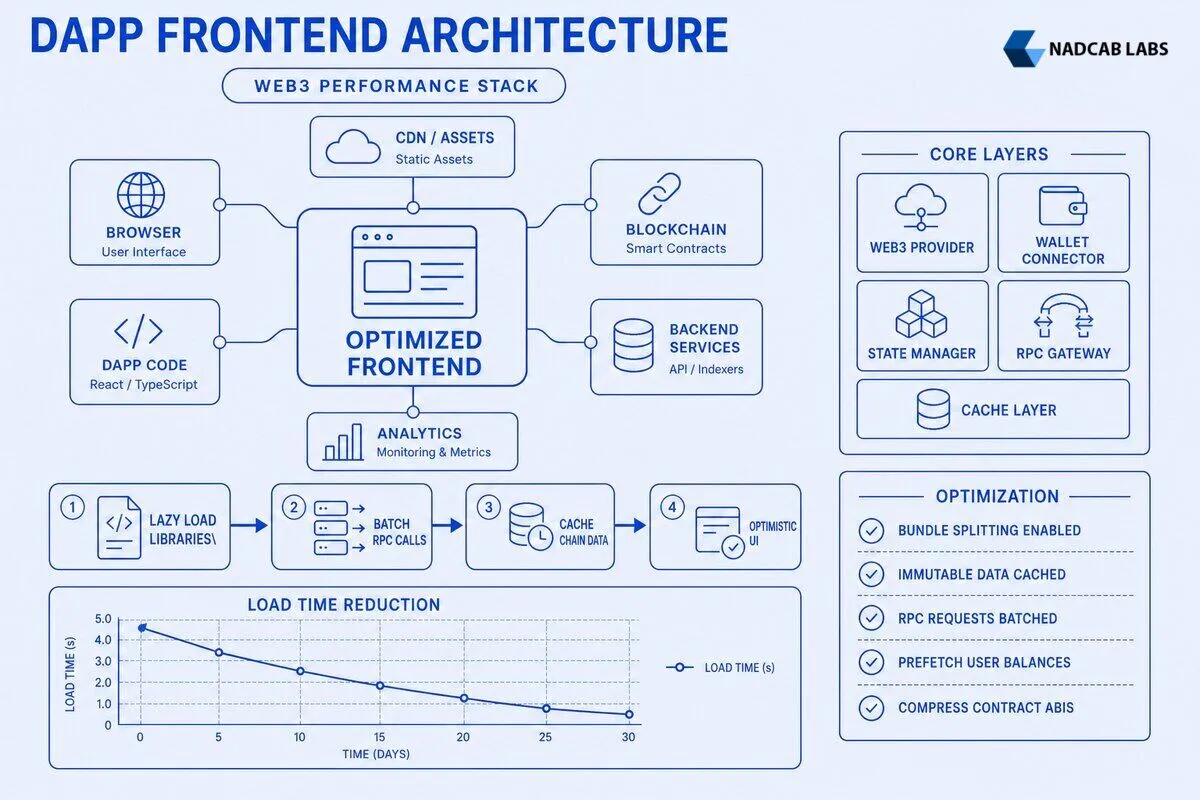
Most dApps ship a single monolithic JavaScript bundle that includes every library, wallet connector, and route upfront—even code the user may never execute. A typical Next.js or React dApp might bundle Web3.js (400 KB), ethers.js (300 KB), WalletConnect (200 KB), and various UI libraries into a 1.5 MB initial payload. On a fast connection this loads in a few seconds, but on mobile 3G it can take 10–15 seconds before the user sees interactive content. Lazy loading and code splitting break this bundle into smaller chunks that load on demand, dramatically reducing time-to-interactive and first contentful paint. dapp frontend.
Start by dynamically importing wallet connectors only when the user clicks “Connect Wallet.” Instead of importing MetaMask, WalletConnect, and Coinbase Wallet at the top level, use React.lazy or dynamic import() to load each connector’s code only when selected. This alone can shave 300–500 KB off your initial bundle. Similarly, if your dApp has multiple routes (swap, stake, governance, NFT gallery), apply route-based code splitting so each page loads only its required dependencies. A user visiting the swap interface doesn’t need the NFT gallery’s Three.js renderer or the governance module’s vote delegation logic. dapp frontend.
Measure the impact with Lighthouse or WebPageTest: before optimization, you might see a 3.2 second time-to-interactive; after lazy loading wallet connectors and splitting routes, this drops to 1.8 seconds—a 44% improvement. Bundle analyzers like webpack-bundle-analyzer or Next.js’s built-in analyzer reveal which dependencies bloat your bundle. Common culprits include moment.js (use date-fns or native Intl instead), lodash (import only needed functions), and duplicate copies of Web3 libraries (ensure you have a single version across dependencies). Tree-shaking and modern build tools (Vite, esbuild) help, but you must explicitly mark side-effect-free modules and avoid default exports that prevent dead-code elimination. dapp frontend.
Code Splitting Implementation Flow
Run bundle analyzer
React.lazy() for connectors
Next.js pages or React Router
Lighthouse TTI, FCP metrics
Don’t forget to lazy load non-critical UI components. If your dashboard shows a chart library (Chart.js, Recharts) below the fold, wrap it in a lazy boundary and load it only when the user scrolls into view. Intersection Observer API makes this trivial: detect when the chart container enters the viewport, trigger the import, and render. This pattern applies to modals, tooltips, and any feature that isn’t immediately visible. The Frontend Tools for dApp Development ecosystem offers libraries like @loadable/component and next/dynamic that handle chunking, prefetching, and loading states automatically, so you can focus on logic rather than webpack configuration. dapp frontend.
What Are the Best Strategies for Optimizing Web3 Provider Calls?
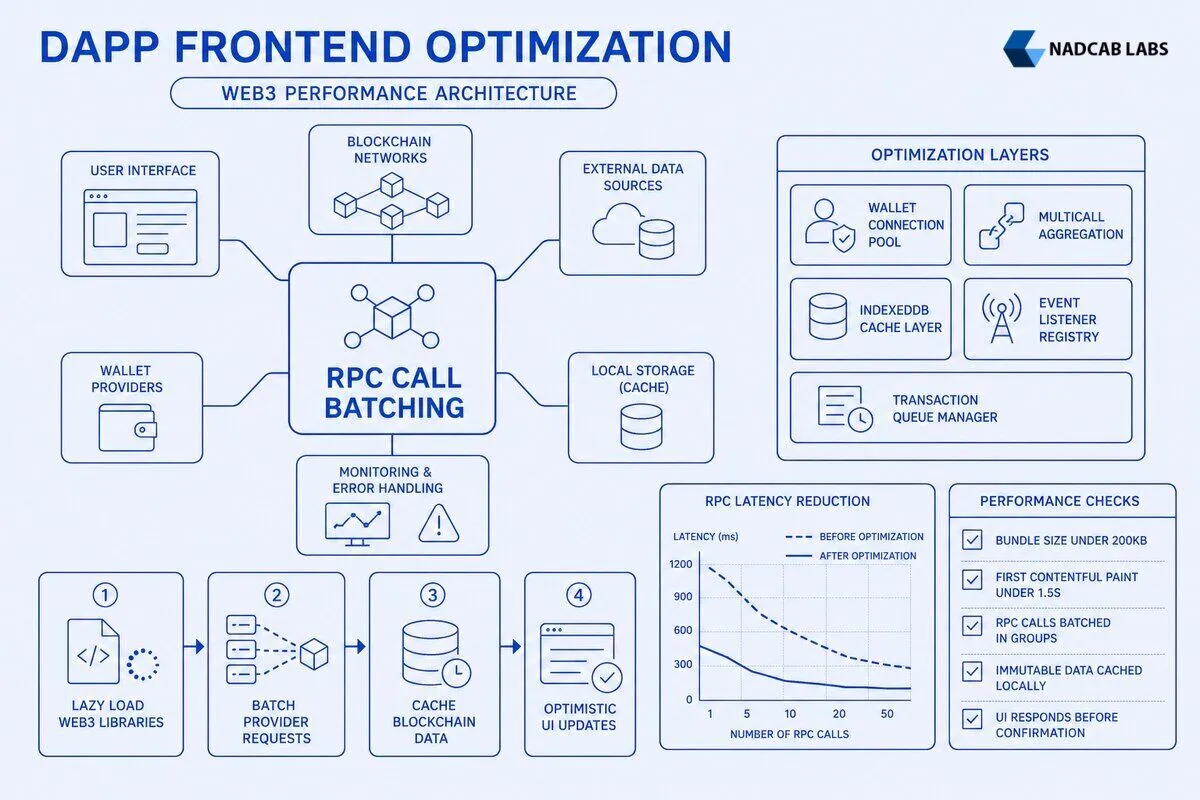
Every eth_call, eth_getBalance, or contract read method hits your RPC provider over the network. If your dApp makes ten separate calls to display a user’s portfolio, you’ve introduced ten network round trips—each with 200–500 ms latency. The solution is batching: combine multiple read requests into a single RPC call using a multicall contract. Multicall aggregates dozens of view function calls into one transaction, executes them atomically on-chain, and returns all results in a single response. This reduces network overhead by 80–90% and makes data-heavy dashboards load almost instantly. dapp frontend.
Multicall contracts (like MakerDAO’s Multicall or Uniswap’s Multicall3) are deployed on most EVM chains. Your frontend constructs an array of call data (target contract address, function signature, parameters), sends it to the multicall contract, and receives an array of results. Libraries like ethers-multicall and viem’s multicall utilities handle encoding and decoding automatically. For example, instead of calling balanceOf(user) separately for ten ERC-20 tokens, you batch all ten calls into one multicall and get all balances in ~300 ms instead of 3 seconds. This is a game-changer for DeFi dashboards, NFT galleries, and any interface that reads multiple contract states. dapp frontend.
Caching immutable data is equally critical. Token metadata (name, symbol, decimals) never changes, yet many dApps fetch it on every page load. Store this data in localStorage or IndexedDB after the first fetch, keyed by contract address and chain ID. When the user returns or navigates between pages, read from the cache instead of hitting the RPC provider. Similarly, cache NFT metadata (image URLs, attributes) fetched from IPFS or Arweave. Use a cache invalidation strategy based on block number or time-to-live (TTL): for mutable data like balances or staking rewards, cache for 30–60 seconds; for immutable data, cache indefinitely. This approach mirrors how dApp Development teams at Nadcab Labs structure their data layers—separating static contract metadata from dynamic user state. dapp frontend.
| Optimization Technique | Latency Reduction | Use Case | Implementation Complexity |
|---|---|---|---|
| Multicall batching (10 calls → 1) | ~85% reduction | Portfolio dashboards, multi-token balances | Low (use ethers-multicall library) |
| localStorage cache for token metadata | ~100% (instant) | Repeated page loads, navigation | Low (simple key-value store) |
| IndexedDB for NFT metadata | ~95% (offline-capable) | NFT galleries, large collections | Medium (requires IndexedDB API or Dexie.js) |
| Debounced balance polling (5s interval) | ~80% fewer calls | Real-time balance updates without spam | Low (use lodash.debounce or custom hook) |
| RPC request deduplication | Variable (eliminates duplicates) | Concurrent component mounts requesting same data | Medium (requires request cache layer) |
Request deduplication prevents redundant calls when multiple components mount simultaneously and request the same data. If three components each call getTokenBalance(tokenA) on mount, a naive implementation fires three identical RPC requests. A deduplication layer (using a Map or cache library like SWR) detects in-flight requests and returns the same promise to all callers, reducing load on your RPC provider and improving response time. This pattern is especially valuable in component-heavy frameworks like React, where re-renders and concurrent mounts are common. dapp frontend.
How Should You Handle Client-Side State Synchronization Without Blocking the UI?
Blockchain confirmations take time—12 seconds on Ethereum, 2 seconds on Polygon, 400 ms on Solana. If your UI waits for on-chain confirmation before updating, users see a frozen interface with no feedback. Optimistic UI updates solve this by immediately reflecting the expected state change in the interface, then reconciling with the actual blockchain state once the transaction confirms. When a user stakes tokens, show the updated staked balance and pending transaction status instantly, even before the transaction is mined. If the transaction fails, revert the optimistic update and display an error. This pattern makes dApps feel as responsive as Web2 apps.
Implement optimistic updates by maintaining two state layers: pending (optimistic) and confirmed (on-chain). When the user initiates a transaction, update the pending state immediately and show a “pending” badge or spinner. Subscribe to the transaction hash and listen for confirmation events. Once confirmed, merge the pending state into confirmed state and remove the pending indicator. If the transaction reverts, discard the pending state and show an error toast. Libraries like React Query and Zustand make this pattern straightforward: you can store optimistic mutations separately from server (blockchain) state and reconcile them on success or rollback on failure.
Heavy computations—signature verification, merkle proof generation, large dataset filtering—should run in Web Workers to avoid blocking the main thread. JavaScript is single-threaded, so any CPU-intensive task freezes the UI until it completes. Web Workers execute code in a background thread, communicating with the main thread via postMessage. For example, if your dApp verifies a merkle proof for an airdrop claim, offload the hashing and tree traversal to a worker. The main thread remains responsive, animations stay smooth, and the user can interact with other UI elements while the proof is computed. This is critical for mobile devices with slower CPUs, where a 500 ms computation can cause noticeable jank.
Optimistic UI Update Process
Click “Stake 100 USDC”
Show staked balance +100, display “Pending” badge
await signer.sendTx()
provider.waitForTransaction(txHash)
Tx mined, receipt OK
Merge pending → confirmed, remove badge, fetch updated on-chain balance
Tx reverted or rejected
Revert staked balance to original, show error toast
Debouncing wallet balance checks and event listeners prevents excessive re-renders. If you subscribe to the “block” event and re-fetch balances on every new block (every 12 seconds on Ethereum), you’re making hundreds of RPC calls per hour—most of which return the same data. Instead, debounce balance updates to fire at most once every 30 seconds, or only when the user’s address appears in a transaction. Use event filters to listen for Transfer events involving the user’s address, rather than polling balanceOf on a timer. This reduces RPC load by 90% and eliminates unnecessary component re-renders, keeping the UI smooth and responsive. The same principle applies to contract event listeners: filter events by indexed parameters (user address, token ID) to receive only relevant updates, not every event emitted by the contract.
Which Caching and Prefetching Techniques Deliver the Biggest Speed Gains?
Service workers enable offline-first dApp architectures by caching the application shell (HTML, CSS, JavaScript) and serving it instantly on repeat visits, even without network connectivity. A properly configured service worker can reduce time-to-interactive from 3 seconds to under 1 second on subsequent loads, because the browser serves cached assets from disk instead of fetching them over the network. For dApps, this means users can open the interface, connect their wallet, and view cached transaction history or NFT collections while the service worker fetches fresh data in the background. This pattern is standard in progressive web apps (PWAs) and works seamlessly with frameworks like Next.js, which offer built-in service worker support via next-pwa.
Prefetching transaction history and NFT metadata during idle time keeps the interface responsive when the user navigates to those sections. Use the requestIdleCallback API to schedule low-priority data fetches when the browser is idle—after the initial render, when the user isn’t scrolling or interacting. For example, if your dApp has a “History” tab that the user hasn’t visited yet, prefetch the last 50 transactions during idle time and store them in IndexedDB. When the user clicks “History,” the data loads instantly from the cache. This technique mirrors how DePIN hardware requirements are optimized for edge caching—preload predictable data before it’s requested.
CDN strategies for IPFS-hosted assets improve load times for NFT images, metadata JSON, and decentralized storage. Public IPFS gateways (ipfs.io, cloudflare-ipfs.com) are often slow or rate-limited. Instead, use a dedicated IPFS pinning service (Pinata, Infura IPFS, NFT.Storage) with a CDN in front, or configure HTTP fallback gateways that serve the same content via traditional CDN (Cloudflare, Fastly). When fetching an NFT image from ipfs://Qm…, try the primary gateway first, then fall back to a secondary gateway if the request times out. Cache the resolved HTTP URL in localStorage so future requests skip the gateway resolution step. This pattern reduces median image load time from 2–5 seconds to under 500 ms.
Performance Impact of Caching Strategies
Implement stale-while-revalidate caching for balance and state data. Serve cached data immediately (stale), then fetch fresh data in the background (revalidate) and update the UI when it arrives. This gives users instant feedback while ensuring data accuracy. For example, when the user opens the dashboard, display their cached token balances from 30 seconds ago, then quietly refresh the balances from the blockchain and update the UI when the new data arrives. This pattern is built into libraries like SWR (stale-while-revalidate) and React Query, which handle cache invalidation, background refetching, and optimistic updates automatically. The result is a dApp that feels instant on every interaction, even when fetching live blockchain data.
Combine these techniques with gas optimization techniques on the contract layer and Frontend Developers who understand Web3-specific performance constraints. A well-optimized dApp frontend can match or exceed the perceived speed of traditional web apps, despite the inherent latency of blockchain interactions. The key is to minimize network round trips, cache aggressively, and provide instant feedback through optimistic UI patterns—turning the blockchain’s asynchronous nature into an advantage rather than a bottleneck.
Measuring performance gains requires real-world metrics, not just Lighthouse scores. Track time-to-interactive (TTI), first contentful paint (FCP), and largest contentful paint (LCP) in production using tools like Google Analytics 4 or custom RUM (real user monitoring). Monitor RPC call volume and response times with your provider’s dashboard (Infura, Alchemy, QuickNode all offer analytics). Set performance budgets: initial bundle under 300 KB, TTI under 2 seconds on 3G, cache hit rate above 80%. These numbers guide optimization priorities and prove ROI to stakeholders. When users report “the app feels faster,” you have data to back it up.
Final Thoughts
Frontend performance optimization for dApps is not about applying generic web performance tricks—it’s about understanding the unique constraints of blockchain interactions and designing around them. Lazy loading Web3 libraries, batching RPC calls with multicall, caching immutable contract data, implementing optimistic UI updates, and prefetching during idle time are proven strategies that reduce load times by 50–80% and make decentralized applications feel as responsive as their centralized counterparts. The difference between a slow dApp and a fast one is rarely the blockchain itself—it’s how intelligently your frontend manages network requests, state synchronization, and user feedback. By treating performance as a core feature from day one, you build dApps that users trust, recommend, and return to—because they simply work, every time, without frustration. If you’re building a high-performance dApp and need expert guidance on frontend architecture, dApp Development teams at Nadcab Labs specialize in optimizing every layer of the stack for speed, reliability, and user experience.
Frequently Asked Questions
Q1.What is the main cause of slow load times in decentralized applications?
The primary cause is large JavaScript bundles containing Web3 libraries, wallet connectors, and contract ABIs loaded upfront. Blockchain RPC latency, unoptimized provider calls, and synchronous transaction polling compound the issue. Nadcab Labs recommends code-splitting, lazy-loading wallet integrations, and batching RPC requests to reduce initial payload and network overhead significantly.
Q2.How does lazy loading reduce dApp bundle size and improve performance?
Lazy loading defers non-critical modules—wallet connectors, charting libraries, contract ABIs—until needed, cutting initial bundle size by 40–60%. React.lazy or dynamic imports load components on-demand, accelerating Time to Interactive. Nadcab Labs implements route-based splitting so users download only the code required for the current view, improving perceived speed.
Q3.Why should I batch Web3 provider calls instead of making individual requests?
Batching multiple eth_call or eth_getBalance requests into a single JSON-RPC batch reduces round-trip latency and RPC rate-limit hits. Providers like Infura and Alchemy support batch requests, cutting network overhead by 50–70%. Nadcab Labs uses multicall contracts and batch utilities to fetch balances, allowances, and state in one call, dramatically improving responsiveness.
Q4.What is optimistic UI and how does it improve perceived dApp speed?
Optimistic UI updates the interface immediately after user action—assuming transaction success—before on-chain confirmation. If the transaction fails, the UI rolls back. This eliminates perceived wait time, making dApps feel instant. Nadcab Labs pairs optimistic updates with background polling and toast notifications to maintain accuracy while delivering seamless user experience.
Q5.Can I cache blockchain data on the client side without breaking accuracy?
Yes, cache immutable data—token metadata, historical events, contract ABIs—in IndexedDB or localStorage with versioned keys. Use short TTLs for mutable state like balances or allowances, and invalidate on user transactions. Nadcab Labs implements SWR (stale-while-revalidate) patterns and event-driven cache invalidation to balance speed and freshness without sacrificing correctness.
Q6.How do service workers help dApps perform better in low-connectivity scenarios?
Service workers cache static assets—HTML, CSS, JavaScript, images—enabling offline shell rendering and instant repeat visits. They intercept network requests, serve cached responses when offline, and queue transactions for retry. Nadcab Labs configures workbox-based service workers to pre-cache critical resources and background-sync pending transactions, ensuring dApps remain functional during intermittent connectivity.
Explore Services
Related Services
Reviewed by

Wazid Khan
Director & Co-Founder
Wazid Khan is the Director & Co-Founder of Nadcab Labs, a forward-thinking digital engineering company specializing in Blockchain, Web3, AI, and enterprise software solutions. With a strong vision for innovation and scalable technology, Wazid has played a key role in building Nadcab Labs into a trusted global technology partner. His expertise lies in strategic planning, business development, and delivering client-centric solutions that drive real-world impact. Under his leadership, the company has successfully delivered numerous projects across industries such as fintech, healthcare, gaming, and logistics. Wazid is passionate about leveraging emerging technologies to create secure, efficient, and future-ready digital ecosystems for businesses worldwide.