Ai Overview
This architectural paradigm enables horizontal scalability by distributing transaction processing across numerous parachains rather than forcing all activity through a single execution environment. The economic security budget backing the Relay Chain currently exceeds several billion dollars in staked value, providing parachains with institutional-grade security guarantees without individual chains needing to bootstrap validator sets.
Key Takeaways
- Polkadot blockchain implements heterogeneous multichain architecture enabling specialized parachains to operate independently while sharing security through a central Relay Chain coordination layer.
- Cross-Chain Messaging Protocol facilitates trustless data transfer between parachains without intermediary bridges, enabling composable applications spanning multiple specialized blockchain environments.
- Shared security model allows parachains to inherit economic protection from Relay Chain validators, eliminating the need for independent consensus mechanisms and validator bootstrapping.
- Nominated proof-of-stake consensus mechanism aligns validator incentives through economic penalties for misbehavior and rewards for honest participation across network operations.
- On-chain governance enables protocol upgrades without contentious hard forks, allowing DOT token holders to coordinate parameter changes and runtime modifications democratically.
- WebAssembly runtime environment supports forkless upgrades where parachains can modify core logic without halting operations or requiring coordinated network migrations.
- Parachain slot auctions create economic alignment mechanisms where projects commit substantial capital through crowdloans to secure network access for defined lease periods.
- Substrate framework empowers custom blockchain creation with modular components for consensus, networking, and storage while maintaining Polkadot ecosystem compatibility.
- Resource allocation through weight-based fee systems optimizes execution costs by accurately pricing computational complexity rather than relying on simple gas models.
- Bridge infrastructure enables connectivity to external ecosystems including Ethereum and Bitcoin, extending Polkadot interoperability beyond native parachains to legacy blockchain networks.
The Polkadot blockchain represents a fundamental reimagining of how distributed networks achieve scalability, security, and interoperability simultaneously. Since launching its mainnet in 2020, Polkadot has matured into a comprehensive ecosystem supporting dozens of specialized blockchains that benefit from shared security while maintaining sovereign governance and technical flexibility. Enterprise adoption across USA, UK, UAE, and Canadian markets continues accelerating as organizations recognize the architectural advantages of heterogeneous multichain systems over monolithic blockchain designs. Understanding Polkadot’s technical foundation becomes essential for architects evaluating infrastructure options for Web3 applications requiring cross-chain composability, predictable security guarantees, and evolutionary adaptability. This comprehensive analysis examines the core components, economic mechanisms, and technical innovations that position Polkadot as foundational infrastructure for interoperable decentralized networks.
Polkadot’s Multichain Architecture as a Foundation for True Interoperability
Polkadot blockchain architecture fundamentally differs from traditional single-chain platforms through its heterogeneous multichain design where multiple specialized blockchains execute in parallel while coordinating through a central Relay Chain. This architectural paradigm enables horizontal scalability by distributing transaction processing across numerous parachains rather than forcing all activity through a single execution environment. Each parachain can optimize for specific use cases, implementing custom state transition functions, consensus mechanisms, and economic models while maintaining security through the shared validator set. The Relay Chain itself remains minimalist, focusing exclusively on coordination, security, and cross-chain messaging rather than general-purpose computation. This separation of concerns allows Polkadot to scale linearly as additional parachains join the network, avoiding the bottlenecks inherent in monolithic blockchain architectures.
The multichain model addresses the blockchain trilemma by achieving scalability through parallelization, security through shared validation, and decentralization through sovereign chain governance. Projects building on Blockchain Technology infrastructure increasingly recognize that single-chain solutions cannot simultaneously optimize for transaction throughput, security guarantees, and feature flexibility. Polkadot’s architecture acknowledges this reality by providing a framework where specialized chains handle specific workloads while benefiting from ecosystem-wide security and interoperability. Institutional adopters in Dubai, London, Toronto, and New York financial districts particularly value this design as it enables compliant financial applications to operate on regulated parachains while maintaining seamless interaction with DeFi protocols on permissionless chains. The architectural flexibility extends to consensus mechanisms, with parachains free to implement proof-of-authority for enterprise use cases or innovative consensus algorithms for experimental applications, all while inheriting Relay Chain security.
Relay Chain Design and Its Role in Shared Security and Coordination
The Relay Chain serves as Polkadot blockchain’s central coordination layer, responsible for network security, consensus, and cross-chain interoperability rather than application logic execution. This minimalist design philosophy keeps the Relay Chain lean and focused, with validators dedicating computational resources exclusively to validating parachain state transitions and finalizing blocks. The architecture employs a sophisticated validator assignment system where validators randomly rotate across parachains, preventing long-term collusion and ensuring every parachain receives fresh validation perspectives. Validators stake substantial DOT holdings that get slashed for misbehavior, creating powerful economic incentives for honest participation. The Relay Chain’s state contains only essential data: validator set information, parachain registry, cross-chain messages, and governance proposals, keeping blockchain bloat minimal and synchronization efficient.
Coordination responsibilities extend beyond simple block validation to include sophisticated mechanisms for parachain block inclusion, availability attestation, and dispute resolution. Validators participate in a multi-stage process where they attest to parachain block validity, ensure data availability through erasure coding, and resolve disputes through additional validation rounds when discrepancies arise. This layered approach provides statistical guarantees that invalid blocks cannot gain finality even if small validator subsets behave maliciously. The economic security budget backing the Relay Chain currently exceeds several billion dollars in staked value, providing parachains with institutional-grade security guarantees without individual chains needing to bootstrap validator sets. Organizations deploying applications across North American and European markets particularly value this shared security model as it eliminates single points of failure common in traditional bridge architectures while providing transparent security metrics for compliance and risk management frameworks.
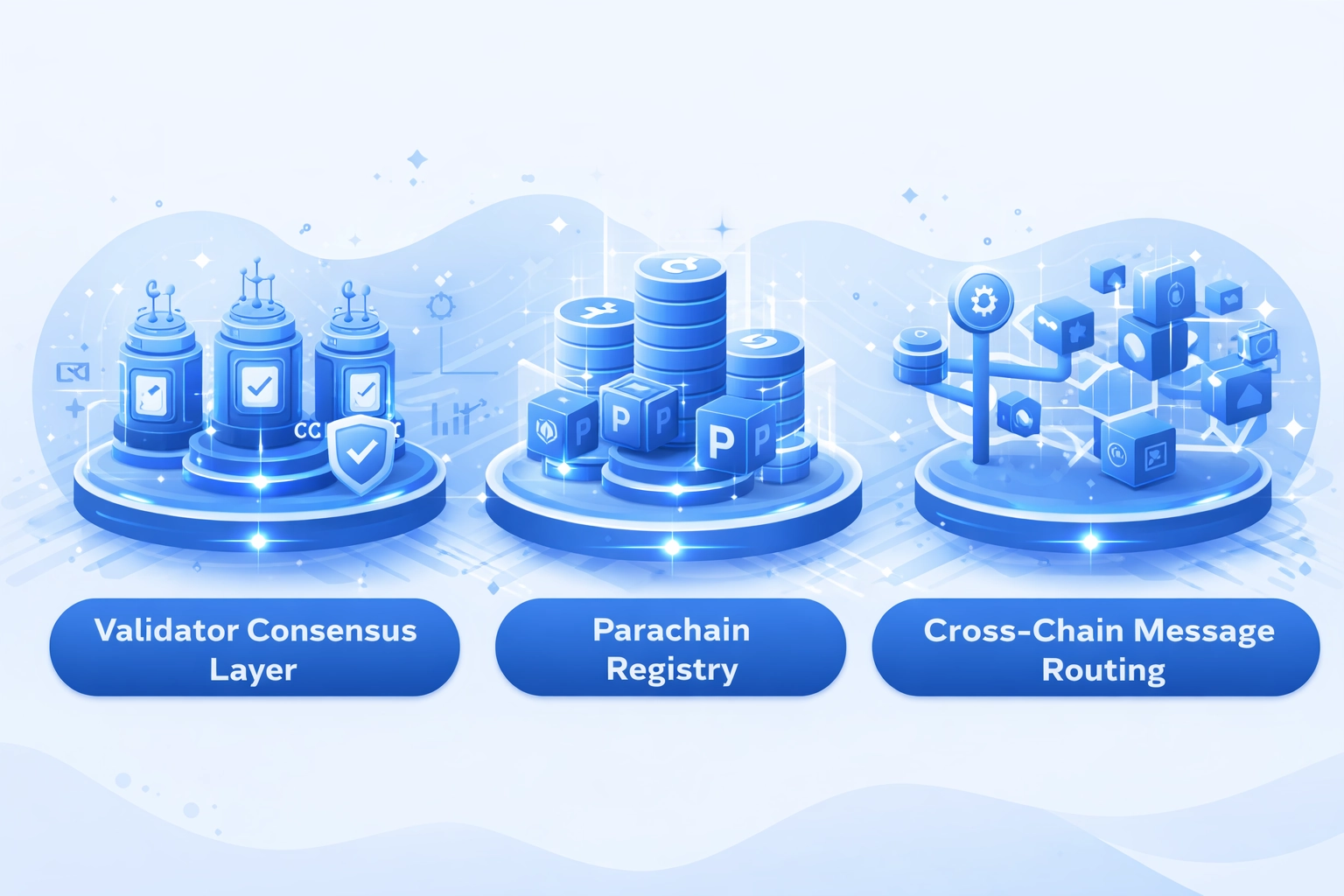 Relay Chain Core Components
Validator Consensus Layer
Nominates validators through proof-of-stake mechanism, assigns them to parachains through verifiable random function, and coordinates block production using BABE and finality through GRANDPA protocols.
Parachain Registry
Maintains authoritative record of active parachains, their lease periods, validation code hashes, and genesis states enabling validators to verify parachain blocks against registered specifications.
Cross-Chain Message Routing
Facilitates trustless message passing between parachains through XCMP protocol, queuing messages in Relay Chain state until destination chains process them with cryptographic proofs of origin.
Parachain Slot Auctions and Economic Security Alignment Mechanisms
Parachain slot auctions represent Polkadot blockchain’s unique economic mechanism for allocating scarce network resources while aligning incentives between projects and token holders. The candle auction format introduces unpredictability in auction end times, discouraging last-minute sniping and encouraging projects to submit their true valuations early in the auction period. Winning projects secure parachain slots for lease periods typically ranging from six months to two years, with DOT tokens locked for the entire duration. This capital commitment requirement serves as a quality filter, ensuring only serious projects with substantial backing obtain limited parachain slots. The auction mechanism has successfully distributed slots to dozens of projects, raising billions in locked DOT value while maintaining decentralized slot allocation without centralized gatekeepers.
Crowdloan campaigns complement the auction system by enabling community participation in parachain funding, where users contribute DOT tokens to support specific projects in exchange for native parachain tokens. This mechanism democratizes access to early-stage blockchain projects while creating network effects around successful parachain candidates. Contributors maintain ownership of their DOT but sacrifice liquidity for the lease duration, aligning their interests with project success. The crowdloan model has enabled projects to raise hundreds of millions in community support, with participation particularly strong from retail investors in USA, Canada, and UK markets seeking exposure to Polkadot ecosystem growth. Some projects have innovated on the basic model by offering liquid crowdloan derivatives, allowing participants to trade positions while maintaining project support. The economic alignment created through auctions and crowdloans ensures parachains have strong incentives to deliver value, as failing projects struggle to renew slots when leases expire.[1]
Parachain Auction Mechanics Comparison
| Auction Phase | Duration | Bidding Activity | Strategic Considerations |
|---|---|---|---|
| Starting Period | 2-3 days | Initial bids establish baseline pricing | Projects signal serious intent through early commitments |
| Active Bidding | 3-4 days | Competitive adjustments and crowdloan momentum | Community engagement critical for crowdloan success |
| Candle Phase | 2 days | Retroactive ending discourages sniping | True valuations revealed earlier in period |
| Lease Period | 6-24 months | Tokens locked, parachain operational | Project delivery crucial for renewal auctions |
Cross-Chain Messaging (XCMP) and Trustless Data Transfer Between Chains
Cross-Chain Messaging Protocol represents the Polkadot blockchain’s solution for trustless communication between parachains without requiring wrapped tokens or centralized bridges. XCMP enables parachains to send messages directly to one another through the Relay Chain, which validates message authenticity and ensures delivery without storing message contents long-term. Messages include asset transfers, smart contract calls, and arbitrary data, with destination parachains processing them according to their own logic and state transition rules. The protocol guarantees message ordering and delivery through Relay Chain consensus, providing cryptographic proof that messages originated from legitimate source parachains. This architecture eliminates single points of failure inherent in traditional bridge designs where multisig committees or centralized validators control cross-chain transfers.
XCMP implementation progresses through phases, with the current Horizontal Relay-routed Message Passing serving as the foundation while full peer-to-peer XCMP develops. The system employs a channel-based model where parachains open communication channels with specific destinations, establishing bandwidth allocations and message routing parameters. XCM (Cross-Consensus Message Format) provides a standardized language for expressing cross-chain intentions, abstracting away implementation details and enabling parachains built on different frameworks to communicate seamlessly. Enterprise applications spanning multiple parachains particularly benefit from this standardization, as developers can compose workflows across DeFi protocols, identity systems, and storage networks without managing bridge complexity. Financial institutions in Dubai and London exploring cross-border settlement applications value XCMP’s trustless guarantees, as transactions execute atomically across chains or fail completely, preventing partial execution risks that plague traditional multi-chain systems.
Shared Security Model and Its Impact on Parachain Risk Reduction
The shared security model fundamentally transforms blockchain security economics by pooling economic guarantees across all Polkadot blockchain parachains rather than fragmenting security budgets across independent chains. New parachains immediately inherit the full security of the Relay Chain validator set, with billions in staked DOT protecting against attacks from the moment the parachain becomes active. This eliminates the bootstrapping problem where new blockchains must attract sufficient validators and stake to achieve meaningful security, a process that can take years and consume significant resources. Parachains avoid the operational complexity of managing validator sets, implementing slashing mechanisms, or coordinating consensus upgrades, focusing instead on application logic and user experience. The shared security architecture makes launching a secure blockchain accessible to teams that previously lacked resources for independent chain operation.
Risk reduction extends beyond initial launch to ongoing operations, as parachains benefit from continuous validator rotation that prevents long-term collusion opportunities. Validators assigned to validate parachain blocks change frequently through verifiable random function selection, ensuring fresh perspectives and reducing attack vectors. The economic cost of attacking a parachain equals the cost of attacking Polkadot itself, requiring acquisition or corruption of substantial validator stake that would be slashed upon detection. This security model particularly appeals to enterprises in regulated markets across USA, UK, Canada, and UAE where security audit requirements and compliance standards demand institutional-grade guarantees. Financial applications processing millions in daily volume can launch on parachains with confidence that security scales with the broader ecosystem rather than depending on application-specific validator sets that may lack economic depth or technical sophistication.
Parachain Integration and Operational Lifecycle
Testnet Validation
Deploy parachain to Rococo or Westend testnet environments to validate runtime logic, test cross-chain messaging, and ensure compatibility with Relay Chain protocols before mainnet registration.
Slot Auction Participation
Compete in candle auctions through direct bidding or crowdloan campaigns to secure parachain slots for defined lease periods ranging from six months to two years of network access.
Genesis State Registration
Submit initial parachain state and runtime WebAssembly blob to Relay Chain, establishing the canonical starting point for parachain block production and validation.
Collator Network Establishment
Deploy collator nodes responsible for transaction aggregation, block production, and submission of parachain blocks to Relay Chain validators for verification and inclusion.
Active Block Production
Begin regular block production with Relay Chain validators verifying state transitions, ensuring data availability, and including parachain blocks in finalized Relay Chain state.
Runtime Upgrades
Execute forkless upgrades by submitting new runtime WebAssembly to Relay Chain, enabling protocol improvements without coordinating hard forks or validator migrations.
Lease Renewal
Participate in subsequent auctions before lease expiration to maintain parachain status, with successful projects demonstrating value to communities through continued crowdloan support.
Continuous Optimization
Monitor performance metrics, optimize weight-based fees, enhance cross-chain integrations, and expand functionality based on user feedback and ecosystem evolution.
Nominated Proof-of-Stake and Validator Incentive Engineering
Nominated Proof-of-Stake distinguishes Polkadot blockchain’s consensus mechanism through its sophisticated incentive alignment between validators and nominators. The system limits the active validator set to several hundred nodes selected based on stake backing, with nominators choosing up to 16 validators to support with their DOT holdings. This design concentrates validation responsibilities among professional operators while democratizing participation through nomination, allowing token holders without technical expertise to earn staking rewards. The election algorithm optimizes for both security and decentralization by distributing stake evenly across validators using the Phragmén method, preventing excessive concentration that could threaten network integrity. Validators receive proportional rewards based on era points earned through block production and parachain validation, with nominators sharing returns minus validator commission.
Slashing mechanisms create powerful disincentives for validator misbehavior, with penalties ranging from small fraction losses for minor infractions to complete stake confiscation for serious attacks. Nominators share slashing penalties proportionally, incentivizing careful validator selection and ongoing performance monitoring. This shared risk model aligns nominator and validator interests, as both parties suffer losses from poor validator performance or malicious behavior. The economic engineering extends to commission structures where validators compete for nominations through service quality and competitive rates, creating market dynamics that reward reliability and punish inadequacy. Institutional stakers in Toronto, New York, and London particularly value this mature staking ecosystem, as professional validators offer enterprise-grade infrastructure with transparent performance histories and competitive economics that enable predictable yield generation on treasury holdings.
On-Chain Governance Architecture and Adaptive Protocol Upgrades
On-chain governance represents one of Polkadot blockchain’s most sophisticated technical achievements, enabling protocol evolution through democratic processes rather than contentious hard forks. The governance system includes multiple stakeholder bodies: the Council representing elected community members, the Technical Committee handling emergency interventions, and the public referendum system where all DOT holders can propose and vote on changes. Proposals progress through clearly defined stages from submission to referendum, with automatic execution upon approval eliminating reliance on developer goodwill for implementation. This formalized process has successfully coordinated dozens of runtime upgrades, treasury spending decisions, and parameter adjustments without network splits or community fragmentation that plague governance-by-social-consensus models.
The governance architecture employs sophisticated mechanisms for preventing plutocracy while respecting stake-weighted decision making. Adaptive quorum biasing adjusts approval thresholds based on voter turnout, with lower turnout requiring supermajorities while high participation enables simple majority passage. This design encourages broad participation while preventing small coordinated groups from pushing through changes during low engagement periods. Time delays between proposal submission and execution provide community review periods, with emergency fast-track procedures available for critical security updates. The treasury system funds ecosystem initiatives through inflation allocation, with spending decisions requiring governance approval and creating sustainable funding for public goods without centralized foundations controlling resources. Enterprise users particularly value governance transparency, as protocol changes follow documented processes rather than opaque developer decisions, enabling better risk assessment and compliance documentation for regulated applications.
Runtime Upgrades Without Forks Using WebAssembly
WebAssembly runtime architecture enables Polkadot blockchain’s forkless upgrade capability, fundamentally changing how blockchain protocols evolve over time. Traditional blockchains hard-code protocol logic in native binaries, requiring coordinated client updates and risking network splits when nodes run incompatible versions. Polkadot stores runtime logic as WebAssembly blobs in the blockchain state itself, with nodes executing this code through Wasm interpreters that remain stable across upgrades. Governance-approved runtime changes simply update the stored Wasm blob, with all nodes automatically executing the new logic at the specified block height without requiring software updates. This architecture decouples protocol evolution from client software, enabling rapid iteration and eliminating coordination friction that slows competing platforms.
The implications extend beyond operational convenience to fundamental governance capabilities, as communities can upgrade everything from consensus parameters to core functionality through on-chain votes. Parachains inherit this capability, enabling application-specific chains to evolve independently while maintaining Relay Chain compatibility. The WebAssembly execution environment provides deterministic computation with performance approaching native code, supporting complex state transitions without sacrificing security or speed. Developers can write runtime logic in multiple languages including Rust, C++, and AssemblyScript, with compilation to Wasm providing platform independence. This flexibility particularly benefits enterprise deployments where business logic changes frequently, as applications can adapt to regulatory requirements or market conditions through governance-approved upgrades rather than lengthy migration processes. Organizations operating across multiple jurisdictions value this adaptability for maintaining compliance as legal frameworks evolve.
Runtime Upgrade Comparison Matrix
| Upgrade Characteristic | Traditional Hard Fork | Polkadot Forkless |
|---|---|---|
| Coordination Requirements | All nodes must update software simultaneously | Automatic execution via WebAssembly blob update |
| Network Split Risk | High if nodes run incompatible versions | Zero with governance consensus |
| Downtime During Upgrade | Often requires network pause | Continuous operation throughout |
| Upgrade Velocity | Months of coordination needed | Weeks from proposal to execution |
| Rollback Capability | Requires another contentious fork | Governance can revert through new proposal |
| Development Agility | Conservative due to coordination costs | Rapid iteration with community approval |
Parathreads as Elastic Infrastructure for On-Demand Blockchain Execution
Parathreads introduce elastic execution capacity to Polkadot blockchain architecture, providing pay-per-use access to Relay Chain security for applications not requiring constant block production. Unlike parachains that secure continuous block slots through auctions, parathreads compete for temporary inclusion on a per-block basis, paying fees only when they need validation. This model dramatically reduces costs for applications with intermittent activity patterns, such as governance systems, low-volume asset transfers, or experimental protocols testing market fit. Parathreads share the same security guarantees as parachains when their blocks get included, inheriting full Relay Chain validator protection without maintaining independent security budgets. The economic model shifts from fixed slot rental to variable consumption pricing, enabling applications to scale costs with actual usage.
The technical implementation employs a block auction system where parathreads bid for inclusion in each Relay Chain block, with highest bidders winning validation slots. This creates dynamic pricing that balances supply and demand, with fees rising during network congestion and falling during quiet periods. Projects can graduate from parathreads to full parachains as usage grows, or downgrade from parachains to parathreads during quiet periods, providing flexibility that fixed slot models lack. The architecture enables thousands of potential parathreads compared to hundreds of parachain slots, dramatically expanding the ecosystem’s capacity for specialized applications. Startups and experimental projects particularly benefit from parathread economics, as they can deploy on Polkadot without committing capital to auction victories or facing ongoing costs regardless of activity levels. This elastic model parallels cloud computing’s shift from dedicated servers to pay-per-use functions, bringing similar economic benefits to blockchain infrastructure.
Bridges and External Chain Connectivity Beyond the Polkadot Ecosystem
Bridge infrastructure extends Polkadot blockchain interoperability beyond native parachains to legacy networks including Ethereum, Bitcoin, and other layer-1 platforms. These bridges enable asset transfers and message passing between Polkadot and external ecosystems, creating liquidity flows and expanding the total addressable market for parachain applications. Technical implementations vary from centralized custodial bridges to trustless designs leveraging light client verification and cryptographic proofs. The Snowbridge project connecting Ethereum demonstrates trustless bridging through on-chain light clients that verify source chain consensus without requiring external validators, maintaining security properties approaching native cross-chain messaging. Bitcoin integration progresses through wrapped token implementations and threshold signature schemes enabling decentralized custody of BTC backing parachain assets.
Bridge design represents critical infrastructure for Polkadot ecosystem growth, as most existing DeFi liquidity and user activity concentrates on Ethereum and other established networks. Effective bridges enable Polkadot applications to tap into this liquidity while offering superior user experiences through lower fees and faster finality. However, bridges introduce security assumptions beyond native Polkadot architecture, as they rely on external chain security and bridge-specific validator sets. The ecosystem prioritizes minimally trusted bridge designs that reduce reliance on committees and custodians, implementing economic penalties for misbehavior and cryptographic verification of cross-chain state. Enterprise users in regulated markets across USA, UK, and Canada carefully evaluate bridge security when deploying applications requiring external asset integration, often preferring parachain-native assets over bridged tokens to minimize attack surface. As bridge technology matures, the vision includes Polkadot serving as central hub connecting all blockchain ecosystems through standardized cross-chain protocols.
Consensus Layer Separation for Scalability and Network Resilience
Polkadot blockchain separates consensus into distinct layers that each optimize for specific objectives, creating a more resilient and scalable architecture than monolithic designs. BABE (Blind Assignment for Blockchain Extension) handles block production through verifiable random function selection of validators, providing probabilistic finality and resistance to grinding attacks. GRANDPA (GHOST-based Recursive Ancestor Deriving Prefix Agreement) provides deterministic finality by finalizing chains rather than individual blocks, enabling efficient finalization of multiple blocks simultaneously. This separation allows the network to continue producing blocks even when finality stalls temporarily, maintaining liveness during network partitions or temporary validator unavailability. The architecture prioritizes different properties at different layers, with BABE optimizing for consistent block production and GRANDPA ensuring irreversible finalization.
The practical implications for users include faster effective confirmation times and greater network resilience compared to single-layer consensus mechanisms. Applications can choose between waiting for probabilistic finality in seconds or deterministic finality in minutes based on transaction value and risk tolerance. The separated architecture also enables protocol upgrades to consensus components independently, as changes to block production don’t require finality gadget modifications and vice versa. This modularity accelerates innovation and reduces coordination overhead for protocol improvements. Enterprise applications requiring guaranteed finality for regulatory compliance benefit from GRANDPA’s deterministic guarantees, while consumer applications prioritizing user experience can accept probabilistic finality for near-instant confirmations. The consensus architecture demonstrates Polkadot’s principle of specialized optimization, where different system components pursue different objectives rather than compromising on a single mechanism.
Block Production Layer
BABE protocol selects validators through VRF for probabilistic block authoring maintaining network liveness.
Finality Gadget Layer
GRANDPA finalizes chains rather than blocks enabling efficient multi-block finalization with deterministic guarantees.
Parachain Validation
Specialized validators verify parachain blocks through availability and validity checks before Relay Chain inclusion.
Availability Distribution
Erasure coding distributes parachain data across validators ensuring availability even if some validators go offline.
Dispute Resolution
Additional validation rounds resolve conflicts when validators disagree on parachain block validity through escalation mechanisms.
Governance Coordination
Referendum system enables protocol upgrades to any consensus component through democratic stakeholder voting processes.
Polkadot SDK and Substrate’s Role in Custom Blockchain Design
Substrate framework provides the technical foundation for building custom blockchains that integrate seamlessly with Polkadot blockchain ecosystem. This modular toolkit includes pre-built components for networking, consensus, storage, and execution that developers combine to create specialized chains optimized for specific use cases. The framework abstracts complex blockchain engineering while maintaining flexibility for customization, enabling teams to launch production-grade chains in months rather than years. Substrate chains can run as standalone networks, connect to Polkadot as parachains, or bridge to other ecosystems, providing deployment flexibility based on project requirements. The architecture employs pallets as modular building blocks, with developers selecting from standard pallets for common functionality or building custom pallets for unique features.
The Polkadot SDK extends Substrate with additional tooling specifically for parachain deployment, including collator node software, XCM integration libraries, and testing frameworks for cross-chain scenarios. This comprehensive toolkit dramatically lowers barriers to blockchain innovation, as teams can focus on application logic rather than reinventing consensus mechanisms or peer-to-peer networking. The framework’s opinionated architecture guides developers toward best practices while preventing common security pitfalls through type-safe programming and formal verification support. Major parachains including Moonbeam, Acala, and Astar built on Substrate demonstrate the framework’s production readiness for high-value applications. Enterprise teams particularly value Substrate’s maintained codebase and active developer community, as they can leverage ecosystem improvements without maintaining independent infrastructure. Organizations in Toronto, New York, and London financial sectors increasingly evaluate Substrate for building permissioned enterprise blockchains that can later connect to public Polkadot infrastructure as requirements evolve.
Interoperable Smart Contract Environments Across Parachains
Smart contract capabilities on Polkadot blockchain span multiple execution environments through specialized parachains supporting different virtual machines and programming languages. EVM-compatible parachains like Moonbeam enable Ethereum developers to deploy existing Solidity contracts with minimal modifications while benefiting from Polkadot’s lower fees and shared security. Wasm-based contract platforms like Astar support Rust and ink! contracts providing native performance and tight Substrate integration. This multi-environment approach acknowledges that no single VM optimally serves all use cases, with EVM offering developer familiarity and ecosystem compatibility while Wasm provides performance and flexibility. Applications can leverage multiple contract environments within single workflows through cross-chain messaging, composing EVM DeFi protocols with Wasm governance systems seamlessly.
The interoperability between contract environments creates unprecedented composability opportunities where developers select optimal platforms for specific application components. A DeFi protocol might handle high-frequency trading on a Wasm parachain optimized for performance while managing governance and treasury operations on an EVM chain familiar to existing community tooling. Cross-chain contract calls through XCM enable these distributed applications to function cohesively despite technical heterogeneity. This architecture contrasts sharply with single-VM platforms where all applications compete for the same execution environment regardless of requirements. Enterprise developers building complex applications across multiple jurisdictions particularly value this flexibility, as they can segregate compliant financial operations on regulated parachains while maintaining permissionless innovation on public chains. The vision includes smart contracts communicating across Polkadot, Ethereum, and other ecosystems through standardized protocols, creating a truly interoperable smart contract internet.
Resource Allocation, Weight Fees, and Execution Cost Optimization
Polkadot blockchain employs sophisticated resource allocation mechanisms that price computational complexity more accurately than simple gas models. The weight-based fee system assigns computational cost units to every operation, with weights reflecting actual resource consumption including CPU cycles, storage operations, and network bandwidth. This granular accounting enables precise optimization of execution costs, as developers can identify expensive operations and redesign logic to minimize weights. The system includes base weights for common operations plus dynamic weights that scale with input parameters, ensuring fees accurately reflect resource usage regardless of transaction complexity. Benchmark-driven weight calibration maintains accuracy across different hardware specifications and network conditions.
Fee optimization extends beyond weight minimization to include block space management and priority mechanisms. Users can specify tip amounts to incentivize faster inclusion during network congestion, creating market-based prioritization without fixed gas price auctions. Storage deposits require tokens to be locked proportional to chain state consumption, internalizing the long-term costs of blockchain bloat rather than allowing state rent to burden future validators. This economic design discourages wasteful storage patterns while ensuring users pay full lifecycle costs of their operations. Enterprise applications managing substantial transaction volumes benefit from predictable fee structures that don’t exhibit Ethereum-style volatility during network congestion. Organizations operating across USA, Canada, and UK markets particularly value cost predictability for financial planning and budget allocation when deploying applications processing millions of monthly transactions.
Weight-Based Fee Model Components
| Fee Component | Purpose | Calculation Method |
|---|---|---|
| Base Weight | Fixed cost for transaction inclusion and signature verification | Constant value per transaction type |
| Execution Weight | CPU and memory resources consumed during state transition | Benchmarked operation costs multiplied by call count |
| Storage Deposit | Long-term cost of maintaining state data on-chain | Bytes stored multiplied by deposit rate per byte |
| Length Fee | Network bandwidth consumed by transaction propagation | Transaction size in bytes multiplied by length multiplier |
| Priority Tip | Optional validator incentive for faster inclusion during congestion | User-specified tip amount added to total fee |
Cross-Ecosystem Composability and Application Layer Innovation
Cross-ecosystem composability represents the ultimate vision for Polkadot blockchain architecture, where applications seamlessly combine functionality from multiple specialized chains regardless of underlying technology stacks. This composability extends beyond simple token transfers to include complex workflows spanning DeFi protocols, identity systems, storage networks, and computation markets. XCM protocol provides the standardized language enabling these cross-chain interactions, with parachains implementing XCM support to participate in ecosystem-wide composability. Real-world applications demonstrate this potential, such as NFT marketplaces that store media on decentralized storage parachains while managing ownership and trading on specialized NFT chains, all while accepting payments through DeFi protocols optimized for low-fee transfers.
Application developers increasingly view Polkadot as an application layer rather than individual parachains, designing workflows that leverage best-in-class specialized chains for each component. A decentralized social network might handle identity on one parachain, content storage on another, payment processing on a third, and governance on a fourth, all coordinated through cross-chain messaging. This architectural approach mirrors microservices in traditional software engineering, with specialized components communicating through well-defined interfaces rather than monolithic applications. Enterprise adopters across USA, UK, Canada, and UAE markets recognize these patterns from cloud infrastructure evolution, where composable services replaced monolithic platforms. The technical foundation enabling this vision includes standardized message formats, reliable cross-chain execution guarantees, and economic incentives aligning parachain operators with broader ecosystem success rather than narrow self-interest.
Cross-Chain Application Architecture Principles
Principle 1: Identify distinct functional domains and assign each to specialized parachains optimized for specific workloads.
Principle 2: Leverage XCM for trustless cross-chain state verification rather than introducing bridge dependencies with additional trust assumptions.
Principle 3: Design message flows for eventual consistency acknowledging cross-chain latency rather than assuming synchronous execution.
Principle 4: Implement idempotent message handlers ensuring operations can safely execute multiple times without corrupting state.
Principle 5: Build fallback mechanisms for cross-chain failures maintaining application functionality when message delivery delays occur.
Principle 6: Monitor cross-chain dependencies tracking which parachains applications rely on for complete functionality assessment.
Principle 7: Version XCM message formats carefully maintaining backward compatibility as protocols evolve across upgrade cycles.
Principle 8: Test cross-chain scenarios extensively using multi-chain testnets simulating production topology and failure modes.
Security Assumptions and Attack Surface in Multichain Systems
Security analysis of Polkadot blockchain requires understanding the distinct trust models and attack surfaces introduced by multichain architecture. The Relay Chain security model assumes that at least two-thirds of staked DOT remains honest, with economic incentives and slashing penalties maintaining this property. Parachains inherit this security through validator assignment and availability mechanisms, but introduce additional assumptions around collator honesty and liveness. While malicious collators cannot produce invalid state transitions due to validator verification, they can withhold valid blocks temporarily disrupting parachain operation. The architecture mitigates this through validator reassignment and collator redundancy, but applications must design for potential liveness interruptions. Cross-chain messaging introduces assumptions about message delivery timing and ordering, with applications needing defensive programming for delayed or reordered messages.
Attack surface analysis identifies potential vectors including validator collusion, parachain runtime exploits, cross-chain message manipulation, and bridge compromise. The economics of validator attacks scale with total staked value, currently requiring billions in capital to corrupt sufficient validators for successful attacks. Runtime exploits remain possible despite WebAssembly sandboxing, with formal verification and comprehensive auditing essential for high-value parachains. Cross-chain messages could theoretically be delayed or reordered through validator manipulation, though economic incentives discourage such behavior. Bridges to external chains introduce the weakest links in security architecture, as they depend on assumptions outside Polkadot’s control. Security-conscious enterprises in regulated markets carefully model these vectors when deploying applications, often implementing additional safeguards including circuit breakers, multi-signature controls, and graduated rollouts that limit blast radius during potential exploits. Continuous security monitoring and incident response planning remain essential despite theoretical guarantees.
Polkadot’s Approach to Future-Proofing Blockchain Infrastructure
Future-proofing mechanisms embedded in Polkadot blockchain architecture enable adaptation to technological advances without requiring system-wide migrations. The combination of on-chain governance and forkless upgrades means the protocol can integrate new cryptographic primitives, consensus innovations, or scaling techniques through stakeholder approval rather than contentious hard forks. This adaptability already demonstrated through multiple major upgrades including staking changes, governance enhancements, and performance optimizations. The WebAssembly runtime environment provides abstraction from specific CPU architectures, ensuring Polkadot remains compatible with future hardware advances including quantum-resistant cryptography implementations. Modular architecture allows components to evolve independently, with consensus layer upgrades decoupled from execution environment changes.
The roadmap includes provisions for next-generation scaling through techniques like asynchronous backing, which improves parachain block production speed, and core-time allocation replacing fixed parachain slots with more flexible resource markets. These changes demonstrate the protocol’s capacity for fundamental improvements without breaking existing applications or requiring coordinated ecosystem migrations. The philosophy emphasizes graceful evolution over revolutionary changes, maintaining backward compatibility while introducing progressive enhancements. Enterprise users particularly value this approach, as it provides confidence in long-term viability without the platform obsolescence risks that plague rapidly changing technology sectors. Organizations making multi-year infrastructure commitments across financial centers in New York, London, Toronto, and Dubai evaluate Polkadot’s upgrade track record and governance maturity as evidence of sustainable evolution capabilities that protect investment value over extended time horizons.
Evaluating Polkadot as a Base Layer for Interoperable Web3 Networks
Evaluating Polkadot blockchain as base layer infrastructure requires assessing both current capabilities and long-term strategic positioning. Current strengths include proven shared security at scale, functional cross-chain messaging, mature governance coordinating ecosystem-wide upgrades, and diverse parachain ecosystem demonstrating real-world utility. The technical architecture addresses fundamental blockchain limitations through parallelization, specialization, and interoperability rather than incremental improvements to monolithic designs. Economic sustainability derives from balanced incentive structures aligning validator, nominator, and parachain interests through carefully engineered mechanisms. The developer ecosystem demonstrates momentum with major projects choosing Polkadot for new launches and established protocols migrating from competing platforms.
Challenges include limited parachain slot availability creating bottlenecks for ecosystem growth, bridge security remaining weaker than native cross-chain messaging, and user experience complexity from multichain architecture. The roadmap addresses these limitations through core-time allocation, trustless bridge implementations, and abstraction layers hiding multichain complexity from end users. Organizations evaluating Polkadot for enterprise deployments should assess specific technical requirements against architecture strengths, with applications requiring cross-chain composability, specialized optimization, or shared security particularly well-suited. The platform demonstrates strongest fit for organizations building blockchain-native applications rather than retrofitting existing systems, with greenfield projects benefiting maximally from architectural flexibility. Adoption trends across financial services, gaming, and infrastructure sectors in USA, UK, UAE, and Canadian markets suggest Polkadot establishing itself as credible alternative to Ethereum dominance for next-generation decentralized applications requiring horizontal scalability and interoperability.
Build Your Next-Generation Application on Polkadot Infrastructure
Partner with our blockchain specialists to design and deploy scalable multichain applications leveraging Polkadot’s shared security and cross-chain messaging capabilities.
Frequently Asked Questions
Q1.1. What makes Polkadot blockchain different from other blockchain platforms?
Polkadot blockchain distinguishes itself through its multichain architecture that enables multiple specialized blockchains to operate in parallel while sharing security through a central Relay Chain. Unlike traditional single-chain platforms, Polkadot allows parachains to customize their governance, consensus mechanisms, and economic models while benefiting from pooled security. The network employs a unique nominated proof-of-stake consensus mechanism and cross-chain messaging protocol that facilitates trustless data transfer between independent chains. This architecture enables horizontal scalability by processing transactions across multiple chains simultaneously rather than relying on a single execution environment, addressing fundamental limitations of monolithic blockchain designs.
Q2.2. How does the parachain auction system work on Polkadot blockchain?
Parachain slot auctions on Polkadot blockchain utilize a candle auction mechanism where projects bid DOT tokens to secure parachain slots for lease periods typically ranging from six months to two years. Projects can raise funds through crowdloans where community members lock DOT tokens in support of specific parachain candidates, receiving project tokens as rewards. The auction system creates economic alignment by requiring substantial capital commitment, ensuring only serious projects with community backing obtain scarce parachain slots. Winning bids lock tokens for the lease duration, reducing circulating supply and creating natural scarcity. This model differs fundamentally from traditional gas fee systems, establishing long-term economic relationships between parachains and the broader Polkadot ecosystem.
Q3.3. What is cross-chain messaging and how does it work in Polkadot blockchain?
Cross-Chain Messaging Protocol in Polkadot blockchain enables trustless communication between parachains without requiring intermediary bridges or wrapped tokens. The system allows parachains to send messages, transfer assets, and trigger smart contract executions across different chains while maintaining security guarantees from the Relay Chain. Messages pass through the Relay Chain validators who verify authenticity and finality before delivery to destination parachains. This architecture eliminates single points of failure common in traditional bridge designs and enables composable applications spanning multiple specialized chains. Cross-chain messaging unlocks new use cases where applications can leverage different parachain capabilities within single workflows, such as combining DeFi protocols on one chain with NFT marketplaces on another.
Q4.4. How does shared security benefit parachains on Polkadot blockchain?
Shared security in Polkadot blockchain allows parachains to inherit economic security from the Relay Chain validator set without maintaining independent consensus mechanisms. This pooled security model means parachains benefit from billions of dollars in staked DOT protecting the network, dramatically reducing the cost and complexity of launching secure blockchain applications. New parachains avoid bootstrapping validator sets and can focus resources on application logic and user experience rather than security infrastructure. The shared security architecture also prevents fragmentation of economic security across isolated chains, maintaining strong security guarantees even as the ecosystem scales to hundreds of parachains. This approach fundamentally transforms blockchain security economics by socializing costs across the entire network.
Q5.5. What role does governance play in Polkadot blockchain operations?
Governance in Polkadot blockchain operates through an on-chain system where DOT token holders can propose, vote on, and automatically execute protocol upgrades without contentious hard forks. The governance structure includes multiple chambers: the public referendum system for community proposals, the Technical Committee for emergency interventions, and the Council representing stakeholder interests. Token holders can delegate voting power to representatives while maintaining sovereignty over critical decisions. This adaptive governance enables Polkadot to evolve protocol parameters, treasury spending, and core functionality based on stakeholder consensus rather than developer discretion. The system has successfully coordinated dozens of runtime upgrades, demonstrating governance as infrastructure for long-term protocol sustainability and community-driven innovation.
Explore Services
Related Services
Reviewed by

Aman Vaths
Founder of Nadcab Labs
Aman Vaths is the Founder & CTO of Nadcab Labs, a global digital engineering company delivering enterprise-grade solutions across AI, Web3, Blockchain, Big Data, Cloud, Cybersecurity, and Modern Application Development. With deep technical leadership and product innovation experience, Aman has positioned Nadcab Labs as one of the most advanced engineering companies driving the next era of intelligent, secure, and scalable software systems. Under his leadership, Nadcab Labs has built 2,000+ global projects across sectors including fintech, banking, healthcare, real estate, logistics, gaming, manufacturing, and next-generation DePIN networks. Aman’s strength lies in architecting high-performance systems, end-to-end platform engineering, and designing enterprise solutions that operate at global scale.