Ai Overview
The Ethereum Virtual Machine (EVM) is a decentralized computation engine that processes and executes smart contracts on the Ethereum blockchain. Creating a contract costs 32,000 gas on top of the standard 21,000 gas intrinsic transaction cost. The SSTORE opcode, which writes data to storage, costs 20,000 gas when setting a value from zero to a nonzero value. The cost difference is dramatic: SSTORE can cost up to 20,000 gas for writing new values, while MSTORE costs only 3 gas.
Key Takeaways
- The EVM (Ethereum Virtual Machine) is a decentralized computation engine that executes smart contracts on the Ethereum blockchain and across EVM-compatible networks such as Polygon, Arbitrum, and Avalanche, functioning as the core runtime environment for all Ethereum-based operations.[1]
- The EVM operates as a stack-based machine with a depth of 1024 items, where each item is a 256-bit word, chosen specifically to optimize native hashing and elliptic curve cryptographic operations that protect fund ownership on the blockchain.[2]
- Over 44 million smart contracts have been deployed on Ethereum since its genesis block, with approximately 70 percent of the 15 million live contracts being copies from one of just 15 templates.[3]
- Each EVM transaction has an intrinsic cost of 21,000 gas, and creating a new contract costs an additional 32,000 gas on top of that, with individual opcodes like the SSTORE instruction costing up to 20,000 gas when setting a storage value from zero to a nonzero value.[4]
- Ethereum’s DeFi ecosystem supported 166 billion dollars in total value locked and 45 billion dollars in Layer 2 TVL, with protocols like Uniswap and Aave driving growth across the network.[5]
- Base emerged as the most active EVM-compatible chain by active addresses, recording 9.78 million active addresses in a single week, followed by BNB Chain at 7.88 million and Ethereum at 2.18 million active addresses.[6]
- Vitalik Buterin introduced Ethereum in 2013, and Gavin Wood designed the EVM and wrote its formal specification, building it using the LLVM compiler framework with approximately 140 opcodes covering everything from arithmetic to storage access.[7]
- The EVM uses three distinct data locations during contract execution, namely the Stack for temporary values, Memory for short-term data during contract execution, and Storage for permanent data that persists between transactions, each with different gas costs.[8]
- The average gas fees on Ethereum have dropped significantly over time, with mid-2025 averages sitting around 1.85 dollars per transaction on mainnet and Layer 2 solutions offering transactions below 0.03 dollars.[9]
- Over 35.7 million ETH, representing 29.8 percent of the total supply, has been staked on the network, reinforcing Ethereum’s Proof of Stake security model and offering institutions annual yields of 3 to 4 percent.[10]
The Ethereum blockchain brought something to the world that Bitcoin could not. While Bitcoin introduced decentralized digital currency, Ethereum introduced programmable money and self-executing contracts. At the center of this innovation sits the EVM (Ethereum Virtual Machine), a computation engine that has become the backbone of decentralized application development and modern blockchain solutions across dozens of blockchain networks.
If you have ever interacted with a DeFi protocol, purchased an NFT, or participated in a DAO vote, the EVM was working behind the scenes to make that interaction possible. But what exactly is the EVM, and how does it enable all of this? This article breaks down the Ethereum Virtual Machine in plain language, covering everything from its architecture and execution model to its gas system, opcodes, and growing cross-chain presence.
What is EVM? Understanding the Ethereum Virtual Machine
The Ethereum Virtual Machine (EVM) is a decentralized computation engine that processes and executes smart contracts on the Ethereum blockchain. Think of it as a global computer that exists not as a single physical machine but as a software layer running simultaneously across thousands of computers, or nodes, worldwide. Every node participating in the Ethereum network runs a copy of the EVM, and when a transaction involving a smart contract is broadcast, every node executes that same transaction independently to arrive at the same result.
This concept might sound abstract, so here is a simpler way to think about it. The Java Virtual Machine (JVM) allows Java programs to run on any computer regardless of the underlying hardware. In a similar fashion, the EVM allows smart contract code to run on any Ethereum node regardless of where that node is located or what operating system it uses. The difference is that while the JVM runs on a single machine, the EVM runs across an entire decentralized network, and the output must be identical on every single node.
The EVM was formally specified in Ethereum’s Yellow Paper, authored by Gavin Wood, and it was written in C++ using the LLVM compiler framework. It operates as what computer scientists call a “state machine,” meaning it computes a new valid state for the blockchain from block to block based on a predefined set of rules. When someone sends Ether, deploys a new contract, or calls a function on an existing contract, the EVM processes that action and updates the global state of the network.
The development of the EVM has been a defining factor in Ethereum’s dominance in the smart contract space. Without it, developers would have no standardized environment for writing, testing, and deploying decentralized applications. The EVM is what makes the entire ecosystem of DeFi, NFTs, DAOs, and gaming dApps possible.
How Does the EVM Work? A Step-by-Step Breakdown
Understanding how the EVM works requires looking at the journey a smart contract takes from human-readable code to execution on the blockchain. The process involves several stages, each of which plays a critical role in ensuring that every transaction is processed accurately and consistently.
1. Writing Smart Contract Code in Solidity or Vyper
Developers write smart contracts using high-level programming languages, with Solidity being the most widely adopted. Solidity has a syntax similar to JavaScript and was designed specifically for the EVM. Vyper is another option, a Python-like language that prioritizes simplicity and security. These languages allow developers to express complex logic, from token transfers to multi-step financial protocols, in a readable format.
2. Compilation into EVM Bytecode
Once the smart contract is written, it must be compiled into bytecode before the EVM can understand it. Bytecode is a low-level, machine readable set of instructions. Tools like Remix IDE, Hardhat, and Truffle handle this compilation process. The resulting bytecode is a hexadecimal string that encodes every function, variable, and logical operation defined in the original contract.
3. Deployment to the Blockchain
The compiled bytecode is sent to the Ethereum network as a transaction. This deployment transaction is processed by validators (under Ethereum’s Proof of Stake consensus), and once confirmed, the bytecode is stored permanently on the blockchain at a specific contract address. Creating a contract costs 32,000 gas on top of the standard 21,000 gas intrinsic transaction cost.
4. Execution Through Opcodes
When a user or another contract interacts with the deployed smart contract, the EVM reads the bytecode and breaks it down into individual instructions called opcodes. These are the fundamental operations the EVM understands, including arithmetic (ADD, MUL, SUB), logic (AND, OR, NOT), memory management (MLOAD, MSTORE), and storage operations (SLOAD, SSTORE). The EVM supports approximately 140 different opcodes, each with a specific gas cost.
5. State Update and Consensus
After the EVM finishes executing the instructions, it produces a new state, which includes updated account balances, changed storage variables, and emitted event logs. This new state is proposed as part of a new block, and once all validators agree through Ethereum’s consensus mechanism, the block is finalized, and the state change becomes permanent.
Recommended Reading:
The Architecture Behind the EVM
The EVM in Ethereum follows a stack-based architecture, which is fundamentally different from register-based systems used by most modern CPUs. In a stack-based model, all operations are performed by pushing values onto and popping values from a data structure called a stack. The EVM’s stack has a maximum depth of 1024 items, and each item is 256 bits (32 bytes) wide. This 256-bit word size was chosen specifically because it aligns with the cryptographic requirements of Ethereum, particularly the 256 bit hashing (Keccak 256) and elliptic curve operations (secp256k1) used to verify transaction signatures and fund ownership.
Beyond the stack, the EVM uses three distinct memory areas during contract execution, each serving a different purpose and carrying a different gas cost profile.
1. Stack
The stack is the primary workspace for computation. It holds the inputs and outputs of EVM instructions. Stack operations are the cheapest in terms of gas. However, the stack cannot store complex data types like arrays or strings, which is why other memory areas exist.
2. Memory
Memory is a temporary data area that exists only during the execution of a single transaction. It is byte addressable and expandable, meaning the EVM can allocate more memory as needed, though doing so increases the gas cost. Memory is wiped clean after each transaction completes.
3. Storage
Storage is the persistent data layer. Unlike memory, storage data remains on the blockchain between transactions and is part of the global Ethereum state. Each smart contract has its own storage, organized as a key-value store where both keys and values are 256-bit words. Storage operations are the most expensive because they permanently alter the blockchain’s state. The SSTORE opcode, which writes data to storage, costs 20,000 gas when setting a value from zero to a nonzero value.
There is also a newer addition called Transient Storage, introduced through recent Ethereum upgrades. Transient storage persists across internal calls within the same transaction but is cleared once the transaction ends. It provides a middle ground between the cheapness of memory and the persistence of storage.
EVM Opcodes: The Language the Machine Speaks
Opcodes are the raw instructions that the EVM interprets and executes. When a Solidity contract is compiled into bytecode, each operation in the source code is translated into one or more opcodes. Understanding opcodes is essential for developers who want to optimize smart contract gas consumption, because the cost of each opcode is predefined and can vary significantly.
Here is a look at the major categories of EVM opcodes:
1. Arithmetic Opcodes
These handle basic math operations. ADD costs 3 gas, MUL costs 5 gas, and EXP (exponentiation) costs 10 gas plus additional dynamic costs based on the size of the exponent. A simple multiplication like 10 times 10 costs just 5 gas, while raising 10 to the power of 18 costs 60 gas.
2. Control Flow Opcodes
JUMP and JUMPI enable the EVM to navigate to different parts of the bytecode based on conditions. These are what make if/else statements and loops possible in compiled contracts.
3. Memory and Storage Opcodes
MLOAD and MSTORE handle reading and writing to volatile memory. SLOAD and SSTORE manage persistent storage. The cost difference is dramatic: SSTORE can cost up to 20,000 gas for writing new values, while MSTORE costs only 3 gas.
4. Ethereum Specific Opcodes
The EVM includes opcodes unique to the blockchain environment. CREATE deploys a new smart contract. BLOCKHASH retrieves the hash of one of the 256 most recent blocks. BALANCE returns the ETH balance of any address. These opcodes allow smart contracts to interact with the broader Ethereum state in ways that traditional programs cannot.
EVM Opcode Categories and Gas Costs
| Opcode Category | Example Opcodes | Gas Cost Range |
|---|---|---|
| Arithmetic Operations | ADD, MUL, SUB, DIV, MOD | 3 to 10 gas (fixed) |
| Comparison and Bitwise | LT, GT, EQ, AND, OR, XOR | 3 gas (fixed) |
| Stack Operations | PUSH, POP, DUP, SWAP | 2 to 3 gas (fixed) |
| Memory Operations | MLOAD, MSTORE, MSTORE8 | 3 gas + expansion cost |
| Storage Operations | SLOAD, SSTORE | 100 to 20,000 gas (dynamic) |
| Contract Creation | CREATE, CREATE2 | 32,000 gas + bytecode cost |
| External Calls | CALL, DELEGATECALL, STATICCALL | 700 gas base + dynamic costs |
Gas: The Fuel That Powers the EVM
Gas is one of the most important concepts in the EVM blockchain ecosystem. Every operation the EVM performs, no matter how small, consumes a measured amount of gas. Gas exists to prevent abuse of the network (such as infinite loops or spam transactions) and to compensate validators for the computational resources they provide.
When you submit a transaction on Ethereum, you specify two things: the gas limit (the maximum amount of gas you are willing to spend) and the gas price (how much ETH you are willing to pay per unit of gas). If your transaction runs out of gas before completing, the entire operation reverts, but the gas already consumed is not refunded. This mechanism is what makes the EVM “quasi Turing complete.” Theoretically, it can run any program, but in practice, every program must terminate within the gas limit.
The gas cost landscape has evolved considerably over Ethereum’s history. Average transaction fees peaked at around 196 dollars per transaction in May of 2021, driven by NFT and DeFi activity. By mid 2025, those averages had dropped to approximately 1.85 dollars on mainnet, largely due to the rollup-centric roadmap that offloads computation to Layer 2 networks. Layer 2 solutions like Arbitrum, Optimism, and Base now offer transactions for less than 0.03 dollars by bundling multiple transactions and submitting them as a single proof to the Ethereum mainnet.
Understanding gas is not just for end users. For smart contract developers, gas optimization is a critical skill. Using multiplication instead of exponentiation, minimizing storage writes, batching operations, and choosing the right data structures can all dramatically reduce the gas cost of a contract, making it cheaper for everyone who interacts with it.
Recommended Reading:
Why Solidity is the Top Language for Ethereum Smart Contracts
The EVM as a Distributed State Machine
One of the most precise ways to describe the EVM in Ethereum is as a “distributed state machine.” This means that the EVM is responsible for computing and maintaining the current “state” of the entire Ethereum network, which includes every account balance, every piece of data stored in every smart contract, and the bytecode of every deployed contract.
Every time a transaction is processed, the EVM transitions Ethereum from one valid state to the next. If you think of Ethereum as a giant database, then each transaction is an update instruction, and the EVM is the engine that validates, processes, and applies those updates. The key constraint is that all nodes must arrive at the exact same result when processing the same transaction. This is what “deterministic execution” means: given the same input, the EVM always produces the same output, regardless of which node is running the computation.
This deterministic nature is critical for consensus. After validators process a block of transactions, they compare their computed state roots, a cryptographic hash derived from the entire state stored in a Merkle Patricia Trie. If any node computes a different state, it is rejected. This is how Ethereum prevents fraud and ensures that every participant has the same view of the network.
The Ethereum state includes several components: externally owned accounts (wallets controlled by private keys) with their ETH balances, contract accounts with their code and storage, and the nonce values that prevent transaction replay attacks. Over 35.7 million ETH, roughly 29.8 percent of the total supply, has been staked on the network, providing the economic backing for this entire consensus system.
EVM Compatibility: Why It Matters for the Blockchain Ecosystem
The EVM blockchain’s meaning extends far beyond Ethereum itself. One of the most impactful developments in the blockchain industry has been the rise of EVM-compatible chains. These are blockchain networks that have implemented their own version of the EVM, allowing them to run Ethereum smart contracts with little to no modification. This compatibility has created an interconnected web of blockchains that share a common developer toolset, programming language (Solidity), and contract standards.
The practical benefit is enormous. A developer who builds a DeFi protocol on Ethereum can deploy that same protocol on BNB Chain, Polygon, Avalanche, or Arbitrum without rewriting the code. This interoperability has been a major driver of growth across the ecosystem, as it lowers the barrier to entry for both developers and users.
The data tells a compelling story about the reach of EVM-compatible chains. According to Nansen analytics, Base recorded 9.78 million active addresses in a single week, making it the most active EVM chain by user count. BNB Chain followed with 7.88 million, Ethereum itself with 2.18 million, and Polygon with 2.08 million. These numbers reflect not just the popularity of individual chains but the collective strength of the EVM standard. Over 30 million users worldwide rely on MetaMask, the most popular EVM wallet, to interact with these networks.
The distinction between “EVM compatible” and “EVM equivalent” is worth noting. EVM-compatible chains can run Ethereum smart contracts but may have variations in their implementation or optimization. EVM equivalent chains, like many modern Layer 2 rollups, aim to mirror Ethereum’s EVM behavior exactly at the bytecode level, ensuring perfect compatibility with every tool and contract in the Ethereum ecosystem.
Popular EVM Compatible Blockchains Compared
| Blockchain | Type | Key Characteristic |
|---|---|---|
| Ethereum | Layer 1 | Original EVM chain, largest dApp ecosystem, highest DeFi TVL |
| BNB Chain | Layer 1 | Uses Proof of Staked Authority, lower fees, and high DeFi and gaming adoption |
| Polygon | Layer 2 / Sidechain | ZK rollup scaling handles thousands of transactions at low cost |
| Arbitrum | Layer 2 (Optimistic Rollup) | Optimistic rollup technology, significantly lower fees than mainnet |
| Base | Layer 2 (Optimistic Rollup) | Highest weekly active addresses among EVM chains (9.78M) |
| Avalanche | Layer 1 | Rapid transaction processing with subnet architecture for custom chains |
| Fantom | Layer 1 | DAG-based consensus, fast finality with EVM contract support |
The Smart Contract Execution Lifecycle on the EVM
To fully understand the Ethereum Virtual Machine explained at a practical level, it helps to trace the complete lifecycle of a smart contract from creation to execution.
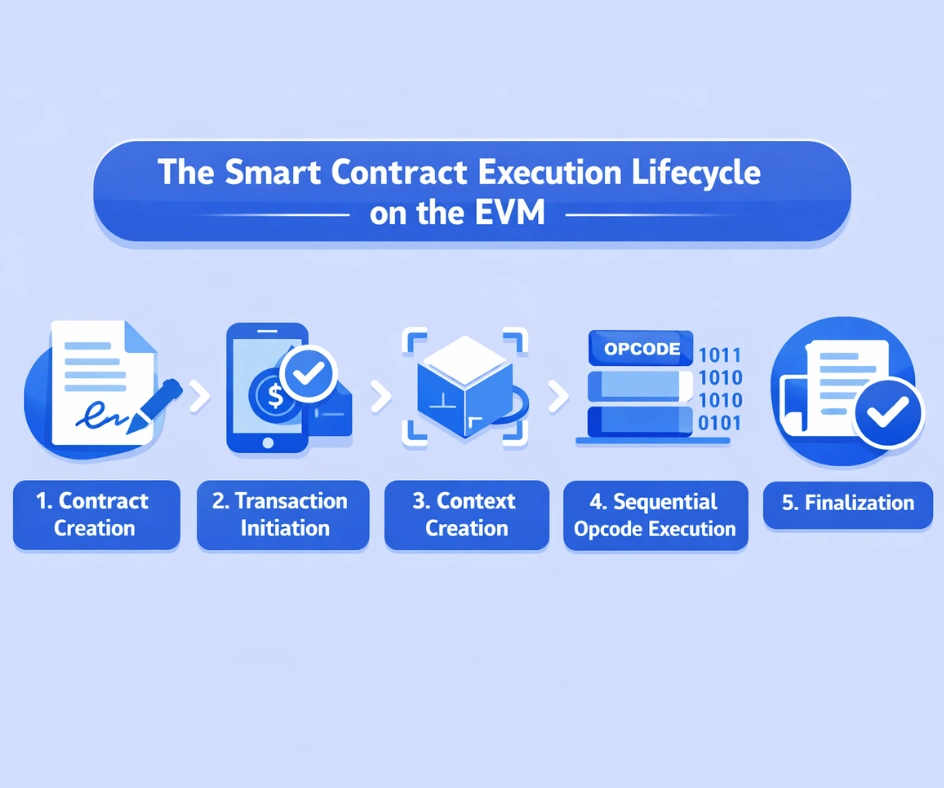
1. Contract Creation
When a developer deploys a smart contract, the EVM creates a new contract account. This account contains the compiled bytecode (the runtime code), a storage area initialized to zero, a balance (which can hold ETH), and a nonce starting at one. The creation transaction includes the initialization bytecode, which runs once during deployment to set up the contract’s initial state, and then returns the runtime bytecode that will be stored on the chain.
2. Transaction Initiation
When a user interacts with the contract, they send a transaction to the contract’s address. This transaction includes calldata, which contains the function selector (the first 4 bytes of the Keccak 256 hash of the function signature), followed by the encoded parameters. The EVM uses this calldata to determine which function to execute and with what inputs.
3. Context Creation
The EVM creates an execution context for the transaction, which includes a fresh stack and memory, access to the contract’s persistent storage, environmental data (the sender’s address, the transaction value, the block number, the gas price), and the gas limit specified by the sender.
4. Sequential Opcode Execution
The EVM reads and executes each opcode in the bytecode sequentially, with JUMP and JUMPI being the exceptions that allow nonlinear execution. For each opcode, the EVM checks that sufficient gas remains, executes the operation, deducts the gas cost, and moves to the next instruction. If at any point the gas runs out, the entire execution reverts, and all state changes are undone.
5. Finalization
If the execution completes successfully, the EVM commits the state changes, transfers any ETH involved, and emits any event logs. The remaining unused gas is refunded to the sender. The validator includes this transaction in the next block, and once the block is finalized through consensus, the changes become permanent.
Recommended Reading:
Security and Isolation in the EVM
Security is baked into the fundamental design of the EVM. Every smart contract executes in an isolated environment, meaning one contract cannot directly access or modify the memory or storage of another contract. Inter-contract communication happens only through well-defined message calls (using opcodes like CALL and DELEGATECALL), and each call creates a new execution context with its own stack and memory.
This isolation model prevents cascading failures. If one contract has a bug or is exploited, the damage is contained to that contract and the funds it controls. However, vulnerabilities in smart contract logic (as opposed to the EVM itself) remain a real concern. Reentrancy attacks, where a malicious contract repeatedly calls back into a vulnerable contract before the first execution finishes, have been responsible for some of the largest exploits in DeFi history.
The EVM also enforces strict execution boundaries through the gas system. An infinite loop in a smart contract will not crash the network; it will simply consume gas until the gas limit is reached, at which point the transaction reverts. This is what makes the EVM “quasi Turing complete”: it can run any computation, but only if that computation terminates within the gas budget. Without this safeguard, a single poorly written or malicious contract could halt the entire network.
Developers building on the EVM have access to a growing set of security tools. OpenZeppelin provides audited, reusable smart contract libraries. Static analysis tools like Slither and Mythril scan bytecode for known vulnerability patterns. Formal verification techniques can mathematically prove that a contract behaves as intended. The combination of EVM level isolation and developer level tooling creates multiple layers of protection.
The Role of the EVM in DeFi, NFTs, and dApp Development
The practical impact of the EVM is measured not in technical specifications but in what it has enabled. The entire DeFi ecosystem, which supported 166 billion dollars in total value locked on Ethereum alone, runs on smart contracts executed by the EVM. Protocols like Aave, which have seen active loans grow from approximately 10 billion dollars to between 20 and 25 billion dollars, depend on the EVM to enforce lending logic, calculate interest rates, manage collateral, and execute liquidations, all without human intervention.
NFTs are another product of the EVM. The ERC 721 and ERC 1155 token standards, which define how non-fungible tokens are created and transferred, are smart contracts that the EVM executes. Every time an NFT is minted, bought, or sold, the EVM processes that transaction according to the contract’s rules.
Decentralized Autonomous Organizations (DAOs) use the EVM to implement governance. Token holders vote on proposals, and smart contracts automatically execute the winning decisions, whether that means allocating funds, changing protocol parameters, or upgrading other contracts. The development of these governance systems would be impossible without the deterministic, trustless execution environment the EVM provides.
The gaming sector has also embraced the EVM. Blockchain-based games use smart contracts to manage in-game assets as NFTs, handle token economies, and ensure fair play. The ability to deploy the same game contracts across multiple EVM-compatible chains gives developers access to users across the entire EVM ecosystem.
Developer Tools and Languages for EVM Development
Building on the EVM requires a specific set of tools and languages. Here is an overview of the most important ones in the development ecosystem:
1. Solidity
The dominant language for EVM smart contract development. Solidity is statically typed with syntax similar to JavaScript, and it compiles directly into EVM bytecode. Most of the DeFi protocols, NFT contracts, and DAO governance systems in production are written in Solidity.
2. Vyper
A Python-inspired language that prioritizes readability and security over flexibility. Vyper intentionally omits certain features (like inheritance and operator overloading) to reduce the risk of hidden vulnerabilities.
3. Hardhat
A development environment for Ethereum that includes local blockchain simulation, automated testing, advanced debugging capabilities, and deployment scripts. Hardhat has become the preferred tool for professional Solidity developers.
4. Remix IDE
A browser-based integrated development environment that lets developers write, compile, test, and deploy smart contracts without installing anything locally. It is widely used for learning and prototyping.
5. Truffle
An older but still widely used framework that provides a full suite of tools for development, testing, and deployment. It includes a built-in testing environment and migration scripts for managing contract upgrades.
6. OpenZeppelin
Not a development tool per se, but a library of security audited smart contracts that developers can inherit and extend. OpenZeppelin provides standardized implementations of ERC 20, ERC 721, access control, and many other common patterns.
The Future of the EVM: zkEVMs and Beyond
The EVM is not static. It continues to evolve through Ethereum Improvement Proposals (EIPs) and network upgrades. The Pectra upgrade in May and the Fusaka upgrade later in the year brought performance improvements and new capabilities to the execution layer. But perhaps the most significant evolution is the emergence of zero-knowledge EVMs (zkEVMs).
A zkEVM combines the EVM execution model with zero-knowledge proof technology. Instead of every node re-executing every transaction, a zkEVM generates a cryptographic proof that the execution was correct. Other nodes can verify this proof in a fraction of the time and cost it would take to re-execute the transactions. This approach promises to dramatically increase throughput while maintaining Ethereum’s security guarantees.
Several projects are building zkEVMs, including Polygon zkEVM, zkSync Era, Scroll, and Linea (developed by ConsenSys). Linea is notable for having integrated six Ethereum upgrades, Paris, Shanghai, Cancun, Prague, Pectra, and Fusaka, all within a single calendar year, achieving real-time parity with mainnet. This pace of development demonstrates that the zkEVM space is maturing rapidly.
Another area of evolution is EVM Object Format (EOF), a proposed restructuring of how EVM bytecode is organized. EOF aims to simplify bytecode validation, improve gas metering, and make the EVM more amenable to static analysis. While EOF is still under discussion, it represents a significant step toward making the EVM more efficient and easier to reason about.
The development of the EVM ecosystem is also being shaped by the growing demand for account abstraction, which would allow smart contract wallets to replace traditional externally owned accounts. This change would enable features like social recovery, gas sponsorship, and batched transactions, all of which would improve the user experience without requiring changes to the core EVM specification.
Blockchain Infrastructure Development in the Real World
The following projects reflect how EVM-compatible architecture and smart contract development are being applied across blockchain ecosystems. Each implementation showcases the same principles discussed throughout this article, from smart contract execution and bytecode compilation to consensus mechanisms and decentralized state management.
⛓️
Everscale Network: High Throughput Blockchain Ecosystem
Built a highly performant blockchain network capable of handling over 100,000 transactions per second using sharding and dynamic multithreading. The development included a full blockchain explorer (Everscan), smart contract execution infrastructure, token standards, and a consensus mechanism designed for fault tolerance and fast finality across DeFi and GameFi applications.
🤖
Athene Network: Decentralized AI Mining Platform
Created a decentralized mining platform for AI development and deployment where researchers, developers, and users securely share AI models, data, and services. The platform uses Proof of Stake consensus and token holder governance, enabling community-driven AI infrastructure with smart contract-based reward distribution and staking mechanisms.
Build Your EVM-Based Blockchain Solution Today:
We bring 8+ years of blockchain development expertise to EVM-based smart contract development and dApp creation. Our specialized team handles everything from Solidity smart contract architecture to multi-chain deployment across EVM-compatible networks, ensuring your platform is built for performance, security, and cross chain interoperability. Whether you need custom DeFi protocols, token contracts, or enterprise blockchain solutions, we deliver results that work.
Final Thoughts
The Ethereum Virtual Machine is more than just a piece of software. It is the computational foundation upon which the entire Ethereum ecosystem, and a large portion of the broader blockchain industry, has been built. From the moment Gavin Wood formalized its specification in the Yellow Paper, the EVM has served as the standard execution environment for smart contracts, enabling everything from simple token transfers to complex, multi-step financial protocols that manage billions of dollars in assets.
What makes the EVM particularly powerful is not any single feature but the combination of its properties. Deterministic execution ensures that every node arrives at the same result. The gas mechanism prevents abuse while compensating validators. The stack-based architecture with 256 bit word size aligns perfectly with the cryptographic operations that blockchain demands. And the isolation model keeps individual contract failures from cascading across the network.
The growth of EVM-compatible chains has amplified this impact exponentially. With networks like BNB Chain, Polygon, Arbitrum, Base, and Avalanche all running EVM implementations, developers can write code once and deploy it across a constellation of blockchains, each optimized for different use cases but all speaking the same computational language. The rise of zkEVMs promises to take this even further, combining the EVM’s familiar execution model with the efficiency of zero-knowledge proofs.
For anyone building in the Web3 space, whether as a developer writing smart contracts, a business exploring blockchain solutions, or an investor evaluating projects, understanding the EVM is not optional. It is the engine that powers decentralized finance, NFT marketplaces, governance systems, and blockchain gaming. As the technology continues to evolve through upgrades like EOF and account abstraction, the EVM’s role as the backbone of decentralized computing will only grow stronger.
Frequently Asked Questions
Q1.What is the Ethereum Virtual Machine?
The Ethereum Virtual Machine is a decentralized computation engine that executes smart contracts and processes transactions across the Ethereum blockchain network. It operates as a software layer running simultaneously on thousands of nodes worldwide, ensuring that every smart contract runs identically on every machine. The EVM reads compiled bytecode, breaks it into individual opcodes, executes them sequentially, and updates the blockchain state based on the results.
Q2.How does EVM differ from regular virtual machines?
Traditional virtual machines like VMware or VirtualBox emulate a complete computer on a single host. The EVM, by contrast, runs across a distributed network of nodes and focuses exclusively on executing smart contracts and managing blockchain state. It has no file system, no networking capabilities, and no operating system. Its only purpose is to process transactions and compute state transitions according to a strict set of rules that all nodes agree on.
Q3.What programming languages work with the EVM?
Solidity is the most widely used language for EVM development, with syntax similar to JavaScript and features designed specifically for smart contract programming. Vyper is a Python-like alternative that emphasizes security and readability. Both languages compile into EVM bytecode. For developers who want lower-level control, Yul provides an intermediate language that sits closer to the opcodes themselves, allowing for fine-tuned gas optimization.
Q4.Why does gas exist in the EVM?
Gas serves two critical purposes. First, it prevents abuse by making every computation cost real money, which stops malicious actors from spamming the network with infinite loops or meaningless transactions. Second, it compensates the validators who dedicate hardware and stake ETH to process and verify transactions. Without gas, there would be no economic incentive to maintain the network and no mechanism to prevent denial of service attacks.
Q5.What makes a blockchain EVM compatible?
An EVM-compatible blockchain has implemented its own version of the Ethereum Virtual Machine, allowing it to execute the same bytecode and smart contracts that run on Ethereum. This means developers can use Solidity, deploy through the same tools like Hardhat or Remix, and interact with contracts using the same wallet interfaces. Popular EVM-compatible chains include BNB Chain, Polygon, Avalanche, Arbitrum, and Base.
Q6.What is a zkEVM and how does it improve the EVM?
A zkEVM combines the Ethereum Virtual Machine with zero-knowledge proof technology. Instead of requiring every node to re-execute every transaction, a zkEVM generates a cryptographic proof that confirms the execution was correct. Other nodes can verify this proof much faster and cheaper than re-executing the original computation. This approach allows Layer 2 networks to process many more transactions while inheriting Ethereum’s security, resulting in lower fees and faster confirmation times for end users.
Explore Services
Related Services
Reviewed by

Aman Vaths
Founder of Nadcab Labs
Aman Vaths is the Founder & CTO of Nadcab Labs, a global digital engineering company delivering enterprise-grade solutions across AI, Web3, Blockchain, Big Data, Cloud, Cybersecurity, and Modern Application Development. With deep technical leadership and product innovation experience, Aman has positioned Nadcab Labs as one of the most advanced engineering companies driving the next era of intelligent, secure, and scalable software systems. Under his leadership, Nadcab Labs has built 2,000+ global projects across sectors including fintech, banking, healthcare, real estate, logistics, gaming, manufacturing, and next-generation DePIN networks. Aman’s strength lies in architecting high-performance systems, end-to-end platform engineering, and designing enterprise solutions that operate at global scale.