Ai Overview
Selfish mining in blockchain is best understood through a simple scenario. Imagine a group of students who each independently work on a difficult exam problem. The rule is that whoever solves it first should immediately share their answer so everyone can move to the next question. A selfish student who solves the problem does not share the answer.
Key Takeaways
- 01
Selfish mining in blockchain is an attack strategy where a miner withholds newly found blocks to build a private chain, forcing honest miners to waste computing power on blocks that will be orphaned. - 02
The attack was formally described by Ittay Eyal and Emin Gun Sirer in their 2013 paper and proved that Selfish Mining in Blockchain could be profitable for a miner controlling as little as 25 to 33 percent of network hash rate. - 03
Selfish Mining in Blockchain exploits Bitcoin’s longest chain rule by secretly building a longer private chain and releasing it at the optimal moment to invalidate the recent work of all honest miners on the network. - 04
The gamma parameter representing how well-connected a selfish miner is to the rest of the network directly lowers the minimum hash rate threshold needed for the attack to become profitable. - 05
Unlike a 51 percent attack which targets transaction reversal, Selfish Mining in Blockchain targets mining revenue by systematically increasing the attacker’s share of block rewards while decreasing honest miners’ effective earnings. - 06
GHash.io briefly crossed 51 percent of Bitcoin’s hash rate in June 2014 and was in a position to execute Selfish Mining in Blockchain, highlighting that mining pool concentration is the primary real-world vector for this attack. - 07
Defenses against Selfish Mining in Blockchain include faster block propagation through the FIBRE network, orphan block monitoring, uncle block reward mechanisms, and forward-error-correcting block relay protocols across the network. - 08
Selfish Mining in Blockchain is distinct from honest mining in that it deliberately breaks the cooperative norm of immediately broadcasting newly discovered blocks, choosing short-term secrecy over network-wide progress and fairness. - 09
As Bitcoin’s mining difficulty continues to increase and block rewards decrease over time, Selfish Mining in Blockchain becomes a more rational economic strategy for large pools seeking to maintain revenue in a more competitive environment. - 10
Indian blockchain security researchers and policy analysts should understand Selfish Mining in Blockchain as part of the broader proof of work centralization risk when evaluating regulatory frameworks for cryptocurrency mining operations.
What is Selfish Mining in Simple Words
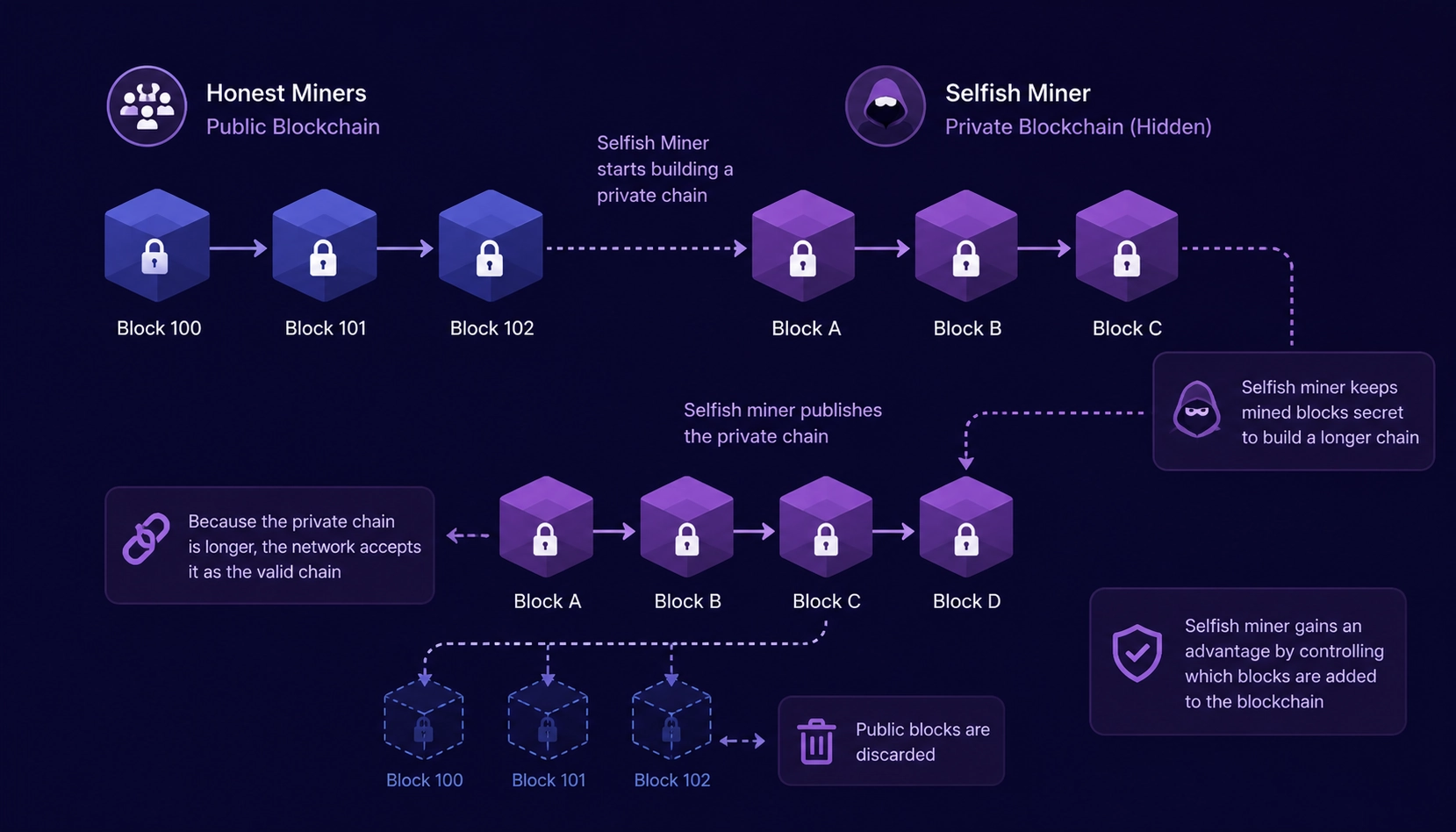
Selfish mining in blockchain is best understood through a simple scenario. Imagine a group of students who each independently work on a difficult exam problem. The rule is that whoever solves it first should immediately share their answer so everyone can move to the next question. A selfish student who solves the problem does not share the answer. Instead, they secretly start working on the next question while everyone else is still struggling with the current one. When others finally solve the current problem and move forward, the selfish student is already ahead. In some scenarios, they can even waste everyone else’s progress by revealing their secret solution at a strategic moment that makes everyone else’s work invalid.
In Bitcoin’s proof of work system, miners compete to solve cryptographic puzzles to win the right to add the next block and claim the block reward. The honest protocol requires that any miner who solves a block broadcasts it immediately to the entire network. Selfish mining in blockchain breaks this norm deliberately. A selfish miner who solves a block keeps it secret, continuing to mine the next block on top of their hidden solution while the rest of the network is still working on the same puzzle the selfish miner has already solved. This hidden work constitutes a private chain that runs ahead of the public chain.
The selfish miner releases their private blocks at carefully chosen moments to maximize their advantage: specifically when the public network is about to catch up and produce a competing block. By flooding the network with their pre-mined private chain at this moment, the selfish miner causes the public network’s recent work to become orphaned, which means those blocks are rejected from the canonical chain and the honest miners who produced them receive no reward. Over time, this strategy allows the selfish miner to earn a larger share of total block rewards than their proportion of hash rate would justify under honest mining, which is precisely why it is considered a rational but harmful attack on the network’s economic integrity.
How Selfish Mining Works in Blockchain Step by Step
The mechanics of selfish mining in blockchain follow a precise and calculated sequence of decisions based on the current state of the private chain versus the public chain. The selfish miner is essentially operating a state machine where each state represents the lead they hold over the public network, and each state transition determines what action to take next. Understanding this state machine is the key to understanding how the attack achieves its strategic advantage over honest miners operating under good faith assumptions.
The attack begins when the selfish miner finds a valid block. Instead of broadcasting it, they keep it private and immediately begin mining the next block on top of it. The public network continues working on the same block height the selfish miner just secretly solved. The selfish miner now has a lead of one block. If the selfish miner finds a second block before the public network finds their first block at that height, the lead grows to two. A lead of two or more blocks puts the selfish miner in a strong position because they can absorb a public block discovery without losing their advantage.
The critical decision point occurs when the public network finds a block and the selfish miner has only a one-block lead. In this situation, there is now a tie between the public chain and the selfish miner’s private chain, both at the same height. The selfish miner immediately releases their private block.
A fraction of the honest network will receive and build on the selfish miner’s block rather than the public block, because network propagation is not instantaneous and whichever block arrives first at a given node is typically the one that node extends. The selfish miner then races to find the next block. If they succeed, they release it immediately, which makes their chain definitively the longest and causes the honest block to be orphaned along with all work honest miners did on extending it.
What is the Architecture Behind Selfish Mining in Blockchain Attack
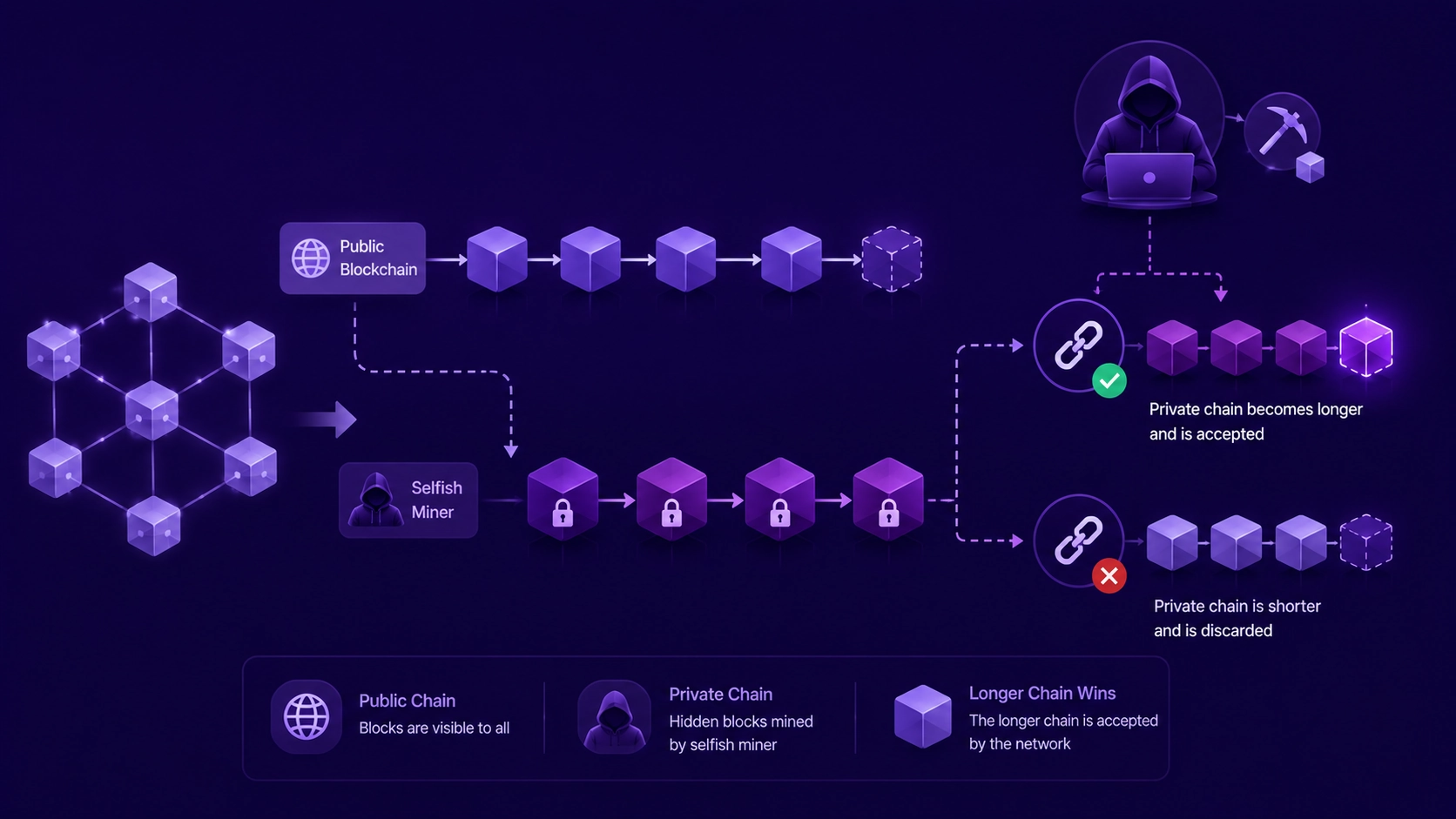
The architecture of a selfish mining attack in blockchain has three core components working together: the private chain management system, the network connectivity optimization layer, and the release decision algorithm. Understanding how these components interact is essential for blockchain security researchers and engineers who are designing detection systems or evaluating the security properties of proof of work networks for Indian enterprise or public blockchain deployments.
The private chain management component is simply the selfish miner’s internal blockchain state that runs separately from the public chain. The selfish miner maintains a fully valid proof of work chain that extends from the last point where their private chain diverged from the public chain. This private chain can be of any length, with each block representing legitimate computational work that solved the puzzle at the correct difficulty level. The key difference from honest mining is that none of these blocks are broadcast until the attacker decides the strategic moment has arrived.
The network connectivity optimization component is what the Selfish Mining in Blockchain research refers to as the gamma factor. To maximize the effectiveness of the attack, the selfish miner invests in being extremely well-connected to the rest of the Bitcoin peer-to-peer network. This means running multiple full nodes across geographically distributed data centres, maintaining direct connections to large mining pools, and using fast relay networks. When the selfish miner releases a block during a tie situation, their superior connectivity ensures that their block reaches more honest miners before the competing public block does, increasing the fraction of honest hash power that unwittingly builds on the selfish chain and extending the attacker’s advantage on each tie cycle.
How Selfish Miners Build a Private Chain in Blockchain
Building and managing a private chain during a Selfish Mining in Blockchain operation requires careful technical infrastructure and real-time monitoring of the public network’s state. The selfish miner must simultaneously track what the public network is doing while extending their private chain, ready to respond instantly when the public network produces a block that changes their strategic calculation. This dual awareness is not difficult to implement technically but requires dedicated software that monitors the public mempool and blockchain state continuously.
The private chain itself consists of fully valid Bitcoin blocks. Each block contains real transactions selected from the public mempool, valid proof of work at the correct difficulty target, a valid previous block hash linking it to either the last shared public block or the previous private block, and a valid timestamp within the acceptable range. The blocks are indistinguishable from honest blocks in every technical respect. The only thing making them selfish blocks is the decision not to broadcast them. When they are eventually released, full nodes that receive them will validate them using exactly the same rules applied to any honest block and will accept them as valid if they form the longest chain.
The transaction selection strategy for private chain blocks is also worth noting. Selfish miners can include higher-fee transactions that honest miners have also selected, which means their private blocks are economically valid and carry full fee revenue. However, if the private chain is eventually released and replaces the public chain, any transactions that were in honest miners’ orphaned blocks but not included in the private chain’s blocks return to the unconfirmed mempool and await re-inclusion. This can cause temporary transaction confirmation delays for users, an indirect harm to the user experience of anyone transacting on the Bitcoin network during a Selfish Mining in Blockchain episode.[1]
What is the Threshold for a Selfish Mining in Blockchain Attack to Succeed
The profitability threshold for selfish mining in blockchain is not a fixed number but a function of two variables: the attacker’s hash rate fraction alpha, and the gamma parameter representing their network connectivity advantage. Eyal and Sirer’s 2013 mathematical analysis showed that under the worst-case gamma assumption of zero, where the selfish miner has no connectivity advantage whatsoever, a miner needs more than 33 percent of the network’s total hash rate for selfish mining to be profitable compared to honest mining. As gamma increases toward one, meaning the selfish miner can consistently route their blocks to more honest miners during tie situations, the minimum profitable hash rate threshold drops toward 25 percent.
This threshold is critically important because it means Selfish Mining in Blockchain does not require majority hash rate, unlike a 51 percent attack. A mining pool with 30 percent of network hash rate and strong network connectivity has a meaningful probability of profiting from selfish mining. Given that several large Bitcoin mining pools have historically approached or exceeded this level, the threat is not purely theoretical. The table below summarizes how the minimum hash rate threshold for profitable Selfish Mining in Blockchain changes across different gamma values based on the original mathematical model.
| Gamma (Network Advantage) | Min Hash Rate for Profitability | Real-World Risk Level | Interpretation |
|---|---|---|---|
| 0.0 (No connectivity advantage) | 33%+ hash rate | Moderate | Very large pools only, historically rare but observed |
| 0.5 (Moderate connectivity) | ~25% hash rate | Elevated | Achievable by several major pools historically |
| 1.0 (Perfect connectivity) | Any positive % | Theoretical | Impossible in practice due to network propagation delays |
| 0.3 (Low connectivity) | ~28% hash rate | Moderate | Within range of several historically large mining pools |
How Selfish Mining Affects the Bitcoin Blockchain Network
The effects of successful selfish mining in blockchain extend beyond the immediate financial harm to honest miners. The attack creates a cascading set of consequences that affect network security, mining decentralization, and the economic rationality of honest participation. Understanding these second and third-order effects is important for Indian blockchain policy researchers and enterprise blockchain architects who need to evaluate proof of work security for their specific use cases.
The most direct effect is the increased orphan rate. Selfish Mining in Blockchain causes more blocks to be orphaned than would occur under purely honest mining behavior. Normal Bitcoin orphan rates are very low, typically below one percent, because the network propagates blocks quickly and forks resolve almost immediately. During an active selfish mining operation, the orphan rate increases as the selfish miner’s released blocks regularly replace honest blocks that the network had briefly accepted. This elevated orphan rate is in principle a detectable signal, though distinguishing selfish mining-induced orphans from orphans caused by natural propagation delays requires careful statistical analysis.
The deeper systemic effect is on mining centralization incentives. If selfish mining becomes known to be profitable and is seen to be occurring, rational miners would have an incentive to join the selfish mining pool rather than continuing to mine honestly and receive a diminished effective reward. This creates a centralization spiral: as the selfish pool grows, it becomes even more profitable to join it, which attracts more miners, which raises the pool’s hash rate further. This concentration eventually threatens the fundamental security assumption of Bitcoin that no single entity controls a majority of hash rate, making the entire network vulnerable to the transaction reversal attacks that a majority hash rate enables.
What is the Difference Between Selfish Mining in Blockchain and 51 Percent Attack
Selfish mining in blockchain and the 51 percent attack are often conflated in popular discussion, but they are distinct threats with different mechanisms, different requirements, and different consequences for the network. Understanding the difference is important for anyone evaluating the security profile of a proof of work blockchain, whether for academic research, enterprise deployment decisions, or regulatory policy development in India’s evolving cryptocurrency framework.
A 51 percent attack requires the attacker to control more than half of the network’s total hash rate. With majority hash rate, the attacker can rewrite recent transaction history by mining a private chain from a point before a target transaction was confirmed, and then releasing this private chain to replace the public chain. The primary harm of a 51 percent attack is double-spending: the attacker sends cryptocurrency to a recipient, receives goods or services, then invalidates that transaction by replacing the block containing it with their private chain. This is a direct and devastating financial fraud that undermines the core value proposition of a blockchain as a trustless payment system.
Selfish Mining in Blockchain requires significantly less hash rate, potentially as low as 25 to 33 percent, and its primary target is not transaction validity but mining revenue. The selfish miner is not trying to reverse transactions for double-spending purposes. They are trying to earn a disproportionate share of block rewards by making honest miners’ computational work unproductive through strategic block withholding and release timing. The harm from selfish mining is economic, undermining the fairness of reward distribution, rather than directly transactional, which is why it is sometimes considered a less immediately dangerous attack even though its lower entry threshold makes it a more accessible strategy for well-resourced mining operations.
How Selfish Mining Breaks the Longest Chain Rule in Blockchain
Bitcoin’s longest chain rule, sometimes called Nakamoto consensus, states that all nodes should always accept and extend the chain that contains the most cumulative proof of work. This rule was designed to resolve forks naturally and automatically without any coordination between nodes. If two miners find valid blocks at the same height simultaneously, the fork resolves organically as the next block is added to one side or the other, making it definitively longer. The shorter side becomes orphaned automatically, and the network converges without any central authority making a decision.
Selfish Mining in Blockchain exploits this rule by gaming the definition of longest chain. The rule is designed for a situation where all miners are broadcasting blocks honestly as soon as they find them. Satoshi Nakamoto’s original whitepaper assumed that a miner would always immediately publish a found block. Selfish mining shows that this assumption, while reasonable for an individual honest miner, is not enforced by the protocol itself. Nothing in the code prevents a miner from withholding a valid block, and the longest chain rule cannot distinguish between a block that was just found and a block that was found ten minutes ago but deliberately withheld.
When the selfish miner releases their private chain and it is longer than the current public chain, the longest chain rule forces every honest node to switch to the selfish chain regardless of the history of how that chain was constructed. The protocol has no concept of block publishing delay. A block is either valid proof of work at the correct height, or it is not. If it is valid and part of the longest chain, nodes must accept it. This is the fundamental protocol property that Selfish Mining in Blockchain weaponizes, turning the cooperative chain selection rule into a mechanism for rewarding block withholding behaviour that the protocol’s designers did not anticipate or defend against in the original specification.
What Are the Technical Conditions That Make Selfish Mining Possible
Several specific technical properties of proof of work blockchains create the conditions that make selfish mining in blockchain a viable strategy. These conditions do not exist in all consensus mechanisms, which is one reason that proof of stake systems like post-merge Ethereum are not subject to the same selfish mining dynamic. For Indian blockchain architects choosing between consensus mechanisms for enterprise or public blockchain deployments, understanding which properties enable Selfish Mining in Blockchain helps clarify the security trade-offs of different consensus designs.
The first condition is the ability to produce valid blocks without immediately publishing them. In proof of work, the computational work of solving the puzzle is entirely separable from the act of broadcasting the result. A miner can complete the work, generate a fully valid block, and choose exactly when to share it. In proof of stake systems, validators are typically assigned to block production slots in advance and the protocol includes timing and attestation requirements that make withholding significantly harder to execute undetected. The clean separation between block production and block publication in proof of work is architecturally fundamental and cannot be removed without changing the nature of the consensus mechanism itself.
The second condition is network propagation delay. Blocks take time to propagate across the peer-to-peer network. During this propagation window, different nodes may be working on different chain tips, creating the tie situations that Selfish Mining in Blockchain exploits during its block release phase. If block propagation were instantaneous, there would be no window for the selfish miner to benefit from their superior connectivity during a tie. The FIBRE fast relay network and the Compact Block Protocol introduced in Bitcoin reduce this window significantly but cannot eliminate it entirely given the physical constraints of global internet latency across the nodes that make up the Bitcoin network.
How Blockchain Networks Detect and Prevent Selfish Mining in Blockchain
Detecting selfish mining in blockchain is fundamentally a statistical inference problem. You cannot observe a selfish miner’s private chain directly. What you can observe are its effects on the public blockchain: an elevated orphan block rate, unusual patterns in block timestamp distribution, and statistical anomalies in the relationship between a mining pool’s declared hash rate and their observed share of confirmed blocks over time. Researchers have proposed several analytical frameworks for detecting these signals, though distinguishing selfish mining from natural propagation effects requires large sample sizes and careful baseline characterization of expected behavior.
One proposed protocol-level defense is the Selfish Mining in Blockchain resistant fork resolution proposed by Eyal and Sirer themselves in their original paper. They suggested that when a node receives two competing blocks at the same height simultaneously, it should choose randomly between them with equal probability rather than defaulting to the first-received block. This change would make the tie-breaking scenario less favourable to the selfish miner, who currently benefits from their superior connectivity routing their block to more nodes first. With random selection, the connectivity advantage that the gamma parameter represents is neutralized, raising the minimum profitable hash rate threshold back toward 33 percent even for well-connected attackers.
Practical defenses that have been implemented include the FIBRE fast block relay network, which dramatically reduces block propagation time across the global Bitcoin network, making the window during which tie situations can be exploited much shorter. Compact Block relay, implemented in Bitcoin Core, allows blocks to be transmitted more efficiently by sending only the short transaction IDs rather than full transaction data, since most transactions in a new block are already known to receiving nodes from the mempool. These improvements do not mathematically eliminate Selfish Mining in Blockchain but they raise the practical difficulty of executing it profitably by compressing the time windows that the attack relies on.
Real World Examples of Selfish Mining Attempts in Blockchain History
While no Selfish Mining in Blockchain attack has been definitively proven and publicly confirmed against Bitcoin mainnet, several historical events have placed specific pools in positions where Selfish Mining in Blockchain would have been mathematically profitable and technically feasible. These events, combined with academic research pointing to statistical anomalies in historical blockchain data, paint a picture of Selfish Mining in Blockchain as a real and persistent background risk rather than a purely theoretical concern. For Indian blockchain security researchers and regulators, these historical data points are relevant context for policy discussions about mining pool oversight and proof of work network governance.
The GHash.io incident in June 2014 is the most widely cited near-selfish-mining event in Bitcoin history. GHash.io, which was the largest Bitcoin mining pool at the time, briefly crossed 51 percent of the network’s total hash rate. At this level, they had more than sufficient hash rate to execute bot Selfish Mining in Blockchain and a full 51 percent attack. To their credit, GHash.io voluntarily pledged not to exceed 40 percent of network hash rate and encouraged miners to redistribute to smaller pools. The incident nevertheless demonstrated that mining pool centralization was reaching dangerous levels and prompted serious community discussion about both Selfish Mining in Blockchain risk and the concentration of proof of work hash rate in general.
| Event | Year | Peak Hash Rate | Selfish Mining Status |
|---|---|---|---|
| GHash.io Concentration | June 2014 | >51% | Technically viable, voluntarily pledged restraint |
| Academic Statistical Study | 2017 to 2018 | Multiple pools ~20 to 30% | Anomalous orphan patterns observed, not conclusively proven |
| Ethereum Classic 51% Attack | 2019 to 2020 | >51% (small network) | Full 51% attack with double-spend on smaller PoW network |
| Foundry USA Concentration | 2022 to 2023 | ~30% hash rate peak | Within Selfish Mining in Blockchain threshold range, no known attack executed |
What is the Future of Selfish Mining as Blockchain Networks Evolve
The future trajectory of selfish mining in blockchain is shaped by two opposing forces: the continued consolidation of Bitcoin mining hash rate into large pools that brings more pools within the profitability threshold, and the ongoing technical improvements to Bitcoin’s network propagation speed that compress the windows the attack exploits. Understanding which force is likely to dominate in the coming years requires looking at both the economics of mining industrialization and the pace of protocol improvements to block relay infrastructure.
On the centralization side, the trend in Bitcoin mining is clearly toward larger and more industrialized operations. The entry of publicly listed mining companies, institutional capital from sovereign wealth funds and hedge funds, and the geographic concentration of mining in low-cost energy regions is producing a smaller number of very large mining entities that each control a growing fraction of network hash rate. As mining margins tighten in the post-halving environment of 2024 through 2028, the economic incentive to explore every available strategy for maintaining profitability, including Selfish Mining in Blockchain, becomes stronger for pools operating at the scale where the attack becomes mathematically viable.
For Indian blockchain researchers, engineers, and policy makers, the Selfish Mining in Blockchain threat is most relevant as an argument for maintaining mining decentralization and network hash rate distribution. India’s regulatory framework for cryptocurrency mining could in principle include provisions requiring pools operating above certain hash rate thresholds to implement technical transparency measures, such as mandatory real-time block announcement logging or hash rate verification systems, that would make Selfish Mining in Blockchain more detectable and therefore less attractive as a strategy.
The academic foundation for these policies exists in the form of the Eyal and Sirer analysis and subsequent research, providing Indian regulators with well-documented technical justifications for any pool oversight requirements they choose to implement as the country’s blockchain regulatory framework matures in 2026 and beyond.
Frequently Asked Questions
Q1.1. What is selfish mining in blockchain in simple words?
Selfish mining in blockchain is a strategy where a miner or mining pool secretly mines blocks without broadcasting them to the public network, building a private chain advantage. When the attacker releases their hidden chain at the right moment, honest miners waste computing power on blocks that become orphaned and invalid.
Q2.2. How is selfish mining different from a 51 percent attack?
A 51 percent attack requires controlling more than half of the network’s total hash rate to rewrite transaction history. Selfish Mining in Blockchain can be profitable with as little as 25 to 33 percent hash rate depending on network connectivity advantages. Selfish mining targets mining revenue rather than double spending, making it a distinct and potentially more accessible threat than a full 51 percent attack.
Q3.3. What hash rate percentage does a miner need to start selfish mining profitably?
The 2013 research paper by Ittay Eyal and Emin Gun Sirer that first described Selfish Mining in Blockchain mathematically showed that a miner with more than 25 to 33 percent of the network’s hash rate can begin earning a disproportionately large share of block rewards through selfish mining, depending on how well-connected they are to the rest of the network.
Q4.4. Does selfish mining work on Ethereum or only on Bitcoin?
Selfish Mining in Blockchain theoretically applies to any proof of work blockchain where miners can withhold newly discovered blocks. It was extensively studied in the context of Bitcoin but the same mathematical principles apply to any PoW network including legacy Ethereum before its merge to proof of stake. Post-merge Ethereum uses proof of stake, which has different and less applicable attack dynamics.
Q5.5. Has selfish mining ever actually happened on a real blockchain?
GHash.io, a Bitcoin mining pool, briefly crossed 51 percent of network hash rate in June 2014 and was in a position to execute Selfish Mining in Blockchain. No definitive confirmed selfish mining attack has been formally proven on Bitcoin mainnet, but researchers have observed statistical anomalies in block propagation timing that are consistent with partial selfish mining behavior by large pools at various points in history.
Q6.6. How does selfish mining break the longest chain rule in Bitcoin?
Bitcoin’s consensus rule is that all nodes follow the longest valid chain. Selfish Mining in Blockchain exploits this by secretly building a private chain longer than the public one. When released at the correct moment, the private chain becomes the longest and replaces the public chain, causing honest miners who were working on the now-shorter public chain to see their recent blocks become orphaned and wasted.
Q7.7. Can blockchain networks be redesigned to make selfish mining impossible?
Fully preventing Selfish Mining in Blockchain through protocol changes alone is mathematically difficult without changing Bitcoin’s core proof of work model. Proposed defenses include selfish mining-resistant fork resolution rules such as those proposed by Eyal and Sirer, timestamp-based orphan weighting, uncle block rewards on Ethereum, and increasing block propagation speed. None of these completely eliminates the attack but they raise the threshold significantly.
Q8.8. What is the gamma parameter in selfish mining and why does it matter?
Gamma in Selfish Mining in Blockchainanalysis represents the proportion of honest miners who choose the selfish miner’s chain over the public chain when a block tie occurs. A selfish miner with better network connectivity has a higher gamma value, meaning more honest miners will follow their released block during a tie, making the attack more profitable. Gamma ranges from zero to one and directly affects the minimum hash rate threshold for profitable selfish mining.
Q9.9. Does joining a large mining pool protect against selfish mining attacks?
Joining a large mining pool does not protect the network from Selfish Mining in Blockchain if the pool itself is the attacker. In fact, large pools are the primary concern because they are most likely to have the hash rate concentration needed to execute selfish mining profitably. Pool participants are effectively contributing to a centralization risk they may not be aware of when they join pools that approach 25 to 33 percent of total network hash rate.
Q10.10. Is selfish mining a concern for Indian Bitcoin miners or mining pools?
For Indian cryptocurrency miners operating in the context of global Bitcoin pools, the selfish mining risk comes from large international pools rather than domestic operations. Indian blockchain researchers and policy makers evaluating proof of work security should understand Selfish Mining in Blockchain as one of the key centralization risks that motivates ongoing research into alternative consensus mechanisms and mining pool transparency requirements in regulated crypto markets.
Explore Services
Related Services
Reviewed by

Aman Vaths
Founder of Nadcab Labs
Aman Vaths is the Founder & CTO of Nadcab Labs, a global digital engineering company delivering enterprise-grade solutions across AI, Web3, Blockchain, Big Data, Cloud, Cybersecurity, and Modern Application Development. With deep technical leadership and product innovation experience, Aman has positioned Nadcab Labs as one of the most advanced engineering companies driving the next era of intelligent, secure, and scalable software systems. Under his leadership, Nadcab Labs has built 2,000+ global projects across sectors including fintech, banking, healthcare, real estate, logistics, gaming, manufacturing, and next-generation DePIN networks. Aman’s strength lies in architecting high-performance systems, end-to-end platform engineering, and designing enterprise solutions that operate at global scale.