Ai Overview
The network builds on whichever valid block it receives first across the majority of nodes. Despite containing all the correct cryptographic elements, the stale block contributes nothing permanent to the blockchain and its miner earns nothing. For miners and mining pool operators, stale blocks represent wasted computational investment, a direct economic loss where energy was spent, hardware was worn, and operating costs were incurred with zero financial return.
Key Takeaways
- 01
A stale block is a fully valid block that was mined correctly but rejected by the network because a competing block was accepted into the canonical chain before it arrived at most nodes. - 02
Stale blocks occur when two miners solve a proof of work puzzle simultaneously and broadcast their blocks to the network, creating a temporary fork that resolves when the next block is added. - 03
The miner who produces a stale block in Bitcoin receives zero reward even though their computational work was valid and correctly solved the proof of work difficulty target at that moment. - 04
Bitcoin and pre-merge Ethereum handled stale blocks differently: Bitcoin discards the losing block completely while Ethereum included uncle blocks in its protocol and paid partial rewards. - 05
Network propagation delay is the primary technical cause of stale blocks: the longer it takes for a newly found block to reach all nodes globally, the higher the chance of a simultaneous competing discovery. - 06
The stale block rate is a key blockchain health metric: a rising stale rate signals increasing network latency, mining centralization pressure, or possible selfish mining activity on the network. - 07
Compact Block relay via BIP 152 and the FIBRE fast block relay network have reduced Bitcoin stale block rates to a fraction of a percent in 2026 by cutting global propagation times below one second. - 08
Transactions inside a stale block are not permanently lost: they return to the unconfirmed mempool and are available for inclusion in the next valid block that becomes part of the canonical chain. - 09
Large mining pools have a natural advantage in reducing stale blocks because pool members can coordinate internally over low-latency private networks rather than relying on the public peer-to-peer relay. - 10
Indian blockchain researchers and mining operators should understand stale blocks as a fundamental proof of work concept that directly affects mining profitability and influences pool centralization economics globally.
What is a Stale Block in Blockchain and Why Does It Matter
A stale block in blockchain is a valid block that was mined in compliance with all consensus rules, carrying a correct proof of work solution at the current difficulty target, but which lost the race to become the next accepted block in the canonical chain. The network builds on whichever valid block it receives first across the majority of nodes. When a competing block arrived faster or propagated more widely before the stale block could establish itself, the stale block is set aside and the canonical chain extends from the winner. Despite containing all the correct cryptographic elements, the stale block contributes nothing permanent to the blockchain and its miner earns nothing.
Understanding stale blocks matters for several interconnected reasons that go beyond simple technical curiosity. For miners and mining pool operators, stale blocks represent wasted computational investment, a direct economic loss where energy was spent, hardware was worn, and operating costs were incurred with zero financial return. At the network level, the frequency of stale blocks, called the stale block rate, serves as a sensitive diagnostic indicator of network health. A rising stale block rate can signal worsening propagation conditions, increasing hash rate concentration, or potentially malicious behavior such as selfish mining where a miner strategically releases blocks to cause honest
miners’ work to become stale.
For Indian blockchain researchers, engineers, and policy analysts evaluating the security and economics of proof of work systems, stale blocks illustrate why decentralization and propagation efficiency are not academic concerns but practical variables that directly affect who gets paid and who does not in a distributed mining network. The phenomenon also explains why large, well-connected mining pools have structural economic advantages over smaller or more geographically isolated miners, a dynamic that contributes to the mining centralization pressure that Bitcoin’s community monitors closely as network hash rate continues reaching new record highs in 2026.
How a Stale Block Is Created in a Blockchain Network
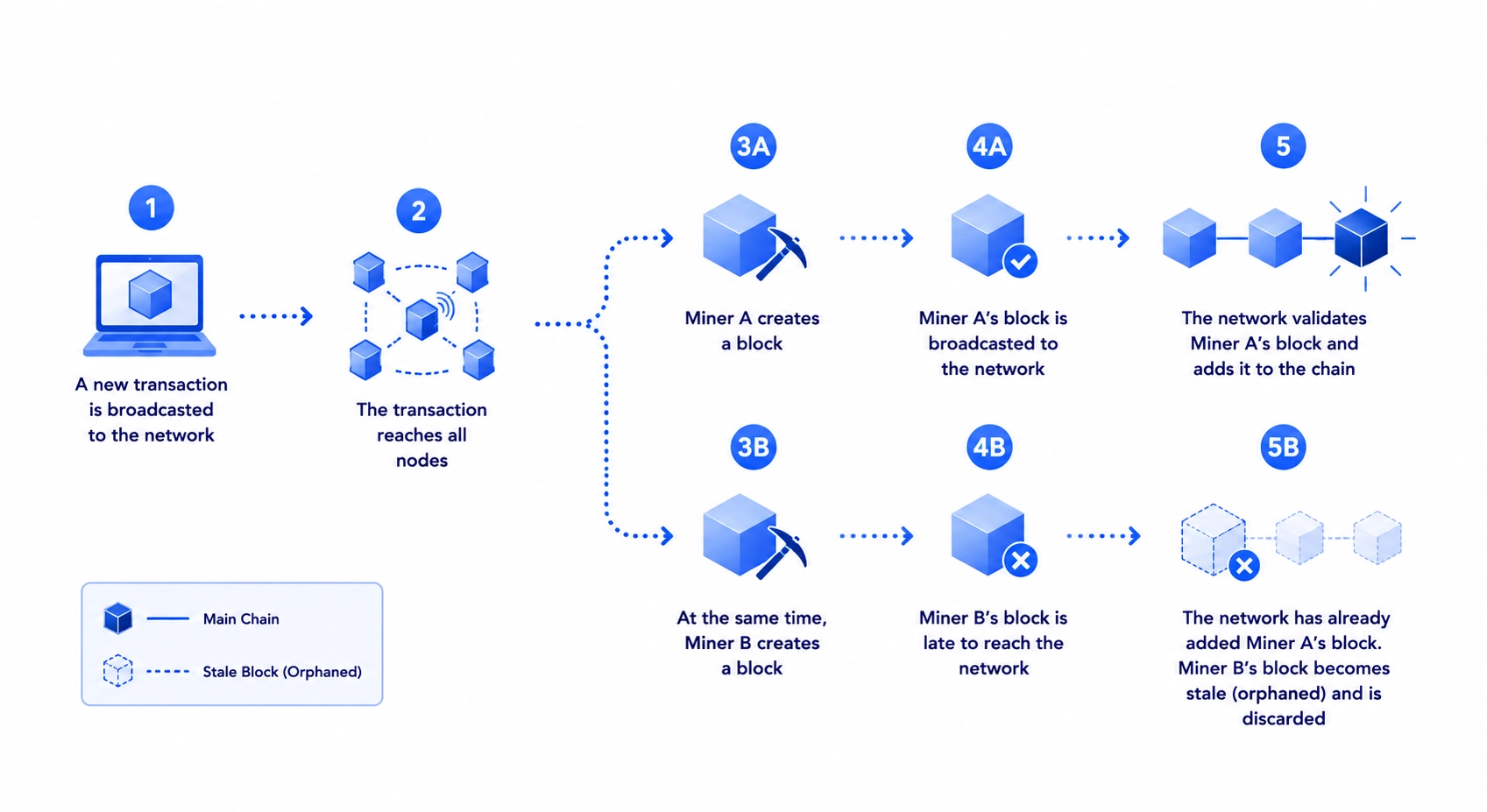
The creation of a stale block always begins with the same triggering event: two separate miners solving the proof of work puzzle and producing a valid block at the same height at nearly the same time. This simultaneous discovery is not caused by any error or malicious intent. It is an inherent statistical property of a competitive proof of work system where thousands of miners globally are making trillions of hash attempts per second. With Bitcoin’s hashrate exceeding 800 EH/s in 2026, the probability that two miners find valid blocks within seconds of each other is low but non-zero and statistically guaranteed to happen periodically across the long history of continuous mining.
When both miners simultaneously broadcast their block to the network, a temporary fork appears. Different nodes receive the two competing blocks in different orders depending on their network position and connectivity. A node in Singapore that receives block A first will extend block A as its current tip of the chain, while a node in India that happens to receive block B first will extend block B. For a brief period, the network is split between two valid but competing views of the chain’s current state. No node is wrong; each is following the rules correctly based on what they received first.
The fork resolves when the next block is mined. Whichever chain receives the next block first becomes definitively longer, and all nodes following the shorter chain immediately switch to the longer one, discarding the competing block. The block that did not receive the follow-on block becomes the stale block. Its transactions, its proof of work, and its miner’s claimed reward all become irrelevant from the perspective of the canonical chain’s history, though the valid transactions it contained still exist in the mempool waiting for inclusion in a subsequent block.
Stale Block vs Orphan Block What Is the Difference
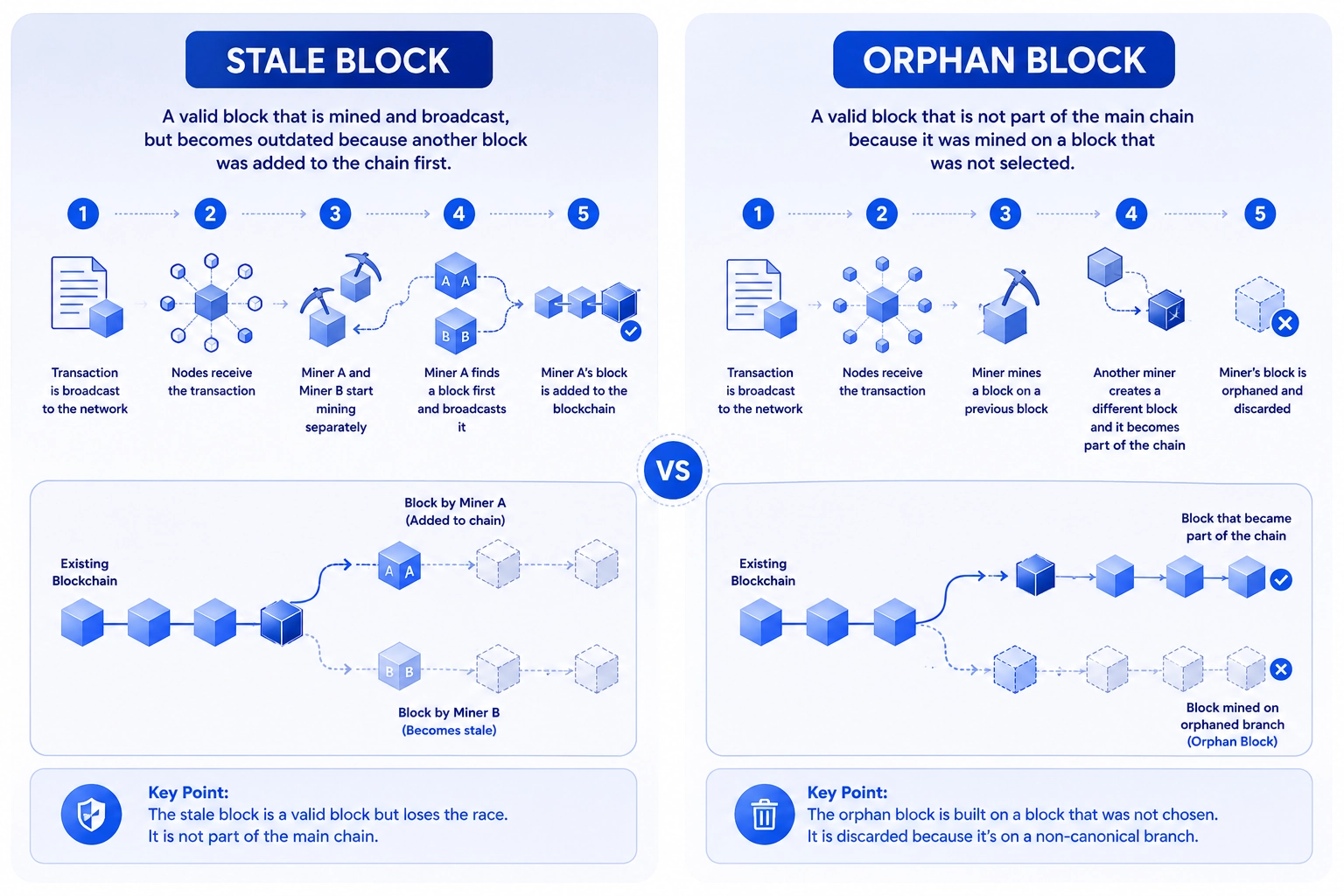
The terms stale block and orphan block are frequently used interchangeably in popular blockchain education materials, but they refer to technically distinct situations in the precise formal definition used by Bitcoin Core developers. Understanding the difference is useful for blockchain engineers in India and globally who work with node software, block explorers, or mining pool monitoring systems where these terms appear in their accurate technical sense.
An orphan block, in its strict technical definition since Bitcoin Core version 0.10, is a block whose parent block is unknown to the receiving node. This can happen when a node receives a block but has not yet received or validated the block that precedes it in the chain. The node cannot immediately connect this block to its view of the chain because the parent is missing. It temporarily stores the block in an orphan block pool and waits until the parent block arrives, after which the orphan can be properly connected and validated. This is a transient network synchronization situation rather than a permanent rejection event.
A stale block is a valid block whose parent is fully known and correctly linked but which is no longer part of the longest valid chain because a competing chain of equal or greater work has been accepted by the network. The stale block was potentially the canonical chain tip for a brief period on some nodes before being displaced.
Unlike an orphan block which is a temporary synchronization state, a stale block is a final state: once the network converges on a longer chain, the displaced block remains stale permanently. In casual usage and in most educational contexts including discussions among Indian blockchain developers, the term orphan block is often used loosely to refer to what is technically a stale block, which is a source of persistent confusion in the broader community.[1]
Stale Block vs Uncle Block How They Compare
Uncle blocks, formally called ommers in Ethereum’s technical specification, represent the same underlying phenomenon as stale blocks but with a fundamentally different protocol response. In pre-merge Ethereum, which used proof of work up until the September 2022 merge to proof of stake, the network’s shorter block time of approximately 12 to 15 seconds meant that stale blocks occurred significantly more frequently than in Bitcoin’s 10-minute block interval system. Ethereum’s designers recognized that simply discarding these blocks, as Bitcoin does, would create strong centralization pressure because large, well-connected mining pools would have a disproportionate advantage in winning propagation races and claiming full rewards while smaller miners suffered higher stale rates.
The uncle block mechanism was Ethereum’s solution. When a valid block lost the canonical chain race, it could be referenced as an uncle by the next block in the canonical chain. The block that included the uncle reference received a small additional reward for doing so, and the miner of the uncle block itself received a partial reward, approximately 75 percent of the full block reward. This economic design reduced the financial penalty for producing a block that became stale due to propagation timing, making Ethereum mining somewhat fairer for geographically dispersed and smaller mining operations compared to a system that pays nothing for stale work.
The uncle rate on pre-merge Ethereum was monitored as an important network health metric for exactly this reason: it measured how frequently valid blocks were losing the propagation race. A high uncle rate indicated either a fast-growing hashrate outpacing propagation infrastructure, or network latency issues affecting the fairness of block reward distribution across the mining population. For Indian blockchain engineers studying the economic design of proof of work consensus mechanisms, the uncle block system is an important case study in how protocol designers can mitigate the centralizing effects of propagation-based competition through carefully considered reward structure adjustments.
Why Stale Blocks Happen in Proof of Work Blockchains
Stale blocks are an inevitable mathematical consequence of combining three properties that every proof of work blockchain has simultaneously: a competitive and memoryless mining process where any miner can find a valid block at any moment regardless of when the last block was found, a geographically distributed network where information propagation takes non-zero time, and a consensus rule that accepts only one block at each height into the canonical chain. Given these three properties, occasional simultaneous discoveries with competing propagation races are guaranteed to happen no matter how efficiently the network is engineered.
The memoryless mining property, which comes from the cryptographic hash function used in proof of work, means that every hashing attempt has an equal independent probability of finding a valid block regardless of how long the previous block took to find. Unlike a lottery where buying more tickets increases your chance of winning before others, hash rate advantage only increases the average number of valid blocks found per unit time, not a miner’s ability to avoid simultaneous discoveries by other miners. Two miners with different hash rates will occasionally find valid blocks at nearly identical moments purely by statistical chance.
The propagation delay dimension is where engineering choices have the most impact on stale block rates. When miner A finds a valid block and broadcasts it, the block must travel across the global internet from A’s node to every other mining node on the network. This takes a finite amount of time measured in milliseconds to seconds.
During this propagation window, miner B anywhere in the world, including in a mining facility in India, might independently find a valid block at the same height. If B finds their block before A’s block has reached B, both blocks exist simultaneously and the fork begins. The shorter this propagation window, the lower the probability of two miners independently finding valid blocks before learning about each other’s discovery.
How Stale Blocks Affect Miners and Mining Rewards
For miners and mining pool operators, stale blocks represent a direct and measurable financial loss that affects the actual profitability of mining operations. The economic impact of stale blocks is calculated as a percentage of total valid blocks found that become stale. If a mining pool produces 100 blocks over a period and 2 of those become stale, the pool’s stale rate is 2 percent and its effective block reward income is 98 percent of what it would have earned if all blocks had been accepted.
This 2 percent reduction flows directly to the bottom line of the operation since the computational cost, electricity, cooling, and hardware depreciation, was incurred equally for both the accepted blocks and the stale blocks.
For individual miners participating in pools, the concept of a stale share is closely related but operates within the pool’s internal accounting system. When a miner submits a valid proof of work share to the mining pool’s server, the pool records it and uses it to calculate that miner’s proportional contribution to the pool’s total work.
If the pool finds a valid block but it becomes stale before being accepted by the Bitcoin network, the entire pool loses the block reward and no member receives payment for that specific block’s worth of work. Mining pool software tracks stale shares and stale blocks separately, using the stale rate as an operational metric that pool operators monitor to optimize their infrastructure and node connectivity.
Large mining pools have a structural economic advantage in this regard. A pool with multiple nodes spread across global data centres can propagate newly found blocks across its own private high-speed network before announcing to the public peer-to-peer network. Pool members who receive the new block header instantly via this private relay can immediately switch to mining the next block, while smaller independent miners or pools using only the public relay continue working on the old height for additional milliseconds. This difference translates into a marginally lower stale rate for large pools, a consistent economic advantage that compounds over thousands of blocks and contributes to the centralization tendency observed in Bitcoin mining globally.
How Stale Blocks Impact Blockchain Network Performance
Beyond the direct economic impact on miners, stale blocks have several performance and security implications for the blockchain network as a whole. The first is effective throughput reduction. In a proof of work system, the total computational work invested by the global mining network is enormous. When a stale block occurs, all the hash attempts that went into finding that stale block contributed nothing to the security or efficiency of the canonical chain. The effective throughput of the network in terms of useful work per unit time is slightly reduced by every stale block because those blocks represent real computational effort that did not advance the canonical chain.
The second impact is temporary transaction confirmation uncertainty. During the brief period when both competing blocks are propagating and different parts of the network disagree on the current chain tip, a user watching transaction confirmations might see a transaction appear confirmed in one block and then lose that confirmation when the fork resolves against the block their transaction was in. The transaction returns to the mempool, but any application logic that acted on the first confirmation, such as releasing goods after what appeared to be a successful payment, could face a brief period of inconsistency. This is why best practices for high-value transactions typically recommend waiting for multiple block confirmations rather than treating a single confirmation as final.
A sustained elevated stale block rate also creates more opportunities for double-spend attempts, though not in the sense of allowing them to succeed against properly designed applications that wait for sufficient confirmations. The fundamental security model of Bitcoin requires that an attacker controlling less than 50 percent of hash rate cannot consistently produce a longer private chain than the honest network. However, during periods of elevated stale rates when the honest network’s chain building is temporarily fragmented across two competing tips, an attacker’s relative advantage is slightly higher than normal, making the confirmation depth required for strong security marginally greater during high-stale-rate periods.
How Bitcoin and Ethereum Handle Stale Blocks Differently
Bitcoin and pre-merge Ethereum represent two distinct philosophies for handling the stale block problem, and comparing them reveals important insights about the trade-offs available to proof of work protocol designers. Bitcoin’s approach is the simpler one: any block that is not part of the longest valid chain is simply discarded. The miner who produced it receives nothing, the transactions return to the mempool, and the network moves forward as if that block never existed except in historical analytical records.
This approach works well for Bitcoin because Bitcoin’s 10-minute block interval makes simultaneous discoveries statistically rare. Compact Block relay via BIP 152 and the FIBRE relay network have reduced global block propagation to under one second, meaning the window during which a competing block can be independently found is extremely small relative to the 10-minute expected block interval. Bitcoin’s stale block rate in 2026 is a tiny fraction of a percent, making the economic harm to the mining ecosystem from stale blocks negligible in aggregate even though it is painful for the specific miner whose block becomes stale in a given instance.
Pre-merge Ethereum’s 12 to 15 second block interval created a fundamentally different situation. With blocks being found 40 to 50 times more frequently per hour, the absolute probability of simultaneous discovery was much higher and the uncle rate reached several percent under normal conditions. The uncle block system was Ethereum’s answer: valid competing blocks were rewarded partially rather than discarded entirely. This economic adjustment reduced but did not eliminate the centralization pressure from stale block rate differentials between large and small mining operations, which became a significant topic of discussion in Ethereum’s mining community before the transition to proof of stake.
| Property | Bitcoin | Pre-Merge Ethereum |
|---|---|---|
| Block Interval | ~10 minutes | ~12 to 15 seconds |
| Stale Block Treatment | Discarded fully | Uncle reward paid |
| Stale Miner Reward | Zero | ~75% of block reward |
| Typical Stale Rate | Below 0.5% | 2 to 6% historically |
| Protocol Name for Stale | Stale Block | Uncle Block (Ommer) |
| Current Status | Active PoW | Merged to PoS (2022) |
What is the Stale Block Rate and Why It Matters
The stale block rate is the percentage of total valid blocks mined in a given period that became stale rather than being accepted into the canonical chain. It is calculated simply as the number of stale blocks divided by the total number of valid blocks found, expressed as a percentage. A stale block rate of 1 percent means that for every 100 valid blocks produced by the entire mining network, one was rejected from the canonical chain in favour of a competing block. Monitoring this metric over time provides a sensitive window into the propagation efficiency and decentralization health of a proof of work network.
Historical Bitcoin stale block rates tell an interesting story about the protocol’s technical evolution. In Bitcoin’s early years when the network was small and block propagation relied on a simple gossip protocol, stale rates of several percent were observed. As the network grew and block propagation became critical to miner economics, the community developed and deployed successive improvements that progressively reduced stale rates. The FIBRE fast relay network reduced latency by transmitting partially-received blocks using forward error correction.
Compact Block relay via BIP 152 reduced bandwidth requirements by sending only transaction IDs rather than full transaction data for blocks whose transactions were mostly already known to receiving nodes. Each improvement pushed the stale rate lower, and by 2026 the Bitcoin stale rate sits below half a percent under normal conditions.
For blockchain security researchers and Indian blockchain network operators, the stale block rate matters as a leading indicator of potential problems before they manifest as visible security incidents. A sudden rise in stale rate without a corresponding rise in hash rate or reduction in propagation infrastructure capability suggests something abnormal is happening: network congestion, infrastructure failures affecting large mining pools, or potentially strategic block withholding behavior consistent with selfish mining. Regular monitoring of stale block rate alongside orphan block tracking tools provides early warning signals that allow network participants to investigate and respond to emerging threats before they reach a critical threshold.
How High Latency and Network Delays Cause Stale Blocks
Network latency is the primary engineering variable that determines how frequently stale blocks occur in a proof of work system. Every millisecond of block propagation delay is a window of time during which another miner anywhere in the world might independently find a valid block at the same height, creating a competing block that starts its own race. The relationship between propagation delay and stale block probability is not linear but exponential: as propagation delay increases, the probability of a competing discovery during that delay window grows rapidly because the global mining network is continuously making hash attempts at an enormous collective rate.
In practical terms, a mining node in India with a 200-millisecond round-trip latency to the nearest well-connected Bitcoin relay node experiences significantly more stale block risk than a mining node in a data centre co-located with FIBRE relay infrastructure at 5-millisecond latency. During those extra 195 milliseconds, the global mining network performs an enormous number of hash attempts. While the probability of another miner finding a valid block in any specific 195-millisecond window is still low in absolute terms, the cumulative effect across thousands of blocks mined annually means a meaningful difference in effective stale block rate and therefore in annual mining profitability for the latency-disadvantaged miner.
For Indian mining operations and blockchain infrastructure companies evaluating proof of work deployment, this latency analysis has direct practical implications. Choosing data centre locations for mining nodes with the lowest possible latency to the FIBRE relay network and to other large mining pools is a meaningful optimization. Participating in mining pools that operate private high-speed relay networks for their members reduces stale block risk at the pool level. Configuring nodes to connect to a diverse set of well-connected peers rather than a small number of geographically proximate nodes reduces the risk that network partitions or congestion at any single peer set create artificial propagation delays that elevate stale rates above the network average.
Can Stale Blocks Be Reduced or Prevented in Blockchain
Stale blocks cannot be completely prevented in any proof of work system because they are a mathematical consequence of combining competitive mining with finite speed-of-light network propagation. However, their rate can be reduced substantially through a combination of protocol improvements, network infrastructure investments, and operational best practices. The history of Bitcoin’s stale block rate improvement from several percent in early years to below half a percent in 2026 demonstrates that sustained engineering effort can push stale rates to levels where their practical impact on the overall system is negligible.
The most impactful improvement has been Compact Block relay defined in BIP 152. Before Compact Blocks, propagating a new block required transmitting all of its transactions to every receiving node, which could represent megabytes of data for a full Bitcoin block. With Compact Blocks, the sender transmits only a block header plus short 6-byte identifiers for each transaction in the block.
Since most transactions in any new block are already known to connected nodes from the mempool, they can reconstruct the full block from their local mempool using these short IDs, requesting only the small number of transactions they do not have. This reduces block propagation bandwidth requirements by 90 percent or more, dramatically cutting the time required for a new block to reach all nodes globally.
| Solution | How It Helps | Impact Level | Who Implements |
|---|---|---|---|
| Compact Block Relay (BIP 152) | Reduces block propagation bandwidth by 90 percent using transaction IDs | Very High | Bitcoin Core nodes |
| FIBRE Relay Network | Sub-second global propagation using UDP and forward error correction | Very High | Mining pool operators |
| Diverse Peer Connectivity | Connecting to many well-connected peers reduces propagation path length | Moderate | Node operators |
| Low Latency Data Centre | Co-location near relay hubs minimizes round-trip propagation delay | Moderate | Mining operations |
| Uncle Block Rewards (Ethereum) | Compensates stale miners partially, reducing centralization incentive | Economic Fix | Protocol designers |
What Stale Blocks Tell Us About Blockchain Network Health
The stale block rate is one of the most informative single metrics available for evaluating the health and fairness of a proof of work blockchain network. It reflects the combined state of multiple underlying factors: propagation infrastructure efficiency, geographic distribution of hash rate, network connectivity quality across the mining ecosystem, and the presence or absence of strategic block timing behavior. Monitoring this metric over time and comparing it against historical baselines and expected values for a given hash rate provides a quantitative foundation for network health assessments that complements the more commonly discussed metrics of hash rate and difficulty.
A stale block rate that is consistent with historical norms and stable over time signals a healthy network where propagation infrastructure is keeping pace with hash rate growth, no significant geographic mining concentration is creating systematic disadvantages for specific miner populations, and no unusual strategic block timing behavior is elevating the rate above expected levels. Conversely, a rising stale rate over several weeks without a corresponding explanation in terms of hash rate growth outpacing propagation capacity improvements suggests that either infrastructure is falling behind or something strategic is happening that warrants closer examination by the research and monitoring community.
For the Indian blockchain community, which increasingly includes serious researchers at IITs and IIMs studying distributed systems and cryptocurrency economics, the stale block rate offers a compelling case study in how a single observable metric can reveal deep structural properties of a decentralized system. The fact that this metric is entirely derivable from public blockchain data, without requiring any privileged access to mining infrastructure or pool software, exemplifies the transparency advantages of public blockchains.
Every block on the Bitcoin ledger is publicly visible, and the history of stale blocks is permanently recorded in the structure of the chain itself, allowing researchers anywhere in India or globally to study mining economics and network health using freely accessible tools and data sources without needing proprietary access to any private system.
Frequently Asked Questions
Q1.1. What is a stale block in blockchain in simple words?
A stale block is a valid block that was successfully mined but never made it into the permanent blockchain because another competing block was accepted by the network first. The miner who found the stale block receives no reward even though they did real computational work to solve the proof of work puzzle correctly.
Q2.2. How is a stale block different from an orphan block?
A stale block is a fully valid block whose parent is known but which lost a race to be accepted as the canonical chain extension. An orphan block technically refers to a block whose parent block is unknown to the receiving node. In modern Bitcoin usage since version 0.10, the term orphan block in common conversation usually refers to what is technically a stale block.
Q3.3. Does a stale block miner lose all their reward?
Yes, the miner who produces a stale block in Bitcoin loses all of the block reward associated with it. The block reward coins in a stale block become unspeakable and are permanently removed from circulation. Any transactions included in the stale block return to the mempool and wait to be included in a future block on the main chain.
Q4.4. How is an uncle block different from a stale block?
Uncle blocks are Ethereum’s approach to handling the same situation that produces stale blocks in Bitcoin. Unlike Bitcoin which simply discards the losing block entirely, pre-merge Ethereum included uncle blocks in the protocol and paid partial rewards to the miners who produced them. This reduced the economic harm to miners from network latency and reduced centralization pressure on mining pools.
Q5.5. Why do stale blocks happen more on faster blockchains?
Stale blocks occur more frequently on blockchains with shorter block times because miners have less time between valid blocks to propagate each block across the network before other miners find the next one. Bitcoin with a 10-minute block interval experiences very few stale blocks. Ethereum pre-merge with a 12-second block interval experienced stale blocks at a measurably higher rate due to the shorter window for propagation.
Q6.6. How often do stale blocks occur on Bitcoin in 2026?
Stale blocks on Bitcoin are extremely rare in 2026 thanks to Compact Block relay via BIP 152 and the FIBRE fast block relay network, which have reduced global block propagation times to under one second. With Bitcoin’s hashrate exceeding 800 EH/s in 2026, stale blocks represent only a fraction of a percent of all blocks mined on the network at any given time.
Q7.7. Can stale blocks indicate a selfish mining attack?
Yes, an unusually elevated stale block rate can be a statistical signal of selfish mining activity in the network. When a miner withholds a found block to build a private chain and then releases it, the honest network’s recent block becomes stale. Sustained periods of elevated stale block rates above historical baselines warrant scrutiny for potential selfish mining activity especially when correlated with specific mining pool activity.
Q8.8. Do the transactions in a stale block get confirmed or lost?
Transactions included in a stale block are not permanently lost. They return to the unconfirmed transaction mempool and are available to be included in subsequent valid blocks on the main chain. For users awaiting confirmation of a specific transaction, a stale block means a temporary delay but the transaction itself remains valid and will eventually be confirmed on the canonical chain.
Q9.9. How does high network latency cause stale blocks in India?
In geographically dispersed mining networks, nodes in regions with higher internet latency, such as parts of rural India, receive new blocks slightly later than nodes in low-latency hubs. During this propagation delay, a local miner might solve a block that conflicts with one already accepted by better-connected nodes. The local miner’s block becomes stale even though they did nothing wrong, which illustrates why mining centralization around low-latency data centres has economic advantages.
Q10.10. What tools can I use to monitor the stale block rate on Bitcoin?
Several public blockchain analytics tools track stale block rate on Bitcoin. Fork Monitor tracks chain reorganizations and stale blocks in real time. BTC.com and Blockchain.com provide block explorers that show orphaned and stale blocks in their historical data. Coin Metrics publishes network health metrics including block propagation statistics. For Indian blockchain researchers and engineers, these tools are freely accessible and provide valuable insight into Bitcoin network health at any point in time.
Explore Services
Related Services
Reviewed by

Aman Vaths
Founder of Nadcab Labs
Aman Vaths is the Founder & CTO of Nadcab Labs, a global digital engineering company delivering enterprise-grade solutions across AI, Web3, Blockchain, Big Data, Cloud, Cybersecurity, and Modern Application Development. With deep technical leadership and product innovation experience, Aman has positioned Nadcab Labs as one of the most advanced engineering companies driving the next era of intelligent, secure, and scalable software systems. Under his leadership, Nadcab Labs has built 2,000+ global projects across sectors including fintech, banking, healthcare, real estate, logistics, gaming, manufacturing, and next-generation DePIN networks. Aman’s strength lies in architecting high-performance systems, end-to-end platform engineering, and designing enterprise solutions that operate at global scale.