Ai Overview
The General Data Protection Regulation (GDPR) is a comprehensive data privacy law enacted by the European Union that came into full force on 25 May 2018. Organisations that proactively achieve compliance unlock tangible business advantages that far outweigh the investment in compliance infrastructure. Tier 2 violations for serious breaches of core GDPR principles including AI data processing rules can reach 20 million euros or 4% of global annual revenue, whichever is higher.
Key Takeaways
- GDPR compliance in India applies to every Indian business processing personal data of EU residents, including via AI chatbots, regardless of company location.
- AI chatbot data privacy is not optional; non-compliant businesses face fines up to 20 million euros or 4% of global annual turnover under GDPR rules.
- Indian businesses must obtain explicit, informed user consent before an AI chatbot collects, stores, or processes any personal data from EU-based users.
- Chatbot privacy policy documentation, Data Processing Agreements, and a clear data retention schedule are foundational pillars of GDPR-compliant AI chatbot operations.
- GDPR data collection rules require Indian companies to apply data minimisation principles so chatbots collect only what is strictly necessary for the stated purpose.
- Personal data security through chatbot data encryption, secure APIs, and role-based access controls is a technical necessity for compliant AI chatbot infrastructure.
- In the event of a data breach, GDPR mandates notification to authorities within 72 hours, making a clear incident response plan critical for Indian businesses using chatbots.
- GDPR compliance in India significantly improves enterprise trust, expands market access in the EU and UAE, and strengthens your competitive position in global markets.
- India’s Digital Personal Data Protection Act and GDPR overlap in key areas, making simultaneous compliance a smart and efficient strategy for future-ready Indian businesses.
- Ethical AI chatbot practices including transparency, fairness, and accountability align directly with GDPR principles and build long-term customer loyalty and brand reputation.
The rise of conversational AI has transformed the way businesses interact with customers. From automating support to qualifying leads, an AI chat assistant has become a core growth tool for businesses across India, the UAE, and global markets. But with this power comes a serious responsibility: handling the personal data these chatbots collect in a way that is lawful, transparent, and respectful of user rights.
GDPR compliance in India is no longer a niche concern for multinational corporations alone. Today, even a growing SaaS startup in Bengaluru or a fintech firm in Mumbai serving European clients must understand and implement GDPR requirements or risk facing enormous financial penalties and irreversible damage to their international reputation. Over our eight-plus years of working with businesses across India and the Gulf region, we have seen first-hand how the right compliance strategy becomes a competitive advantage rather than a burden.
This guide covers everything you need to know about GDPR for AI chatbots, from foundational definitions to a practical step-by-step compliance checklist, so that your business can confidently grow in regulated global markets.
What is GDPR and Why Every Indian Business Should Know About It?
The General Data Protection Regulation (GDPR) is a comprehensive data privacy law enacted by the European Union that came into full force on 25 May 2018. It establishes a unified framework for how organisations collect, store, process, and share the personal data of EU residents. What makes GDPR uniquely powerful is its extraterritorial reach: it applies not only to businesses based in Europe but to any organisation worldwide that offers goods or services to, or monitors the behaviour of, EU data subjects.
For Indian businesses, this means that if your AI chatbot on your website greets and collects data from a visitor in Germany or France, you are immediately within GDPR’s jurisdiction. There is no threshold of company size or transaction volume that exempts you. The regulation is built on eight core principles: lawfulness and transparency, purpose limitation, data minimisation, accuracy, storage limitation, integrity and confidentiality, accountability, and user data protection laws.
Over the past eight-plus years, we have guided hundreds of Indian businesses through the GDPR landscape. One of the most common realizations among our clients is that GDPR is not just a technical checklist but a broader cultural shift toward prioritizing user rights and personal data security across every business process. This mindset is central to effective GDPR Compliance in India, especially for AI chatbots that operate continuously, rely heavily on automation, and can collect large volumes of sensitive user information without users fully realizing it.
Data Minimisation
Collect only the personal data strictly required for the stated business purpose. No excess collection, no passive hoarding of user information by chatbot systems.
Lawful Basis
Every data processing activity must have a clear legal basis, most commonly GDPR consent management or legitimate interest. Chatbot interactions must align to one of these bases.
Accountability
Businesses must be able to demonstrate compliance at any time. This means maintaining detailed records of data processing activities, audits, and GDPR risk management documentation.
How GDPR Actually Works and What It Means for AI Chatbots in India?
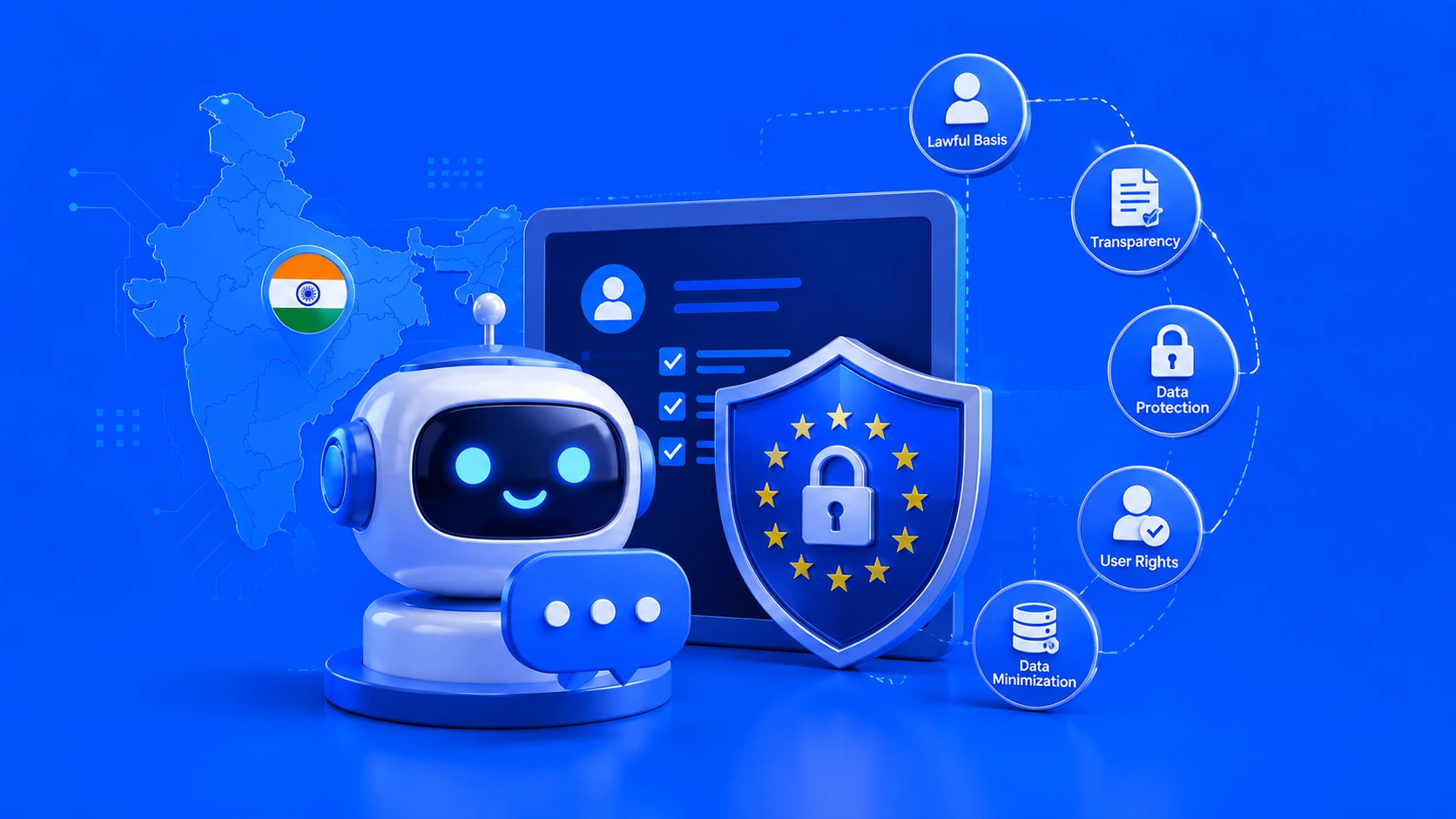
GDPR operates through a system of roles, rights, and obligations. At its core, it distinguishes between data controllers (the entity that decides why and how data is processed, typically your business) and data processors (the entity that processes data on your behalf, such as the AI chatbot platform provider). Both have distinct legal obligations, and Indian businesses operating chatbots must understand which role they occupy in each scenario.
An AI chatbot collects data in multiple ways: it captures typed text, identifies users through account logins, tracks IP addresses to understand geolocation, stores conversation logs for training and quality assurance, and may integrate with CRMs or ticketing systems. Under GDPR, all this constitutes AI data processing and must be governed by a clear legal basis, documented in a Record of Processing Activities (RoPA), and disclosed in your chatbot privacy policy.
GDPR compliance in India also grants EU users eight key rights: the right to be informed, right of access, right to rectification, right to erasure (the “right to be forgotten”), right to restrict processing, right to data portability, right to object, and rights around automated decision-making. Your AI chatbot infrastructure must have mechanisms to respond to all eight of these rights within stipulated timeframes, typically 30 days.
Does GDPR Apply to Your Indian Business or Startup?
The single most important question every Indian business owner should ask is whether their chatbot or web platform is accessible to EU residents. If the answer is yes, GDPR likely applies. The regulation is triggered under two main conditions: first, when a business offers goods or services to EU residents, even if those services are free, and second, when it monitors the behaviour of EU users through activities such as tracking user journeys, analytics, or personalized interactions. Understanding these triggers is essential for maintaining proper GDPR Compliance in India.
The compliance obligation is reinforced by recent enforcement trends. In 2025 and into 2026, the European Data Protection Board significantly ramped up cross-border enforcement against non-EU businesses, including several Asia-Pacific firms.[1] Indian IT firms, SaaS providers, e-commerce platforms, and B2B service companies with any EU-facing digital touchpoint are firmly within this scope.
GDPR Applicability Triggers for Indian Businesses
| Business Type | GDPR Trigger | Compliance Required? |
|---|---|---|
| Indian SaaS with EU clients | Offering services to EU residents | Yes – Full GDPR |
| E-commerce site open to EU | Accepting EU orders, chatbot support | Yes – Full GDPR |
| Domestic Indian business only | No EU users, no EU targeting | DPDPA Only |
| Startup with global website | EU visitors tracked via chatbot/analytics | Yes – Full GDPR |
| IT outsourcing firm (India/UAE) | Processing EU client employee data | Yes – Processor obligations |
Real Benefits of GDPR Compliance in India for Businesses Using AI Chatbots
GDPR compliance in India is not just about avoiding penalties. Organisations that proactively achieve compliance unlock tangible business advantages that far outweigh the investment in compliance infrastructure. Based on our experience with Indian businesses across IT, healthcare, fintech, and e-commerce, here are the most impactful benefits.
Global Market Access
GDPR compliance in India opens doors to EU and UK enterprise procurement, where compliance certification is a baseline vendor requirement for signing B2B contracts involving chatbot data handling.
Enhanced Customer Trust
Transparent chatbot privacy policy and ethical AI chatbot practices build measurable trust. Users are more willing to engage with AI systems they know are governed by internationally recognised personal data security standards.
Better Data Quality
Applying GDPR data collection standards forces Indian businesses to clean up redundant data stores, which naturally improves the accuracy and quality of data used for AI training and customer analytics.
Beyond these three core benefits, businesses also report reduced insurance premiums for cyber liability coverage once they implement documented GDPR risk management protocols. Investors in growth-stage Indian companies increasingly evaluate data governance maturity as a factor in due diligence, making GDPR readiness a fundraising asset as well.
What Happens If Indian Businesses Do Not Follow GDPR Rules?
The consequences of ignoring GDPR compliance in India are severe and multidimensional. Regulatory penalties are only one part of the risk equation. The broader commercial, reputational, and operational consequences can be even more damaging for a growing Indian business.
Financial Penalties
Tier 1 violations attract fines up to 10 million euros (approx. Rs 90 crore). Tier 2 violations for serious breaches of core GDPR principles including AI data processing rules can reach 20 million euros or 4% of global annual revenue, whichever is higher.
Contract Terminations
EU enterprise clients typically include GDPR compliance in India clauses in service contracts. A compliance failure gives them the right to immediately terminate contracts without compensation, causing direct revenue loss.
Reputational Damage
GDPR enforcement decisions are published publicly by EU supervisory authorities. An Indian company named in a GDPR enforcement action faces permanent reputational damage visible to any prospect doing due diligence.
Data Processing Bans
Supervisory authorities can issue temporary or permanent bans on data processing activities, which would make it impossible for your chatbot to operate for EU users until compliance is demonstrated and verified.
Common GDPR Mistakes Indian Businesses Make With AI Chatbots
After reviewing dozens of AI chatbot implementations for Indian and UAE-based businesses, our team has identified a consistent set of GDPR compliance in India failures that keep recurring. Awareness of these mistakes is the first step toward avoiding them.
No Consent Banner
Launching an AI chatbot without a proper GDPR consent management banner is the most frequent mistake. Pre-ticked boxes or implied consent do not meet GDPR’s explicit consent standard.
Vague Privacy Policy
A generic chatbot privacy policy that does not specify what the AI collects, why it collects it, how long it is retained, and with whom it is shared fails GDPR’s transparency requirement entirely.
Missing Data Processing Agreement
Using third-party AI chatbot platforms without signing a DPA with the vendor is a direct GDPR violation. All chatbot data processing relationships must be contractually governed.
Unencrypted Chat Logs
Storing chatbot conversation logs in plain text without chatbot data encryption violates the GDPR requirement for appropriate technical security measures to protect personal data security.
Indefinite Data Retention
Many Indian businesses retain chatbot data forever by default. GDPR’s storage limitation principle requires a defined, documented retention schedule with automatic deletion once the purpose is fulfilled.
No Breach Response Plan
Lacking a documented incident response plan for AI chatbot security measures means Indian businesses typically exceed GDPR’s mandatory 72-hour breach notification window, compounding penalty exposure.
What Personal Data Your AI Chatbot Collects and Why It Matters Under GDPR?
Understanding precisely what your AI chatbot collects is the foundation of any GDPR compliance in India strategy. Many Indian businesses are surprised to discover how many categories of personal data their chatbot system captures, often automatically, without deliberate configuration.
AI Chatbot Data Collection Categories Under GDPR
| Data Category | Examples | GDPR Risk Level |
|---|---|---|
| Identity Data | Name, email, phone number | High |
| Technical Data | IP address, browser type, session ID | High |
| Behavioural Data | Pages visited, questions asked, click paths | Medium |
| Conversation Logs | Full chat transcripts stored for AI training | High |
| Special Category Data | Health, financial, or religious data mentioned in chat | Very High |
| Derived Insights | Inferred preferences, sentiment scores | Medium |
Special category data, even when shared voluntarily by the user during a chat session, requires explicit consent and additional safeguards under GDPR. This is a particularly important concern for AI chatbots used in healthcare, HR, or financial services contexts where sensitive topics naturally arise in conversation.
Step by Step Guide to Achieving GDPR Compliance in India for AI Chatbots
This practical AI compliance checklist has been refined through our work with Indian businesses across multiple industries. Follow these steps in order to build a robust GDPR compliance in India framework around your AI chatbot operations.
Conduct a Data Mapping Audit
Map every data point your AI chatbot collects, from identity fields to conversation logs. Document the data flow from user input through processing, storage, and any third-party integrations. This forms your Record of Processing Activities, a mandatory GDPR document.
Establish a Legal Basis for Each Processing Activity
Identify which of GDPR’s six lawful bases applies to each chatbot data activity: consent, contract, legal obligation, vital interests, public task, or legitimate interest. GDPR consent management is the most commonly used basis but requires the highest standards of implementation.
Rewrite Your Chatbot Privacy Policy
Your chatbot privacy policy must be specific, clear, and jargon-free. It should cover what is collected, why, how long it is stored, who has access, how users can exercise their rights, and contact details for your data protection officer or nominated representative.
Implement Technical Safeguards
Enable chatbot data encryption for data in transit (TLS 1.2+) and at rest (AES-256). Apply role-based access controls so only authorised personnel can access chatbot logs. Conduct regular AI chatbot security measures audits and penetration testing.
Sign Data Processing Agreements with Vendors
Review every third-party vendor involved in your chatbot stack: the AI platform provider, cloud hosting, CRM integrations, and analytics tools. Ensure a valid DPA is in place for all of them before any EU user data flows through the system.
Build a Data Subject Rights Response System
Create clear internal processes to handle user requests for data access, correction, deletion, or portability within 30 days. Many Indian businesses use a dedicated email or in-chatbot form to capture these requests and route them to the appropriate data owner.
Train Your Team and Document Everything
GDPR accountability requires documented evidence of compliance. Train all staff who interact with chatbot data. Maintain your RoPA, DPAs, consent records, and GDPR risk management assessments in an auditable format accessible on demand.
How Indian Businesses Can Get User Consent the Right Way Under GDPR?
GDPR consent management is one of the most misunderstood areas of GDPR compliance in India. Consent must be freely given, specific, informed, and unambiguous. For AI chatbots, this means the consent experience must meet five non-negotiable standards before any GDPR data collection begins.
Granular Options
Users must be able to consent separately to analytics tracking, chatbot personalisation, and marketing communications. Bundling all purposes into one consent tick box is a GDPR violation.
Easy Withdrawal
Withdrawing consent must be as easy as giving it. If you use a one-click consent button, your AI chatbot must also offer a one-click opt-out accessible from within the chat interface or privacy settings.
No Pre-Ticking
Consent boxes must default to unchecked. Silence or inactivity cannot be treated as consent. Users must take an active, affirmative step to indicate agreement to GDPR data collection by your chatbot.
Consent Records
Maintain timestamped records of every consent event: who consented, when, which version of the policy they saw, and what they agreed to. This record is mandatory for GDPR accountability in any enforcement investigation.
Age Verification
GDPR requires special protections for children under 16 (or 13 in some EU countries). If your AI chatbot could be used by minors, you must implement age-gating and parental consent mechanisms as part of your AI privacy regulations compliance.
How to Handle Data Breach in Your AI Chatbot as an Indian Business?
A data breach involving your AI chatbot is not a question of if but when. Attackers specifically target chatbot systems because they are internet-facing, frequently connected to CRMs and databases, and often insufficiently monitored. Under GDPR, a breach involving EU resident data triggers a strict response protocol that Indian businesses must have pre-planned and ready to execute.
GDPR compliance in India requires you to notify the relevant EU supervisory authority within 72 hours of becoming aware of a breach. If the breach is likely to result in high risk to individuals, you must also notify affected users directly without undue delay. Most Indian businesses do not have a formal incident response plan in place, which makes compliance with this 72-hour window practically impossible without advance preparation.
AI Chatbot Breach Response Timeline (GDPR 72-Hour Window)
Is There a GDPR Certification and How Can Indian Companies Get It?
Article 42 of the GDPR specifically provides for certification mechanisms as a tool for demonstrating compliance. While a single universal “GDPR Certification” issued by the EU does not yet exist, several widely recognised certifications and frameworks align closely with GDPR’s requirements and are increasingly demanded by EU enterprise clients contracting Indian businesses.
ISO 27001
The most globally recognised information security management standard. Achieving ISO 27001 certification signals robust personal data security practices and directly supports GDPR compliance in India by demonstrating systematic GDPR data handling practices.
SOC 2 Type II
Particularly relevant for Indian SaaS companies, SOC 2 Type II audits your security, availability, and confidentiality controls over time. It is a strong complement to GDPR compliance in India for AI chatbots serving North American and EU clients.
EU-U.S. DPF Participation
For Indian businesses with US operations or cloud infrastructure, participation in the EU-U.S. Data Privacy Framework helps legitimise cross-border transfers of chatbot data, a key element of GDPR risk management for globally distributed AI systems.
Why GDPR Compliance in India is the Key to Entering Global Markets?
For Indian businesses eyeing expansion into Europe, the UK, or even the UAE, GDPR compliance in India has become a de facto passport. Dubai-based and UAE enterprises increasingly adopt GDPR-aligned standards as part of their commitment to international privacy norms, particularly through the UAE Personal Data Protection Law which shares significant architectural similarities with GDPR. Businesses that achieve GDPR compliance find themselves naturally well-positioned for UAE compliance as well.
From a procurement perspective, European enterprises and government tenders routinely require vendors to demonstrate GDPR compliance in India or equivalent standards before shortlisting them. Indian IT firms and SaaS providers that can produce a GDPR compliance report, DPA templates, and evidence of secure AI communication infrastructure win more deals and command higher contract values than those that cannot.
There is also a brand equity dimension. Companies that publicly communicate their commitment to ethical AI chatbot practices and AI governance and compliance are building trust at scale. In an era where data scandals regularly make international headlines, being the company that prioritises user data protection laws is a powerful differentiator that accelerates growth in regulated markets.
Market Advantage: GDPR Compliant vs Non-Compliant Indian AI Businesses
GDPR vs Indian Data Protection Law What Indian Businesses Need to Understand
India’s Digital Personal Data Protection Act (DPDPA) 2023 is the country’s most comprehensive data privacy law to date. While it shares the GDPR’s core objective of protecting individual data rights, there are several important differences that businesses using AI chatbots must understand when developing a dual compliance strategy. For companies managing both local and international user data, GDPR Compliance in India now requires aligning with the requirements of both regulations.
GDPR vs India DPDPA: Key Differences for AI Chatbot Businesses
| Dimension | GDPR (EU) | DPDPA (India) |
|---|---|---|
| Geographic Scope | EU residents globally, including when processed in India | Indian residents’ digital personal data within India and abroad |
| Maximum Penalty | 20 million euros or 4% of global turnover | Up to Rs 250 crore per instance |
| Consent Standard | Freely given, specific, informed, unambiguous | Free, specific, informed, unconditional, unambiguous |
| Right to Erasure | Explicit right to be forgotten | Right to erasure included, subject to exemptions |
| Data Localisation | Cross-border transfer rules with adequacy decisions | Government to notify restricted countries for transfers |
| DPO Requirement | Mandatory for certain controllers and processors | Consent Manager concept; DPO-equivalent provisions expected |
The strategic insight here is that building for GDPR compliance in India naturally achieves most of the requirements of the DPDPA as well. The higher bar of GDPR consent management, security standards, and data subject rights management covers the majority of DPDPA obligations. Indian businesses should therefore prioritise GDPR compliance first as the more demanding standard, then layer in DPDPA-specific requirements as they become notified by the Indian government.
The GDPR Compliance in India: Final Checklist for AI Chatbot Businesses
- Complete a data mapping audit covering all AI chatbot data collection points
- Establish a documented legal basis for each AI data processing activity
- Implement a robust GDPR consent management system with granular user controls
- Update your chatbot privacy policy to meet GDPR’s transparency requirements
- Sign Data Processing Agreements with every third-party chatbot vendor
- Deploy chatbot data encryption for data in transit and at rest
- Build a data subject rights response process capable of 30-day turnaround
- Prepare a 72-hour breach notification plan with assigned GDPR risk management roles
- Train your entire team on GDPR data handling practices and AI compliance checklist
- Document all compliance activities for GDPR accountability and audit readiness
Achieving GDPR compliance in India for your AI chatbot is a structured, achievable process when approached with the right expertise and a clear framework. The investment in compliance pays dividends in global market access, customer trust, and reduced operational risk that compound over time. As AI governance and compliance standards continue to evolve globally, Indian businesses that build strong data privacy foundations today will be the ones leading their industries in the years ahead.
Start Your GDPR Compliance Journey Today
Our team of certified compliance experts will help you build a GDPR-ready AI chatbot infrastructure that opens global markets and protects your business.
Frequently Asked Questions About AI Chatbots
Q1.1. Does GDPR apply to Indian businesses?
Yes, GDPR applies to Indian businesses if they process personal data of EU residents, regardless of where the company is located. Any Indian firm serving European customers must comply fully.
Q2.2. What is GDPR compliance in India and why does it matter for my business?
GDPR compliance in India means following EU data privacy rules when handling European user data. It builds customer trust, avoids heavy fines, and opens doors to global markets for Indian companies.
Q3.3. Do AI chatbots need to follow GDPR rules?
Absolutely. AI chatbots collect names, emails, chat histories, and behavioral data. All of this qualifies as personal data under GDPR, so any chatbot interacting with EU users must meet GDPR standards.
Q4.4. What happens if my Indian startup violates GDPR?
Violations can lead to fines of up to 20 million euros or 4% of annual global turnover. Along with financial penalties, Indian startups may also face reputational harm and lose valuable EU business partnerships. This is why GDPR Compliance in India has become increasingly important for companies working with European customers and partners.
Q5.5. How do I get user consent for my AI chatbot under GDPR?
Consent must be freely given, specific, informed, and unambiguous. You need a clear opt-in mechanism before data collection starts, with no pre-ticked boxes and easy withdrawal options available always.
Q6.6. What is a GDPR data breach notification requirement?
Under GDPR, if your AI chatbot experiences a data breach, you must notify the relevant supervisory authority within 72 hours of becoming aware of it. Affected users must also be informed without unnecessary delay. This requirement makes GDPR Compliance in India especially important for businesses handling customer data through AI systems.
Q7.7. Is there a GDPR certification for Indian companies?
GDPR does not have a single official certification, but approved codes of conduct and certification schemes under Article 42 and 43 exist. Indian companies can pursue these through accredited certification bodies in Europe.
Q8.8. What is the difference between GDPR and India's DPDP Act?
GDPR is the European Union regulation that protects the personal data of EU residents across the globe, while India’s DPDP Act 2023 focuses on the handling of personal data within India. Although both laws share similar privacy principles, they differ in scope, penalties, and enforcement mechanisms. Understanding these differences is important for businesses managing GDPR Compliance in India alongside local data protection requirements.
Q9.9. How does GDPR affect Indian SaaS companies with EU clients?
Indian SaaS companies acting as data processors for EU clients must sign Data Processing Agreements, implement technical safeguards, and assist clients with data subject rights requests under GDPR obligations.
Q10.10. Can an AI chatbot be GDPR compliant by design?
Yes. Privacy by design is a core GDPR requirement. Building your AI chatbot with features like data minimization, encryption, access controls, and automatic data deletion from the beginning helps ensure compliance is built into the system rather than added later. This approach also strengthens GDPR Compliance in India for businesses handling sensitive customer data.
Explore Services
Related Services
Reviewed by

Aman Vaths
Founder of Nadcab Labs
Aman Vaths is the Founder & CTO of Nadcab Labs, a global digital engineering company delivering enterprise-grade solutions across AI, Web3, Blockchain, Big Data, Cloud, Cybersecurity, and Modern Application Development. With deep technical leadership and product innovation experience, Aman has positioned Nadcab Labs as one of the most advanced engineering companies driving the next era of intelligent, secure, and scalable software systems. Under his leadership, Nadcab Labs has built 2,000+ global projects across sectors including fintech, banking, healthcare, real estate, logistics, gaming, manufacturing, and next-generation DePIN networks. Aman’s strength lies in architecting high-performance systems, end-to-end platform engineering, and designing enterprise solutions that operate at global scale.