Ai Overview
The process of understanding user input is where most of the intelligence in a chatbot lives. Instead, the chatbot architecture activates a pipeline that begins with tokenization, where the sentence is split into individual words or sub word units. This level of automation reduces operational cost while improving the speed and consistency of service delivery at the same time. The adaptive capability of AI chatbots is what transforms them from a launch-time investment into a compounding long-term asset.
Key Takeaways
- Understanding how AI chatbot works begins with natural language processing that interprets user text accurately and intelligently in real time.
- Machine learning algorithms allow chatbots to continuously improve response accuracy based on previous interactions and new AI training data inputs.
- Intent recognition and entity extraction together help chatbots understand not just what users say but precisely what action or information they need.
- Context management in conversational AI keeps conversations coherent across multiple messages, making daily interactions feel natural and less robotic.
- Large language models power advanced chatbot architecture enabling human-like response generation across customer support, retail, and service industries globally.
- Businesses in India, Dubai, the UK, and the USA are leveraging automation through AI chatbots to cut costs and dramatically improve customer satisfaction.
- Personalization in AI chatbots uses behavioural data and past sessions to deliver tailored responses that genuinely match each user’s unique preferences.
- Deep learning models trained on vast AI training data sets allow chatbots to handle complex, ambiguous queries with higher accuracy than rule-based systems.
- Real-time response generation reduces user wait time significantly, improving satisfaction scores and increasing retention across digital platforms and apps.
- Data-driven improvements in chatbot interactions ensure businesses can track performance metrics, refine AI training data, and deliver measurably better user outcomes.
Over the past decade, AI chatbots have transformed from basic scripted tools into intelligent, adaptive systems that play a central role in how businesses interact with users every single day. Whether you are a customer in Mumbai looking for quick support, a shopper in Dubai checking an order status, a business user in London resolving a billing query, or a consumer in New York seeking product guidance, the AI chat assistant behind that interface is working through a complex chain of intelligence layers to serve you instantly. Understanding how AI chatbot works is no longer just a technical curiosity. It is a business-critical insight that shapes strategy, product experience, and customer loyalty.
At our agency, with over 8 years of hands-on experience building and deploying conversational AI solutions for clients across India, the UAE, the UK, and the USA, we have seen first-hand how the right chatbot architecture changes the game entirely. This guide walks you through every layer of how AI chatbot works and why daily user experience depends so heavily on the decisions made within those layers.
How AI Chatbot Works in Daily User Interactions?
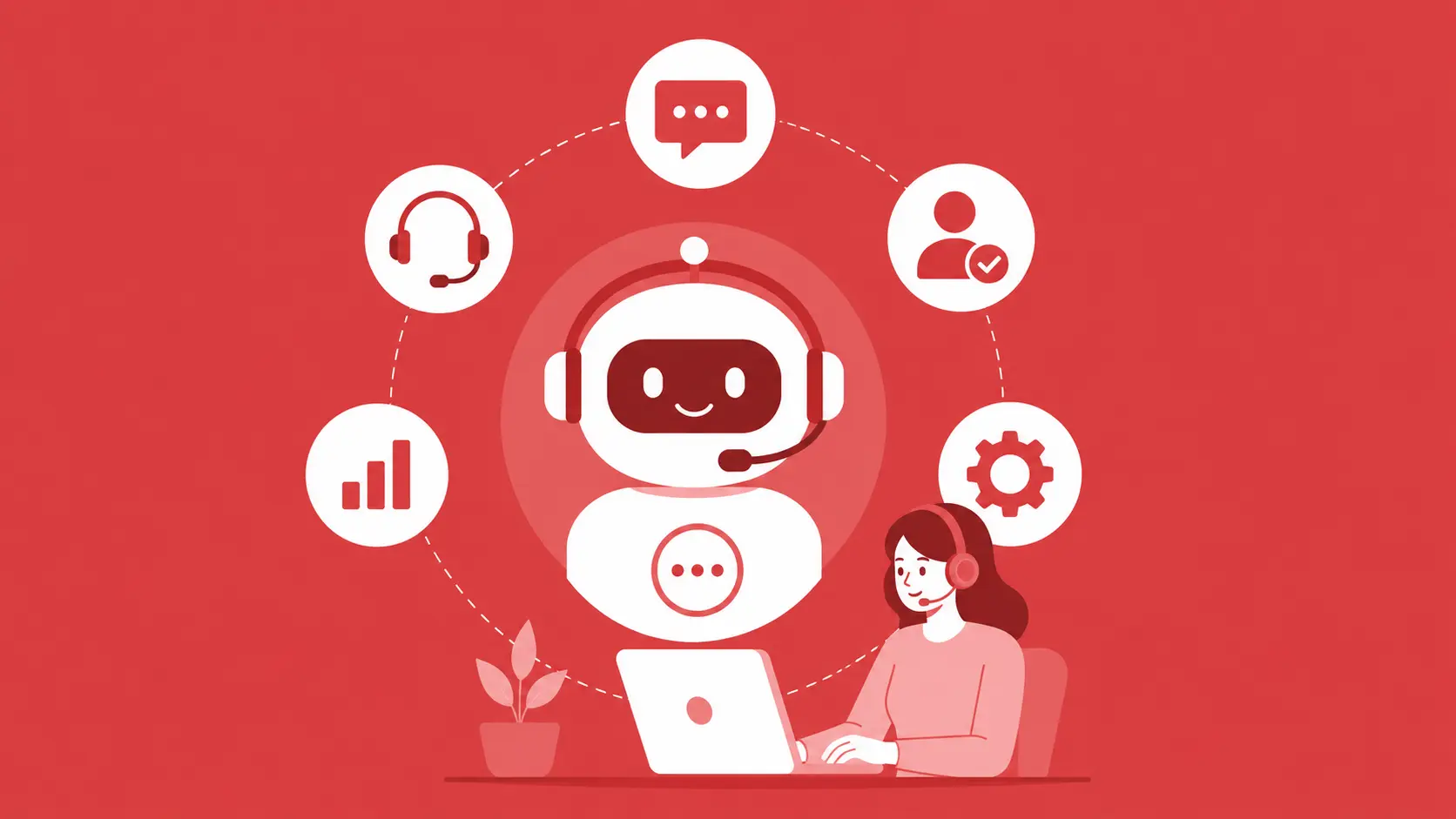
To understand how AI chatbot works in a real user interaction, picture the full journey from the moment a user types a message to the moment a reply appears on screen. The process involves multiple simultaneous operations: parsing the text, classifying the intent, pulling contextual memory, generating a response, and formatting the output. All of this happens in milliseconds.
In daily use across customer support portals, e-commerce platforms, banking apps, and healthcare services in markets like India and Dubai, AI chatbots are the first line of interaction. They handle thousands of simultaneous conversations without any degradation in quality or speed, something no human team can replicate at scale. This is the foundation of their growing adoption.
User Input
Text or voice query enters the chatbot interface through web, app, or messaging platform.
NLP Processing
Natural language processing breaks down the text into tokens, classifies intent, and extracts entities.
Intent Match
Machine learning algorithms match the classified intent to the correct response path or knowledge base.
Response Output
Response generation crafts the final reply and delivers it back to the user interface in real time.
How AI Chatbots Process and Understand User Input?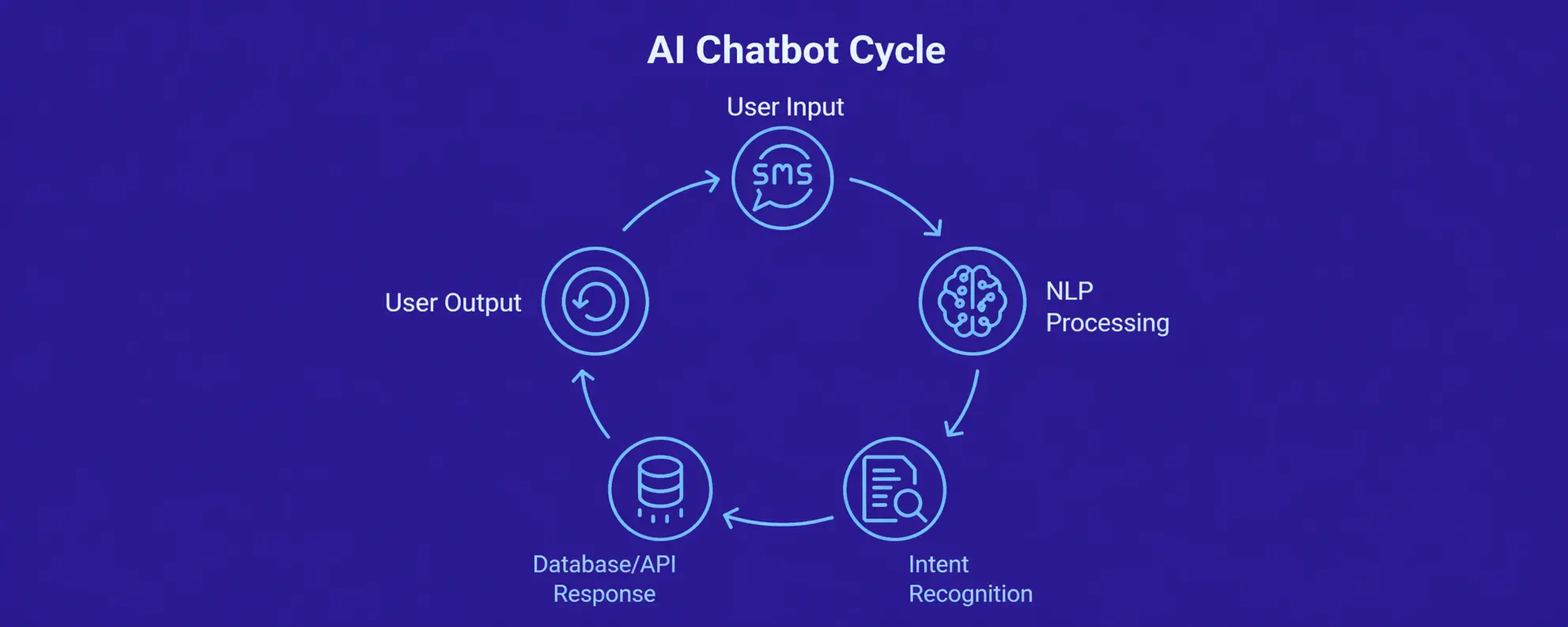
The process of understanding user input is where most of the intelligence in a chatbot lives. When a user types a message, the chatbot does not simply look for keyword matches. Instead, the chatbot architecture activates a pipeline that begins with tokenization, where the sentence is split into individual words or sub word units. Each token is then assigned a vector representation using pre-trained embeddings, allowing the system to understand semantic relationships between words.
This is followed by syntactic analysis, which examines grammar structure, and semantic analysis, which extracts meaning. Both steps are powered by deep learning models trained on massive AI training data sets. In our experience working with enterprises in India and UAE, this pipeline must be fine-tuned for regional language patterns, informal phrasing, and industry-specific vocabulary to deliver truly accurate understanding.
Role of Natural Language Processing in Daily Chatbot Use
Natural language processing forms the scientific core of every AI chatbot that actually delivers results. When you study how AI chatbot works at a technical level, NLP is the layer that does the heaviest lifting. It bridges the fundamental gap between human language, which is inherently ambiguous, context-dependent, and emotionally layered, and machine computation, which requires structured, logical inputs. Without robust natural language processing built into the chatbot architecture, no system can reliably interpret what a user is truly asking.
In daily interactions, the NLP layer handles spell correction, slang interpretation, multilingual translation, sentiment analysis, and named entity recognition simultaneously. Consider a customer in Dubai who types “myn order hasnt arrved yet.” The pipeline corrects the spelling, classifies the topic as order tracking, performs entity extraction to isolate the order reference, and routes the entire conversation to the correct response flow without the user ever knowing how much processing just happened. That invisible accuracy is precisely what makes how AI chatbot works so genuinely useful in daily interactions rather than a source of frustration.
According to industry research published by a major technology news outlet in 2026, enterprises investing in NLP-driven chatbot upgrades reported measurably higher customer satisfaction scores across digital channels.[1]
How Machine Learning Improves Chatbot Responses in Daily Use?
Machine learning is what separates a static chatbot from one that genuinely evolves. Traditional rule-based bots rely on predefined decision trees, but AI chatbots trained with machine learning algorithms adapt based on real interaction data. Every conversation becomes a data point that can be fed back into the model to improve future performance.
In practice, this means a chatbot deployed for a retail brand in the UK in January will perform significantly better by March, because it will have processed thousands of real customer conversations and adjusted its weights accordingly. Supervised learning, reinforcement learning from human feedback, and semi-supervised techniques all play roles in this continuous improvement cycle.
| Learning Method | How It Works | Daily Benefit |
|---|---|---|
| Supervised Learning | Trains on labelled input-output AI training data pairs reviewed by humans. | Higher accuracy on common queries from day one of deployment. |
| Reinforcement Learning | Uses reward signals from user feedback to reinforce correct response paths. | Improves handling of edge cases and unusual conversational flows. |
| Transfer Learning | Applies knowledge from large language models trained on general data to specific domains. | Reduces training time and cost while maintaining domain relevance. |
| Continual Learning | Updates the model incrementally as new interaction data becomes available. | Keeps the chatbot current with evolving user language and business context. |
How AI Chatbots Recognize User Intent for Better Experience?
Intent recognition is arguably the most critical function in the entire customer-facing layer of any AI chatbot. Every message a user sends carries an intent, which is the underlying goal or action they want to accomplish. Identifying this intent correctly is what determines whether the conversation delivers genuine value or leaves the user frustrated enough to abandon the interaction entirely.
In modern chatbot architecture, this works through classification models trained on thousands of example utterances per intent category. These models assign a probability score to each possible intent and select the most likely match. Combined with entity extraction, which identifies specific details like names, dates, product IDs, and locations within the message, the system can route the conversation with remarkable precision.
For businesses in India and the USA deploying chatbots in customer support scenarios, understanding how AI chatbot works at this intent layer is directly tied to business outcomes. Robust intent recognition translates into lower escalation rates and higher first-contact resolution scores, both of which are key performance indicators that leadership teams in competitive markets track closely and act on.
Context Management in AI Chatbots for Smooth Daily Conversations
One of the most common complaints about early chatbots was that they could not follow the thread of a conversation. Each message was treated independently, leading to confusing and repetitive interactions. AI Agent Context Management solves this problem entirely by enabling the chatbot to maintain and reference conversational history throughout a session.
Modern conversational AI systems store a context window, which is a rolling memory of recent exchanges, along with key entities and state variables like account information, selected product, or unresolved issue. This allows the chatbot to understand follow-up questions like “what about the other one?” or “can I change that?” without requiring the user to repeat themselves.
Context Management: How It Flows
User sends initial message. Chatbot creates a new session context object and logs the first intent and entities.
Each subsequent message is analysed alongside the stored context, allowing the chatbot to resolve pronouns and references accurately.
State variables like “order ID = 9823” or “issue type = refund” are carried forward and used in response generation for that session.
At session end, resolved and unresolved intents are logged as AI training data for future machine learning improvement cycles.
Real-Time Responses and Their Impact on Daily User Experience
Response generation speed is one of the defining metrics of chatbot performance in daily user experience. Users across markets like the UK and UAE have extremely low tolerance for lag in digital interactions, and the numbers back this up consistently. Response times above two seconds lead to significantly higher abandonment rates on chat interfaces, a pattern we have observed repeatedly across client deployments over the past 8 years.
A key part of understanding how AI chatbots work is recognizing why they respond so fast. Rather than computing answers from scratch during a live conversation, AI chatbots run inference on pre-trained large language models deployed on high-performance cloud infrastructure. The deep learning models have already absorbed and structured their intelligence during the training phase, meaning live interactions are essentially fast lookup and assembly operations. This is fundamentally different from how earlier rule-based systems worked, where even simple lookups could introduce noticeable delays that broke the conversational rhythm.
For businesses deploying chatbots in India across high-volume sectors like banking and telecom, real-time response capability is not a feature to be considered later. It is a core architectural requirement for maintaining user trust and preventing drop-off to competitor channels where response times are already optimized.
Personalization in AI Chatbots for Enhanced Daily Interactions
Personalization is where conversational AI moves from functional to genuinely impressive. A personalized chatbot experience is one where the user feels recognized, understood, and served based on their specific history and preferences rather than receiving a generic response that any anonymous visitor would get. This level of personalization is now achievable through a combination of user profile data, session history, and machine learning-driven behavioural analysis.
For example, a returning user in the USA who has previously purchased a specific product category can receive proactively relevant recommendations, while a first-time visitor receives onboarding guidance. The chatbot architecture stores user-specific context between sessions when permissions allow, making each subsequent interaction smoother and more efficient than the last.
Personalization also extends to communication style. Deep learning models can be tuned to adapt tone, vocabulary complexity, and response length based on signals inferred from how a user writes, creating a dialogue that feels more human and less mechanical.
How AI Chatbots Simplify Everyday User Tasks?
The practical value of understanding how AI chatbot works becomes clearest when you examine the everyday tasks these systems handle at scale. From booking appointments and checking account balances to filing support tickets and processing returns, AI chatbots automate multi-step workflows that previously required human intervention at every stage.
In markets like Dubai and India, where mobile-first digital interactions dominate consumer behaviour, this capability carries significant adoption advantages. Users do not need to navigate complex app menus, search through help centres, or wait for business hours to get something done. The ability to complete transactional tasks entirely within a chat interface removes friction at every point in the user journey. They simply ask and receive, and that simplicity is increasingly the standard users expect rather than a feature they appreciate as exceptional.
| Everyday Task | How AI Chatbot Handles It | User Benefit |
|---|---|---|
| Order Tracking | Entity extraction identifies order ID; automation retrieves live status from backend. | Instant status without hold times or agent dependency. |
| Appointment Booking | Conversational AI collects date, time, and service preference through guided dialogue flow. | Seamless booking available 24 hours a day, 7 days a week. |
| FAQ Resolution | Intent recognition maps query to the correct knowledge base article automatically. | Reduces need to search help pages or wait for human response. |
| Complaint Filing | Chatbot collects structured complaint data via natural language processing and auto-creates tickets. | Faster resolution with accurate complaint categorization from the start. |
Improving User Efficiency Through AI Chatbot Automation
Automation is the engine that drives real efficiency gains when AI chatbots are deployed with intention and depth. Rather than simply answering questions, a well-built chatbot powered by automation can complete end-to-end workflows within a single conversation thread: verify identity, retrieve account data, process a request, send a confirmation, and update the backend system, all without a human agent touching the interaction.
For enterprises in the UK and USA managing high volumes of routine customer interactions daily, this is where how AI chatbots work translates directly into bottom-line impact. This level of automation reduces operational cost while improving the speed and consistency of service delivery at the same time. Customer support teams are freed from repetitive queries and can redirect their attention toward genuinely complex cases that benefit from human judgment and nuanced thinking.
Having built automation pipelines for numerous enterprise clients across India, Dubai, the UK, and the USA over 8 years, our agency has observed a consistent pattern. Businesses that integrate automation deeply into their chatbot architecture, rather than treating the chatbot as a glorified FAQ tool, consistently outperform those that do not. The difference in efficiency metrics is substantial and typically measurable within the first 90 days of going live.
Reducing Response Time to Enhance Daily User Experience
Response time is one of the most direct levers available to improve user experience in a chatbot deployment. Every second of delay translates into a measurable drop in user satisfaction and a measurable increase in session abandonment. Understanding how AI chatbot works in relation to latency requires examining both the model inference layer and the infrastructure layer.
At the model level, using optimized and quantized versions of large language models, or employing smaller specialized models for specific intent categories, reduces the time required for response generation. At the infrastructure level, deploying chatbot services in geographically distributed cloud regions, such as placing servers in the Middle East for UAE users and in South Asian data centres for India users, reduces round-trip latency significantly.
Response Time Impact on User Satisfaction
Data-Driven Improvements in Daily Chatbot Interactions
Beyond model retraining, AI chatbots generate an enormous volume of structured behavioural data that can be used to improve experience design, conversation flows, and business logic. Analysing which intents have the highest fall-back rates, which user journeys result in abandonment, and which responses consistently earn positive feedback signals are all forms of data-driven improvement that operate independently of model updates and deliver value on their own terms.
This is an often overlooked dimension of how AI chatbots work in practice. The system is not just a customer-facing interface. It is simultaneously a research instrument that captures how real users think, speak, and prioritise their needs across thousands of daily interactions. For enterprise clients in the UK and USA we have worked with, establishing a regular analytics review cadence around chatbot performance data has consistently been one of the highest-return activities in the entire chatbot programme. The data reveals not just chatbot weaknesses but also genuine insights into what customers care about and how they naturally express those needs, intelligence that is valuable well beyond the chatbot team and across the entire digital product function.
| Data Metric | What It Measures | Improvement Action |
|---|---|---|
| Fall-back Rate | Percentage of messages the chatbot fails to understand or classify. | Add new training utterances for unrecognized intents in AI training data. |
| Containment Rate | Percentage of conversations fully resolved without human escalation. | Expand automation coverage for frequently escalated scenarios. |
| Session Length | Average number of turns required to complete a user goal. | Optimize conversation flows to reduce unnecessary dialogue turns. |
| CSAT Score | Direct user satisfaction rating collected at session end. | Use low-rated sessions as priority AI training data for model fine-tuning. |
Challenges in AI Chatbots Affecting Daily User Experience
While the capabilities of modern AI chatbots are genuinely impressive, it would be intellectually dishonest to discuss how AI chatbot works without addressing the real challenges that affect daily user experience. Understanding these limitations is essential for setting appropriate expectations, designing robust fullback mechanisms, and planning realistic improvement roadmaps.
Ambiguity in Language
Natural language processing struggles when users express the same intent in vastly different ways or use highly informal, regionally specific language without clear context clues.
Context Overflow
Long or complex conversations can exceed the context window of large language models, causing the chatbot to lose track of earlier information and produce inconsistent responses.
Hallucination Risk
Deep learning models can generate confident but factually incorrect responses when queried outside their AI training data domain, a critical risk in regulated sectors.
Emotional Intelligence Gap
While sentiment detection has improved significantly, AI chatbots still struggle with nuanced emotional states that require empathy, humour, or culturally sensitive responses.
How AI Chatbots Adapt to Improve User Experience Over Time?
The adaptive capability of AI chatbots is what transforms them from a launch-time investment into a compounding long-term asset. Understanding how AI chatbot works over time requires appreciating the feedback loops built into the system at every layer, from machine learning retraining to conversation design iteration to infrastructure scaling.
A mature chatbot program, such as those we have managed for enterprise clients across India, UK, USA, and Dubai over the past 8 years, combines automated model updates with regular human review, A/B testing of alternative conversation flows, and structured feedback collection from end users. Each cycle produces measurable improvements in the metrics that matter most: containment rate, satisfaction score, and task completion rate.
Looking ahead, the integration of multimodal large language models that can process images, audio, and text simultaneously is set to expand chatbot capabilities dramatically. Conversational AI systems will increasingly move beyond text into voice, visual search, and augmented reality interfaces, requiring the same principles of natural language processing and machine learning but applied across richer input channels.
For businesses in any market looking to build or scale an AI chatbot program, the single most important insight from our experience is this: the quality of outcomes depends directly on the quality of the process around the technology. Selecting the right chatbot architecture, investing in quality AI training data, designing thoughtful conversation flows, and maintaining a disciplined improvement cycle are what separate high-performing chatbot programs from those that plateau after launch.
Adaptation Cycle Summary
Collect interaction data and performance metrics from all live conversations
Analyse fall-back cases and low-scoring sessions to identify improvement areas
Retrain deep learning models and update AI training data with labelled examples
Deploy improved model version and monitor performance against baseline metrics
Ready to Build a Smarter AI Chatbot?
Transform your customer support with intelligent conversational AI built for real results across India, Dubai, UK and USA.
Frequently Asked Questions About AI Chatbots
Q1.1. How does an AI chatbot actually understand what I am saying?
AI chatbots use natural language processing to break down your message into meaningful parts, identifying keywords, intent, and context so they can generate an accurate and relevant response every time.
Q2.2. Is an AI chatbot the same as a regular chatbot?
No. A regular chatbot follows fixed rules and scripts, while an AI chatbot uses machine learning and deep learning models to understand varied language, learn from conversations, and improve responses continuously over time.
Q3.3. How does an AI chatbot learn and get smarter over time?
AI chatbots are trained on large volumes of AI training data and use machine learning algorithms to update their responses based on new interactions, feedback signals, and retraining cycles, making them progressively more accurate and helpful.
Q4.4. Can an AI chatbot remember what I said earlier in a conversation?
Yes, most modern AI chatbots use context management systems that retain conversation history within a session, allowing them to reference earlier messages and deliver smoother, more connected responses throughout the interaction.
Q5.5. How fast can an AI chatbot reply compared to a human agent?
AI chatbots respond instantly, typically within milliseconds, because they process queries using pre-trained large language models and server-side automation, unlike human agents who need time to read, think, and type a reply.
Q6.6. Are AI chatbots used for customer support in businesses?
Absolutely. Businesses across the UK, USA, UAE, and India widely deploy AI chatbots for customer support to handle queries around the clock, reduce wait times, resolve common issues, and free human agents for complex tasks.
Q7.7. What technology powers an AI chatbot behind the scenes?
The core technologies include natural language processing, intent recognition, entity extraction, deep learning models, and large language models. Together these form the chatbot architecture that powers understanding and response generation.
Q8.8. Can an AI chatbot handle multiple languages?
Yes, many modern AI chatbots support multilingual interactions through language-specific training datasets and natural language processing pipelines, making them especially useful in diverse markets like India, Dubai, and the USA.
Q9.9. Is my data safe when I use an AI chatbot?
Reputable AI chatbot platforms follow strict data privacy regulations. However, it is important to choose providers that comply with GDPR in the UK, PDPB norms in India, and data protection laws in the UAE for full safety.
Q10.10. How is an AI chatbot different from a virtual assistant like Siri or Alexa?
Virtual assistants like Siri handle device-level commands using voice, while AI chatbots are purpose-built for text-based conversational AI, usually integrated into websites, apps, or platforms for specific customer support or task automation goals.
Explore Services
Related Services
Reviewed by

Aman Vaths
Founder of Nadcab Labs
Aman Vaths is the Founder & CTO of Nadcab Labs, a global digital engineering company delivering enterprise-grade solutions across AI, Web3, Blockchain, Big Data, Cloud, Cybersecurity, and Modern Application Development. With deep technical leadership and product innovation experience, Aman has positioned Nadcab Labs as one of the most advanced engineering companies driving the next era of intelligent, secure, and scalable software systems. Under his leadership, Nadcab Labs has built 2,000+ global projects across sectors including fintech, banking, healthcare, real estate, logistics, gaming, manufacturing, and next-generation DePIN networks. Aman’s strength lies in architecting high-performance systems, end-to-end platform engineering, and designing enterprise solutions that operate at global scale.