Ai Overview
The AI chatbot market size has become one of the most compelling growth stories in the global technology industry over the past decade. Businesses report $8 return per $1 invested, with 57% achieving significant ROI within 12 months. North America, anchored by the USA, accounts for approximately 31% of global chatbot revenue, driven by early enterprise adoption, large technology vendor ecosystems, and high per-interaction ROI documentation.
Key Takeaways
- ✔The global AI chatbot market size in 2026 is valued at approximately $11 to $13.28 billion, reflecting extraordinary sector-wide momentum and sustained enterprise investment.
- ✔The AI chatbot market forecast projects growth to over $37 billion by 2030, powered by generative AI chatbot trends and rising adoption across every major vertical.
- ✔Chatbot market growth rate stands between 23.15% and 29.7% CAGR, making it one of the fastest-growing technology segments across the USA, UK, UAE, and India.
- ✔AI chatbot adoption growth has reached 987 million global users in 2026, with DataReportal reporting over one billion active conversational AI users worldwide this year.
- ✔North America leads chatbot market share with 31% of global revenue, while Asia-Pacific including India is the fastest-growing region with accelerating adoption rates.
- ✔Generative AI chatbot market valuation reaches $12.98 billion in 2026, growing at 31.11% CAGR, far outpacing conventional rule-based chatbot segments globally.
- ✔Leading chatbot companies include ChatGPT at 68% share, Google Gemini at 18.2%, Meta AI, Microsoft Copilot, and emerging players reshaping the competitive landscape rapidly.
- ✔Businesses deploying chatbots report 57% achieving strong ROI within the first year, with average returns of 148 to 200% and annual cost savings exceeding $8 billion.
- ✔UAE Dubai and India are emerging as high-priority chatbot investment hubs, driven by smart city policies, digital banking expansion, and mobile-first consumer populations.
- ✔Chatbot automation trends now extend beyond customer service into sales, HR, healthcare, logistics, and financial advisory roles across enterprise and SMB segments globally.
AI Chatbot Market Size Overview and Industry Scope
The AI chatbot market size has become one of the most compelling growth stories in the global technology industry over the past decade. With over eight years of experience guiding businesses through digital transformation, our agency has observed how conversational AI has evolved from a novel experiment into an indispensable business infrastructure. As of 2026, the global chatbot market size sits firmly in the $11 to $13.28 billion range, a figure that underlines just how mainstream AI chatbot adoption growth has become across sectors including retail, banking, healthcare, and government services.
Whether you are a business leader in London assessing automation ROI, a startup founder in Dubai exploring customer engagement tools, a mid-size enterprise in Mumbai seeking to scale support operations, or a technology investor in New York tracking AI chatbot market analysis, the data points uniformly in one direction: the AI chat assistant sector is accelerating, not slowing down. With 987 million people now using AI chatbots globally and 95% of customer service interactions expected to involve AI by the close of 2026, the conversational AI market size represents one of the most important investment and operational decisions for businesses today.
Global AI Chatbot Market Valuation and Revenue Analysis
The AI chatbot market valuation has followed an exceptional trajectory. According to Research and Markets, the chatbot market was valued at $10.25 billion in 2025 and jumped to $13.28 billion in 2026, representing a 29.5% single-year increase. Grand View Research places the 2024 baseline at $7.76 billion, projecting a climb to $27.29 billion by 2030 at a 23.3% CAGR. Mordor Intelligence offers a parallel view, estimating $11.45 billion in 2026 growing to $32.45 billion by 2031 at a 23.15% CAGR. The variance across sources reflects different definitional scopes, but all forecasters agree on one core reality: the conversational AI market size is on a sustained upward path.
For businesses in the USA, UK, UAE, and India, understanding this AI chatbot market valuation context is essential for strategic planning. The UK’s enterprise sector has accelerated chatbot adoption post-pandemic, while UAE’s Vision 2030 digital agenda places conversational AI at the core of public-private service delivery. In India, where digital consumers number in the hundreds of millions, chatbot market growth is reshaping e-commerce, fintech, and telecom customer engagement at scale.
| Research Source | 2026 Valuation | Forecast Year | Forecast Value | CAGR |
|---|---|---|---|---|
| Research and Markets | $13.28 Billion | 2030 | $37.53 Billion | 29.7% |
| Grand View Research | ~$11 Billion | 2030 | $27.29 Billion | 23.3% |
| Mordor Intelligence | $11.45 Billion | 2031 | $32.45 Billion | 23.15% |
| Route Mobile | $11.775 Billion | 2033 | $41.24 Billion | 19.6% |
| Roots Analysis (via Genuity) | ~$11 Billion | 2035 | $61.97 Billion | 23.8% |
Historical AI Chatbot Market Size and Growth Trends
Tracing the historical AI chatbot market size gives critical context to the growth we observe today. The chatbot market began its structured expansion around 2018 when NLP maturity, cloud infrastructure, and mobile adoption converged to make conversational AI practical for enterprise use. By 2021, several UK and US enterprises had moved beyond pilots into production deployments, particularly in financial services and e-commerce. India’s rapid smartphone penetration during this period created a parallel wave of consumer-facing chatbot integration among telecom operators, banks, and D2C brands.
The real inflection came in late 2022 and through 2023, when generative AI chatbot trends redefined what conversational AI could accomplish. The chatbot market growth shifted from incremental to exponential as LLM-powered bots replaced rigid decision trees with fluid, contextual dialogue. By 2024 the market reached $7.76 billion per Grand View Research, and by 2025 it climbed to $9.57 billion. The progression toward $11 to $13 billion in 2026 reflects not just broader adoption but deeper integration across business functions.
| Year | Market Size (Approx.) | Key Milestone |
|---|---|---|
| 2020 | ~$2.9 Billion | COVID-19 accelerates digital customer service adoption |
| 2021 | ~$3.9 Billion | Enterprise pilots scale to production in UK and USA |
| 2022 | ~$5.1 Billion | NLP improvements drive cross-industry adoption |
| 2023 | ~$6.3 Billion | ChatGPT launch triggers generative AI chatbot boom globally |
| 2024 | $7.76 Billion | LLM-powered bots enter mainstream enterprise workflows |
| 2025 | $9.57 Billion | Agentic AI and multimodal chatbots reach commercial scale |
| 2026 | $11 – $13.28 Billion | AI chatbot market size surpasses $13B, 987M global users |
AI Chatbot Market CAGR and Year on Year Growth Rate Analysis
The chatbot market growth rate is one of the most closely watched metrics for technology investors and enterprise strategists alike. With a CAGR ranging from 19.6% on the conservative end to 29.7% on the more aggressive projections, the AI chatbot market consistently outperforms many adjacent technology categories including CRM software, cloud storage, and traditional analytics platforms. For context, the broader enterprise software market grows at approximately 11% CAGR, making chatbot automation trends roughly two to three times as dynamic.
Year on year, the AI chatbot market analysis shows compounding momentum. From 2024 to 2025 the market grew approximately 23%, and from 2025 to 2026 Research and Markets data indicates a 29.5% single-year increase. This acceleration, rather than deceleration, at scale is unusually strong and reflects structural tailwinds including LLM cost collapse, mainstream consumer familiarity, and proven enterprise ROI across USA, UK, India, and UAE deployments.
Forecasted AI Chatbot Market Size and Future Growth Projections
The AI chatbot market forecast paints a picture of consistent, substantial growth well into the next decade. By 2030, the market is expected to reach between $27.29 billion and $37.53 billion. By 2031 Mordor Intelligence places it at $32.45 billion. Looking further, Roots Analysis projects the chatbot market reaching $61.97 billion by 2035, while a longer-range view puts cumulative value north of $72 billion by that year. The generative AI chatbot segment is growing even faster: valued at $12.98 billion in 2026, it is forecast to reach $113.35 billion by 2034 at a 31.11% CAGR, per ColorWhistle data.
For strategic planners in the UAE and India especially, these AI chatbot market trends signal an urgent window for investment and integration. Dubai’s smart city infrastructure and India’s national digital stack both create policy-level support that will sustain AI chatbot adoption growth well beyond current market baselines. UK businesses post-Brexit are also leveraging chatbot automation as a competitive lever for cost-efficient customer operations, and American enterprises continue to increase generative AI chatbot spending as proven ROI removes budget approval friction.
AI Chatbot Market Growth Timeline
2026: $11 to $13.28 Billion | 987M global users | Generative AI chatbot mainstream adoption
Key Drivers Accelerating Growth in the AI Chatbot Market
Understanding what is driving the AI Chatbot Market Growth is essential for businesses planning their 2026 and beyond conversational AI strategies. Through our work with clients across multiple industries in the UK, USA, UAE, and India, we have identified six primary drivers that explain why the chatbot market size has sustained above-20% annual growth over consecutive years.
Proven and Measurable ROI
Businesses report $8 return per $1 invested, with 57% achieving significant ROI within 12 months. This eliminates budget approval barriers that slowed chatbot adoption in earlier years.
Generative AI Capabilities
The shift from rule-based to LLM-powered bots has dramatically improved conversational quality, enabling contextual, multi-turn dialogue that consumers now expect from every brand.
LLM Inference Cost Collapse
GPT-4 class inference costs have fallen dramatically since 2024, making AI chatbots economically viable for SMBs and startups, not just large enterprises in USA, UK, UAE, and India.
Mobile-First Consumer Demand
64% of customers say 24/7 availability is the best chatbot feature. India’s 700M+ smartphone users and UAE’s tech-savvy population are primary demand accelerators for conversational AI.
Government Digital Agendas
UAE’s Vision 2030, India’s Digital India initiative, and UK’s AI strategy each explicitly support AI-powered public service automation, creating policy-level demand that sustains chatbot market growth.
Chatbot Automation Trends in Ops
Beyond customer service, chatbots now handle HR onboarding, IT helpdesk, inventory queries, and compliance workflows, expanding the total addressable market significantly across enterprise segments.
Current Trends Influencing AI Chatbot Market Adoption
The AI Chatbot Market Trends of 2026 reflect a maturation of the industry beyond novelty into strategic necessity. Chatbot automation trends now encompass omnichannel orchestration, proactive customer outreach, lead qualification automation, and zero-party data collection across messaging channels. Our agency has tracked several specific adoption patterns that business leaders and investors should understand when evaluating the conversational AI market size opportunity.
Chatbot marketing has shifted from engagement widgets to full-funnel conversation journeys, with AI chat qualifiers converting at 28 to 40%, compared to 2 to 3% for traditional web forms. Gartner has projected that traditional search engine volume will drop 25% by 2026 due to AI chatbot usage, reshaping digital discovery entirely. For UK and US businesses particularly, this means SEO and chatbot strategy are now inseparable disciplines. In UAE, WhatsApp-based chatbots have emerged as the dominant channel for customer engagement, while in India, regional language support in chatbots has unlocked vernacular market segments worth hundreds of millions of users.
Top AI Chatbot Market Trends in 2026
Emerging Technology Trends in the AI Chatbot Industry
Conversational AI innovations in 2026 are reshaping what it means to deploy a chatbot. The industry has moved well beyond simple FAQ bots into territory that intersects with autonomous agents, multimodal interfaces, emotional intelligence, and predictive analytics. These emerging technology trends are directly influencing AI chatbot market analysis projections and justify the premium valuations seen in recent investment rounds.
Key among conversational AI innovations is the rise of agentic architecture, where chatbots can independently browse the web, call APIs, manage calendars, file documents, and trigger business workflows across connected systems. This shifts chatbots from reactive tools to proactive business agents. Additionally, retrieval-augmented generation (RAG) allows enterprise bots to draw from proprietary company data in real time, making responses hyper-relevant and reducing hallucination rates that previously concerned UK and US enterprise buyers. In India and UAE, the emergence of voice-first vernacular AI chatbots is creating entirely new product categories within the AI chatbot market.[1]
AI Chatbot Market Share Analysis by Region and Geography
The chatbot market share by region reveals a global landscape where North America leads in current revenue while Asia-Pacific drives the fastest growth. Understanding this geographic split is critical for businesses and investors assessing where to prioritize AI chatbot adoption growth. The AI Chatbot Market Share Analysis across geographies shows clear regional leaders and emerging challengers that will define market dynamics through 2030.
North America, anchored by the USA, accounts for approximately 31% of global chatbot revenue, driven by early enterprise adoption, large technology vendor ecosystems, and high per-interaction ROI documentation. Europe, led by the UK and Germany, contributes roughly 24% of market revenue, though GDPR compliance requirements have shaped deployment patterns toward privacy-preserving architectures. The Middle East including UAE and the GCC is one of the fastest-growing sub-regions, with Dubai’s smart city programs and digital economy strategy driving public and private sector adoption in parallel. India leads Asia-Pacific growth within the conversational AI market size, with fintech, e-commerce, and telecom sectors deploying chatbots at scale to serve its 700 million internet users.
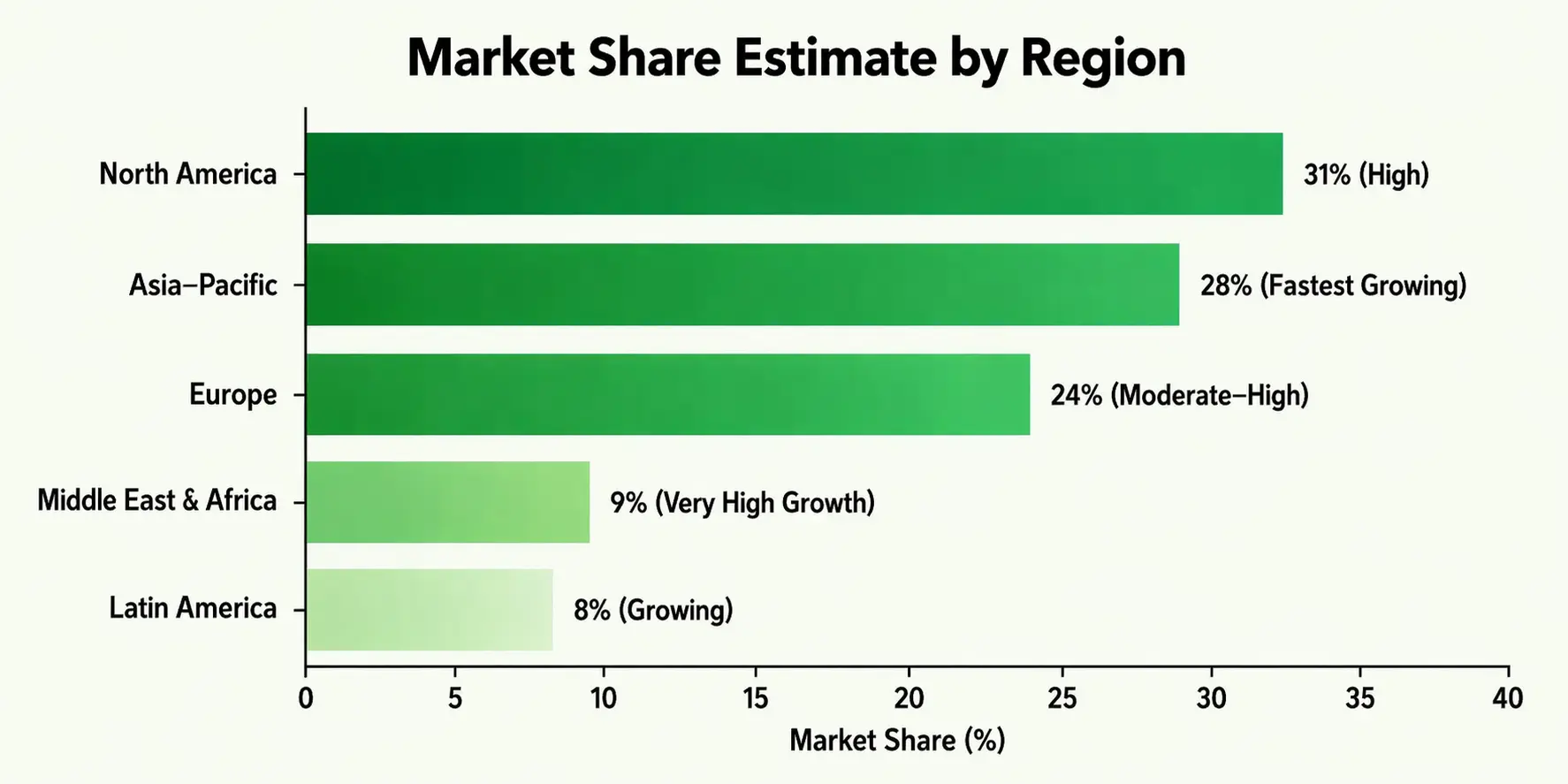
| Region | Market Share Est. | Growth Rate | Key Market |
|---|---|---|---|
| North America | ~31% | High | USA, Canada |
| Europe | ~24% | Moderate-High | UK, Germany, France |
| Asia-Pacific | ~28% | Fastest Growing | India, China, Japan |
| Middle East and Africa | ~9% | Very High Growth | UAE Dubai, Saudi Arabia |
| Latin America | ~8% | Growing | Brazil, Mexico |
AI Chatbot Market Share Analysis by Industry Vertical Segments
The AI Chatbot Market Share Analysis by vertical reveals that adoption is not uniform across industries. Certain sectors have embraced chatbot automation trends at a pace that now places them ahead of the overall market average. Retail and e-commerce, banking and financial services, healthcare, telecom, and travel are the five industries that collectively account for the majority of current chatbot market share by deployment volume.
| Industry Vertical | Adoption Rate | Primary Use Case | Key Markets |
|---|---|---|---|
| Retail and E-Commerce | Very High | Order tracking, recommendations, cart recovery | USA, UK, India |
| Banking and Financial Services | Very High | Account queries, fraud alerts, loan applications | UAE, USA, UK |
| Healthcare | High | Appointment booking, symptom checking, patient FAQs | USA, India, UK |
| Telecom | High | Billing support, plan upgrades, technical troubleshooting | India, UAE, UK |
| Travel and Hospitality | Moderate-High | Booking assistance, itinerary management, concierge | UAE, USA, UK |
| Real Estate | Growing | Lead qualification, property queries, virtual tours | UAE Dubai, India |
AI Chatbot Market Share Analysis by Deployment Models
The AI Chatbot Market Analysis by deployment model highlights a decisive shift toward cloud-based and hybrid architectures. Cloud-hosted chatbot solutions account for the majority of new deployments in 2026, driven by lower upfront costs, faster iteration cycles, and the availability of foundation model APIs that make building sophisticated conversational AI accessible without deep in-house ML expertise. This has particularly accelerated AI chatbot adoption growth among mid-market businesses in the UK and India.
On-premises deployments, while declining as a share of total market, remain significant in regulated sectors including government, defence, and financial services in UAE and the UK where data sovereignty requirements mandate local processing. Hybrid deployments are growing in enterprises that need the flexibility of cloud-scale LLM inference combined with on-premises data processing for sensitive customer records. This three-tier deployment landscape reflects a maturing conversational AI market where one-size-fits-all architectures have given way to purpose-built configurations.
| Deployment Model | Market Share | Growth Trend | Best Suited For |
|---|---|---|---|
| Cloud-Based | ~62% | Accelerating | SMBs, e-commerce, startups, fast iteration |
| On-Premises | ~19% | Declining Share | Government, defence, regulated finance in UAE and UK |
| Hybrid | ~19% | Growing Strongly | Large enterprises, healthcare, multinational operations |
AI Chatbot Market Share Analysis by Enterprise Size
Enterprise size segmentation reveals important nuances within the overall chatbot market share picture. Large enterprises with over 1,000 employees continue to lead in total spending, but SMB adoption has accelerated sharply in 2025 and 2026 as LLM inference costs fell and no-code chatbot platforms matured. According to available data, 91% of businesses with over 50 employees now use chatbots in at least one workflow, and 78% of enterprises have integrated chatbots across multiple business functions, a clear signal of how deeply conversational AI has penetrated mainstream business operations.
| Segment | Adoption Rate | Spending Share | Primary Use |
|---|---|---|---|
| Large Enterprise (1000+ employees) | 91% | ~52% | Multi-function automation, enterprise-grade NLP |
| Mid-Market (100-999 employees) | 78% | ~30% | Customer support, sales qualification, HR automation |
| Small Business (under 100 employees) | 64% plan adoption | ~18% | Lead capture, FAQ automation, appointment booking |
Competitive Market Share Analysis of Leading AI Chatbot Providers
The competitive AI Chatbot Market Share Analysis in 2026 is defined by a dramatic reshaping of platform dominance. According to Similar web data from January 2026, ChatGPT holds approximately 68% of global generative AI web traffic, down sharply from 87.2% a year earlier. Google Gemini has emerged as the fastest-growing competitor, capturing 18.2% of market share, representing 370% year-on-year growth. Other leading chatbot companies including DeepSeek at 3.9%, Grok at 2.9%, Perplexity at 2.1%, Anthropic’s Claude at 2.0%, and Microsoft Copilot at 1.2% collectively illustrate a rapidly diversifying competitive field.
For enterprise buyers across the USA, UK, India, and UAE, this competitive diversity creates both opportunity and complexity. Businesses are no longer choosing between ChatGPT or nothing; the landscape now includes specialized vertical-specific players, privacy-focused on-premises providers, and deeply integrated ecosystem platforms that combine chatbot capabilities with CRM, ERP, and marketing automation workflows. Understanding which leading chatbot companies align with specific use cases is now a critical component of any AI Chatbot Market Analysis for procurement or investment purposes.
Investment and Funding Trends in the AI Chatbot Market
Investment activity in the AI chatbot market reflects institutional confidence in the AI chatbot market forecast. Generative AI spending in banking alone is forecast to reach $85 billion by 2030 at a 55% CAGR, with chatbots representing a core component of that allocation. Across verticals, McKinsey and Gartner research indicate that enterprise AI spending is front-loaded toward conversational and agent-based systems because the ROI evidence is strongest and deployment timelines are shorter than general AI transformation programs.
Venture capital activity has followed this institutional confidence. Multiple leading chatbot companies secured significant funding rounds in 2024 and 2025, particularly in the agentic AI, vertical-specific enterprise chatbot, and multilingual conversational AI segments. Dubai and the UAE have emerged as active funding hubs, with government-backed investment vehicles channelling capital into AI chatbot infrastructure as part of broader digital economy goals. India’s start-up ecosystem has similarly seen strong VC interest in vernacular AI chatbot platforms targeting tier 2 and tier 3 city consumer markets, a segment largely untapped by global platforms.
Key Investment Data Points in AI Chatbot Market
Future Trends and Long Term Growth Outlook of the AI Chatbot Market
The long-term AI chatbot market forecast points to a period of sustained expansion driven by structural technology shifts rather than just cyclical demand. Conversational AI innovations will continue to compound as foundation model capability improves, inference costs decline, and enterprise integration tooling matures. By 2030, Gartner’s prediction that 25% of organizations will use chatbots as their primary customer service channel is tracking ahead of schedule based on current AI chatbot adoption growth data.
The AI Chatbot Market Trends shaping the 2027 to 2035 horizon include full agentic autonomy where chatbots execute complex multi-step business processes independently, emotional intelligence layers that allow bots to respond appropriately to user sentiment, deep ERP and CRM integration that makes chatbots the primary business process interface, and real-time personalization at population scale using streaming data architectures. In India and UAE, the convergence of government digital mandates and private sector investment will likely place these markets among the top five globally by chatbot revenue per capita by 2030.
With 59% of consumers already believing generative AI will change how they interact with brands, and 95% of customer service interactions expected to involve AI by year end, the window for businesses in the USA, UK, UAE, and India to establish competitive chatbot capabilities is narrowing. Those who act now on the AI chatbot market opportunity will benefit from first-mover advantage in conversational brand experience, operational cost efficiency, and data-rich customer intelligence that late adopters will spend years trying to replicate. The chatbot market size will not stay at $13 billion for long.
Launch Your AI Chatbot Today
Join hundreds of businesses across the UK, USA, UAE, and India using our proven AI chatbot solutions to cut costs, boost conversions, and scale effortlessly.
Frequently Asked Questions About AI Chatbots
Q1.1. How big is the AI chatbot market right now?
The global AI chatbot market size in 2026 is valued between $11 billion and $13.28 billion depending on the research firm. It is projected to exceed $37 billion by 2030, driven by strong enterprise adoption and generative AI advancements.
Q2.2. What is the growth rate of the AI chatbot market?
The AI chatbot market is growing at a compound annual growth rate between 23% and 29.7%. This rapid chatbot market growth rate reflects increasing business demand for automated customer service, cost reduction, and 24/7 conversational AI support across industries.
Q3.3. Which country leads in AI chatbot adoption?
North America leads global AI chatbot adoption, contributing roughly 31% of total revenue. However, Asia-Pacific including India and UAE is the fastest-growing region, with India and China emerging as major chatbot markets due to large digital user bases.
Q4.4. What industries use AI chatbots the most?
Retail, banking, healthcare, and e-commerce are the top industries using AI chatbots. Banking chatbot interactions are expected to exceed 90% success rates in 2026, and healthcare chatbot adoption is growing due to patient query automation and appointment management.
Q5.5. How much money do businesses save using AI chatbots?
Businesses using AI chatbots save up to 30% on customer support costs, saving an estimated $8 billion annually across industries. Every $1 invested in chatbots returns around $8 in business value, making chatbot ROI one of the strongest in enterprise technology.
Q6.6. What is generative AI chatbot market size?
The generative AI chatbot segment alone is valued at approximately $12.98 billion in 2026 and is forecast to reach $113 billion by 2034 at a 31.11% CAGR. This segment grows faster than traditional rule-based chatbots due to LLM-powered intelligence and contextual understanding.
Q7.7. Who are the leading chatbot companies in the world?
Leading chatbot companies include OpenAI with ChatGPT holding around 68% market share, Google Gemini at 18.2%, Microsoft Copilot, Meta AI, DeepSeek, Perplexity, and Anthropic’s Claude. The competitive landscape is shifting rapidly as newer players gain significant traction.
Q8.8. Is AI chatbot adoption growing in India and UAE?
Yes, India and UAE are among the fastest-growing markets for AI chatbot adoption. India’s large tech workforce and mobile-first consumers drive demand, while Dubai’s smart city initiatives and digital economy strategy accelerate chatbot integration across banking and government services.
Q9.9. What will the AI chatbot market look like in 2030?
By 2030 the AI chatbot market is projected to reach between $27 billion and $37 billion depending on the forecast source. Factors including generative AI improvements, lower inference costs, and mainstream enterprise adoption will sustain above-20% annual growth through this period.
Q10.10. Why are businesses investing in AI chatbots in 2026?
Businesses invest in AI chatbots in 2026 because 57% report significant ROI within the first year, average returns reach 148 to 200%, and chatbots reduce operational costs dramatically. With 95% of customer service interactions expected to involve AI, the business case is now proven.
Explore Services
Related Services
Reviewed by

Aman Vaths
Founder of Nadcab Labs
Aman Vaths is the Founder & CTO of Nadcab Labs, a global digital engineering company delivering enterprise-grade solutions across AI, Web3, Blockchain, Big Data, Cloud, Cybersecurity, and Modern Application Development. With deep technical leadership and product innovation experience, Aman has positioned Nadcab Labs as one of the most advanced engineering companies driving the next era of intelligent, secure, and scalable software systems. Under his leadership, Nadcab Labs has built 2,000+ global projects across sectors including fintech, banking, healthcare, real estate, logistics, gaming, manufacturing, and next-generation DePIN networks. Aman’s strength lies in architecting high-performance systems, end-to-end platform engineering, and designing enterprise solutions that operate at global scale.