Ai Overview
Formal verification for smart contracts is a rigorous, mathematics-based approach that uses logical proofs to guarantee that a contract behaves correctly under all possible conditions—eliminating entire classes of vulnerabilities rather than merely detecting known bugs. This technique is increasingly essential for high-stakes DeFi protocols, cross-chain bridges, and governance systems where a single exploit can drain billions of dollars or compromise decentralized decision-making.
Formal verification for smart contracts is a rigorous, mathematics-based approach that uses logical proofs to guarantee that a contract behaves correctly under all possible conditions—eliminating entire classes of vulnerabilities rather than merely detecting known bugs. Unlike traditional auditing methods that rely on testing sample inputs or analyzing code patterns, formal verification mathematically proves that critical properties—such as the absence of reentrancy or the correct execution of fund transfers—hold true in every conceivable execution scenario. This technique is increasingly essential for high-stakes DeFi protocols, cross-chain bridges, and governance systems where a single exploit can drain billions of dollars or compromise decentralized decision-making.
Key Takeaways
- Formal verification uses mathematical proofs to guarantee smart contract correctness, providing stronger assurances than empirical testing or static analysis.
- Theorem proving and symbolic execution are the two dominant techniques, each exploring contract logic through formal specifications or exhaustive path analysis.
- Critical properties—including safety (no reentrancy, no overflow), liveness (guaranteed withdrawals), and functional correctness—can be formally proven.
- High-value DeFi protocols, cross-chain bridges, and governance contracts benefit most from formal verification due to their non-negotiable security requirements.
- Trade-offs include significantly higher time and cost, the need for precise formal specifications, and limited tool maturity compared to conventional audit methods.
- Formal verification complements but does not replace comprehensive Smart Contract Audit workflows, which integrate multiple security techniques.
What Is Formal Verification and How Does It Differ from Traditional Smart Contract Auditing?
Formal verification is a method rooted in mathematical logic that proves—rather than tests—the correctness of smart contract code. In traditional auditing, security experts review source code, run automated static analysis tools like Slither or MythX, and execute dynamic tests against sample inputs to identify vulnerabilities. These methods are empirical: they check whether the contract fails under known attack vectors or common coding mistakes. Formal verification, by contrast, constructs a mathematical model of the contract and uses theorem-proving or model-checking algorithms to demonstrate that specific properties hold in every possible execution state. If a formal proof succeeds, the contract is guaranteed to be free of the proven vulnerability class—no edge cases can slip through.
The distinction between formal verification and static or dynamic analysis lies in exhaustiveness. Static analysis scans code for patterns associated with bugs—such as unprotected external calls that might trigger reentrancy—but cannot prove the absence of all vulnerabilities. Dynamic analysis executes the contract with various inputs to observe behavior, yet it can only test a finite subset of the infinite input space. Formal verification, however, treats the contract as a formal system: it encodes the contract logic in a specification language, defines desired properties (for example, “the contract balance can never become negative”), and applies logical inference rules to prove or disprove those properties. When a proof is found, it covers all inputs, all execution paths, and all possible states—offering a level of certainty that testing alone cannot achieve.
Why does formal verification provide stronger guarantees? Because it shifts the question from “did we find bugs?” to “can bugs of this type exist?” Consider a DeFi lending protocol that must never allow a user to withdraw more funds than their collateral permits. Traditional audits might test dozens or hundreds of withdrawal scenarios, but formal verification can prove mathematically that, given the contract’s invariants and state-transition rules, no sequence of transactions can violate the collateral constraint. This is particularly valuable for contracts managing large sums: the 2016 DAO hack, the 2020 bZx flash-loan exploits, and numerous reentrancy attacks exploited edge cases that manual review and standard testing missed. Formal verification aims to close those gaps by providing provable correctness for mission-critical properties.
That said, formal verification is not a silver bullet. It requires precise formal specifications—if the specification is incomplete or incorrect, the proof may hold but the contract can still misbehave in ways the specification did not cover. Additionally, formal verification tools and the expertise to use them are less mature and more expensive than conventional audit techniques. Many projects adopt a hybrid approach: they apply formal verification to the most critical components (such as fund custody logic or governance vote counting) and use static analysis, dynamic testing, and manual review for the rest. This layered strategy balances rigor with practicality, ensuring that the highest-risk code receives mathematical guarantees while the broader codebase benefits from proven audit methodologies. For an overview of how these methods integrate into a complete audit workflow, see the guide on Smart Contract Auditing Process Explained.
Formal Verification vs Traditional Auditing Methods
| Method | Coverage | Guarantee Level | Cost/Time |
|---|---|---|---|
| Manual Code Review | Subjective, depends on auditor expertise | Heuristic—finds known patterns | Moderate (2-4 weeks typical) |
| Static Analysis | All code paths, pattern-based | High for known vulnerabilities, false positives common | Low (automated, hours to days) |
| Dynamic Testing | Finite test cases, sample inputs | Empirical—cannot prove absence of bugs | Moderate (depends on test suite size) |
| Formal Verification | All possible execution paths and states | Mathematical proof—provable correctness for specified properties | High (6-12 weeks, specialized expertise) |
This table illustrates that formal verification offers the strongest guarantee—mathematical proof—but at a significantly higher cost and time investment. Projects must weigh these trade-offs against the value at risk and the criticality of the contract’s function. For a detailed comparison of static and dynamic methods, refer to Static vs Dynamic Analysis.
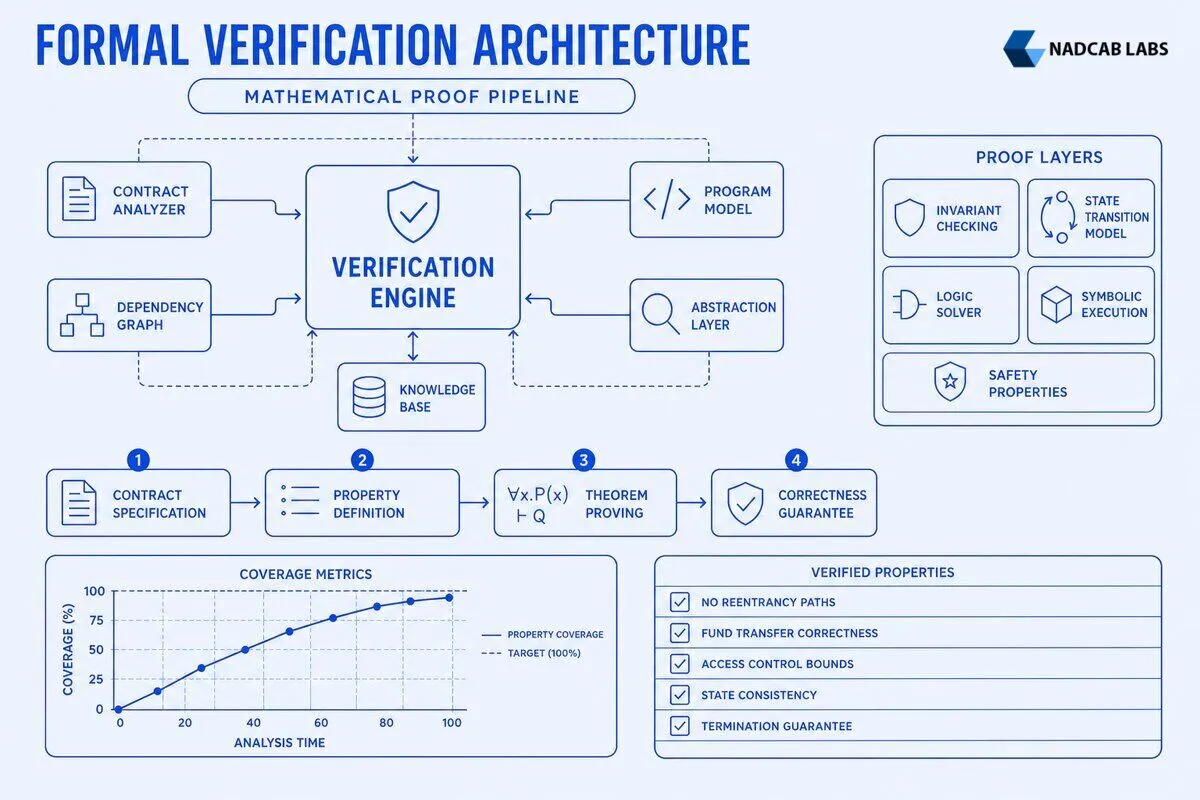
How Do Theorem Proving and Symbolic Execution Work in Smart Contract Verification?
Formal verification for smart contracts employs several core techniques, with theorem proving and symbolic execution being the most prominent. Each approach has distinct strengths and is suited to different verification goals. Understanding how these methods operate under the hood clarifies why formal verification can provide guarantees that testing cannot.
Theorem proving translates the smart contract’s source code into a formal specification language—often a variant of first-order logic or higher-order logic—and then uses automated or interactive theorem provers to derive proofs of desired properties. The process begins by encoding the contract’s state variables, functions, and state transitions as mathematical objects. For example, a simple token contract might be modeled with a state mapping each address to a balance, and the transfer function modeled as a state-transition rule that decrements the sender’s balance and increments the receiver’s balance. The auditor then writes formal properties (also called assertions or invariants) in the specification language, such as “the sum of all balances remains constant after any transfer” or “no address can have a negative balance.” The theorem prover attempts to construct a logical proof that these properties hold for all possible states and all valid sequences of function calls. If the prover succeeds, the property is guaranteed; if it finds a counterexample, the contract contains a bug.
Theorem proving is particularly powerful for verifying high-level invariants and functional correctness. It can prove that a DeFi protocol’s interest calculation is mathematically correct, that a governance contract’s vote-counting logic always produces the right outcome, or that a custody contract never allows unauthorized withdrawals. However, theorem proving requires significant manual effort: writing precise formal specifications is non-trivial, and interactive provers often need human guidance to complete complex proofs. Tools like Coq, Isabelle, and the K Framework are used in this space. For instance, the K Framework has been used to formally verify the Ethereum Virtual Machine (EVM) semantics and to prove properties of high-value DeFi protocols. The investment in theorem proving pays off when the contract’s correctness is absolutely critical and the cost of failure is catastrophic.
Symbolic execution takes a different approach: instead of proving properties in abstract logic, it explores the contract’s execution paths using symbolic inputs—variables that represent any possible value—rather than concrete test values. A symbolic execution engine starts at the contract’s entry point and systematically explores every branch (if-else, loop iteration, function call) by tracking path conditions (the logical constraints that must hold for that path to be taken). When the engine encounters a branch like if (balance > amount), it forks into two symbolic states: one where balance > amount is true and one where it is false. Each state accumulates constraints, and the engine uses a constraint solver (such as an SMT solver like Z3) to check whether a given path is feasible and whether it can lead to a violation of a specified property, such as an assertion failure or a revert condition.
Symbolic execution is highly effective for finding concrete counterexamples—specific inputs that trigger a bug. It is commonly used to detect vulnerabilities like integer overflows, reentrancy, and unhandled exceptions. Tools such as Mythril and Manticore implement symbolic execution for EVM bytecode, allowing them to analyze deployed contracts without access to source code. The main limitation of symbolic execution is path explosion: complex contracts with many branches can generate an exponential number of paths, making exhaustive exploration infeasible. To manage this, symbolic execution tools use heuristics, path pruning, and bounded exploration (limiting loop iterations or recursion depth). While symbolic execution may not prove the absence of all bugs, it is excellent at uncovering edge cases that manual review and standard testing miss. For more on how symbolic execution fits into the broader audit toolset, see MythX vs Slither vs CertiK vs Oyente.
Model checking is a third formal technique that verifies whether a finite-state model of the contract satisfies temporal logic properties. The contract is abstracted into a state machine, and the model checker exhaustively explores all reachable states to verify properties like “eventually, all pending withdrawals will be processed” (a liveness property) or “the contract never enters a state where funds are locked” (a safety property). Model checking is particularly useful for protocols with complex state machines, such as multi-phase auctions or cross-chain bridges with commit-reveal schemes. Tools like NuSMV and SPIN have been adapted for blockchain verification, though model checking is less common than theorem proving or symbolic execution due to the state-space explosion problem in large contracts.
Formal Verification Workflow: From Code to Proof
Write Smart Contract Code
Define Formal Specifications & Properties
Translate to Formal Model (Logic or Symbolic)
Run Theorem Prover or Symbolic Executor
Obtain Proof or Counterexample
This sequence shows the end-to-end formal verification process. Each step is critical: incomplete specifications in Step 2 will produce incomplete proofs, and poorly chosen properties may miss important security concerns.
In practice, formal verification projects often combine these techniques. A team might use symbolic execution to find and fix concrete bugs, then apply theorem proving to prove that critical invariants hold after the bugs are patched. This layered approach maximizes coverage: symbolic execution catches low-hanging fruit quickly, while theorem proving provides the deep guarantees needed for high-assurance components. For developers interested in learning these methods, the roadmap outlined in Smart Contract Auditor Roadmap includes formal methods training as an advanced skill set.
Which Smart Contract Properties Can Be Formally Verified?
Formal verification is most effective when applied to well-defined properties that can be expressed in mathematical logic. Smart contract properties generally fall into three categories: safety properties, liveness properties, and functional correctness. Each category addresses different aspects of contract behavior and requires different verification techniques.
Safety properties assert that “something bad never happens.” In the context of smart contracts, safety properties include the absence of reentrancy vulnerabilities, integer overflows or underflows, unauthorized access to privileged functions, and violations of access-control invariants. For example, a formal specification might state “no external call can modify the contract’s state in a way that allows a second withdrawal before the first completes” (preventing reentrancy). Another common safety property is “the contract’s total token supply never exceeds the maximum cap defined at initialization.” Formal verification can prove these properties by showing that, no matter what sequence of transactions is executed, the contract’s state transitions never violate the specified constraints. Symbolic execution is particularly well-suited to detecting safety violations: if a path exists that leads to a revert or an assertion failure, the symbolic executor will find a concrete input sequence that triggers it.
Liveness properties assert that “something good eventually happens.” These properties are harder to verify than safety properties because they involve reasoning about infinite execution sequences. In smart contracts, liveness properties might include guarantees like “any user who has deposited funds can eventually withdraw them” or “a pending transaction will eventually be finalized.” Liveness is critical for protocols where funds can become locked due to logic errors—for instance, a contract that requires a specific sequence of function calls to release funds but never reaches that state. Model checking and temporal logic are the primary tools for verifying liveness properties: the verifier checks that, from any reachable state, there exists a path to a state where the desired condition holds. Liveness verification is less common in practice than safety verification because it is computationally more expensive and because many liveness issues are caught by testing or manual review. However, for high-stakes custody contracts and cross-chain bridges, proving liveness properties can prevent catastrophic fund lockups.
Functional correctness is the most comprehensive form of verification: it proves that the contract implements its intended business logic exactly as specified. For example, a decentralized exchange (DEX) contract might have a formal specification stating “the price of token A in terms of token B always equals the ratio of the reserves, adjusted for fees, according to the constant-product formula.” Formal verification can prove that every trade executed by the contract preserves this invariant. Similarly, a lending protocol might specify “the interest accrued on a loan equals the principal multiplied by the annual percentage rate, prorated for the time elapsed.” Proving functional correctness requires a complete formal specification of the contract’s intended behavior—essentially a mathematical model of the business logic. This is labor-intensive but invaluable for DeFi protocols where incorrect calculations can lead to arbitrage opportunities, insolvency, or loss of user funds. Theorem proving is the dominant technique for functional correctness, as it can handle complex arithmetic and logical relationships that symbolic execution struggles with.
Verification Coverage by Property Type
Data reflects typical coverage priorities in formal verification engagements for DeFi and infrastructure contracts. Safety properties dominate because they are the most critical and the easiest to specify formally.
Not all properties are equally amenable to formal verification. Properties that depend on external systems—such as “the contract will always receive accurate price data from an oracle”—cannot be verified in isolation because they involve assumptions about off-chain behavior. Similarly, properties that involve human judgment—such as “the governance proposal is reasonable”—are outside the scope of formal methods. Formal verification is most powerful when applied to self-contained, deterministic logic within the contract itself. For a broader discussion of what can and cannot be audited, see Smart Contract Myths and Facts.
Real-world examples illustrate the value of formal verification. The MakerDAO stablecoin system underwent formal verification to prove that its collateralization and liquidation mechanisms maintain system solvency under all market conditions. The Uniswap V3 core contracts were formally verified to ensure that the constant-product invariant holds and that liquidity providers cannot be exploited. These projects invested heavily in formal methods because the cost of a bug—measured in billions of dollars of total value locked—far exceeds the cost of verification. For projects considering formal verification, the decision often hinges on the value at risk and the complexity of the contract logic. High-value DeFi protocols, cross-chain bridges, and governance systems are prime candidates; simpler contracts with lower stakes may not justify the expense.
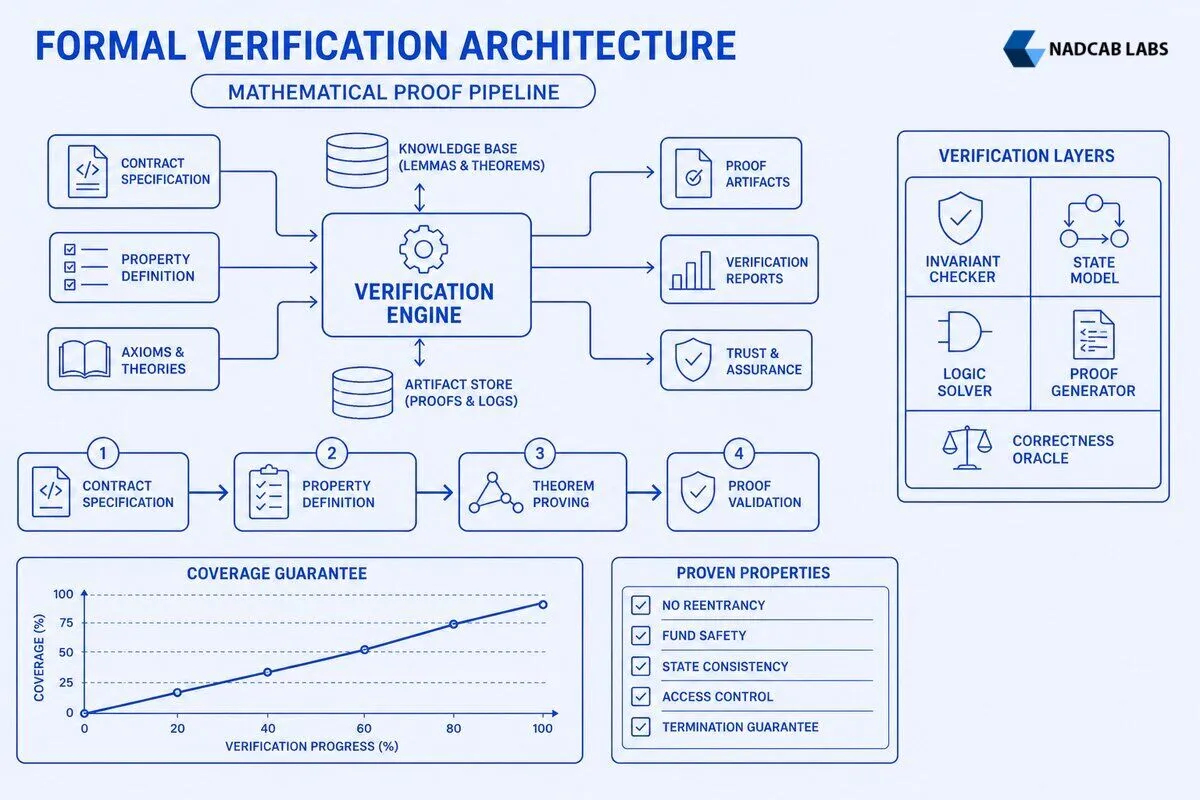
When Should Projects Choose Formal Verification Over Standard Audit Methods?
Formal verification is not a one-size-fits-all solution. Its high cost, specialized expertise requirements, and time investment mean that it is most appropriate for contracts where the consequences of failure are catastrophic and where traditional audit methods provide insufficient assurance. Understanding when to deploy formal verification—and when to rely on conventional audits—is essential for making cost-effective security decisions.
High-value DeFi protocols managing billions in total value locked (TVL) are the canonical use case for formal verification. Protocols like Aave, Compound, and Curve handle enormous sums of user funds, and a single exploit can drain hundreds of millions of dollars in minutes. For these projects, the cost of formal verification—often ranging from $200,000 to $500,000 for a comprehensive engagement—is a small fraction of the value at risk. Formal verification provides mathematical guarantees that critical properties hold: that interest calculations are correct, that liquidation logic cannot be gamed, that collateralization ratios are always maintained. These guarantees go beyond what static analysis or testing can offer, because they cover all possible execution paths and all possible market conditions. For instance, a formal proof that “the protocol remains solvent even if all users attempt to withdraw simultaneously” provides confidence that no edge case can trigger a bank run or insolvency event. Projects in this category should consider formal verification as a mandatory component of their security posture, especially for core contracts that handle fund custody and financial logic. To explore how formal verification integrates with other audit methods, see the comprehensive Smart Contract Audit service page.
Cross-chain bridges and custody contracts are another high-priority domain for formal verification. Bridges that lock funds on one blockchain and mint wrapped tokens on another are frequent targets for attackers, with exploits like the Ronin bridge hack (over $600 million stolen) and the Poly Network hack (initially $600 million, later returned) highlighting the risks. The complexity of cross-chain logic—involving multi-signature schemes, time-locks, and state synchronization between chains—creates numerous opportunities for subtle bugs. Formal verification can prove that the bridge’s locking and unlocking logic is correct, that no sequence of transactions can mint tokens without corresponding locked collateral, and that the bridge cannot be drained by replaying old messages. These properties are difficult to test exhaustively because they involve interactions between multiple blockchains and depend on the timing and ordering of transactions. A formal proof provides the assurance that the bridge will behave correctly under all conditions, including adversarial scenarios where attackers control transaction ordering or attempt to exploit race conditions.
Governance and treasury contracts also benefit from formal verification, particularly when they control large treasuries or make irreversible decisions. Decentralized autonomous organizations (DAOs) use governance contracts to vote on proposals, allocate funds, and upgrade protocols. A bug in the vote-counting logic or the proposal execution mechanism can lead to unauthorized fund transfers, denial of service, or governance capture by malicious actors. Formal verification can prove that the governance contract correctly implements voting rules (for example, “a proposal passes if and only if it receives more than 50% of votes”), that vote weights are calculated correctly, and that only approved proposals can be executed. These properties are critical for maintaining trust in decentralized governance: users must be confident that their votes matter and that the system cannot be manipulated. For organizations managing multi-million-dollar treasuries, the cost of formal verification is justified by the assurance that the governance mechanism is mathematically sound. For more on how governance contracts fit into broader smart contract architectures, see smart contract architecture for real estate tokenization, which discusses multi-stakeholder decision-making.
Conversely, projects that do not need formal verification include simple token contracts with no complex logic, low-value experimental protocols, and contracts that have already been battle-tested through extensive use and multiple audits. A basic ERC-20 token with no additional features can be adequately secured through static analysis and manual review; the cost of formal verification would be disproportionate to the risk. Similarly, a small DeFi protocol with a TVL under $1 million may find that a standard audit costing $20,000 to $50,000 provides sufficient security without the expense of formal methods. The key is to assess the value at risk, the complexity of the contract, and the consequences of failure. If a bug could lead to a loss exceeding the cost of formal verification by an order of magnitude or more, formal verification is a prudent investment. If the potential loss is modest and the contract is straightforward, conventional audit methods are more cost-effective. For a detailed breakdown of audit costs and pricing models, refer to Smart Contract Audit Pricing Models Explained.
Decision Matrix: When to Use Formal Verification
| Project Type | Value at Risk | Logic Complexity | Formal Verification Recommended? |
|---|---|---|---|
| DeFi Protocol (Lending, DEX) | >$100M TVL | High (financial logic, oracles) | Yes—critical for provable correctness |
| Cross-Chain Bridge | >$50M TVL | Very High (multi-chain state sync) | Yes—prevents catastrophic exploits |
| DAO Governance Contract | >$10M treasury | Medium (vote counting, proposal execution) | Yes—ensures governance integrity |
| Simple ERC-20 Token | <$5M market cap | Low (standard transfer logic) | No—standard audit sufficient |
| NFT Marketplace | Variable | Medium (royalty splits, escrow) | Optional—depends on TVL and user base |
| Experimental DeFi Protocol | <$1M TVL | High (novel mechanisms) | No—iterate with standard audits first |
This decision matrix shows that formal verification is most justified when both the value at risk and the logic complexity are high. Projects should also consider their risk tolerance and the maturity of their codebase. Early-stage protocols may benefit more from rapid iteration and conventional audits, reserving formal verification for later stages when the design is stable and the TVL is significant. For teams building on emerging platforms, such as Bitcoin Smart Contracts, formal verification may be premature until the platform’s tooling and semantics are well-established.
What Are the Limitations and Trade-offs of Formal Verification for Smart Contracts?
Despite its powerful guarantees, formal verification is not a panacea. It comes with significant limitations and trade-offs that projects must understand before committing to a formal verification engagement. These constraints include time and cost, the challenge of writing correct specifications, the maturity of available tools, and the need for specialized expertise.
Time and cost are the most immediate barriers. A comprehensive formal verification engagement for a complex DeFi protocol can take six to twelve weeks and cost between $200,000 and $500,000, compared to a standard audit that might take two to four weeks and cost $30,000 to $100,000. The higher cost reflects the labor-intensive nature of formal methods: auditors must translate the contract into a formal model, write precise specifications for every property to be verified, run theorem provers or symbolic executors (which can take hours or days of computation), and iterate on the specifications as issues are discovered. For projects with tight timelines or limited budgets, this investment may be prohibitive. Moreover, formal verification does not eliminate the need for other audit methods—static analysis, dynamic testing, and manual review are still necessary to catch issues that formal verification does not cover, such as business logic errors not captured in the specifications or vulnerabilities in external dependencies. The result is that formal verification adds to the overall security budget rather than replacing existing costs.
Specification challenges are a fundamental limitation of formal verification. A formal proof is only as good as the specification it is based on: if the specification is incomplete, incorrect, or ambiguous, the proof may hold but the contract can still behave incorrectly. Writing a complete formal specification requires deep understanding of both the contract’s intended behavior and the formal language used to express it. For example, a specification might state “the contract’s balance equals the sum of all user deposits minus all withdrawals,” but if it fails to account for fees, interest accrual, or liquidation penalties, the proof will not catch bugs in those areas. Specification errors are surprisingly common, especially in complex protocols with many interacting components. The only way to mitigate this risk is through rigorous specification review, ideally involving both the contract developers (who understand the intended behavior) and formal methods experts (who understand the specification language). This iterative process adds time and cost, and there is no guarantee that the final specification is perfect. For a discussion of common pitfalls in smart contract security, see How Auditing Smart Contracts Helps Stop Cyber Threats.
Tool maturity is another constraint. While formal verification tools for smart contracts have improved significantly in recent years, they are still less mature and less user-friendly than conventional audit tools. Theorem provers like Coq and Isabelle require significant expertise and manual intervention; they are not push-button solutions. Symbolic execution tools like Mythril and Manticore can suffer from path explosion and may time out on large contracts without producing a definitive result. Model checkers can struggle with state-space explosion in contracts with many variables or complex state machines. Additionally, formal verification tools are often tailored to specific languages or platforms—tools for Ethereum’s Solidity may not work for Rust-based smart contracts on Solana or Polkadot, requiring separate toolchains and expertise. The result is that formal verification is not yet a commodity service: it requires specialized vendors, extended timelines, and a willingness to work with cutting-edge (and sometimes buggy) tools. For an overview of the current tool landscape, see Top Security Tools for Smart Contract Auditing.
Developer expertise is a related challenge. Formal verification requires skills that are rare in the blockchain development community: proficiency in formal logic, experience with theorem provers or symbolic execution engines, and the ability to translate business requirements into mathematical specifications. Most smart contract developers are trained in software engineering, not formal methods, and the learning curve is steep. This skills gap limits the supply of qualified auditors and drives up the cost of formal verification services. It also means that projects must rely on external experts rather than performing formal verification in-house, which can create communication challenges and delays. Some organizations are addressing this by training their developers in formal methods or by hiring dedicated formal verification engineers, but this is a long-term investment that may not be feasible for smaller projects. For developers interested in building these skills, the Smart Contract Auditor Roadmap outlines a learning path that includes formal methods training.
Another limitation is that formal verification cannot catch all classes of vulnerabilities. It is excellent at proving properties about the contract’s internal logic—such as the absence of reentrancy or the correctness of arithmetic—but it cannot verify assumptions about the external world. For example, formal verification cannot prove that an oracle will always provide accurate price data, that a multi-signature wallet’s signers are honest, or that a governance process will not be captured by malicious actors. These are systemic risks that lie outside the contract’s code and must be addressed through other means, such as economic incentives, decentralized oracle networks, or social governance mechanisms. Similarly, formal verification cannot catch bugs introduced by compiler errors, virtual machine bugs, or hardware failures—though these are rare, they are not zero-probability events. For a comprehensive view of smart contract risks, including systemic and external factors, see EVMbench.
Finally, formal verification does not address usability or user experience issues. A contract can be formally verified to be mathematically correct yet still be difficult to use, poorly documented, or vulnerable to social engineering attacks. For example, a wallet contract might be proven to never lose funds due to code bugs, but if its user interface is confusing and users accidentally send funds to the wrong address, the formal verification provides no protection. Security is a holistic concern that includes code correctness, operational security, user education, and incident response. Formal verification is one tool in the security toolkit, not a complete solution. For a balanced perspective on what formal verification can and cannot do, see Smart Contract Audit vs Testing, which discusses the complementary roles of different security methods.
Trade-off Summary: Formal Verification vs Conventional Audits
| Factor | Formal Verification | Conventional Audit |
|---|---|---|
| Assurance Level | Mathematical proof—highest possible for specified properties | Empirical—high confidence but not absolute |
| Cost | $200K–$500K for comprehensive engagement | $30K–$100K for standard audit |
| Timeline | 6–12 weeks | 2–4 weeks |
| Expertise Required | Rare—formal methods specialists | Moderate—experienced smart contract auditors |
| Coverage | All execution paths for specified properties | Known vulnerabilities and common patterns |
| Specification Risk | High—proof is only as good as the spec | Low—auditors review code directly |
| Tool Maturity | Moderate—improving but not yet commodity | High—mature tools widely available |
This table underscores that formal verification offers the highest assurance but at a significantly higher cost and with greater complexity. Projects must weigh these factors against their security needs, budget, and timeline. For many projects, a hybrid approach is optimal: apply formal verification to the most critical components (such as fund custody and core financial logic) and use conventional audits for the rest. This strategy balances rigor with practicality, ensuring that the highest-risk code receives mathematical guarantees while the broader codebase benefits from proven audit methodologies. For projects considering this approach, consulting with a firm that offers both formal verification and conventional audits—such as Smart Contract Development services—can streamline the process and ensure that all security bases are covered.
Looking ahead, the formal verification landscape is evolving. Advances in automated theorem proving, better integration with development workflows (such as formal verification plugins for IDEs), and the emergence of domain-specific languages designed for formal verification (like Scilla and Move) are making formal methods more accessible. Additionally, the rise of AI-assisted formal verification—where machine learning models help generate specifications or guide theorem provers—promises to reduce the manual effort required. However, these innovations are still in early stages, and for the foreseeable future, formal verification will remain a specialized, high-cost service reserved for the most critical smart contracts. For insights into how AI is impacting smart contract security more broadly, see AI Powered Smart Contract Attacks Are Rising in 2026 — Security Experts Issue Urgent Warning and Ai proof of Inference.
Final Thoughts
Formal verification for smart contracts represents the gold standard in blockchain security, offering mathematical proofs that critical properties hold under all possible conditions. By employing theorem proving, symbolic execution, and model checking, formal verification can guarantee the absence of entire vulnerability classes—from reentrancy and overflow to incorrect financial calculations and governance logic flaws. This level of assurance is unmatched by traditional auditing methods, which rely on empirical testing and pattern recognition. For high-value DeFi protocols, cross-chain bridges, and governance contracts managing billions in assets or making irreversible decisions, formal verification is not a luxury but a necessity: the cost of a bug far exceeds the investment in formal methods. However, formal verification comes with significant trade-offs—higher cost, longer timelines, the challenge of writing correct specifications, and the need for rare expertise. Most projects benefit from a hybrid approach, applying formal verification to the most critical components while using conventional audits for the rest. As tools mature and expertise grows, formal verification will become more accessible, but for now, it remains a specialized discipline that delivers the strongest possible security guarantees for smart contracts that cannot afford to fail. For teams ready to invest in provable correctness, partnering with experienced providers—such as Hire Smart contract developer services—ensures that formal verification is executed correctly and that the resulting proofs provide genuine assurance. In an ecosystem where a single exploit can drain hundreds of millions of dollars, formal verification is the ultimate defense: a mathematical guarantee that the code does exactly what it is supposed to do, every time, under every condition.
Frequently Asked Questions
Q1.What is formal verification in smart contract auditing?
Formal verification is a mathematical technique that proves smart contract code behaves exactly as specified under all possible conditions. Unlike testing that checks sample scenarios, it uses theorem provers and model checkers to exhaustively verify correctness against formal specifications written in temporal logic or invariant expressions, providing mathematical certainty rather than probabilistic confidence.
Q2.How does formal verification differ from static and dynamic analysis?
Static analysis scans code patterns for known vulnerabilities without execution. Dynamic analysis tests runtime behavior with specific inputs. Formal verification mathematically proves correctness across all execution paths simultaneously. While static/dynamic methods find bugs probabilistically, formal verification provides absolute guarantees for verified properties—though it requires precise specifications and significantly more computational resources.
Q3.Which blockchain projects need formal verification?
High-value DeFi protocols, cross-chain bridges, stablecoin systems, governance contracts, and any smart contract managing over $10M typically require formal verification. Projects handling irreversible financial operations, implementing novel cryptographic primitives, or operating in regulated environments benefit most. Nadcab Labs recommends it for all mission-critical infrastructure where mathematical certainty justifies the additional cost.
Q4.What tools are used for formal verification of smart contracts?
Leading tools include Certora Prover for EVM contracts, K Framework for multi-chain verification, Runtime Verification’s KEVM, and Coq/Isabelle theorem provers. Solidity-specific tools like SMTChecker integrate with compilers. Nadcab Labs employs Certora for invariant checking, TLA+ for protocol modeling, and custom Z3-based solvers for complex financial logic verification across Ethereum and compatible chains.
Q5.Can formal verification catch all smart contract vulnerabilities?
Formal verification proves only what you specify—it cannot catch unspecified requirements or business logic errors. It excels at mathematical properties (overflow, reentrancy guards, access control) but misses issues outside formal specifications. Implementation bugs in compilers, runtime environments, or incorrect specifications themselves remain risks. Nadcab Labs combines formal methods with comprehensive auditing for complete coverage.
Q6.How much does formal verification cost compared to standard audits?
Formal verification typically costs 2-4× standard audits, ranging $50,000-$250,000 depending on contract complexity and property count. Specification development adds 30-50% timeline overhead. However, it provides mathematical guarantees standard audits cannot. For high-value protocols, this cost is justified—Nadcab Labs structures hybrid approaches where critical components receive formal verification while peripheral contracts undergo traditional auditing.
Explore Services
Related Services
Reviewed by

Aman Vaths
Founder of Nadcab Labs
Aman Vaths is the Founder & CTO of Nadcab Labs, a global digital engineering company delivering enterprise-grade solutions across AI, Web3, Blockchain, Big Data, Cloud, Cybersecurity, and Modern Application Development. With deep technical leadership and product innovation experience, Aman has positioned Nadcab Labs as one of the most advanced engineering companies driving the next era of intelligent, secure, and scalable software systems. Under his leadership, Nadcab Labs has built 2,000+ global projects across sectors including fintech, banking, healthcare, real estate, logistics, gaming, manufacturing, and next-generation DePIN networks. Aman’s strength lies in architecting high-performance systems, end-to-end platform engineering, and designing enterprise solutions that operate at global scale.