Ai Overview
The financial software market encompasses a wide spectrum of digital tools and platforms designed to manage, process, report, and analyze financial data. 68% of firms operating on cloud based financial software infrastructure. Mobile-first banking experiences and digital banking software adoption have surged, with 70% mobile banking penetration now recorded among financial service users globally.
Key Takeaways
- The global financial software market is projected to surpass USD 248 billion by 2029, growing at a robust CAGR of over 11% through the forecast period.
- Cloud based financial software dominates deployment preferences, with over 68% of financial institutions migrating to cloud-native platforms for scalability and cost efficiency.
- AI powered financial software is reshaping decision-making cycles, with nearly 65% of global institutions already embedding AI tools into core financial management solutions.
- India and UAE are among the fastest-growing markets in the fintech software market, driven by digital banking mandates and rising enterprise adoption of SaaS financial platforms.
- Enterprise financial software is forecast to reach USD 26.35 billion by 2030, with a CAGR of 16.9%, making it the highest-growth subsegment in the financial software industry.
- Compliance management software demand is surging due to Basel III, MiFID II, and region-specific regulatory mandates pushing institutions toward automated financial reporting solutions.
- The accounting software market is a critical subset, with automated accounting systems reducing manual effort by up to 70% across mid-market and enterprise financial operations.
- Investment management software and treasury management software are gaining traction as multi-entity organizations demand unified financial analytics software across global operations.
- North America holds the largest market share at 34%, while Asia-Pacific including India is the fastest-growing region with a projected 25% market contribution by 2030.
- Vendors offering embedded AI analytics, low-code customization, and cybersecurity resilience are gaining significant premium pricing power and enterprise retention advantage in the financial software market.
The financial software market is no longer just a back-office utility. Over the past decade, it has evolved into a strategic asset that drives competitive differentiation for banks, enterprises, and fintech companies alike. With 8+ years of experience partnering with clients across India, Dubai, and beyond, our agency has observed first-hand how this industry has shifted from on-premise legacy tools to intelligent, cloud-native, AI-powered ecosystems. In this comprehensive blog, we break down the financial software market size, share, growth trends, and what the forecast from 2026 to 2030 truly means for businesses planning their next investment.
From the accounting software market to digital banking software, and from risk management software to investment management software, every sub-segment is undergoing rapid transformation. This analysis is grounded in verified market data and practical insights from our experience working across the financial software industry.
Financial Software Market Scope and Background
The financial software market encompasses a wide spectrum of digital tools and platforms designed to manage, process, report, and analyze financial data. This includes enterprise financial software, SaaS financial platforms, digital banking software, financial planning software, treasury management software, and risk management software. The market serves a diverse range of end users including banks, insurance companies, asset management firms, corporate treasuries, and emerging fintech startups.
Historically, financial institutions relied heavily on on-premise systems with rigid architectures and high maintenance overhead. The transition toward cloud based financial software over the past five years has been the most significant structural shift the financial software industry has seen. Today, SaaS delivery models dominate new deployments, and vendors are embedding AI powered financial software capabilities directly into core product layers.
For markets like India and the UAE, this transition has been accelerated by government-led digital finance initiatives, a rising SME base demanding affordable financial management solutions, and a young, tech-savvy consumer segment that expects mobile-first financial experiences. Dubai in particular has positioned itself as a regional fintech hub, with regulatory sandboxes and DIFC frameworks encouraging rapid software innovation in the financial sector.
Market Size and Valuation (2026–2030)
Understanding the market growth forecast requires looking at the numbers across both broad and segment-level lenses. The overall financial software market reflects staggering momentum. At the segment level, financial management software is projected to rise from USD 14.77 billion in 2025 to USD 16.2 billion in 2026, while enterprise financial management software is on track to reach USD 26.35 billion by 2030. The financial reporting solutions sub-market alone is expected to grow to USD 40.83 billion by 2032 at a CAGR of 13.77%.
| Segment | 2025 Value | 2026 Value | 2030 Forecast | CAGR |
|---|---|---|---|---|
| Financial Services Software | USD 323.43 Bn (2025) | USD 156.76 Bn | USD 323.43 Bn (2035) | 8.38% |
| Financial Management Software | USD 14.77 Bn | USD 16.2 Bn | USD 23.67 Bn | 9.7% |
| Enterprise Financial Management Software | USD 12.05 Bn | USD 14.11 Bn | USD 26.35 Bn | 16.9% |
| Financial Planning Software | USD 5.9 Bn | Est. USD 6.8 Bn | USD 20.2 Bn (2032) | 16.6% |
| Financial Reporting Solutions | USD 16.54 Bn | USD 18.74 Bn | USD 40.83 Bn (2032) | 13.77% |
Financial Software Market Growth and Forecast Analysis
The market growth forecast for the financial software market between 2026 and 2030 reflects a convergence of macro trends: digitalization of financial services, regulatory modernization, and the shift toward real-time data processing. Several indicators confirm that the fintech software market is entering a high-velocity growth phase.
AI Adoption in Financial Institutions (2026)
65% of institutions integrating AI powered financial software
Cloud Deployment Penetration
68% of firms operating on cloud based financial software infrastructure
Automation Adoption Rate
71% of enterprises using automated accounting systems for workflows
Compliance Software Integration
64% of institutions investing in compliance management software solutions
The financial analytics software segment is particularly noteworthy. As financial institutions gather increasing volumes of transaction data, the need for real-time processing and predictive modeling capabilities is accelerating adoption of advanced analytics platforms. Vendors that can offer integrated financial analytics software alongside core accounting and ERP functions are gaining stronger enterprise retention rates and expanded wallet share.
For businesses in India and UAE, the growth forecast aligns with broader national digitalization agendas. India’s Digital India push and UAE’s Smart Finance vision are creating policy-backed tailwinds for the fintech software market in both geographies.
Forces Driving Industry Expansion
Multiple converging forces are accelerating demand across the financial software industry. Based on our experience advising financial sector clients across South Asia and the Gulf region, the following drivers are the most impactful:
AI and Machine Learning Integration
AI powered financial software is enabling predictive analytics, automated fraud detection, and intelligent financial reporting solutions that reduce operational costs significantly.
Cloud Adoption and SaaS Growth
SaaS financial platforms deliver scalable, subscription-based access with lower upfront investment, making enterprise-grade tools accessible to mid-market organizations across India and UAE.
Digital Banking Software Demand
Mobile-first banking experiences and digital banking software adoption have surged, with 70% mobile banking penetration now recorded among financial service users globally.
Growing SME Segment
South Korea alone recorded 8.29 million SMEs in 2025, and comparable growth in India signals rising demand for affordable financial management solutions in the SME space.
Cybersecurity and Data Integrity
66% of financial firms are upgrading cybersecurity infrastructure, driving demand for enterprise financial software platforms with built-in data protection and audit trail capabilities.
Regulatory Complexity
Basel III, MiFID II, and region-specific mandates are compelling institutions to adopt compliance management software and automated financial reporting solutions to remain regulatory-compliant.
Bottlenecks Holding Back Market Growth
Despite strong momentum, the financial software market faces meaningful friction points that can slow adoption cycles and impact return on investment for buyers and vendors alike.
Legacy System Integration
Many financial institutions still operate on decades-old ERP systems. Migrating to modern SaaS financial platforms requires complex data migration and custom API bridging, which increases timelines and costs.
Talent Shortage in Fintech
Demand for financial software experts is growing at 12% annually per US BLS data. This talent gap creates bottlenecks in both internal IT teams managing platforms and vendors building new features for the fintech software market.
Data Security Concerns
Financial data is among the most sensitive and regulated in existence. Despite advances in cloud security, many enterprises in India and UAE remain cautious about moving critical financial data to cloud environments.
High Customization Costs
The diverse needs of global customers make one-size-fits-all financial management solutions impractical. Vendors like Intuit and Envestnet face ongoing pressure to balance customization with scalability and cost control.
Regulatory Fragmentation
Businesses operating across India, UAE, EU, and the US must comply with distinct and sometimes conflicting regulatory requirements. This creates added complexity for compliance management software integration across multi-jurisdictional operations.
User Adoption Resistance
Even when organizations invest in AI powered financial software, internal resistance from finance teams unfamiliar with modern tools slows ROI realization and creates underutilization of purchased platforms.
Breakdown by Type, Deployment, and End User
The financial software market can be segmented across multiple dimensions including software type, deployment model, and end-user vertical. This segmentation reveals distinct growth pockets and investment priorities across the financial software industry.
| Dimension | Segment | Market Share / Trend |
|---|---|---|
| Software Type | Accounting Software Market | Largest segment; strong SME demand |
| Software Type | Risk Management Software | Fast-growing due to regulatory mandates |
| Software Type | Treasury Management Software | High adoption in large enterprises |
| Deployment | Cloud Based Financial Software | Dominant; 68% penetration rate (2026) |
| Deployment | On-Premise | Declining; limited to regulated govt entities |
| End User | BFSI Sector | Largest end-user segment globally |
| End User | Healthcare and SMEs | Highest adoption growth rate in 2026 |
Financial Software Market Share Across Regions
Regional dynamics in the financial software market are shaped by regulatory environments, digital infrastructure maturity, and investment activity in the fintech software market. Here is how major regions compare in 2026.
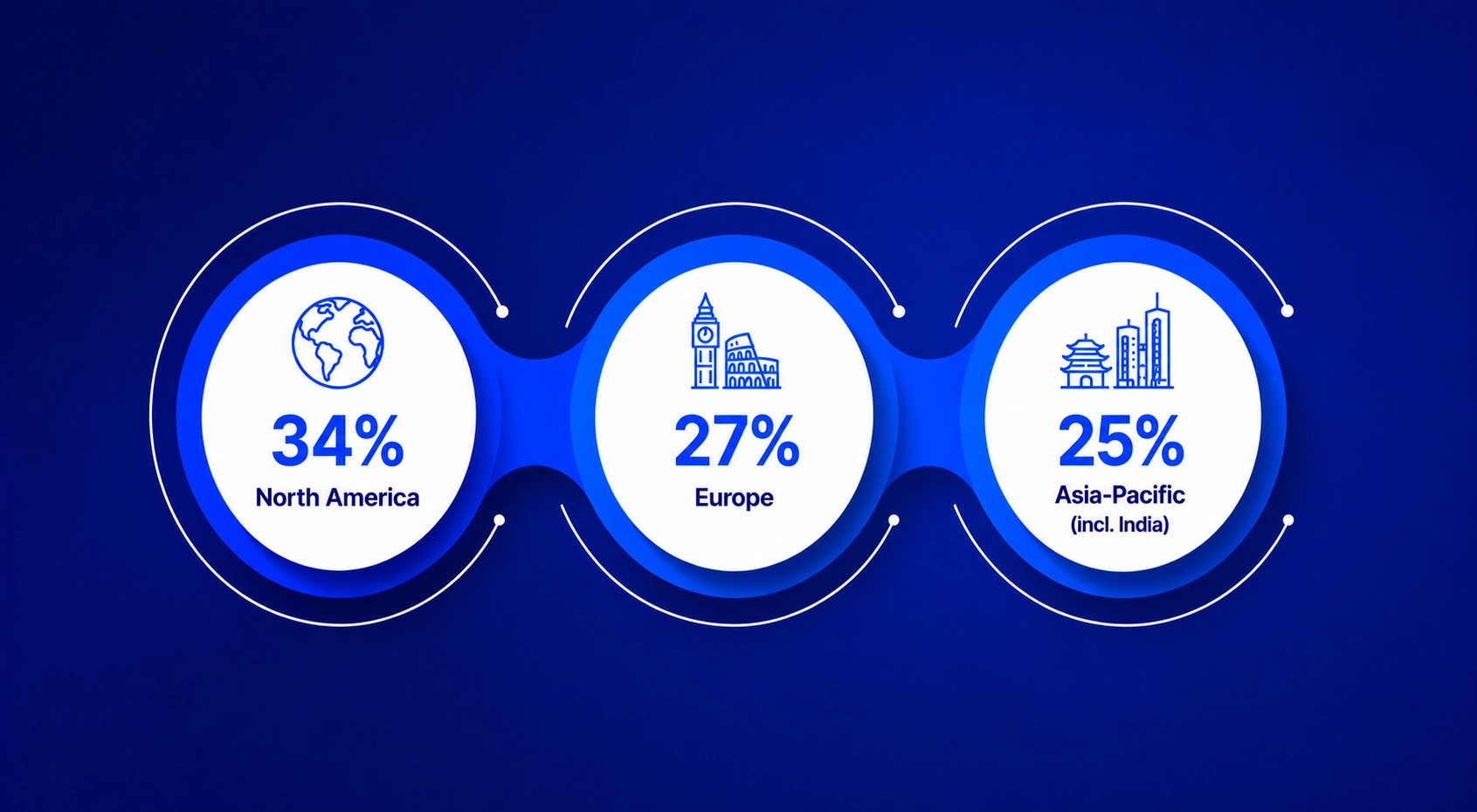
Leads with USD 156.76 Bn share. Strong enterprise financial software adoption and AI integration across US financial institutions.
Strong compliance management software demand driven by GDPR and MiFID II. Digital banking software growth is steady at 65% adoption.
Fastest-growing region. India’s fintech software market is propelled by UPI infrastructure, digital lending, and government digitization mandates.
India’s financial software market is particularly compelling. With over 73% of financial users relying on mobile-based financial services and the government’s push toward digital infrastructure, both enterprise and consumer-oriented financial planning software segments are on high-growth trajectories. UAE’s Dubai remains the primary hub for financial analytics software across the Gulf, with regulatory frameworks explicitly designed to accelerate fintech software market growth.
Vendor Profiles and Industry Competition
The financial software market is highly competitive, with a mix of global giants, regional specialists, and agile fintech startups competing for market share. The vendor landscape in the fintech software market is undergoing rapid consolidation through M&A activity, while simultaneously being disrupted by niche players with superior AI capabilities.
Oracle
Oracle leads in enterprise financial software with its Fusion ERP suite. It dominates treasury management software and financial reporting solutions for large enterprises globally.
SAP
SAP’s S/4HANA platform combines financial analytics software with ERP capabilities. It holds strong adoption across India and Europe for compliance-heavy financial management solutions.
Intuit
Intuit’s QuickBooks and TurboTax platforms dominate the SME accounting software market. Its AI-powered assistant features are accelerating adoption among small businesses in emerging markets.
Workiva
Workiva specializes in financial reporting solutions and compliance management software. It is a preferred choice for enterprises with complex multi-entity reporting and audit requirements.
OneStream
OneStream is rapidly gaining traction in the enterprise financial software space with its unified platform for consolidation, planning, and financial analytics software in one system.
Zoho Finance
Zoho’s financial suite has become a top choice in India and UAE for SMEs seeking integrated cloud based financial software with accounting, invoicing, and expense management in one platform.
Technologies Redefining the Industry
Several transformative technologies are reshaping the foundations of the financial software industry. Understanding these shifts is essential for any business evaluating investment in the fintech software market.
Artificial Intelligence and Predictive Analytics
AI powered financial software is eliminating manual processes in forecasting, fraud detection, and loan underwriting. Financial analytics software now delivers real-time risk scoring and revenue projections with minimal human input.
Blockchain for Financial Reporting
Blockchain is increasingly embedded in financial reporting solutions to create immutable audit trails. Around 60% of institutions are currently exploring blockchain adoption within their financial software ecosystems.
API-First Architecture and Open Banking
64% API integration adoption is reshaping how SaaS financial platforms connect with ERP systems, CRM tools, and payment gateways. Open banking APIs are creating unified financial ecosystems across digital banking software layers.
Embedded Finance and Super Apps
Super apps combining payments, investments, insurance, and lifestyle services are emerging as the dominant financial interface in India and Southeast Asia. Embedded finance within digital banking software platforms is a core growth vector for the fintech software market.
RegTech and Automated Compliance
RegTech capabilities are now embedded directly into the compliance management software stack. Machine learning-backed AML detection and dynamic financial reporting solutions are enabling real-time regulatory adherence across multiple jurisdictions.
Funding Patterns and Investment Shifts
Capital allocation in the financial software market reflects investor confidence in the long-term fundamentals of the fintech software market. High-intent investment activity is concentrated in three key areas: enterprise performance management platforms, cloud accounting ecosystems, and intelligent financial reporting solutions.
Vendors that demonstrate proprietary AI capabilities, high annual recurring revenue (ARR) growth, and strong cybersecurity frameworks are commanding premium valuations. Investment management software and treasury management software startups are attracting private equity attention due to the large total addressable market and recurring revenue models inherent to SaaS financial platforms.
In India, venture capital inflows into the fintech software market reached record levels, with digital lending, InsurTech, and financial planning software platforms receiving the bulk of funding. In the UAE, DIFC and ADGM-registered financial software firms are attracting sovereign wealth fund interest as part of broader smart economy mandates. [1]
Regulatory Pressures and Compliance Demands
Regulatory complexity is one of the most powerful demand catalysts in the financial software market. Governments and financial regulators globally are tightening oversight, and the only viable response for institutions is robust compliance management software supported by automated financial reporting solutions.
Basel III (Global)
Demands detailed capital adequacy reporting and stress testing capabilities. Driving major investments in risk management software and financial analytics software across banking institutions globally.
MiFID II (Europe)
Requires investor protection, trade transparency, and detailed transaction reporting. European institutions rely heavily on compliance management software and investment management software for adherence.
RBI Guidelines (India)
Reserve Bank of India mandates on digital lending, data localization, and payment system audits are accelerating demand for compliant cloud based financial software among Indian banks and NBFCs.
CBUAE and DIFC (UAE)
UAE’s Central Bank and DIFC regulatory framework are pushing fintech firms to embed real-time AML monitoring, KYC automation, and digital transaction reporting into their SaaS financial platforms.
Dodd-Frank (USA)
Post-2008 reforms under Dodd-Frank continue to shape financial reporting solutions and risk management software requirements for US financial institutions and global subsidiaries operating stateside.
GDPR (Europe and Global)
GDPR compliance requires investment in privacy-enhancing technologies embedded within enterprise financial software platforms, especially for institutions storing customer financial data across EU borders.
Financial Software Market Prospects and Future Trajectory
Looking ahead to 2030, the financial software market is poised for a fundamental restructuring rather than incremental growth. Based on current investment patterns, technology adoption curves, and regulatory trajectories, the following shifts are anticipated across the financial software industry.
Hyper-Personalized Financial Tools
AI powered financial software will deliver individualized financial planning software recommendations in real time, moving beyond generic budgeting tools to personalized wealth optimization platforms for retail and enterprise users.
Autonomous Finance Operations
Automated accounting systems will evolve into fully autonomous finance operations, where reconciliation, compliance reporting, and treasury management software actions are executed without manual intervention.
Unified Financial Platforms
The market growth forecast points toward platform consolidation, with vendors integrating investment management software, risk management software, and financial analytics software into a single, modular enterprise suite.
For India, the trajectory includes greater integration of UPI-level infrastructure with enterprise financial management solutions, enabling real-time treasury reconciliation at national scale. For the UAE, the smart finance agenda supports widespread adoption of digital banking software and cross-border financial reporting solutions aligned with Gulf Cooperation Council regulatory standards.
The fintech software market will also see greater consolidation as large vendors acquire niche compliance management software and financial analytics software companies to round out their product offerings and defend against disruption from focused startups.
Actionable Insights for Industry Stakeholders
With over 8 years of hands-on experience working with financial institutions, enterprise clients, and fintech innovators across India and the UAE, our agency offers the following strategic recommendations for stakeholders navigating the financial software market in 2026 and beyond.
For Banks and Financial Institutions
Prioritize AI powered financial software and compliance management software investments. Audit current legacy platforms for cloud migration readiness. Align financial reporting solutions with latest regulatory requirements in your operating jurisdictions.
For Enterprise CFOs and Finance Leaders
Evaluate SaaS financial platforms for total cost of ownership versus on-premise alternatives. Build toward unified financial ecosystems that integrate treasury management software, financial analytics software, and investment management software.
For Investors and VCs
Target vendors with strong ARR growth, embedded AI capabilities, and proven compliance automation in financial software. The financial software market’s 9-17% CAGR range across sub-segments offers strong long-term return potential.
The financial software market in 2026 is not just about technology adoption. It is about competitive positioning. Organizations that move decisively toward AI powered financial software, adopt cloud based financial software infrastructure, and embed compliance management software into their core operations will hold a sustainable edge over those that delay. For businesses in India and UAE specifically, the opportunity window is wide open, backed by policy support and a rapidly maturing digital finance ecosystem.
People Also Ask
Q1.1. How big is the financial software market right now?
The financial software market is currently valued at over USD 156 billion in 2026 and is on a strong growth path. Businesses across India, UAE, and globally are rapidly adopting cloud-based and AI-powered financial tools.
Q2.2. What is the expected growth rate of the financial software market by 2030?
The financial software market is forecast to grow at a CAGR ranging from 9.7% to 17.2% depending on segment. Enterprise financial management software alone is expected to reach USD 26.35 billion by 2030.
Q3.3. Which countries are driving the most demand for financial software?
North America leads globally, but India and UAE are the fastest-growing markets. Government digital finance initiatives, rising fintech activity, and SME adoption are strong demand drivers in both countries.
Q4.4. What types of financial software are businesses using the most today?
Businesses widely use accounting software, financial planning software, risk management software, and treasury management software. Cloud-based and SaaS financial platforms are the most preferred formats due to scalability and cost efficiency.
Q5.5. Is AI really changing how financial software works?
Yes, AI-powered financial software is transforming real-time decision-making, fraud detection, compliance automation, and predictive analytics. Nearly 65% of financial institutions are already integrating AI tools into their financial management solutions.
Q6.6. How does cloud-based financial software benefit small businesses?
Cloud based financial software removes the need for costly hardware, enables remote access, auto-updates compliance rules, and scales easily with business growth. It is especially valuable for SMEs in emerging markets like India and the UAE.
Q7.7. What are the biggest challenges businesses face when adopting financial software?
The key challenges include data security concerns, high customization costs, integration with legacy systems, and shortage of skilled professionals. Regulatory compliance complexity is also a major bottleneck in markets like India and the EU.
Q8.8. Which vendors are leading the financial software market globally?
Oracle, SAP, Workiva, IBM, Intuit, and OneStream are among the top players. These companies are heavily investing in AI analytics, SaaS financial platforms, and compliance management software to stay competitive.
Q9.9. What role does compliance play in shaping the financial software market?
Regulatory frameworks like Basel III, MiFID II, and India’s RBI guidelines are pushing businesses to adopt compliance management software. Automated compliance tools are now a core part of enterprise financial software offerings.
Q10.10. Will fintech startups disrupt the traditional financial software market?
Fintech startups are already disrupting the financial software industry by offering faster, cheaper, and more user-friendly alternatives to legacy systems. Their agility in adopting AI, open APIs, and embedded finance models is reshaping competitive dynamics globally.
Explore Services
Related Services
Reviewed by

Aman Vaths
Founder of Nadcab Labs
Aman Vaths is the Founder & CTO of Nadcab Labs, a global digital engineering company delivering enterprise-grade solutions across AI, Web3, Blockchain, Big Data, Cloud, Cybersecurity, and Modern Application Development. With deep technical leadership and product innovation experience, Aman has positioned Nadcab Labs as one of the most advanced engineering companies driving the next era of intelligent, secure, and scalable software systems. Under his leadership, Nadcab Labs has built 2,000+ global projects across sectors including fintech, banking, healthcare, real estate, logistics, gaming, manufacturing, and next-generation DePIN networks. Aman’s strength lies in architecting high-performance systems, end-to-end platform engineering, and designing enterprise solutions that operate at global scale.