Ai Overview
The financial industry is no longer tolerant of slow, rigid software cycles. Teams building financial software today must deliver accurate, compliant, and user-ready systems at a pace that matches the market. Agile methodology has become the structural answer to this demand, offering financial technology teams a reliable, proven framework that prioritizes speed without sacrificing quality. Projects that once took 18 months to ship are now going live in under six months.
Key Takeaways
- ✓ Agile methodology enables financial software teams to deliver working features in short, structured sprint cycles of one to four weeks.
- ✓ Scrum framework and iterative workflow reduce project failure rates by allowing continuous feedback and real-time course corrections.
- ✓ Cross functional teams using agile project management complete fintech applications up to 40 percent faster than traditional waterfall approaches.
- ✓ Regulatory compliance is embedded into every sprint, making banking software modernization auditable and aligned with changing financial regulations.
- ✓ Continuous integration and continuous delivery pipelines in agile teams significantly reduce bugs reaching production in digital banking platforms.
- ✓ Agile transformation in financial technology organizations improves stakeholder communication, reduces scope creep, and increases overall delivery predictability.
- ✓ DevOps in fintech combined with agile methodology meaning creates a unified pipeline from code commit to production deployment for financial systems.
- ✓ Risk identification in agile financial projects happens at the sprint level, preventing large-scale failures and expensive last-minute reworks in fintech applications.
- ✓ Software lifecycle management through agile ensures that financial software scales gracefully to meet growing user demand and market regulation shifts.
- ✓ India and UAE fintech markets are seeing rapid agile team collaboration adoption as both regions accelerate digital banking platform rollouts in 2026.
The financial industry is no longer tolerant of slow, rigid software cycles. Teams building financial software today must deliver accurate, compliant, and user-ready systems at a pace that matches the market. Agile methodology has become the structural answer to this demand, offering financial technology teams a reliable, proven framework that prioritizes speed without sacrificing quality.
With over 8 years of experience delivering agile-led solutions across banking, fintech applications, and enterprise finance platforms in India and the UAE, we have witnessed how agile methodology meaning translates into real business outcomes. Projects that once took 18 months to ship are now going live in under six months. Compliance gaps that used to surface at the end of a project are now caught within the first sprint.
This guide explains how agile methodology transforms financial software projects from concept to delivery, covering everything from sprint planning and iterative workflow to regulatory compliance and agile team collaboration. Whether you are modernizing a legacy banking system in Mumbai or launching a digital banking platform in Dubai, the principles here apply directly to your context.
What is Agile Methodology in Financial Software?
Understanding what is agile methodology begins with recognizing that it is not simply a project management style but a complete philosophy for building complex software systems. In the context of financial technology, agile methodology meaning refers to an iterative workflow where software is planned, built, tested, and reviewed in short cycles called sprints, typically ranging from one to four weeks.
Traditional waterfall projects in the financial sector would gather all requirements upfront, lock the scope, and deliver a final product months or years later. The problem was that financial markets, regulations, and user expectations changed faster than the project timeline allowed. Agile project management inverts this model. Requirements evolve, priorities shift, and the product grows incrementally in response to real stakeholder feedback.
In financial technology projects, this means banking teams, compliance officers, security engineers, and product owners collaborate continuously. Rather than handing off a completed module to compliance review at the end of a project, agile embeds compliance awareness into every sprint cycle. This dramatically reduces the risk of costly reworks and failed audits that have historically plagued large-scale banking software modernization initiatives.
Iterative Workflow
Short sprint cycles replace long, rigid release schedules in financial software projects.
Cross Functional Teams
Developers, QA, compliance, and business analysts collaborate in unified sprint teams.
Continuous Delivery
Working software ships regularly, giving financial teams early and consistent value.
Core Principles of Agile That Align With Financial Project Goals
The Agile Manifesto’s 12 principles align almost perfectly with the demands of financial software projects. Financial technology organizations operate in environments where customer expectations are high, regulatory frameworks are strict, and technical debt is expensive. Agile methodology addresses each of these pressure points through a set of structured, practical principles.
The first principle is customer collaboration over contract negotiation. In financial software, this translates to regular sprint reviews with business stakeholders, product owners from banking operations, and end-user feedback sessions that directly inform the next iteration. The second principle, responding to change over following a plan, is especially critical in markets like India and the UAE, where fintech regulations and digital banking platform standards evolve quickly.
Delivering working software frequently is another agile principle that financial teams consistently benefit from. Rather than waiting for a complete system, stakeholders see functional components every sprint. This builds confidence, catches misalignments early, and ensures the final financial technology product reflects actual business needs rather than assumptions made months earlier.
How Agile Changes the Way Financial Software Teams Work?
Before agile transformation, financial software teams often worked in siloed structures where business analysts, engineers, testers, and compliance reviewers rarely communicated until handoff moments. This created an assembly line of misunderstandings, last-minute changes, and costly delays. Agile methodology dismantles these silos by design.
Agile team collaboration introduces daily stand-ups, sprint planning sessions, retrospectives, and backlog grooming ceremonies. These are not administrative overhead. They are structured communication rituals that keep every team member aligned on priorities, blockers, and goals. In a financial software project, where a single miscommunication can result in a compliance gap or a data integrity issue, this level of structured communication is not optional but essential.
The role of a Scrum master in financial projects is to protect the team from scope creep, lead retrospectives that improve team processes, and ensure sprint commitments remain realistic. Product owners connect business stakeholders with engineering teams by translating financial requirements into actionable sprint backlog tasks. This clear division of responsibilities is one reason agile methodology consistently performs better than traditional project management approaches in complex financial technology environments.
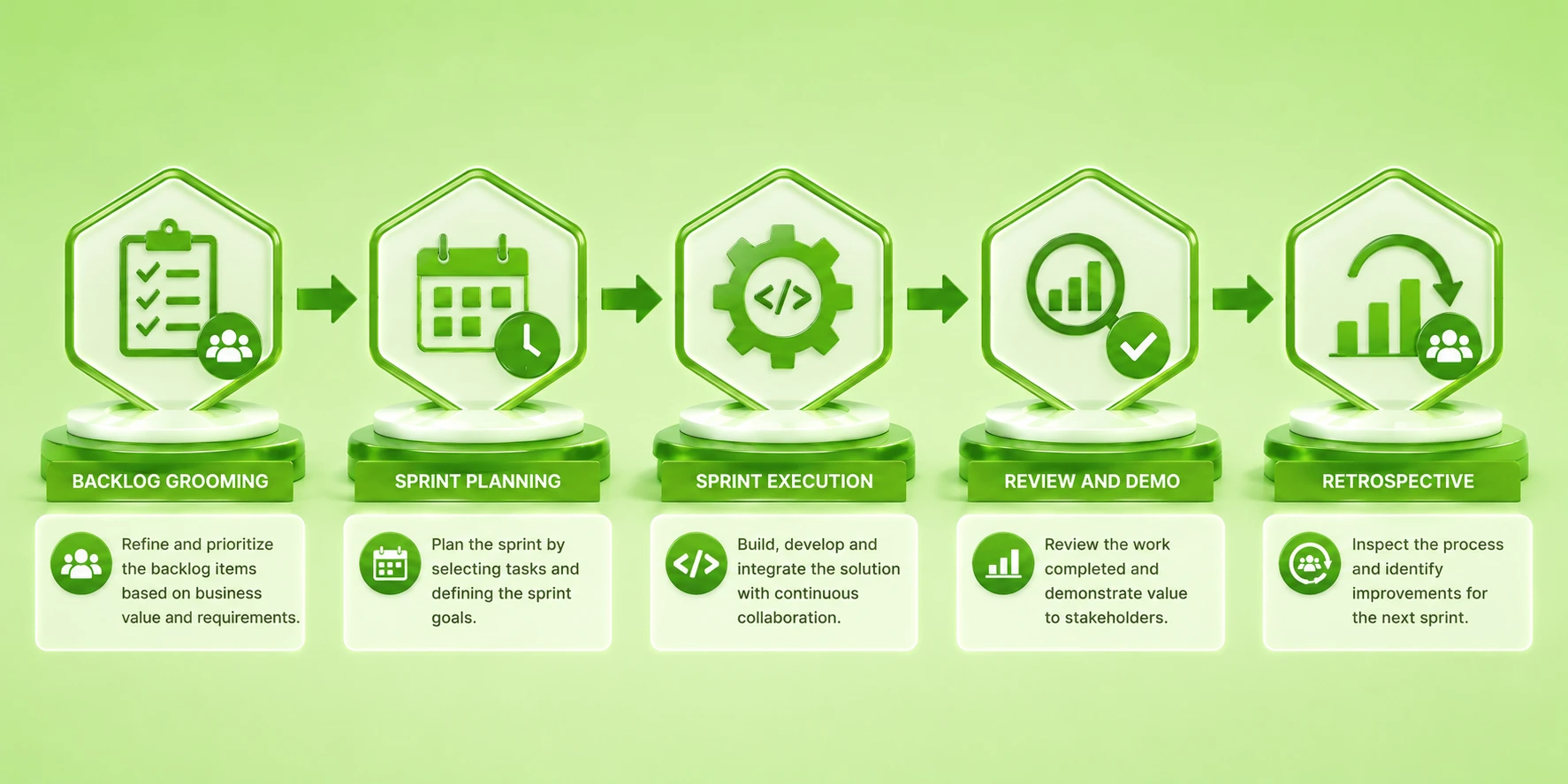
Agile Sprint Cycle in Financial Software Projects
Sprint Planning and Execution in Financial Software Projects
Sprint planning is the foundation of the Scrum framework and is arguably the most critical ceremony in any agile financial software project. During sprint planning, the product owner presents the highest-priority items from the backlog, the engineering team estimates effort, and the team collectively commits to what will be delivered by the end of the sprint. For financial technology teams, this ceremony ensures that every sprint has clear, measurable goals tied to business value.
In financial software projects, sprint backlogs typically include a mix of feature development, compliance requirements, security improvements, and technical debt reduction tasks. An experienced team using agile methodology understands how to balance these priorities so that each sprint delivers visible business progress while also strengthening the stability and long term health of the underlying system.
Sprint execution in financial technology environments requires daily stand-ups where each team member shares what they completed, what they are working on, and whether anything is blocking progress. Blockers in financial projects often involve waiting for compliance sign-off, access to secure testing environments, or clarification from a regulatory body. By surfacing these blockers daily, agile teams minimize the time that work sits idle and keeps the iterative workflow moving forward efficiently.
How Agile Accelerates the Execution Process in Finance?
Speed is a competitive advantage in financial technology. Banks and fintech applications that can deploy new features, fix critical bugs, and respond to regulatory changes faster than competitors enjoy a measurable edge in acquiring and retaining customers. Agile methodology is the operational engine that powers this speed without sacrificing the rigor that financial software demands.
Continuous integration practices mean that code written by a financial software engineer is automatically tested and merged within hours rather than days. Continuous delivery pipelines extend this further, enabling working builds to reach staging environments after every sprint, where business stakeholders and compliance teams can review real functionality. This drastically compresses the feedback loop that traditionally added weeks or months to financial project timelines.
| Metric | Waterfall Projects | Agile Projects |
|---|---|---|
| Average Delivery Time | 12 to 24 months | 4 to 9 months |
| Compliance Check Frequency | End of project only | Every sprint cycle |
| Stakeholder Feedback Loops | Milestone reviews only | Every 1 to 4 weeks |
| Bug Discovery Timing | Late-stage testing phase | Within the same sprint |
| Scope Change Management | Costly and disruptive | Handled at backlog level |
Iterative Approach and Its Role in Building Financial Systems
The iterative workflow at the heart of agile methodology is especially valuable when building complex financial systems such as core banking platforms, loan origination systems, investment management tools, and payment processing engines. These systems cannot be built in a single pass because the requirements are too large, the domain knowledge is too specialized, and the risks of getting something wrong are too high.
By approaching financial system construction iteratively, agile teams build a working foundation in early sprints and then progressively layer more complex functionality on top. For example, a digital banking platform project might begin with basic account inquiry screens in sprint one, add transaction history and filtering in sprint two, introduce fund transfer workflows in sprint three, and incorporate real-time fraud alerts in sprint four. Each layer builds on the one before it, and each is reviewed and tested before the next begins.
This approach is significantly superior to building every component simultaneously and integrating at the end. Integration failures in financial technology systems are particularly dangerous because they can affect transaction accuracy, account balances, and data integrity. The iterative workflow catches these issues early, when they are still manageable and inexpensive to fix.
Managing Risks During Agile Execution in Financial Projects
Risk management in financial software projects has historically been a point of failure for large-scale programs. When risks are only assessed at project initiation or milestone gates, they tend to compound silently until they become crises. Agile methodology integrates risk management into the regular rhythm of the project through sprint retrospectives, backlog prioritization, and continuous stakeholder communication.
In our experience working with financial technology clients in India and the UAE, the most common risks in financial software projects include regulatory changes mid-project, third-party integration failures, key personnel turnover, and shifting business priorities. Agile teams address each of these through specific practices. Regulatory risk is mitigated by including compliance tasks in every sprint backlog. Integration risks are reduced by delivering integration points in early sprints and testing them thoroughly. Personnel risks are managed by encouraging collective code ownership and comprehensive documentation within the sprint workflow.
The sprint retrospective is one of the most powerful risk management tools available to agile financial teams. By honestly reviewing what went well and what did not at the end of every sprint, teams identify systemic issues before they escalate. This ceremony creates a culture of continuous improvement that directly reduces the probability and impact of risks throughout the software lifecycle management process.
Regulatory Risk
Compliance tasks embedded in every sprint protect teams from late-stage regulatory surprises.
Integration Risk
Early sprints test third-party integrations first, catching failures before they cascade into larger issues.
Team Risk
Collective code ownership and sprint documentation reduce dependency on any single team member.
How Agile Methodology Improves Collaboration Between Teams?
One of the most transformative impacts of agile methodology in financial software projects is its effect on team collaboration. In pre-agile financial organizations, engineering teams, business analysts, compliance officers, and quality assurance specialists often functioned as separate departments with their own timelines, priorities, and communication styles. Agile brings these groups into a single, unified sprint team with shared goals and mutual accountability.
Agile team collaboration is most visible in the daily stand-up ceremony. In a financial software context, this brief meeting might include a backend engineer reporting progress on a payment gateway integration, a compliance specialist confirming that a new feature meets KYC requirements, a QA engineer sharing test results from the previous day, and a product owner clarifying the acceptance criteria for an upcoming user story. This level of daily cross-functional communication is unprecedented in traditional project structures and is a primary driver of agile project management success.
DevOps in fintech extends agile team collaboration beyond sprint ceremonies into the technical infrastructure itself. When engineering and operations teams share ownership of the deployment pipeline, release cycles become faster and more reliable. Continuous integration servers automatically run test suites when new code is committed, giving the entire team visibility into system health at any moment. This shared technical transparency is a cornerstone of effective agile transformation in banking software modernization programs.
Testing and Quality Assurance in Agile Financial Projects
Quality assurance in agile financial projects is not a phase that happens at the end of the project. It is a continuous activity embedded within every sprint. This is a fundamental difference between agile methodology and traditional waterfall approaches, and it has profound implications for the quality and reliability of financial software systems.
Agile QA in financial technology projects encompasses unit testing, integration testing, performance testing, security testing, and user acceptance testing, all of which occur within or immediately after each sprint. Continuous integration pipelines automatically execute unit and integration tests every time a developer pushes code. This means that broken functionality is detected within minutes rather than weeks, and the team can fix the issue while the code is still fresh in their minds.
Performance testing is particularly important in digital banking platforms and payment processing systems, where response time and throughput directly affect user experience and regulatory compliance. Agile teams that integrate performance testing into their sprint cycles can identify bottlenecks early and address them incrementally rather than facing a catastrophic performance failure during final load testing before launch.[1]
Agile QA Coverage in Financial Software Sprints
Handling Regulatory Compliance Through Agile Execution
Regulatory compliance is one of the most challenging aspects of financial software projects, and it is one of the areas where agile methodology offers the greatest strategic advantage. In markets like India and the UAE, financial technology regulations evolve continuously. The Reserve Bank of India, the UAE Central Bank, and international standards bodies like the Financial Action Task Force regularly update their requirements for digital banking platforms, payment processors, and investment management systems.
Agile teams handle regulatory compliance by treating compliance requirements as backlog items with the same priority weight as functional features. When a new regulation is announced, the product owner adds the corresponding compliance tasks to the backlog, estimates their effort with the team, and schedules them into upcoming sprints. This ensures that regulatory changes are absorbed into the project flow without disrupting the overall delivery timeline.
Compliance-aware sprint planning also means that regulatory documentation, audit trails, and compliance evidence are produced continuously throughout the project rather than assembled in a scramble at the end. This makes audits significantly faster and less stressful for financial technology teams. Agile transformation in compliance-heavy financial organizations consistently results in shorter audit cycles, fewer compliance findings, and greater confidence from regulators that the organization has robust controls in place throughout the software lifecycle management process.
Common Challenges of Applying Agile in Financial Software Projects
While agile methodology delivers significant benefits in financial software projects, the transition from traditional project structures is not without its challenges. Understanding these challenges and knowing how to address them is essential for any financial technology organization considering or already undertaking agile transformation.
One of the most common challenges is cultural resistance. Financial institutions, especially established banks and insurance companies, have deeply ingrained project management cultures built around detailed upfront planning, formal approvals, and hierarchical decision-making. Agile methodology requires a shift toward decentralized decision-making, self-organizing teams, and tolerance for emergent requirements. This cultural shift requires strong leadership sponsorship, patient coaching, and often a series of small agile pilots before organization-wide adoption.
Fixed-scope contracts are another significant challenge in financial software projects. Many financial institutions engage vendors through procurement processes that require detailed scope specifications upfront. This is fundamentally at odds with the agile principle of welcoming changing requirements. Successful agile financial organizations address this by transitioning to outcome-based contracts and time-and-materials arrangements that allow scope to evolve while maintaining budget and timeline discipline.
| Challenge | Root Cause | Agile Solution |
|---|---|---|
| Cultural Resistance | Hierarchical financial org structures | Agile coaching and small pilot programs |
| Fixed-Scope Contracts | Procurement process rigidity | Outcome-based and T&M contracts |
| Distributed Teams | Multi-location financial operations | Async stand-ups and virtual sprint boards |
| Legacy System Constraints | Outdated banking infrastructure | Strangler fig pattern with incremental APIs |
| Compliance Documentation | Regulatory audit requirements | Sprint-level compliance artefacts per cycle |
How Agile Transforms Project Delivery in Financial Organizations?
Agile methodology transformation fundamentally changes how financial organizations think about and measure project success. In traditional project structures, success was defined by delivering the agreed scope on time and within budget. In agile financial organizations, success is measured by business value delivered, user satisfaction achieved, and technical quality maintained across every sprint cycle.
Financial organizations that have completed agile transformation consistently report faster time-to-market for new financial products, higher user adoption rates for digital banking platforms, and lower post-launch defect rates. These outcomes translate directly into competitive advantage in markets like India and the UAE, where digital banking adoption is accelerating rapidly and user expectations for seamless financial technology experiences are rising quickly.
At scale, agile transformation in financial organizations involves far more than adopting sprint ceremonies. It requires restructuring teams around products instead of traditional project management models, investing in continuous integration and continuous delivery infrastructure, building internal agile coaching capabilities, and redesigning governance processes to support the faster and more flexible pace of agile methodology. Financial organizations that make these deeper structural investments consistently outperform those that adopt agile practices only at the surface level, especially in the speed, quality, and reliability of their financial software systems.
Faster Time to Market
Agile financial teams ship features in weeks, not quarters, gaining competitive speed in fintech applications.
Fewer Post-Launch Bugs
Continuous integration and sprint-level testing dramatically reduce defects reaching production in digital banking platforms.
Stakeholder Confidence
Regular sprint demos and transparent backlog management triple stakeholder trust in financial software project delivery.
Launch Secure Financial Platforms With Confidence
We help fintech companies build scalable digital products with agile execution, compliance focused architecture, and faster product delivery.
Frequently Asked Questions
Q1.1. What is agile methodology and how does it work in simple terms?
Agile methodology is a flexible approach to building software where teams work in short cycles called sprints, delivering small pieces of working software regularly and adjusting the plan based on feedback throughout the project.
Q2.2. Why do fintech companies prefer agile methodology over waterfall?
Fintech companies prefer agile methodology because it allows them to respond quickly to regulatory changes, user feedback, and market shifts, making financial software delivery faster and more aligned with real business needs than rigid waterfall planning.
Q3.3. How long is a typical sprint in a financial software project?
Most agile sprint planning cycles in financial software projects run from one to four weeks, with two week sprints being the most widely used in agile methodology because they balance fast delivery with enough time to complete meaningful and reviewable work.
Q4.4. Can agile methodology handle strict financial regulatory compliance?
Yes, agile methodology handles regulatory compliance by treating compliance tasks as backlog items included in every sprint, ensuring that audit trails and regulatory evidence are produced continuously rather than scrambled together at project end.
Q5.5. What is the Scrum framework and how does it relate to agile?
The Scrum framework is the most widely used implementation of agile methodology, organizing work into sprints with defined ceremonies including sprint planning, daily stand-ups, sprint reviews, and retrospectives to keep financial software teams structured and focused.
Q6.6. How does agile team collaboration improve in financial software projects?
Agile team collaboration improves because daily stand ups, sprint reviews, and shared backlogs keep engineers, compliance officers, QA specialists, and product owners in constant communication, reducing the handoff delays commonly seen in traditional financial project delivery compared to agile methodology.
Q7.7. What is agile transformation and is it hard for banks to adopt?
Agile transformation is the process of shifting a financial organization from traditional project management to agile methodology, and while it involves cultural change, banks that invest in coaching and pilot programs consistently achieve stronger results in delivery speed, collaboration, and software quality.
Q8.8. How does continuous integration support agile in digital banking platforms?
Continuous integration automatically tests and merges code changes multiple times daily, supporting agile methodology by giving financial teams instant visibility into system health and preventing the accumulation of bugs that usually surface late in traditional digital banking platform projects.
Q9.9. Does agile methodology work for large financial institutions or only startups?
Agile methodology works for organizations of all sizes, including large banks and insurance companies, though larger institutions may use scaled agile frameworks like SAFe to coordinate multiple sprint teams working on interconnected financial technology systems simultaneously.
Q10.10. What are the key differences between agile and waterfall in financial software projects?
The key differences are that waterfall locks scope upfront and delivers once at the end, while agile methodology plans incrementally, delivers working software every sprint, and welcomes changing requirements, making it far more suited to the pace of modern financial technology environments.
Explore Services
Related Services
Reviewed by

Aman Vaths
Founder of Nadcab Labs
Aman Vaths is the Founder & CTO of Nadcab Labs, a global digital engineering company delivering enterprise-grade solutions across AI, Web3, Blockchain, Big Data, Cloud, Cybersecurity, and Modern Application Development. With deep technical leadership and product innovation experience, Aman has positioned Nadcab Labs as one of the most advanced engineering companies driving the next era of intelligent, secure, and scalable software systems. Under his leadership, Nadcab Labs has built 2,000+ global projects across sectors including fintech, banking, healthcare, real estate, logistics, gaming, manufacturing, and next-generation DePIN networks. Aman’s strength lies in architecting high-performance systems, end-to-end platform engineering, and designing enterprise solutions that operate at global scale.