Ai Overview
In the context of financial software systems, “secrets” refer to any piece of sensitive information that a service or application needs to function but must never be exposed publicly. This includes database passwords, API keys, OAuth tokens, TLS certificates, private keys, and service account credentials. US banks alone spent over $14 billion on cybersecurity in 2026, with identity and access management representing the single largest budget line item.
Key Takeaways
- HashiCorp Vault is the industry-leading secrets management platform used by financial institutions to secure credentials, API keys, and encryption keys at scale.
- Dynamic secrets generated by HashiCorp Vault expire automatically, eliminating long-lived static credentials that are a primary cause of financial data breaches.
- Identity-based access control in HashiCorp Vault ensures only verified human, machine, and AI agent identities can retrieve sensitive financial data or credentials.
- HashiCorp Vault open source provides a free, cloud-agnostic foundation while enterprise tiers add HSM integration, namespaces, and advanced policy controls for finance teams.
- Vault integrates natively with Kubernetes secrets management, HashiCorp Vault Docker environments, and CI/CD pipelines used across modern banking application security stacks.
- Encryption key management within HashiCorp Vault protects financial data both at rest and in transit through a dedicated Transit secrets engine, reducing exposure risk significantly.
- Compliance and audit logging in HashiCorp Vault produces a tamper-evident, full-fidelity trail of every secrets access event, directly supporting PCI-DSS, RBI, and GDPR obligations.
- Multi cloud security is a core design principle in HashiCorp Vault, making it the preferred choice for financial institutions operating across AWS, Azure, Google Cloud, and on-premise environments.
- Infrastructure security automation powered by HashiCorp Vault reduces manual credential rotation overhead from days to minutes, as documented in real-world banking deployments globally.
- Financial institutions in India and UAE increasingly adopt HashiCorp Vault as a foundational layer in their secure DevOps workflows to meet intensifying regulatory and operational security demands.
In today’s interconnected financial ecosystem, sensitive data protection is no longer optional. Every transaction, every API call, every database query in a financial software environment depends on the secure handling of credentials, keys, and tokens. A single exposed secret can trigger regulatory sanctions, operational failures, and irreparable reputational harm. This is the precise challenge that HashiCorp Vault was architected to solve.
With over eight years of experience building and securing financial systems across India, UAE, and global markets, we have implemented HashiCorp Vault across dozens of complex banking, lending, and trading platforms. This guide distills everything we have learned about how HashiCorp Vault manages, encrypts, and governs secrets inside real-world financial software infrastructures.
What Secrets Management Means in Financial Software Systems?
In the context of financial software systems, “secrets” refer to any piece of sensitive information that a service or application needs to function but must never be exposed publicly. This includes database passwords, API keys, OAuth tokens, TLS certificates, private keys, and service account credentials. Managing these secrets means controlling their creation, storage, distribution, rotation, and revocation across an entire infrastructure.
In legacy financial architectures, secrets were often stored in plaintext configuration files, environment variables, or hardcoded directly in source repositories. This approach created severe vulnerabilities. A developer accidentally committing a database password to a version control system, or an old API key sitting dormant in a config file for years, represent classic data breach prevention failures that HashiCorp Vault documentation explicitly addresses through centralized secret storage and governance.
Secrets management in financial systems means treating every credential as a lifecycle object: it is created with intent, distributed through controlled channels, automatically rotated on schedule, and revoked immediately upon compromise or expiry. HashiCorp Vault operationalizes this full lifecycle, replacing ad-hoc secret handling with a policy-driven, auditable system that financial teams can trust under regulatory scrutiny.
Secure Credential Storage
All secrets are stored encrypted in Vault’s internal or external backends, never in plaintext or source code.
Automated Rotation
Credentials are rotated automatically on configurable schedules, removing the manual rotation burden from security and engineering teams.
Policy-Based Access
Every secret access request is evaluated against policies tied to verified identities, ensuring principle of least privilege across all services.
Why Do Financial Software Systems Need a Dedicated Secrets Manager?
Financial systems operate at the intersection of the highest data sensitivity and the most aggressive regulatory oversight of any industry. A dedicated secrets manager like HashiCorp Vault is not simply a convenience tool; it is a compliance and security necessity. US banks alone spent over $14 billion on cybersecurity in 2026, with identity and access management representing the single largest budget line item.[1]
Without a dedicated secrets manager, financial institutions face proliferating risks: hardcoded passwords in microservices, stale API keys in third-party integrations, inconsistent rotation policies across cloud providers, and zero visibility into who accessed which credential and when. These gaps directly translate into regulatory findings, data breach exposure, and operational failures in banking application security environments.
The financial industry in India operates under RBI’s IT Framework for Banks and PCI-DSS mandates, while UAE financial institutions follow CBUAE guidelines and NESA controls. Both regulatory environments explicitly require strong encryption key management, access logging, and the elimination of shared static credentials. A tool like HashiCorp Vault, with its compliance and audit logging capabilities, directly aligns with these regulatory obligations out of the box.
How HashiCorp Vault Fits Into Financial Software Infrastructure?
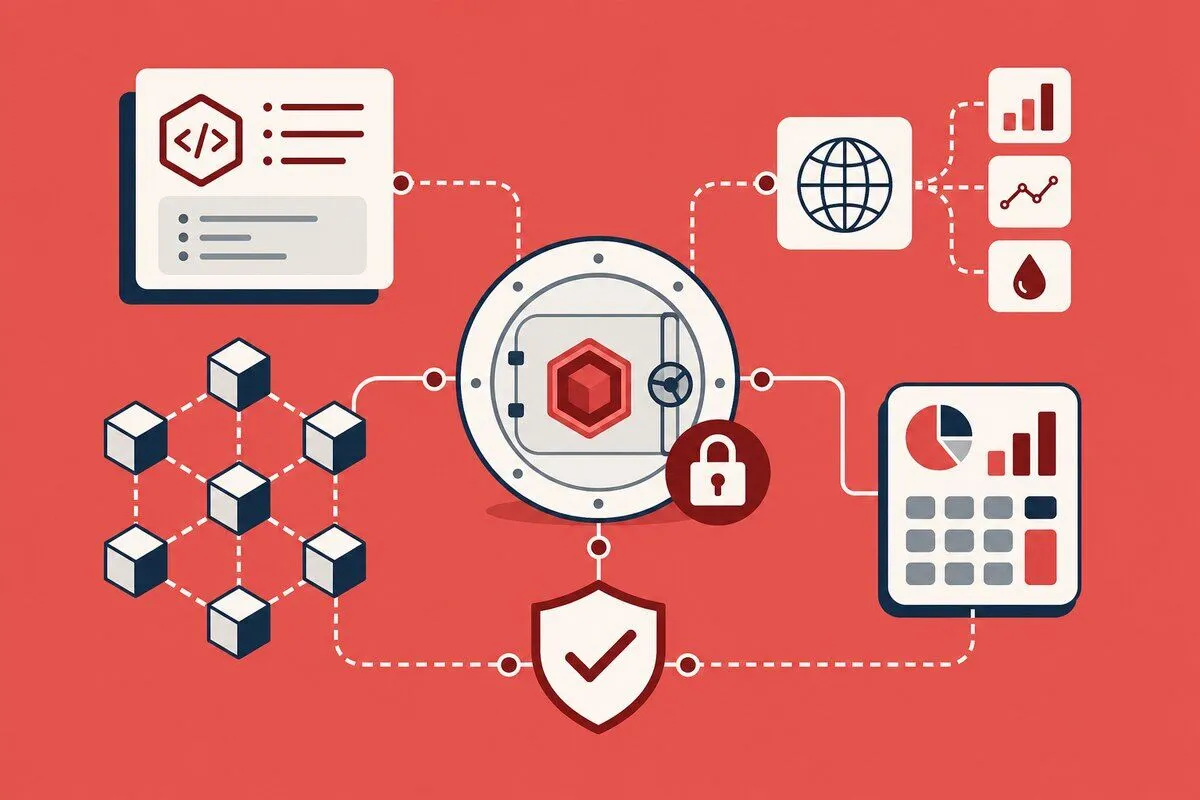
HashiCorp Vault is designed as a central secrets broker sitting at the heart of financial infrastructure. Rather than each application maintaining its own credential store, every service authenticates to Vault using its verified identity and receives only the secrets it is authorized to access. This model fundamentally changes the security posture of financial systems from scattered, inconsistent secret storage to a unified, policy-governed secrets plane.
In a typical financial software stack, Vault sits between the identity layer (Active Directory, Kubernetes service accounts, AWS IAM roles, or platform-specific auth methods) and the data layer (databases, payment APIs, message queues). When a payment processing microservice needs a database credential, it authenticates to Vault, receives a short-lived dynamic secret, uses it for its session, and the credential expires. This flow is what makes secure DevOps workflows genuinely secure in financial contexts.
HashiCorp Vault also integrates with infrastructure as code tools, particularly Terraform, to automate secrets provisioning as part of infrastructure creation. When a new financial service is spun up in Kubernetes, Vault policies and roles can be automatically assigned through infrastructure automation, ensuring every new workload follows the same security baseline from its first second of operation.
HashiCorp Vault in Financial Infrastructure Flow
Core Features of HashiCorp Vault That Matter in Finance
Understanding what HashiCorp Vault actually does for financial systems requires looking at its feature set with a practitioner’s eye. The following capabilities directly address the most pressing security challenges in banking, lending, trading, and payments infrastructure.
Dynamic Secrets
On-demand, short-lived credentials for databases, cloud providers, and SSH. No long-lived static credentials anywhere in the stack.
Encryption as a Service
The Transit engine provides encryption key management without exposing keys to applications, keeping sensitive data protection server-side.
Identity-Based Access
Identity-based access control evaluates every request against policies tied to verified machine or human identities, not just IP addresses.
PKI Secrets Engine
Generate, issue, and revoke TLS certificates on demand with configurable TTLs. Critical for securing financial microservice communication channels.
Audit Logging
Every request and response is logged in a tamper-evident stream, enabling full forensic reconstruction of credential access for compliance teams.
Multi-Cloud Support
Multi cloud security across AWS, Azure, GCP, and private data centers. Financial platforms spanning multiple cloud providers rely on this vendor-agnostic architecture.
Kubernetes Integration
Kubernetes secrets management via the Vault Agent Injector and CSI driver, enabling secrets injection directly into pod environments at runtime.
Docker Support
HashiCorp Vault Docker images make it straightforward to run Vault in containerized environments used across modern financial software CI/CD pipelines.
Enterprise Namespaces
Enterprise namespaces allow large financial institutions to run multi-tenant Vault environments with strict isolation between business units, regions, and regulatory domains.
Dynamic Secrets and Why They Matter for Financial Platforms
Dynamic secrets represent the most impactful architectural shift in secrets management for financial platforms. Rather than storing a fixed database password that every service shares and that might go unrotated for months, HashiCorp Vault generates a unique, time-limited credential for each requesting service at the moment it is needed. When the session ends or the TTL expires, Vault automatically revokes the credential at the source.
For a banking application security context, this matters enormously. Consider a payment processing service that needs to query a core banking database. With static credentials, a breach of the payment service exposes the shared database password indefinitely. With dynamic secrets from HashiCorp Vault, the compromised credential is valid for perhaps one hour and has already expired before an attacker can act on it. This is the fundamental mechanism behind data breach prevention in modern financial architectures.
HashiCorp Vault supports dynamic secrets for an extensive range of backend systems relevant to finance: PostgreSQL, MySQL, Oracle, MongoDB, Cassandra, RabbitMQ, Redis, AWS IAM, Azure Active Directory, Google Cloud, and SSH. For financial institutions running heterogeneous technology stacks across India or the UAE, this breadth means Vault can serve as the single secrets authority across virtually the entire infrastructure without gaps.
Risk Reduction With Dynamic Secrets vs Static Credentials
How Secrets Are Stored and Accessed Inside Financial Systems?
Inside HashiCorp Vault, secrets are organized within a hierarchical path structure across logical mounts called secrets engines. Each secrets engine is purpose-built for a specific backend type: KV (Key-Value) for static secrets like API keys and application configs, Database for dynamic database credentials, PKI for certificate management, Transit for encryption key management, and AWS/Azure/GCP for cloud provider secrets.
When a financial application needs to access a secret, it first authenticates to HashiCorp Vault using its configured auth method. Vault verifies the identity against the configured identity provider (Kubernetes service account, AWS IAM role, LDAP group membership, or a Vault AppRole). Upon successful authentication, Vault issues a token with specific policies attached. The application then uses this token to make API calls to the appropriate secrets engine path.
For high-availability financial deployments, HashiCorp Vault Enterprise supports integrated storage (Raft) with automatic leader election, ensuring no single point of failure for the secrets infrastructure. The HashiCorp Vault download includes everything needed to configure a production Raft cluster. Vault Enterprise also supports HSM integration for cryptographic operations, which is a requirement in certain regulatory environments like those governed by RBI in India or CBUAE in the UAE.
How HashiCorp Vault Manages Encryption Across Financial Software?
Encryption key management is one of the most critical and frequently mishandled aspects of financial data security. HashiCorp Vault addresses this through its Transit Secrets Engine, which provides encryption as a service without ever exposing the raw encryption keys to applications. Financial applications send plaintext data to Vault, receive ciphertext back, and store it in their databases. Decryption follows the same path. The keys never leave Vault.
This architecture means that even if a financial application’s database is fully compromised, the ciphertext stored there is useless without access to Vault. The attacker would need to also compromise the Vault cluster and have a valid, authorized identity capable of requesting decryption. For financial institutions handling cardholder data, PII, or transaction records, this layered model directly satisfies multiple PCI-DSS and data protection requirements.
HashiCorp Vault’s Transit engine also supports key rotation without application changes, convergent encryption for searchable ciphertext, and the ability to rewrap ciphertext under a new key version without decryption. For financial institutions managing years of encrypted customer records, this key lifecycle management capability prevents the accumulation of cryptographic technical debt.
| Encryption Feature | HashiCorp Vault Transit Engine | Traditional App-Level Encryption |
|---|---|---|
| Key Storage | Server-side, never exposed to apps | Stored in app config or environment |
| Key Rotation | Automatic, no app code changes required | Manual, requires redeployment |
| Audit Visibility | Full request-level logging | Limited or none |
| Access Control | Identity-based, policy-driven | Implicit, code-level only |
| HSM Support | Yes (Enterprise), hardware-backed | Rare, complex to implement |
| Compliance Alignment | PCI-DSS, GDPR, RBI, NESA ready | Requires significant additional effort |
Access Control and Identity Policies in Financial Secrets Management
Identity-based access control is the conceptual foundation of HashiCorp Vault’s security model. Every interaction with Vault is mediated by a policy: a declarative document that specifies which paths a given identity can read, write, list, or delete. Financial institutions design these policies to map precisely to their least-privilege access requirements, ensuring that a payment microservice can only access payment-related secrets and nothing else.
Vault’s policy engine supports both path-based and capability-based controls. In a financial context, this means you can write a policy that allows a specific Kubernetes service account to read database credentials for the production payments database only between certain hours, or that restricts an IAM role to listing secrets under a specific path but never reading them. This granularity is what separates HashiCorp Vault from simpler secret stores.
HashiCorp Vault Enterprise adds Sentinel policies, which allow even more sophisticated rule authoring including time-based restrictions, multi-party authorization requirements (where two approvers must sign off before a secret is released), and contextual policy conditions based on request metadata. For financial institutions subject to dual-control requirements in high-risk operations, this feature is directly applicable to meet those internal governance standards.
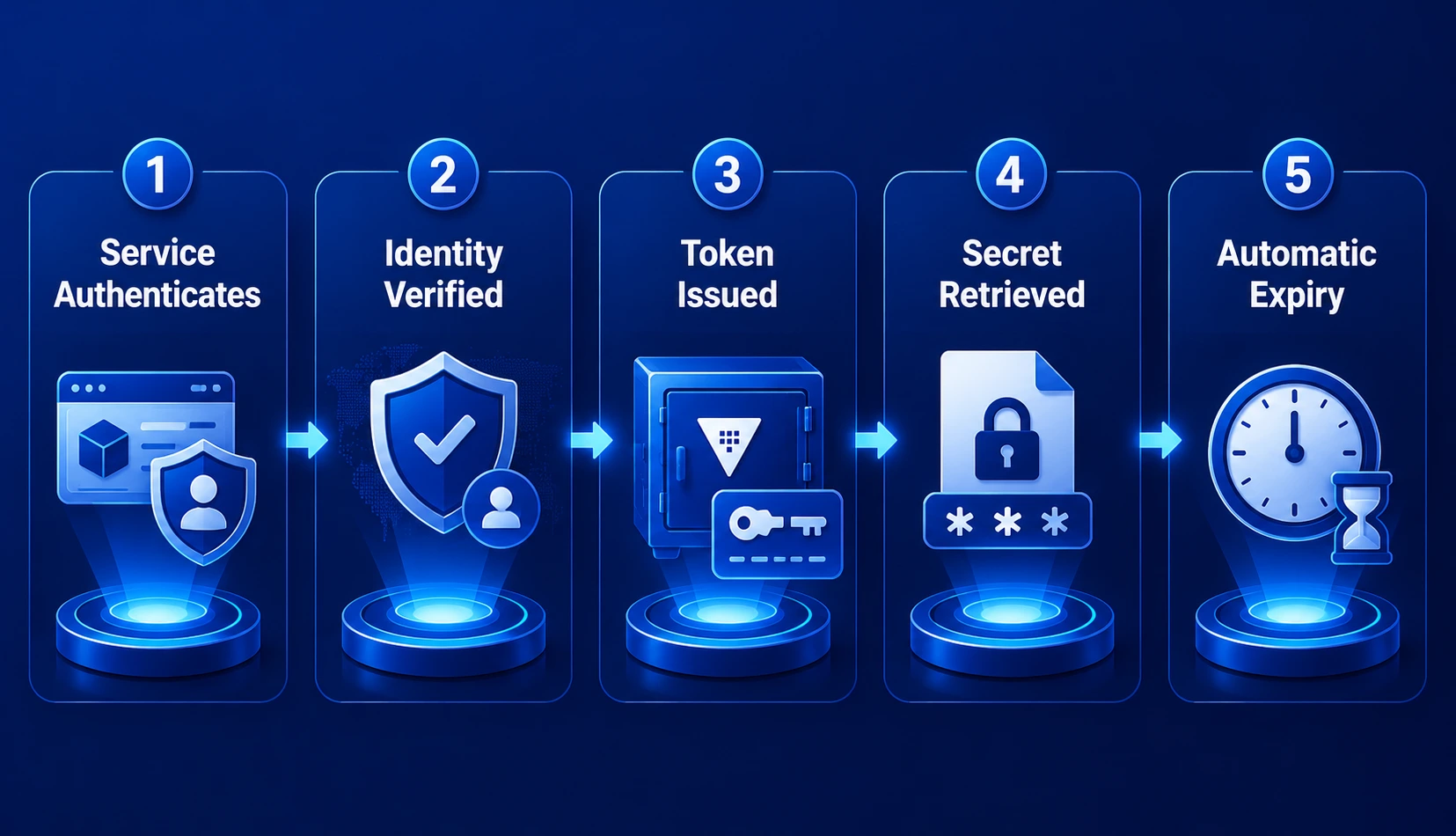
Identity-Based Access Flow in HashiCorp Vault
Service Authenticates
The financial microservice presents its Kubernetes service account token, AWS IAM role, or AppRole credentials to the Vault auth endpoint.
Identity Verified
Vault validates the identity against the configured identity provider and determines which policies apply to this identity.
Token Issued
A short-lived Vault token is issued with the applicable policies attached. This token has a TTL configured for the service’s operational window.
Secret Retrieved
The service uses the token to request its authorized secrets. Vault evaluates the policy, logs the request, and returns the permitted secret.
Automatic Expiry
Both the token and the dynamic secret expire automatically at their configured TTL, requiring the service to re-authenticate on its next cycle.
Integrating Vault With Financial Software Tech Stack Components
One of HashiCorp Vault’s greatest strengths for financial platforms is its extensive integration ecosystem. A modern financial software stack typically spans multiple layers: container orchestration (Kubernetes), CI/CD pipelines (Jenkins, GitHub Actions, GitLab CI), databases (PostgreSQL, Oracle, MongoDB), message brokers (Kafka, RabbitMQ), cloud platforms (AWS, Azure), and custom microservices. HashiCorp Vault integrates with all of these through native auth methods, secrets engines, and well-documented SDKs.
For Kubernetes environments, HashiCorp Vault Docker images and Helm charts make cluster deployment straightforward. The Vault Agent Injector automatically intercepts pod startup, authenticates to Vault on behalf of the pod, and injects the required secrets as files or environment variables. For financial services teams adopting Kubernetes secrets management, this means no changes to application code whatsoever.
In secure DevOps workflows, HashiCorp Vault integrates with CI/CD systems so that build pipelines never store credentials in plaintext. A GitHub Actions workflow can authenticate to Vault using JWT/OIDC, retrieve the necessary credentials for deployment, use them for the deployment step, and have them revoked automatically when the pipeline completes. This model eliminates the practice of storing sensitive credentials in CI/CD platform secret stores that have weaker access controls than Vault.
How HashiCorp Vault Supports Compliance in Financial Systems?
Regulatory compliance is not a side benefit of HashiCorp Vault; it is a core value proposition for financial institutions. Every major financial compliance framework demands some combination of encryption key management, access control, credential lifecycle management, and audit evidence. HashiCorp Vault delivers all of these through a single, unified platform, reducing the compliance surface area that security and compliance teams need to manage.
Compliance Framework Alignment
| Compliance Framework | Region | HashiCorp Vault Coverage |
|---|---|---|
| PCI-DSS v4.0 | Global | Encryption, access control, key rotation, audit logs |
| RBI IT Framework | India | Credential management, encryption, change tracking |
| CBUAE Guidelines | UAE (Dubai) | Data protection, IAM, incident response readiness |
| GDPR | EU / Global | Data encryption, access governance, data minimization |
| SOC 2 Type II | Global | Security, availability, confidentiality controls and evidence |
| NESA UAE IA Std | UAE | Information security controls, key management, access logging |
Teams pursuing HashiCorp Vault certification (particularly the Vault Operations Professional track) are trained specifically on configuring Vault for compliance-aligned deployments. This certification validates that practitioners can design policies, configure audit backends, and operate Vault in environments where regulatory evidence is required. For financial institutions, having HashiCorp Vault certified engineers on staff is increasingly a signal of security maturity.
Audit Logging and Monitoring Inside Financial Secrets Infrastructure
Compliance and audit logging in HashiCorp Vault is not a secondary feature; it is architecturally fundamental. Vault mandates that at least one audit backend is enabled before it will serve any secrets in production mode. This design decision reflects how seriously HashiCorp treats the audit trail for financial and regulated environments. If the audit backend becomes unavailable, Vault stops serving requests to protect the integrity of the compliance record.
Every single request to HashiCorp Vault, including authentication attempts, secret reads, policy changes, and configuration updates, is written to the audit log with full request and response metadata. The log entries include the requesting token’s identity, the operation performed, the path accessed, the timestamp, and the response code. For financial forensics teams, this provides a complete reconstruction capability for any incident involving secrets access.
HashiCorp Vault audit logs ship to file, syslog, or socket backends, and integrate naturally with SIEM platforms like Splunk, Elastic, and Datadog. Financial security operations centres in India and UAE route Vault audit logs into their central SIEM for real-time anomaly detection: spotting an unusual spike in secret read attempts, access from an unexpected IP range, or a service account reading secrets outside its normal operational hours.
File Audit Backend
Writes structured JSON logs to a local file path. The most common configuration for log shippers like Filebeat or Fluentd to forward to SIEM.
Syslog Audit Backend
Sends audit events directly to the system syslog service. Convenient for existing syslog infrastructure in on-premise financial data centres.
Socket Audit Backend
Streams audit events to a TCP or UDP socket for real-time ingestion into log aggregators and monitoring pipelines in cloud-native environments.
Common Challenges When Adopting Secrets Management in Finance
Despite its power, adopting HashiCorp Vault in a financial institution comes with real operational challenges. Over eight years of implementations across banking, fintech, and investment platforms in India and UAE, our team has encountered the same categories of friction repeatedly. Understanding these ahead of time allows financial teams to plan migrations more realistically.
Secret Sprawl Discovery
Financial platforms accumulate secrets across dozens of systems over years. Inventorying all existing credentials before migration is time-consuming but essential.
Legacy App Compatibility
Older core banking applications may not support dynamic secrets natively. Vault Agent and proxy modes help bridge this gap without requiring application code changes.
HashiCorp Vault Pricing and Licensing
Evaluating HashiCorp Vault pricing between open source, HCP Vault, and Enterprise tiers requires careful assessment of compliance features needed versus operational capacity available.
Policy Design Complexity
Writing least-privilege policies for hundreds of microservices across multiple environments requires careful planning. Poor policy design creates both security gaps and operational bottlenecks.
High Availability Setup
Configuring a production-grade, highly available Vault cluster with Raft storage and disaster recovery replication requires operational expertise beyond standard hashicorp vault documentation reading.
Team Skills Gap
Vault is a sophisticated platform. Financial teams benefit significantly from investing in HashiCorp Vault certification programs before attempting enterprise-scale production deployments.
What Strong Secrets Management Means for Financial Software Security?
Strong secrets management, anchored by HashiCorp Vault, is not just a technical hygiene measure. It represents a fundamental shift in how financial institutions think about trust inside their infrastructure. In a world where the perimeter has dissolved and every microservice, container, and cloud function is a potential attack surface, the ability to cryptographically verify identity and grant only time-limited, minimal-privilege access becomes the primary security control.
For financial platforms in India and UAE, where regulatory scrutiny is intensifying and the attack surface is expanding with cloud adoption, HashiCorp Vault provides the infrastructure security automation layer that allows security teams to enforce consistent controls at scale without manual overhead. The shift from days of manual rotation to under five minutes, documented in real NORD/LB deployments, is not an anomaly. It reflects what happens when a purpose-built secrets management platform replaces ad-hoc practices.
What is hashicorp vault at its core? It is a trust authority for your infrastructure. It decides which identities are allowed to access which secrets, under which conditions, for how long. In financial software, where the consequences of misplaced trust are measured in regulatory fines, customer impact, and reputational harm, having that trust authority be explicit, policy-driven, and fully auditable is not an option. It is the baseline from which strong financial software security must be built.
Whether you are evaluating HashiCorp Vault open source for a startup fintech in Bengaluru, assessing HashiCorp Vault pricing for a regional bank in Dubai, or planning a Kubernetes secrets management rollout for a lending platform migrating to microservices, the foundational decision to adopt a proper secrets management platform is the one that pays compounding security dividends for years. The hashicorp vault documentation, enterprise support, and a growing community of certified practitioners make this transition more accessible than ever in 2026.
Ready to Implement HashiCorp Vault in Your Financial Platform?
From policy design to production rollout, our team brings proven expertise in HashiCorp Vault for regulated financial environments across India and UAE.
Frequently Asked Questions
Q1.1. What is HashiCorp Vault and why do financial teams use it?
HashiCorp Vault is an identity-based secrets management platform that securely stores, manages, and controls access to tokens, passwords, API keys, and encryption keys. Financial teams use it to eliminate static credential risks, enforce access policies, and meet strict regulatory compliance requirements across complex infrastructure environments.
Q2.2. How does HashiCorp Vault handle database credentials in banking apps?
HashiCorp Vault uses dynamic secrets to generate short-lived, on-demand database credentials for banking applications. Each service receives a unique credential that automatically expires after a set time, dramatically reducing the risk of credential theft, misuse, or long-term exposure inside financial systems and their connected databases.
Q3.3. Is HashiCorp Vault open source and free to use for finance teams?
Yes, HashiCorp Vault open source (Community Edition) is free. However, enterprise features like HSM integration, namespaces, disaster recovery replication, and advanced Sentinel policies require a paid license. Finance teams in India and UAE often start with the open source tier before upgrading to enterprise as their compliance needs grow.
Q4.4. Where can I find HashiCorp Vault documentation and download it?
You can access HashiCorp Vault documentation at developer.hashicorp.com/vault/docs. The HashiCorp Vault download is available at the same official portal. The platform supports Linux, macOS, and Windows, and detailed setup guides cover both standalone and clustered production deployments for enterprise environments.
Q5.5. Can HashiCorp Vault run with Docker and Kubernetes in financial infrastructure?
Absolutely. HashiCorp Vault Docker images are available on Docker Hub and the official registry. Vault integrates natively with Kubernetes secrets management via the Vault Agent Injector and CSI provider, allowing financial applications running in Kubernetes clusters to securely retrieve secrets at runtime without hardcoding credentials.
Q6.6. How much does HashiCorp Vault pricing cost for a financial institution?
HashiCorp Vault pricing varies based on deployment type. The Community Edition is free. HCP Vault Dedicated (managed cloud) is billed per cluster. Vault Enterprise pricing is based on nodes and features needed. Financial institutions in India and Dubai typically evaluate total cost of ownership including operational overhead when choosing between tiers.
Q7.7. What is HashiCorp Vault certification and is it worth getting?
HashiCorp Vault certification (the Vault Associate and Vault Operations Professional exams) validates your ability to operate and configure Vault in real environments. For security engineers and DevOps professionals working in financial firms, this certification demonstrates practical expertise in secure credential storage, encryption key management, and policy authoring.
Q8.8. How does HashiCorp Vault help with financial regulatory compliance?
HashiCorp Vault supports compliance and audit logging by maintaining a detailed, tamper-evident audit trail of every secret access event. This helps financial institutions in India and UAE satisfy requirements under PCI-DSS, RBI guidelines, GDPR, and other frameworks by proving who accessed what sensitive data and exactly when.
Q9.9. What are dynamic secrets in HashiCorp Vault and how do they improve security?
Dynamic secrets are credentials generated by HashiCorp Vault on demand, unique to each request, with a built-in time-to-live. Unlike static passwords stored in config files, dynamic secrets expire automatically. For financial platforms, this means a compromised credential is only valid for a short window, drastically reducing data breach prevention exposure.
Q10.10. How does HashiCorp Vault compare to other secrets management tools for finance?
Compared to AWS Secrets Manager or Azure Key Vault, HashiCorp Vault offers greater flexibility, multi cloud security support, and infrastructure security automation that is not locked to a single provider. For financial institutions running hybrid or multi-cloud environments across India and UAE, Vault’s vendor-agnostic architecture provides a distinct operational advantage.
Explore Services
Related Services
Reviewed by

Aman Vaths
Founder of Nadcab Labs
Aman Vaths is the Founder & CTO of Nadcab Labs, a global digital engineering company delivering enterprise-grade solutions across AI, Web3, Blockchain, Big Data, Cloud, Cybersecurity, and Modern Application Development. With deep technical leadership and product innovation experience, Aman has positioned Nadcab Labs as one of the most advanced engineering companies driving the next era of intelligent, secure, and scalable software systems. Under his leadership, Nadcab Labs has built 2,000+ global projects across sectors including fintech, banking, healthcare, real estate, logistics, gaming, manufacturing, and next-generation DePIN networks. Aman’s strength lies in architecting high-performance systems, end-to-end platform engineering, and designing enterprise solutions that operate at global scale.