Ai Overview
Accounting software is a digital tool designed to record, organise, and manage the day-to-day financial transactions of a business. Understanding the distinction between these two categories of accounting and finance software is essential before making an investment decision. Finance teams can create reports on demand, schedule delivery to stakeholders, and drill down into specific cost centres or revenue streams.
Key Takeaways
- 01. Financial management software goes beyond bookkeeping by offering strategic planning, forecasting, and real-time cash flow visibility for businesses.
- 02. Accounting software is ideal for small businesses focused on daily transaction recording, invoicing, and tax compliance with straightforward financial needs.
- 03. Cloud financial management software offers real-time access, lower infrastructure costs, and automatic updates suited for businesses across India and UAE.
- 04. Budgeting and forecasting tools in financial management software help businesses anticipate revenue gaps and allocate resources more effectively.
- 05. Automated financial reporting reduces human error and saves hours weekly, allowing finance teams to focus on analysis rather than manual data entry.
- 06. Integration with payroll management software and banking systems ensures accurate reconciliation and eliminates duplicate data entry across departments.
- 07. Data security in enterprise financial software must include encryption, role-based access controls, and compliance with regional regulations in India and UAE.
- 08. Growing businesses often outgrow basic accounting software and require a full finance management system to manage multi-entity and multi-currency operations.
- 09. Expense tracking software within a finance management system provides granular visibility into spending patterns and helps control overhead costs effectively.
- 10. Choosing the right financial management software depends on business size, industry, compliance requirements, and the level of financial analytics tools needed.
When businesses explore tools to manage their finances, two categories often come up: accounting software and financial software. While both deal with money and financial data, they serve very different purposes and address different stages of a business’s financial maturity. With over eight years of experience building and deploying business financial software for companies across India and UAE (Dubai), our team has seen firsthand how choosing the wrong tool creates bottlenecks, compliance issues, and missed growth opportunities.
This guide breaks down the core differences, capabilities, and use cases for both accounting software and financial management software, so your business can make the right decision with confidence.
What is Accounting Software?
Accounting software is a digital tool designed to record, organise, and manage the day-to-day financial transactions of a business. It covers core bookkeeping functions such as recording income and expenses, generating invoices, tracking accounts payable and accounts receivable, and preparing financial statements like profit and loss reports and balance sheets.
For small businesses, freelancers, and early-stage startups in India and UAE, bookkeeping software and invoicing and billing software form the backbone of financial record-keeping. The primary goal is accuracy in transactional data and compliance with local tax laws such as GST in India or VAT in the UAE.
Accounting and finance software at this level is typically user-friendly, affordable, and focused on operational tasks rather than strategic decision-making. It answers questions like: How much did we earn this month? What do we owe suppliers? Are our books balanced?
What is Financial Management Software?
Financial management software is a broader, more advanced category of business financial software that encompasses accounting functions while adding strategic layers such as budgeting, financial forecasting, cash flow management, financial analytics, and multi-entity reporting. It is designed for businesses that need not just to record finances but to actively plan, control, and optimise their financial health.
A robust finance management system provides CFOs, finance directors, and business owners with real-time dashboards, predictive insights, and scenario planning tools. It answers deeper questions like: Can we afford to expand next quarter? Where are we overspending? How will a new hire affect our cash flow over six months?
Enterprise financial software at this level often integrates with ERP systems, CRM platforms, payroll management software, and banking APIs to create a unified view of financial health across the organisation. For growing businesses in India and UAE, this integration is often the difference between reactive and proactive financial decision-making.
Core Functions of Accounting Software
Accounting software centres on transactional accuracy and compliance. The core functions that businesses rely on from business accounting solutions include the following:
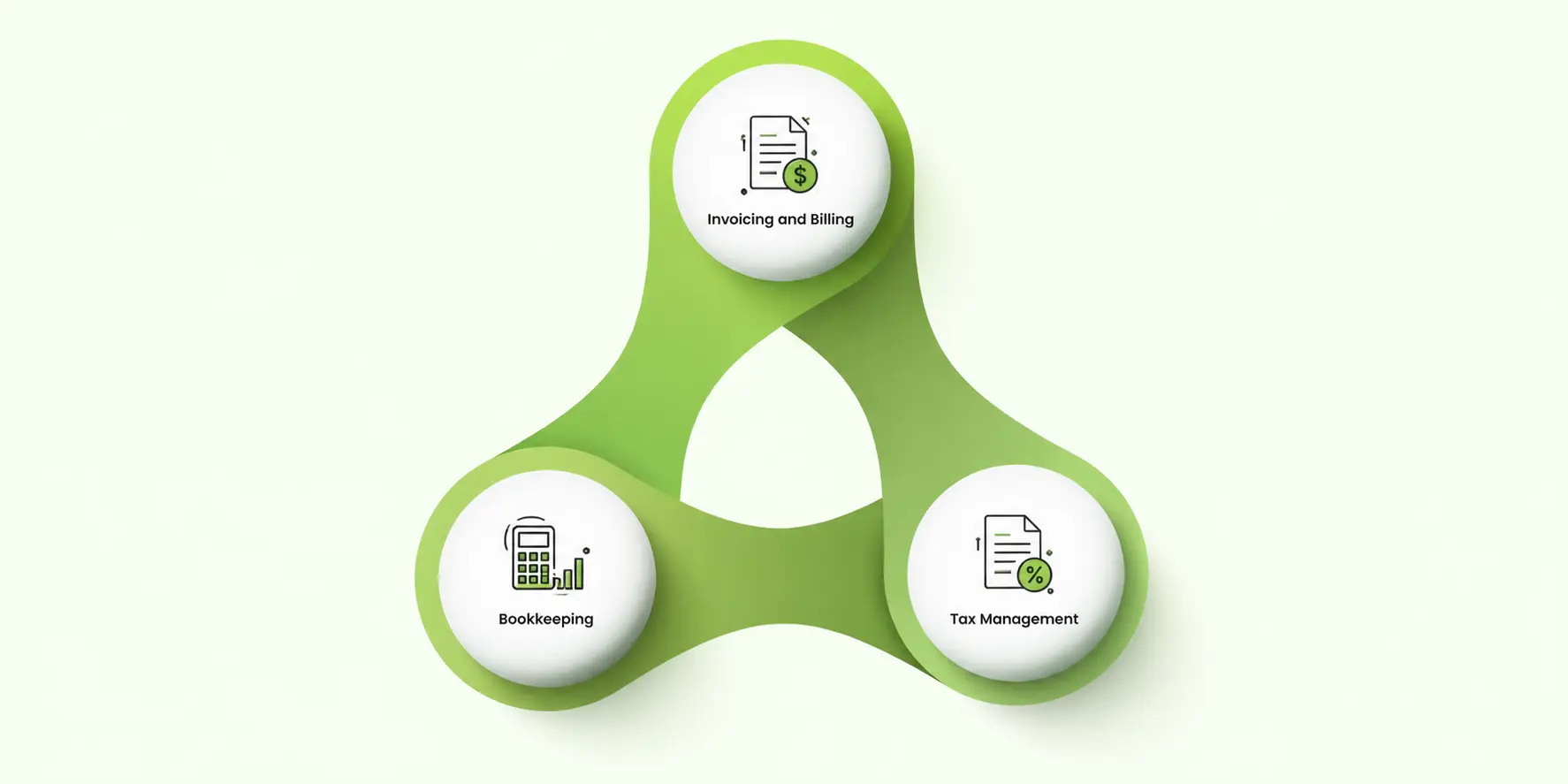
Invoicing and Billing
Generate professional invoices, track payment status, and automate reminders using invoicing and billing software built into accounting platforms.
Bookkeeping
Record daily transactions, reconcile bank statements, and maintain a general ledger using bookkeeping software that keeps records audit-ready at all times.
Tax Management
Tax management software within accounting platforms calculates applicable taxes, generates returns, and ensures compliance with GST or VAT regulations.
Additionally, accounts payable software and accounts receivable software track money owed to and from the business, ensuring cash flow stays predictable and vendor relationships remain healthy. Most accounting platforms also produce standard financial reports including profit and loss statements, balance sheets, and cash flow summaries.
Key Features of Financial Management Software
Financial management software builds upon accounting capabilities and adds powerful strategic layers. Here are the defining features that separate a full finance management system from basic accounting tools:
Budgeting and Forecasting
Budgeting and forecasting software tools allow finance teams to create annual budgets, run what-if scenarios, and compare actual performance against planned targets on a rolling basis.
Cash Flow Management
Cash flow management software provides rolling cash flow projections, flags potential shortfalls weeks in advance, and helps businesses time their receivables and payables strategically.
Financial Analytics Tools
Financial analytics tools turn raw data into actionable KPI dashboards, trend analyses, and performance benchmarks, giving leadership the clarity needed for strategic decision-making.
Automated Financial Reporting
Automated financial reporting schedules and distributes reports to stakeholders on preset schedules, eliminating manual compilation and ensuring consistency across departments.
Multi-Entity Management
Enterprise financial software handles consolidated reporting across subsidiaries, departments, or regional offices, which is critical for businesses operating across India and UAE simultaneously.
Financial Planning Tools
Financial planning tools support long-term capital allocation, investment analysis, and strategic workforce cost planning, helping CFOs build three-to-five year financial roadmaps.
Main Differences Between Accounting Software and Financial Management Software
Understanding the distinction between these two categories of accounting and finance software is essential before making an investment decision. The table below outlines the primary differences across key dimensions:
| Dimension | Accounting Software | Financial Management Software |
|---|---|---|
| Primary Focus | Transaction recording and compliance | Strategic planning and financial control |
| Target User | Small businesses, bookkeepers, freelancers | Mid to large businesses, CFOs, finance teams |
| Budgeting Tools | Limited or basic | Advanced with scenario modelling |
| Reporting | Standard financial statements | Custom dashboards and automated reports |
| Integrations | Basic banking and tax integrations | ERP, CRM, payroll, banking, and HR systems |
| Multi-Currency | Often limited | Full multi-currency and multi-entity support |
| Cost Range | Lower, subscription from a few hundred per month | Higher, based on features, users, and customisation |
Reporting Capabilities in Accounting and Financial Management Software
Financial reporting software capabilities vary significantly between the two categories. Standard accounting software produces three core reports: the income statement, balance sheet, and cash flow statement. These are essential for tax filing and basic performance reviews but offer limited depth for forward-looking decisions.
Financial management software, on the other hand, delivers automated financial reporting with customisable dashboards, variance analysis, departmental breakdowns, and period-over-period comparisons. Finance teams can create reports on demand, schedule delivery to stakeholders, and drill down into specific cost centres or revenue streams. [1]
For businesses in the UAE managing VAT returns or in India managing GST compliance alongside investor reporting, the depth of financial reporting software in a full finance management system provides both compliance coverage and strategic insight in a single platform.
Budgeting and Forecasting Tools Compared
Budgeting and forecasting software is one of the clearest differentiators between accounting tools and a full financial management platform. Most accounting software offers a basic budget module where users can enter expected figures and compare them to actuals at month-end. This is useful but static.
Accounting Software Budgeting
- Simple annual budget entry
- Basic actual vs budget comparison
- Department-level allocation
- No scenario modelling
- Limited rolling forecasts
Financial Management Software Budgeting
- Rolling 12 to 36-month forecasts
- What-if scenario planning
- Driver-based budgeting models
- Automated reforecast on actuals
- Cross-departmental budget consolidation
Why It Matters for Growth
- Predict cash gaps before they occur
- Align hiring with revenue projections
- Plan capital expenditure strategically
- Present credible plans to investors
- Adjust quickly to market changes
Financial planning tools in a complete finance management system connect budgets to actual performance in real time, allowing finance teams to spot variances early and take corrective action before quarter-end surprises arise.
Automation Features and Daily Workflows
Automation is where financial management software truly separates itself from traditional bookkeeping software. In daily workflows, automation eliminates repetitive manual tasks, reduces error rates, and frees up finance professionals to focus on higher-value analysis. The following shows how automation works across both categories:
Bank Reconciliation Automation
Both accounting and financial management platforms now offer automated bank feeds. However, financial management software adds intelligent categorisation rules, exception flagging, and approval workflows that accounting tools typically lack.
Automated Invoicing and Collections
Invoicing and billing software in financial management platforms automates recurring invoices, payment reminders, and overdue escalations, significantly improving accounts receivable turnaround times.
Expense Tracking Automation
Expense tracking software in modern platforms allows employees to capture receipts via mobile, automatically extracts amounts, and routes expenses through approval chains without any manual data entry from finance staff.
Automated Period Close
Enterprise financial software automates month-end and year-end close processes, running checklists, accruals, amortisation schedules, and consolidations, cutting close time from days to hours for finance teams.
Integration With Payroll and Banking Systems
One of the most practically valuable capabilities of financial management software is its ability to integrate seamlessly with payroll management software, banking APIs, and other enterprise systems. This eliminates the data silos that plague businesses relying on disconnected tools.
When payroll management software is connected to a finance management system, salary processing, employer contributions, and tax deductions are automatically reflected in the general ledger. There is no manual journal entry, no risk of discrepancy, and payroll costs are immediately visible in budget vs actual dashboards.
Key Integration Points in Financial Management Software
Banking APIs
Real-time balance feeds, automatic reconciliation, and payment initiation directly from the finance platform.
Payroll Systems
Payroll data flows directly into cost centre reports, ensuring salary expenses are tracked with full granularity.
ERP and CRM
Sales data from CRM populates revenue forecasts automatically, reducing the lag between deals won and finance visibility.
For businesses in India and UAE with operations across multiple banking relationships and entities, this integration capability is not a luxury but a necessity for maintaining accurate, real-time financial visibility.
Data Security and Compliance Considerations
Financial data is among the most sensitive information a business holds. Whether you choose accounting software or a full financial management software platform, data security must be a non-negotiable requirement in your evaluation process.
Cloud financial management software from reputable providers offers multiple security layers including AES-256 encryption, multi-factor authentication, role-based access controls, and regular third-party security audits. For businesses in India, compliance with the PDPB (Personal Data Protection Bill) is increasingly important. For UAE-based businesses, alignment with UAE PDPL and DIFC data protection standards is required.
India Compliance
GST return filing, TDS compliance, PDPB data residency requirements, and SEBI reporting for listed companies are all addressed in enterprise-grade financial management platforms.
UAE Compliance
VAT return automation, UAE PDPL alignment, DIFC data protection standards, and FTA audit trail requirements are essential for businesses operating in Dubai and the wider UAE.
Universal Security Standards
SOC 2 Type II certification, ISO 27001 alignment, regular penetration testing, and disaster recovery provisions are baseline expectations for any business financial software handling sensitive data.
How Financial Management Software Supports Growth?
Growth-stage businesses face a unique financial challenge: the volume and complexity of financial data increases rapidly while the capacity of their finance team often lags behind. Financial management software bridges this gap by scaling financial operations without proportionally scaling headcount.
Impact of Financial Management Software on Business Efficiency
Beyond efficiency, financial management software supports growth by providing the data quality and analytical depth that investors, lenders, and board members expect. A business that can produce detailed rolling forecasts, consolidated multi-entity reports, and scenario analyses is simply better positioned to raise capital and attract strategic partners than one relying solely on basic accounting tools.
When Small Businesses Need Accounting Software?
Not every business needs the full power of a finance management system from day one. For many small businesses, accounting software is the right starting point. Understanding when accounting software is sufficient helps avoid overspending on features a business is not yet ready to use.
Accounting software is a strong fit when a business has a single legal entity with straightforward revenue streams, a finance function managed by one or two people, compliance needs limited to standard tax filings, no immediate requirement for investor-grade financial reporting, and a relatively predictable cash flow that does not need complex forecasting tools.
In these scenarios, business accounting solutions that focus on invoicing, bookkeeping, and basic reporting provide excellent value without the learning curve or cost of enterprise financial software. The key is to choose a platform that can grow with the business so migration costs are minimised when the time comes to upgrade.
Signs You Need Financial Management Software
There are clear indicators that a business has outgrown its basic accounting software and needs a dedicated financial management software platform. Watch for these signals:
Month-End Takes Too Long
If closing the books takes more than five working days each month, manual processes and disconnected tools are creating bottlenecks that automated financial reporting in a finance management system can solve.
Multiple Entities or Currencies
Managing subsidiaries in both India and UAE, or handling transactions in INR and AED, requires multi-entity consolidation that goes beyond what standard accounting software can handle reliably.
Cash Flow Surprises
If the business regularly encounters unexpected cash shortfalls, cash flow management software with rolling projections and early warning alerts is essential to maintain financial stability and growth.
Investor or Board Reporting Required
Investors and boards expect detailed KPI dashboards, variance analyses, and forward-looking financial models that only a proper financial management software platform can produce efficiently.
Finance Team Spending Time on Spreadsheets
When skilled finance professionals spend most of their time compiling data in spreadsheets rather than analysing it, a finance management system with automated financial reporting is overdue.
Budget vs Actual Tracking is Manual
If budget monitoring requires manually pulling actuals and comparing them in spreadsheets, budgeting and forecasting software integrated into a proper platform would save significant time and reduce errors.
Cost Comparison Between Accounting and Financial Management Software
Cost is one of the most frequently asked questions when businesses evaluate accounting software versus financial management software. The table below provides a general cost framework to set realistic expectations:
| Category | Accounting Software | Financial Management Software |
|---|---|---|
| Entry Level | Very affordable, basic plans start low | Mid-range pricing, more features included |
| Mid-Market | Moderate, scales with users and features | Higher investment, covers multi-entity needs |
| Enterprise | Custom pricing for large organisations | Significant investment; custom builds available |
| Implementation Cost | Minimal, mostly self-service setup | Moderate to high, includes data migration |
| Training Requirements | Low, intuitive interfaces | Moderate, structured onboarding recommended |
| ROI Timeline | Immediate through time savings | Three to six months, then compounding returns |
Note: Costs vary significantly by vendor, region, number of users, and customisation scope. Always request a detailed quote based on your specific business requirements.
Choosing the Right Software for Your Business
Selecting between accounting software and financial management software is not a one-size-fits-all decision. It depends on your business size, growth trajectory, industry, compliance obligations, and the level of financial insight your leadership team requires to make confident decisions.
With over eight years of experience building and implementing business financial software for clients across India and UAE, our team recommends evaluating the following framework before making your final decision:
Decision Framework for Choosing Financial Management Software
Assess Your Current Pain Points
List the top five tasks consuming most of your finance team’s time. If they are analytical tasks masked by manual data work, financial management software is likely the answer.
Define Your Reporting Requirements
Map out every report your leadership, investors, and board require monthly. If standard accounting reports cannot serve these needs, financial reporting software in a full platform is necessary.
Evaluate Integration Needs
List all systems your finance function must connect to, including payroll management software, banking APIs, CRM, and ERP. Ensure the platform you choose supports native or API-based integration with all of them.
Consider Scalability Over Current Needs
Choose a cloud financial management software platform that can scale as the business grows. Migrating financial systems is costly and disruptive, so selecting a platform with room to grow avoids future disruption.
Validate Vendor Support and Localisation
For businesses in India and UAE, ensure the vendor offers local compliance support, regional data hosting options, and responsive support in your timezone. Generic global platforms often fall short on local tax and regulatory specifics.
Ultimately, the right financial management software is the one that removes friction from your finance function today while giving you the infrastructure to support where your business needs to be in three to five years. Whether that is a focused accounting platform or a comprehensive finance management system, the decision should be driven by data, not assumptions.
Ready to Upgrade Your Financial Management Software?
Let our team help you identify, design, and deploy the right financial management software built for your business goals in India and UAE.
Frequently Asked Questions
Q1.1. What is the difference between accounting software and financial management software?
Accounting software handles day-to-day bookkeeping tasks like recording transactions and generating invoices, while financial management software offers broader tools including budgeting, forecasting, and strategic financial planning for businesses.
Q2.2. Which financial management software is best for small businesses in India?
For small businesses in India, cloud-based financial management software with invoicing, GST compliance, expense tracking, and payroll integration tends to work best. It saves time and reduces manual errors in daily finance operations.
Q3.3. Is financial management software suitable for startups in Dubai or UAE?
Yes, financial management software is well suited for startups in Dubai and the UAE. It supports multi-currency transactions, VAT compliance, and real-time financial reporting which are all critical needs for businesses operating in the UAE market.
Q4.4. How does cloud financial management software help businesses save money?
Cloud financial management software eliminates the need for expensive on-premise hardware and IT maintenance. It offers subscription-based pricing and automates repetitive tasks, which reduces administrative costs and increases overall operational efficiency for businesses.
Q5.5. Can financial management software replace a finance team or accountant?
No, financial management software is a tool that supports your finance team by automating routine tasks. It helps accountants and finance managers work faster and more accurately but does not replace the judgment and expertise a trained professional provides.
Q6.6. What features should I look for in financial management software?
Look for features like automated financial reporting, budgeting and forecasting tools, cash flow management, payroll integration, tax management, multi-currency support, and strong data security when evaluating financial management software for your business.
Q7.7. How long does it take to set up financial management software for a business?
Setup time varies by solution and business size. Basic cloud financial management software can be configured in a few days, while enterprise financial software with custom integrations and data migration may take a few weeks to go fully live.
Q8.8. Is my financial data safe with cloud-based financial management software?
Reputable cloud financial management software providers use bank-grade encryption, multi-factor authentication, and regular security audits. Always check for compliance with local data regulations in India and the UAE before selecting a platform.
Q9.9. What is the average cost of financial management software for a medium-sized business?
Costs range widely depending on features and users. Basic plans may start around a few thousand rupees or AED per month, while full-featured enterprise financial software with advanced analytics and integrations can cost significantly more annually.
Q10.10. How does financial management software support business growth and scaling?
Explore Services
Related Services
Reviewed by

Aman Vaths
Founder of Nadcab Labs
Aman Vaths is the Founder & CTO of Nadcab Labs, a global digital engineering company delivering enterprise-grade solutions across AI, Web3, Blockchain, Big Data, Cloud, Cybersecurity, and Modern Application Development. With deep technical leadership and product innovation experience, Aman has positioned Nadcab Labs as one of the most advanced engineering companies driving the next era of intelligent, secure, and scalable software systems. Under his leadership, Nadcab Labs has built 2,000+ global projects across sectors including fintech, banking, healthcare, real estate, logistics, gaming, manufacturing, and next-generation DePIN networks. Aman’s strength lies in architecting high-performance systems, end-to-end platform engineering, and designing enterprise solutions that operate at global scale.