Ai Overview
Financial software refers to any digital application designed to manage, record, analyze, and report on financial transactions and data within an organization. Businesses report up to 35% reduction in finance operations cost after migrating to digital financial solutions. Accounting software with automated reconciliation reduces data entry errors by up to 90%, ensuring your financial records are always accurate and reliable for internal and external stakeholders.
Key Takeaways
- ✓Financial software automates bookkeeping, invoicing, and expense tracking, reducing human error and cutting operational costs significantly for businesses of all sizes.
- ✓Cloud based financial software offers real-time access, automatic updates, and lower upfront costs compared to traditional on-premise finance management system deployments.
- ✓AI powered financial software uses machine learning to detect fraud, automate reconciliation, and generate predictive financial analytics that inform smarter strategic decisions.
- ✓Businesses in India and UAE benefit from financial software with built-in GST and VAT compliance modules that automate tax calculations and generate audit-ready financial reports.
- ✓Enterprise financial software integrates payroll management software, budgeting software, and financial reporting tools into one unified platform for end-to-end financial control.
- ✓The ROI of financial management software is measurable through time savings, error reduction, compliance accuracy, and faster month-end close cycles across finance teams.
- ✓Security in financial software must include data encryption, multi-factor authentication, and role-based access controls to protect sensitive financial and customer data.
- ✓Financial automation software minimizes manual intervention in cash flow management, expense approval workflows, and financial reporting, boosting team productivity by over 40%.
- ✓Industry-specific digital financial solutions exist for banking, healthcare, retail, and logistics sectors, each addressing unique compliance, reporting, and transaction processing needs.
- ✓Choosing the right financial analytics platform requires evaluating scalability, integration capability, compliance support, vendor reliability, and total cost of ownership carefully.
In today’s fast-moving business landscape, managing finances manually is no longer a viable option. Whether you run a startup in Bengaluru, a trading firm in Dubai, or an enterprise across multiple markets, financial software has become the backbone of every sound financial operation. With over eight years of experience delivering digital financial solutions to clients across India and the UAE, we have seen first-hand how the right financial software development strategy transforms business outcomes.
From accounting software to AI powered financial software, businesses today have access to a rich ecosystem of tools designed to automate, streamline, and scale their financial operations. This guide covers everything you need to know, including types, features, benefits, costs, security, compliance, and how to choose the right finance management system for your needs.
What is Financial Software and How Does it Work?
Financial software refers to any digital application designed to manage, record, analyze, and report on financial transactions and data within an organization. At its core, a finance management system connects various financial processes including bookkeeping, budgeting, payroll, invoicing, and reporting into a unified digital environment.
When a business adopts financial management software, the system automatically records every transaction, categorizes expenses, reconciles accounts, and produces financial reports without manual data entry. Many organizations also integrate sales tax software to automate tax calculations, compliance reporting, and transaction tracking. The software integrates with banks, payment gateways, and ERP systems to pull real-time data and display it through dashboards and financial analytics platforms.
Data Capture
Automates transaction recording from multiple sources in real time
Processing
Categorizes, reconciles, and validates financial entries instantly
Reporting
Generates audit-ready reports, balance sheets, and P&L statements
Finance tracking software works by maintaining a centralized ledger that updates across departments simultaneously, giving finance teams, management, and auditors a single version of financial truth at all times.
Types of Financial Software Used Across Industries
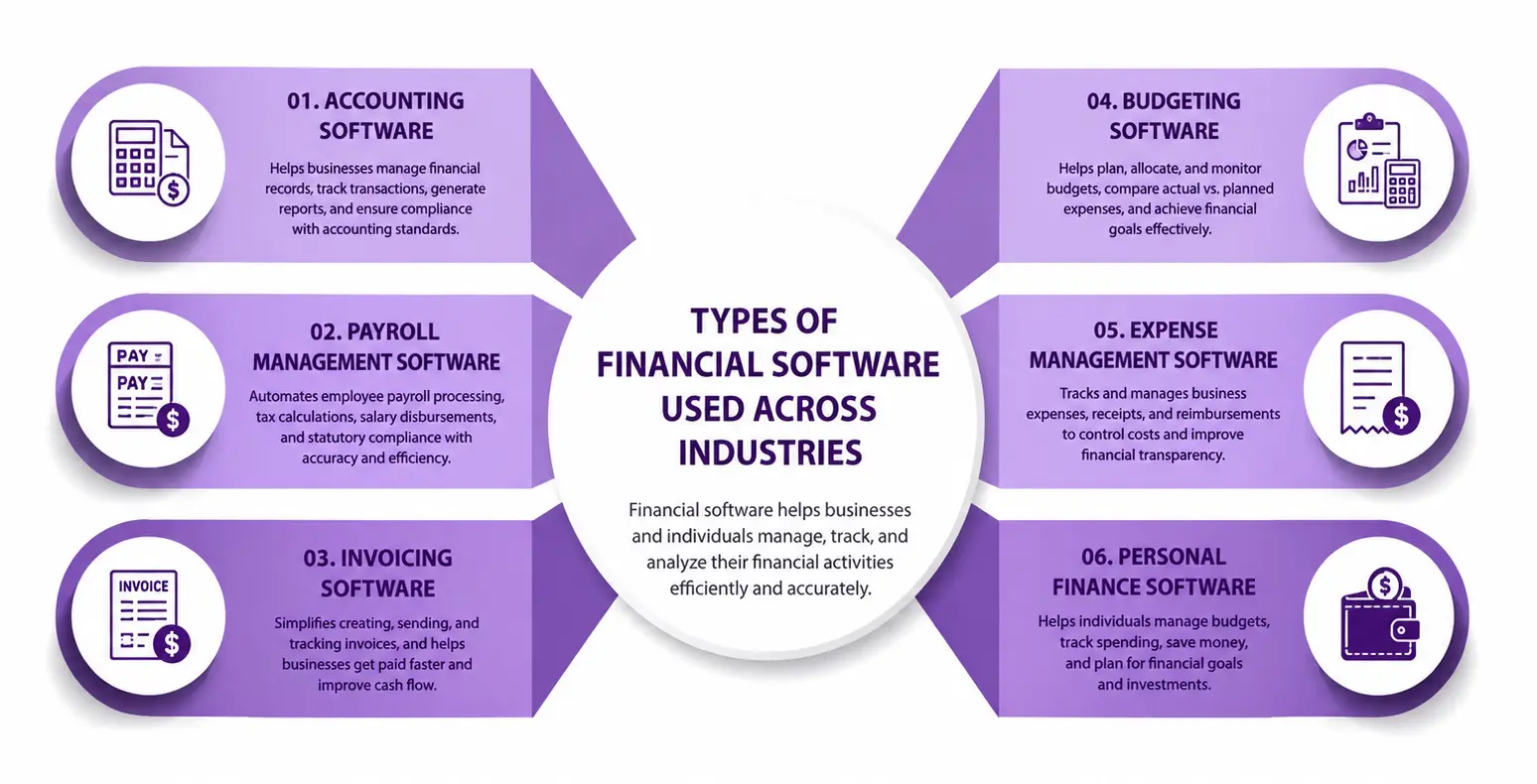
The ecosystem of financial software is broad and diverse. Different business models and industries require different tools. Below is a structured overview of the most widely used types of business finance software across India and UAE markets.
Accounting Software
Handles general ledger management, accounts payable and receivable, bank reconciliation, and financial close processes for businesses of all scales.
Payroll Management Software
Automates salary calculations, tax deductions, provident fund, ESI contributions, and generates payslips for employees across India and UAE operations.
Invoicing Software
Creates and sends professional invoices, tracks payment, sends reminders, and integrates with accounting entries. SaaS teams use usage-based billing software that automates this and maintains accurate cash flow records.
Budgeting Software
Enables departments to plan, allocate, and monitor budgets. It compares actual spending against forecasts and provides variance analysis through integrated financial reporting tools.
Expense Management Software
Streamlines employee expense claims, receipt scanning, approval workflows, and reimbursements while maintaining a full audit trail for compliance and internal controls.
Personal Finance Software
Helps individuals track income, expenses, investments, and savings goals. Popular in retail banking and consumer fintech applications across the UAE and Indian markets.
Key Features of Financial Software for Modern Businesses
Modern financial software is packed with advanced capabilities that go far beyond basic accounting. Here are the core features that leading financial management software platforms offer to growing businesses:
| Feature | Description | Business Impact |
|---|---|---|
| Real-Time Dashboards | Live financial data visualization across all modules | Faster, more informed decisions by leadership |
| Automated Reconciliation | Matches transactions with bank statements automatically | Eliminates reconciliation errors and saves hours weekly |
| Multi-Currency Support | Manages transactions in INR, AED, USD, and more | Essential for India-UAE cross-border business operations |
| Tax Compliance Engine | Built-in GST (India) and VAT (UAE) calculation modules | Reduces filing errors and regulatory penalties |
| Financial Reporting Tools | Custom P&L, balance sheets, cash flow statements | Audit-ready reports available in minutes not days |
| Role-Based Access Control | Restricts data access based on user roles | Strengthens internal security and audit compliance |
| API Integration | Connects with ERP, CRM, and banking platforms | Creates a seamless, connected financial ecosystem |
Top Benefits of Financial Software for Companies
The advantages of implementing financial software extend beyond just saving time. Here are the most impactful benefits that businesses across India and Dubai report after adopting a robust finance management system:
Core Functions of Modern Finance Management Platforms
A comprehensive finance management system fulfills several critical operational functions. These core capabilities define whether a platform is suited for your business or not:
General Ledger Management
The general ledger is the heart of all financial software. It records every financial transaction, classifies them by account type, and forms the basis for all financial reporting tools output including the balance sheet and income statement.
Accounts Payable and Receivable
Bookkeeping software manages outstanding invoices, vendor payments, and customer collections. Automated reminders reduce overdue accounts while improving cash flow management across the business.
Financial Forecasting and Planning
Financial planning software uses historical data to project future revenue, expenses, and cash positions. These forecasts are critical for investor reporting, board presentations, and strategic planning cycles.
Payroll Processing
Payroll management software calculates salaries, tax withholdings, and benefits contributions, then distributes payments on schedule while maintaining complete payroll records for statutory compliance.
Audit and Compliance Management
Enterprise financial software maintains complete audit trails, access logs, and financial records required for internal audits, external audits, and regulatory submissions in both India and UAE jurisdictions.
Latest Trends Shaping Financial Management Technology
The financial software landscape is evolving rapidly. According to a 2026 McKinsey report, fintechs are now generating $650 billion in revenue globally, growing at 21% year-over-year.[1] Here are the trends that are reshaping digital financial solutions today:
Embedded Finance
Financial capabilities like lending, insurance, and payroll are now embedded directly into non-financial apps, creating seamless digital financial solutions within industry-specific platforms.
Open Banking APIs
Open banking standards allow financial management software to connect directly with banking data, enabling real-time balance checks, instant payment initiation, and automated reconciliation flows.
RegTech Integration
Regulatory technology is now built directly into financial software stacks. This gives businesses automated compliance monitoring for GST, VAT, AML, and other regulations applicable in India and UAE.
Cloud Based vs On Premise Financial Systems
One of the most important decisions businesses face when adopting financial software is whether to go with cloud based financial software or an on-premise finance management system. Each has distinct advantages depending on your size, security requirements, and budget.
| Parameter | Cloud Based Financial Software | On-Premise Finance System |
|---|---|---|
| Upfront Cost | Low (subscription model) | High (infrastructure investment) |
| Accessibility | Anytime, anywhere via browser | Limited to office network |
| Scalability | Instantly scalable as you grow | Requires hardware upgrades |
| Updates | Automatic, no downtime | Manual, requires IT team |
| Data Control | Managed by vendor with SLA | Full internal control |
| Best For | SMBs, startups, multi-location businesses | Banks, regulated enterprises with strict data policies |
Technologies Used in Financial Software
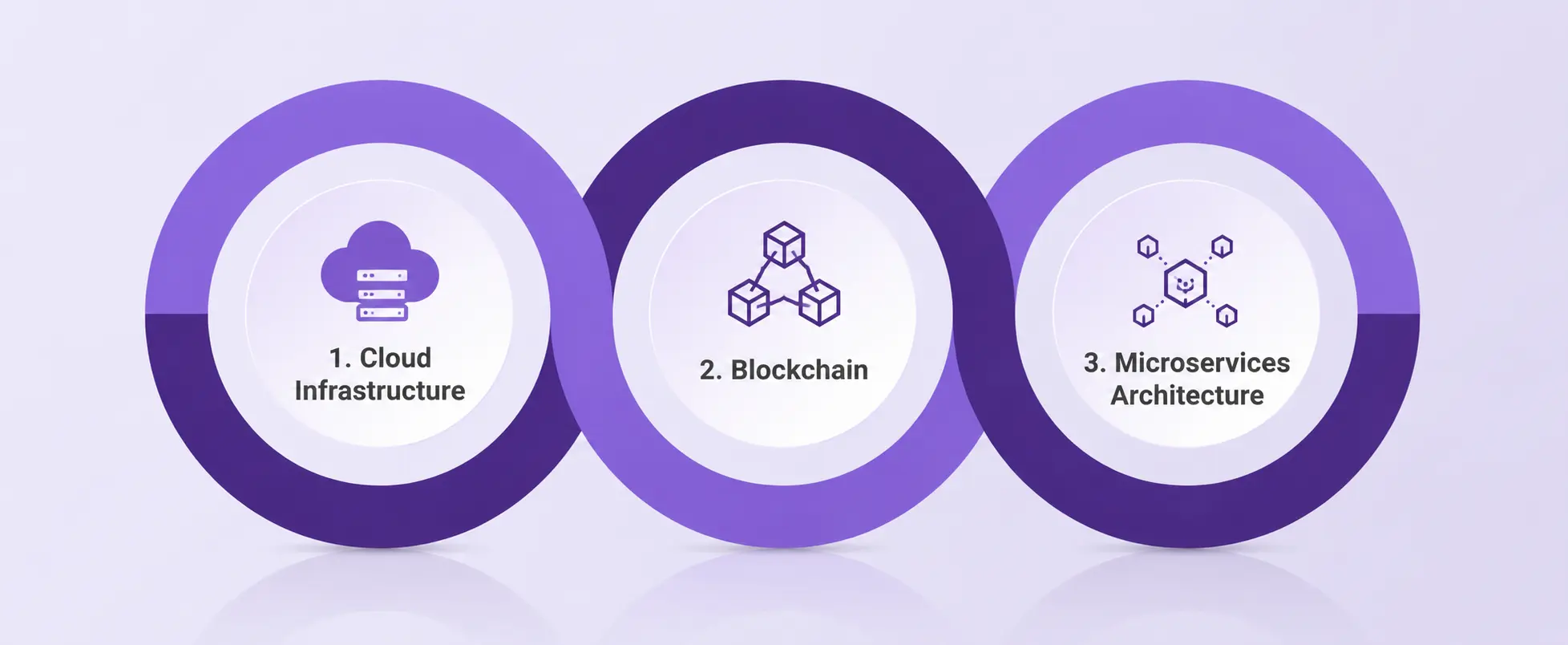
The technical foundation of modern financial software involves a combination of proven and emerging technologies that together deliver reliability, speed, and security at scale.
Cloud Infrastructure
AWS, Azure, and GCP power most cloud based financial software deployments with high availability and disaster recovery.
Blockchain
Used in enterprise financial software for immutable audit trails, smart contract-based payments, and cross-border settlement between India and UAE.
Microservices Architecture
Allows financial management software to be modular, enabling independent updates of payroll, reporting, or invoicing modules without system-wide downtime.
Additionally, modern financial analytics platforms leverage Python and R for statistical modelling, REST and GraphQL APIs for integration, and PostgreSQL or MongoDB for high-performance transactional data storage.
Role of AI and Automation in Financial Platforms
AI powered financial software is no longer a luxury. According to the Cambridge Centre for Alternative Finance 2026 Global AI in Financial Services Report, 81% of financial services firms are already adopting AI at some level. The impact on financial automation software is profound:
How AI Enhances Financial Software Capabilities
Fraud Detection
ML models flag anomalous transactions in milliseconds, protecting business accounts from fraudulent activities 24/7.
Predictive Forecasting
AI analyses historical financial data to produce accurate cash flow and revenue forecasts, enhancing financial planning software precision.
Auto-Categorization
Expense management software uses NLP to automatically categorize transactions without manual review, saving finance teams hours each week.
Financial automation software also uses robotic process automation (RPA) to handle high-volume, rule-based tasks such as data entry, invoice matching, and report generation without human intervention. This allows finance professionals to focus on strategic analysis rather than administrative work.
Common Security Risks in Financial Software
Even the most advanced financial software carries inherent security risks that businesses must proactively address. Understanding these vulnerabilities is the first step toward building secure digital financial solutions:
Data Breach Risk
Unauthorized access to finance management system databases can expose sensitive financial records. Strong encryption at rest and in transit is mandatory for all enterprise financial software deployments.
SQL Injection Attacks
Malicious SQL queries can compromise financial databases if input validation is poor. Financial software must implement parameterized queries and regular penetration testing to eliminate this risk.
Credential Theft
Phishing attacks targeting finance team credentials can give attackers access to invoicing software and payroll management software. Multi-factor authentication must be standard on all accounts.
Financial Compliance Standards Every Business Should Know
Compliance is non-negotiable when adopting financial software. Whether you operate in India, UAE, or both, here are the key compliance frameworks your finance management system must support:
| Standard | Region | What It Covers | Relevant To |
|---|---|---|---|
| GST Compliance | India | Goods and Services Tax filing, returns, and reconciliation | All India-registered businesses |
| VAT Compliance | UAE (Dubai) | 5% VAT on goods and services, FTA filing requirements | UAE-registered businesses above threshold |
| PCI-DSS | Global | Payment card data security and handling standards | Businesses processing card payments |
| IFRS | Global | International financial reporting standards for public companies | Listed companies and multinationals |
| AML/KYC | India and UAE | Anti-money laundering and customer identity verification | Financial institutions and fintech platforms |
Steps Involved in Building Financial Software
Building enterprise-grade financial software from the ground up follows a structured process. With over eight years in this domain, here is the approach we follow for delivering scalable, compliant, and secure business finance software:
Requirements Discovery
Map all financial workflows, compliance requirements, user roles, and integration needs. Define KPIs for the finance management system and validate them with key stakeholders across finance, IT, and compliance teams.
Architecture Planning
Select the tech stack, define the database schema, and plan the microservices architecture. Decide between cloud based financial software and hybrid deployments based on data residency and security requirements.
UI/UX Design
Design intuitive dashboards, approval flows, and reporting interfaces. The UX of financial management software directly impacts adoption rates, especially for non-technical finance users across different departments.
Core Module Implementation
Build core modules including bookkeeping software, payroll management software, expense management software, and financial reporting tools. Ensure each module is independently testable and deployable.
Security Hardening and Compliance
Integrate encryption, MFA, role-based access control, and compliance rules for GST/VAT/AML. Run penetration testing and third-party security audits before any user-facing deployment of the financial software.
Testing, Launch, and Support
Conduct UAT with finance teams, run data migration from legacy accounting software, and launch with a phased rollout. Provide post-launch support for bug fixes, tax rule updates, and feature enhancements.
Factors That Affect Financial Software Cost
The investment required for financial software varies significantly based on the scope and complexity of the project. Here are the primary factors that influence the total cost of your business finance software:
| Cost Factor | Low Impact | High Impact |
|---|---|---|
| Number of Users | 5-10 finance users | 500+ enterprise users across departments |
| Modules Required | Accounting and invoicing only | Full suite including AI analytics platform and payroll |
| Deployment Model | Cloud based financial software (SaaS) | Custom on-premise with dedicated servers |
| Compliance Scope | Single country GST filing | Multi-country (India + UAE) AML/KYC/IFRS |
| AI and Automation | Basic rule-based automation | Full AI powered financial software with ML forecasting |
For SMBs in India, ready-to-use financial management software typically costs between INR 50,000 to INR 3,00,000 annually. Custom enterprise financial software for large organizations in Dubai can range from AED 50,000 to AED 5,00,000 depending on the full project scope.
Measuring ROI of Financial Management Systems
Investing in financial management software delivers measurable returns across multiple dimensions. Here is how businesses quantify the ROI of their digital financial solutions:
Reduction in time spent on manual financial reporting tasks after adopting finance tracking software
Drop in data entry errors when financial automation software replaces manual bookkeeping processes
Faster monthly close cycles after implementing enterprise financial software with automated reconciliation
The ROI calculation should also account for intangible benefits including improved investor confidence, better audit outcomes, reduced compliance risk, and enhanced employee satisfaction from removing tedious manual finance tasks.
Financial Software for Banking, Healthcare and Retail
Every industry has unique financial requirements. The best financial software is tailored to the specific operational workflows, compliance mandates, and reporting standards of each sector. Here is how digital financial solutions serve major industries:
Industry Specific Applications of Digital Finance Platforms
Beyond banking, healthcare, and retail, digital financial solutions are transforming finance functions across a wide range of other sectors:
Logistics and Supply Chain
Finance tracking software integrates with fleet management and inventory systems to track cost per shipment, vendor payments, and cross-border financial transactions between India and Dubai warehouses.
Real Estate
Property management firms use financial planning software to track rental income, maintenance expenses, mortgage payments, and generate property-level P&L reports for investors and boards.
Education
Educational institutions rely on bookkeeping software and fee management modules to handle student fee collections, scholarship disbursements, campus expense tracking, and annual audit preparation.
How to Choose the Right Financial Software?
With hundreds of financial software options available across India and UAE, selecting the right finance management system requires a methodical evaluation. Here is our eight-point checklist refined through years of client engagements:
Define Your Needs Precisely
List all required modules including payroll, budgeting, invoicing, and financial reporting tools before evaluating any vendor.
Check Regional Compliance
Ensure the financial management software supports GST for India and VAT for UAE with automatic updates when tax rules change.
Evaluate Scalability
Choose cloud based financial software that grows with your transaction volume, user count, and business complexity without costly re-implementations.
Assess Integration Capabilities
The financial analytics platform must integrate seamlessly with your ERP, CRM, banking portals, and e-commerce platforms via open APIs.
Review Security Certifications
Confirm the vendor holds ISO 27001, SOC 2, or PCI-DSS certifications relevant to your industry and the sensitivity of your financial data.
Request a Live Demo
Always test the financial software with your actual data scenarios before committing. Evaluate usability, reporting speed, and performance under realistic load conditions.
Calculate Total Cost of Ownership
Look beyond the license fee. Account for implementation, training, integration, maintenance, and annual subscription costs for the full business finance software lifecycle.
Evaluate Vendor Support Quality
Responsive vendor support is critical for financial software. Verify SLA terms, local support availability in India or UAE, and the vendor’s track record for resolving critical issues quickly.
Choosing the right financial software is not just a technology decision. It is a strategic business decision that will shape how your finance team operates, how confidently leadership makes decisions, and how efficiently your organization scales. With our experience delivering digital financial solutions across sectors in India and Dubai, we understand that the right finance management system makes the difference between financial clarity and costly confusion.
Build Smarter Financial Software With Us
From financial planning tools to AI-powered analytics, we design and deliver financial software that drives real results for businesses in India and UAE.
People Also Ask
Q1.1. What is financial software and why do businesses use it?
Financial software is a digital tool that helps businesses manage money, track expenses, process payroll, and generate financial reports. Companies in India and UAE use it to improve accuracy, reduce manual errors, and stay financially compliant with local regulations.
Q2.2. What are the main types of financial software available today?
The main types include accounting software, budgeting software, payroll management software, invoicing software, expense management software, and financial planning software. Each type serves a specific business function and can be used independently or as part of a larger finance management system.
Q3.3. How does cloud based financial software differ from traditional systems?
Cloud based financial software is hosted online and accessible from anywhere, while traditional on-premise systems run on local servers. Cloud solutions offer automatic updates, lower upfront costs, better scalability, and real-time data access, making them popular for growing businesses in India and Dubai.
Q4.4. Is financial software safe for storing sensitive business data?
Yes, most enterprise financial software uses strong encryption, multi-factor authentication, and role-based access controls. However, businesses must still follow compliance standards and choose vendors with strong security certifications to protect financial and customer data from breaches.
Q5.5. Can small businesses in India use financial software affordably?
Absolutely. Many providers offer affordable or subscription-based financial management software plans suited for small and medium businesses in India. Cloud-based options especially reduce upfront infrastructure costs while still delivering payroll, invoicing, and expense management features.
Q6.6. What features should I look for in financial software?
You should look for features like real-time financial reporting tools, automated invoicing, cash flow management, payroll processing, multi-currency support, tax compliance tools, and integration with existing business tools. AI powered financial software also adds forecasting and anomaly detection capabilities.
Q7.7. How long does it take to set up financial software for a business?
Setup time depends on the complexity of your business needs. Basic accounting software can be configured in a few days, while full enterprise financial software with custom workflows, integrations, and compliance modules may take several weeks to implement properly.
Q8.8. What is the role of AI in modern financial software?
AI in financial software automates repetitive tasks like data entry, invoice matching, and expense categorization. It also provides predictive analytics, flags suspicious transactions, and helps finance teams make faster, data-driven decisions through a smart financial analytics platform.
Q9.9. How does financial software help with tax compliance in UAE and India?
Financial software includes built-in compliance modules that support GST in India and VAT in UAE. It automates tax calculations, generates compliant reports, and maintains audit-ready records, significantly reducing the risk of penalties or filing errors for businesses operating in both regions.
Q10.10. What is the average cost of financial software for a mid-size company?
Costs vary widely based on features, number of users, and whether the solution is cloud-based or on-premise. Mid-size businesses typically spend between INR 50,000 to INR 5,00,000 annually in India, while UAE businesses may budget AED 5,000 to AED 50,000 depending on the scope and vendor.
Explore Services
Related Services
Reviewed by

Aman Vaths
Founder of Nadcab Labs
Aman Vaths is the Founder & CTO of Nadcab Labs, a global digital engineering company delivering enterprise-grade solutions across AI, Web3, Blockchain, Big Data, Cloud, Cybersecurity, and Modern Application Development. With deep technical leadership and product innovation experience, Aman has positioned Nadcab Labs as one of the most advanced engineering companies driving the next era of intelligent, secure, and scalable software systems. Under his leadership, Nadcab Labs has built 2,000+ global projects across sectors including fintech, banking, healthcare, real estate, logistics, gaming, manufacturing, and next-generation DePIN networks. Aman’s strength lies in architecting high-performance systems, end-to-end platform engineering, and designing enterprise solutions that operate at global scale.