Key Takeaways
- The global domain name registrar market was valued at USD 2.45 billion in 2024 and is projected to grow to USD 3.62 billion by 2033, showing how fast online presence is becoming a basic need for businesses and individuals worldwide.[1]
- As of Q2 2025, total domain registrations reached 371.7 million across all TLDs, with new generic TLDs surging 13.5% year-over-year, reflecting a rising demand to own an online identity beyond just .com and .net.[2]
- Domains with publicly listed registration data receive an average of 12.76 spam emails per domain, making private domain registration a practical necessity rather than just an optional add-on.[3]
- Traditional registrars like GoDaddy renew a .com domain at $19.99 per year, while at-cost alternatives charge nearly half that, which means renewal pricing from popular registrars often comes as a shock after the first year.[4]
- Domain transfers between registrars can take anywhere from 5 to 7 days on average, and delays in verification or approval can lock your domain in limbo during that period, causing potential downtime for active websites.[5]
- Paying for a domain with cryptocurrency requires no banking information, no KYC identity verification, and processes faster than standard card payments, making it the most friction-free path to domain ownership available today.[6]
- Cybercrime costs globally are estimated to reach $11.36 trillion annually by 2026, making WHOIS privacy and anonymous domain ownership not just a preference but a reasonable layer of protection for any website owner.[7]
When you decide to start a website, the first thing you need is a domain name. Buying that domain should take a few minutes. But if you have ever tried to buy domain online through a traditional registrar, you know it rarely works that way. Account sign-ups, email verifications, payment approvals, and WHOIS forms can turn what should be a two-minute task into a frustrating hour-long process. Sudo, a platform that lets users pay with cryptocurrency, cuts through all of that friction and hands you domain ownership almost instantly.
This blog walks you through why traditional registrars slow you down, how crypto payments change that experience, and why private domain registration matters more than most people think.
Why Buying a Domain Online Still Feels Harder Than It Should
The internet has made a lot of things faster. Ordering food, booking flights, and sending money across countries. But registering a domain name through most major registrars still involves the kind of process you would expect from ten years ago. The steps themselves are not complicated, but the friction adds up quickly.
Most people who want to buy domain online are doing it because they have an idea and they want to act on it now. That urgency collides with a registration process that was built for a different era.
How to Buy Domain with Crypto on Sudo Without KYC in 2026
What Slows Down Traditional Registrars
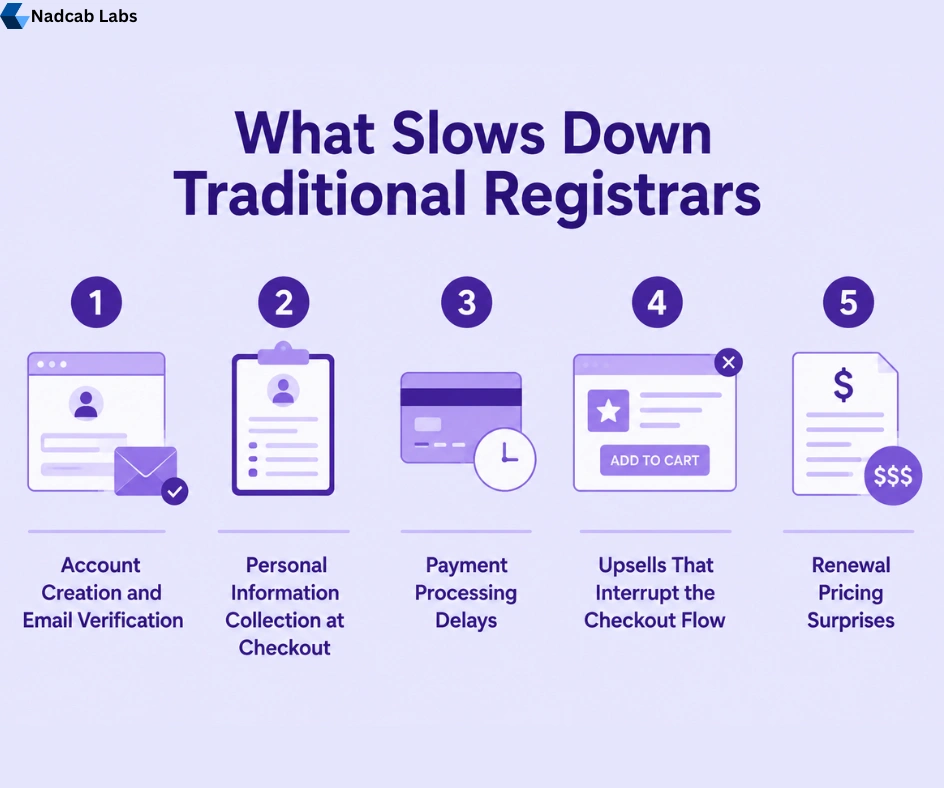
The friction starts at the very first screen and does not stop until you finally land on a confirmation page. Here is a closer look at each stage that slows things down.
1. Account Creation and Email Verification
Before you can buy a domain on most platforms, you have to create an account. That means entering your name, email address, sometimes a phone number, and then waiting for a verification email to arrive. If the email goes to spam, you lose another few minutes. This step alone is unnecessary for someone who just wants to search for a domain name and pay for it.
2. Personal Information Collection at Checkout
Most traditional registrars ask you to fill in your full name, physical address, city, country, and phone number before checkout. This data ends up in the public WHOIS database by default unless you pay for privacy protection as an add-on. Domains with publicly disclosed registration data receive an average of 12.76 spam emails per domain, which means skipping privacy protection has real consequences.
3. Payment Processing Delays
Credit and debit card payments go through multiple layers before they are confirmed. Your bank may flag an unfamiliar merchant. Your card issuer might require a two-factor authentication step. International users sometimes face currency conversion issues or blocked transactions from registrars that only support certain card types. All of this adds time between clicking “buy” and actually owning the domain.
4. Upsells That Interrupt the Checkout Flow
GoDaddy, one of the largest registrars in the world serving primarily small businesses as of 2024, is well known for bundling extra services into the checkout path. SSL certificates, email accounts, website builders, and privacy add-ons appear as suggested items before you reach payment. Some of these pop up again after checkout. The process is designed to increase order value, not to get you to domain ownership faster.
5. Renewal Pricing Surprises
Traditional registrars often use low introductory prices to attract first-time buyers. A .com domain at GoDaddy renews at $19.99 per year, which is nearly double what at-cost registrars charge. Users who register a domain without checking renewal costs find out the real price only when their first renewal notice arrives.
Traditional Registrar vs Crypto-Based Domain Registration
| Factor | Traditional Registrar (e.g., GoDaddy, Namecheap) | Crypto-Based Registration (e.g., Sudo) |
|---|---|---|
| Account Requirement | Full account with email verification required | Email only or no account needed in some cases |
| KYC Verification | Often required (ID, address proof) | Not required |
| Payment Method | Credit/debit card, PayPal (bank-linked) | BTC, ETH, USDT, and other crypto |
| Payment Processing Time | Minutes to hours (subject to bank approval) | Confirmed on-chain, then instant provisioning |
| WHOIS Privacy | Paid add-on at most registrars | Often included by default |
| Cross-Border Access | Card rejections and regional restrictions are common | Works from anywhere without restrictions |
| Checkout Upsells | Frequent (SSL, hosting, email bundles) | Minimal to none |
How Sudo Makes Buying a Domain Online Faster
Sudo approaches domain registration differently. Instead of building its process around legacy payment systems and data collection habits, it uses cryptocurrency as the foundation. This shift in payment method alone removes the biggest bottlenecks in a traditional checkout flow.
1. Crypto Payments Confirm Without Bank Approval
When you pay for a domain with cryptocurrency, there is no bank in the middle deciding whether to approve the transaction. Instead, the payment is powered by blockchain technology and goes directly to the blockchain network. Once the transaction is confirmed on-chain, the domain is provisioned automatically. There is no waiting for a payment processor to manually review anything, and there are no fraud holds or surprise cancellations after the fact. Bitcoin transactions are also processed quickly, usually within a few minutes, which means the gap between paying and owning your domain is very short.
2. No KYC Means No Identity Submission
KYC stands for Know Your Customer, a verification process where you submit identity documents like a passport, government ID, or proof of address. Some traditional registrars, including Namecheap, have reportedly started requesting passport uploads, face ID video checks, and proof of address for certain account actions. Sudo does not require any of this. You search for a domain, pay with crypto, and the registration completes. That is a materially shorter process than what major registrars currently ask for.
3. No Geographic Payment Barriers
Cryptocurrency can be used from anywhere in the world without worrying about payment restrictions or currency conversion. This is a genuine advantage for users in countries where card payments are frequently declined by international merchants, or where local currency conversion fees add up. Registering a domain should not depend on where you happen to live or which bank issued your card.
How Crypto Payment Gateways Works
Private Domain Registration: Why Your WHOIS Data Is Not Just a Formality
When you register a domain, ICANN (the Internet Corporation for Assigned Names and Numbers) requires registrars to collect your name, address, phone number, and email. Traditionally, all of this data was published publicly in the WHOIS database, where anyone on the internet could look it up. This includes spammers, competitors, domain hijackers, and social engineers.
Private domain registration, also called WHOIS protection, replaces your real contact details with proxy information in the public WHOIS record. Your domain still works normally. ICANN still has your real details on file. But anyone searching the public database sees the registrar’s contact information instead of yours.
1. Spam Arrives Immediately Without It
Within hours of registering a domain without privacy protection, you can expect emails and calls from web designers, SEO firms, and domain services. Domains with publicly disclosed registration data receive an average of 12.76 spam emails per domain, and this does not stop over time.
2. Identity Theft Risk Is Real
Your full name, address, phone number, and email in a public database is exactly the kind of data identity thieves look for. Global cybercrime costs are estimated to reach $11.36 trillion annually by 2026, and the WHOIS database is an openly accessible starting point for data gathering. Enabling private domain registration removes one easy source of personal data.
3. Social Engineering Attacks Use WHOIS Data
Attackers can use publicly available WHOIS records to impersonate you when contacting registrar support. They might claim to be you, use your address and phone number as verification details, and attempt to transfer your domain to a different account. WHOIS privacy makes this specific attack much harder to execute.
4. What Crypto Payments Add to the Privacy Picture
Paying with cryptocurrency means no banking information is tied to your domain registration. Unlike a credit card payment, which links your identity through your bank account, a crypto transaction requires no personal financial data. When combined with private domain registration, this means neither your WHOIS record nor your payment method exposes who you are.
What to Look for in a Domain Registrar Before You Buy
Not all registrars are built the same way. Before you commit to any platform, whether it is the cheapest domain registrar you found through a quick search or a well-known name you have seen advertised, a few things are worth checking.
1. Renewal Pricing, Not Just Registration Pricing
Many registrars offer very low first-year pricing to get you to register, then charge significantly more for renewal. Before you register, look at what year two and beyond will actually cost you. A domain at $1.99 for the first year that renews at $19.99 is not the deal it appears to be.
2. Whether WHOIS Privacy Is Free or Paid
Some registrars include WHOIS privacy protection in the base registration price. Others charge extra for it. If privacy is important to you, factor that into the total cost comparison rather than just the headline domain price.
3. Payment Method Options
If you want to pay with crypto, not every registrar supports it. Platforms that do accept cryptocurrency generally include Bitcoin, Ethereum, USDT (Tether), Litecoin, and sometimes others like Monero or Dogecoin. Checking what payment methods are accepted before you start the registration process saves time later.
4. DNS Management Controls
Once you own a domain, you need to be able to point it to your hosting or website builder. Look for a registrar that gives you clear, accessible DNS management. Custom nameservers, A records, CNAME records, and MX record editing should all be manageable without needing to contact support for basic changes.
5. TLD Availability
Generic top-level domains held over 60% of the market in 2024, with .com, .org, and .net remaining the most common choices. But new gTLDs grew by 5 million registrations in 2024, showing that buyers are exploring extensions like .io, .store, .xyz, and others. A good registrar should offer a wide range of TLDs, so you have real choices, not just the basics.
What Are Crypto Payment Gateways And How Do They Work?
Popular Domain Extensions and Their Common Use Cases
| Domain Extension | Best For | Notes |
|---|---|---|
| .com | Businesses, personal brands, and general websites | Most recognized globally, over 37% of all registered domains |
| .org | Non-profits, communities, open-source projects | Strong trust signal for mission-driven sites |
| .io | Tech startups, SaaS platforms, developer tools | Popular in the tech community as an alternative to .com |
| .store | E-commerce and online retail | Clearly communicates online shopping intent |
| .xyz | Startups, creatives, Web3 projects | One of the fastest-growing new gTLDs in recent years |
| .net | Networks, internet services, tech companies | Strong second choice when .com version is unavailable |
Sudo Domain Registration
The moment your crypto payment is confirmed on the blockchain, the domain provisioning begins automatically. There is no manual step where a human at Sudo reviews your order. The blockchain confirmation serves as the green light, and your domain becomes yours.
From there, you can configure DNS settings, connect your domain to a hosting account, or set up nameservers. The full control of the domain is transferred to you right away, not after a review queue or a business-hours delay.
Compare that to the standard experience at a major registrar. If your card payment triggers a fraud review, your order can sit in a pending state for hours. If you registered during off-peak hours, support may not be available to resolve it immediately. None of these scenarios happens when the payment method is crypto.
How Fast Domain Registration Helps Real Projects
The following example shows how a faster, privacy-first domain registration process directly serves the kind of projects where timing and anonymity matter. These case studies reflect the same principles discussed throughout this blog, from instant crypto-based provisioning to private ownership and frictionless setup.
🔐
DentNet: Decentralized Telecom Infrastructure
Built a blockchain-based platform that decentralizes mobile data, voice minutes, and telecom services into a global marketplace. Users can buy, sell, and trade telecom assets across borders with eSIM technology, token staking, and a decentralized swap system. The project required a fast, private domain setup from day one to maintain operational security, which is exactly the kind of use case where Sudo’s approach makes a difference.
Register Your Domain Online With Sudo Today:
Skip the account forms, the bank approvals, and the WHOIS privacy add-ons. Sudo lets you search for a domain, pay with crypto, and own it in minutes. No KYC. No delays. Full control from the moment your transaction confirms.
Conclusion
Buying a domain online should be one of the simplest things you do when starting a project or a business. The technology to make it fast has existed for years. The problem is that most major registrars built their checkout flows around legacy banking systems and data collection models that prioritize their own needs over the buyer’s experience.
Sudo’s approach removes the layers that slow things down. Crypto payments bypass the bank approval queue. No KYC requirement means no documents to upload and no delays waiting for identity review. Private domain registration means your personal information does not end up in a public database the moment you click register.
The domain name registrar market was valued at USD 2.45 billion in 2024 and is growing steadily. As more people and businesses establish an online presence, the demand for faster and more private registration options will only increase. Platforms like Sudo represent where domain registration is heading: faster, more direct, and more respectful of user privacy from the first step to the last.
Frequently Asked Questions
Is it safe to buy a domain online using cryptocurrency?
Yes. Cryptocurrency payments are processed on the blockchain, which means every transaction is recorded and cannot be altered. There is no banking information involved, and the payment confirms automatically once the transaction clears on-chain. The main thing to ensure is that you are using a legitimate and accredited domain registrar that accepts crypto as a payment method.
What does private domain registration actually protect me from?
Private domain registration keeps your name, address, phone number, and email out of the public WHOIS database. Without it, that information is visible to anyone who runs a WHOIS lookup on your domain, which includes spammers, competitors, and people who use social engineering to impersonate domain owners and attempt unauthorized transfers.
How is buying a domain with crypto faster than using a credit card?
Credit card payments go through your bank, the merchant payment processor, and sometimes a fraud detection layer. Any one of these can delay or block the transaction. Crypto payments go directly on the blockchain and do not require approval from any financial institution. Once confirmed on-chain, your domain is provisioned automatically.
Do I need to submit any identity documents to register a domain on Sudo?
No. Sudo does not require KYC verification, meaning you do not need to submit a passport, government ID, or proof of address to complete a domain registration. This is one of the key differences between Sudo and many traditional registrars that have started implementing stricter identity checks.
What cryptocurrencies can I use to buy a domain online?
This depends on the specific platform, but most crypto-accepting registrars support Bitcoin (BTC), Ethereum (ETH), and USDT (Tether) as the primary options. Some also accept Litecoin, Dogecoin, Monero, BNB, and others. Tether is particularly practical because it is a stablecoin, meaning its value stays close to the US dollar and avoids the price volatility that Bitcoin or Ethereum can experience during a transaction.
Can I use any domain extension when buying through Sudo with crypto?
Yes, as long as the registrar you are using supports the extension you want. Most platforms that accept crypto for domain registration support the major extensions, including .com, .net, .org, .io, .xyz, and .store, among others. It is worth checking the available TLD list on the specific platform before starting your registration to make sure your preferred extension is supported.
Reviewed by

Aman Vaths
Founder of Nadcab Labs
Aman Vaths is the Founder & CTO of Nadcab Labs, a global digital engineering company delivering enterprise-grade solutions across AI, Web3, Blockchain, Big Data, Cloud, Cybersecurity, and Modern Application Development. With deep technical leadership and product innovation experience, Aman has positioned Nadcab Labs as one of the most advanced engineering companies driving the next era of intelligent, secure, and scalable software systems. Under his leadership, Nadcab Labs has built 2,000+ global projects across sectors including fintech, banking, healthcare, real estate, logistics, gaming, manufacturing, and next-generation DePIN networks. Aman’s strength lies in architecting high-performance systems, end-to-end platform engineering, and designing enterprise solutions that operate at global scale.