Ai Overview
Non-fungible tokens are unique digital assets stored on a blockchain that prove ownership of items like digital art, music, videos, or virtual collectibles. But in 2021, Larva Labs moved all 10,000 CryptoPunk images and their attribute data fully on-chain. According to Pinata, a leading IPFS pinning service, storing a single 200 MB high-resolution NFT on Ethereum would cost roughly $92,000. Music NFTs generated over $520 million in revenue through streaming-linked tokens.
When people hear the word NFT, most of them picture a digital image that lives “on the blockchain.” But that picture is not always accurate. The truth is, most NFTs do not actually store their images or media files on the blockchain at all. What actually sits on the blockchain in most cases is just a smart contract with a link pointing to where the real file is kept.
This is where the difference between on-chain NFTs and off-chain NFTs becomes really important. Understanding where your NFT data actually lives, how it is stored, and what happens if the storage system fails can help you make better decisions as a creator, collector, or developer, especially when evaluating different NFT marketplace solutions. In this guide, we will break down everything about on-chain vs off-chain NFTs in a way that is easy to understand, using real examples and actual data from the industry
Non-fungible tokens are unique digital assets stored on a blockchain that prove ownership of items like digital art, music, videos, or virtual collectibles. Each NFT is different and cannot be exchanged on a one-to-one basis like cryptocurrencies such as Bitcoin. They are bought and sold online using cryptocurrency, and the blockchain record acts as proof that a specific person owns that digital item.
Every NFT has two main parts. The first part is the smart contract, which is the code that lives on the blockchain. This code keeps track of who owns the NFT, the rules for buying and selling it, and a pointer or reference to the actual media file. The second part is the media file itself, which could be an image, a video, a song, or even a 3D model.
Now here is the important question: where does that media file actually live? This single question is what separates on-chain NFTs from off-chain NFTs, and it has a big impact on the security, longevity, and value of the token. If the media file disappears because the storage system went offline, the owner is left holding a smart contract that points to nothing. This is not just a theoretical risk. It has already happened to real NFT holders.
Recommended Reading:
On-chain NFTs are tokens where everything, including the image, the metadata, and the smart contract, is stored directly on the blockchain. Nothing is kept outside. The entire NFT exists within the blockchain network itself.
This means that if you own an on-chain NFT, your token does not depend on any external server, cloud service, or third-party storage system. As long as the blockchain keeps running, your NFT and all its data will survive. This is the strongest form of digital ownership available today.
When a developer creates an on-chain NFT, they write the entire content of the token into the smart contract. For images, this usually means using a very compact format like SVG (Scalable Vector Graphics), which can describe an image using code rather than pixels. The metadata, which includes things like the NFT’s name, description, unique traits, and properties, is also written directly into the smart contract.
The smart contract is then deployed to the blockchain (most commonly Ethereum), and everything is permanently recorded. Anyone with access to the blockchain can read the data, view the image, and verify the ownership without needing to connect to any outside system.
The most famous example of on-chain NFTs is CryptoPunks. Originally launched in 2017 by Larva Labs, CryptoPunks started with the image data stored off-chain. But in 2021, Larva Labs moved all 10,000 CryptoPunk images and their attribute data fully on-chain. The process used over 73 million gas on Ethereum. After this move, every CryptoPunk image can be retrieved directly from the Ethereum blockchain without relying on any external source.
Another well-known example is Autoglyphs, also created by Larva Labs. These are the first on-chain generative art pieces on Ethereum, where the art is actually generated by the smart contract code itself. The algorithm that creates the visual pattern is stored on the blockchain, making it fully self-contained.
The biggest advantage is permanence. Because everything is stored on the blockchain, the NFT cannot be altered, deleted, or lost due to a server failure. The data is duplicated across thousands of nodes worldwide.
On-chain NFTs also offer full transparency. Anyone can verify the authenticity, ownership history, and content of the token by looking at the blockchain. There is no need to trust a third party to keep the files available.
From a trading perspective, on-chain NFTs meet all the requirements of the Ethereum network natively, which means they tend to have better liquidity and can be transferred more easily between wallets and marketplaces.
The cost is the biggest problem. Storing data directly on Ethereum is extremely expensive. According to the Ethereum protocol, storing a single 256-bit word (32 bytes) costs 20,000 gas. That means storing just 1 KB of data requires about 640,000 gas. At typical network conditions, a single high-resolution image could cost thousands of dollars to store on-chain.
When Larva Labs put CryptoPunks on chain, it was only possible because each image is just 24 by 24 pixels, which is an incredibly small file size. Storing a standard JPEG image of a few megabytes would be practically impossible at current Ethereum storage costs.
On-chain NFTs also face size limitations. Blockchains are not designed to be storage systems. They are designed for transaction processing and state management. Trying to store large amounts of data on them goes against their core purpose, which leads to network congestion and higher fees for everyone.
Recommended Reading:
NFT Marketplace Development Guide
Off-chain NFTs are the most common type of NFTs you will find on marketplaces today. With off-chain NFTs, the smart contract is deployed on the blockchain, but the actual media file (the image, video, or audio) and often the metadata are stored somewhere outside the blockchain.
The smart contract contains a link or pointer that tells marketplaces and wallets where to find the media file. When you view an NFT on a platform like OpenSea, the platform reads the smart contract, follows the link, and then displays the image from wherever it is stored.
There are three main types of off-chain storage used for NFTs:
When an off-chain NFT is minted, the smart contract stores a URI (Uniform Resource Identifier) that points to a JSON metadata file. This metadata file contains information about the NFT, such as its name, description, properties, and a link to the actual image file.
There are two common ways to link to off-chain data:
Off-chain storage makes NFTs affordable. Without it, only the wealthiest creators could afford to mint NFTs. Gas fees for minting are much lower because only the smart contract and a small reference link need to go on-chain, not the entire media file.
Off-chain storage also supports larger and richer media files. You can store high-resolution images, full-length videos, interactive 3D models, and music albums without worrying about blockchain storage limits.
For buyers, off-chain NFTs are often easier to access. Platforms like NBA Top Shot allow users to purchase NFTs with regular credit cards and store them in custodial wallets, without needing any blockchain knowledge at all.
The biggest risk is data loss. If the storage system goes down, the NFT’s media file becomes inaccessible. The owner still holds the token on the blockchain, but it points to nothing. This already happened when Coachella’s lifetime pass NFTs were stored on FTX, and after FTX collapsed, those NFT files became unreachable.
With centralized storage, there is also the risk of content manipulation. If files are stored on a company server, the company could theoretically change or delete the content at any time.
Even IPFS has limitations. While IPFS is a distribution protocol, it is not a guaranteed storage system on its own. If no node on the IPFS network continues to “pin” (hold a copy of) the data, the file will eventually become unavailable. This is why many projects use services like Pinata to keep their IPFS data reliably pinned.
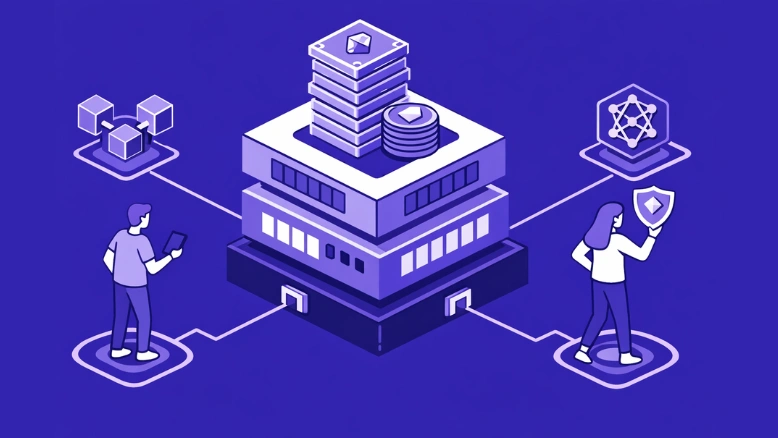
Whether an NFT is stored on-chain or off-chain, the smart contract is always the foundation. Smart contracts are self-executing programs that run on the blockchain. They contain the rules and logic that govern how the NFT works.
An NFT smart contract handles several important functions. It manages the minting process (creating new tokens), keeps a record of ownership, handles transfers between wallets, enforces royalty payments to creators on secondary sales, and stores or links to the NFT’s metadata.
Every time an NFT is bought, sold, or transferred, the smart contract executes these operations automatically. There is no need for a middleman or a central authority to verify the transaction. The blockchain itself serves as the trust layer.
The two most widely used token standards for NFTs on Ethereum are ERC 721 and ERC 1155.
For on-chain NFTs, the smart contract stores everything: the code that generates or displays the image, the metadata, and all the ownership logic. The contract is larger and more expensive to deploy, but it creates a completely self-contained token.
For off-chain NFTs, the smart contract is smaller. It stores the ownership logic, the token standard implementation, and a URI that points to an external metadata file. The metadata file then points to the actual image file. This two-step linking process is what makes off-chain NFTs cheaper to create but also more dependent on external systems.
Recommended Reading:
What Is an NFT Marketplace? How It Works End-to-End
Metadata is the information that describes an NFT. Think of it as the identity card for the token. It typically includes the NFT’s name, a description, the link to the image or media file, and any special attributes or traits (like rarity, color, or category).
When metadata is stored on-chain, all of this information is written directly into the smart contract. This gives the highest level of security because no one can change the metadata without changing the blockchain itself. CryptoPunks, for example, have all their attribute data (hair styles, glasses, beards, hats) stored on chain alongside the images.
However, on-chain metadata is limited in what it can describe. Complex or lengthy descriptions, large numbers of traits, or rich formatting are difficult to store on-chain because of the gas costs involved.
Most NFTs use off-chain metadata. The smart contract contains a tokenURI function that returns a link to a JSON file. This JSON file, usually hosted on IPFS or a centralized server, contains all the descriptive information about the NFT.
Here is a simplified example of what off-chain metadata looks like:
Off-chain metadata allows for much richer and more detailed descriptions, and it can be updated if the smart contract supports mutable URIs. However, this updatability is also a risk because it means the metadata could potentially be changed after purchase.
Some advanced NFT projects use a hybrid approach where the most important metadata (like token ID, ownership history, and content hash) is stored on chain, while the full media file and detailed descriptions are stored off-chain on IPFS or Arweave. The on-chain hash serves as a fingerprint that can verify whether the off-chain content has been tampered with.
This hybrid model gives you the cost savings of off-chain storage while still maintaining a verifiable link between the token and its content.
One of the most important decisions an NFT project makes is choosing where to store the media files. For off-chain NFTs, the choice of storage directly affects the long term survival and trustworthiness of the collection. Let us look at the three major decentralized storage networks used in the NFT space.
IPFS is not actually a storage system by itself. It is a protocol for distributing and accessing files across a peer-to-peer network. When you upload a file to IPFS, it gets a unique CID (Content Identifier) based on the file’s content. Any node on the IPFS network can serve that file to anyone who requests it using the CID.
The key strength of IPFS is content addressing. Because files are identified by their content rather than their location, it is very difficult to tamper with them. If someone changes even a single byte of the file, the CID changes completely.
However, IPFS has a big limitation: there is no built-in incentive for nodes to keep storing your data. If no one actively “pins” (keeps a copy of) your file, it will eventually be garbage collected and become unavailable. This is why NFT projects using IPFS need to either run their own IPFS nodes or use pinning services like Pinata, which charges about $0.035 per GB per month.
Filecoin was created by the same team that built IPFS (Protocol Labs) to solve the incentive problem. Filecoin adds a blockchain-based marketplace where storage providers (miners) are paid in FIL tokens to store data reliably over time.
Storage providers on Filecoin must continuously prove they are still holding the data through two mechanisms: Proof of Replication (PoRep) confirms that the miner has actually stored a unique copy of the data, and Proof of Spacetime (PoSt) verifies that the data continues to be stored over the agreed period.
Filecoin works well for large datasets and enterprise-level storage needs. It integrates directly with IPFS, making it easy for developers to use both systems together. The downside is that storage deals on Filecoin are contract-based, meaning they need to be renewed periodically for long-term storage.
Arweave takes a completely different approach. Instead of recurring payments, Arweave offers permanent storage for a one-time fee. The system is backed by an endowment pool that funds storage costs into the future, guaranteeing at least 200 years of data availability based on the historical trend of storage costs declining about 30 percent per year.
Arweave uses a unique data structure called the “blockweave” instead of a traditional blockchain. Data stored on Arweave is replicated across many nodes and becomes part of the permanent record. Projects like Mirror.xyz (a decentralized publishing platform) use Arweave to store content that creators want to keep available forever.
For NFTs specifically, Arweave is considered one of the strongest options for off-chain storage because of its permanence guarantee. Once the data is uploaded and paid for, it does not require any ongoing maintenance or fee payments.
One of the biggest factors in deciding between on-chain and off-chain NFTs is cost. Let us look at what it actually costs to store data on different blockchain networks.
On Ethereum, storing a 256-bit word (32 bytes) in a smart contract’s storage costs 20,000 gas through the SSTORE operation. This means storing 1 KB of data requires about 640,000 gas. At current network conditions with gas prices around 1 to 3 Gwei and ETH prices in the thousands of dollars, even small amounts of data can become expensive quickly.
According to Pinata, a leading IPFS pinning service, storing a single 200 MB high-resolution NFT on Ethereum would cost roughly $92,000. Scaling that to a 10,000-piece collection would push costs into the billions. This is precisely why the vast majority of NFT projects choose off-chain storage for their media files.
Other blockchains offer lower storage costs than Ethereum. Solana, which handles about 18 percent of NFT transactions, has much lower fees because of its different architecture. Polygon, an Ethereum Layer 2 solution, also offers significantly reduced costs while still connecting to Ethereum’s security.
Some newer blockchains like Aptos and Sui have been designed with NFT-friendly features from the ground up, allowing more on-chain data at lower costs than Ethereum. However, none of these chains can match Ethereum’s level of decentralization and security, which is why Ethereum remains the dominant chain for high-value NFT projects.
For comparison, IPFS pinning through Pinata costs about $0.035 per GB per month. Arweave charges a one-time fee that works out to roughly $12 per GB at current rates. Filecoin’s costs vary based on market conditions, but the Filecoin Plus program has subsidized storage to make it essentially free for verified clients.
The cost difference between on-chain and off-chain storage is not just significant; it is multiple orders of magnitude. This economic reality is why the industry has settled on a model where ownership logic lives on chain, while media files live off chain.
Recommended Reading:
Primary vs Secondary NFT Marketplaces
If you are buying an NFT and want to know whether it is stored on-chain or off-chain, here is a simple process you can follow:
Go to the NFT’s listing on a marketplace like OpenSea. Scroll down to the “Details” section and click on the contract address link. This will take you to a block explorer like Etherscan.
On Etherscan, go to the “Read Contract” tab and find the tokenURI function. Enter the token ID of the NFT you want to check (this is usually visible in the NFT’s name, like “OnChain Monkey #5717” where the ID would be 5717).
If the response is a URL (starting with https:// or ipfs://), the NFT’s metadata is stored off-chain. The URL points to an external file.
If the response contains the actual data (such as a Base64 encoded SVG image or a JSON string with all the metadata embedded), the NFT is stored on chain. No external link means the data lives directly on the blockchain.
For example, when you query OnChain Monkey tokens, no external link appears in the response because everything is embedded in the smart contract. But when you check a typical off-chain NFT like Power Music Club, you will see an external URL pointing to where the media is hosted.
The NFT market has evolved considerably since its explosive growth in 2021. The speculative frenzy has cooled, and the industry has shifted toward a leaner, utility-driven ecosystem where real ownership and sustainable models define the landscape. Here is where things stand right now.
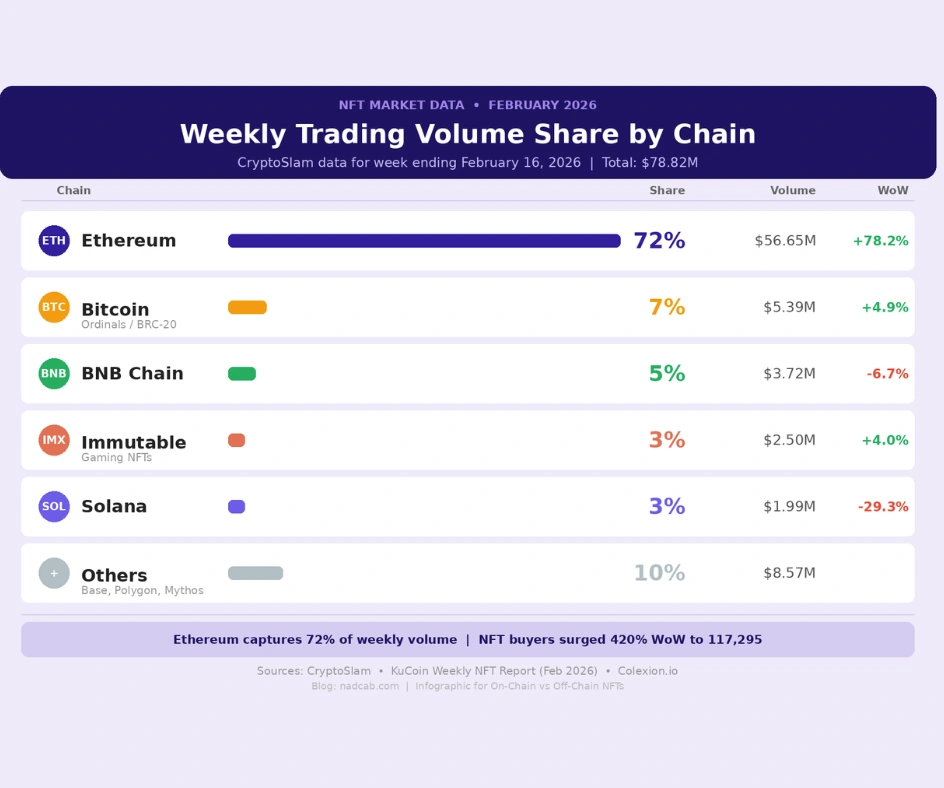
The global NFT market was valued at approximately $43.08 billion in 2025, with projections suggesting growth toward $60.82 billion in 2026 and $245.42 billion by 2029, according to Colexion research. Average monthly Ethereum NFT trading volume reached approximately $720 million in Q1 2026, showing a clear rebound of roughly 50 percent from the 2024 low.
Ethereum continues to lead the NFT space, powering roughly 62 percent of all NFT contracts and capturing 72 percent of weekly trading volume as of mid February 2026, according to CryptoSlam data. Bitcoin Ordinals have emerged as a notable force, holding about 7 percent of weekly volume. BNB Chain holds around 5 percent through its DeFi and NFT hybrid offerings. Immutable captures about 3 percent by powering transactions for over 120 blockchain games, while Solana dropped to roughly 3 percent of weekly volume in early 2026.
Gaming NFTs now account for 38 percent of total transaction volume, making it the largest category, with transaction counts growing 140 percent year over year. AI-powered NFTs represent 30 percent of all new project developments in 2026. Digital art holds about 21 percent of the market. Music NFTs generated over $520 million in revenue through streaming-linked tokens. Real estate NFTs grew by 32 percent year over year, surpassing $1.4 billion in market size. Event ticketing NFTs now make up 5.3 percent of ticket sales across major US venues.
The industry standard remains a hybrid approach, with on-chain ownership and transaction logic paired with off-chain media storage. Most professional NFT projects use IPFS, Arweave, or Filecoin for their media files rather than centralized servers. Over 80 percent of creators use royalty-enforcing smart contracts, and Ethereum-based platforms generated over $920 million in creator royalties in 2025.
The choice between on-chain and off-chain storage depends on what you are building and what matters most to your project and your users.
Your project uses small, simple visual formats like pixel art, SVG graphics, or text-based tokens. Permanence and full decentralization are the highest priority. Your audience is willing to pay higher minting costs for the guarantee of permanent, tamper-proof storage. You are building generative art where the algorithm can be stored in the smart contract itself.
Your project involves high-resolution images, videos, music, or other large media files. You need to keep minting costs low to attract a wider audience. You want a good balance between decentralization and affordability. Your collection has thousands of items that would be impractical to store on a chain.
You want the best of both worlds. Store the ownership logic, content hash, and critical metadata on chain, while keeping the full media files on IPFS or Arweave. This way, the blockchain serves as the verification layer, and even if someone obtains the off-chain file, they can verify its authenticity against the on-chain hash.
Many of the most successful NFT projects in 2025 use this hybrid model. It provides strong guarantees without the extreme costs of full-on chain storage.
The following projects show how NFT infrastructure and blockchain storage solutions are already being applied in practice. Each project demonstrates the same principles discussed throughout this article, from smart contract design and token standards to decentralized data handling and community-driven development.
🎮
BendDAO is a decentralized NFT lending protocol that allows users to borrow ETH instantly using blue-chip NFTs as collateral. The platform uses on-chain smart contracts for transparent lending rules, automated liquidation protection, and peer-to-pool liquidity, showing how NFT ownership data stored on the blockchain enables entirely new financial applications.
Build Your NFT Project with the Right Storage Strategy:
Our specialized blockchain development team handles everything from NFT smart contract creation and metadata design to IPFS integration and multi-chain deployment. Whether you need fully on-chain generative art, off-chain marketplace infrastructure, or a hybrid storage solution, we build NFT platforms that protect your assets and serve your users. Let us help you choose the right architecture for your project.
Start Your NFT Development Project
The debate between on-chain and off-chain NFTs is not about which one is “better” in an absolute sense. Each approach serves a different purpose, comes with its own set of trade-offs, and fits different types of projects.
On-chain NFTs offer the strongest form of digital ownership. When everything lives on the blockchain, there is no dependency on external services, no risk of broken links, and no possibility of data tampering. But this strength comes at a very high cost, both in terms of money and in terms of the limitations it places on file size and complexity. Only projects with very small files, like pixel art or generative SVG images, can realistically go fully on-chain.
Off-chain NFTs, on the other hand, power the vast majority of the NFT market. They make it possible for artists to mint high-resolution artwork, musicians to release full albums, game developers to create rich in-game assets, and event organizers to issue digital tickets, all without spending a fortune on blockchain storage. The key is choosing the right off-chain storage: decentralized options like IPFS with dedicated pinning, Filecoin, or Arweave offer much stronger guarantees than centralized servers.
The smartest approach for most projects in 2025 is a hybrid model. Store the ownership logic, content hashes, and critical metadata on the blockchain to guarantee authenticity and ownership. Store the media files on a decentralized storage network to guarantee availability and affordability. This combination gives users confidence that their NFTs are both verifiable and durable, without the extreme costs of full on-chain storage.
As blockchain technology continues to develop with upgrades like Ethereum’s EIP 4844 (which introduced much cheaper blob storage) and the growth of Layer 2 solutions, the cost of on-chain storage may decrease over time. When that happens, we could see more projects moving toward fully on-chain storage. But for now, understanding the difference between on-chain and off-chain NFTs is essential for anyone creating, buying, or building in the NFT space.
Frequently Asked Questions
Q1.What is the main difference between on chain NFTs and off chain NFTs?
On-chain NFTs store everything (image, metadata, and smart contract) directly on the blockchain. Off-chain NFTs only store the smart contract and a link on the blockchain, while the actual media files are kept on external storage like IPFS, Arweave, or centralized servers.
Q2.Are on chain NFTs always better than off chain NFTs?
Not necessarily. On-chain NFTs are more permanent and tamper-proof, but they are also much more expensive to create and are limited to small file sizes. Off-chain NFTs allow for larger, richer media files at a fraction of the cost. The best choice depends on your project’s specific needs and budget.
Q3.What happens to an off chain NFT if the storage server goes down?
If the external storage hosting the media file goes offline, the NFT’s image or content becomes inaccessible. The token itself still exists on the blockchain with its ownership record, but it points to a dead link. Using decentralized storage like IPFS with pinning or Arweave greatly reduces this risk.
Q4.What is IPFS and why do most NFTs use it?
IPFS (InterPlanetary File System) is a peer-to-peer file distribution protocol that uses content-based addressing. Files get a unique hash based on their content, making tampering very difficult. Most NFTs use IPFS because it offers a balance between decentralization, cost efficiency, and data integrity without needing full on-chain storage.
Q5.How can I check if an NFT is stored on chain or off chain?
Go to the NFT’s contract on a block explorer like Etherscan, use the “Read Contract” tab, and query the tokenURI function with the NFT’s token ID. If the response is a URL pointing to an external source, it is off-chain. If the response contains embedded data (like a Base64 SVG or inline JSON), the NFT is on chain.
Q6.Which blockchain is best for on chain NFTs?
Ethereum remains the most popular blockchain for on-chain NFTs because of its high security and large developer community. However, chains like Solana, Polygon, and Aptos offer lower storage costs, making them attractive for projects that want to store more data on-chain without the extreme gas fees that Ethereum charges.
Explore Services
Related Services
Reviewed by

Aman Vaths
Founder of Nadcab Labs
Aman Vaths is the Founder & CTO of Nadcab Labs, a global digital engineering company delivering enterprise-grade solutions across AI, Web3, Blockchain, Big Data, Cloud, Cybersecurity, and Modern Application Development. With deep technical leadership and product innovation experience, Aman has positioned Nadcab Labs as one of the most advanced engineering companies driving the next era of intelligent, secure, and scalable software systems. Under his leadership, Nadcab Labs has built 2,000+ global projects across sectors including fintech, banking, healthcare, real estate, logistics, gaming, manufacturing, and next-generation DePIN networks. Aman’s strength lies in architecting high-performance systems, end-to-end platform engineering, and designing enterprise solutions that operate at global scale.