Ai Overview
Every time someone buys, sells, or mints an NFT, a smart contract is running behind the scenes. Attackers found reentrancy flaws in two of the platform’s older, unaudited contracts and used them to steal approximately $3 million worth of NFTs. Reports showed that hackers drained roughly $88 million in crypto from the system through this method by manipulating the protocol’s view of token value. About four Bored Apes and other assets worth roughly $3 million were lost in that single incident.
Key Takeaways
- Over $100 million worth of NFTs were stolen between July 2021 and July 2022, with the average theft amounting to $300,000 per incident, according to blockchain analytics firm Elliptic.[1]
- The NFT Trader hack in December 2023 resulted in a loss of approximately $3 million, caused by a reentrancy flaw found in the project’s older smart contracts that had not been audited or updated.[2]
- In a 2018 analysis of nearly 970,000 smart contracts on Ethereum, researchers found that roughly 1 in 20 contracts, or about 34,200 total, were at risk of being exploited by attackers.[3]
- The Bored Ape Yacht Club Instagram hack in April 2022 led to NFTs worth approximately $13.7 million being stolen after attackers used a fake smart contract to drain connected wallets.[4]
- Smart contracts for NFTs primarily follow the ERC-721 token standard on Ethereum. Errors in Solidity, Vyper, or Rust code used to write these contracts can cause unintended behavior across the entire application.[5]
- A smart contract flaw in one NFT project allowed an attacker to collect 330 NFTs by removing the per-wallet purchase limit, which was supposed to allow only two NFTs per wallet address.[6]
Smart Contract Risks in NFTs
Every time someone buys, sells, or mints an NFT, a smart contract is running behind the scenes. These are small pieces of code living on the blockchain. They handle the transfer of ownership, royalty payments, and transaction records without any middleman. Sounds great, right?
The problem is that these contracts are written by humans, and humans make mistakes. A single flaw in the code can open the door for attackers to walk away with millions of dollars. This is not a theoretical risk. It has happened many times, and the numbers are alarming. This is why partnering with an experienced NFT marketplace development company is essential to ensure secure smart contract architecture, regular security audits, and protection against common NFT exploits and vulnerabilities.
According to a report by Elliptic, over $100 million worth of NFTs were stolen between July 2021 and July 2022 alone, with thieves making off with an average of $300,000 per incident. In December 2023, the NFT Trader platform lost an estimated $3 million due to a reentrancy flaw in old smart contracts. These are not random events. They follow a pattern of known, preventable vulnerabilities that developers fail to address before deployment.
This blog breaks down the most serious NFT smart contract vulnerabilities, explains real exploits in plain language, and tells you what actually works to keep your project safe.
Recommended Reading:
What Is a Smart Contract and Why Does It Matter for NFTs?
A smart contract is a program stored on the blockchain. Once it is deployed, it runs exactly as written. There is no way to stop it or edit it mid-run. For NFT projects, smart contracts manage everything from minting new tokens to recording ownership on-chain, distributing royalties to creators, and executing trades on marketplaces.
This automation is part of what makes NFTs exciting. But it also means there is zero room for error. If the code has a bug, that bug is live on-chain, visible to everyone, and can be used against the project at any time.
NFTs on Ethereum mostly follow the ERC-721 or ERC-1155 token standards. Contracts are written in languages like Solidity, Vyper, or Rust. These are powerful languages, but they require careful, experienced writing. A small mistake, a missing check, an unclosed loop, can turn into a catastrophic loss.
The Most Dangerous NFT Smart Contract Vulnerabilities
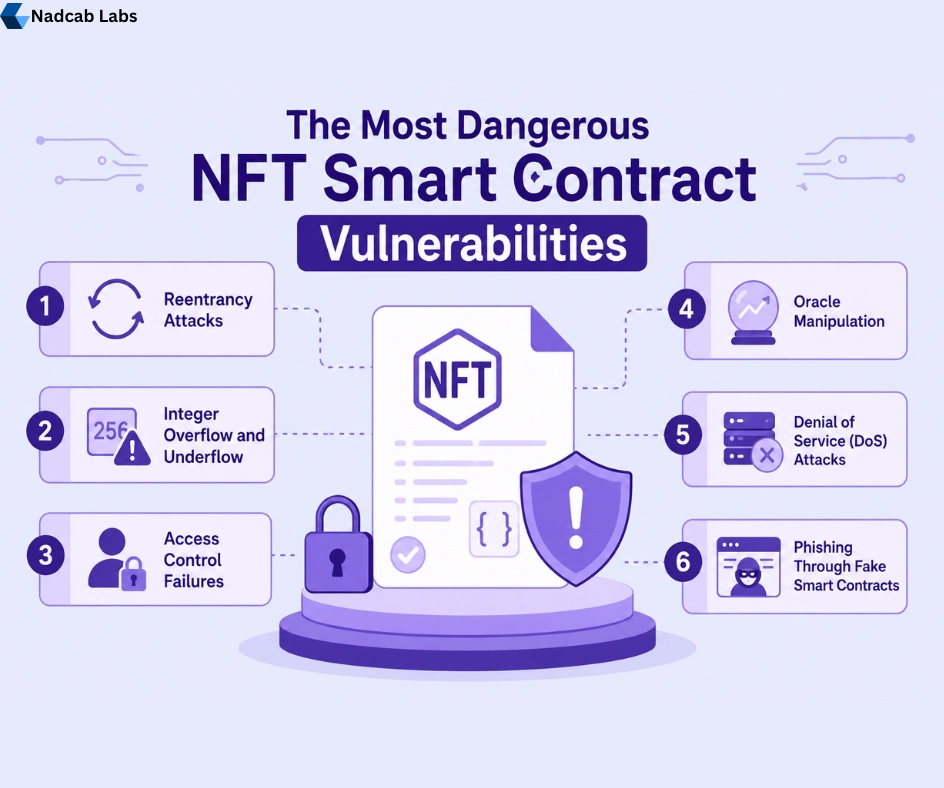
1. Reentrancy Attacks
This is one of the oldest and most destructive vulnerabilities in the Ethereum world. It happens when a smart contract sends funds or assets to an external address before it has finished updating its own internal records. A malicious contract receiving the transfer can call back into the vulnerable contract before it updates, draining funds repeatedly in a loop.
The NFT Trader hack of December 2023 is a perfect real-world example. Attackers found reentrancy flaws in two of the platform’s older, unaudited contracts and used them to steal approximately $3 million worth of NFTs. The attackers included someone who stole Bored Ape and Mutant Ape NFTs and held them for ransom before returning some. The hack would likely have been caught by even a basic audit.
The OMNI protocol was hit by the same type of attack in July 2022, leading to losses of over $1.4 million on Ethereum.
2. Integer Overflow and Underflow
Smart contracts deal with large numbers constantly. When a number exceeds the maximum value the code can hold, it wraps around to zero or a completely unexpected value. This is called integer overflow. When a number goes below zero, it wraps to a very large number. This is called underflow. Both can be exploited to manipulate token balances, bypass access controls, or mint far more tokens than intended.
The OMNI Real Estate token exploit on BNB Smart Chain in January 2023 involved exactly this kind of vulnerability, combined with improper argument validation. Attackers used the overflow to their advantage and made the contract behave in ways the developers never planned.
3. Access Control Failures
Every smart contract has certain functions that should only be callable by the owner or admin: minting new tokens, updating metadata, and pausing the contract. If access controls are written incorrectly, any user can call those functions.
In the NFT world, this has led to unauthorized minting, token metadata changes, and unauthorized ownership transfers. A real example happened when an attacker was able to collect 330 NFTs from a project by simply bypassing the per-wallet minting limit. The contract was supposed to cap purchases at two per wallet. The attacker removed that check and minted at will.
4. Oracle Manipulation
Many smart contracts rely on external data feeds called oracles to get information like NFT prices or asset values. If an attacker can manipulate what the oracle reports, they can trick the smart contract into executing transactions at false prices.
The AllianceBlock token hack in February 2023 is a documented case. An exploiter tampered with a price oracle in a borrowing protocol, which led to significant token manipulation. Reports showed that hackers drained roughly $88 million in crypto from the system through this method by manipulating the protocol’s view of token value.
5. Denial of Service (DoS) Attacks
A DoS attack targets the availability of a smart contract. Attackers can do this by exploiting Ethereum’s gas limits. If they can create an infinite loop inside a function or make a function require too much gas to run, the entire contract can become frozen or unusable.
For NFT projects with ongoing sales, staking functions, or royalty distributions, this can be devastating. Users cannot transact. Funds can get locked. The project loses trust overnight.
6. Phishing Through Fake Smart Contracts
Not every attack targets the smart contract code directly. Many of the biggest NFT losses have come from social engineering attacks that trick users into connecting their wallets to fake contracts.
In April 2022, the official Bored Ape Yacht Club Instagram account was hacked. Attackers posted a fake minting link that led to a fraudulent smart contract. When users connected their wallets, the contract drained their NFTs and crypto. About four Bored Apes and other assets worth roughly $3 million were lost in that single incident.
OpenSea users were targeted similarly in February 2022. Phishing emails impersonating OpenSea support led users to a malicious website. By interacting with it, users unknowingly signed transactions that handed over their NFTs. The total losses from that attack exceeded $3.4 million in ETH.
Recommended Reading:
Major NFT Smart Contract Exploits (2021 to 2023)
| Project / Platform | Year | Loss | Vulnerability Type |
|---|---|---|---|
| Lympo (Animoca Brands) | January 2022 | $18.7 million | Hot wallet hack, 165.2M LMT tokens drained |
| OpenSea (Phishing) | February 2022 | $3.4 million | Phishing attack via fake emails, malicious contract |
| Bored Ape Yacht Club | April 2022 | $13.7 million | Instagram hack, fake minting smart contract |
| OMNI Protocol | July 2022 | $1.4 million | Reentrancy attack on the Ethereum-based NFT protocol |
| OMNI Real Estate (BNB) | January 2023 | Undisclosed | Integer overflow, improper argument validation |
| NFT Trader | December 2023 | ~$3 million | Reentrancy vulnerability in legacy contracts |
NFT Security Risks Beyond the Code
Smart contract bugs are not the only threat NFT projects face. Security risks also exist outside the contract itself. Here are the main non-code threats that have caused real losses.
1. Rug Pulls
This is when project creators generate hype, collect funds from buyers, and then disappear with the money. The smart contract itself may be perfectly written, but the intent behind the project is fraudulent. The NFT tokens become worthless instantly. Rug pulls have been one of the most common ways NFT buyers lost money in 2022 and 2023.
2. Fake Token Copies
Bad actors create NFT collections that look exactly like popular, trusted projects. They use similar names, logos, and artwork. Buyers mistake them for the real thing and pay real money for worthless fakes. Once the value of the copycat is exposed, it collapses.
3. Malicious Airdrops
Attackers send NFTs or tokens directly to user wallets. These tokens look harmless or even valuable. When users try to sell or interact with them, the action triggers a malicious function in the airdropped token’s contract, which then drains the user’s wallet or redirects them to a phishing site.
4. Social Media Account Takeovers
NFT project teams are targets for account hackers. If an attacker gets into an official Twitter, Instagram, or Discord account, they can post fake mint links or fraudulent smart contract addresses to thousands of followers. The BAYC Instagram hack is a prime example of how social media compromises lead directly to financial losses.
5. Copy-Pasted Code Without Testing
Many NFT projects are launched quickly. Developers copy code from existing contracts or open-source repositories without fully understanding it or testing it. This is one of the most common reasons vulnerabilities end up in production. Code copied from one project may carry that project’s bugs into a completely different application. Security experts widely flag repeated, unexamined code as a major red flag when evaluating any new NFT project.
NFT Smart Contract Security Practices That Actually Work
The good news is that most NFT smart contract vulnerabilities are preventable. The bad news is that many projects skip the most basic steps. Here is what genuinely makes a difference.
1. Third-Party Smart Contract Audits
Before deploying any NFT contract on the mainnet, it should go through a full audit by an independent security firm. Companies like CertiK, Hacken, and OpenZeppelin specialize in uncovering logical bugs, reentrancy holes, access control gaps, and gas inefficiencies that in-house developers miss. Audits should cover both manual code inspection and automated scanning.
2. Multi-Signature Wallets for Admin Functions
Administrative permissions like minting, metadata updates, or contract pausing should never be controlled by a single private key. Multi-signature wallets require multiple approvals before any critical action can be executed. If one key is compromised, the attacker still cannot act alone.
3. Time Locks on Critical Functions
A time lock adds a delay between when a change is proposed and when it takes effect. This gives the development team and the community time to notice and stop malicious or unintended changes before they go live. It is especially useful for contract upgrades and fund withdrawals.
4. Decentralized Storage for Metadata
NFT metadata, the information that describes what the token looks like and what it represents, should be stored on decentralized networks like IPFS or Arweave. If metadata is stored on a central server, it can be deleted, altered, or taken offline. This can make NFTs appear to have no value even when the token still exists on-chain.
5. Write Simple, Readable Code
Complex code is harder to audit and easier to exploit. The simpler and more readable a smart contract is, the easier it is to find bugs before deployment. Writing clean, well-commented code is not just a style preference. It directly reduces the chance that a vulnerability goes undetected.
6. Use Proven Auditing Tools
Tools like MythX, Slither, and Manticore are widely used for automated smart contract analysis. They scan for known vulnerability patterns, including reentrancy, integer overflow, and dangerous function calls. These tools are not a replacement for a manual audit, but they add an important layer of automated checking that can catch issues quickly during development.
7. Educate Your Community
A lot of NFT losses happen because users are tricked, not because the contract has a bug. Educating your holders about phishing attempts, fake mint links, and suspicious airdrops reduces the damage attackers can do, even if they compromise a social media account. Clear communication channels and verified links should be pinned at all times.
Recommended Reading:
NFT Smart Contract Security Checklist
| Security Area | What to Check | Tools or Methods |
|---|---|---|
| Reentrancy | State updates before external calls, no recursive callbacks | Slither, manual review, ReentrancyGuard pattern |
| Integer Overflow/Underflow | All arithmetic operations bounded, SafeMath in use | MythX, Slither, OpenZeppelin SafeMath library |
| Access Control | Only authorized addresses can call privileged functions | Role-based access, OpenZeppelin AccessControl |
| Oracle Security | Price feeds from multiple trusted oracle sources | Chainlink oracles, time-weighted average prices |
| Gas Limits | No unbounded loops, gas-efficient storage patterns | Gas profiling, Hardhat gas reporter |
| Metadata Storage | Metadata pinned on IPFS or Arweave, not a central server | Pinata (IPFS), Arweave, manual verification |
| Third-Party Audit | Full code review by an independent security team before launch | CertiK, Hacken, OpenZeppelin, Manticore |
NFT Smart Contract Security in Practice
The challenges described in this blog are not just theoretical. The following projects show how smart contract security and NFT-focused blockchain architecture are applied in real production environments. Each one reflects the principles of secure design: audited contracts, access control, decentralized structure, and community-driven governance.
💧
BendDAO: NFT Liquidity in Decentralized Finance
Developed the token infrastructure for BendDAO, a protocol that allows users to use NFTs as collateral in DeFi lending. Smart contract security was the top priority given that the system handles both NFT assets and borrowed crypto simultaneously. The contracts were designed to prevent reentrancy during collateral interactions and to use proper oracle price feeds for NFT valuations to avoid manipulation attacks.
Build a Secure NFT Smart Contract Today:
Our team of blockchain developers and smart contract specialists handles everything from writing and auditing your NFT contracts to deploying them across multiple chains. Whether you are launching an NFT collection, a marketplace, or an NFT-powered DeFi protocol, we make sure your contracts are built right the first time with no shortcuts on security.
Final Thoughts
NFT smart contracts are the engine behind every transaction, every minting event, and every royalty payment in the NFT world. When they work correctly, they are powerful. When they fail, the damage is immediate and often permanent. The blockchain cannot be rewound.
The data is clear. Over $100 million was stolen in a single year. Attacks average $300,000 per incident. Platforms like NFT Trader, OMNI, and Lympo are all falling to vulnerabilities that proper audits could have caught. These numbers are not meant to frighten people away from NFTs. They are meant to show that the risks are real and that the solutions are already known.
Reentrancy attacks, integer overflows, access control gaps, oracle manipulation, and phishing-driven fake contracts are the main threats. Most of them are preventable. Third-party audits, multi-signature wallets, time locks, decentralized metadata storage, and clear community education are the tools that work.
If you are building an NFT project, security cannot be an afterthought. It needs to be part of the design from the very beginning. And if you are a collector, knowing what to look for before connecting your wallet to any contract is one of the most important things you can do to protect yourself.
Frequently Asked Questions
Q1.What is a smart contract vulnerability in the context of NFTs?
A smart contract vulnerability is a flaw or weakness in the code that runs an NFT’s logic on the blockchain. It can allow attackers to steal NFTs, mint more tokens than allowed, manipulate ownership records, or lock up funds. These flaws can exist in the way the contract handles external calls, math operations, access permissions, or data inputs.
Q2.How does a reentrancy attack work in an NFT project?
A reentrancy attack happens when a smart contract sends assets to an external address before updating its own internal records. A malicious contract receiving the transfer can immediately call back into the original contract before the records are updated. This loop allows the attacker to repeatedly drain funds or NFTs. The NFT Trader and OMNI protocol hacks are well-known examples of this attack in the NFT space.
Q3.What should I look for before minting an NFT to stay safe?
Before minting, check whether the project’s smart contract has been audited by a recognized firm. Verify that the mint link comes from an official verified source, not a social media post. Never connect your wallet to a link shared in comments or DMs. Check community forums for any reports of suspicious behavior and research the development team’s history before committing funds.
Q4.Are NFT smart contracts fixable after deployment?
Traditional smart contracts are not editable once deployed on the blockchain. This is by design but it also means bugs are permanent unless the project uses an upgradeable proxy contract pattern. That is why pre-deployment auditing is so important. Some projects deploy upgradeable contracts to allow patching, but this introduces its own security considerations around who controls the upgrade.
Q5.What is the difference between NFT phishing and a smart contract exploit?
A smart contract exploit takes advantage of a flaw inside the contract’s code itself. Phishing targets the user rather than the code. In a phishing attack, users are tricked into voluntarily signing malicious transactions or visiting fake websites that look like trusted platforms. Both lead to asset loss, but the entry point is different. Phishing can succeed even if the legitimate smart contract is perfectly written.
Q6.Why is metadata storage important for NFT security?
NFT metadata contains the description, image link, and attributes of the token. If this data is stored on a centralized server, the server owner can change or delete it. This means your NFT could appear blank or show completely different content even though you still hold the token. Storing metadata on decentralized networks like IPFS or Arweave prevents this kind of manipulation and makes the asset genuinely permanent.
Explore Services
Related Services
Reviewed by

Aman Vaths
Founder of Nadcab Labs
Aman Vaths is the Founder & CTO of Nadcab Labs, a global digital engineering company delivering enterprise-grade solutions across AI, Web3, Blockchain, Big Data, Cloud, Cybersecurity, and Modern Application Development. With deep technical leadership and product innovation experience, Aman has positioned Nadcab Labs as one of the most advanced engineering companies driving the next era of intelligent, secure, and scalable software systems. Under his leadership, Nadcab Labs has built 2,000+ global projects across sectors including fintech, banking, healthcare, real estate, logistics, gaming, manufacturing, and next-generation DePIN networks. Aman’s strength lies in architecting high-performance systems, end-to-end platform engineering, and designing enterprise solutions that operate at global scale.