Ai Overview
Before we jump into the NFT creation process, it is important to understand what an NFT actually is. Ethereum is the most widely used blockchain for NFTs, powering nearly 62% of all NFT transactions globally. On Ethereum, gas fees can be quite high during busy periods, sometimes reaching $50 or more for a single minting transaction. Music NFTs have become a growing segment, with streaming-linked tokens bringing in over $520 million in revenue.
Key Takeaways
- The global NFT market was valued at around $43.08 billion in 2024, and it is expected to grow to approximately $247.41 billion by 2029, showing strong long term growth driven by gaming, art, and real-world utility use cases.
[1] - Ethereum continues to power nearly 62% of all NFT transactions, while Solana handles around 18% of NFT traffic due to its faster speeds and lower transaction costs.
[2] - NFT marketplace development costs range from $30,000 to $150,000, with basic platforms costing $30,000 to $50,000 and advanced ones with custom smart contracts and multi-chain support reaching $150,000 or more.
[3] - OpenSea remains the top NFT marketplace with over 2.4 million monthly active users and hosts more than 80 million NFTs across multiple blockchains.
[4] - Gaming NFTs account for 38% of global NFT transaction volume, making gaming the largest single category in the NFT space ahead of art and collectibles.
[5] - Minting an NFT on Solana can cost as low as $0.005 in gas fees, while minting on Ethereum can cost $50 or more during high network activity, making blockchain choice a key factor in the NFT creation process.
[6] - Over 85 million NFTs were minted worldwide in the first half of 2025 alone, showing that the minting process is becoming more accessible to everyday creators and artists.
[7]
Non-fungible tokens, commonly known as NFTs, have changed the way people think about digital ownership. Whether it is a piece of digital art, a song, a game item, or even a virtual property deed, NFTs allow creators to prove ownership and sell their work directly to buyers across the globe. The NFT creation process is no longer something only developers or tech experts can do. Today, anyone with an internet connection, a digital file, and a crypto wallet can create, mint, and sell NFTs using modern NFT marketplace solutions available on various NFT marketplaces.
The NFT market has grown rapidly over the past few years. According to CoinLedger, the global NFT market was valued at approximately $43.08 billion in 2024, and projections suggest it could reach $247.41 billion by 2029. This kind of growth tells us that NFTs are not just a passing trend. They are becoming a real part of the digital economy. In this blog, we will walk you through every step of how NFTs are created, how the NFT minting process works, and how you can sell your NFTs on the best NFT selling platforms available today.
What Exactly Is an NFT and Why Does It Matter
Before we jump into the NFT creation process, it is important to understand what an NFT actually is. NFT stands for Non-Fungible Token. The word “non-fungible” simply means that each token is unique and cannot be swapped equally for another. Think of it like this: a one-hundred-rupee note can be exchanged for another one-hundred-rupee note because they hold the same value. But a painting by a famous artist cannot be exchanged equally for another painting because each one is different. NFTs work on the same idea, but in the digital world.
Each NFT is stored on a blockchain, which acts like a public ledger that records ownership and transaction history. This blockchain record cannot be changed or deleted, which makes NFTs very useful for proving who owns a digital item. The development of NFT technology has opened doors for artists, musicians, game makers, and even businesses to sell digital goods in a completely new way.
How NFTs Are Created: The Complete Process
Learning how to create an NFT is simpler than most people think. The NFT creation process involves a few clear steps, and you do not need to know how to write code. Let us go through each step one by one.
1. Choose or Create Your Digital Asset
The first step in the NFT creation process is deciding what digital file you want to turn into an NFT. This could be a digital painting, a photograph, a music track, a video clip, a 3D model, or even a written piece. The file itself is what gives your NFT its value. Your digital asset should focus on originality and quality, because buyers on NFT marketplaces are looking for something that stands out.
2. Pick the Right Blockchain
The next step is choosing which blockchain you want your NFT to live on. Ethereum is the most widely used blockchain for NFTs, powering nearly 62% of all NFT transactions globally. However, alternatives like Solana, Polygon, and Binance Smart Chain have become popular because they offer lower gas fees and faster transaction speeds. Your choice of blockchain will affect how much you pay in NFT gas fees and how fast your NFT gets listed.
3. Set Up a Crypto Wallet
You will need a crypto wallet to store your cryptocurrency and interact with NFT marketplaces. MetaMask is one of the most popular wallets and supports Ethereum and many other networks. Other options include Trust Wallet, Phantom (for Solana), and Coinbase Wallet. Make sure your wallet is funded with enough cryptocurrency to cover the NFT gas fees during minting.
4. Select an NFT Minting Platform
Once your wallet is ready, you need to pick an NFT minting platform where you will upload and mint your digital asset. Each platform has different features, fees, and supported blockchains. The growth of these platforms has made it possible for beginners to start minting NFTs without any technical background.
Recommended Reading:
NFT Marketplace Development Guide Architecture, Cost, Security & Compliance Explained
Understanding the NFT Minting Process
Minting NFTs is the actual process of turning your digital file into a token on the blockchain. When you mint an NFT, you are writing a unique piece of data to the blockchain that records information about the creator, the description, and the ownership of the digital item. This makes your digital file officially a one-of-a-kind asset that can be bought, sold, or traded.
When creators mint NFTs, they often consider the potential appeal and rarity of their tokens. For newcomers exploring digital assets, understanding what is Treasure NFT can help guide creative decisions. Treasure NFTs could represent highly sought-after digital collectibles or assets with added utility, making them more attractive to collectors when they go to market.”
1. How Does Minting Actually Work
When you mint an NFT on a platform like OpenSea or Rarible, you upload your digital file and add details such as the name, description, and any special properties. The platform then interacts with the blockchain through a smart contract to create your token. Smart contracts are self-executing programs on the blockchain that handle the entire process automatically. They take care of cryptocurrency transfers, deliver the NFT to buyers, distribute royalties to creators, and record every transaction permanently on the blockchain. This means no middleman is needed.
2. What Are NFT Gas Fees
NFT gas fees are the costs you pay to the blockchain network for processing your transaction. On Ethereum, gas fees can be quite high during busy periods, sometimes reaching $50 or more for a single minting transaction. This happens because Ethereum can only process about 15 to 30 transactions per second, and when many people are using the network at the same time, fees go up. On the other hand, Solana charges as little as $0.005 per transaction because of its high throughput design. Polygon, a Layer 2 solution for Ethereum, charges around $0.10 for NFT minting. The development of these alternative blockchains has made the minting process much more affordable for new creators.
3. Lazy Minting: A Cost-Effective Option
Some NFT minting platforms offer a feature called “lazy minting.” With lazy minting, the NFT is not actually written to the blockchain until someone buys it. This means the creator does not pay any upfront gas fees. Instead, the buyer pays the gas fee as part of the purchase. OpenSea popularized this method, and it has made it possible for creators to list their NFTs without any initial cost. This is a great option if you are just starting out and want to test the waters without spending money.
Top NFT Marketplaces for Selling Your NFTs
Choosing the right NFT marketplace is a big part of the NFT listing process. Different platforms serve different types of creators and buyers. Here is a look at some of the most popular NFT selling platforms and what makes each one different.
1. OpenSea
OpenSea is the largest NFT marketplace in the world, with over 2.4 million monthly active users. It hosts more than 80 million NFTs across multiple blockchains, including Ethereum, Polygon, Solana, and others. The platform charges a 2.5% service fee on every sale. OpenSea supports various sale types, including fixed price listings and timed auctions. Over the years, it has become the go-to platform for both beginners and experienced NFT creators.
2. Rarible
Rarible stands out because of its community governance model. The platform has its own RARI token, which allows users to vote on decisions like fee structures and new features. This gives creators a say in how the platform evolves. Rarible supports Ethereum, Polygon, and other blockchains, and it hosts over 300,000 NFTs.
3. SuperRare
SuperRare is a curated NFT marketplace focused on high-quality digital art. Unlike OpenSea, where anyone can list an NFT, SuperRare requires artists to apply and get approved before they can sell. This approach keeps the quality high and attracts serious art collectors who are willing to pay premium prices.
4. Magic Eden
Magic Eden has become the leading NFT marketplace on the Solana blockchain. It is popular among gaming NFT creators and collectors because of Solana’s fast transaction times and very low fees. Magic Eden has helped bring more attention to Solana-based NFT projects.
Recommended Reading:
How to Sell NFTs: The NFT Listing Process
Once you have minted your NFT, the next step is selling it. The NFT listing process involves setting up your sale on your chosen NFT marketplace. Let us break this down into simple steps.
1. List Your NFT for Sale
After minting, you will see a “Sell” button on your NFT’s page. Clicking it will open options for how you want to sell. You can choose between a fixed price sale, where you set a specific amount, or a timed auction, where buyers place bids over a set period. Some platforms also offer Dutch auctions, where the price starts high and drops over time until someone buys.
2. Set Your NFT Pricing Strategy
Your NFT pricing strategy plays a huge role in whether your NFT sells. If you price too high, buyers might skip over your listing. If you price too low, you might not get the value your work deserves. Look at similar NFTs on the marketplace to get an idea of what buyers are paying. The average NFT sale price has stabilized around $940, according to recent data. This shows that the market is maturing, and buyers are becoming more thoughtful about what they purchase.
3. Set Up Royalties
One of the best things about selling NFTs is the ability to earn royalties on future sales. When you create an NFT, you can set a royalty percentage, usually between 5% and 10%. Every time your NFT is sold to a new owner on the secondary market, you automatically receive that percentage of the sale price. Over 80% of creators now use royalty-enforcing smart contracts, showing how important this feature has become in the development of the NFT space.
NFT Marketplace Development Costs
| Development Component | Cost Range | Key Considerations |
|---|---|---|
| Basic Platform Features | $30,000 – $50,000 | User authentication, NFT minting, buying/selling functionality, basic wallet integration |
| Advanced Platform Features | $100,000 – $150,000+ | Custom smart contracts, multi-chain support, advanced analytics, decentralized storage, royalty management |
| UI/UX Design | $5,000 – $20,000 | Simple interface vs. custom-branded design with detailed elements |
| Blockchain Integration | $10,000 – $20,000 | Ethereum most common, alternatives like Solana or BSC may vary |
| Smart Contract Development | Included in platform costs | Token standards (ERC-721, ERC-1155), security audits, testing |
| Security Implementation | $5,000 – $15,000 | Encryption, multi-factor authentication, and regular security audits |
| Ongoing Maintenance | $1,000 – $5,000/month | Server hosting, updates, customer support, security monitoring |
NFT Gas Fees Across Different Blockchains
Understanding NFT gas fees is one of the most important parts of the NFT creation process. The blockchain you choose will directly affect how much you spend during the minting process. Here is a comparison of gas fees across major blockchains used for NFT development.
Gas Fees Comparison Across Blockchains
| Blockchain | NFT Minting Fee | Transaction Speed |
|---|---|---|
| Ethereum | $3.78 average (can spike to $50+) | 15-30 TPS |
| Solana | $0.005 | 4,000+ TPS |
| Polygon | $0.10 | 7,000+ TPS |
| BNB Chain | $0.50 | 300+ TPS |
| Avalanche | $0.20 | 4,500+ TPS |
| Arbitrum (Layer 2) | $0.05 | Inherits Ethereum security |
As you can see, the development of alternative blockchains and Layer 2 solutions has given creators many more affordable options. If you are just getting started with NFT creation, choosing a blockchain like Solana or Polygon can save you a lot of money in gas fees while still giving you access to a large audience of buyers.
The Role of Smart Contracts in NFT Development
Smart contracts are the backbone of the entire NFT ecosystem. They are self-running programs stored on the blockchain that carry out tasks automatically when certain conditions are met. In the context of NFTs, smart contracts handle everything from minting and ownership transfers to royalty payments.
When you mint an NFT, a smart contract assigns a unique token ID and links it to your digital file’s metadata. This metadata includes information like the creator’s name, a description of the work, and a link to where the actual file is stored, usually on a decentralized storage system like IPFS (InterPlanetary File System). The two most common token standards used in NFT development are ERC 721 and ERC 1155. ERC 721 is the original NFT standard that creates truly unique tokens. ERC 1155 is a newer standard that allows both fungible and non-fungible tokens to be managed through a single smart contract, which is useful for gaming applications where you might need both unique items and currency.
Recommended Reading:
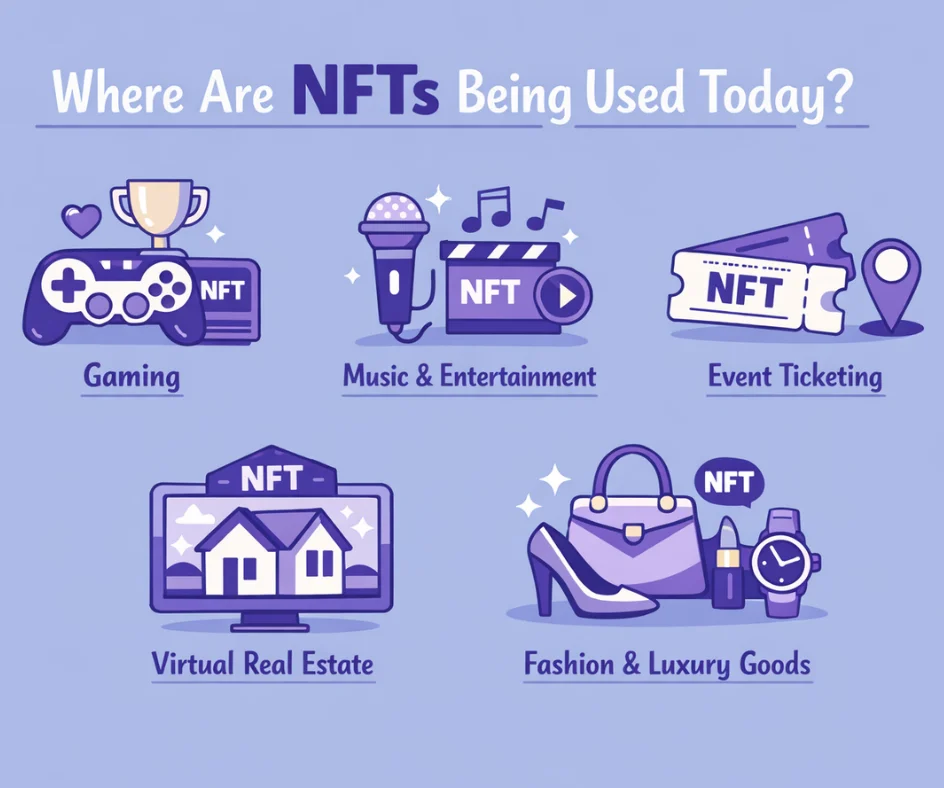
Where Are NFTs Being Used Today
The NFT market has moved far beyond just digital art. Today, NFTs are being used in many different industries, and the development of new use cases continues to grow every month.
1. Gaming
Gaming NFTs account for 38% of global NFT transaction volume, making it the single largest category. Play-to-earn games like Axie Infinity and The Sandbox allow players to own in-game items as NFTs. These items can be traded on open marketplaces, giving players real-world value for their time spent gaming.
2. Music and Entertainment
Music NFTs have become a growing segment, with streaming-linked tokens bringing in over $520 million in revenue. Artists can tokenize their songs, albums, or concert tickets and sell them directly to fans. This removes the middleman and gives artists a much larger share of the profits.
3. Event Ticketing
NFT-based event tickets now make up 5.3% of ticket sales across major US venues. These tickets are stored on the blockchain, making them nearly impossible to fake. This helps event organizers fight ticket fraud while also allowing them to set up royalties on resales.
4. Virtual Real Estate
Virtual real estate NFTs grew by 32% year over year, with the market size reaching $1.4 billion. Platforms like Decentraland and The Sandbox let users buy, build on, and sell virtual land plots as NFTs. The growth of metaverse economies is making virtual property a serious investment category.
5. Fashion and Luxury Goods
Fashion NFTs, powered by digital wearables and luxury brand partnerships, have reached a valuation of $890 million. Phygital NFTs, which are tokens linked to physical products, saw a 60% rise in transaction volume, especially in the luxury market segment.
Tips for a Strong NFT Pricing Strategy
Setting the right price for your NFT can make the difference between a sale and a listing that sits untouched for months. Here are some practical tips to build a good NFT pricing strategy.
First, study the market. Look at what similar NFTs are selling for on the NFT marketplace you plan to use. Check the floor price of collections in your category. Second, consider your audience. If you are a new creator, starting with a lower price can help you build a following and get your first sales. Third, factor in all costs. Your NFT gas fees, platform service charges, and any marketing expenses should all be considered when deciding your price. Fourth, think about editions. Selling multiple copies of the same NFT at a lower price can sometimes bring in more total revenue than selling one copy at a high price. Fifth, use your personal brand as a pricing tool. As you build a reputation in the NFT space, you can gradually increase your prices.
NFT Platform Innovations in the Real World
The following projects show how NFT and blockchain technology are already being used across music, gaming, and digital asset trading. Each project reflects the same principles discussed throughout this article, from smart contract-powered transactions and token-based governance to community-driven growth and decentralized marketplace management.
🎵
NEWM: Decentralized Music NFT Platform
Built a blockchain-based platform on Cardano that lets musicians tokenize their work as NFTs, receive real-time royalties, and connect directly with fans. The platform features an NFT marketplace for music assets, automated royalty payments through smart contracts, and Proof of Stake-based governance for community participation.
Launch Your NFT Marketplace Platform Today:
We bring blockchain expertise to NFT marketplace development. Our specialized team handles everything from smart contract creation to multi-chain integration, ensuring your platform is built for growth, security, and user experience. Whether you need a curated art marketplace or a gaming NFT platform, we deliver solutions that work.
Final Thoughts
The NFT creation process has become much simpler and more affordable than it was just a few years ago. From choosing your digital asset and picking a blockchain to minting NFTs on a platform like OpenSea and listing them for sale, the entire journey can be completed in less than an hour. The development of lazy minting, low-cost blockchains like Solana and Polygon, and user-friendly NFT marketplaces has removed most of the barriers that once kept everyday creators out of the space.
The numbers tell the story clearly. The global NFT market grew from $43.08 billion in 2024 and is projected to reach $247.41 billion by 2029. Over 85 million NFTs were minted in just the first half of 2025. Gaming NFTs, music tokens, event tickets, and virtual real estate are all seeing real adoption and real revenue. Whether you are an artist looking to monetize your work, a musician wanting to connect with fans, or a business exploring the development of an NFT marketplace, now is a strong time to get involved. The technology is mature, the tools are accessible, and the market continues to grow.
Frequently Asked Questions
Q1.What is NFT minting process?
NFT minting is the process of turning a digital file like an image, music, or video into a unique token on the blockchain. When you mint an NFT, the blockchain records its ownership and details permanently, making it a verified one of a kind digital asset.
Q2.How much does minting cost?
The cost of minting an NFT depends on which blockchain you use. On Ethereum, gas fees can range from a few dollars to over $50 during busy times. On Solana, minting costs as little as $0.005, and on Polygon it is around $0.10 per transaction.
Q3.Which NFT marketplace is best?
OpenSea is the largest and most popular NFT marketplace, supporting multiple blockchains and hosting over 80 million NFTs. Rarible is good for community driven trading, SuperRare is ideal for high end digital art, and Magic Eden leads on the Solana blockchain.
Q4.Can I create NFTs for free?
Yes, you can create NFTs for free using lazy minting on platforms like OpenSea. With lazy minting, the NFT is not written to the blockchain until someone buys it, so you pay no upfront gas fees. The buyer covers the gas fee at the time of purchase.
Q5.What is lazy minting in NFTs?
Lazy minting is a method where the NFT is listed on a marketplace without being immediately written to the blockchain. The actual minting happens only when someone purchases the NFT, and the gas fee is paid by the buyer instead of the creator.
Q6.How do NFT royalties work exactly?
When you create an NFT, you can set a royalty percentage, usually between 5% and 10%. Every time your NFT is resold on the secondary market, the smart contract automatically sends that percentage of the sale price to your wallet without needing any manual effort.
Explore Services
Related Services
Reviewed by

Aman Vaths
Founder of Nadcab Labs
Aman Vaths is the Founder & CTO of Nadcab Labs, a global digital engineering company delivering enterprise-grade solutions across AI, Web3, Blockchain, Big Data, Cloud, Cybersecurity, and Modern Application Development. With deep technical leadership and product innovation experience, Aman has positioned Nadcab Labs as one of the most advanced engineering companies driving the next era of intelligent, secure, and scalable software systems. Under his leadership, Nadcab Labs has built 2,000+ global projects across sectors including fintech, banking, healthcare, real estate, logistics, gaming, manufacturing, and next-generation DePIN networks. Aman’s strength lies in architecting high-performance systems, end-to-end platform engineering, and designing enterprise solutions that operate at global scale.