Ai Overview
Then came the idea that players could actually earn real money through gameplay. Today, we are looking at something that combines all of this with a business model that has existed for decades: multi-level marketing. But once you understand how Play-to-Earn (P2E) games work and how blockchain enables transparent, automated reward systems, it starts to make a lot of sense.
Key Takeaways
- Blockchain MLM in gaming removes the need for middlemen and puts earning power directly in the hands of players and community builders.
- Smart contracts automate commission payouts in real time, eliminating delays and reducing the risk of fraud or manipulation.
- Play-to-Earn models powered by referral networks and token-based rewards create layered income streams for both casual players and serious network builders.
- NFT-based assets, guild systems, and DAO governance are reshaping how MLM compensation plans are structured in Web3 gaming.
- Token volatility, smart contract vulnerabilities, and regulatory uncertainty remain the biggest risks in this space.
- Cross-chain interoperability and AI-driven reward automation are set to be the next major growth drivers in blockchain gaming MLM.
Introduction: When Gaming Economies Met Network Marketing
Online gaming has gone through several phases. First it was about entertainment. Then came in-game purchases. Then came the idea that players could actually earn real money through gameplay. Today, we are looking at something that combines all of this with a business model that has existed for decades: multi-level marketing.
The combination sounds unusual at first. But once you understand how Play-to-Earn (P2E) games work and how blockchain enables transparent, automated reward systems, it starts to make a lot of sense. Players recruit other players, build networks, and earn a share of the activity happening within their downline. Smart contracts handle all the distribution. There is no company controlling the payouts. The code does it automatically.
This is not a trend built on hype alone. The Play-to-Earn gaming model has attracted millions of players globally, and the integration of referral-based income structures is accelerating that growth. If you are building in this space or exploring it, this guide will walk you through everything that matters: how it works, the risks involved, the compensation models, and where the industry is heading.
At our agency, with over 8 years of hands-on experience building decentralized MLM platforms and blockchain gaming ecosystems, we have seen what works, what fails, and what is genuinely worth building. This article reflects that experience directly.
Understanding Blockchain in Gaming
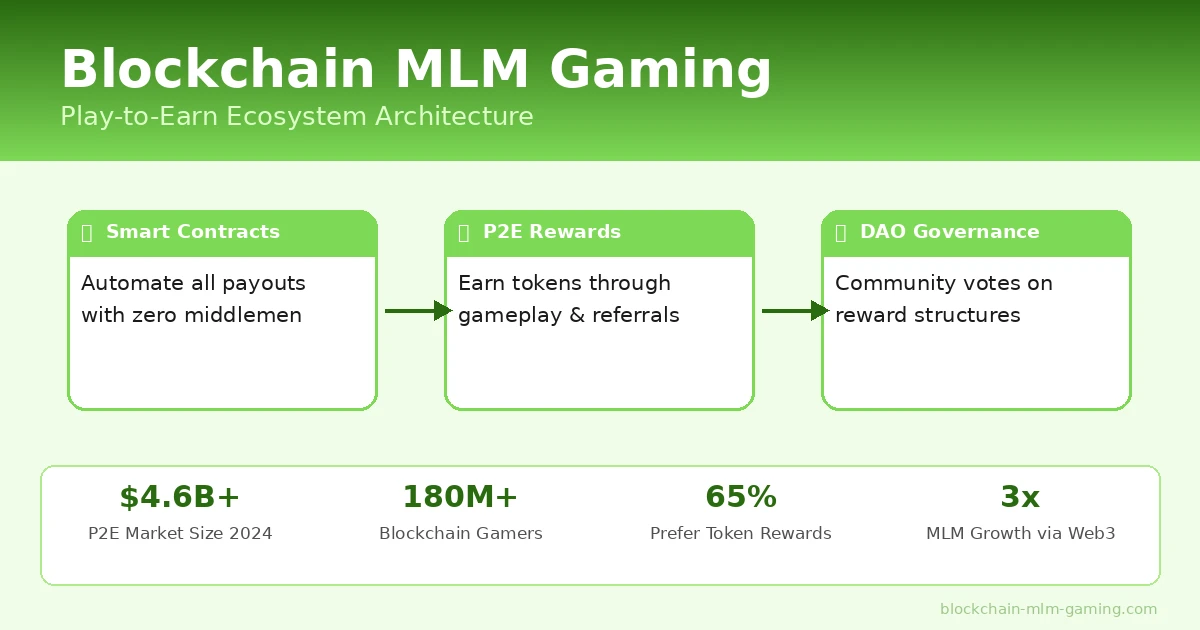
Blockchain in gaming means that the assets you own inside a game, such as weapons, skins, characters, and land, exist on a public ledger. They are not stored on a company’s server that could shut down tomorrow. They belong to the player’s wallet. Nobody can take them away, duplicate them unfairly, or alter their properties without the rules of the smart contract allowing it.
Non-fungible tokens (NFTs) are the most common form of blockchain-based game assets. Each NFT is unique, verifiable, and tradeable on open marketplaces. Game tokens, on the other hand, are fungible currencies that players earn through gameplay and can convert into real-world value.
Smart contracts sit at the center of everything. When you complete a quest, make a referral, or stake your tokens, the smart contract fires automatically and distributes value based on pre-written rules. No human approval is needed. No company can hold back your earnings. This is what makes blockchain gaming fundamentally different from traditional gaming monetization.
For those building gaming MLM platforms, this level of transparency and automation is the single biggest advantage. You can read more about how this technology is applied in our deep-dive on blockchain MLM network structures.
What is MLM in a Blockchain Environment?
Multi-level marketing is a business model where participants earn income not just from their own sales or activity, but also from the activity of people they recruit. Those recruits can recruit others, creating a layered network where earnings flow upward through each level.
In a traditional MLM, a central company controls the reward pool, decides the commission rates, processes payments, and holds significant control over whether participants actually get paid. Disputes are common. Payout delays are common. Lack of transparency is common.
Blockchain changes this entirely. In a decentralized MLM, the compensation rules are written into a smart contract. Once deployed, those rules cannot be changed without consensus. Every transaction, every commission, every referral link is recorded on a public blockchain that anyone can audit. This is not a promise made by a marketing brochure. It is verifiable code.
Traditional MLM vs. Blockchain MLM: A Direct Comparison
| Feature | Traditional MLM | Blockchain MLM |
|---|---|---|
| Payment Control | Central company | Smart contract (automated) |
| Transparency | Limited, internal reports | Fully public on blockchain |
| Payout Speed | Weekly or monthly | Instant or near-instant |
| Geographic Limits | Regional restrictions | Global, borderless |
| Fraud Risk | High (human-managed) | Low (code-enforced rules) |
| Asset Ownership | Controlled by company | Player-owned via wallet |
| Rule Changes | Company decides unilaterally | Requires on-chain governance vote |
This fundamental shift is why developers, investors, and gaming communities are paying close attention to cryptocurrency MLM software platforms that bring these two worlds together effectively.
How MLM Models Integrate Into Play-to-Earn Ecosystems
The integration of MLM into P2E is not as forced as it might sound. P2E games already reward activity. Players earn tokens for winning battles, completing missions, or contributing to the game world. Adding a referral layer simply means that bringing a new player into the ecosystem also earns you a reward, and that reward extends multiple levels deep depending on the compensation plan.
Here is a practical example. You play a P2E game and invite five friends. Each friend invites three more. At every level, a percentage of the token earnings generated by each recruited player flows back up to you. The smart contract calculates this automatically based on the defined commission structure. You do not have to track it. The blockchain does.
There are four main ways MLM integrates into P2E ecosystems:
Referral-Based Reward Systems: Every new player you recruit earns you tokens. When your recruit levels up or earns in-game rewards, a portion gets credited to your wallet. This is the most direct MLM mechanism inside a gaming environment.
Token-Based Commission Structures: Commissions are paid in the platform’s native token. Players who build large downlines receive passive token income tied directly to the performance of their network. This aligns everyone’s interest. A strong network means a stronger token economy for everyone.
Gamified Incentive Mechanisms: Platforms add game mechanics to the MLM structure itself. Achieving a certain network size unlocks new character abilities, game maps, or exclusive NFT drops. The MLM structure becomes part of the game, not just a business layer on top of it.
DAO-Based Governance: In more mature ecosystems, Decentralized Autonomous Organizations (DAOs) allow the player community to vote on commission rates, reward structures, and platform upgrades. This gives participants real ownership of the ecosystem they are building inside.
Want to go deeper on how the underlying network architecture works? Our guide on blockchain-based MLM network design covers the technical blueprints in detail.
Launch Your Blockchain Gaming MLM Platform
We build Play-to-Earn ecosystems with smart contract-powered MLM compensation plans. Transparent, scalable, and built to grow your gaming community.
Key Benefits of Blockchain MLM in Gaming
The reasons this model is gaining traction come down to real, measurable advantages that traditional gaming income models simply cannot offer.
Transparent Earnings Tracking: Every commission, every reward, every transaction is recorded on the blockchain. Players can verify their own earnings and check that the platform is paying out correctly. This level of visibility builds trust in ways that traditional MLM programs never could. According to research on blockchain transparency, immutable ledgers are one of the strongest trust mechanisms in digital commerce today.
Global Participation Without Intermediaries: A player in Southeast Asia and a player in South America participate on equal footing. There are no currency conversions, no bank delays, and no regional lockouts. This borderless nature is one of the strongest growth drivers for blockchain gaming MLM platforms. Our analysis of blockchain MLM adoption rates shows that emerging markets are the fastest-growing participant base.
Secure and Tamper-Proof Transactions: Smart contracts execute based on pre-set conditions. Once deployed and audited, they cannot be altered by any single party. This eliminates the most common concern in traditional MLM: that the company might change the rules mid-game and cut commissions.
Passive Income for Gamers: A player who built a large referral network three months ago continues to earn as long as their recruited players remain active. This creates genuine passive income streams, not just active grind-based rewards.
Community-Driven Growth: Because participants are financially incentivized to recruit and support other players, marketing happens organically. The community grows itself. Platform development costs that would normally go into paid advertising get redirected into the reward pool, which makes the rewards more attractive and accelerates growth further.
Popular Compensation Plans for Gaming MLM
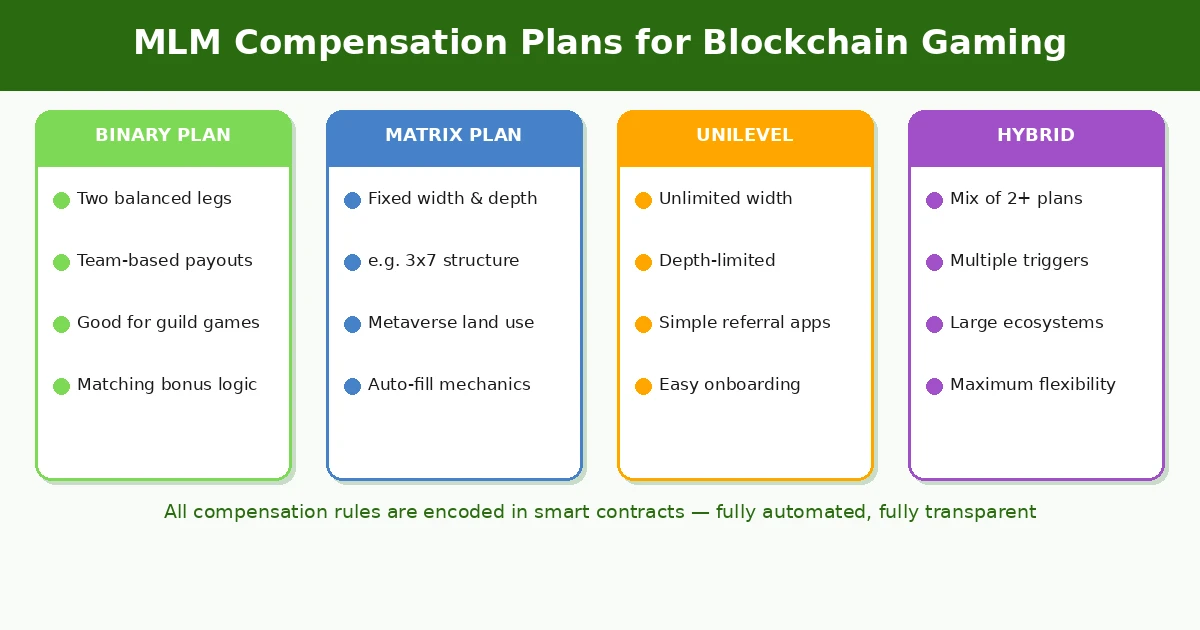
The compensation plan is the engine of any MLM system. In blockchain gaming, these plans are coded directly into smart contracts, which means they need to be designed carefully before deployment. Changing them later requires governance votes or contract upgrades, both of which are complex. Getting the design right from the start is critical.
Compensation Plan Comparison for Blockchain Gaming MLM
| Plan Type | Structure | Best For | Payout Trigger |
|---|---|---|---|
| Binary Plan | 2 legs, balanced earnings | Team-building games, guild systems | Matching leg performance |
| Matrix Plan | Fixed width and depth (e.g., 3×7) | Metaverse land ownership models | Matrix position fill |
| Unilevel Plan | Unlimited width, limited depth | Casual P2E referral programs | Direct recruit activity |
| Hybrid Plan | Combination of two or more plans | Large-scale gaming ecosystems | Multiple condition triggers |
| Token Staking Pools | Lock tokens, earn from pool | Long-term holder incentives | Staking duration and pool share |
The binary plan is widely used in competitive team games where two guilds or factions compete against each other. The matrix plan fits well into metaverse real estate models where land plots are organized in grids. The unilevel plan works best for simple P2E referral programs where simplicity and ease of onboarding matter more than maximizing depth commissions.
Token staking pools add a passive reward layer that encourages players to hold the platform token rather than immediately sell it. This helps stabilize token economics, which is one of the most difficult challenges in blockchain gaming. If you are building any of these systems, our cryptocurrency MLM software supports all major compensation plan types with fully configurable smart contract templates.
The MLM Lifecycle in a Play-to-Earn Ecosystem
Understanding how a player moves through the system helps both platform designers and participants set realistic expectations. The lifecycle is not just about recruitment. It is about progression, retention, and community sustainability.
Stage 1 — Onboarding: A player is referred by an existing network participant. They set up a crypto wallet, acquire the platform token, and start playing.
Stage 2 — Active Play: The player engages with the game, earns in-game tokens, and understands the reward structure. They see their referrer earning commissions from their activity.
Stage 3 — Network Building: Motivated by passive income potential, the player starts recruiting others. Their downline grows. Commission earnings increase with each active recruit.
Stage 4 — Staking and Governance: As the player’s network matures, they stake tokens, participate in DAO votes, and influence platform direction. They become a stakeholder, not just a participant.
Stage 5 — Leadership and Compounding: Top network builders achieve leadership status, unlock exclusive NFT rewards, and earn from multiple commission levels simultaneously. Their platform influence grows alongside their income.
This lifecycle creates stickiness. Players who have built networks have a strong reason to stay and keep their recruits active. That organic retention is something no advertising budget can replicate. To understand how the underlying distributed ledger technology powers these MLM mechanics, it is worth exploring the technical architecture in detail.
Real Use Cases of Blockchain MLM in Play-to-Earn
This is not a theoretical model. There are active, functioning use cases across multiple gaming categories right now.
NFT-Based Game Asset Promotion: Players earn commissions when the people they refer purchase NFT characters, weapons, or land. The referral is tracked on-chain, and the commission is distributed automatically. Games using this model see higher NFT sales velocity because the community has a financial reason to market the assets for them.
Guild-Based Reward Systems: Guilds in blockchain games function similarly to downlines in MLM. A guild leader recruits members, those members earn in-game rewards, and the guild leader takes a percentage. Games like these have seen guild leaders generating income equivalent to full-time employment in markets where the game’s token has strong value.
Esports Referral Ecosystems: Competitive gaming platforms have integrated referral systems where tournament organizers earn a cut of entry fees or token transactions generated by players they bring to the platform. This creates an incentivized promoter network that operates at a scale no internal marketing team could match.
Metaverse-Based MLM Gaming Platforms: In virtual worlds, participants recruit new residents and earn from the economic activity those residents generate. Whether that is buying virtual land, trading digital goods, or attending virtual events, each transaction generates a small commission that flows up through the referral chain.
The Web3 space is moving fast in this direction. Our look at how Web3 is disrupting traditional network marketing gives a broader picture of where this is heading beyond gaming specifically.
Challenges and Risks You Cannot Ignore
It would be dishonest to write about blockchain gaming MLM without addressing the significant risks. After 8 years in this space, we have seen projects fail for the same reasons repeatedly. Here is a direct summary of what you need to watch out for.
Regulatory Uncertainty: Regulators in the United States, European Union, and several Asian jurisdictions are actively examining whether P2E tokens qualify as securities. The SEC’s existing framework on digital asset classification creates legal exposure for platforms that structure token rewards in ways that resemble investment contracts. Platforms operating without proper legal counsel face significant regulatory risk.
Token Volatility: When a player’s income is denominated in a volatile token, a 60% price drop can wipe out months of earnings. This has been one of the biggest drivers of player attrition in P2E games. Platforms that have not built stable token mechanisms into their economics see users leave during downturns, which further accelerates the token’s decline.
Smart Contract Vulnerabilities: Bugs in smart contract code have resulted in hundreds of millions of dollars in losses across the blockchain industry. An MLM platform with a poorly audited contract is a target. Re-entrancy attacks, overflow errors, and logic flaws in commission calculation functions are the most common attack vectors.
Reward Model Sustainability: Many P2E games launched with reward rates that were only sustainable if token prices kept rising and new players kept joining. When growth slowed, the economics collapsed. A reward model needs to be self-sustaining from in-game economic activity, not dependent on endless new capital entering the system.
Security and Compliance Considerations
Building a compliant and secure blockchain gaming MLM platform is not optional. It is what separates projects that survive from those that get shut down or hacked within their first year.
Smart Contract Audits: Every smart contract powering the MLM compensation logic must be audited by an independent security firm before going live. Reputable auditing companies review the code for known vulnerability patterns and logic errors. This is a non-negotiable step for any serious platform. Audit reports should be published publicly to build community trust.
Anti-Fraud Mechanisms: On-chain fraud detection monitors for wallet clustering, where a single user creates multiple wallets to farm referral bonuses. Platforms should implement cooldown periods, unique wallet requirements, and activity thresholds before commissions are unlocked.
KYC and AML Integration: Know Your Customer (KYC) and Anti-Money Laundering (AML) requirements are increasingly expected by regulators, particularly for platforms processing significant transaction volumes. Integrating identity verification without compromising the decentralized user experience is challenging but achievable with modern Web3 identity solutions.
Sustainable Tokenomics Design: A well-designed token economy should have clear emission schedules, burn mechanisms, and utility that extends beyond reward payouts. Tokens that have no purpose other than being paid out as rewards tend toward zero over time. Building real in-game utility and governance rights into the token creates sustainable demand.
The concept of trustless payout systems is central to getting this right. Our detailed coverage of trustless MLM payout infrastructure explains how to architect these systems from the ground up.
Future Trends in Blockchain Gaming MLM
The next two to three years are going to see significant shifts in how these platforms operate. Based on what we are seeing at the development level, here are the trends that will matter most.
AI-Driven Reward Automation: Artificial intelligence will be integrated into reward distribution to dynamically adjust commission rates based on player behavior, market conditions, and ecosystem health. Rather than fixed rates written into a static smart contract, AI oracle systems will feed real-time data into adaptive smart contracts that optimize rewards for long-term sustainability.
Cross-Chain Gaming Ecosystems: Players will not be locked into a single blockchain. Cross-chain bridges and interoperability protocols will allow a player on Ethereum to recruit a player on Solana or Polygon. Commission flows will move across chains automatically. This expands the addressable player base enormously and reduces the network effect barriers that currently limit individual platform growth.
Interoperable NFTs: NFT assets will move between games. A sword you earned in one P2E game might be usable in another that runs on a different blockchain. MLM structures that reward players for expanding the broader NFT ecosystem, rather than just one game, will become more common. This creates a form of cross-game referral income that does not currently exist at scale.
Web3 Community-Led Expansion: DAO governance is maturing. Future gaming MLM platforms will give token holders not just voting rights but active design authority over game mechanics, reward structures, and platform partnerships. The community will genuinely build and own the platform they are marketing. This is the final step in making blockchain gaming MLM truly decentralized in practice, not just in name.
“The platforms that will lead the next phase of blockchain gaming MLM are those that combine rigorous tokenomics design with genuine community governance. Hype-driven launches will not survive. Ecosystem-first thinking will.”
MLM Blockchain Strategy Team, 8+ Years in Decentralized Network Design
Conclusion: Why This Combination Has Real Long-Term Potential
Blockchain MLM in gaming is not a gimmick. It is a structural shift in how online gaming economies can work. It removes the need for a central authority controlling payouts. It creates genuine passive income opportunities for players who build communities. It aligns the incentives of the platform and its users in a way that traditional gaming models never could.
That said, the risks are real. Token volatility, smart contract bugs, regulatory pressure, and unsustainable reward models have already taken down dozens of projects. The difference between a platform that thrives and one that collapses comes down to three things: sound tokenomics, secure code, and genuine player utility.
The long-term growth potential is significant. As cross-chain infrastructure matures, as AI-driven reward optimization becomes more accessible, and as regulators develop clearer frameworks, the best-designed blockchain gaming MLM platforms will attract larger and more diverse player bases than anything we have seen so far.
If you are building in this space, start with the fundamentals. Design your compensation plan around sustainability. Audit your contracts before launch. Give your community real governance power. And build for the long term, not the next token price pump.
For a broader view of how decentralized networks are evolving, our full breakdown of blockchain MLM network architecture and the current adoption landscape are good next reads.
Frequently Asked Questions
Q1.Can a regular gamer actually make a sustainable income through a blockchain MLM gaming platform?
It depends on the platform’s tokenomics and how actively the gamer builds their referral network. A casual player who only games without recruiting others will earn token rewards from gameplay, but those earnings are typically modest and fluctuate with token price. A player who also focuses on network building, bringing in active players across two or three levels, can generate meaningful passive income that compounds over time. The key word is “sustainable.” Platforms that tie rewards to real in-game economic activity, rather than just new-member entry fees, tend to hold up far longer. Before joining any platform, check whether the reward model makes sense if new signups slow down. If it collapses the moment recruitment stops, that is a red flag, not a gaming opportunity.
Q2.How are MLM commissions actually paid out in a blockchain gaming environment, and who controls that process?
This is one of the most important distinctions between traditional MLM and blockchain MLM. In a conventional MLM, a company processes your commissions manually and transfers money through a payment system it controls. In a blockchain gaming platform, commission logic is written directly into a smart contract. When the trigger conditions are met, such as your recruit completing a transaction or earning a certain number of tokens, the smart contract fires automatically and sends your commission to your wallet. Nobody approves it. Nobody can delay it. Nobody can quietly change the rate. The contract executes exactly as written. The only caveat is that this only holds if the smart contract has been properly audited. A buggy contract can still misbehave, which is why independent security audits are a non-negotiable step before any serious platform goes live.
Q3.What is the difference between a guild system in a blockchain game and a traditional MLM downline?
Functionally, they are very similar, but the motivation behind joining is different. In a traditional MLM, you join a downline primarily to earn money by recruiting others who buy products. In a blockchain gaming guild, you join because you want to play the game, and the MLM-style income layer is built on top of the gameplay itself. A guild leader recruits members, those members earn in-game rewards, and the guild leader earns a percentage of what the members generate. The income is real and tied to actual game activity, not just to recruitment. This makes the guild model feel more natural to gamers and less like a business opportunity being forced onto a hobby. The best blockchain gaming MLM platforms blur this line intentionally, so players never feel like they are in a sales program. They feel like they are building a team.
Q4.Is it legal to run a blockchain MLM platform inside a Play-to-Earn game, and what do I need to watch out for from a regulatory standpoint?
Legality varies significantly by jurisdiction and depends heavily on how the token and the compensation plan are structured. The biggest concern from regulators, particularly the SEC in the United States, is whether the tokens distributed through your MLM system qualify as securities under the Howey Test. If participants are buying into your platform primarily expecting profits based on the efforts of others, that is the profile of a security, and it triggers registration requirements and investor protection obligations. Beyond securities law, some countries have specific MLM regulations that require income disclosures, ban pyramid structures, or limit the number of reward levels. Operating globally without legal counsel is genuinely risky. At minimum, you need a qualified attorney familiar with both blockchain and MLM law in every major market you are targeting. KYC and AML compliance are also increasingly expected even for decentralized platforms, especially those operating at scale.
Q5.Why do so many Play-to-Earn games with MLM reward systems fail within a year, and what separates the ones that survive?
The most common cause of failure is a reward model that is only sustainable if token prices keep rising and new players keep joining. When growth naturally plateaus, which it always does at some point, the economics collapse. Players who joined later find that the token they earned is worth a fraction of what it was, and they leave. That exit drives the price down further. It becomes a cycle. The platforms that survive are the ones where the reward pool is funded by actual in-game economic activity, such as marketplace fees, NFT trading volume, and in-game item purchases, rather than just new member payments. They also tend to have token burn mechanisms that reduce supply over time, real utility for the token beyond earning and selling it, and a DAO governance structure that lets the community adapt the economics before things go wrong. Longevity in this space is not an accident. It is engineered from day one.
Q6.How will cross-chain technology change blockchain gaming MLM over the next few years, and should developers be building for it now?
Cross-chain technology is going to remove one of the biggest limitations in blockchain gaming MLM right now: the fact that players on different blockchains cannot interact within the same reward network. If your platform is on Ethereum and a potential recruit is using Solana, they are currently stuck in separate ecosystems. Cross-chain bridges and interoperability protocols like LayerZero and Wormhole are changing that. In the next two to three years, we will likely see MLM gaming platforms where a player on one chain recruits a player on a completely different chain, and commission flows move cross-chain automatically through smart contract-to-smart contract communication. For developers building today, the honest answer is that building cross-chain from scratch right now adds significant complexity and cost. A better approach is to design your smart contract architecture to be chain-agnostic from the start, so when cross-chain integration becomes more plug-and-play, you can adopt it without rebuilding your core system. Do not rush it, but do not ignore it either.
Explore Services
Related Services
Reviewed by

Aman Vaths
Founder of Nadcab Labs
Aman Vaths is the Founder & CTO of Nadcab Labs, a global digital engineering company delivering enterprise-grade solutions across AI, Web3, Blockchain, Big Data, Cloud, Cybersecurity, and Modern Application Development. With deep technical leadership and product innovation experience, Aman has positioned Nadcab Labs as one of the most advanced engineering companies driving the next era of intelligent, secure, and scalable software systems. Under his leadership, Nadcab Labs has built 2,000+ global projects across sectors including fintech, banking, healthcare, real estate, logistics, gaming, manufacturing, and next-generation DePIN networks. Aman’s strength lies in architecting high-performance systems, end-to-end platform engineering, and designing enterprise solutions that operate at global scale.