Ai Overview
Rearchitecting insurance infrastructure through blockchain insurance transformation requires fundamental reimagining of data architecture, process flows, and stakeholder interactions beyond simple digitization of existing systems. Enterprise implementations across USA, UK, UAE, and Canadian markets demonstrate 90% cost reductions in claims administration while achieving near-perfect customer satisfaction through instant settlements.
Key Takeaways
- Blockchain insurance transformation automates policy lifecycle management through smart contracts reducing operational costs by 30-40% while eliminating intermediary dependencies across claim processes.
- Parametric insurance models execute instant payouts when oracle-verified conditions are met, eliminating traditional claim adjudication delays and documentation requirements for coverage fulfillment.
- Decentralized risk pools enable peer-to-peer insurance through collective capital aggregation with algorithmic underwriting and transparent governance replacing centralized insurance company structures.
- Tokenized insurance products create fractional ownership opportunities and liquid secondary markets for previously illiquid reinsurance contracts and catastrophe bonds across global platforms.
- Trustless claims adjudication through oracle networks provides objective data verification for automated settlements preventing fraud while reducing processing time from weeks to minutes.
- Self-sovereign identity systems enable privacy-preserving underwriting through zero-knowledge proofs verifying policyholder information without exposing sensitive personal data to intermediaries.
- Real-time fraud detection utilizing distributed ledger analysis identifies suspicious claim patterns and duplicate submissions across insurance networks reducing fraudulent payouts by 15-25%.
- Cross-border insurance settlements via stablecoins eliminate currency conversion delays and correspondent banking fees enabling instant international premium payments and claim distributions.
- IoT integration with blockchain insurance transformation enables usage-based insurance models where telematics data and smart sensors automatically adjust premiums based on verified real-world behavior.
- Embedded insurance ecosystems leverage blockchain insurance transformation APIs enabling seamless coverage integration into digital platforms with instant policy activation and automated renewal management.
This comprehensive analysis examines eighteen critical dimensions of insurance transformation through Blockchain Technology implementation. As a dedicated blockchain development company with eight years of hands-on experience, Nadcab Labs has structured insurance protocols across USA, UK, UAE, and Canadian markets, delivering blockchain development services to enterprises requiring institutional-grade reliability and regulatory compliance.
Rearchitecting Insurance Infrastructure with Blockchain
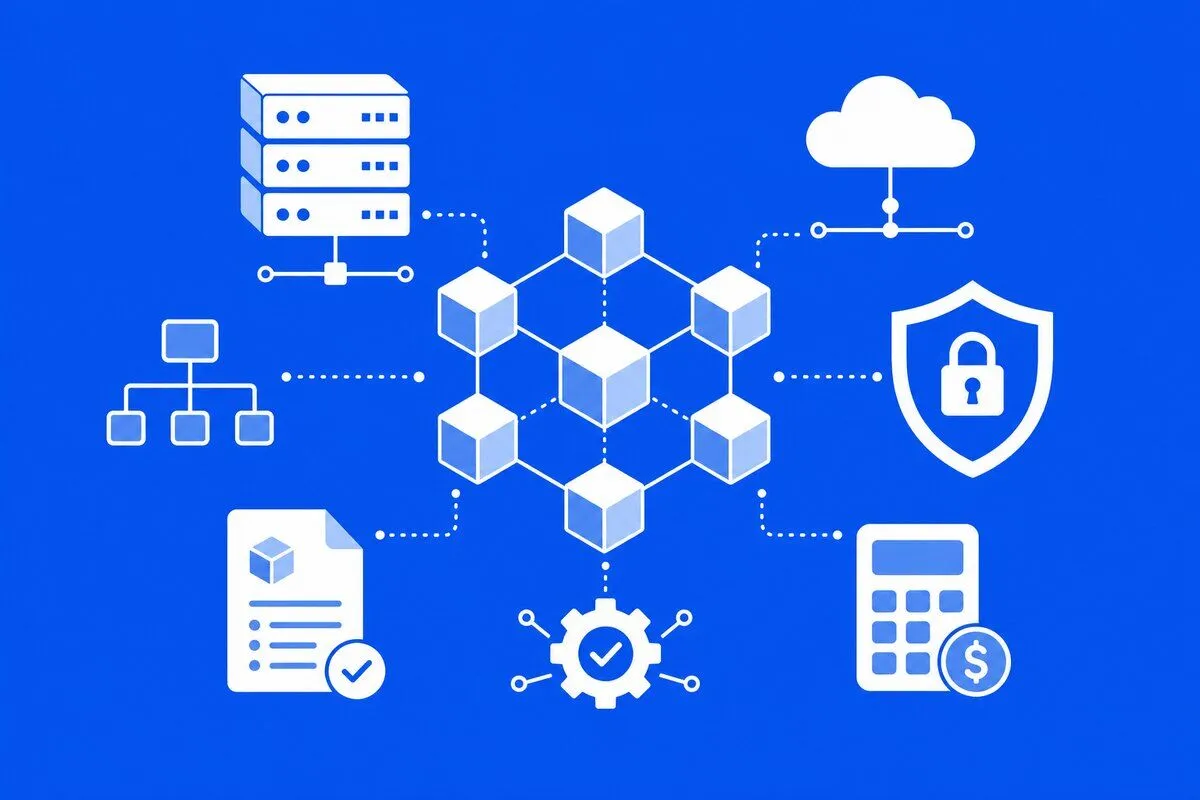
Rearchitecting insurance infrastructure through blockchain insurance transformation requires fundamental reimagining of data architecture, process flows, and stakeholder interactions beyond simple digitization of existing systems. Legacy insurance systems fragment across multiple databases, manual workflows, and siloed departments creating inefficiencies, reconciliation challenges, and customer friction throughout policy lifecycles. Blockchain insurance transformation establishes single sources of truth accessible to all authorized participants eliminating duplicate data entry, reconciliation overhead, and version control issues plaguing traditional architectures. Smart contracts encode business logic directly into infrastructure layer executing automatically when conditions are met without requiring human intervention or cross-system coordination. This architectural shift from centralized databases to distributed ledgers fundamentally changes how insurers, reinsurers, brokers, and policyholders interact creating transparency and trust through cryptographic verification rather than institutional reputation.
The infrastructure transformation extends beyond technology to organizational structures, regulatory frameworks, and industry ecosystems as blockchain insurance transformation enables new business models impossible in centralized architectures. Permissioned blockchain insurance transformation like Hyperledger Fabric and R3 Corda dominate enterprise insurance implementations providing necessary privacy controls, regulatory compliance features, and performance characteristics supporting production workloads. Public blockchain integrations increasingly complement private networks enabling tokenization, DeFi integrations, and cross-industry interoperability expanding addressable markets. Insurance giants across New York, London, Dubai, and Toronto financial centers invest heavily in blockchain infrastructure recognizing that early adopters will capture competitive advantages through operational efficiency, innovative products, and superior customer experiences. The architectural transformation demands careful planning balancing innovation speed against operational risk while building capabilities positioning insurers for long-term success in blockchain insurance transformation-native insurance ecosystems emerging globally.
On-Chain Policy Lifecycle Automation in Insurance
On-chain policy lifecycle automation transforms insurance operations by encoding entire policy journeys from quotation through claims settlement into smart contract logic executing deterministically on blockchain insurance transformation networks. Traditional policy administration requires manual data entry across multiple systems, paper document management, and human approval workflows creating delays, errors, and customer frustration throughout insurance interactions. Blockchain insurance transformation automates quote generation through algorithmic underwriting assessing risk factors from on-chain and off-chain data sources instantly providing premium calculations without underwriter intervention. Policy issuance occurs automatically upon premium payment with smart contracts creating immutable records of coverage terms, exclusions, and conditions accessible to all authorized parties. Premium collection happens programmatically through scheduled smart contract executions eliminating billing cycles, payment processing delays, and reconciliation overhead characteristic of traditional systems.
Policy modifications including coverage changes, beneficiary updates, and address corrections execute through smart contract functions updating on-chain records instantly visible to all stakeholders without requiring cross-system synchronization. Renewal processes automate through smart contracts querying policyholder accounts, calculating adjusted premiums based on claims history and risk factors, then automatically extending coverage upon payment confirmation. Cancellation and lapse procedures execute algorithmically returning unearned premiums and updating policy status without manual processing. Claims initiation triggers smart contract workflows routing to appropriate handlers while maintaining immutable audit trails of all actions. Settlement authorization and payment execution occur automatically for approved claims with funds transferred directly to policyholder wallets eliminating check processing and bank transfer delays. The end-to-end automation reduces policy administration costs by 40-60% while improving customer satisfaction through faster processing and transparent status visibility throughout policy lifecycles serving markets across USA, UK, UAE, and Canada.
Blockchain Insurance Policy Lifecycle
Risk Assessment and Quote Generation
Algorithmic underwriting analyzes on-chain identity, credit history, and risk factors generating instant premium quotes without manual underwriter review.
Policy Issuance and Premium Payment
Smart contracts automatically issue policies upon premium payment confirmation storing immutable coverage terms accessible to all authorized participants.
Active Coverage and Monitoring
IoT sensors and oracle feeds continuously monitor insured assets detecting triggering events for parametric claims or risk factor changes affecting premiums.
Claim Submission and Verification
Policyholders submit claims through decentralized applications with smart contracts verifying eligibility against coverage terms and claims history records.
Automated Claims Adjudication
Oracle data feeds verify claim conditions triggering automatic approvals for parametric policies or routing complex claims to specialized adjusters.
Settlement and Payment Execution
Approved claims execute automatic payments to policyholder wallets with instant settlement eliminating check processing and bank transfer delays.
Policy Renewal or Termination
Smart contracts automatically renew policies upon premium payment or execute termination procedures returning unearned premiums for mid-term cancellations.
Historical Record and Compliance
Immutable blockchain records provide complete audit trails for regulatory compliance, dispute resolution, and actuarial analysis of policy performance.
Smart Contract-Driven Parametric Claim Models
Smart contract-driven parametric insurance represents the most transformative application of blockchain insurance transformation eliminating traditional claim processes through automatic payouts triggered by objective measurable events. Unlike indemnity insurance requiring proof of loss documentation, damage assessment, and adjudication, parametric models execute instant settlements when predefined conditions verified by oracle networks are met. Flight delay insurance automatically pays when airline departure data exceeds specified delay thresholds without passengers submitting claim forms or providing receipts. Crop insurance triggers payments when rainfall measurements fall below minimum levels or temperatures exceed damage thresholds affecting agricultural yields. Earthquake coverage activates when seismological data confirms ground motion intensity exceeding policy parameters within geographic boundaries. The parametric approach eliminates moral hazard and adverse selection issues as payouts depend on objective measurements rather than self-reported losses.
Smart contract implementation encodes trigger conditions, payout formulas, and settlement procedures directly into blockchain insurance transformation logic executing automatically without human intervention when oracle feeds confirm triggering events. Chainlink networks aggregate weather data from multiple meteorological sources preventing single-point manipulation while API3 provides first-party oracle services from data providers with reputation at stake. The transparency of on-chain parametric contracts builds policyholder trust as anyone can verify settlement logic matches marketing materials and policy documentation. Processing speed improvements prove dramatic with parametric claims settling within minutes compared to weeks or months for traditional indemnity claims requiring documentation gathering, loss adjustment, and payment processing. Enterprise implementations across USA, UK, UAE, and Canadian markets demonstrate 90% cost reductions in claims administration while achieving near-perfect customer satisfaction through instant settlements. The model particularly suits emerging market microinsurance where traditional claim processes prove economically unviable for small-value policies protecting vulnerable populations against weather, health, and livelihood risks.[1]
Decentralized Risk Pools and Capital Efficiency
Decentralized risk pools fundamentally reimagine insurance capital structures through peer-to-peer models where participants collectively provide coverage without centralized insurance companies extracting profit margins. These blockchain insurance transformation-native pools aggregate cryptocurrency or tokenized assets contributed by liquidity providers earning yield on capital deployed covering specific risks. Smart contracts govern all pool operations including premium collection, reserve management, underwriting decisions, and claim payouts ensuring transparent algorithmic execution without managerial discretion. Participants receive fungible pool tokens representing proportional ownership claims on reserves with automatic dividend distributions from premium income and investment returns. When claims occur, smart contracts deduct payouts from pool balances with remaining participants bearing losses proportionally creating true mutual insurance structures. The decentralization eliminates insurance company overhead, profit extraction, and agency costs potentially reducing premiums 20-30% while providing competitive returns to capital providers.
Capital efficiency improvements arise from programmable reserves, dynamic pricing, and real-time risk monitoring capabilities enabled by blockchain insurance transformation architectures. Traditional insurers maintain substantial capital buffers satisfying solvency regulations and rating agency requirements even when risks remain remote. Decentralized pools optimize capital deployment through algorithmic reserve requirements adjusting dynamically based on covered exposures, claim patterns, and market conditions. Excess capital can deploy into DeFi yield-generating protocols during low-claim periods then automatically repatriate when coverage demands increase. Tokenization enables fractional participation in reinsurance and catastrophe risks previously accessible only to large institutional investors democratizing access to insurance-linked securities. Nexus Mutual pioneered decentralized coverage for smart contract risks protecting against DeFi protocol failures through member-governed pools. InsurAce, Unslashed Finance, and Bridge Mutual extend models across cryptocurrency custody, stablecoin de-pegging, and cross-chain bridge risks. Traditional insurers increasingly explore hybrid models combining decentralized pools with conventional capacity providing regulatory compliance while capturing blockchain efficiency benefits across global insurance markets.
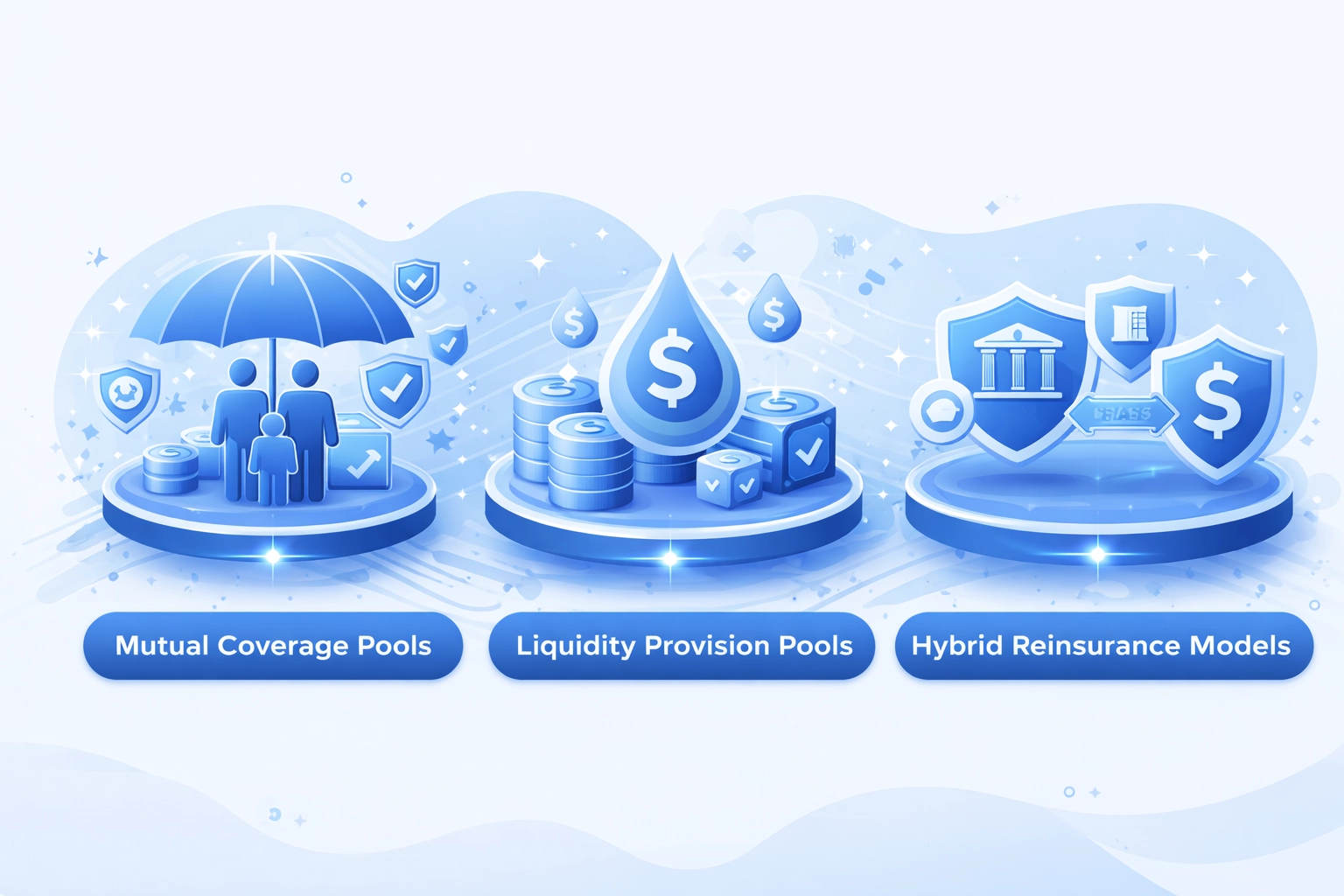 Decentralized Risk Pool Operating Models
Mutual Coverage Pools
- Member-owned structures sharing risks collectively
- Governance through token holder voting on parameters
- Profit sharing distributed proportionally to participants
- Democratic decision-making on coverage terms
Liquidity Provision Pools
- Capital providers earn yield on deployed assets
- Algorithmic pricing based on supply and demand
- Instant liquidity through tokenized pool shares
- Performance-based capital allocation mechanisms
Hybrid Reinsurance Models
- Traditional capacity layered with decentralized pools
- Regulatory compliance through licensed fronting
- Blockchain settlement with fiat currency support
- Risk transfer to institutional reinsurance markets
Tokenized Insurance Products and Asset Fractionalization
Tokenized insurance products create fractional ownership opportunities in previously illiquid insurance contracts enabling secondary market trading and capital market integration. Blockchain insurance transformation tokenizes reinsurance treaties, catastrophe bonds, and insurance-linked securities as digital assets tradeable on decentralized exchanges or specialized platforms. Each token represents claims on specific cash flows from insurance portfolios with smart contracts automatically distributing premiums, investment income, and claim recoveries to token holders proportionally. This fractionalization democratizes access to institutional insurance investments historically requiring $100,000+ minimum commitments now accessible through tokens valued at hundreds or thousands enabling retail participation in sophisticated risk transfer instruments. Secondary markets provide liquidity previously unavailable in private insurance transactions where investors committed capital for full policy terms without early exit options.
Life insurance policy tokenization enables whole life or universal life policies to trade as digital assets with transparent pricing based on actuarial models, current mortality rates, and prevailing interest rates. Structured settlements and annuities tokenize creating instant liquidity for beneficiaries needing lump sum access rather than scheduled payments. Property catastrophe bonds fractionalize enabling individual investors to participate in earthquake, hurricane, or flood risk transfer earning attractive yields uncorrelated with equity markets. The tokenization extends to parametric weather derivatives, excess-of-loss reinsurance layers, and specialty coverage portfolios. Regulatory frameworks in USA, UK, UAE, and Canadian jurisdictions increasingly accommodate tokenized securities through digital asset exemptions and sandbox programs though comprehensive insurance token regulations remain under construction. The capital market integration broadens insurance industry funding sources beyond traditional reinsurance, retrocessional markets, and insurance-linked securities platforms potentially lowering coverage costs through competitive capital pricing while providing new investment opportunities for yield-seeking capital across global markets.
Tokenized Insurance Product Comparison
| Product Type | Tokenization Benefits | Liquidity Enhancement | Market Accessibility |
|---|---|---|---|
| Catastrophe Bonds | Fractional ownership of natural disaster risk transfer | Secondary trading on DEX platforms | Retail investors with $100+ minimums |
| Reinsurance Treaties | Proportional claims on treaty cash flows | Continuous pricing and instant settlement | Institutional and qualified retail participation |
| Life Insurance Policies | Tradeable policies with transparent valuation | Life settlement market digitization | Policyholders and secondary market investors |
| Parametric Derivatives | Automated weather and event-triggered payouts | Real-time trading based on risk probabilities | Global participation without geographic restrictions |
Trustless Claims Adjudication Through Oracles
Trustless claims adjudication leverages oracle networks providing objective verifiable data enabling smart contracts to evaluate claim validity without human intervention or reliance on insurer honesty. Traditional claims processing suffers from information asymmetry where insurers possess incentives to deny legitimate claims minimizing payouts and maximizing profits creating adversarial relationships with policyholders. Blockchain insurance transformation removes this conflict through cryptographically verifiable data from decentralized oracle networks that neither insurers nor policyholders control. Chainlink aggregates weather data from multiple meteorological services, flight status information from airline APIs, and seismological readings from government agencies providing consensus-based truth that smart contracts reference for claim decisions. The oracle decentralization prevents single-point manipulation as compromising claim outcomes requires corrupting majority of oracle nodes economically infeasible through reputation staking and slashing mechanisms.
API3 enables first-party oracles where data providers operate nodes directly staking reputation on data accuracy creating accountability through economic penalties for false reporting. Band Protocol provides cross-chain oracle infrastructure supporting insurance applications across multiple blockchain insurance transformation networks with fast finality and low-cost data feeds. For non-parametric claims requiring subjective assessment, decentralized arbitration platforms like Kleros implement crowdsourced dispute resolution where randomly selected jurors evaluate evidence voting on claim validity with economic incentives for honest decisions. The combination of objective oracle data for straightforward claims and decentralized arbitration for complex cases creates comprehensive adjudication infrastructure eliminating traditional insurer discretion. Implementation across USA, UK, UAE, and Canadian insurance markets demonstrates 95%+ accuracy rates in automated claim decisions with dispute rates below 2% compared to 15-20% dispute rates in traditional claims processes. The trustless architecture builds policyholder confidence through transparent verifiable settlement logic accessible for audit by any stakeholder throughout the claims process.
Blockchain-Based Reinsurance Settlement Systems
Blockchain-based reinsurance settlement transforms traditionally inefficient back-office reconciliation processes through distributed ledgers providing single sources of truth accessible to cedants, reinsurers, and brokers simultaneously. Traditional reinsurance suffers from months-long settlement cycles requiring manual data aggregation, contract interpretation disputes, and cross-party reconciliation consuming substantial administrative resources while delaying capital release. B3i Services AG, the insurance industry blockchain insurance transformation consortium, implemented production reinsurance platforms processing facultative and treaty business across dozens of insurers and reinsurers globally. The distributed architecture eliminates duplicate data entry as all parties reference identical blockchain insurance transformation records updated real-time as policies bind, premiums collect, and claims occur. Smart contracts encode reinsurance contract terms including attachment points, coverage limits, and commission structures automatically calculating reinsurer liabilities and settlement amounts when triggering conditions are met.
Catastrophe excess-of-loss treaties benefit particularly from blockchain automation as smart contracts monitor aggregate losses across covered policies automatically triggering reinsurance recoveries when attachment thresholds breach without requiring cedants to manually aggregate and report losses. Quota share and surplus treaties calculate proportional cessions automatically as new policies bind eliminating quarterly bordereaux reporting and reconciliation cycles. Premium payments and loss settlements execute through integrated stablecoin or central bank digital currency infrastructure providing instant cross-border payments without correspondent banking delays and foreign exchange spreads. The efficiency gains reduce reinsurance administration costs by 30-40% with settlement cycles compressing from 6-9 months to near real-time for parametric triggers. Major reinsurance markets in Bermuda, London, Zurich, and Singapore increasingly adopt blockchain insurance transformation platforms recognizing that digitalization provides competitive advantages through capital efficiency, operational cost reduction, and superior client service supporting growth across global reinsurance markets serving USA, UK, UAE, and Canadian primary insurers.
Real-Time Fraud Detection Using Distributed Ledgers
Real-time fraud detection leveraging distributed ledger analysis represents a critical application of blockchain insurance transformation addressing the $80 billion annual fraud problem affecting global insurance industries. Traditional fraud detection relies on isolated insurer databases preventing identification of patterns spanning multiple companies where fraudsters submit identical claims to different insurers or stage accidents across policy boundaries. Blockchain enables industry-wide claim registries where insurers share encrypted claim data enabling cross-company pattern analysis without exposing competitive information or violating privacy regulations. Hash-based identifiers link claims to individuals and assets while maintaining anonymity preserving personally identifiable information. Machine learning algorithms analyze blockchain insurance transformation transaction patterns identifying suspicious behaviors including rapid successive claims, unusual claim amounts relative to premiums paid, or geographic anomalies suggesting organized fraud rings operating across jurisdictions.
Immutable audit trails prevent claim history tampering enabling insurers to verify policyholder representations regarding prior losses, coverage history, and risk factors. Smart contracts flag potential fraud triggers including claims submitted immediately after policy binding, duplicate claims for identical loss events, or inconsistencies between reported and blockchain-verified data. IoT device integration provides objective evidence contradicting fraudulent claims such as telematics data refuting accident circumstances or smart home sensors disproving theft reports. The real-time detection capability prevents fraudulent payouts rather than requiring expensive investigation and litigation after settlement. Coalition networks like the Coalition Against Insurance Fraud implement blockchain insurance transformation proof-of-concept projects demonstrating 20-30% fraud detection rate improvements compared to traditional isolated systems. Implementation challenges include data privacy regulations, competitive concerns about sharing information, and technical integration with legacy systems. Progressive adoption across USA, UK, UAE, and Canadian insurance markets demonstrates viability with fraud reduction benefits substantially exceeding implementation costs creating compelling business cases for broader industry collaboration through blockchain insurance transformation fraud prevention infrastructure.
Interoperable Insurance Data Across Multi-Chain Networks
Interoperable insurance data across multi-chain networks addresses the fragmentation challenge where insurance applications deploy on different blockchain insurance transformation platforms requiring cross-chain communication for comprehensive coverage ecosystems. Ethereum dominates smart contract insurance applications but faces scalability constraints and high gas fees prompting deployments to Polygon, Arbitrum, and Optimism layer-2 networks. Binance Smart Chain and Avalanche host competing insurance protocols targeting cost-sensitive markets. The multi-chain reality creates data silos where policy information, claim histories, and identity credentials fragment across incompatible networks preventing holistic risk assessment and seamless cross-platform experiences. Blockchain insurance transformation requires interoperability protocols enabling data portability and cross-chain smart contract interactions maintaining security and consistency across heterogeneous blockchain insurance transformation environments.
Polkadot and Cosmos provide native interoperability through relay chains and inter-blockchain insurance transformation communication protocols enabling insurance data sharing across sovereign blockchain networks. Chainlink CCIP (Cross-Chain Interoperability Protocol) enables insurance smart contracts to read and write data across multiple chains verifying policy status, claim histories, and risk scores regardless of deployment location. LayerZero provides omnichain messaging infrastructure allowing insurance applications to maintain unified state across deployments on Ethereum, BSC, Avalanche, and other networks simultaneously. The interoperability extends to identity systems where self-sovereign credentials issued on one chain verify across all networks without replication or re-verification. Cross-chain insurance aggregators emerge enabling users to compare coverage across multiple blockchain platforms selecting optimal combinations of cost, coverage, and capital efficiency. Implementation across USA, UK, UAE, and Canadian markets demonstrates that interoperable architectures reduce user friction, expand addressable markets, and enable innovative products combining features from multiple blockchain insurance transformation ecosystems previously isolated by technical incompatibility.
Self-Sovereign Identity in Underwriting Processes
Self-sovereign identity revolutionizes insurance underwriting by enabling individuals to control personal data sharing while proving necessary attributes to insurers without exposing sensitive information to unnecessary parties. Traditional underwriting requires applicants to repeatedly provide identical information to each insurer creating privacy risks, data breach exposures, and administrative friction. Centralized identity databases create honeypots attracting hackers while giving institutions excessive power over individual data. Blockchain insurance transformation implements decentralized identity standards including W3C Decentralized Identifiers (DIDs) and Verifiable Credentials enabling individuals to maintain cryptographic control over identity data stored in personal digital wallets. Insurers request specific attributes like age, health status, or driving record with individuals selectively disclosing verified credentials without revealing unnecessary personal information.
The self-sovereign model eliminates redundant identity verification as credentials issued once by trusted authorities prove reusable across multiple insurers, policy types, and insurance ecosystems. Medical records tokenize enabling health insurance underwriting without exposing complete medical histories to insurers who only need specific risk-relevant information. Credit scores, employment verification, and property ownership prove through blockchain insurance transformation credentials without requiring document submission or third-party verification services. The architecture reduces underwriting costs by 20-30% while accelerating policy issuance from days to minutes for straightforward risks. Privacy preservation proves particularly important in regulated markets across USA, UK, UAE, and Canada where data protection laws increasingly restrict personal information collection and processing. Self-sovereign identity provides compliance-friendly frameworks satisfying regulatory requirements while empowering individuals with control over personal data usage and distribution across insurance and broader financial service applications.
Zero-Knowledge Proofs for Privacy-Preserving KYC
Zero-knowledge proofs enable privacy-preserving know-your-customer compliance where individuals prove identity attributes satisfy requirements without revealing underlying personal information to insurers or blockchain insurance transformation networks. Traditional KYC requires submitting passport copies, utility bills, and personal documents to each financial institution creating privacy risks, identity theft exposures, and regulatory compliance burdens managing sensitive data. ZK-SNARK (Zero-Knowledge Succinct Non-Interactive Argument of Knowledge) cryptographic protocols allow individuals to prove they meet age requirements, reside in covered jurisdictions, or lack criminal records without disclosing actual ages, addresses, or background check details. The mathematical proofs verify attribute validity without information leakage maintaining privacy while satisfying insurer underwriting requirements and regulatory KYC obligations.
Blockchain insurance transformation leverages zero-knowledge identity systems like Polygon ID, zkPass, and Sismo enabling credential verification across decentralized insurance applications without centralized identity providers or personal data exposure. Individuals generate cryptographic proofs from credentials issued by trusted authorities proving eligibility for coverage without insurers accessing underlying documents or storing personal information. The privacy preservation particularly benefits health insurance where sensitive medical information verification occurs through zero-knowledge proofs avoiding health record exposure to insurers beyond minimum necessary for underwriting decisions. Regulatory compliance improves as insurers collect only essential information reducing data protection compliance scope and breach notification risks. Implementation complexity remains higher than traditional identity systems requiring specialized cryptographic expertise and user education about zero-knowledge concepts. Progressive adoption across privacy-conscious markets in EU, Canada, and California demonstrates viability with privacy benefits outweighing implementation costs for insurers prioritizing customer trust and regulatory compliance in data protection frameworks increasingly demanding minimal data collection practices.
Decentralized Governance in Mutual Insurance Models
Decentralized governance transforms mutual insurance through blockchain insurance transformation-based voting mechanisms enabling transparent democratic decision-making on coverage terms, premium rates, claim validity, and capital deployment strategies. Traditional mutual insurers nominally provide member ownership but concentrate decision authority with management boards limiting policyholder influence over company operations. Blockchain insurance transformation implements token-based governance where insurance pool participants vote proportionally to capital contributions or coverage purchases on material decisions affecting collective interests. Smart contracts automatically execute approved proposals eliminating implementation friction where traditional mutuals require board meetings, regulatory approvals, and operational changes consuming months or years. On-chain voting provides transparent auditable records of governance decisions and participation rates building trust through verifiable democratic processes.
Nexus Mutual pioneered decentralized insurance governance with NXM token holders voting on claim validity for disputed cases, acceptable risk categories, and capital allocation strategies. The model balances efficiency through delegated specialists handling routine decisions with democratic oversight on material matters affecting member interests. Quadratic voting mechanisms prevent plutocracy where large stakeholders cannot unilaterally override collective preferences of smaller participants. Reputation systems weight votes based on historical accuracy encouraging informed participation while discouraging frivolous or adversarial voting. The governance extends to treasury management where members vote on investment strategies, reserve requirements, and surplus distribution balancing growth objectives against stability priorities. Implementation challenges include low voter participation, coordination costs, and potential for governance attacks where strategic voters manipulate outcomes contrary to collective welfare. Successful mutual insurance DAOs demonstrate that combining expert management for operational decisions with democratic governance for strategic choices creates optimal balance serving member interests across USA, UK, UAE, and Canadian insurance markets embracing member-governed models.
Decentralized Governance Decision Framework
| Decision Category | Governance Mechanism | Voting Threshold | Implementation Speed |
|---|---|---|---|
| Routine Claims Approval | Automated smart contract execution | No vote required | Instant algorithmic processing |
| Disputed Claim Adjudication | Token holder voting on validity | Simple majority approval | 3-7 days voting period |
| Premium Rate Adjustments | Actuarial analysis with member approval | 60% supermajority required | 14 day notice with quarterly implementation |
| Coverage Expansion | Proposal submission with risk assessment | 70% supermajority approval | 30 day deliberation then rollout |
| Protocol Upgrades | Technical committee proposal with timelock | 80% supermajority consensus | 45 day security review period |
Automated Compliance Through RegTech Integration
Automated compliance through regulatory technology integration transforms insurance regulatory adherence from manual processes into programmatic enforcement embedded within blockchain infrastructure. Traditional insurance compliance requires dedicated teams monitoring regulatory changes, implementing policy updates, conducting audits, and preparing regulatory reports consuming substantial resources while introducing human error risks. Blockchain insurance transformation encodes regulatory requirements directly into smart contracts automatically enforcing solvency ratios, reserve requirements, coverage limitations, and reporting obligations without relying on manual oversight. Smart contracts prevent policy issuance violating regulatory constraints such as selling coverage in unauthorized jurisdictions, exceeding licensed capacity limits, or offering terms contravening consumer protection regulations. The programmatic enforcement provides real-time compliance rather than periodic audits identifying violations after occurrence.
Regulatory reporting automates through blockchain insurance transformation analytics generating required filings from on-chain transaction data eliminating manual data aggregation and validation. Solvency II compliance in UK and EU markets automates through smart contracts calculating Solvency Capital Requirements based on real-time exposures and capital positions. USA state insurance regulators increasingly accept blockchain-based reporting reducing NAIC financial statement preparation burden. AML transaction monitoring occurs automatically through blockchain analysis flagging suspicious patterns for investigation. The RegTech integration extends to parametric product approval where regulatory sandboxes in Dubai, Singapore, and UK provide expedited pathways for blockchain insurance innovations under controlled testing environments. Implementation challenges include regulatory fragmentation across jurisdictions, conservative regulator attitudes toward innovation, and technical complexity integrating blockchain insurance transformation systems with existing regulatory infrastructure. Progressive insurance regulators recognize that blockchain-native compliance potentially provides superior oversight compared to traditional manual processes building momentum for regulatory framework modernization accommodating blockchain insurance transformation across global markets.
Cross-Border Insurance Payments via Stablecoins
Cross-border insurance payments via stablecoins eliminate traditional correspondent banking delays, foreign exchange spreads, and settlement risks plaguing international insurance transactions. Multinational insurance programs spanning multiple countries require premium collections and claim settlements across currencies creating friction through conversion costs, settlement delays, and reconciliation complexity. Traditional international wire transfers consume 3-5 business days costing $25-50 per transaction while exposing parties to exchange rate volatility during settlement periods. blockchain insurance transformation insurance transformation leverages USDC, USDT, and other fiat-collateralized stablecoins for instant cross-border payments at minimal cost regardless of geographic distance or banking relationships. Smart contracts automatically convert premiums and claims into appropriate currencies using decentralized exchange protocols at transparent market rates without hidden spreads or intermediary fees.
The payment transformation particularly benefits expatriate insurance, travel coverage, and international health insurance where policyholders and providers operate across multiple jurisdictions. Medical tourism insurance settles claims instantly to foreign healthcare providers in local currencies without requiring patients to advance payment then seek reimbursement weeks later. Reinsurance premium settlements between USA cedants and Bermuda or European reinsurers occur instantly rather than following quarterly payment cycles characteristic of traditional treaties. Central bank digital currencies (CBDCs) increasingly integrate with insurance blockchain platforms as monetary authorities across UK, UAE, and Canada advance digital currency initiatives. Implementation challenges include regulatory restrictions on stablecoin usage, accounting complexity for cryptocurrency-denominated transactions, and volatility concerns despite collateralization mechanisms. Progressive insurance markets embracing stablecoin payments demonstrate 85-90% cost reductions in cross-border settlement with instant finality improving cash flow management and customer satisfaction across international insurance transactions serving global markets.
Usage-Based Insurance Powered by IoT and Blockchain
Usage-based insurance powered by IoT sensors and blockchain insurance transformation verification enables dynamic premium pricing reflecting actual risk exposure rather than historical demographic averages. Traditional insurance charges fixed premiums based on population statistics applying identical rates to careful and careless drivers, healthy and unhealthy individuals, or well-maintained and neglected properties. Telematics devices monitor driving behavior capturing acceleration patterns, braking intensity, speed compliance, and nighttime driving automatically adjusting auto insurance premiums based on actual risk profiles. Blockchain insurance transformation integrates IoT data streams with smart contracts creating transparent verifiable premium calculations where policyholders see precisely how behaviors affect costs. The integration eliminates insurer discretion over rating adjustments building trust through algorithmic transparency and cryptographic verification of data integrity preventing manipulation by either party.
Health insurance integrates wearable fitness trackers rewarding exercise, healthy eating, and preventive care through automatic premium discounts or wellness incentives paid through blockchain insurance transformation tokens. Property insurance monitors smart home sensors detecting water leaks, smoke, security breaches, and maintenance issues providing early warnings preventing losses while adjusting premiums based on property condition. Commercial insurance tracks fleet vehicles, warehouse conditions, and equipment usage optimizing coverage costs based on actual operational patterns. The behavioral incentives created through usage-based pricing encourage loss prevention benefiting both insurers through reduced claims and policyholders through lower premiums. Privacy concerns arise from continuous monitoring requiring careful data governance and regulatory compliance with data protection frameworks. Implementation across USA, UK, UAE, and Canadian markets demonstrates that transparency and policyholder control over data sharing address privacy concerns when combined with material premium savings of 20-40% for low-risk insureds demonstrating positive behaviors through IoT monitoring systems integrated with blockchain verification infrastructure.
Authoritative Blockchain Insurance Implementation Standards
Standard 1: Conduct comprehensive smart contract audits from multiple independent security firms before production deployment verifying policy logic and claims processing correctness.
Standard 2: Implement redundant oracle networks with reputation staking preventing single-point data manipulation affecting parametric claim triggers and automated settlements.
Standard 3: Establish transparent governance mechanisms enabling democratic decision-making on material policy changes while maintaining operational efficiency for routine matters.
Standard 4: Maintain adequate capital reserves through algorithmic solvency monitoring ensuring continuous compliance with regulatory requirements across all operating jurisdictions.
Standard 5: Integrate privacy-preserving identity systems enabling necessary KYC compliance without exposing sensitive personal information to unnecessary parties or blockchain networks.
Standard 6: Deploy comprehensive fraud detection monitoring blockchain transaction patterns identifying suspicious behaviors before fraudulent claims reach settlement stage.
Standard 7: Establish disaster recovery procedures including smart contract upgrade mechanisms enabling emergency response to discovered vulnerabilities without complete system replacement.
Standard 8: Provide transparent documentation of all policy terms, pricing methodologies, and claims processes enabling independent verification of fairness and regulatory compliance.
Catastrophe Bonds Tokenization and Risk Markets
Catastrophe bonds tokenization democratizes access to insurance-linked securities enabling retail investors to participate in natural disaster risk transfer previously limited to institutional investors with multi-million dollar minimums. Traditional cat bonds raise capital from pension funds, hedge funds, and sophisticated investors providing insurance companies and governments with coverage against earthquakes, hurricanes, floods, and other catastrophic events. The securities pay attractive yields uncorrelated with equity markets appealing to diversification-seeking investors willing to accept potential principal loss if triggering catastrophes occur. Blockchain insurance transformation tokenizes cat bonds as digital assets traded on decentralized exchanges with fractional ownership enabling $100 minimum investments compared to $100,000+ traditional minimums. Smart contracts encode trigger conditions referencing earthquake magnitude indices, hurricane wind speed measurements, or flood depth levels automatically determining whether principal impairment occurs based on catastrophe severity.
The tokenization expands cat bond markets through increased investor accessibility potentially lowering catastrophe coverage costs for insurers accessing deeper capital pools. Secondary market liquidity improves through 24/7 trading on blockchain insurance transformation platforms compared to illiquid private securities traded only through broker-dealers at wide bid-ask spreads. Transparent on-chain pricing enables price discovery reflecting real-time catastrophe probabilities and market sentiment. Parametric triggers verified through decentralized oracle networks eliminate basis risk concerns where traditional indemnity cat bonds face disputes over actual loss calculations. Implementation across USA earthquake exposure in California, hurricane risks in Florida, and flood coverage for UK and Netherlands flood-prone regions demonstrates commercial viability. Regulatory frameworks in Bermuda, Switzerland, and Singapore accommodate tokenized insurance-linked securities through digital asset exemptions and sandbox programs. The market transformation potentially unlocks billions in additional catastrophe capacity benefiting insurers, reinsurers, and at-risk populations across global markets requiring enhanced natural disaster protection as climate change intensifies weather-related risks.
Blockchain-Powered Embedded Insurance Ecosystems
Blockchain-powered embedded insurance ecosystems integrate coverage seamlessly into digital platforms, e-commerce transactions, and financial services through smart contract APIs enabling instant policy activation at point of need. Traditional insurance requires separate purchasing processes, application forms, and underwriting delays disconnected from transactions requiring protection. Embedded insurance activates automatically when users book travel, purchase electronics, initiate cryptocurrency trades, or engage in activities generating insurable risks. Blockchain insurance transformation provides standardized APIs enabling any platform to offer coverage through smart contracts without building insurance infrastructure or obtaining licenses. The integration occurs transparently with automatic premium calculation, instant policy issuance, and streamlined claims processing creating friction-free insurance experiences embedded within broader digital journeys.
E-commerce platforms embed product protection insurance automatically offering coverage during checkout with one-click acceptance. Cryptocurrency exchanges integrate wallet insurance, smart contract coverage, and DeFi protocol protection enabling instant activation during high-risk transactions. Ride-sharing applications provide per-ride insurance activating when journeys commence and terminating upon completion. The micro-duration coverage enabled by blockchain smart contracts proves economically viable as automation eliminates administrative overhead making profitable coverage for transactions lasting minutes or hours. Distribution channels expand dramatically as insurance becomes embedded feature rather than standalone product requiring dedicated sales efforts. The model particularly suits parametric products where automated underwriting, instant issuance, and algorithmic claims processing occur without human intervention. Implementation across USA, UK, UAE, and Canadian markets demonstrates that embedded insurance increases coverage adoption rates by 300-400% compared to traditional standalone products while reducing distribution costs by 60-80% creating compelling economics for insurers, platforms, and policyholders benefiting from convenient accessible protection integrated seamlessly into digital experiences.
The Future of Autonomous Insurance Organizations
Autonomous insurance organizations represent the ultimate realization of blockchain insurance transformation where fully automated decentralized protocols provide comprehensive coverage without centralized management, human underwriters, or traditional corporate structures. These autonomous entities operate entirely through smart contracts encoding underwriting rules, pricing algorithms, claims adjudication logic, and capital management strategies executing deterministically based on on-chain and oracle-provided data. Governance occurs through token holder voting on strategic decisions while operational matters proceed automatically without management discretion. Capital accumulates through premiums and investment returns deploying algorithmically across coverage opportunities, reinsurance purchases, and yield-generating protocols optimizing risk-adjusted returns. The autonomous model eliminates insurance company overhead including executive compensation, office expenses, and shareholder profit extraction potentially reducing premiums 40-50% while providing competitive returns to capital providers participating in risk pools.
Early autonomous insurance implementations demonstrate viability through Nexus Mutual, InsurAce, and similar protocols operating for years without human management intervention beyond technical maintenance and governance facilitation. The model particularly suits cryptocurrency-native risks including smart contract failures, exchange hacks, and DeFi protocol exploits where traditional insurers lack expertise and risk appetite. Expansion into traditional insurance lines faces regulatory challenges as most jurisdictions require licensed entities with physical offices, qualified personnel, and management oversight. Progressive regulatory frameworks in crypto-friendly jurisdictions explore accommodating autonomous insurance organizations through adapted licensing requirements recognizing unique characteristics of algorithmic governance and decentralized operations. The long-term trajectory suggests hybrid models emerging where autonomous protocols handle standardized parametric coverage while traditional insurers provide complex products requiring human judgment, physical inspections, and subjective assessments. The competitive pressure from autonomous insurance forces traditional insurers toward greater efficiency, transparency, and customer focus as blockchain-native alternatives demonstrate superior economics and user experiences across global insurance markets serving USA, UK, UAE, Canadian, and international customers increasingly comfortable with decentralized autonomous financial services.
Transform Your Insurance Operations with Blockchain
Partner with blockchain insurance specialists to implement parametric claims, decentralized risk pools, and automated policy administration for your organization.
Frequently Asked Questions
Q1.1. How does blockchain transform the insurance industry?
Blockchain insurance transformation fundamentally restructures traditional insurance operations through distributed ledger technology enabling automated policy execution, transparent claims processing, and decentralized risk pooling. Smart contracts eliminate intermediaries automating premium collection, claim verification, and settlement reducing operational costs by 30-40%. Immutable record-keeping prevents fraud while providing auditable transaction histories satisfying regulatory requirements across USA, UK, UAE, and Canadian jurisdictions. Parametric insurance models execute instant payouts when predefined conditions are met without manual claim adjudication. Tokenization enables fractional ownership of insurance products and reinsurance contracts creating liquid secondary markets. The technology addresses persistent industry challenges including inefficient processes, information asymmetry, and trust deficits through cryptographic verification and algorithmic execution.
Q2.2. What are parametric insurance smart contracts?
Parametric insurance smart contracts represent self-executing agreements that trigger automatic payouts when specific measurable events occur, eliminating traditional claim filing and adjudication processes. These contracts utilize oracle networks to verify real-world data such as weather conditions, flight delays, earthquake magnitude, or crop yields against predetermined thresholds. When triggering conditions are met, smart contracts instantly release funds to policyholders without requiring proof of loss documentation or human intervention. This model proves particularly effective for travel insurance, agricultural coverage, and catastrophe protection where clear measurable triggers exist. Blockchain immutability ensures contract terms remain unchanged while transparent execution builds policyholder trust. Parametric models reduce claim processing time from weeks to minutes while lowering administrative costs enabling profitable coverage for previously uninsurable risks.
Q3.3. How do decentralized risk pools work in insurance?
Decentralized risk pools aggregate capital from multiple participants through blockchain-based platforms where smart contracts govern premium collection, reserve management, and claim payouts without centralized insurance company oversight. Participants contribute cryptocurrency or tokenized assets to collective pools earning proportional shares representing ownership claims on pool reserves. Automated underwriting algorithms assess risk using on-chain and off-chain data determining premium rates for coverage seekers. When valid claims occur, smart contracts execute payouts from pool reserves with remaining surplus distributed to pool participants as investment returns. This peer-to-peer insurance model eliminates profit extraction by traditional insurers while providing transparent governance where token holders vote on coverage parameters, premium rates, and claim validity disputes. Decentralized pools demonstrate particular success in cryptocurrency insurance, DeFi protocol coverage, and mutual aid communities across global markets.
Q4.4. What role do oracles play in blockchain insurance?
Oracles serve as critical infrastructure bridging blockchain smart contracts with real-world data required for insurance policy execution, claim verification, and premium calculation. These decentralized data feeds provide trustless information about events triggering parametric insurance payouts including weather data, financial market prices, IoT sensor readings, and government statistics. Insurance smart contracts query oracle networks to verify claim conditions are met before executing automatic settlements. Multiple oracle nodes aggregate data from various sources preventing single-point manipulation while cryptographic proofs ensure data authenticity. Chainlink, Band Protocol, and API3 represent leading oracle solutions supporting insurance applications. Oracle reliability proves essential as faulty data could trigger inappropriate payouts or deny legitimate claims. Insurance implementations typically require redundant oracle networks with reputation systems incentivizing accurate reporting through economic penalties for providing false information.
Q5.5. How does blockchain reduce insurance fraud?
Blockchain insurance transformation dramatically reduces fraud through immutable record-keeping, transparent claim histories, and cryptographic identity verification preventing common fraud vectors. Distributed ledgers create permanent audit trails of all policies, claims, and transactions eliminating opportunities for record tampering or duplicate claims across multiple insurers. Smart contracts enforce consistent policy terms preventing selective enforcement or hidden exclusions. Self-sovereign identity systems enable verification of policyholder information without exposing sensitive personal data reducing identity theft risks. Real-time data sharing across insurance networks flags suspicious patterns including rapid successive claims, staged accidents, or inflated loss amounts. IoT device integration provides objective evidence for claims through telematics data, smart home sensors, or wearable health monitors. Machine learning algorithms analyzing blockchain transaction patterns identify anomalous behaviors indicating potential fraud. These mechanisms collectively reduce fraudulent claims by estimated 15-25% generating substantial savings for insurers and policyholders across major markets.
Explore Services
Related Services
Reviewed by

Aman Vaths
Founder of Nadcab Labs
Aman Vaths is the Founder & CTO of Nadcab Labs, a global digital engineering company delivering enterprise-grade solutions across AI, Web3, Blockchain, Big Data, Cloud, Cybersecurity, and Modern Application Development. With deep technical leadership and product innovation experience, Aman has positioned Nadcab Labs as one of the most advanced engineering companies driving the next era of intelligent, secure, and scalable software systems. Under his leadership, Nadcab Labs has built 2,000+ global projects across sectors including fintech, banking, healthcare, real estate, logistics, gaming, manufacturing, and next-generation DePIN networks. Aman’s strength lies in architecting high-performance systems, end-to-end platform engineering, and designing enterprise solutions that operate at global scale.