Ai Overview
A blockchain developer is a software professional who designs, builds, tests, and maintains systems that run on blockchain technology. Protocol-level bugs can result in chain splits that affect the entire network, which is why core developers carry so much more responsibility and cost accordingly. Entry-level salaries in the United States start around $92,000 to $140,000, which is already higher than many other software engineering entry points because of the specialized knowledge required.
Key Takeaways
- Blockchain development is not one job. It covers protocol engineering, smart contract development, infrastructure, and application-layer work, and each one requires a different skill set.
- There are two main categories: core blockchain developers who build the blockchain itself, and blockchain software developers who build products on top of existing blockchains.
- Blockchain developers work under constraints that traditional developers do not face, including immutable code, public execution, gas costs, and irreversible transactions.
- Security is built into the developer role, not outsourced to a separate team. Every blockchain developer must think like an attacker.
- Core protocol engineers earn the highest salaries (up to $262K+) due to extreme scarcity and network-wide responsibility.
- Most companies need blockchain software developers, not protocol engineers. Hiring the wrong profile leads to overengineering, delays, and budget waste.
- Career growth depends on specialization depth, security expertise, and the ability to work across both on-chain and off-chain systems.
- Real-world blockchain systems are hybrid. Developers must coordinate smart contracts with indexers, oracles, relayers, and off-chain services.
If you search for “blockchain developer” on any job board right now, you will find listings that look completely different from each other. One posting asks for a Solidity developer to build DeFi smart contracts. Another wants a Rust engineer to work on a Layer-1 consensus mechanism. A third needs someone to set up node infrastructure and manage RPC endpoints. All three are called “blockchain developer,” but the actual work, the tools, and the day-to-day responsibilities have almost nothing in common.
This confusion is not just a naming problem. It creates real issues for hiring managers who end up interviewing protocol engineers for application-layer jobs, for developers who apply to roles that do not match their skills, and for founders who do not know what kind of talent their project actually needs. I have seen startups burn through months of runway because they hired a deep systems engineer when all they needed was someone who could write and deploy Solidity contracts on Ethereum.
This article breaks down what blockchain developers actually do, the two primary categories they fall into, the specific skills each type needs, what you can expect to earn in 2026, and how the career path typically unfolds. Whether you are planning to become a blockchain developer, hiring one, or building a product that depends on this expertise, getting these distinctions right will save you time, money, and a lot of frustration.
What Is a Blockchain Developer?
A blockchain developer is a software professional who designs, builds, tests, and maintains systems that run on blockchain technology. These systems rely on distributed ledgers, cryptographic security, and consensus mechanisms instead of centralized servers and databases.
That definition sounds straightforward, but the reality is that “blockchain developer” has become an umbrella term. The person building the consensus algorithm for a new Layer-1 chain and the person writing a token swap contract on Uniswap are both blockchain developers. But the knowledge they need, the risks they manage, and the tools they use are worlds apart.
What makes blockchain development fundamentally different from traditional software engineering comes down to a few hard constraints. Once you deploy code to a blockchain, it is often permanent. There is no “rollback to the last version” the way you would with a backend server. Execution is public, meaning anyone can inspect what your code does. Every operation costs real money in the form of gas fees. And if there is a bug, the financial losses can be immediate and irreversible. These constraints make the job closer to security engineering and systems engineering than to typical web or mobile development.
For organizations exploring how blockchain fits into their business strategy, this guide to enterprise blockchain applications provides practical context for where these developers create value.
The Two Types of Blockchain Developers
 s
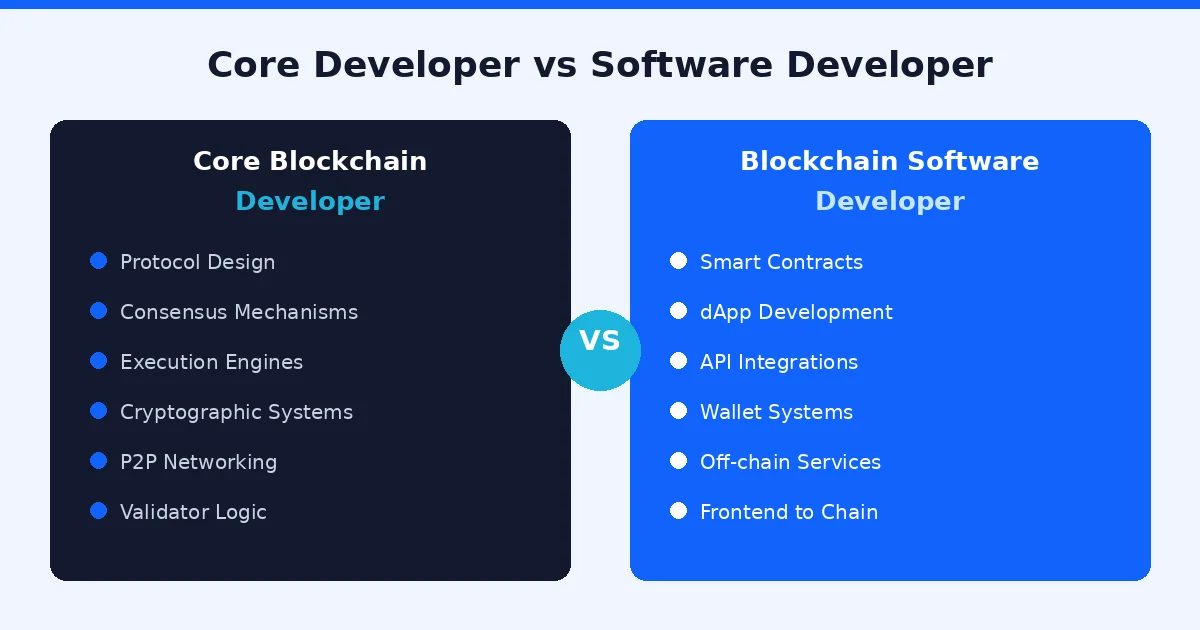
sThe blockchain industry generally splits developers into two categories: core blockchain developers and blockchain software developers. This is not just an academic distinction. These are genuinely different jobs that require different training, different thinking, and different career paths. Confusing them is one of the most common and expensive mistakes companies make when building blockchain teams.
Core Blockchain Developer
A core blockchain developer works at the protocol level. They are the people who build and maintain the blockchain itself. Think of them as the engineers who design the engine of a car, not the people who drive it or build features on top of it.
Their work includes designing and implementing consensus mechanisms such as Proof of Work, Proof of Stake, and Byzantine Fault Tolerant variants. They build the block structure, define how transactions are processed, write the state transition logic that determines how the blockchain moves from one valid state to the next, and handle the peer-to-peer networking layer that keeps nodes in sync. They also work on execution engines like the Ethereum Virtual Machine or WebAssembly runtimes, implement cryptographic primitives for verification and security, and design fee models that keep the network economically sustainable.
Core developers maintain or contribute to blockchain clients like Geth, Nethermind, and Erigon for Ethereum, Cosmos SDK modules for Cosmos-based chains, Substrate runtimes for Polkadot, and Solana validator software. Understanding how mining difficulty works is just one slice of the protocol-level knowledge they must have.
This is one of the hardest roles to hire for in all of tech. It requires deep expertise in distributed systems, hands-on experience with low-level languages like Go, Rust, or C++, and the ability to reason about what happens when parts of a network fail, act maliciously, or disagree with each other. The talent pool is tiny because the skillset is so specialized.
Blockchain Software Developer
A blockchain software developer builds applications on top of existing blockchain platforms like Ethereum, Solana, Polygon, or Binance Smart Chain. They do not modify how the blockchain works. Instead, they use it as a foundation to create products that people and businesses interact with.
Their day-to-day work revolves around writing smart contracts, building backend APIs that talk to blockchain networks, integrating wallet functionality, setting up indexing systems to make on-chain data queryable, and connecting frontend interfaces to smart contracts. They are the ones building the DeFi protocols, NFT marketplaces, DAO governance systems, and token-based platforms that most people think of when they hear “blockchain product.”
This is the more common role and the one that most startups, enterprises, and Web3 consulting companies are actively hiring for. The languages involved typically include Solidity for Ethereum-compatible chains, Rust for Solana and some newer platforms, and Move for Aptos and Sui, along with JavaScript or TypeScript for frontend and tooling. If you are considering working with a professional team to build on blockchain, a dedicated blockchain company can help match the right developer profile to your project needs.
Core Blockchain Developer vs Blockchain Software Developer: Detailed Comparison
| Aspect | Core Blockchain Developer | Blockchain Software Developer |
|---|---|---|
| Primary Focus | Designing and maintaining the blockchain protocol | Building applications and products on existing blockchains |
| Working Layer | Base layer (Layer-1 / protocol layer) | Application layer (dApps, smart contracts, platforms) |
| Core Responsibility | Defining how blocks, transactions, and state transitions work | Implementing business logic via smart contracts and off-chain services |
| Consensus Involvement | Directly designs or modifies consensus mechanisms | Does not modify consensus; interacts with finalized blocks only |
| Programming Languages | Go, Rust, C++, Java (system-level) | Solidity, Rust, Move, JavaScript, TypeScript |
| Cryptography Usage | Implements cryptographic primitives and verification logic | Applies existing cryptographic functions provided by the platform |
| Risk Surface | Network-wide failures, consensus splits, chain halts | Contract exploits, logic bugs, user fund loss |
| Upgrade Impact | Protocol upgrades can affect the entire network | Contract upgrades affect only the specific application |
| Typical Projects | New blockchains, protocol upgrades, blockchain forks | DeFi apps, NFT platforms, wallets, DAOs |
| Hiring Frequency | Rare and highly specialized | Common and in high demand |
| When You Need This | Building or modifying a blockchain network | Building products on Ethereum, Solana, Polygon, etc. |
The takeaway here is simple. If your company is building a new blockchain or forking an existing one, you need core developers. If you are building a product that runs on an existing blockchain, you need software developers. Most companies fall into the second category. Protocol-level bugs can result in chain splits that affect the entire network, which is why core developers carry so much more responsibility and cost accordingly.
Key Responsibilities of a Blockchain Developer
Regardless of whether a developer works at the protocol level or the application level, blockchain development involves responsibilities that you will not find in a standard software engineering role. The work goes beyond writing code. It includes thinking about economic incentives, adversarial behavior, and the long-term consequences of decisions that cannot be easily reversed.
On-Chain Development
This is where the core product logic lives. Smart contracts handle asset transfers, enforce business rules, manage state transitions, and define economic incentives for participants. Every line of on-chain code must be deterministic, meaning it produces the same output given the same input regardless of when or where it runs. The code needs to be minimal because every operation costs gas, and it must be auditable because anyone on the network can inspect it. There is no hiding logic behind an API gateway here.
Off-Chain System Design
Almost every real blockchain product depends on off-chain components. Indexers like The Graph allow applications to query blockchain data without scanning every block. Oracles bring external data, like asset prices or weather information, into smart contracts that otherwise have no access to the outside world. Relayers submit transactions on behalf of users. Monitoring tools watch for suspicious activity. A good blockchain developer understands that the on-chain piece is just one part of the system, and that off-chain failures should never compromise on-chain integrity. For a deeper look into how external data feeds work, read about developing real-world data oracles for blockchain.
Infrastructure Management
Blockchain applications need infrastructure to interact with the network. This includes running or connecting to nodes, setting up RPC nodes that serve as the communication bridge between applications and the blockchain, and configuring validator setups for networks that use Proof of Stake. Infrastructure work is often unglamorous but absolutely critical. If your node goes down or your RPC endpoint becomes unreliable, your entire application stops working.
Security and Risk Management
In blockchain development, security is not something you hand off to a separate security team after the code is written. It is baked into the development process from day one. Developers are responsible for threat modeling, analyzing attack surfaces, understanding economic attack vectors like MEV (Maximal Extractable Value), and protecting against front-running and sandwich attacks. Key management is another major concern because if private keys are compromised, there is no customer support line to call. Every blockchain developer must think like an attacker to build systems that can withstand one.
Day-to-Day Work
On a typical day, a blockchain developer might translate product requirements into secure contract logic, write and audit smart contracts, run simulations and test suites, deploy upgrades to testnets or mainnets, monitor live contracts for unexpected behavior, and respond to incidents like exploits or network forks. It is a mix of deep technical work, collaboration with product teams, and constant vigilance. The stakes are higher than most software roles because mistakes can mean real financial loss for users.
Essential Skills Every Blockchain Developer Needs
Blockchain development is not about learning one programming language and calling it a day. It requires a stacked skill set that combines software engineering, cryptography, economic reasoning, and security awareness. Here is what that looks like in practice.
1. Smart Contract Engineering
This is the most visible skill for application-layer developers. You need to be proficient in at least one smart contract language, whether that is Solidity for Ethereum and EVM-compatible chains, Rust for Solana, Move for Aptos and Sui, or Ink! for Polkadot. Beyond syntax, you need to understand deterministic execution, gas optimization techniques, the difference between storage and memory in terms of cost, upgrade patterns like proxy and diamond contracts, access control models, and common vulnerabilities like reentrancy. Writing a smart contract that works is the easy part. Writing one that works, costs reasonable gas, handles edge cases, and cannot be exploited is what separates junior developers from senior ones.
2. Applied Cryptography
You do not need a PhD in mathematics, but you need a solid working understanding of the cryptographic building blocks that blockchain relies on. This includes hash functions like SHA-256 and Keccak, digital signature schemes like ECDSA and EdDSA, Merkle trees for data verification, commitment schemes, the basics of zero-knowledge proofs, and the pitfalls around randomness generation on-chain. The goal is not to implement these from scratch but to understand what guarantees they provide and, just as importantly, what they do not guarantee.
3. On-Chain Data Modeling
On-chain storage is nothing like a traditional database. Storage is expensive, with every byte costing gas. Writes are permanent and visible to everyone on the network. State bloat does not just slow down your application; it affects the entire blockchain. Developers need to design data layouts that are minimal, efficient, and forward-compatible. This means thinking carefully about what data actually needs to live on-chain versus what can be stored off-chain with just a hash or reference on the blockchain.
4. Off-Chain System Integration
The smartest contract in the world is not very useful if it cannot communicate with the rest of the system. Blockchain developers need to understand how to build and integrate indexers, event listeners, oracle networks for external data feeds, relayers for transaction submission, and off-chain validation systems. This is the connective tissue that makes blockchain applications actually usable. If you have ever used a DeFi protocol and wondered how it shows your portfolio value in real time, that is off-chain infrastructure doing the heavy lifting.
5. Security Engineering Mindset
This one cannot be overstated. Blockchain operates in an adversarial environment where anyone can interact with your contracts, including people actively trying to exploit them. Developers need skills in threat modeling, attack surface analysis, understanding MEV and front-running mechanics, and thinking through economic attack vectors. Good blockchain developers run their own internal audits, write extensive test suites, and approach every deployment with the assumption that someone will try to break it.
The Blockchain Development Lifecycle
Blockchain projects do not follow the same development cycle as traditional software. The stakes of immutability and public execution change how teams plan, build, and ship. Here is how a typical blockchain development lifecycle plays out from start to finish.
Phase 1: Requirement Analysis and Threat Modeling. Before writing any code, the team maps out what needs to happen on-chain versus off-chain. They identify trust assumptions, define who can call which functions, and model potential attack scenarios. This phase is more intensive than in traditional development because you cannot patch things easily after deployment.
Phase 2: Architecture and Protocol Design. The team decides on the blockchain platform, chooses smart contract patterns, designs the state layout, and plans how on-chain and off-chain components will interact. For teams building across multiple blockchain ecosystems, understanding how these integrate with emerging technologies like AR/VR in the metaverse is becoming increasingly relevant.
Phase 3: Smart Contract Development and Testing. Contracts are written, unit tested, and put through integration tests. Developers use tools like Hardhat, Foundry, or Anchor depending on the chain. Gas profiling happens here to make sure operations stay within reasonable cost bounds.
Phase 4: Security Audit and Review. Internal audits come first, followed by external audits from specialized firms. This phase catches vulnerabilities that developers might miss when they are too close to the code. Major DeFi protocols routinely spend $100K or more on audits, and for good reason.
Phase 5: Testnet Deployment and Simulation. Contracts are deployed to testnets where they face real network conditions without real money at risk. Teams run stress tests, simulate edge cases, and verify that everything works as expected under load.
Phase 6: Mainnet Deployment. The actual launch. This is often a staged rollout, with controlled access or limited liquidity in the early days. Monitoring systems go live to track contract behavior in real time.
Phase 7: Monitoring, Maintenance, and Upgrades. Post-deployment, the team monitors for exploits, optimizes gas usage based on real-world patterns, responds to incidents, and plans contract upgrades when needed using established patterns like proxy contracts.
Blockchain Developer Career Growth Path
Blockchain development has matured enough that there is now a recognizable career ladder, though it does not look exactly like the one in traditional software engineering. Progression depends less on years of experience and more on depth of specialization, security track record, and the complexity of systems you have built and shipped.
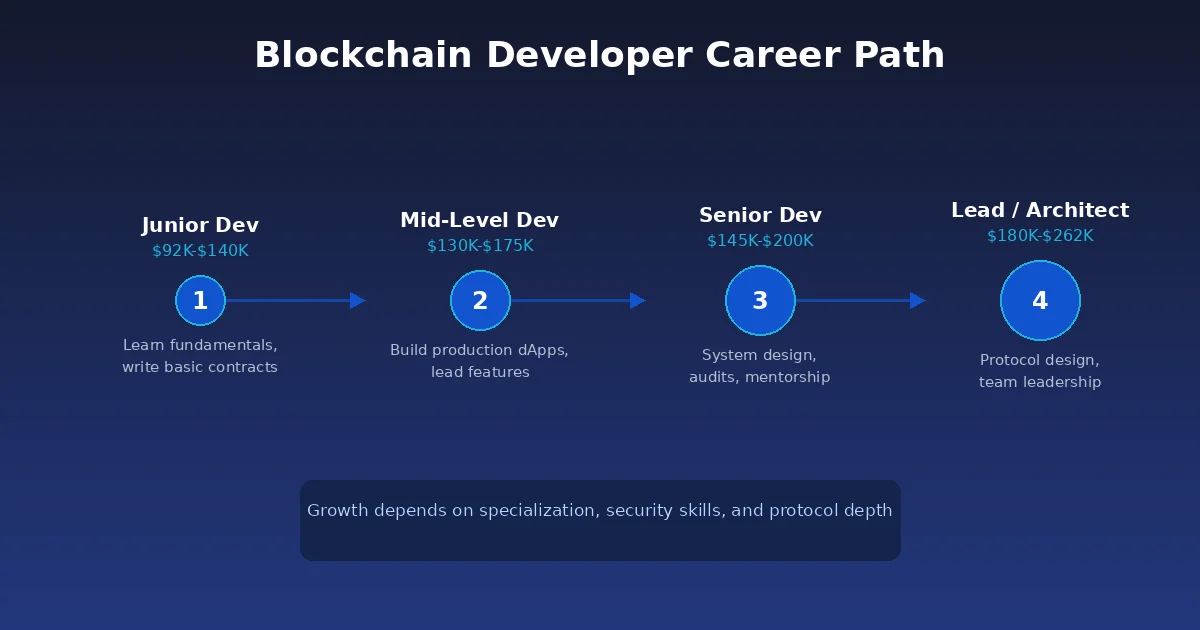
Junior Blockchain Developer (0 to 2 years). At this stage, you are learning the fundamentals. You write basic smart contracts, understand how transactions work, get familiar with development tools like Hardhat or Foundry, and start learning to spot common vulnerabilities. Most junior developers work on application-layer projects under the guidance of senior engineers. Entry-level salaries in the United States start around $92,000 to $140,000, which is already higher than many other software engineering entry points because of the specialized knowledge required.
Mid-Level Blockchain Developer (2 to 5 years). You are now building production dApps independently, leading feature development, and starting to own system design decisions. You understand gas optimization deeply, can design contract architectures, and have probably been through at least one security incident or audit cycle. You start to specialize, whether that is DeFi protocols, NFT infrastructure, DAO systems, or cross-chain tooling. Salaries at this level range from $130,000 to $175,000.
Senior Blockchain Developer (5 to 8 years). At the senior level, you are responsible for end-to-end system design, lead security reviews, mentor junior developers, and make architectural decisions that affect the entire product. You likely have deep expertise in one or two blockchain ecosystems and can work across both on-chain and off-chain systems fluently. Senior developers command salaries between $145,000 and $200,000, with top performers at well-funded protocols earning significantly more.
Lead, Architect, or Core Protocol Engineer (8+ years). This is the top of the ladder for technical contributors. You might be designing protocol-level changes, leading blockchain architecture for an organization, or working on core infrastructure that entire ecosystems depend on. Core protocol engineers sit here, and their salaries reflect the extreme scarcity of this skill set, ranging from $180,000 to $262,000 and sometimes higher with equity and token compensation.
Ready to Build Your Blockchain Product?
Whether you need smart contract engineers, protocol architects, or a full blockchain development team, we connect you with the right talent and technical strategy to ship secure, scalable products.
Blockchain Developer Salary Expectations in 2026
Blockchain development continues to be one of the highest-paying specializations in software engineering. The reason is straightforward: demand for experienced blockchain talent significantly exceeds supply. Companies are competing for developers who understand distributed systems, can write secure smart contracts, and have production experience with blockchain architectures. That competition pushes salaries well above traditional software engineering benchmarks.
In the United States, average annual salaries for blockchain developers range from $140,000 to $150,000, with entry-level positions starting around $121,000 and senior or protocol-level roles exceeding $200,000. These numbers do not include token grants, equity, or bonuses, which are common at crypto-native companies and can add substantial additional compensation.
Salary by Role and Experience Level
| Role / Experience Level | Average Base Salary (USD) | Salary Range (USD) |
|---|---|---|
| Entry-Level Blockchain Software Developer | $121,000 | $92,000 – $140,000 |
| Mid-Level Blockchain App Developer | $145,000 | $130,000 – $175,000 |
| Senior Blockchain Software Developer | $160,000 | $145,000 – $200,000 |
| Core Protocol Developer (All Levels) | $180,000 | $160,000 – $262,000 |
| Rust-Focused Web3 Specialist | $150,000 | $120,000 – $275,000 |
The wide range for Rust-focused specialists reflects the diversity of Rust roles in Web3. Some are writing Solana programs, others are working on zero-knowledge proof systems, and a few are building core infrastructure for newer chains. The top end of that range typically goes to people working on protocol-level Rust code at well-funded projects.
Salary by Industry Sector
Where you work matters almost as much as what you do. Finance and DeFi consistently offer the highest compensation because the systems handle real money and regulatory requirements add complexity. Consulting firms pay well for project-based expertise, while emerging sectors like healthcare and supply chain offer growing opportunities as blockchain adoption expands into these areas.
| Industry Sector | Average Base Salary (USD) | Key Pay Factors |
|---|---|---|
| Finance / DeFi | $160,000 | High-volume transactions, compliance demands, financial risk |
| Information Technology | $150,000 | Scalable infrastructure projects, platform development |
| Healthcare / Supply Chain | $140,000 | Data security, traceability, regulatory compliance |
| Gaming / NFTs | $135,000 | Creative development, user engagement, marketplace design |
| Management and Consulting | $130,000 | Project diversity, client exposure, advisory roles |
Why Blockchain Developer Salaries Are So High
People often ask why blockchain developers earn significantly more than other software engineers with similar years of experience. The answer comes down to three factors that compound on each other.
First, the supply of qualified blockchain developers is genuinely small. Building on a blockchain requires knowledge that most computer science programs do not teach. Distributed computing, applied cryptography, and adversarial system design are niche topics. The number of developers who have both the theoretical background and the production experience to build secure blockchain systems is a fraction of the broader developer pool.
Second, the consequences of mistakes are immediate and severe. A bug in a traditional web application might cause downtime or a bad user experience. A bug in a DeFi smart contract can drain millions of dollars in minutes, with no way to undo it. Companies pay a premium for developers who understand these risks and can build systems that prevent them.
Third, the market is growing faster than the talent pipeline. As more enterprises, financial institutions, and startups adopt blockchain technology, the demand for developers keeps increasing. But training a competent blockchain engineer takes years. You cannot take a web developer and turn them into a protocol engineer in a bootcamp. This supply-demand gap is what keeps salaries elevated across the board.
Who Should You Actually Hire?
One of the most common mistakes I see is companies hiring the wrong type of blockchain developer for their project. Here is a practical breakdown.
You need a core blockchain developer if: You are building a new blockchain network from scratch. You are forking or significantly modifying an existing protocol. You are running validator infrastructure at scale. You are developing a custom execution environment or virtual machine. You are designing a new consensus mechanism.
You need a blockchain software developer if: You are building a product on Ethereum, Solana, Polygon, or another existing chain. You are creating a DeFi protocol, NFT platform, or token-based system. You need smart contract development and audit capabilities. You are integrating blockchain functionality into an existing product. You need wallet integration, indexing, or API development.
Most companies, including the majority of startups and enterprises entering the blockchain space, need software developers, not protocol engineers. Hiring a core developer for application-layer work leads to overengineered solutions, slower delivery, and significantly higher costs. Save the protocol talent for when you genuinely need protocol work.
Where Blockchain Development Is Heading
Blockchain development as a discipline has matured considerably over the past few years. The wild west days of deploying unaudited contracts and hoping for the best are mostly behind us. What we are seeing now is a professionalization of the field, with clearer role definitions, better tooling, established security practices, and more structured career paths.
The developers who will thrive going forward are the ones who combine deep technical skills with practical judgment. Knowing how to write a smart contract is table stakes. Understanding when something should not be on a blockchain, knowing how to design systems that fail gracefully, and being able to communicate technical trade-offs to non-technical stakeholders is what will separate good blockchain developers from great ones.
Whether you are starting your career, scaling a team, or evaluating whether blockchain is right for your product, the most important thing is getting the fundamentals right. Understand the roles. Respect the constraints. Build with security in mind from day one. The technology will keep evolving, but those principles are not going anywhere.
Frequently Asked Questions About Blockchain Developers
Q1.What is the difference between a blockchain developer and a smart contract developer?
A smart contract developer focuses on writing and testing on-chain logic, such as token rules or protocol functions. A blockchain developer works at a broader system level, deciding how contracts, infrastructure, wallets, APIs, and off-chain services work together in production environments.
Q2.Are smart contracts enough to build a complete blockchain application?
No. Smart contracts handle only deterministic on-chain logic. Real blockchain applications also require off-chain systems such as backend services, indexers, databases, monitoring tools, and user-facing interfaces. Without these components, applications are difficult to scale and maintain.
Q3.Is blockchain development similar to traditional web development?
Only at a surface level. Blockchain development introduces immutability, public execution, economic costs, delayed finality, and adversarial environments. These constraints fundamentally change how systems are designed, tested, and deployed.
Q4.Can a Web2 backend developer transition into a blockchain developer role?
Yes, but only with significant mindset and skill shifts.
They must learn deterministic execution, cryptographic trust models, on-chain cost constraints, and irreversible deployment risks. Without understanding these fundamentals, Web2 experience alone is insufficient for production-grade blockchain development.
Q5.How should companies evaluate blockchain developers during hiring?
Companies should evaluate real production exposure, not just language knowledge.
Key signals include experience with mainnet deployments, handling upgrades, responding to incidents, understanding on-chain vs off-chain boundaries, and reasoning about security and economic risks. Certifications and tutorials are far less important than hands-on system accountability.
Q6.What is a blockchain developer?
A blockchain developer is a software professional who designs, builds and maintains blockchain-based systems such as smart contracts, decentralized applications and supporting infrastructure. They work with distributed ledgers, cryptography and consensus mechanisms instead of centralized databases and servers.
Q7.What does a blockchain developer do?
A blockchain developer writes smart contract designs, decentralized application logic manages blockchain integrations, and ensures the security of on-chain systems. Their work includes testing deployments, monitoring live contracts and handling upgrades while accounting for immutability, public execution, and economic risk.
Q8.Is blockchain a high paying job?
Yes, blockchain development is considered a high-paying career. The combination of limited skilled talent, high security ris,k irreversible deployments, and rapid industry growth leads to higher salaries compared to most Web2 software engineering roles.
Q9.Is learning blockchain development hard
Blockchain development is harder than traditional software development because it involves cryptography, decentralized systems, economic constraints, and immutable code. However, developers with strong backend fundamentals and security understanding can learn blockchain development successfully with practice.
Q10.How to become a blockchain software developer?
To become a blockchain software developer, start with software engineering fundamentals, then learn blockchain basics, smart contract development, security practice, and on chain off chain architecture. Building real projects and gaining mainnet experience is more important than certifications.
Explore Services
Related Services
Reviewed by

Aman Vaths
Founder of Nadcab Labs
Aman Vaths is the Founder & CTO of Nadcab Labs, a global digital engineering company delivering enterprise-grade solutions across AI, Web3, Blockchain, Big Data, Cloud, Cybersecurity, and Modern Application Development. With deep technical leadership and product innovation experience, Aman has positioned Nadcab Labs as one of the most advanced engineering companies driving the next era of intelligent, secure, and scalable software systems. Under his leadership, Nadcab Labs has built 2,000+ global projects across sectors including fintech, banking, healthcare, real estate, logistics, gaming, manufacturing, and next-generation DePIN networks. Aman’s strength lies in architecting high-performance systems, end-to-end platform engineering, and designing enterprise solutions that operate at global scale.