Ai Overview
The strategic imperative for private equity tokenization use cases emerges from structural inefficiencies that have plagued alternative investments for decades. 35% of assets under management, representing millions in expenses for billion-dollar funds. Lowering minimum investments from $1-5 million to fractional amounts enables fund managers to access broader investor bases including accredited individuals, smaller family offices, and international allocators.
Key Takeaways
- Private equity tokenization use cases transform venture capital fund structures by converting limited partnership interests into programmable digital securities enabling fractional ownership and automated administration.
- Tokenized VC funds reduce entry barriers from multi-million dollar commitments to fractional amounts, democratizing access for accredited investors across USA, UK, UAE, and Canadian markets.
- Smart contract automation eliminates manual fund administration processes, reducing operational costs by 40-60% while improving accuracy in capital calls, distributions, and carried interest calculations.
- Secondary market infrastructure for tokenized private equity tokenization use cases interests provides liquidity solutions for traditionally illiquid 7-10 year fund commitments through compliant digital securities exchanges.
- On-chain governance frameworks enable token holders to participate in fund decisions through transparent voting mechanisms embedded directly in smart contract logic.
- Regulatory compliance automation through security token standards like ERC-1400 and ERC-3643 embeds transfer restrictions, accreditation verification, and jurisdictional rules into token contracts.
- Real-time NAV calculation using oracle-fed valuation data provides institutional investors with unprecedented transparency into portfolio performance and fund-level metrics.
- Cross-border fundraising becomes operationally feasible through tokenized structures that automate multi-jurisdiction compliance and enable global investor participation in single fund vehicles.
- Tokenized carried interest mechanisms align general partner incentives with limited partner returns through transparent, automated waterfall calculations recorded on immutable blockchain ledgers.
- Integration with digital asset custodians licensed in major financial centers ensures institutional-grade security for tokenized private equity holdings while maintaining regulatory compliance standards.
Private equity tokenization use cases represent one of the most significant innovations in institutional asset management since the creation of limited partnership structures in the 1970s. The venture capital industry, characterized by high entry barriers, operational inefficiency, and extreme illiquidity, stands to benefit dramatically from blockchain-enabled transformation. Traditional VC funds require $1-5 million minimum commitments, lock capital for 7-10 years without exit options, and impose substantial administrative overhead on both fund managers and investors. Tokenization addresses these fundamental limitations by digitizing fund interests into programmable securities that maintain legal compliance while introducing operational automation, fractional ownership, and secondary market liquidity. Similar to how real estate tokenization has transformed property investment accessibility, private equity tokenization use cases are reshaping how institutional and accredited investors access alternative investments. Financial centers across New York, London, Dubai, and Toronto increasingly recognize tokenization as essential infrastructure for next-generation fund management, with early adopters demonstrating measurable improvements in cost efficiency, investor access, and operational transparency.
Strategic Rationale Behind Tokenizing private equity tokenization use cases Structures
The strategic imperative for private equity tokenization use cases emerges from structural inefficiencies that have plagued alternative investments for decades. Traditional fund administration involves multiple intermediaries including administrators, transfer agents, and distribution processors, each extracting fees while introducing operational delays and error risks. Annual fund administration costs typically range from 0.15% to 0.35% of assets under management, representing millions in expenses for billion-dollar funds. Smart contract automation eliminates these intermediary costs while improving execution accuracy and speed. Beyond cost reduction, tokenization enables fund managers to access broader capital pools by lowering minimum investment thresholds from institutional-scale commitments to fractional amounts accessible to accredited individuals. This democratization expands addressable markets without compromising fund quality or investor sophistication requirements.
Institutional investors pursuing private equity tokenization use cases gain operational benefits including real-time position visibility, automated compliance tracking, and simplified portfolio management across multiple fund commitments. Family offices managing dozens of VC fund investments particularly value consolidated dashboards displaying real-time NAV, capital call schedules, and distribution forecasts across their entire alternative investment portfolio. Pension funds in Canadian markets appreciate transparent on-chain records that simplify audit requirements and regulatory reporting obligations. Fund managers benefit from reduced administrative burden, allowing teams to focus on portfolio company value creation rather than manual back-office processes. The competitive advantage extends to fundraising, where progressive funds offering tokenized structures differentiate themselves in crowded markets, particularly when targeting younger, tech-savvy institutional allocators who expect modern digital infrastructure.
How Tokenized Private Equity Redefines Capital Formation in VC
Private equity tokenization use cases fundamentally alter venture capital fundraising dynamics by enabling continuous capital formation rather than discrete closing events. Traditional VC funds conduct first closes, interim closes, and final closes over 12-18 month fundraising periods, creating administrative complexity and uncertain capital availability during portfolio construction phases. Tokenized structures support rolling admissions where new investors purchase tokens representing pro-rata fund interests at current NAV, similar to open-end mutual fund mechanics adapted for illiquid assets. This continuous fundraising capability proves particularly valuable for emerging managers who struggle to achieve minimum fund size thresholds, as they can begin investing with smaller initial capital while adding limited partners over time as track record develops.
Cross-border capital formation benefits dramatically from private equity tokenization use cases that automate multi-jurisdiction compliance. A fund domiciled in Delaware can simultaneously market to investors in London, Dubai, and Toronto through tokenized structures that embed jurisdictional transfer restrictions and automatically enforce regulatory requirements for each investor class. Smart contracts verify accreditation status, enforce holding periods, and restrict transfers to compliant parties without manual intervention. This automation reduces legal complexity and cost associated with cross-border private equity tokenization use cases placements, opening global capital pools that traditional fund structures access only through expensive, time-consuming multi-jurisdiction offerings. The result is more efficient capital formation connecting fund managers with optimal investor bases regardless of geographic constraints, while maintaining full regulatory compliance across all relevant jurisdictions.
Fractional Ownership Models for Venture Capital via Tokenization
Fractional ownership represents one of the most transformative private equity tokenization use cases, breaking down institutional-scale fund commitments into accessible units for accredited individual investors. A $100 million venture fund traditionally requiring $1-5 million minimum investments can issue 100,000 security tokens at $1,000 each, enabling broader participation while maintaining quality investor standards through accreditation requirements. This fractionalization doesn’t dilute fund quality or governance rights, as token holders collectively possess the same economic and information rights as traditional limited partners. The fractional model particularly appeals to high-net-worth individuals in USA and UK markets seeking alternative investment diversification but lacking capital scale for direct institutional allocations.
Operational implementation of fractional private equity tokenization use cases requires sophisticated smart contract architecture that maintains proportional rights across thousands of token holders while preserving fund manager control over investment decisions. Token holders receive pro-rata distributions, access to information rights, and voting participation on matters requiring LP consent, all automated through smart contracts that calculate exact entitlements based on token ownership percentages. This fractional structure enables institutional investors to make smaller allocation decisions across more diverse manager relationships, building portfolios of 20-30 VC fund exposures rather than concentrated positions in 5-10 funds. Family offices particularly benefit from this diversification capability, constructing customized venture portfolios tailored to specific sector focuses, geographic preferences, or stage orientations without requiring massive capital commitments to each individual fund relationship.
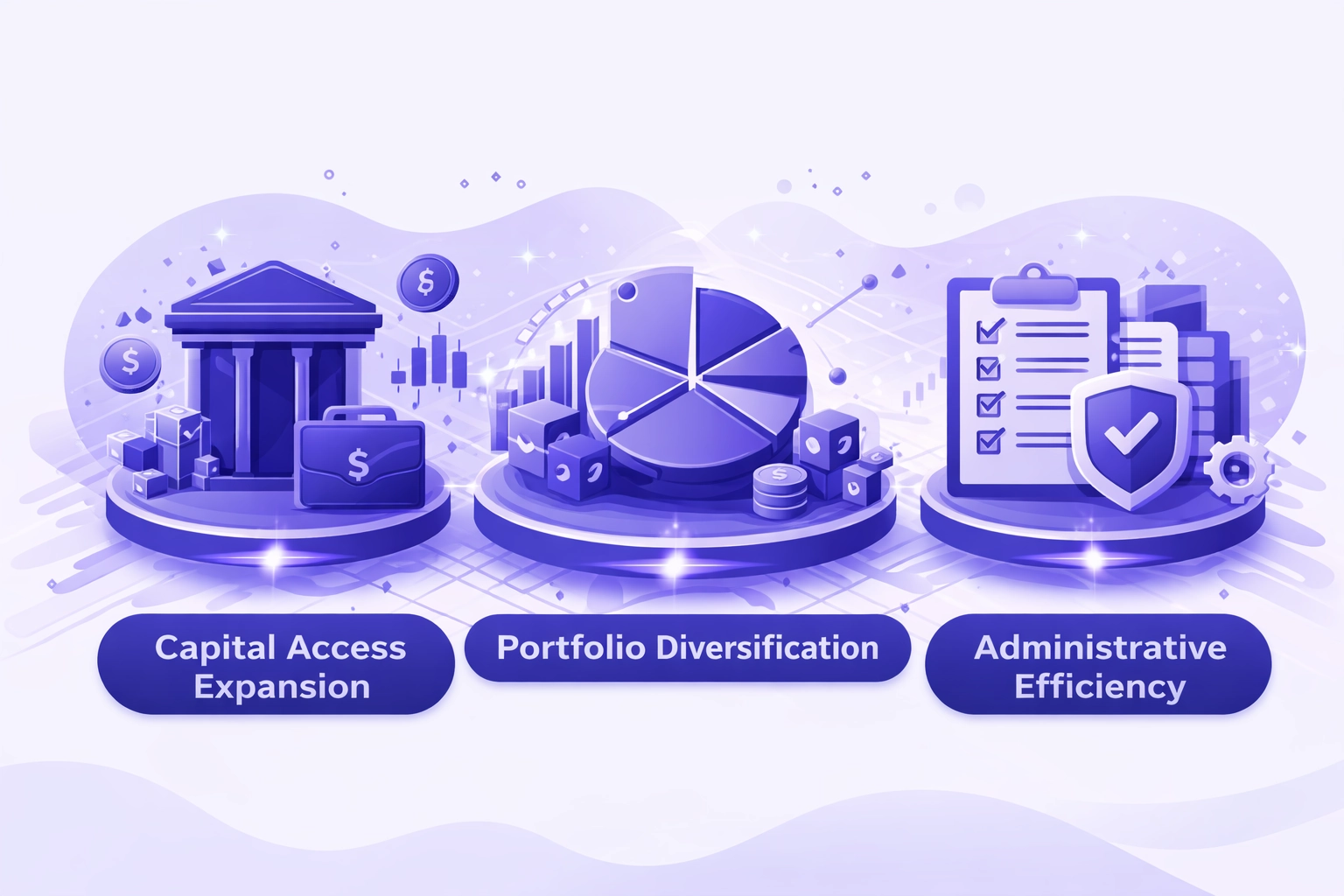 Fractional Ownership Implementation Benefits
Capital Access Expansion
Lowering minimum investments from $1-5 million to fractional amounts enables fund managers to access broader investor bases including accredited individuals, smaller family offices, and international allocators.
Portfolio Diversification
Investors construct broader venture portfolios across multiple managers, stages, and sectors without requiring massive capital outlays, improving risk-adjusted returns through enhanced diversification.
Administrative Efficiency
Smart contracts automatically calculate and execute pro-rata distributions, capital calls, and voting rights for thousands of fractional token holders without manual administrator intervention.
Smart Contract-Driven Fund Administration in Tokenized PE
Smart contract automation represents the operational core of private equity tokenization use cases, replacing manual administrative processes with programmable execution of fund terms. Traditional fund administration involves quarterly capital call notices sent via email, followed by wire transfer instructions, payment tracking, and reconciliation across potentially hundreds of limited partners. Tokenized funds automate this entire workflow: smart contracts issue on-chain capital call notices viewable through investor dashboards, calculate exact payment amounts based on token holdings and remaining commitments, and verify payment receipt automatically. Investors authorize payments through integrated banking connections or stablecoin transfers, with smart contracts updating internal ledgers instantly upon confirmation. This automation reduces capital call cycle time from weeks to days while eliminating reconciliation errors and missed payments.
Distribution processing showcases another compelling application of private equity tokenization use cases through smart contract automation. When portfolio companies exit through acquisitions or IPOs, fund managers calculate distribution waterfalls determining proceeds allocation between limited partners and general partners based on preferred returns, catch-up provisions, and carried interest percentages. Traditional administrators manually execute these calculations and process wire transfers over multi-week periods. Smart contracts encode waterfall logic directly into token contracts, automatically calculating exact distribution amounts for each token holder based on current holdings, historical contributions, and contractual terms. Distributions execute simultaneously across all token holders once fund managers authorize proceeds release, with immutable on-chain records documenting exact allocation methodologies. This automation particularly benefits complex waterfall structures common in institutional funds, where manual calculations introduce error risks and processing delays that smart contracts eliminate entirely.
Liquidity Engineering for Traditionally Illiquid VC Assets
Liquidity engineering through private equity tokenization use cases addresses the fundamental illiquidity challenge that has historically limited institutional adoption of venture capital strategies. Traditional VC funds lock investor capital for entire fund terms, typically 7-10 years, with limited partner interests tradeable only through complex, inefficient secondary markets involving specialized brokers and steep discounts to NAV. Tokenized structures enable compliant secondary trading through digital securities exchanges that connect buyers and sellers while enforcing transfer restrictions embedded in smart contracts. These regulated platforms verify purchaser accreditation, enforce lock-up periods, and ensure compliance with securities laws across relevant jurisdictions, facilitating liquidity without compromising fund stability or regulatory compliance.
Practical implementation of liquidity-enhancing private equity tokenization use cases requires careful design balancing investor exit flexibility with fund operational stability. Fund managers typically impose graduated lock-up schedules, restricting transfers during initial years while permitting quarterly or semi-annual trading windows in later periods after portfolios mature. Smart contracts automatically enforce these restrictions, rejecting non-compliant transfer attempts while facilitating approved transactions. Secondary market pricing mechanisms vary from NAV-based pricing updated quarterly to market-making systems where specialized liquidity providers quote bid-ask spreads on tokenized fund interests. Institutional investors in UK and Dubai markets particularly value these liquidity provisions, as they enable portfolio rebalancing and tactical allocation adjustments previously impossible with traditional fund structures. The liquidity premium attracts capital that would otherwise avoid venture investing due to illiquidity constraints, expanding addressable markets for fund managers who offer thoughtfully designed secondary trading capabilities.
Liquidity Comparison: Traditional vs Tokenized PE Funds
| Liquidity Feature | Traditional Structure | Tokenized Structure |
|---|---|---|
| Secondary Market Access | Limited to specialized brokers with 6-12 month transaction timelines | Digital securities exchanges with automated matching and settlement |
| Transaction Costs | 5-15% broker fees plus legal costs for transfer documentation | 1-3% platform fees with automated compliance verification |
| Price Discovery | Opaque negotiations with significant NAV discounts | Transparent order books with visible bid-ask spreads near NAV |
| Settlement Time | 30-90 days for legal review and transfer approval | 1-5 days for smart contract execution and custody transfer |
| Minimum Transaction Size | Typically $500K-$1M due to transaction costs | Fractional amounts limited only by minimum token unit |
Secondary Market Design for Tokenized Private Equity Interests
Secondary market infrastructure for private equity tokenization use cases requires sophisticated platform architecture that balances liquidity provision with regulatory compliance and fund stability preservation. Digital securities exchanges operating in New York, London, and other financial centers provide order book matching, market-making services, and custody integration specifically designed for tokenized alternative investments. These platforms verify accredited investor status through integrated KYC systems, enforce transfer restrictions programmed into security tokens, and facilitate settlement through connections to licensed digital asset custodians. Market participants include original limited partners seeking exits, new investors pursuing VC exposure, and specialized liquidity providers who quote markets in tokenized fund interests similar to traditional over-the-counter secondary brokers.
Pricing mechanisms in secondary markets for private equity tokenization use cases employ hybrid approaches combining fundamental NAV analysis with market supply-demand dynamics. Fund managers publish quarterly NAV updates based on portfolio company valuations, providing reference pricing for market participants. Trading typically occurs at premiums or discounts to stated NAV based on market sentiment, fund performance trajectory, and overall alternative investment market conditions. Some platforms implement periodic auction mechanisms where trades batch at specified intervals, improving price discovery while limiting intra-period volatility. Institutional investors particularly value the transparency these structured secondary markets provide compared to opaque traditional channels, as public order books display real-time pricing information and trading volumes. The result is more efficient price discovery that benefits both sellers receiving fair value and buyers accessing opportunities at reasonable valuations, while fund managers maintain appropriate controls over investor composition through smart contract-enforced transfer restrictions.
Tokenization as a Tool for Reducing VC Fund Entry Barriers
Private equity tokenization use cases democratize venture capital access by eliminating traditional barriers that have historically limited participation to ultra-high-net-worth individuals and large institutions. Minimum investment requirements of $1-5 million effectively excluded 99% of accredited investors from top-tier VC funds, concentrating alternative investment returns among the wealthiest capital allocators. Tokenized structures reduce minimums to $25,000-$100,000 or lower, opening institutional-quality venture opportunities to successful professionals, smaller family offices, and international investors who meet accreditation standards but lack multi-million dollar check sizes. This expansion doesn’t compromise fund quality, as aggregated capital from many smaller investors achieves the same total fund size while broadening LP diversity and network effects.
Operational barriers also diminish through private equity tokenization use cases that simplify subscription processes, reduce legal complexity, and streamline ongoing investor relations. Traditional fund subscriptions require extensive paperwork, legal review, and manual processing that discourages participation from investors uncomfortable with complex private equity tokenization use cases placement documentation. Tokenized platforms provide standardized digital subscription workflows with embedded legal terms, automated accreditation verification, and integrated payment processing that reduce subscription completion time from weeks to hours. Ongoing investor communications leverage token holder dashboards displaying real-time portfolio metrics, capital call schedules, and distribution histories rather than quarterly PDF reports and manual distribution notices. These operational improvements particularly benefit international investors in Dubai, Singapore, and other markets outside traditional US and UK fund ecosystems, as tokenized platforms provide consistent user experiences regardless of geographic location while automatically handling multi-jurisdiction compliance requirements.
Institutional Risk Management in Tokenized Private Equity Funds
Risk management frameworks for private equity tokenization use cases must address both traditional venture capital risks and novel considerations introduced by blockchain infrastructure. Core VC risks including portfolio concentration, manager selection, valuation uncertainty, and exit timing remain unchanged by tokenization, requiring standard institutional due diligence on fund strategy, team experience, and portfolio construction. New risk dimensions include smart contract security, custody technology, regulatory uncertainty around digital securities, and secondary market liquidity assumptions. Institutional investors conduct comprehensive technology audits examining smart contract code, platform security architecture, disaster recovery procedures, and integration with licensed custodians before committing capital to tokenized structures.
Operational risk mitigation in private equity tokenization use cases involves multi-layered controls including formal smart contract audits by specialized security firms, insurance coverage for custody and technology failures, and fallback mechanisms enabling asset recovery if platform failures occur. Leading tokenization platforms maintain reserve funds covering potential smart contract vulnerabilities, carry comprehensive cyber liability insurance, and implement multi-signature authorization requirements for critical functions like distribution processing. Canadian pension funds and other institutional allocators require evidence of SOC 2 compliance, penetration testing results, and disaster recovery documentation before approving investments. Regulatory risk management focuses on structures that maintain compliance across multiple jurisdictions even as regulatory frameworks evolve, typically achieved through conservative interpretations of securities laws and proactive engagement with regulators in key markets including SEC in USA, FCA in UK, and relevant authorities in UAE and Canada.
Tokenized Private Equity Fund Lifecycle Management
Fund Structure Design
Establish legal entity, draft limited partnership agreement encoding terms into smart contracts, define token economics, and select security token standard for implementation.
Regulatory Registration
File appropriate securities registrations in target jurisdictions, obtain necessary licenses for token issuance, and establish compliance frameworks for ongoing regulatory obligations.
Platform Integration
Deploy smart contracts on selected blockchain, integrate with custody providers and compliance systems, establish banking connections for fiat-token conversions.
Capital Formation
Conduct fundraising through tokenized subscription process, issue security tokens to investors upon capital receipt, and maintain compliant investor registry on-chain.
Investment Period Operations
Execute portfolio investments, process capital calls through smart contracts, provide token holders with portfolio updates and governance participation opportunities.
Harvest Period Management
Manage portfolio company exits, calculate waterfall distributions automatically through smart contracts, process distribution payments to token holders based on programmed terms.
Secondary Market Activation
Enable compliant token transfers through approved digital securities exchanges, facilitate liquidity provision for token holders subject to smart contract restrictions.
Fund Wind-Down
Complete final distributions, conduct terminal audits with on-chain verification, archive immutable transaction records, and formally close fund with token redemption or conversion.
On-Chain Governance Frameworks for Venture Capital Token Holders
Governance mechanisms in private equity tokenization use cases enable transparent, efficient decision-making while maintaining appropriate fund manager control over investment operations. Traditional limited partnership agreements grant LPs voting rights on specific matters including key person events, advisory board elections, fund term extensions, and changes to investment strategy. Tokenized structures encode these governance rights directly into smart contracts, with voting proposals published on-chain and token holders casting votes through digital wallets. Smart contracts automatically tally votes weighted by token holdings, verify quorum requirements, and execute approved actions without manual intervention. This transparency provides token holders with complete visibility into governance proposals, voting results, and historical decision records stored immutably on blockchain.
Advanced governance applications of private equity tokenization use cases include delegated voting where token holders assign voting power to specialized advisory firms or other experts, similar to proxy voting in public equities. This delegation proves particularly valuable for smaller investors who lack resources for detailed fund governance analysis but want positions aligned with their interests. Some platforms implement quadratic voting mechanisms where voting power scales with square root of token holdings rather than linear proportion, reducing dominance of largest investors in governance outcomes. Institutional investors in Canadian and UK markets particularly value governance transparency these systems provide, as immutable on-chain records simplify compliance documentation and audit trails required by fiduciary duty obligations. The result is more engaged limited partner bases where governance participation increases due to reduced friction, while fund managers benefit from clear, documented stakeholder approval for major decisions.
Regulatory Architecture for Tokenized PE Across Global Jurisdictions
Regulatory compliance frameworks for private equity tokenization use cases must navigate complex, evolving securities regulations across multiple jurisdictions where funds market to investors. In USA markets, tokenized funds typically structure as Regulation D private equity tokenization use cases placements relying on Rule 506(b) or 506(c) exemptions, requiring verification of accredited investor status and restricting general solicitation under 506(b) or mandating heightened verification under 506(c). SEC guidance increasingly addresses digital securities, with staff statements clarifying that tokenization doesn’t change fundamental securities law application but introduces new compliance considerations around custody, transfer restrictions, and platform registrations. Fund managers work with specialized securities counsel to ensure token contracts properly encode regulatory requirements including holding periods, transfer restrictions, and investor suitability criteria.
International regulatory architecture for private equity tokenization use cases involves coordinating compliance across UK’s FCA framework, Dubai’s DFSA regulations, Canadian provincial securities laws, and other relevant jurisdictions where token holders reside. Security token standards like ERC-1400 and ERC-3643 facilitate multi-jurisdiction compliance by embedding transfer rules specific to each regulatory regime directly into smart contracts. Tokens automatically verify purchaser location, enforce jurisdictional transfer restrictions, and maintain separate compliance controls for different investor classes. This programmable compliance reduces operational complexity and risk compared to manual enforcement of cross-border securities restrictions. However, regulatory uncertainty remains around certain aspects including custody requirements, broker-dealer registration for secondary platforms, and tax treatment, requiring ongoing legal monitoring and conservative structural choices that maintain compliance even as frameworks evolve across key markets.
NAV Calculation and Real-Time Valuation Using On-Chain Data
Net asset value calculation represents a critical component of private equity tokenization use cases, as accurate, transparent valuation underpins token pricing in secondary markets and investor confidence in fund management. Traditional VC funds calculate NAV quarterly using portfolio company valuations derived from recent funding rounds, comparable public company multiples, or discounted cash flow analysis. This quarterly cadence creates significant information lag where investors operate with stale valuation data for extended periods. Tokenized structures enable more frequent NAV updates by automating data collection from portfolio companies and integrating external market data through oracle systems. Some platforms publish monthly or even weekly NAV estimates based on updated inputs, though most maintain quarterly formal valuations consistent with traditional fund accounting standards.
On-chain data integration enhances private equity tokenization use cases by publishing NAV components transparently on blockchain for token holder verification. Smart contracts store portfolio company valuations, fund expenses, outstanding commitments, and other NAV inputs with cryptographic hashes linking to supporting documentation. Token holders access detailed NAV calculation methodologies and underlying assumptions through integrated dashboards, dramatically improving transparency compared to traditional quarterly reports with limited valuation disclosure. This transparency particularly benefits institutional investors in USA and Canadian markets who face enhanced scrutiny around alternative investment valuations from auditors and regulators. Real-time metrics including capital deployment pace, realized returns to date, and remaining dry powder provide token holders with comprehensive fund performance visibility between formal NAV updates, enabling more informed secondary market trading decisions and portfolio allocation choices.
NAV Component Transparency in Tokenized Funds
| NAV Component | Traditional Disclosure | Tokenized Transparency |
|---|---|---|
| Portfolio Company Valuations | Aggregate values in quarterly reports with limited methodology disclosure | Individual company valuations with methodology, assumptions, and supporting data accessible on-chain |
| Fund Expenses | Summarized annually with expense ratio calculations | Real-time expense tracking with detailed categorization and automatic NAV impact calculation |
| Outstanding Commitments | Reported quarterly with aggregate commitment and draw down status | Individual LP commitments tracked on-chain with remaining capital and draw down history visible |
| Distributions | Periodic statements with waterfall calculations in annual reports | Automatic waterfall execution with transaction-level distribution records immutably recorded |
| Performance Metrics | IRR and multiple calculations reported quarterly with limited underlying data | Real-time performance dashboards with cash flow details enabling LP verification of calculations |
Custody, Compliance, and Transfer Restrictions in Tokenized PE
Custody infrastructure for private equity tokenization use cases requires licensed digital asset custodians that meet institutional security and regulatory standards while integrating with traditional financial infrastructure. Leading custody providers serving tokenized securities markets maintain SOC 2 Type II certifications, comprehensive insurance coverage, and regulatory licenses in key jurisdictions including New York, London, and Singapore. These custodians employ multi-signature wallets, hardware security modules, and cold storage protocols protecting token holdings from theft or loss. Integration with traditional banking systems enables seamless fiat-to-token conversions for capital calls and token-to-fiat conversions for distributions, while maintaining complete audit trails for regulatory reporting and investor tax documentation.
Transfer restriction enforcement represents a critical compliance component of private equity tokenization use cases, ensuring token movements comply with securities regulations and fund-specific constraints. Security token standards embed transfer logic directly into smart contracts, automatically verifying transaction compliance before execution. Common restrictions include investor accreditation requirements, holding period enforcement, jurisdictional limitations, and fund-specific approval processes for certain transfer types. Smart contracts query integrated compliance oracles that maintain current regulatory status for wallet addresses, rejecting transfers to non-compliant parties automatically. This programmable compliance proves particularly valuable for funds marketing across USA, UK, UAE, and Canadian jurisdictions where different regulatory frameworks apply to different investor classes. The automation reduces compliance costs and risks compared to manual transfer approval processes while providing regulators with transparent, auditable enforcement mechanisms demonstrating robust securities law adherence.
Interoperability Between Traditional Fund Infrastructure and Blockchain
Integration between blockchain-based private equity tokenization use cases and traditional fund infrastructure requires sophisticated technical architecture connecting on-chain token operations with off-chain banking, accounting, and reporting systems. Fund administrators maintain systems of record tracking capital accounts, investment transactions, and financial statements that must synchronize with blockchain-based token registries and smart contract operations. Leading platforms implement bidirectional APIs where capital calls triggered by smart contracts generate corresponding entries in traditional fund accounting systems, while NAV updates calculated in standard fund administration software publish to blockchain oracles feeding token pricing mechanisms. This interoperability ensures regulatory filings, audited financial statements, and tax reporting maintain compatibility with existing standards while capturing efficiency benefits of blockchain automation.
Banking integration for private equity tokenization use cases enables seamless capital flows between fiat banking systems and blockchain-based token operations. Specialized payment processors provide fiat on-ramps where investors wire funds to escrow accounts, triggering automatic token issuance upon payment clearing. Distribution off-ramps convert token-based distribution instructions into wire transfers to investor bank accounts, with smart contracts maintaining immutable records of all conversion transactions. Some platforms integrate stablecoins as intermediate layers where capital calls and distributions execute in USDC or other fiat-pegged tokens before final conversion to traditional banking rails. This multi-layer approach optimizes transaction costs while maintaining regulatory compliance and investor familiarity with traditional banking interfaces. Institutional investors particularly value these seamless integrations that enable blockchain benefits without requiring complete migration away from established financial infrastructure and operational workflows they rely on for portfolio management across traditional and tokenized holdings.
Capital Call Automation Using Smart Contracts in VC Funds
Capital call automation represents one of the highest-value applications of private equity tokenization use cases, eliminating manual processes that create operational friction and introduce error risks. Traditional capital calls require fund administrators to calculate required contributions from each LP based on remaining commitments, send notice emails with wire instructions, track incoming payments, reconcile receipts against expected amounts, and follow up on late payments. This manual workflow typically requires 2-3 weeks for completion and involves substantial administrative overhead. Smart contracts automate the entire process: fund managers trigger capital calls through management interfaces, contracts automatically calculate exact amounts owed by each token holder based on on-chain commitment records, and notify token holders through integrated messaging while displaying payment details in investor dashboards.
Payment execution in private equity tokenization use cases supports multiple modalities including traditional wire transfers, stablecoin payments, and automated ACH debits depending on investor preferences and jurisdictional constraints. Token holders authorize payments through integrated banking connections or digital wallets, with smart contracts verifying payment receipt and updating internal capital accounts automatically. Late payment management implements automated reminder systems and contractual penalty calculations without manual intervention. The efficiency gains prove substantial, with tokenized funds reducing capital call processing time from weeks to 3-5 days while eliminating reconciliation errors that plague manual processes. Institutional investors in Dubai and other international markets particularly appreciate standardized capital call workflows that function identically regardless of investor location, compared to traditional processes requiring jurisdiction-specific wire instructions and creating complexity in cross-border fund operations.
Tokenized Carried Interest and Incentive Alignment Mechanisms
Carried interest tokenization extends private equity tokenization use cases to general partner economics, creating transparent, automated execution of performance fee calculations that align GP and LP interests. Traditional carried interest involves complex waterfall calculations determining when GPs earn performance fees based on preferred returns, catch-up provisions, and ultimate profit sharing ratios. Fund administrators manually calculate these amounts during distribution events, with potential disputes around calculation methodologies and timing. Smart contracts encode exact waterfall logic specified in limited partnership agreements, automatically calculating carried interest amounts when distribution events occur based on fund-level returns and contractual terms. This automation eliminates calculation disputes while providing transparent execution visible to all stakeholders through on-chain transaction records.
Advanced applications of private equity tokenization use cases include tokenized GP interests that themselves become tradeable securities, enabling GP team members to monetize portions of carry before final fund liquidation. This innovation addresses GP liquidity challenges where partners wait 10+ years for carry realization despite generating substantial paper wealth through successful portfolio investments. Tokenized carry structures issue separate security tokens representing GP profit participations, tradeable subject to appropriate restrictions on secondary markets. Some platforms implement vesting schedules directly into carry tokens, automatically adjusting token holder entitlements based on continued employment or performance milestones. These mechanisms prove particularly valuable for emerging managers in competitive talent markets who use tokenized carry structures to attract and retain investment professionals by offering more liquidity and flexibility than traditional carry arrangements, while maintaining long-term alignment through programmatic vesting and performance conditions encoded directly into smart contracts.
Critical Success Factors for Institutional PE Tokenization
Factor 1: Engage experienced securities counsel in all target jurisdictions to ensure proper regulatory compliance across USA, UK, UAE, and Canadian markets.
Factor 2: Select established security token platforms with proven technology, licensed custody partners, and existing institutional client base.
Factor 3: Implement comprehensive smart contract audits from specialized security firms before deploying contracts controlling investor capital.
Factor 4: Design token economics carefully balancing liquidity provision with fund stability through appropriate transfer restrictions and lock-up periods.
Factor 5: Maintain parallel traditional fund administration during initial tokenization phases to provide fallback mechanisms and regulatory comfort.
Factor 6: Invest in investor education helping LPs understand tokenization benefits while addressing technology concerns and regulatory questions.
Factor 7: Secure appropriate insurance coverage including cyber liability, errors and omissions, and custody insurance protecting against technology failures.
Factor 8: Establish clear governance frameworks defining roles and responsibilities for smart contract upgrades, emergency interventions, and technology incidents.
Impact of Tokenization on Fund Lifecycle and Exit Strategies
Private equity tokenization use cases reshape traditional fund lifecycle dynamics by enabling continuous fundraising, flexible term structures, and novel exit mechanisms that improve outcomes for both GPs and LPs. Traditional VC funds operate on fixed 10-year terms with potential extensions, constraining exit timing to fund maturity regardless of optimal portfolio liquidity timing. Tokenized structures support evergreen fund designs where managers continuously raise capital, invest in opportunities, harvest exits, and distribute proceeds without artificial timeline constraints imposed by fund term expirations. This perpetual structure proves particularly suitable for certain investment strategies including rolling venture portfolios or thematic funds focused on long-term secular trends that exceed traditional fund horizons.
Exit strategy flexibility through private equity tokenization use cases extends to both portfolio company exits and LP portfolio liquidity management. Fund managers optimize portfolio company exit timing based on market conditions and company readiness rather than fund term pressures, as secondary market liquidity for tokenized fund interests reduces LP pressure for premature exits. Some tokenized structures implement tender offer mechanisms where funds periodically offer to repurchase tokens at NAV from LPs seeking liquidity, providing controlled exit opportunities that maintain fund stability. These flexible structures attract longer-term institutional capital from pension funds, endowments, and family offices willing to commit to extended holding periods in exchange for superior returns and professional management, while still maintaining option value through secondary market access. The result is improved alignment between fund structures, investment strategies, and capital provider objectives compared to rigid traditional fund templates.
Data Transparency and Auditability in Tokenized PE Investments
Data transparency represents a transformative benefit of private equity tokenization use cases, providing institutional investors with unprecedented visibility into fund operations, portfolio performance, and fee calculations. Traditional fund reporting relies on quarterly statements with aggregate performance metrics and limited underlying detail, creating information asymmetries between fund managers and limited partners. Tokenized structures publish granular operational data on-chain including individual investment valuations, expense line items, capital call and distribution calculations, and governance activity records. Token holders access real-time dashboards displaying fund-level metrics, portfolio company performance, and comparative analytics across their entire alternative investment holdings. This transparency dramatically improves LP ability to monitor fund performance, verify fee calculations, and conduct effective governance oversight.
Auditability enhancements through private equity tokenization use cases simplify compliance verification and reduce audit costs through immutable blockchain records documenting all fund transactions. Annual fund audits traditionally involve sampling transactions, verifying calculations, and confirming asset existence through extensive documentation requests to fund administrators. Smart contract-based funds provide auditors with complete transaction histories, automated calculation verification, and cryptographic proof of asset ownership through blockchain records. This comprehensive audit trail reduces sampling requirements and verification procedures, potentially decreasing audit costs by 30-50% while improving audit quality through complete transaction coverage. Regulatory authorities benefit from similar transparency advantages, with immutable records facilitating examinations and investigations more efficiently than traditional document production processes. Institutional investors in Canadian markets subject to enhanced alternative investment scrutiny particularly value audit trail improvements that demonstrate fiduciary compliance and proper oversight.
Institutional Due Diligence for Blockchain-Based Fund Structures
Due diligence frameworks for private equity tokenization use cases must expand beyond traditional fund assessment to encompass technology evaluation, platform risk analysis, and smart contract security verification. Institutional investors conduct comprehensive reviews of blockchain architecture including network selection rationale, consensus mechanism security properties, and transaction throughput capacity under stressed conditions. Platform diligence examines security token issuance technology, custody integration quality, compliance automation capabilities, and disaster recovery procedures. Smart contract audits from specialized security firms like Trail of Bits, OpenZeppelin, or Certik become mandatory prerequisites for institutional allocation, with investors requiring multiple independent audits and formal verification for critical contract functions controlling capital flows.
Operational due diligence for private equity tokenization use cases evaluates integration quality between blockchain systems and traditional fund infrastructure, assessing whether accounting reconciliation, banking connectivity, and regulatory reporting function reliably across hybrid architectures. Investors review business continuity plans addressing blockchain network disruptions, smart contract bugs, or platform failures, requiring documented fallback procedures enabling continued fund operations if technology issues arise. Legal diligence expands to cover novel considerations including smart contract legal enforceability, regulatory treatment across jurisdictions, and IP rights around platform technology. Institutional allocators in USA, UK, and Dubai markets often engage specialized blockchain consultants to supplement internal diligence capabilities, recognizing that tokenization introduces technical complexities requiring expertise beyond traditional alternative investment analysis. Despite additional diligence requirements, early institutional adopters recognize that thorough evaluation of properly structured tokenized funds reveals superior operational frameworks compared to traditional alternatives once technology and regulatory risks receive appropriate assessment and mitigation.
Cross-Border VC Fundraising Enabled by Asset Tokenization
Cross-border fundraising represents one of the most compelling private equity tokenization use cases, dramatically reducing complexity and cost associated with marketing funds across multiple jurisdictions. Traditional international fund offerings require separate legal documentation for each target market, jurisdiction-specific regulatory filings, and complex coordination around subscription mechanics, capital call timing, and distribution payments across different banking systems and currencies. Tokenized structures consolidate these processes through smart contracts that automatically enforce jurisdiction-specific requirements while providing unified investor experiences. A single token issuance can accommodate investors from USA, UK, UAE, and Canada with smart contracts programmatically applying appropriate transfer restrictions, holding periods, and disclosure requirements based on each token holder’s location and investor classification.
Operational efficiencies in cross-border private equity tokenization use cases extend beyond legal compliance to payment processing, currency management, and tax documentation. Tokenized funds integrate with payment processors supporting multiple currencies and banking systems, automatically converting capital calls and distributions to investor local currencies at market rates. Smart contracts maintain multi-currency accounting tracking each investor’s contributions and entitlements in their preferred denomination while consolidating fund-level reporting in base currency. Tax documentation automation generates jurisdiction-specific reports required for investor compliance in home countries, reducing manual processing that traditionally creates substantial overhead in international fund operations. These efficiencies enable emerging managers to access global capital pools previously available only to large, established funds with resources for complex international offerings. The result is more efficient global capital allocation toward high-quality investment opportunities regardless of fund manager location, while investors gain access to differentiated strategies in markets like Dubai, Toronto, and other emerging venture ecosystems that traditional fund structures made prohibitively expensive to access.
Role of Oracles in Pricing and Reporting Tokenized PE Assets
Oracle integration provides critical infrastructure for private equity tokenization use cases, connecting on-chain smart contracts with off-chain data sources required for valuation, compliance, and operational functions. Portfolio company valuations originate from off-chain sources including recent funding rounds, comparable public company data, and third-party valuation firms, requiring secure mechanisms for publishing this information to blockchain networks where smart contracts calculate NAV and secondary market pricing. Oracle providers like Chainlink or Band Protocol aggregate data from multiple sources, apply consensus mechanisms detecting anomalies, and publish cryptographically signed price feeds that smart contracts consume with high confidence in accuracy and manipulation resistance. This architecture maintains data integrity while enabling smart contract automation dependent on reliable external information.
Compliance data requirements for private equity tokenization use cases also leverage oracle systems that verify investor accreditation status, jurisdictional restrictions, and regulatory changes affecting token transferability. Accreditation oracles integrate with identity verification providers and databases tracking investor qualifications, providing smart contracts with real-time verification data for transfer approval decisions. Regulatory oracles monitor securities law changes across relevant jurisdictions, automatically updating smart contract restrictions when regulatory requirements evolve. This oracle-dependent architecture requires careful design addressing potential manipulation risks, data staleness issues, and single points of failure. Leading tokenization platforms implement redundant oracle systems with multiple data providers, anomaly detection algorithms, and manual override capabilities enabling human intervention when oracle data appears incorrect. Institutional investors conducting due diligence on tokenized funds scrutinize oracle architecture as critical infrastructure determining platform reliability and security, recognizing that oracle failures could disrupt fund operations or enable manipulation despite sound smart contract design.
Security Token Standards for PE Tokenization
| Token Standard | Key Features | Primary Use Cases |
|---|---|---|
| ERC-1400 | Partition-based transfers, document management, controller operations | Multi-class fund structures with different investor rights tiers |
| ERC-3643 | Identity-based compliance, jurisdiction restrictions, automated regulatory enforcement | International funds with complex multi-jurisdiction compliance requirements |
| ERC-1404 | Simple transfer restrictions, error messaging, whitelist management | Straightforward single-jurisdiction funds with basic compliance needs |
| ST-20 | Polymath-native standard, built-in compliance modules, KYC integration | Funds leveraging Polymath ecosystem with standardized compliance infrastructure |
Security Token Standards Powering Private Equity Tokenization
Security token standards provide technical foundations for private equity tokenization use cases, defining smart contract interfaces and functionalities that enable regulatory compliance automation. ERC-1400 emerged as leading standard for complex securities offering partition-based token management where single issuances contain multiple token classes with different rights and restrictions. This capability proves essential for VC funds issuing different share classes with varied liquidation preferences, voting rights, or fee structures. The standard includes document management features enabling attachment of legal agreements and disclosure documents to token contracts, ensuring investors access current prospectuses and partnership agreements through token interfaces. Controller operations allow authorized parties including fund administrators and regulators to execute emergency transfers or freezes when required by legal proceedings or regulatory orders.
ERC-3643 (T-REX standard) provides alternative architecture for private equity tokenization use cases emphasizing identity-based compliance where token transfer restrictions tie to verified investor identities rather than wallet addresses. This approach enables more sophisticated compliance rules considering investor jurisdiction, accreditation status, investment limits, and holding period calculations based on identity claims managed through decentralized identity systems. The standard supports multiple trust levels for identity verification allowing graduated compliance confidence based on verification thoroughness. International funds particularly benefit from ERC-3643’s jurisdiction-aware transfer logic that automatically enforces country-specific securities regulations. Platform selection between standards depends on fund structure complexity, regulatory requirements across target jurisdictions, and technical preferences of fund managers and investors. Many tokenization platforms support multiple standards enabling fund-specific selection based on optimal fit for particular offering characteristics and investor base composition.
Portfolio Diversification Benefits Through Tokenized VC Exposure
Diversification advantages through private equity tokenization use cases enable investors to construct venture portfolios that better manage risk and optimize returns compared to traditional concentrated allocations. Institutional investors historically limited VC allocations to 5-10% of total portfolios due to illiquidity constraints and concentrated exposure risks from minimum investment sizes requiring substantial capital commitments to individual funds. Tokenization enables broader diversification across 15-25 fund relationships through fractional investments, spreading capital across different managers, vintages, stages, sectors, and geographies without proportional increases in total alternative allocation sizes. This enhanced diversification reduces single-manager risk while maintaining overall venture exposure levels, improving risk-adjusted returns through reduced portfolio volatility.
Strategic diversification applications of private equity tokenization use cases include vintage year diversification where investors maintain continuous exposure across multiple fund vintages rather than concentrating investments in single years that may represent market peaks. This dollar-cost averaging approach smooths returns across market cycles, reducing sensitivity to entry timing luck that significantly impacts venture returns. Geographic diversification becomes operationally feasible through tokenized access to international funds in Dubai, Singapore, and other emerging venture markets that traditional structures made cost-prohibitive for smaller allocators. Sector specialization opportunities expand as investors construct portfolios combining generalist funds with deep tech, healthcare, fintech, and other specialized managers without requiring massive capital outlays. Family offices particularly benefit from these diversification capabilities, as they can build customized venture programs aligned with specific strategic interests, expertise, and return objectives while managing risk through broader exposure profiles than historically achievable at their asset scale.
Challenges of Scaling Tokenized Private Equity for Institutions
Scaling challenges for private equity tokenization use cases include technological limitations, regulatory uncertainties, and operational integration complexities that must resolve before widespread institutional adoption. Current blockchain networks face throughput constraints limiting transaction volumes during market stress, with gas cost spikes on Ethereum creating unpredictable transaction expenses that complicate budgeting for fund operations. Layer 2 scaling solutions and alternative blockchain architectures address these limitations but introduce additional technical complexity and potential security tradeoffs. Institutional investors require confidence in platform stability and performance across all market conditions before committing substantial assets to tokenized structures, making proven operational track records and stress test results essential prerequisites for large-scale adoption.
Regulatory uncertainty represents another significant scaling barrier for private equity tokenization use cases, as securities frameworks continue evolving their treatment of digital assets. Questions around custody requirements, broker-dealer registrations for secondary platforms, and tax treatment remain partially resolved across different jurisdictions. Institutional investors requiring clear regulatory pathways often adopt wait-and-see approaches until frameworks mature, limiting addressable capital pools for tokenized offerings. Operational integration challenges include connecting tokenized fund operations with existing portfolio management systems, accounting platforms, and reporting tools that institutional allocators rely on for investment operations. Building robust APIs and data feeds enabling seamless integration requires substantial technical investment from platform providers. Despite these challenges, progressive institutions recognize that current limitations represent solvable engineering and regulatory problems rather than fundamental barriers, with early adopters gaining competitive advantages through improved operations and access to innovation-focused capital sources while these challenges progressively resolve through ecosystem maturation.
Integration of Tokenized PE with Digital Asset Custodians
Digital asset custody integration provides essential infrastructure for private equity tokenization use cases, enabling institutional-grade security for tokenized fund holdings while maintaining operational flexibility required for active fund management. Licensed custodians including Anchorage Digital, Coinbase Custody, and BitGo serve institutional clients requiring SOC 2 compliance, insurance coverage exceeding $100 million, and regulatory licenses in key jurisdictions. These custodians implement multi-party computation, hardware security modules, and geographically distributed key storage protecting private keys controlling token holdings from theft, loss, or insider threats. Integration with fund operations enables authorized parties including fund managers and administrators to initiate transactions through secure API connections while maintaining separation of duties and multi-signature approval requirements for high-value operations.
Custody architecture for private equity tokenization use cases typically implements tiered structures where hot wallets maintain limited funds for operational transactions including capital call collections and distribution payments, while cold storage secures majority holdings in offline environments protected from network-based attacks. Smart contract integrations enable custodians to verify transaction legitimacy before execution, checking that capital calls match fund terms and distributions follow waterfall calculations before approving token movements. Recovery mechanisms address scenarios where private keys become lost or compromised, typically involving multi-party key reconstruction protocols or secure backup procedures that balance security with operational continuity requirements. Institutional investors evaluate custody arrangements as primary risk factors in tokenized fund due diligence, requiring evidence of proper custody practices, insurance coverage, and disaster recovery capabilities before committing capital, recognizing that custody failures could result in complete loss of holdings despite sound fund management.
Future Outlook of Tokenized Venture Capital in Institutional Finance
Future trajectory for private equity tokenization use cases points toward mainstream institutional adoption as technological infrastructure matures, regulatory frameworks clarify, and operational track records accumulate. Current market penetration remains limited with less than 1% of global private equity assets tokenized, representing enormous growth potential as institutions gain confidence in blockchain-based fund structures. Regulatory developments across USA, UK, UAE, and Canadian markets increasingly provide clear pathways for compliant tokenized securities offerings, removing uncertainty that previously discouraged institutional participation. Technology improvements including layer 2 scaling, improved custody solutions, and standardized security token protocols address performance and interoperability limitations that constrained early implementations. The result is accelerating adoption curves as barriers systematically resolve through ecosystem collaboration and investment.
Innovation trajectories for private equity tokenization use cases include integration with decentralized finance protocols enabling tokenized fund interests to serve as collateral for lending, participate in liquidity pools, or generate additional yields through structured products. Cross-protocol composability could enable sophisticated strategies where investors use tokenized VC positions as collateral for leverage, diversify through tokenized fund-of-funds structures, or implement hedging strategies previously unavailable in illiquid alternative investments. AI-powered portfolio analytics leveraging on-chain data transparency may enable superior manager selection, risk management, and allocation optimization compared to traditional approaches relying on limited disclosure. The ultimate vision involves seamless integration of tokenized private equity within broader digital asset portfolios where investors manage traditional securities, cryptocurrencies, real estate tokens, and venture fund interests through unified interfaces with real-time performance tracking, automated rebalancing, and intelligent tax optimization across entire holdings. Institutional finance evolution toward this integrated digital asset ecosystem positions early tokenization adopters favorably for future competitive advantage as these technologies progressively mature and converge.
Transform Your Fund Structure with Tokenization
Partner with our blockchain specialists to design and implement tokenized private equity fund structures that enhance liquidity, reduce costs, and expand your investor base.
People Also Ask
Q1.1. What is private equity tokenization and how does it work?
Private equity tokenization use cases involve converting ownership interests in venture capital funds, buyout funds, or direct investments into digital security tokens on blockchain networks. These tokens represent fractional equity stakes and are governed by smart contracts that automate fund administration, capital calls, distributions, and compliance. The process digitizes traditional limited partnership interests, enabling programmable ownership transfer, transparent record-keeping, and automated execution of fund terms. Tokenization maintains all legal rights and economic interests while adding blockchain-based efficiency, fractional liquidity, and global accessibility. Institutional investors access these opportunities through regulated security token platforms that integrate with existing custody and compliance infrastructure in markets like New York, London, Dubai, and Toronto.
Q2.2. How does tokenization improve liquidity in venture capital investments?
Private equity tokenization use cases address the notorious illiquidity problem of VC investments by creating secondary market infrastructure for tokenized fund interests. Traditional VC funds lock capital for 7-10 years with limited exit options, while tokenized structures enable regulated trading on digital security exchanges before fund maturity. Smart contracts enforce transfer restrictions, accreditation requirements, and lock-up periods while facilitating compliant transactions. This secondary liquidity doesn’t compromise fund stability since managers retain controls over token transferability. Institutional LPs gain portfolio rebalancing flexibility, individual accredited investors access previously unavailable opportunities, and fund managers attract broader capital pools by offering partial liquidity solutions that traditional structures cannot provide.
Q3.3. What are the regulatory requirements for tokenized private equity funds?
Private equity tokenization use cases must comply with securities regulations in each operating jurisdiction, including SEC rules in USA, FCA requirements in UK, DFSA frameworks in Dubai, and CSA guidelines in Canada. Tokenized funds typically register as Regulation D private placements, Regulation S offshore offerings, or Regulation A+ qualified offerings depending on investor base and capital targets. Compliance requirements include KYC/AML verification, accredited investor certification, transfer restrictions enforcement, ongoing disclosure obligations, and custody through licensed digital asset custodians. Security token standards like ERC-1400 or ERC-3643 embed compliance rules directly into smart contracts, automating regulatory requirements. Legal structures often involve special purpose vehicles specifically designed for tokenized asset management with proper securities counsel oversight.
Q4.4. How do smart contracts automate private equity fund administration?
Private equity tokenization use cases leverage smart contracts to automate capital call notices, commitment tracking, contribution payments, distribution calculations, and carried interest waterfall execution. These programmable contracts eliminate manual administrative processes, reducing operational costs by 40-60% compared to traditional fund administration. Smart contracts automatically execute NAV calculations based on oracle-fed valuation data, distribute proceeds according to predetermined waterfalls, and maintain immutable records of all transactions. Fund managers deploy standardized contract templates that encode limited partnership agreement terms, ensuring consistent execution without human error. Integration with banking infrastructure enables automated fiat-to-token conversions for capital calls and token-to-fiat conversions for distributions, streamlining the entire fund operation lifecycle.
Q5.5. What types of institutional investors are adopting tokenized private equity?
Private equity tokenization use cases attract family offices, pension funds, endowments, insurance companies, and registered investment advisors seeking improved efficiency and access in alternative investments. High-net-worth individuals gain fractional access to institutional-quality VC funds previously requiring $1-5 million minimum commitments. Sovereign wealth funds in UAE and Middle Eastern markets actively explore tokenization for portfolio diversification across global venture opportunities. Canadian pension systems evaluate blockchain-based private equity for operational cost reduction and enhanced transparency. Traditional institutional investors appreciate tokenization’s familiar legal structures combined with technological efficiency gains, while crypto-native institutions view tokenized PE as bridge assets connecting traditional finance with decentralized infrastructure.
Explore Services
Related Services
Reviewed by

Aman Vaths
Founder of Nadcab Labs
Aman Vaths is the Founder & CTO of Nadcab Labs, a global digital engineering company delivering enterprise-grade solutions across AI, Web3, Blockchain, Big Data, Cloud, Cybersecurity, and Modern Application Development. With deep technical leadership and product innovation experience, Aman has positioned Nadcab Labs as one of the most advanced engineering companies driving the next era of intelligent, secure, and scalable software systems. Under his leadership, Nadcab Labs has built 2,000+ global projects across sectors including fintech, banking, healthcare, real estate, logistics, gaming, manufacturing, and next-generation DePIN networks. Aman’s strength lies in architecting high-performance systems, end-to-end platform engineering, and designing enterprise solutions that operate at global scale.