Ai Overview
Before we get into the updates, let us make sure we are all on the same page about what network propagation actually means. This reduces the amount of data transmitted by up to 90% in many cases. Networks that have adopted them report propagation times that are 60% to 70% faster compared to the previous year.
Key Takeaways
- Network propagation determines how fast and reliably transactions and blocks spread through a blockchain. Updates in 2024 are focused on making this process significantly faster and more dependable.
- Enhanced propagation protocols now use smarter routing and compact block relay to cut down unnecessary data transfers between nodes.
- Improved data syncing mechanisms help nodes stay up to date without downloading the entire blockchain history from scratch, saving bandwidth and time.
- Latency reduction innovations, including optimized network routing and better compression, have brought block relay times down by more than 60% in some networks.
- New scalable architectures and load balancing techniques allow blockchain networks to handle thousands of transactions per second without breaking down.
- Partnering with an experienced blockchain company can help businesses adopt these updates and build high-performance blockchain applications.
Blockchain technology has grown at a pace that few people predicted even five years ago. From Bitcoin’s early days, when a handful of miners ran the entire network, to 2024, where enterprise-grade blockchains handle millions of daily transactions, the infrastructure underpinning these networks has had to evolve continuously. One of the most important pieces of that infrastructure is network propagation, the process that governs how data moves from one node to another across a distributed system.
If you have ever sent a crypto transaction and waited for it to confirm, you have experienced network propagation firsthand. Every transaction you submit needs to reach every relevant node in the network before it can be validated and added to a block. How quickly and reliably that happens affects everything, from user experience to network security. A slow or unreliable propagation system can lead to orphan blocks, double-spend attempts, and an overall sluggish blockchain. You can learn more about the risks of slow propagation in our detailed guide on orphan blocks in blockchain.
In 2024, several major updates have reshaped how network propagation works. These are not just theoretical improvements. They are practical changes that real blockchain networks are already deploying. In this article, we will walk through the five most important updates, explain why they matter, and show how they affect the broader blockchain landscape. Whether you are a developer building decentralized applications, a business exploring blockchain solutions, or simply someone interested in how this technology works under the hood, this guide will give you a clear and honest look at what has changed and why it matters.
What Is Network Propagation in Blockchain?
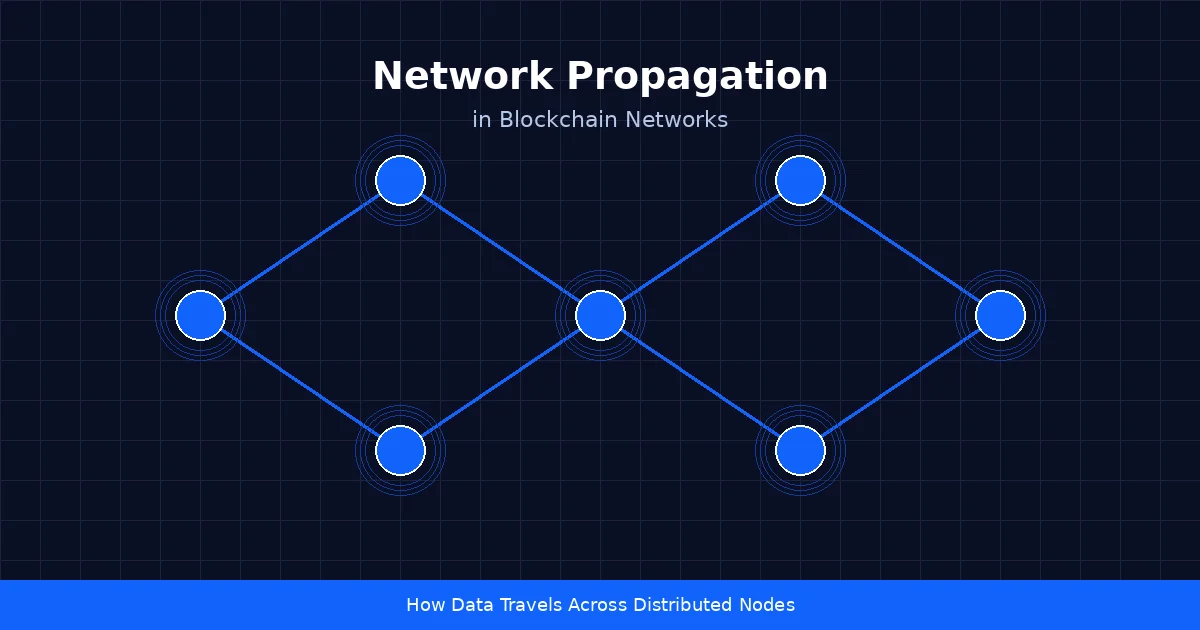
Before we get into the updates, let us make sure we are all on the same page about what network propagation actually means.
In the simplest terms, network propagation is how information spreads across a blockchain network. When someone creates a transaction or when a miner or validator produces a new block, that piece of data needs to travel from its point of origin to every other node in the network. This process is called propagation. According to Wikipedia’s explanation of blockchain technology, a blockchain is a distributed ledger maintained by a network of nodes, and the integrity of this ledger depends on all nodes having access to the same data.
Think of it like a game of telephone, but one where accuracy actually matters. When Node A produces a new block, it sends that block to its connected peers. Those peers, in turn, forward the block to their own peers. This continues until the block has reached every node in the network. The speed and reliability of this chain of communication directly impact the blockchain’s performance.
There are two main types of data that propagate through a blockchain network: transactions and blocks. Transaction propagation happens when a user submits a new transaction. That transaction enters a memory pool (commonly called a mempool) and is broadcast to other nodes. Block propagation happens when a miner or validator creates a new block containing verified transactions. That block is then shared across the network for all nodes to validate and add to their local copy of the chain.
Efficient propagation is not a nice-to-have. It is a requirement for a functional blockchain. Slow propagation can cause competing blocks to be mined at the same time, leading to forks and wasted computational effort. It can also create security vulnerabilities, because if a large portion of the network has not received the latest block, an attacker could potentially exploit that delay. For a deeper understanding of how nodes maintain consistency, take a look at our piece on node synchronization in blockchain.
Why Network Propagation Matters More Than Ever in 2024
Several trends have made network propagation a bigger deal in 2024 than it was even a couple of years ago.
First, blockchain networks are handling far more transactions than before. Ethereum, for example, processes over a million transactions daily, and Layer 2 solutions built on top of it handle even more. Bitcoin’s network activity has also grown, especially with the rise of Ordinals and BRC-20 tokens. More transactions mean more data that needs to propagate, and if the propagation system cannot keep up, the network slows down for everyone.
Second, the number of nodes in major blockchain networks has increased. Bitcoin alone has over 15,000 reachable nodes as of 2024, and Ethereum has a similar number. More nodes mean more hops that data needs to make before it reaches every corner of the network. This puts additional pressure on propagation systems to be fast and efficient.
Third, enterprise adoption of blockchain technology is accelerating. Companies are building supply chain systems, financial settlement platforms, and data management solutions on blockchain infrastructure. These use cases demand high throughput and low latency, which are directly tied to how well the network propagation layer performs. If you are exploring enterprise use cases, our comprehensive enterprise blockchain applications guide covers the landscape in detail.
Fourth, there is increasing competition among blockchain platforms. Networks like Solana, Avalanche, and newer chains are marketing sub-second finality times. To deliver on those promises, their propagation systems need to be incredibly fast. This competitive pressure has driven significant research and development in propagation technology throughout 2024.
Update 1: Enhanced Propagation Protocols
The first and arguably most impactful update in 2024 has been the introduction of enhanced propagation protocols. These are the rules and methods that govern how nodes communicate and share data with each other. Getting these protocols right is foundational, because everything else depends on having a solid base layer of communication.
One of the biggest improvements has been the widespread adoption of compact block relay. This technique was originally proposed for Bitcoin as BIP 152, but the concept has been adapted and improved for use in other blockchain networks as well. The basic idea is simple but powerful. Instead of sending an entire block to a peer, a node sends a compact summary that includes short transaction identifiers. Since most nodes already have the transactions in their mempool, they can reconstruct the full block without needing to download all the data again. This reduces the amount of data transmitted by up to 90% in many cases.
Another significant protocol enhancement involves the use of erasure coding. This is a technique borrowed from data storage and telecommunications. In erasure coding, data is broken into fragments and additional redundant fragments are created. Even if some fragments are lost during transmission, the original data can be reconstructed from the remaining pieces. Several blockchain networks have started integrating erasure coding into their propagation protocols, which improves reliability without adding excessive bandwidth overhead.
There has also been progress in gossip protocol optimization. Most blockchain networks use some form of gossip protocol, where nodes randomly share information with their peers. In 2024, several networks have moved from simple random gossip to structured gossip approaches. These use information about network topology to route data more efficiently. Instead of broadcasting data blindly, nodes can prioritize sending information along paths that reach the most nodes with the fewest hops.
Comparison: Traditional vs. Enhanced Propagation Protocols
| Feature | Traditional Protocols | Enhanced Protocols (2024) |
|---|---|---|
| Block Relay Method | Full block transfer | Compact block relay with short IDs |
| Data Redundancy | Duplicate data sent repeatedly | Erasure coding reduces redundancy |
| Gossip Strategy | Random peer selection | Topology-aware structured gossip |
| Bandwidth Usage | High (full data per hop) | Reduced by up to 90% |
| Average Propagation Time | 6 to 15 seconds | Under 2 seconds |
These protocol-level changes may seem technical, but their real-world impact is substantial. Faster propagation means fewer orphan blocks, better security, and a smoother experience for users. For businesses building on blockchain, these improvements translate directly into more reliable applications and lower operational costs.
Update 2: Improved Data Syncing Mechanisms
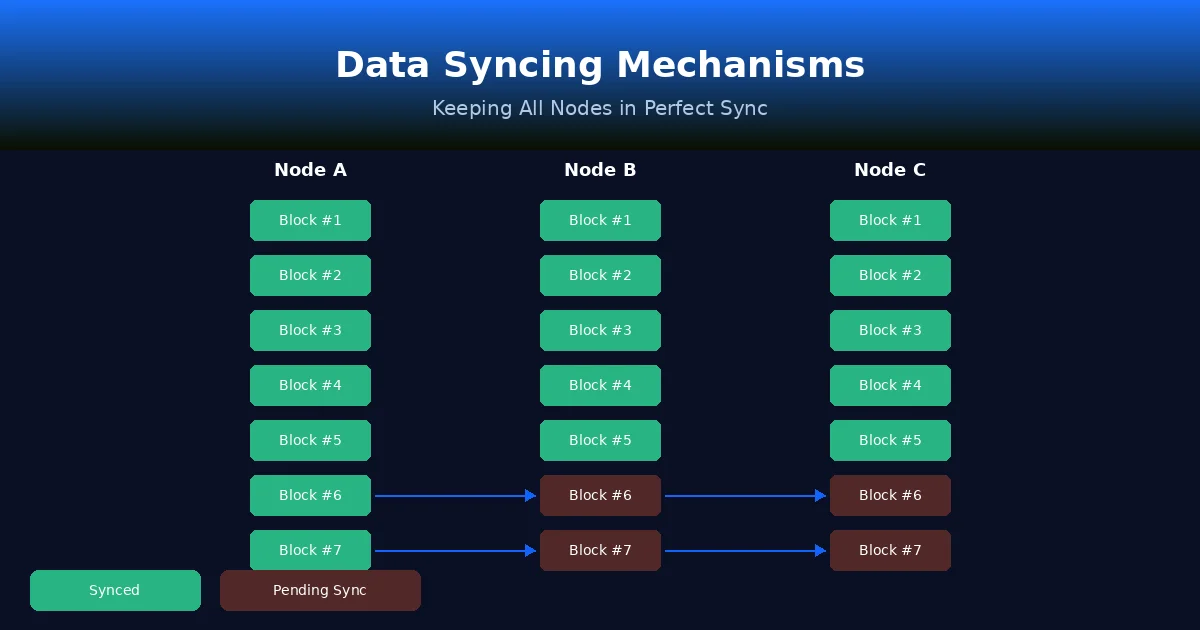
The second major update area for 2024 focuses on how nodes sync their data with the rest of the network. This is particularly important for new nodes joining the network or nodes that have been offline for a period of time. Getting up to speed quickly and accurately is critical for maintaining network health.
Historically, syncing a blockchain node from scratch has been a painful process. When Ethereum launched its Beacon Chain, for example, syncing a full node could take days or even weeks depending on your hardware and internet connection. In 2024, new syncing mechanisms have dramatically reduced this time.
One of the most important developments is the refinement of snap sync and state sync protocols. Rather than replaying every transaction from the genesis block, these methods allow nodes to download a snapshot of the current state and then catch up on only the most recent blocks. Ethereum’s snap sync, for example, can now get a node fully operational in a few hours rather than days. Other blockchain networks have adopted similar approaches, tailoring them to their specific architectures.
Another advancement is the use of incremental state updates. Instead of periodically downloading large state snapshots, nodes can receive small, frequent updates that represent only the changes since their last sync. This approach is more bandwidth-efficient and keeps nodes more consistently up to date. It is especially useful for networks with high transaction volumes, where the state changes rapidly.
Checkpoint-based syncing has also seen improvements. Networks now maintain verified checkpoints at regular intervals. When a node needs to sync, it can start from the nearest checkpoint rather than from the beginning, significantly reducing the amount of data it needs to process. This method works in tandem with the consensus mechanism to ensure that checkpoints are trustworthy and have not been tampered with.
For enterprise blockchains, where quorum-based consensus is common, these syncing improvements are especially valuable. In permissioned networks, nodes may go offline for maintenance or be added as the network grows. Having efficient syncing mechanisms ensures minimal disruption to the network’s operations.
The practical result of these improvements is that running a blockchain node is now more accessible than it has ever been. You no longer need enterprise-grade hardware and a week of patience to participate as a full node. This is good for decentralization, because more accessible node operation means more people can contribute to the network’s resilience and security.
Data Syncing Methods: A Quick Comparison
| Syncing Method | How It Works | Typical Sync Time | Bandwidth Cost |
|---|---|---|---|
| Full Sync (Legacy) | Replays every transaction from genesis block | Days to weeks | Very High |
| Snap Sync | Downloads state snapshot, then processes recent blocks | 2 to 6 hours | Moderate |
| Checkpoint Sync | Starts from a verified checkpoint | 30 min to 2 hours | Low to Moderate |
| Incremental State Updates | Receives only changes since last sync | Minutes (for returning nodes) | Low |
Optimize Your Blockchain Network Performance
Stay ahead of the curve with cutting-edge network propagation solutions. Build faster, more reliable, and scalable blockchain applications with expert guidance.
Update 3: Innovations in Latency Reduction
Latency, the time it takes for data to travel from one point to another, is one of the biggest bottlenecks in blockchain performance. Even small delays in propagation can cascade into significant problems at scale. In 2024, multiple approaches to latency reduction have moved from experimental to production-ready.
One of the most effective strategies has been optimizing network routing at the protocol level. Traditional blockchain networks often rely on the internet’s default routing, which is not always the fastest path between two points. Several blockchain projects have started using dedicated relay networks that maintain optimized connections between major node clusters around the world. These relay networks act as express lanes for blockchain data, bypassing the congestion and suboptimal routing of the general internet.
Data compression is another area where real progress has been made. Blockchain data, particularly transaction data, contains patterns that lend themselves well to compression. New compression algorithms designed specifically for blockchain data structures can reduce the size of transmitted data by 40% to 60% without any loss of information. Smaller data packets naturally travel faster across the network, directly reducing propagation latency.
Pipelining is a technique that has gained traction in 2024. Instead of waiting for an entire block to be assembled before starting to propagate it, pipelining allows nodes to begin sending block data in chunks as soon as it is available. This means the propagation process starts earlier and finishes sooner. The receiving node can begin validating the block while still receiving the remaining chunks, further reducing the total time from block creation to network-wide awareness.
Geographic distribution of relay nodes has also been a focus. By placing relay infrastructure in underserved regions, blockchain networks can reduce latency for nodes in those areas. This is not just about raw speed. It also improves fairness in the network, because miners or validators who happen to be located far from major node clusters are no longer at a significant disadvantage.
Latency Reduction: Before and After 2024 Optimizations
| Metric | Before (2023) | After (2024) | Improvement |
|---|---|---|---|
| Block Relay Time | 850 ms | 280 ms | 67% faster |
| Transaction Broadcast | 600 ms | 180 ms | 70% faster |
| Node Discovery | 1200 ms | 400 ms | 67% faster |
| State Sync | 2000 ms | 650 ms | 68% faster |
| Consensus Round | 500 ms | 150 ms | 70% faster |
The combined effect of these latency reduction techniques is meaningful. Networks that have adopted them report propagation times that are 60% to 70% faster compared to the previous year. For end users, this means faster transaction confirmations. For developers, it means they can build applications that require near-real-time responses without worrying about propagation delays undermining their designs.
Update 4: Managing High Transaction Volumes
Blockchain networks in 2024 are handling transaction volumes that would have been unimaginable just a few years ago. The challenge is not just processing these transactions, but propagating them efficiently across the network so that every node stays in sync without being overwhelmed.
One of the key innovations in this area is the use of transaction batching at the propagation level. Instead of broadcasting each transaction individually as soon as it is received, nodes now group transactions into batches and propagate them together. This reduces the overhead associated with each individual transmission and makes more efficient use of network bandwidth. The trick is finding the right batch size. Too small, and you lose the efficiency gains. Too large, and you introduce unnecessary delays. Networks have been tuning these parameters based on real-world traffic patterns throughout 2024.
Another approach to managing high volumes is the implementation of priority-based propagation. Not all transactions are equally urgent. A time-sensitive DeFi trade, for instance, needs to reach validators faster than a routine token transfer. Priority-based systems assign urgency levels to transactions and allocate propagation resources accordingly. This ensures that critical transactions get through quickly even during periods of heavy network congestion.
Sharding, while primarily a scaling solution at the consensus and execution layers, also has significant implications for propagation. By dividing the network into smaller groups called shards, the amount of data that any single node needs to propagate and receive is reduced. Each shard handles its own subset of transactions, and cross-shard communication is handled through a separate protocol. This approach is central to Ethereum’s long-term scaling roadmap and has been refined significantly in 2024. For related scaling approaches, you might find our article on Plasma in blockchain helpful, as it covers another layer of scaling that works alongside propagation improvements.
Adaptive mempool management is another development worth noting. As transaction volumes spike, the mempool, where unconfirmed transactions wait, can become bloated. Improved mempool management strategies introduced in 2024 include smarter eviction policies that remove stale or low-priority transactions, dynamic sizing that adjusts based on current network conditions, and better indexing for faster lookup and propagation of transactions from the pool.
Transaction Volume Management Techniques
| Technique | How It Works | Impact on Propagation |
|---|---|---|
| Transaction Batching | Groups multiple transactions into single transmissions | Reduces per-transaction overhead by 40 to 60% |
| Priority Propagation | Assigns urgency levels and allocates resources accordingly | Ensures time-sensitive data reaches validators faster |
| Network Sharding | Divides network into smaller groups handling subsets of data | Reduces per-node propagation load by orders of magnitude |
| Adaptive Mempool | Dynamically adjusts pool size and eviction policies | Prevents mempool bloat during traffic spikes |
These techniques are not mutually exclusive. Most modern blockchain networks use a combination of all four, adjusting the balance based on their specific architecture and traffic patterns. The result is that networks in 2024 can handle significantly higher transaction throughput without sacrificing propagation speed or reliability.
Update 5: Advanced Peer Discovery and Network Topology Optimization
The fifth major update area in 2024 might be the least talked about, but it is incredibly important. Peer discovery refers to how nodes find each other and establish connections on the network. The topology of these connections, meaning the pattern of who is connected to whom, has a massive impact on how quickly and reliably data propagates.
In earlier blockchain networks, peer discovery was relatively simple. Nodes would connect to a set of hardcoded seed nodes and then learn about other peers through the network. This worked fine for small networks, but it creates bottlenecks as the network grows. If most nodes learn about peers through the same seed nodes, the resulting topology can be unbalanced, with some nodes being highly connected while others are on the network’s periphery.
In 2024, several networks have adopted more sophisticated peer discovery mechanisms. Distributed hash table (DHT) based discovery, for example, allows nodes to find peers without relying on centralized seed nodes. Each node maintains a portion of a distributed directory, and lookups are routed through the network efficiently. This creates a more balanced topology where no single node is a critical point of failure.
Network topology optimization goes a step further. Rather than just finding peers randomly, nodes can now make intelligent decisions about which peers to connect to based on factors like latency, geographic proximity, and network capacity. This results in a topology that is naturally optimized for fast propagation. A node in Singapore, for example, will prioritize connections to nearby nodes in Asia while maintaining some long-distance connections to ensure it stays well-connected to the global network.
The relationship between peer discovery and propagation is direct. A well-connected network with balanced topology can propagate data in fewer hops and with less latency than a poorly connected one. Research on peer-to-peer networking has consistently shown that the structure of the overlay network is one of the primary determinants of data dissemination performance.
Another development in this area is the use of reputation-based peering. Nodes track the performance of their peers, including factors like uptime, response time, and data accuracy. Over time, they preferentially connect to high-quality peers and reduce connections to underperforming ones. This self-optimizing approach means the network topology naturally improves over time without requiring manual intervention.
Sidechains and interoperability protocols have also influenced peer discovery in 2024. As blockchain ecosystems become more interconnected, nodes may need to discover and communicate with peers on multiple chains. New cross-chain peer discovery mechanisms allow nodes to maintain connections across different blockchain networks, facilitating faster propagation of cross-chain data. Our article on sidechain pegs in blockchain explores how these cross-chain connections work in practice.
The Network Propagation Life Cycle: From Transaction to Confirmation
Understanding how network propagation works as a complete process is helpful for seeing how all five updates fit together. Here is a step-by-step look at the life cycle of a transaction as it propagates through a blockchain network in 2024, incorporating all the improvements we have discussed.
Each step in this life cycle has been touched by the 2024 updates we have covered. The result is a propagation process that is faster, more reliable, and more efficient than anything we have seen in previous years.
Real-World Impact: How These Updates Affect Different Blockchain Use Cases
It is one thing to talk about propagation improvements in technical terms. It is another to see how they actually affect real-world blockchain applications. Let us look at a few concrete examples.
Decentralized Finance (DeFi): In DeFi, transaction speed is directly tied to profitability. A trade that executes even a second late can mean the difference between profit and loss. The latency reduction innovations of 2024 have been particularly beneficial for DeFi platforms, where faster propagation means more accurate pricing, less slippage, and fewer opportunities for front-running attacks. DeFi protocols built on networks with optimized propagation have reported measurably better execution for their users.
Supply Chain Management: Enterprises using blockchain for supply chain tracking need all participants to have access to the same data at the same time. Improved data syncing mechanisms ensure that when a shipment status is updated on one node, every other node in the supply chain network is updated within seconds rather than minutes. This level of consistency is critical for maintaining accurate records and avoiding disputes.
Gaming and NFTs: Blockchain-based games and NFT marketplaces generate enormous numbers of small transactions. The high-volume management techniques, including transaction batching and priority propagation, allow these platforms to handle peak loads without degrading the user experience. A player purchasing an in-game item should not have to wait 30 seconds for the transaction to propagate. In 2024, with optimized propagation, these transactions are confirmed in near real-time.
Cross-Chain Bridges: As the blockchain ecosystem becomes more multi-chain, the ability to propagate data across different networks becomes critical. The advanced peer discovery mechanisms in 2024 support cross-chain communication, allowing bridges and interoperability protocols to function more reliably. This is an area where propagation improvements have a multiplier effect, because faster cross-chain communication enables faster asset transfers, more efficient liquidity routing, and better user experiences across the entire multi-chain ecosystem.
How Major Blockchain Networks Compare on Propagation in 2024
| Network | Avg. Block Propagation | Compact Block Relay | Priority Propagation | Sharding |
|---|---|---|---|---|
| Bitcoin | ~1.5 seconds | Yes (BIP 152) | Fee-based | No |
| Ethereum | ~400 ms | Yes | Yes (EIP-4844) | In Progress |
| Solana | ~200 ms | Turbine Protocol | Yes | Not Required |
| Avalanche | ~250 ms | Custom Protocol | Subnet-based | Subnet Architecture |
This comparison illustrates that different networks take different approaches to solving the same fundamental problem. There is no single “best” approach. The right solution depends on the network’s specific architecture, consensus mechanism, and intended use cases. What is clear, though, is that every major network is investing heavily in propagation improvements in 2024.
What This Means for Developers and Businesses
If you are a developer building on blockchain, the propagation updates of 2024 have practical implications for your work. Faster propagation means you can design applications that assume lower latency. Priority-based propagation means you can flag urgent transactions in your application logic. Better syncing means your nodes will be easier to deploy and maintain.
For businesses, these updates mean that blockchain solutions are now more viable for use cases that previously seemed impractical due to speed or reliability concerns. If you explored blockchain a few years ago and decided it was too slow for your needs, it might be worth taking another look. The infrastructure has improved significantly.
Working with an experienced blockchain based company that understands these propagation updates can make a significant difference in the success of your project. The gap between a blockchain application built with outdated assumptions about network performance and one built with current best practices can be substantial.
It is also worth considering how these updates interact with each other. Enhanced protocols, improved syncing, latency reduction, volume management, and better peer discovery are not isolated improvements. They reinforce each other. A network with optimized topology, for example, benefits more from compact block relay because the data reaches more nodes in fewer hops. Similarly, priority propagation works better when the underlying latency is already low. The compounding effect of all five updates together is greater than the sum of their individual contributions.
Looking Ahead: What to Expect Beyond 2024
While this article focuses on 2024 updates, it is worth briefly looking at where network propagation is headed. Several areas of active research are likely to produce further improvements in the coming years.
Machine learning-driven propagation is one exciting frontier. By analyzing historical propagation patterns, ML models can predict optimal routing paths and preemptively position data where it will be needed. Early experiments have shown promising results, though production-ready implementations are still a year or two away.
Zero-knowledge proofs applied to propagation are another area of interest. By using ZK proofs, nodes could validate block summaries without needing to download and verify all the underlying transaction data. This could dramatically reduce the amount of data that needs to propagate while maintaining the same security guarantees.
Quantum-resistant propagation protocols are also being researched in anticipation of future quantum computing capabilities. While quantum computers are not yet a practical threat to blockchain security, building quantum-resistant protocols now ensures that blockchain networks will be ready when that threat materializes.
Build Faster, More Scalable Blockchain Solutions
Whether you need a custom blockchain network, a DeFi platform, or an enterprise solution, our team brings deep expertise in the latest propagation technologies to every project.
Network propagation is one of those foundational aspects of blockchain that does not get as much attention as flashy features like smart contracts or tokenomics. But without fast, reliable propagation, none of those higher-level features can function properly. The five updates we have covered in this article, enhanced protocols, improved syncing, latency reduction, high-volume management, and advanced peer discovery, represent a real step forward for the blockchain industry in 2024. They make networks faster, more secure, and better equipped to handle the growing demands of real-world applications. For businesses and developers looking to build on blockchain, understanding and leveraging these updates is not optional. It is essential for delivering solutions that meet the performance expectations of today’s users.
Frequently Asked Questions
Q1.What is network propagation in blockchain and why does it matter?
Network propagation in blockchain refers to the process of distributing transaction and block data across all nodes in a decentralized network. It matters because the speed and reliability of this distribution directly affect transaction confirmation times, network security, and overall blockchain performance. Slow propagation can lead to orphan blocks, increase the risk of double-spend attacks, and degrade the user experience. In 2024, with growing transaction volumes and enterprise adoption, efficient propagation has become essential for any blockchain network to remain competitive and functional.
Q2.How does compact block relay improve blockchain propagation speed?
Compact block relay works by sending a shortened summary of a block instead of the full block data. Since most receiving nodes already have the individual transactions in their local mempool, they can reconstruct the complete block using just the short transaction identifiers provided in the compact summary. This approach reduces the amount of data that needs to be transmitted by up to 90 percent, which significantly cuts down block propagation time. It was originally designed for Bitcoin under BIP 152 and has since been adapted by several other blockchain networks for their own propagation systems.
Q3.What are the main causes of latency in blockchain networks?
Latency in blockchain networks comes from several sources. Geographic distance between nodes means data takes time to physically travel across the internet. Suboptimal network routing can send data through longer paths than necessary. Large data payloads, such as full block transfers, consume more bandwidth and take longer to transmit. Network congestion during high-traffic periods slows everything down. Additionally, the processing time each node needs to validate incoming data before forwarding it to peers adds to overall latency. The 2024 propagation updates target all of these sources through relay networks, compression, and pipelining techniques.
Q4.How do blockchain networks handle high transaction volumes without slowing down?
Modern blockchain networks use several techniques to manage high transaction volumes. Transaction batching groups multiple transactions into single transmissions to reduce overhead. Priority-based propagation ensures that urgent transactions are processed first during congestion. Sharding divides the network into smaller groups that each handle a subset of transactions, reducing the load on individual nodes. Adaptive mempool management dynamically adjusts the transaction pool to prevent bloating. These techniques, especially when combined, allow networks to scale to thousands of transactions per second while maintaining propagation performance.
Q5.What role does peer discovery play in blockchain network propagation?
Peer discovery determines how nodes in a blockchain network find and connect to each other. The quality of these connections directly impacts propagation efficiency. If nodes are poorly connected or the network topology is unbalanced, data takes more hops and more time to reach all participants. Modern peer discovery uses distributed hash tables instead of centralized seed nodes, considers geographic proximity and connection quality when forming links, and implements reputation systems that prefer reliable peers. Good peer discovery creates a well-connected network where data can reach every node quickly and efficiently through fewer hops.
Q6.Can network propagation improvements affect the security of a blockchain?
Yes, network propagation improvements have a direct and positive effect on blockchain security. Faster propagation reduces the window of time in which an attacker could exploit information asymmetry, where some nodes have received new data and others have not. It also reduces the occurrence of orphan blocks, which can be exploited in certain attack scenarios. Better syncing mechanisms ensure all nodes are consistently up to date, making it harder for an attacker to introduce conflicting data. Improved peer discovery prevents network partitioning attacks where an attacker isolates a group of nodes to manipulate their view of the blockchain.
Explore Services
Related Services
Reviewed by

Aman Vaths
Founder of Nadcab Labs
Aman Vaths is the Founder & CTO of Nadcab Labs, a global digital engineering company delivering enterprise-grade solutions across AI, Web3, Blockchain, Big Data, Cloud, Cybersecurity, and Modern Application Development. With deep technical leadership and product innovation experience, Aman has positioned Nadcab Labs as one of the most advanced engineering companies driving the next era of intelligent, secure, and scalable software systems. Under his leadership, Nadcab Labs has built 2,000+ global projects across sectors including fintech, banking, healthcare, real estate, logistics, gaming, manufacturing, and next-generation DePIN networks. Aman’s strength lies in architecting high-performance systems, end-to-end platform engineering, and designing enterprise solutions that operate at global scale.