Ai Overview
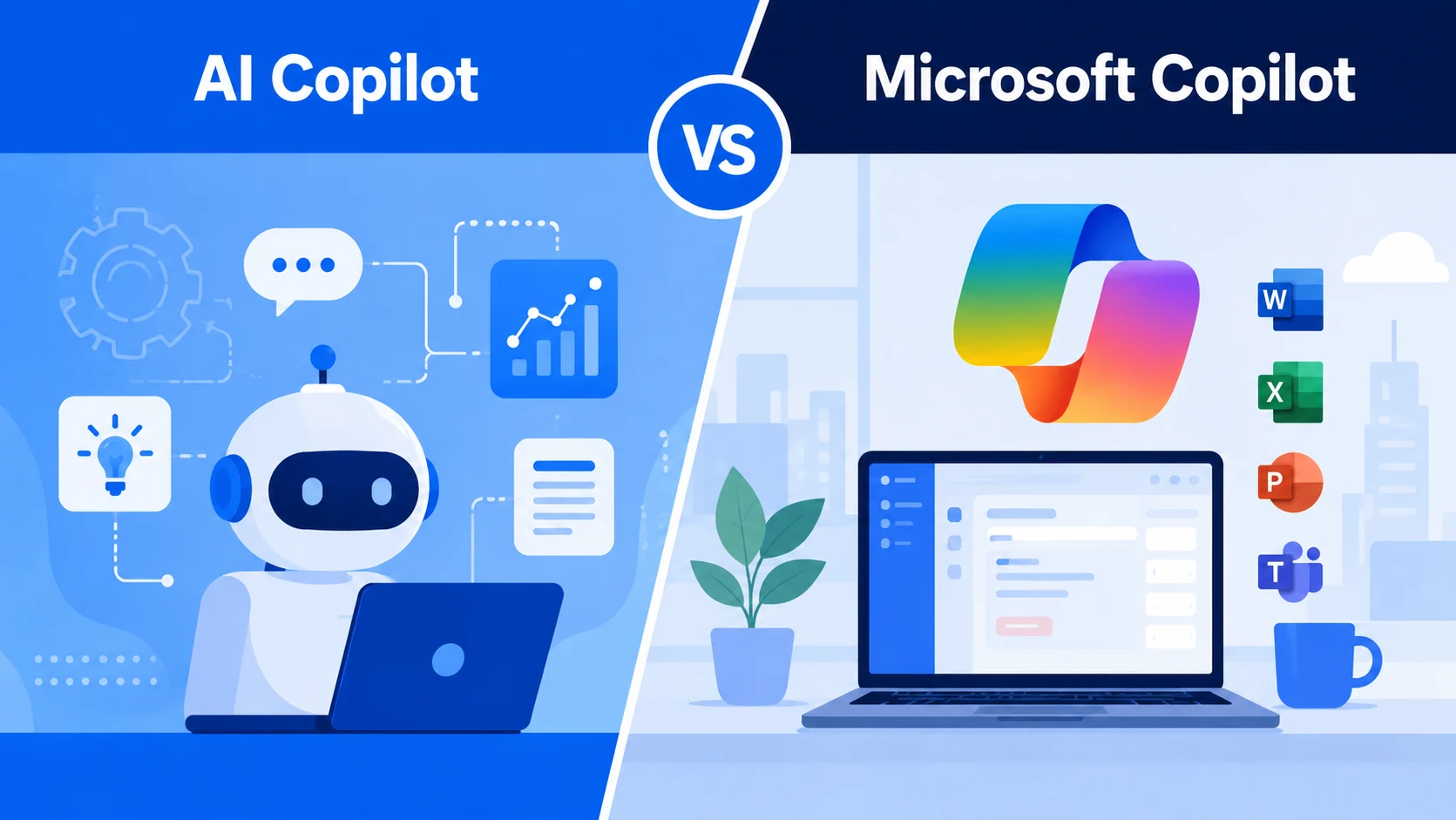
AI Copilot Security is the discipline of designing, implementing, and maintaining protective controls around AI-powered assistant systems that process, generate, or interact with sensitive organizational data. Unlike conventional software security, AI Copilot Security must address threats that emerge from the AI reasoning layer itself, not just the surrounding infrastructure.
Key Takeaways
- 01. AI Copilot Security integrates layered encryption, access controls, and real-time threat detection to safeguard sensitive enterprise data effectively.
- 02. Prompt injection and data leakage through AI outputs remain the highest-priority security vulnerabilities in modern AI Copilot systems globally.
- 03. Zero-trust architecture combined with least-privilege principles forms the strongest access control foundation in AI Copilot Security deployments.
- 04. Businesses in the US, UAE, and India must align their AI Copilot Security strategy with GDPR, DPDP Act, and UAE data protection frameworks.
- 05. AES-256 encryption at rest and TLS 1.3 in transit are the baseline encryption standards for any production AI Copilot Security implementation.
- 06. Continuous behavioral monitoring and anomaly detection reduce mean time to detect threats in AI Copilot environments by up to 70 percent.
- 07. Output filtering and semantic guardrails prevent AI Copilot systems from inadvertently exposing classified or confidential information in responses.
- 08. Secure data processing pipelines in AI Copilot workflows isolate sensitive computations and prevent cross-tenant data exposure in shared environments.
- 09. AI Copilot Security audits conducted quarterly help identify evolving vulnerabilities before attackers can exploit newly discovered AI-specific attack vectors.
- 10. The future of AI Copilot Security lies in federated learning, privacy-preserving computation, and autonomous threat response integrated at the model layer.
Across enterprise environments in the US, UAE, and India, artificial intelligence Copilot systems are rapidly becoming the operational backbone of modern organizations. They assist with decision-making, data analysis, customer engagement, and internal workflow automation at a scale that was previously unimaginable. However, this rapid adoption has brought AI Copilot Security to the center of every enterprise risk conversation.
Over the past eight years, our team has worked alongside enterprises across sectors including healthcare, finance, legal, and logistics to architect AI Copilot Security frameworks that hold up under real-world conditions. What we have observed consistently is that organizations which treat AI Copilot Security as an afterthought face compounding vulnerabilities that eventually result in data breaches, regulatory penalties, and reputational damage.
This guide breaks down every dimension of AI Copilot Security, from access controls and encryption to monitoring, compliance, and the future trajectory of secure AI workflows. Whether you are building, deploying, or auditing an AI Copilot system, this resource provides the depth and specificity your team needs.
What is AI Copilot Security in Modern Systems?
AI Copilot Security is the discipline of designing, implementing, and maintaining protective controls around AI-powered assistant systems that process, generate, or interact with sensitive organizational data. Unlike conventional software security, AI Copilot Security must address threats that emerge from the AI reasoning layer itself, not just the surrounding infrastructure.
Modern AI Copilot systems operate across three primary layers: the data ingestion layer, the model inference layer, and the output delivery layer. Each of these layers presents a distinct attack surface that requires dedicated security controls. AI Copilot Security frameworks address all three simultaneously, creating an end-to-end protection architecture that scales with the complexity of the enterprise environment.
Data Ingestion Layer
Controls what data enters the AI Copilot system, applying validation, sanitization, and classification before any processing begins.
Model Inference Layer
Protects the reasoning and generation process from prompt injection, adversarial inputs, and unauthorized model behavior during live operations.
Output Delivery Layer
Filters, validates, and audits AI-generated responses to prevent unintended disclosure of classified or regulated information before delivery.
In markets like India, where data localization requirements are tightening, and in the UAE, where free zone regulations govern cross-border data flows, AI Copilot Security frameworks must be jurisdiction-aware. US enterprises navigating HIPAA, SOC 2, and CCPA requirements similarly depend on AI Copilot Security to maintain compliance while scaling AI-assisted operations.
Why is Sensitive Data Protection Important in AI Copilot?
AI Copilot systems are uniquely positioned within the enterprise data ecosystem. They interact with HR records, financial data, legal documents, customer personally identifiable information, and strategic plans simultaneously. This broad data access makes sensitive data protection within AI Copilot Security not just a best practice but an operational necessity.
When sensitive data protection fails in an AI Copilot environment, the consequences are amplified compared to traditional software breaches. An AI Copilot system that has been compromised can actively generate outputs that expose sensitive information at scale, in natural language, to any user querying it. This creates a breach propagation risk that is fundamentally different from static data theft.
From a regulatory standpoint, India’s DPDP Act imposes significant financial penalties for mishandling personal data, including data processed through AI systems. Dubai’s DIFC Data Protection Law similarly holds organizations accountable for AI-assisted data handling. In the US, sector-specific regulations create a layered compliance burden that only a purpose-built AI Copilot Security framework can address comprehensively.
How AI Copilot Security Handles Sensitive Data Safely?
AI Copilot Security handles sensitive data through a structured pipeline that applies security controls at every stage of the data journey. This pipeline is not a single tool but a coordinated system of policies, technical controls, and human oversight mechanisms working together.
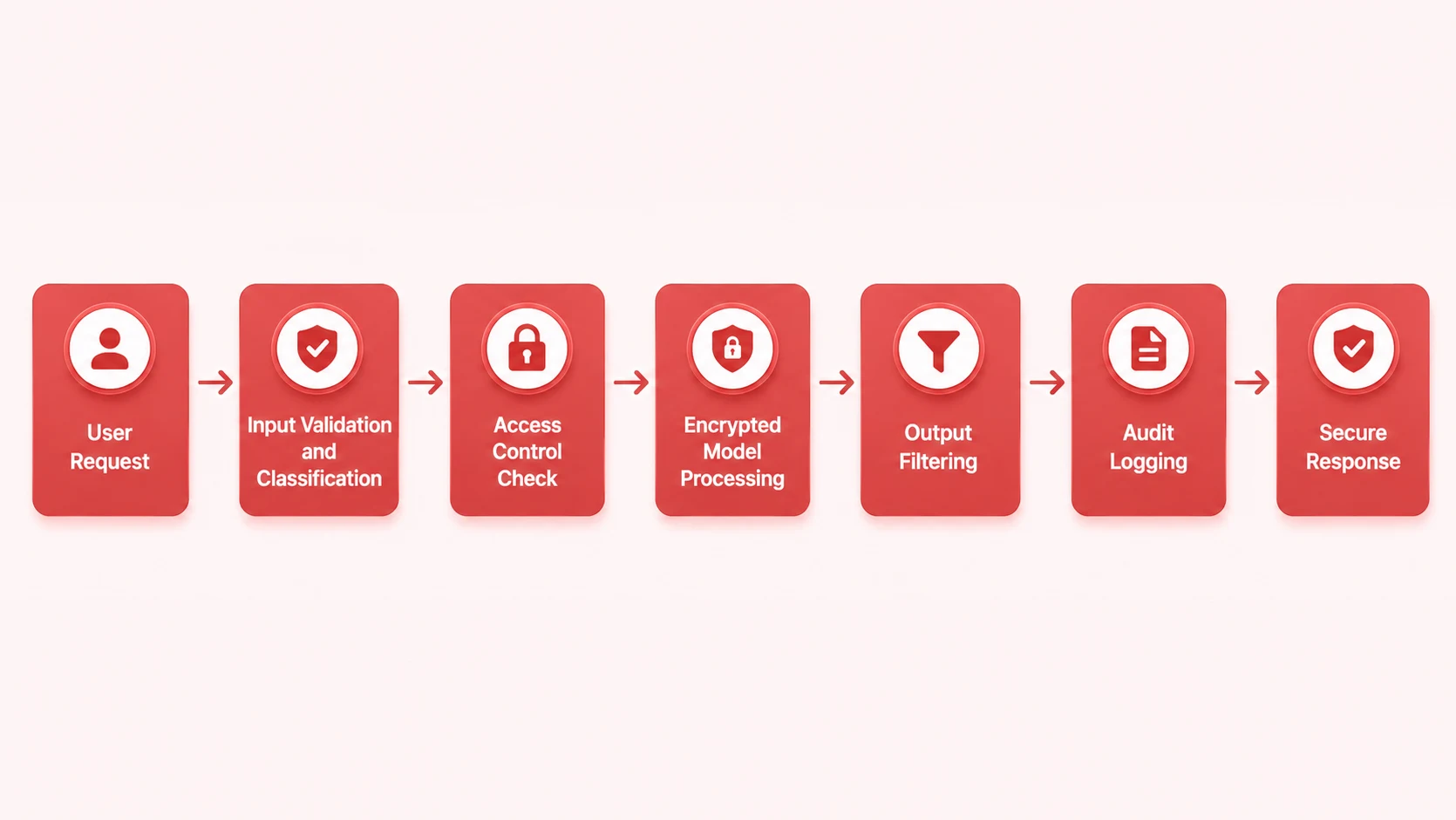
Each step in this pipeline carries specific security responsibilities. Input validation prevents malformed or malicious queries from reaching the model. Access control checks verify that the requesting user has clearance for the data scope implied by their query. Encrypted model processing ensures that inference computations cannot be intercepted or tampered with. Output filtering applies the final layer of data loss prevention before any response reaches the end user.
Audit logging is often underestimated in AI Copilot Security implementations, but it is critical. Every interaction with a sensitive data system must be recorded with sufficient granularity to support forensic investigation, compliance auditing, and behavioral analysis. Organizations in regulated industries across India, the UAE, and the US cannot afford to operate AI Copilot systems without comprehensive audit trails.
Common AI Copilot Security Risks in Modern Systems
Understanding the risk landscape is the first step in building an effective AI Copilot Security posture. After eight years of auditing and securing AI systems across enterprise environments, our team has identified six categories of risk that appear consistently, regardless of industry or geography.
Prompt Injection Attacks
Attackers embed malicious instructions within user inputs to override system prompts and manipulate AI Copilot behavior, potentially extracting restricted data or bypassing access rules entirely.
Data Leakage Through Outputs
AI Copilot systems can inadvertently include sensitive information from training data or retrieval contexts within generated responses, exposing regulated or classified data to unauthorized users.
Insecure Third-Party Integrations
AI Copilot tools connected to external APIs, databases, or plugins inherit those systems’ vulnerabilities. Weak integration security creates backdoor access paths into otherwise protected AI Copilot environments.
Misconfigured Access Permissions
Overly permissive access configurations allow users to query data beyond their authorization scope. In AI Copilot systems, a single misconfiguration can expose entire datasets through natural language queries.
Model Poisoning and Manipulation
Adversaries who gain access to the training or fine-tuning pipeline can introduce biased or malicious behavior into the model itself, creating persistent AI Copilot Security vulnerabilities that survive standard patching.
Insufficient Audit and Logging
Without comprehensive audit trails, security teams cannot detect anomalous patterns or reconstruct breach timelines. This gap makes AI Copilot Security incidents far harder to contain and remediate effectively.
A recent analysis by cybersecurity researchers highlights that prompt injection remains the most underestimated AI Copilot Security vulnerability in enterprise deployments globally.[1] Organizations in India and the UAE, where AI adoption is accelerating rapidly, face heightened exposure as AI Copilot systems are deployed faster than security frameworks can mature.
Data Access Control in AI Copilot Security Systems
Data access control is the cornerstone of any functional AI Copilot Security implementation. Without granular, dynamic access control, every other security measure becomes significantly less effective. Our experience across enterprise deployments in the US, UAE, and India has shown that access control failures account for the majority of AI-related data exposure incidents.
Effective AI Copilot Security access control operates on the principle of least privilege. Each user, process, or integration receives only the minimum data access required to fulfill its specific function. When combined with zero-trust architecture, this principle ensures that no user or system component is implicitly trusted, regardless of their position within the network.
| Access Control Method | Description | Best For | Complexity |
|---|---|---|---|
| Role-Based Access Control | Assigns permissions based on predefined user roles within the organization | Mid-size enterprises with defined org structures | Low |
| Attribute-Based Access Control | Evaluates multiple attributes including user context, data sensitivity, and environment | Complex regulated environments in US and UAE | High |
| Zero-Trust Architecture | Verifies every request continuously regardless of network location or prior authentication | High-security AI Copilot deployments at scale | High |
| Policy-Based Access Control | Applies organizational policy rules dynamically to govern data access decisions in real time | Compliance-driven organizations in India | Medium |
Implementing dynamic access control in AI Copilot Security requires integration between the identity provider, the AI system’s context layer, and the data access gateway. When a user queries an AI Copilot system, the access control layer must evaluate the query scope in real time and restrict the model’s retrieval to only the data that user is authorized to access. This prevents horizontal privilege escalation through natural language queries.
Encryption Methods Used in AI Copilot Security
Encryption is the technical backbone of AI Copilot Security. It ensures that sensitive data cannot be read or exploited even if it is intercepted or accessed without authorization. Effective AI Copilot Security implementations apply encryption at multiple points across the data lifecycle, not just at a single layer.
Encryption Architecture in AI Copilot Security
For organizations in the UAE operating under DIFC or ADGM regulations, and those in India complying with the DPDP Act, implementing all four encryption layers is not optional. US enterprises under HIPAA or CMMC requirements similarly face audit requirements that demand documented encryption controls across every data state within their AI Copilot Security architecture.
Is Your AI Copilot Security Framework Enterprise-Ready?
Our team audits, architects, and implements AI Copilot Security systems for enterprises across the US, UAE, and India. Get a security assessment today.
Preventing Data Leakage in AI Copilot Systems
Data leakage prevention in AI Copilot Security requires a different approach than traditional Data Loss Prevention tools. Because the leakage vector is the AI system’s generated output rather than a file transfer or email attachment, conventional DLP solutions are largely ineffective without AI-specific extensions.
Effective AI Copilot Security implements data leakage prevention at three distinct points: before the model processes the query, during output generation, and at the point of delivery. Each intervention point targets a different leakage mechanism and requires different technical controls.
Secure Data Processing in AI Copilot Workflows
Secure data processing within AI Copilot Security addresses how the system handles data during active computation. This is the stage of the AI Copilot workflow where vulnerabilities are most difficult to detect and most costly to exploit. Securing this stage requires both architectural decisions and runtime controls.
The most critical principle in secure AI Copilot processing is data isolation. In multi-tenant environments, where multiple organizations or departments share the same AI Copilot infrastructure, strict isolation prevents cross-tenant data contamination. This is particularly relevant for AI Copilot Security in cloud-hosted environments used by enterprises in Dubai and US cloud regions.
Secure Processing Workflow in AI Copilot Security
Memory management is another critical component of secure AI Copilot processing. AI Copilot systems that retain session data or conversation context across user sessions create a risk that data from one user’s session can influence or appear in another’s. AI Copilot Security best practice mandates session-scoped memory with cryptographic purging after each interaction concludes.
Monitoring and Threat Detection in AI Copilot Systems
Monitoring is what separates reactive AI Copilot Security from proactive AI Copilot Security. Organizations that wait for a breach notification before reviewing their AI Copilot system logs are already behind. Effective monitoring detects threats during their reconnaissance phase, long before any data is exfiltrated or exploited.
Modern AI Copilot Security monitoring combines traditional SIEM capabilities with AI-specific behavioral analytics. Standard log analysis looks for known attack signatures, while AI behavioral analytics identifies anomalous patterns in how users interact with the AI Copilot system, patterns that may indicate an attack in progress even if no known signature matches.
| Monitoring Type | What It Detects | Response Action | Detection Speed |
|---|---|---|---|
| Query Behavioral Analytics | Unusual query frequency, scope expansion, or off-hours access patterns | Session flagging and MFA re-authentication trigger | Real-time |
| Output Content Scanning | PII patterns, financial identifiers, or classified data in generated responses | Response suppression and security team alert | Real-time |
| API Integration Monitoring | Unexpected data requests from integrated third-party systems or plugins | Integration suspension and forensic logging | Near real-time |
| Model Drift Detection | Changes in model output distributions that may indicate poisoning or manipulation | Model rollback and integrity verification | Scheduled |
Threat Detection Effectiveness by Method
Compliance and Data Protection in AI Copilot Security
Regulatory compliance is not separate from AI Copilot Security; it is one of its primary drivers. Enterprises operating AI Copilot systems across multiple jurisdictions must navigate an increasingly complex web of data protection regulations, each with specific requirements for how AI systems may process, store, and disclose sensitive information.
Our eight years of experience working with regulated enterprises has shown that compliance-driven AI Copilot Security is both more rigorous and more effective than security programs driven purely by technical concerns. When legal accountability is attached to security failures, organizations invest more deeply in getting AI Copilot Security right from the start.
United States
AI Copilot Security must align with HIPAA for healthcare data, SOC 2 for cloud service providers, CCPA for California resident data, and CMMC for defense contractors. Each framework imposes specific audit and technical control requirements on AI systems handling regulated data.
UAE (Dubai)
The DIFC Data Protection Law 2020 and Abu Dhabi Global Market regulations govern AI Copilot Security for financial and professional services. Data residency requirements in UAE free zones create additional constraints on where AI inference and storage can be hosted.
India
India’s DPDP Act 2023 introduces consent-based data processing obligations that apply directly to AI Copilot systems collecting or using personal data. AI Copilot Security implementations in India must include consent management, purpose limitation controls, and data principal rights support.
The intersection of these regulatory frameworks means that multinational enterprises operating AI Copilot systems across the US, UAE, and India need a unified AI Copilot Security compliance architecture that satisfies the most stringent requirements of all three jurisdictions simultaneously. This typically involves data sovereignty controls, cross-border transfer agreements, and jurisdiction-aware data classification policies embedded directly into the AI Copilot Security infrastructure.
Future of AI Copilot Security in Modern Systems
The future of AI Copilot Security is defined by three converging trends: the shift toward privacy-preserving computation, the maturation of autonomous threat response systems, and the integration of security controls at the model architecture level rather than as external overlays.
Federated learning, which allows AI Copilot models to train on distributed data without centralizing it, represents the most significant near-term advance in AI Copilot Security architecture. By eliminating the central data aggregation step, federated approaches dramatically reduce the attack surface for sensitive data exposure during model training.
AI Copilot Security Roadmap
Organizations standardize on zero-trust access control, AES-256 encryption, and continuous output monitoring as the foundational layer of AI Copilot Security across enterprise deployments.
AI Copilot Security systems gain the ability to autonomously isolate compromised sessions, revoke access tokens, and trigger incident response workflows without human intervention, reducing mean time to respond from hours to seconds.
Homomorphic encryption and secure multi-party computation become practical at production scale, allowing AI Copilot systems to process sensitive data without ever decrypting it, fundamentally changing the AI Copilot Security threat model.
AI Copilot models are designed from the ground up with security properties baked into the weights and architecture rather than applied as external controls, making AI Copilot Security an intrinsic property of the model rather than a compliance layer.
Enterprises in the US, UAE, and India that invest in building adaptable AI Copilot Security frameworks today will be positioned to adopt these emerging capabilities without requiring complete architectural rebuilds. The organizations that treat AI Copilot Security as a foundational capability rather than a reactive function will maintain competitive advantage as the threat landscape evolves.
Build Your AI Copilot Security Architecture Today
Partner with our team of AI Copilot Security specialists to design and implement a secure, compliant, and scalable AI Copilot system for your enterprise. Trusted by organizations across the US, UAE, and India.
Frequently Asked Questions
Q1.1.What is AI Copilot Security and why does it matter for businesses today?
AI Copilot Security refers to the set of protocols, policies, and technical safeguards that protect sensitive data processed by AI-powered assistant systems. It matters because businesses in the US, UAE, and India are increasingly relying on AI Copilot tools to handle confidential workflows, making robust security non-negotiable.
Q2.2. How does AI Copilot Security protect sensitive customer data from unauthorized access?
AI Copilot Security uses layered access controls, role-based permissions, and encrypted data pipelines to ensure that only authorized users can interact with sensitive customer information. These measures prevent unauthorized exposure during AI-assisted operations across enterprise environments.
Q3.3. What are the biggest AI Copilot Security risks organizations face in 2025 and 2026?
The biggest AI Copilot Security risks include prompt injection attacks, data leakage through model outputs, insecure third-party integrations, and misconfigured access permissions. Organizations in high-regulation sectors across the US, Dubai, and India are particularly exposed without proper AI Copilot Security frameworks in place.
Q4.4. Is AI Copilot Security compliance-ready for regulations like GDPR, DPDP, and UAE data laws?
Yes, a well-architected AI Copilot Security system is built with compliance in mind. It aligns with frameworks such as GDPR for European data, India’s DPDP Act, and UAE’s data protection regulations, ensuring organizations can operate AI Copilot systems without violating cross-border data sovereignty rules.
Q5.5. How does AI Copilot Security handle data encryption for sensitive information at rest and in transit?
AI Copilot Security applies AES-256 encryption for data at rest and TLS 1.3 protocols for data in transit. This dual-layer encryption approach ensures that sensitive information processed through AI Copilot workflows remains protected from interception or unauthorized extraction throughout its lifecycle.
Q6.6. Can AI Copilot Security prevent data leakage during AI-generated responses or outputs?
AI includes output filtering mechanisms, semantic guardrails, and response validation layers that actively scan AI-generated content before delivery. These controls significantly reduce the risk of unintentional data leakage occurring when the AI Copilot generates responses from sensitive internal datasets.
Q7.7. What role does monitoring play in maintaining AI Security across enterprise systems?
Continuous monitoring is central to AI Copilot Security. Real-time threat detection tools track anomalous query patterns, unauthorized data requests, and suspicious access behaviors. This proactive monitoring approach helps security teams in enterprises across India, the US, and UAE identify and neutralize threats before they escalate.
Q8.8. How is AI Copilot Security different from general cybersecurity practices in traditional software?
Security addresses unique challenges not found in traditional software security, including model hallucination risks, prompt manipulation, and AI-specific data exposure vectors. Unlike conventional cybersecurity, AI Copilot Security must protect both the underlying data and the AI reasoning process itself.
Q9.9. What access control methods are most effective in AI Copilot Security systems?
The most effective access control methods in AI Copilot Security include zero-trust architecture, attribute-based access control, multi-factor authentication, and least-privilege principles. These methods ensure that AI Copilot systems only expose the minimum necessary data to each verified user or role within the organization.
Q10.10. How should businesses in India, the US, and UAE start implementing AI Copilot Security?
Businesses should begin with a comprehensive AI Copilot Security audit to identify data exposure points, followed by deploying role-based access controls and encryption standards. Partnering with experienced AI security specialists familiar with local regulations in India, the US, and UAE ensures a compliant and resilient AI Copilot Security posture from day one.
Explore Services
Related Services
Reviewed by

Aman Vaths
Founder of Nadcab Labs
Aman Vaths is the Founder & CTO of Nadcab Labs, a global digital engineering company delivering enterprise-grade solutions across AI, Web3, Blockchain, Big Data, Cloud, Cybersecurity, and Modern Application Development. With deep technical leadership and product innovation experience, Aman has positioned Nadcab Labs as one of the most advanced engineering companies driving the next era of intelligent, secure, and scalable software systems. Under his leadership, Nadcab Labs has built 2,000+ global projects across sectors including fintech, banking, healthcare, real estate, logistics, gaming, manufacturing, and next-generation DePIN networks. Aman’s strength lies in architecting high-performance systems, end-to-end platform engineering, and designing enterprise solutions that operate at global scale.