Ai Overview
To understand what is sql injection, consider this: every time a user interacts with a banking app, the app communicates with a backend database using Structured Query Language (SQL). Databases hold everything: account balances, personal identification numbers, loan data, transaction logs, and identity information for millions of customers. The breach impacted hundreds of organizations, with per-record costs estimated at $165 and total damages reaching billions.
Key Takeaways
- ✓A single SQL injection attack can bypass banking authentication and expose millions of customer records within minutes using automated tools.
- ✓SQL injection remains the top OWASP-listed vulnerability exploited in banking apps across India, UAE, and global financial institutions today.
- ✓Banking data breach incidents driven by malicious SQL queries expose account numbers, passwords, PII, and sensitive transaction data simultaneously.
- ✓Database authentication flaws in legacy banking systems are frequently targeted as the easiest entry points for SQL injection attack campaigns.
- ✓Input validation security failures in web forms and API endpoints are the leading cause of successful SQL injection in financial platforms worldwide.
- ✓The average cost of a banking data breach caused by SQL injection can reach hundreds of millions due to regulatory fines, legal costs, and customer loss.
- ✓Secure coding practices including parameterized queries and prepared statements are the most effective SQL injection prevention techniques available today.
- ✓Blind SQL injection attacks on banking apps often go undetected for months as they leave minimal traces in standard server logs and monitoring systems.
- ✓OWASP SQL injection risks have been documented for over two decades, yet banking sector vulnerabilities continue to appear in new platform releases.
- ✓Banks in India and UAE must comply with strict cybersecurity mandates that require continuous testing and SQL injection prevention as part of their security programs.
Imagine a scenario: a hacker types a few crafted characters into a banking app login field, and within minutes, millions of customer records are flowing out of the database into their hands. This is not a hypothetical. It is the real, repeatable consequence of a successful SQL injection attack on a banking platform. Over our 8+ years of working with financial software platforms across India, the UAE, and global markets, we have seen firsthand how data theft in banking repeatedly traces back to this one exploitable flaw.
The threat is not theoretical. Banking cybersecurity threats are evolving fast, yet SQL injection attack patterns remain disturbingly consistent. This guide breaks down exactly how it works, what gets exposed, and what banks must do to protect their customers and their reputation.
What is SQL Injection and Why Does It Matter in Banking?
To understand what is sql injection, consider this: every time a user interacts with a banking app, the app communicates with a backend database using Structured Query Language (SQL). When input fields are not properly secured, an attacker can insert malicious SQL queries into those fields, tricking the database into executing commands it was never supposed to run.
In banking, the stakes are extraordinarily high. Databases hold everything: account balances, personal identification numbers, loan data, transaction logs, and identity information for millions of customers. A successful SQL injection attack does not just steal a few passwords. It can hand an attacker the keys to an entire banking infrastructure. That is why what is sql injection awareness is considered a foundation of any serious web application security program in the financial sector.
Authentication Bypass
Attackers skip login entirely using database authentication flaws
Mass Data Extraction
Millions of customer banking records dumped in one query
System Manipulation
Unauthorized database access enables data modification and deletion
How Banking Apps Store and Manage Customer Records?
Modern banking apps rely on relational databases like MySQL, Oracle, Microsoft SQL Server, and PostgreSQL to store customer banking records. These databases are organized into tables: one for account holders, another for transactions, one for loan data, and so on. Every time a customer logs in, transfers money, or checks a balance, the app fires an SQL query to retrieve or update the right data.
The problem is scale and centralization. A single banking database can hold records for 10 million, 50 million, or even 100 million customers. All of that data is connected, relational, and accessible through query logic. When database security vulnerabilities exist in the query layer, the entire data store becomes accessible from a single entry point. This centralized structure is precisely what makes SQL injection in banking so catastrophic when it succeeds.
The Weak Points in Banking Apps That Invite SQL Injection
Not all banking platforms are equally vulnerable, but many share common weak points that invite SQL injection attacks. Our team has assessed dozens of financial platforms across India and the UAE, and the same database security vulnerabilities appear repeatedly. These are the most common attack surfaces:
Login Forms
Username and password fields with missing input validation security allow raw SQL characters to pass into backend queries unfiltered.
Search and Filter APIs
Transaction search tools that accept date ranges or keyword filters often construct SQL queries dynamically without sanitizing the input, creating injection points.
URL Parameters
Banking portals that pass account IDs or transaction references directly in URLs are highly susceptible to SQL injection attack through parameter manipulation.
Third-Party Integrations
Payment gateways, KYC verification systems, and third-party credit check modules with poor secure coding practices introduce injection risk into otherwise hardened banking apps.
Legacy Backend Systems
Older banking core systems often lack modern parameterized query support, leaving exposed endpoints that were never designed to handle web application security threats.
Mobile App Backends
REST APIs powering mobile banking apps often pass user inputs directly to database queries, especially in rapidly built fintech platforms that prioritize speed over security.
How a SQL Injection Attack Actually Works Step by Step?
Understanding exactly how a SQL injection attack unfolds makes it easier to appreciate why it is so dangerous in a banking context. The process is methodical, and in many cases, automated tools reduce the time from discovery to full data extraction to under an hour.
Target Identification
The attacker identifies a banking app with user-facing input fields: a login page, a statement search bar, or a URL with dynamic parameters. Automated scanners like sqlmap probe these for SQL injection vulnerabilities in seconds.
Injection Point Testing
The attacker inserts basic SQL characters like a single quote ' or a double dash -- into input fields. An error message or unexpected behavior in the response reveals that the app is building SQL queries from raw user input, confirming the vulnerability.
Malicious Query Crafting
The attacker crafts malicious SQL queries designed to manipulate the original query logic. A classic login bypass uses input like ' OR '1'='1, which tricks the database authentication into returning a valid session for any user.
Schema Reconnaissance
Using UNION-based SQL injection, the attacker queries system tables to map out the database schema: table names, column names, and data types. This tells them exactly where customer banking records live within the database.
Mass Data Extraction
With the schema mapped, the attacker runs bulk SELECT queries or uses automated data dump tools to extract entire tables of sensitive financial information: names, account numbers, passwords, and transaction histories at scale.
Exfiltration and Cover-Up
Stolen data is transferred to external servers. Sophisticated attackers also modify logs, add backdoor accounts, or stage the attack to look like normal traffic, making detection significantly harder for banking cybersecurity teams.
How One SQL Injection Can Expose Millions of Banking Records in Minutes?
The speed at which a SQL injection attack can scale is what makes it uniquely devastating in banking. Unlike targeted phishing attacks that steal one account at a time, a SQL injection attack targets the database itself, where all records are stored together. Once an attacker gains unauthorized database access through a single vulnerable endpoint, the entire record set is within reach.
Consider a banking platform that stores 30 million customer records in a central database. A single UNION-based injection on a poorly secured transaction search API can return all rows from the customers table in one query response. Automated tools can then paginate through millions of records in minutes, extracting names, account numbers, hashed passwords, dates of birth, and contact information faster than any human analyst could detect the anomalous traffic.
The Speed of a SQL Injection Attack on Banking Data
This is why OWASP SQL injection risks consistently rank at the top of the financial sector threat landscape. The attack requires minimal skill with modern automation tools, targets the most valuable data a bank holds, and can be completed before any alert reaches a human security analyst.
What Kind of Data Gets Exposed in a Banking Breach?
The financial data exposure resulting from a successful SQL injection attack is rarely limited to one data type. Banking databases are relational: accounts are linked to transactions, which are linked to personal profiles, which are linked to loan records. Pulling one table often gives access to all of them through foreign key relationships.
| Data Category | Examples of Sensitive Financial Information | Risk Level |
|---|---|---|
| Identity Data | Full name, date of birth, Aadhaar / Emirates ID numbers, address | Critical |
| Authentication Data | Hashed or plaintext passwords, PINs, security question answers | Critical |
| Account Data | Account numbers, IFSC codes, IBAN, routing numbers, balance info | Critical |
| Card Data | Card numbers, CVV data, expiry dates, billing addresses | Critical |
| Transaction Data | Payment histories, merchant names, timestamps, transfer amounts | High |
| Loan and Credit Data | Credit scores, loan amounts, repayment schedules, collateral data | High |
Real Banking Breaches That Started With SQL Injection
The history of cyberattack on banks is well-documented, and SQL injection features prominently in the timeline. These are not isolated incidents. They form a pattern that financial institutions in India, the UAE, and globally have repeatedly failed to break.
How Far One Breach Can Spread Across a Banking System?
A SQL injection attack rarely stops at one database table or one customer segment. Banking systems are deeply interconnected. Once unauthorized database access is achieved, the lateral spread potential is enormous. Here is how a single breach escalates:
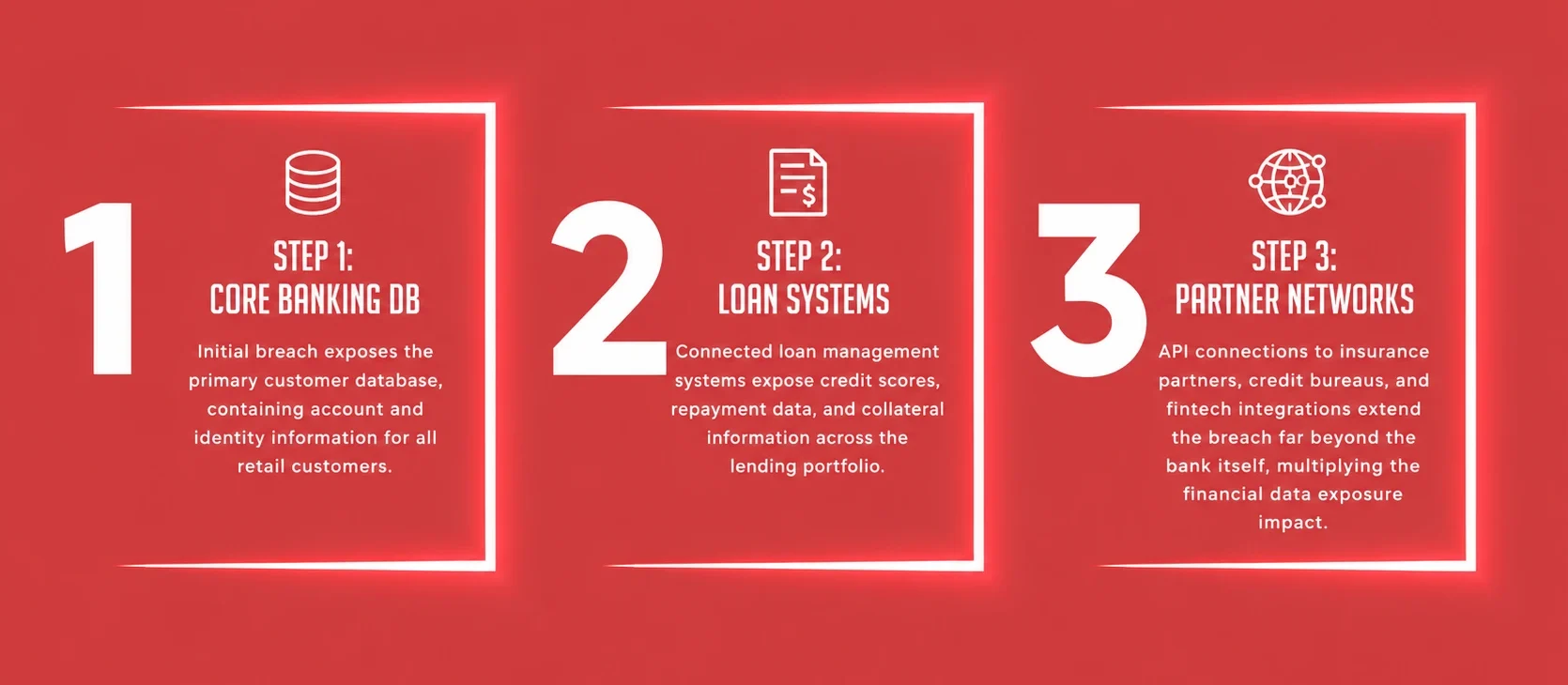
Step 1: Core Banking DB
Initial breach exposes the primary customer database, containing account and identity information for all retail customers.
Step 2: Loan Systems
Connected loan management systems expose credit scores, repayment data, and collateral information across the lending portfolio.
Step 3: Partner Networks
API connections to insurance partners, credit bureaus, and fintech integrations extend the breach far beyond the bank itself, multiplying the financial data exposure impact.
The cascade effect of a single SQL injection attack in a large banking system can ultimately compromise data across subsidiaries, partner institutions, and even regulatory reporting systems, turning a web application security failure into a systemic financial sector incident.
Why SQL Injection in Banking is Harder to Detect Than You Think?
Many banking cybersecurity teams assume they will catch a SQL injection attack quickly. The reality is far more challenging. Attackers who understand banking systems design their malicious SQL queries to look like legitimate database traffic, making them extremely difficult to distinguish from normal application behaviour.
Blind Injection Detection Gap
Blind SQL injection attacks infer data through boolean or time-based responses, generating no obvious error messages or large data dumps that would trigger standard security alerts.
Log Masking Techniques
Attackers use URL encoding, comment insertion, and whitespace manipulation to obfuscate malicious SQL queries from signature-based Web Application Firewall rules and log analysers.
Slow Extraction Timing
Advanced attackers slow down extraction to match normal traffic volumes, stretching a full database dump over days or weeks to avoid triggering bandwidth or rate-based anomaly detection systems.
The absence of immediate signals is exactly what allows data theft in banking to go unnoticed. Industry reports show that the average time between a breach occurring and its discovery in the financial sector is often measured in weeks, during which time attackers have unrestricted access to sensitive financial information.
The Human and Financial Cost of Exposed Banking Records
Behind every statistic about a banking data breach are real people who face identity theft, financial loss, and psychological distress. The human cost of a SQL injection attack on a bank extends far beyond the immediate technical incident, rippling outward into customers’ lives for years after the breach occurs.
| Cost Category | Impact on Bank | Impact on Customer |
|---|---|---|
| Regulatory Fines | RBI, SEBI, CBUAE penalties running into crores / millions of dirhams | Indirect impact through reduced service quality or bank instability |
| Fraud and Identity Theft | Reimbursement costs for fraudulent transactions and liability exposure | Unauthorized withdrawals, fake loan applications, credit score damage |
| Legal Costs | Class action lawsuits, compliance audits, and external investigation fees | Time and cost of filing complaints and seeking legal recourse |
| Reputational Damage | Customer churn, reduced deposit growth, negative media coverage globally | Loss of trust in digital banking, increased anxiety about online transactions |
| Remediation Costs | Emergency patching, security audits, system rebuilds, and reissuing millions of cards | Service disruptions during emergency maintenance periods |
How Banks Can Prevent SQL Injection Before It Causes Damage?
SQL injection prevention is not a luxury for banking platforms. It is a non-negotiable baseline security requirement. The good news is that the techniques to prevent SQL injection are well-understood and widely available. What is missing in many institutions is the consistent application of secure coding practices across every layer of their platform.
What Happens After Millions of Banking Records Are Exposed?
Once a banking data breach is confirmed, the bank enters a crisis response cycle that is both operationally exhausting and enormously expensive. The sequence of events following a major SQL injection attack reveals just how far-reaching the consequences of poor web application security can be.
Why SQL Injection Still Remains a Threat to Banking Apps Today?
Given that SQL injection has been on the OWASP Top 10 list for nearly two decades, one might reasonably ask: why is it still a problem in 2026? The answer is uncomfortable but important for any bank or fintech operating in India, the UAE, or anywhere globally. SQL injection persists because the conditions that enable it have not been eliminated.
Why the Threat Persists in Banking
- Legacy Codebase: Many banks still run core banking logic written in the 1990s and 2000s, long before modern SQL injection prevention patterns were standard practice in financial app engineering.
- Rapid Fintech Growth: The fast-growing fintech sector in India and the UAE prioritizes speed to market, often deploying web applications before comprehensive database security vulnerability assessments are completed.
- Third-Party Risk: Banks increasingly rely on vendor-supplied modules, payment gateways, and open-source components that may carry their own SQL injection vulnerabilities outside the bank’s direct control.
- Unpatched Systems: Industry data shows that a significant percentage of known vulnerabilities remain unpatched for over 180 days, giving attackers ample time to exploit SQL injection flaws already identified by security researchers.
- Automation Tools: Freely available tools like sqlmap have made SQL injection attack execution accessible to even low-skill threat actors, dramatically increasing the volume of banking cybersecurity threats across all market segments.
- Developer Skills Gap: A shortage of security-aware developers in many organizations means that new features are regularly built without input validation security or adherence to secure coding practices for database interactions.
The persistence of SQL injection as a top banking cybersecurity threat is ultimately a governance problem as much as a technical one. Banks that treat web application security as a compliance checkbox rather than an operational priority will continue to face breach risk, regardless of how well-documented the prevention techniques become.
In our experience working across financial platforms in India and the UAE, the banks and fintechs that invest seriously in SQL injection prevention, enforce secure coding practices at every stage of the build process, and conduct regular penetration tests are the ones that avoid becoming a headline. The techniques exist. The standards are clear. What a banking data breach always reveals, in hindsight, is not a lack of knowledge about SQL injection, but a failure to apply that knowledge before the attacker did.
Is Your Banking App Protected Against SQL Injection?
We help financial platforms in India and UAE eliminate SQL injection vulnerabilities with expert security audits and secure architecture reviews.
Frequently Asked Questions
Q1.1. What is SQL injection and how does it affect banks?
SQL injection is a cyberattack where hackers insert malicious SQL queries into input fields of a web application. In banking, this lets attackers access, steal, or manipulate millions of customer records stored in backend databases without proper authorization.
Q2.2. Can a single SQL injection attack really expose millions of records?
Yes, absolutely. Because banking databases store centralized customer data, a single successful SQL injection attack can give an attacker unrestricted access to entire tables containing account numbers, passwords, and transaction histories affecting millions of users at once.
Q3.3. How do hackers find SQL injection vulnerabilities in banking apps?
Attackers use automated scanning tools, manual input testing, and OWASP SQL injection checklists to find weak input fields in login forms, search boxes, and API endpoints of banking platforms that lack proper input validation security controls.
Q4.4. What kind of data can be stolen through a banking SQL injection breach?
Through a SQL injection attack on a bank, hackers can steal customer names, account numbers, card details, transaction histories, login credentials, national IDs, and other sensitive financial information stored in the database.
Q5.5. Is SQL injection still a real threat to banks in 2026?
Yes, SQL injection remains one of the top threats to banking apps in 2026. Despite being a well-known vulnerability, many banks still run legacy systems or third-party integrations with database authentication flaws that remain unpatched and open to exploitation.
Q6.6. How long does a SQL injection attack on a bank take?
A targeted SQL injection attack can extract thousands of banking records in minutes using automated dump tools. Once the attacker identifies a vulnerable query parameter, the entire breach including data exfiltration can happen faster than most detection systems can respond.
Q7.7. What is the difference between blind SQL injection and regular SQL injection?
Regular SQL injection returns database data directly in the response. Blind SQL injection does not show data visibly but lets attackers infer information through true or false responses or time delays, making it harder to detect in banking apps.
Q8.8. How can banks in India and UAE protect themselves from SQL injection?
Banks in India and the UAE should implement parameterized queries, strict input validation security, web application firewalls, regular penetration testing, and follow RBI and CBUAE cybersecurity guidelines to reduce SQL injection attack risks.
Q9.9. What should a customer do if their bank data is exposed through SQL injection?
Customers should immediately change their banking passwords, enable two-factor authentication, monitor transactions for fraud, freeze credit if needed, and report the incident to their bank and the relevant financial regulatory authority in their country.
Q10.10. Does SQL injection prevention require rebuilding the entire banking app?
Not necessarily. SQL injection prevention can often be implemented through code-level fixes like parameterized queries and stored procedures, combined with WAF rules and security patches, without requiring a complete rebuild of the banking platform.
Explore Services
Related Services
Reviewed by

Aman Vaths
Founder of Nadcab Labs
Aman Vaths is the Founder & CTO of Nadcab Labs, a global digital engineering company delivering enterprise-grade solutions across AI, Web3, Blockchain, Big Data, Cloud, Cybersecurity, and Modern Application Development. With deep technical leadership and product innovation experience, Aman has positioned Nadcab Labs as one of the most advanced engineering companies driving the next era of intelligent, secure, and scalable software systems. Under his leadership, Nadcab Labs has built 2,000+ global projects across sectors including fintech, banking, healthcare, real estate, logistics, gaming, manufacturing, and next-generation DePIN networks. Aman’s strength lies in architecting high-performance systems, end-to-end platform engineering, and designing enterprise solutions that operate at global scale.