Ai Overview
Every reliable financial platform is built on intentional structural decisions. Software architecture is not simply a technical diagram. In financial software, the cost of failure is not just downtime. Software architecture consulting has emerged as one of the most critical investment areas for financial institutions seeking to modernize.
Key Takeaways
- ✓Software architecture is the primary determinant of reliability, scalability, and security across every financial software platform in production today.
- ✓Architectural decision making directly impacts how well fintech platforms handle peak load, regulatory audits, and concurrent transaction processing.
- ✓Microservices architecture and event driven architecture are the two most adopted software architecture patterns in high-volume financial system design globally.
- ✓Financial data integrity requires atomic transaction design, consistent state management, and robust rollback capabilities built into the architecture layer.
- ✓Regulatory compliance architecture must be embedded from the start of system planning, not added as an afterthought, especially for RBI and CBUAE-regulated platforms.
- ✓Payment system architecture and API gateway design form the nervous system of any modern high availability financial platform serving millions of users.
- ✓Building scalable financial platforms requires layered service separation, stateless compute, and disciplined database partitioning from the first architectural sprint.
- ✓Software failure prevention strategies embedded in architecture reduce incident recovery times and protect customer trust in high-stakes financial environments.
- ✓Core banking system design exposes whether an institution has prioritized short-term speed or long-term structural resilience in its technology choices.
- ✓Software architecture consulting provides institutions in India and UAE with the expert guidance needed to align technical blueprints with business and compliance goals.
In an era where billions of transactions flow through digital platforms every day, the structural blueprint underneath every financial system matters more than ever. financial software platforms in India, UAE, and across global markets are only as reliable as the software architecture decisions that were made before a single line of code was written. What is software architecture, and why does it hold such immense weight in financial systems? At its core, software architecture is the foundational framework that determines how components are structured, how they communicate, and how the system behaves under pressure.
With over 8 years of hands-on experience in designing and consulting on software architecture design for high-stakes financial environments, we have witnessed how a single architectural decision can be the difference between a platform that scales confidently and one that collapses under load. Fintech platform stability, financial data integrity, and regulatory compliance architecture are not abstract concepts. They are direct outcomes of deliberate architectural choices made at every stage of system planning.
This guide explores how software architecture shapes, sustains, and secures financial software platforms across every dimension of performance and compliance.
Why is Software Architecture the Foundation of Financial Software Reliability?
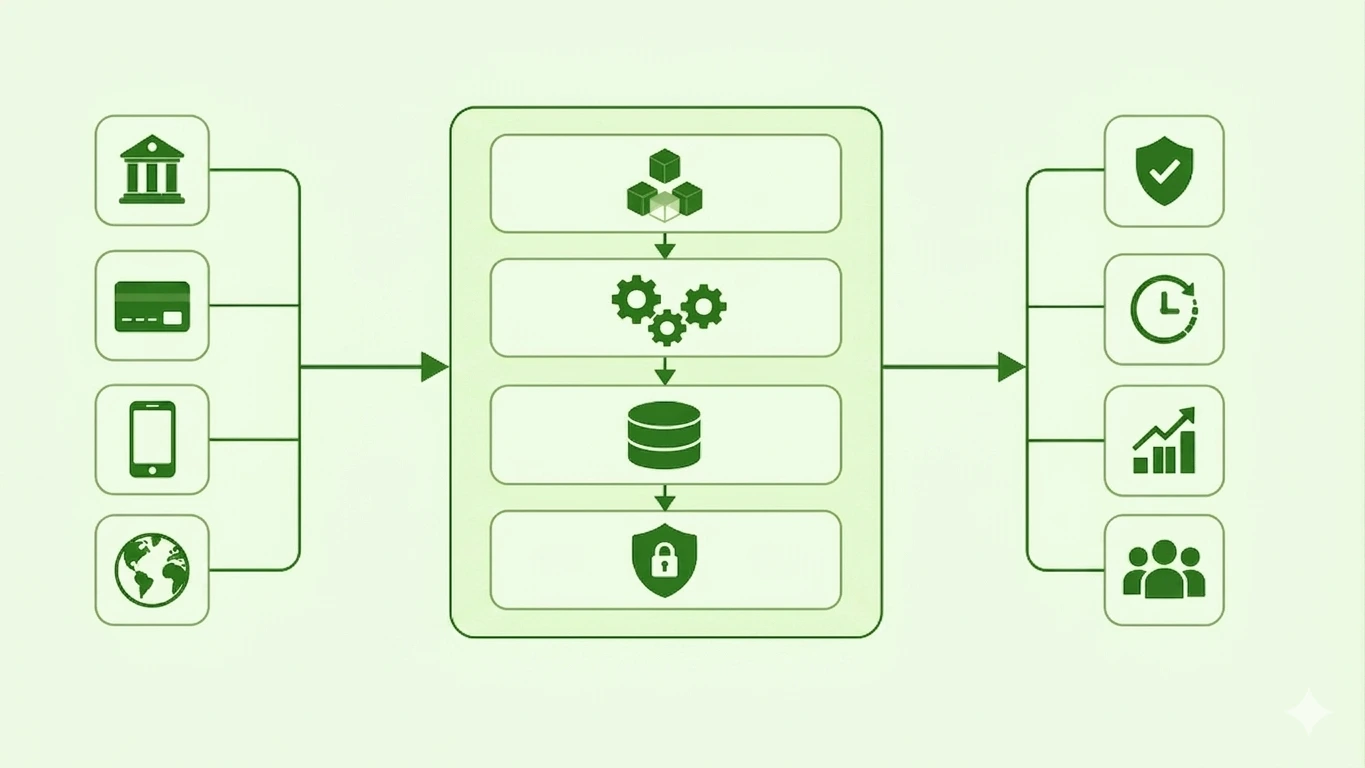
Every reliable financial platform is built on intentional structural decisions. Software architecture is not simply a technical diagram. It is a strategic framework that determines how every part of a system interacts, recovers, and performs. When we work with banking clients across India and Dubai, the first question we always ask is not about features. It is about foundations. What is the architectural plan, and does it account for failure as confidently as it accounts for functionality?
Financial software reliability depends on three pillars: consistency, availability, and partition tolerance, which collectively form the CAP theorem. Software architecture design is the practice of balancing these pillars in a way that serves the specific demands of financial operations. A poorly planned architecture might allow a platform to function in controlled conditions but expose severe vulnerabilities during high-traffic events like payroll processing cycles, market openings, or festive season payment surges in India.
Fintech platform stability is not accidental. It is architected. With software architecture consulting, financial institutions gain a clear blueprint before any engineering begins, ensuring that structural reliability is the starting point, not a correction made after launch.
How Architectural Decision Making Shapes the Stability of Financial Platforms?
Architectural decision making is the structured process by which engineering leaders evaluate trade-offs and commit to structural choices that will shape a platform for years. In financial software, these decisions carry consequences that are felt in performance, compliance, security, and maintainability. Our team has seen first-hand how choosing a monolithic approach for a payment gateway in early-stage fintech leads to painful re-architecturing within 18 months when transaction volumes begin to scale.
Effective architectural decision making in financial system design involves selecting database models that support ACID compliance, choosing service communication protocols that minimize latency, and designing fault-tolerant patterns that isolate failures. These are not one-time decisions. They evolve through a process of documented Architecture Decision Records (ADRs), which allow teams to track why a given pattern was chosen and what it replaced.
Service Boundary Design
Defining where one service ends and another begins is critical in microservices architecture. Poor boundary decisions cause tight coupling, which erodes fintech platform stability under load.
Data Consistency Models
Selecting between strong consistency and eventual consistency determines how transaction processing systems handle concurrent writes across distributed financial services.
Failure Isolation Patterns
Circuit breakers, bulkheads, and retry policies are architectural decision-making tools that prevent one failing service from cascading into a full-platform outage.
Core Software Architecture Patterns Used in Financial Software Design
Understanding software architecture patterns is essential for anyone building or evaluating financial software. These patterns are proven structural templates that solve recurring design challenges. In financial system design, the right pattern determines throughput, resilience, and operational simplicity. Below is a reference table of the most critical patterns and their role in financial platforms.
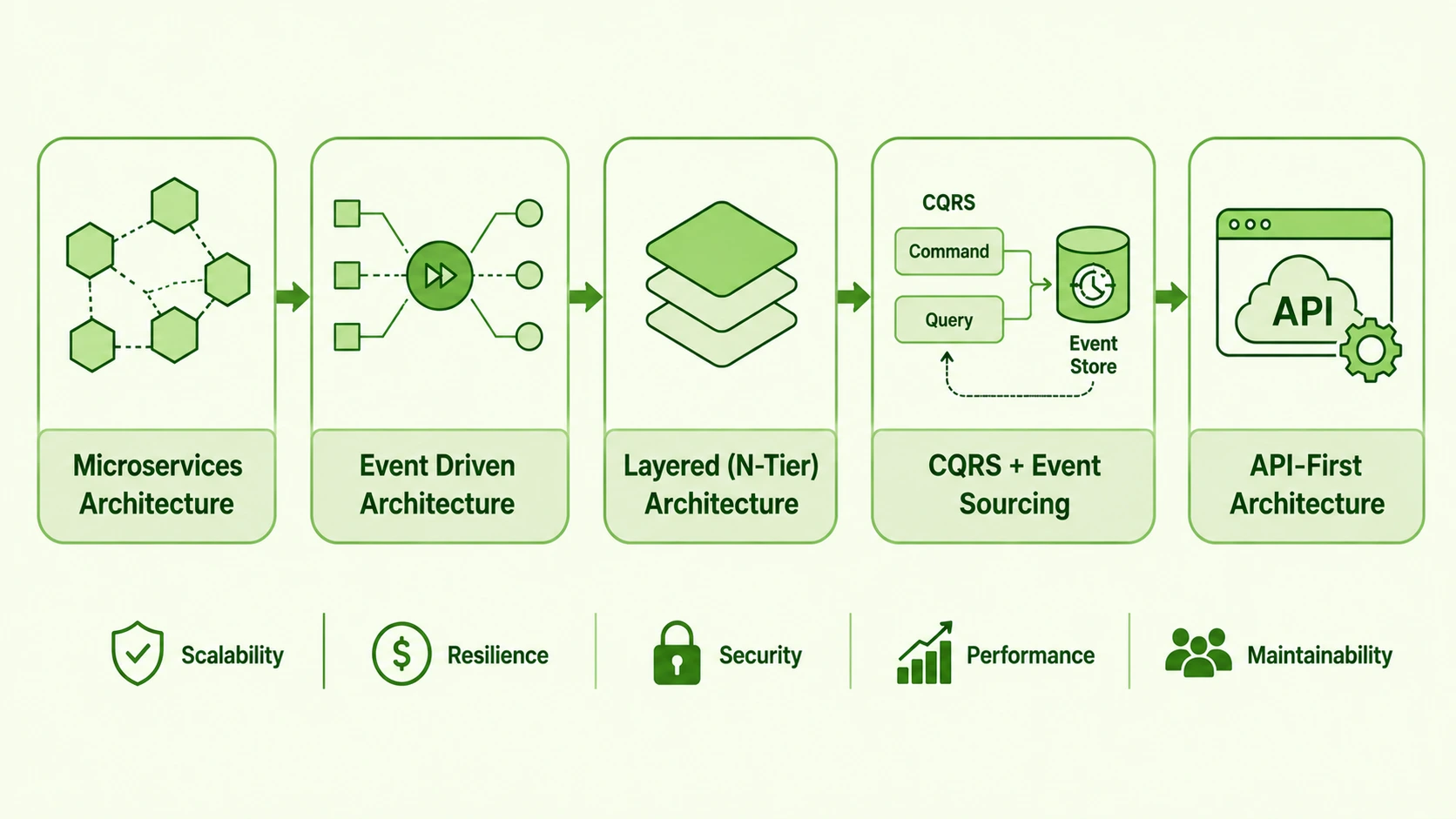
| Architecture Pattern | Best Use Case | Key Benefit in Finance | Risk if Misapplied |
|---|---|---|---|
| Microservices Architecture | Core banking modules, payment engines | Independent scaling and deployment | Operational complexity, service sprawl |
| Event Driven Architecture | Transaction processing systems, fraud alerts | Decoupled, async communication | Event ordering issues, debugging complexity |
| Layered (N-Tier) Architecture | Legacy financial system migration | Clear separation of responsibilities | Tight coupling between layers |
| CQRS + Event Sourcing | Audit-intensive financial platforms | Immutable audit trail, state replay | Steep learning curve, storage overhead |
| API-First Architecture | Open banking, third-party integrations | Composable, reusable services | Insecure API gateway design exposure |
How Financial System Design Influences Long Term Platform Performance?
Long-term performance in financial software is not about raw computing power. It is about how well the financial system design anticipates future demands and accommodates them without requiring complete structural rebuilds. In our experience consulting on payment system architecture for platforms serving both Indian Tier-1 and Tier-2 markets and UAE-based digital banks, the platforms that age well share one trait: intentional layering.
Performance degradation in financial platforms is typically not a sudden event. It is a slow erosion caused by architectural debt. When transaction processing logic is tightly coupled with reporting logic, or when authentication shares database connections with financial computations, the system begins to buckle as user volumes grow. Software architecture best practices demand separation of concerns at every layer, giving each function its own computational domain and its own resource allocation.
A software architecture diagram of a well-designed financial platform will reveal clear boundaries between the API gateway layer, the business logic layer, the data persistence layer, and the event streaming layer. These boundaries are not cosmetic. They are the structural reason why the platform can absorb 10x traffic spikes during market events or public holidays without degrading service quality.
Financial Platform Performance: Architecture-Driven Lifecycle
Phase 1: Blueprint Stage
Software architecture design decisions are locked in. Poor choices here propagate through every future phase. Correct layering and service boundaries are established.
Phase 2: Initial Scale
High availability systems begin to be tested as user acquisition accelerates. API gateway design and caching strategies absorb first scaling pressure.
Phase 3: Regulatory Expansion
Regulatory compliance architecture is stress-tested as audits begin. Platforms with embedded compliance logic pass faster and with fewer engineering interventions.
Phase 4: Long-Term Maturity
Platforms built on software architecture best practices require less re-engineering. New features integrate cleanly without disrupting core transaction processing systems.
The Role of Transaction Processing Systems in Maintaining Platform Reliability
Transaction processing systems are the operational heart of any financial platform. Whether processing a mobile payment in Mumbai, a wire transfer in Dubai, or a real-time stock settlement on an exchange, the transaction engine must be both fast and incorruptible. Software architecture is what determines whether the transaction layer can deliver on both promises simultaneously.
The architectural principles underpinning reliable transaction processing systems include atomicity, which ensures a transaction either completes fully or not at all; isolation, which prevents concurrent transactions from interfering with each other; durability, which ensures committed transactions survive system failures; and consistency, which ensures the database moves from one valid state to another. These are the ACID properties, and they are only achievable through deliberate software architecture choices at the database and service layer.
How Software Architecture Supports High Availability in Financial Platforms?
High availability systems are not aspirational targets. In regulated financial environments, they are contractual obligations. Downtime in a payment gateway or core banking portal translates directly into regulatory scrutiny, reputational damage, and financial loss. Software architecture is the engineering discipline that makes genuine high availability achievable rather than just promised.
The software architecture patterns that underpin high availability include active-active clustering, where multiple nodes handle live traffic simultaneously; geo-redundant data replication, which ensures regional failures do not take down the platform globally; and load-balanced service meshes that distribute API calls across healthy instances in real time. These patterns are visible in the software architecture diagram of every Tier-1 bank and neobank operating at scale in India and the UAE today.
Zero-Downtime Deployments
Blue-green and canary deployment strategies built into software architecture ensure financial platforms update without service interruption.
Adoption Rate: 92%
Geo-Redundant Replication
Multi-region data replication ensures that hardware failure or regional outages do not impact core banking system design uptime commitments.
Adoption Rate: 87%
Auto-Healing Service Mesh
A properly designed service mesh with automatic health checks and rerouting maintains high availability systems even when individual microservices become unstable.
Adoption Rate: 79%
Why Does Financial Data Integrity Depend on Strong Architectural Decisions?
Financial data integrity means that every record is accurate, consistent, and trustworthy from the moment it is written to the moment it is retrieved. In financial software, even a rounding error or a missed rollback can cascade into audit failures, regulatory penalties, or customer disputes. Software architecture is the layer where integrity is either guaranteed or left vulnerable.
Architectural choices that protect financial data integrity include two-phase commit protocols for distributed transactions, idempotency keys that prevent duplicate payment processing, and write-ahead logging (WAL) that provides a tamper-evident record of all state changes. These are not optional enhancements. They are fundamental to any financial software platform that processes real money and remains accountable to regulators in India or UAE.
The adoption of CQRS with event sourcing has become a leading software architecture pattern for financial data integrity because it provides a complete, immutable history of every state change. This approach supports both real-time querying and complete state reconstruction for audit purposes, making it one of the most powerful tools in modern financial system design. [1]
How Regulatory Compliance Architecture Shapes Financial Software Structure?
Regulatory compliance architecture is the practice of designing financial software so that compliance is a structural feature rather than a manual process. For platforms operating under RBI guidelines in India or CBUAE and DFSA oversight in the UAE, compliance cannot be bolted on at the end of a project. It must be embedded at the system design level.
This means building audit log services that capture every sensitive operation with immutable timestamps, designing data residency controls that prevent customer financial data from crossing regulated geographic boundaries, and creating consent and permission layers that align with data privacy frameworks like India’s DPDPA or UAE’s Federal Decree-Law No. 45 of 2021.
Compliance-First Architecture
- ✓ Audit logs built into every service layer
- ✓ Data residency enforced at the architecture level
- ✓ Consent management as a core module
- ✓ Faster regulatory audits and approvals
- ✓ Lower technical debt over time
Compliance-After Architecture
- ✗ Compliance retrofitted to existing services
- ✗ Data residency enforced only by policy
- ✗ Audit capability added as an addon module
- ✗ Slower audits with higher engineering cost
- ✗ High risk of structural refactoring
Building Scalable Financial Platforms Through Purposeful Architectural Choices
Building scalable financial platforms is one of the most demanding engineering challenges in modern software. Scalability in financial software is not just about handling more users. It is about maintaining the same level of financial data integrity, latency, and compliance assurance as volumes grow from thousands to tens of millions of transactions per day.
The architectural choices that enable scalability in financial platforms include database sharding strategies that distribute transaction loads across multiple database nodes, horizontal scaling of stateless service pods using container orchestration platforms, intelligent caching layers that serve frequently requested financial data without repeated database calls, and asynchronous processing queues that absorb transaction surges without overwhelming synchronous services.
Database Sharding
Horizontal data partitioning for transaction scale
Stateless Services
Enables independent horizontal pod scaling
Async Processing Queues
Absorbs transaction surges without service loss
Intelligent Caching
Serves financial data faster without DB overhead
Multi-Region Routing
Routes requests to nearest low-latency node
Observability Pipelines
Real-time metrics for proactive performance tuning
Event Sourcing
Immutable ledger tracking for complete audit compliance
Rate Limiting
Prevents API abuse and guarantees platform availability
How Software Architecture Decisions Prevent Failures in Financial Software?
Software failure prevention strategies are not reactive patches. They are proactive architectural commitments that reduce the probability and impact of failures before they occur. In financial software, the cost of failure is not just downtime. It is loss of customer trust, regulatory investigation, and in extreme cases, systemic financial risk.
Effective software failure prevention strategies built into software architecture include circuit breakers that stop cascading failures across interconnected services, timeout and retry policies that prevent service threads from blocking indefinitely, dead letter queues that capture unprocessable transactions for manual review without data loss, and graceful degradation patterns that serve reduced functionality rather than full platform outages when dependencies fail.
What Core Banking System Design Reveals About Architectural Priorities?
Core banking system design is perhaps the most demanding context in which software architecture decisions are made and evaluated. A core banking platform must handle account management, loan processing, interest calculations, payment clearing, and regulatory reporting simultaneously, often across millions of concurrent users. What is software architecture worth in this context? It is worth everything.
Modern core banking system design has moved away from the monolithic systems of the previous decade and toward modular, API-first architectures with microservices for each banking function. This shift is driven by the recognition that software architecture best practices demand loose coupling and high cohesion, the same principles that allow a bank to update its KYC module without taking the payment engine offline.
| Core Banking Module | Architecture Pattern Applied | Reliability Impact |
|---|---|---|
| Account Ledger | CQRS + Event Sourcing | Immutable audit trail, zero data loss |
| Payment Processing | Event Driven Architecture + Queue | Surge absorption, no dropped transactions |
| KYC and Identity | Microservices Architecture | Independent updates without platform risk |
| Regulatory Reporting | Regulatory Compliance Architecture Layer | Real-time compliance with minimal overhead |
| Fraud Detection | Event Driven Architecture + ML Pipeline | Sub-100ms real-time fraud scoring |
How Strong Software Architecture Decisions Define the Future of Financial Platforms?
The future of financial software platforms is being written today, in the architectural decisions that engineering teams are committing to right now. As financial services in India and UAE move deeper into real-time payments, embedded finance, and API-driven open banking, the software architecture layer becomes even more strategically important. Platforms built on robust architectural foundations can absorb new product requirements, integrate emerging technologies, and meet evolving regulations without structural overhauls.
Software architecture consulting has emerged as one of the most critical investment areas for financial institutions seeking to modernize. Rather than engaging in costly re-platforming after failures, forward-thinking institutions are investing in architectural assessments, software architecture diagrams, and pattern reviews before they build. This proactive approach reduces risk, accelerates time to market, and produces platforms that serve customers reliably for years rather than months.
From microservices architecture in neobanks to regulatory compliance architecture in traditional institutions, every structural decision made today creates either a competitive advantage or a liability. The financial platforms that will define the next decade are being architected right now, and the quality of those architectural decisions will determine who leads and who is left rebuilding from scratch. Software architecture best practices are not academic principles. They are the engineering discipline that separates reliable financial software from systems that fail exactly when they are needed most.
Frequently Asked Questions
Q1.1. What is software architecture and why does it matter for financial platforms?
Software architecture refers to the high-level structural design of a system, defining how components interact. For financial platforms, it directly determines reliability, scalability, and security under high transaction loads.
Q2.2. Which software architecture patterns work best for fintech apps?
Microservices architecture and event driven architecture are widely preferred in fintech. They allow independent scaling, faster updates, and resilient transaction processing systems without disrupting the entire platform.
Q3.3. How does software architecture help prevent financial software failures?
A well-planned software architecture isolates failure points, uses redundancy, and applies circuit breakers. These software failure prevention strategies ensure one component issue does not cascade across the entire financial platform.
Q4.4. What is the role of API gateway design in financial software architecture?
API gateway design acts as a controlled entry point managing authentication, rate limiting, and routing. In financial system design, it protects sensitive endpoints and ensures secure, structured communication across all services.
Q5.5. How does microservices architecture improve core banking system design?
Microservices architecture breaks core banking functions into independent services like payments, accounts, and compliance. This makes core banking system design more modular, maintainable, and easier to update without system-wide downtime.
Q6.6. Why is regulatory compliance architecture important for fintech platforms in India and UAE?
India and UAE both have strict data handling and financial reporting regulations. Regulatory compliance architecture ensures financial software is structured to meet RBI, SEBI, CBUAE, and DFSA guidelines without custom workarounds.
Q7.7. How does event driven architecture support high availability in financial software?
Event driven architecture decouples services through asynchronous messaging, reducing bottlenecks. This supports high availability systems by ensuring transactions continue processing even when individual services temporarily slow down.
Q8.8. What is the difference between software architecture design and software architecture consulting?
Software architecture design focuses on creating the technical blueprint of a system. Software architecture consulting involves expert guidance on choosing the right patterns, tools, and decisions suited to your business and compliance needs.
Q9.9. How does financial data integrity relate to software architecture choices?
Financial data integrity depends on how your architecture handles writes, rollbacks, and concurrency. Strong architectural decision making ensures atomic transactions, consistent state management, and accurate audit trails at every layer.
Q10.10. How do I build scalable financial platforms using software architecture best practices?
Building scalable financial platforms requires layered design, stateless services, efficient database sharding, and event-driven flows. Applying software architecture best practices from the start reduces the cost and risk of future restructuring.
Explore Services
Related Services
Reviewed by

Aman Vaths
Founder of Nadcab Labs
Aman Vaths is the Founder & CTO of Nadcab Labs, a global digital engineering company delivering enterprise-grade solutions across AI, Web3, Blockchain, Big Data, Cloud, Cybersecurity, and Modern Application Development. With deep technical leadership and product innovation experience, Aman has positioned Nadcab Labs as one of the most advanced engineering companies driving the next era of intelligent, secure, and scalable software systems. Under his leadership, Nadcab Labs has built 2,000+ global projects across sectors including fintech, banking, healthcare, real estate, logistics, gaming, manufacturing, and next-generation DePIN networks. Aman’s strength lies in architecting high-performance systems, end-to-end platform engineering, and designing enterprise solutions that operate at global scale.