Ai Overview
Blockchain developers deal with a lot of moving parts. Between writing smart contracts, running tests, tracking transactions, and keeping users in the loop, things can get complicated fast. That is exactly why tools like Tenderly and Blocknative exist. Both platforms serve developers and teams working in the blockchain space, but they solve different problems.
Blockchain developers deal with a lot of moving parts. Between writing smart contracts, running tests, tracking transactions, and keeping users in the loop, things can get complicated fast. That is exactly why tools like Tenderly and Blocknative exist. Both platforms serve developers and teams working in the blockchain space, but they solve different problems. Tenderly is all about helping developers build and debug smart contracts, while Blocknative focuses on transaction visibility and keeping end users informed in real time. So which one should you use? The answer depends on what you are building and what matters most to your project. This article walks you through both tools in detail so you can make a confident decision.
Key Takeaways
- Tenderly is built for Ethereum developers who need powerful debugging, simulation, and smart contract monitoring tools.
- Blocknative is designed for real-time transaction tracking and user notifications, making it ideal for user-facing dApps.
- Both tools serve different stages of the blockchain development lifecycle and are not direct replacements for each other.
- Using Tenderly and Blocknative together gives you complete coverage from contract development to user delivery.
- DeFi platforms, NFT marketplaces, and enterprise blockchain projects benefit the most from combining these tools.
- Choosing the right tool depends on whether your priority is contract-level performance or end-user transaction experience.
What Are Blockchain Development Tools and Why Do They Matter?
If you have ever tried building a decentralized application from scratch, you know how much goes on behind the scenes. Writing a smart contract is just the beginning. You also need to test it, deploy it, monitor its behavior on the network, and fix issues when they pop up. Blockchain development tools handle all of this. They are the software platforms and utilities that help developers write, test, deploy, and manage blockchain applications without losing their minds in the process.
Think of it this way. A smart contract, once deployed on a network like Ethereum, cannot be easily changed. If something goes wrong, the cost of fixing it is high. That is why having the right set of tools before, during, and after deployment is so important. Good development tools reduce the risk of bugs, save time during testing, and give developers the visibility they need to understand what is happening on the blockchain at any given moment.
The rise of decentralized finance (DeFi), non-fungible tokens (NFTs), and enterprise blockchain applications has only increased the demand for reliable development tools. Projects are more complex now. There are more tokens, more protocols, and more users interacting with smart contracts every day. Developers need tools that keep up with that pace, and Tenderly and Blocknative are two of the most well-known options in the market right now.
Understanding Tenderly: A Developer-First Platform
Tenderly was built with one audience in mind: developers working on Ethereum-based smart contracts. The platform gives you a set of tools that cover the full range of smart contract development. You can monitor your contracts in real time, simulate transactions before pushing them live, and dig into failed transactions to find out exactly what went wrong. It is the kind of tool that saves hours of debugging time and helps you avoid expensive mistakes.
One of the things that sets Tenderly apart is its simulation engine. Before you deploy a contract or execute a transaction, you can run it through a simulated environment that mirrors the actual blockchain. This lets you see what would happen without spending real gas fees. For developers working on complex protocols where a single bug could drain a liquidity pool, this feature alone can justify the cost of using the platform.
Tenderly also provides detailed transaction traces. When a transaction fails or produces unexpected results, you can walk through the entire execution step by step. This level of visibility is critical for projects that involve multiple smart contracts interacting with each other. If you are building something like a DeFi lending protocol or a multi-token swap system, understanding how data flows between contracts is essential. Tenderly makes that process much more manageable.
For teams looking to optimize their blockchain development workflow, Tenderly fits naturally into the development pipeline. It connects with common development frameworks, supports multiple Ethereum-compatible networks, and provides dashboards that give you a clear picture of your contract performance over time.
Understanding Blocknative: Built for Transaction Visibility
Blocknative takes a different approach. Instead of focusing on the developer side of things, it focuses on what happens after a transaction is submitted. When a user sends a transaction on a blockchain network, it does not get confirmed instantly. It enters a waiting area called the mempool, where it sits until a validator picks it up and includes it in a block. During that waiting period, users are often left in the dark. They do not know if their transaction will go through, how long it will take, or if it has failed. Blocknative solves that problem.
The platform provides real-time transaction monitoring that tracks every stage of a transaction’s journey. From the moment it hits the mempool to the point where it is confirmed on the blockchain, Blocknative keeps users and developers informed. This is especially useful in fast-moving environments like DeFi, where timing matters. If you are making a trade on a decentralized exchange and the price is moving quickly, knowing the status of your transaction in real time can make a big difference.
Blocknative also offers notification systems that developers can integrate into their applications. When something changes with a user’s transaction, the platform sends an alert. This creates a smoother user experience because people do not have to refresh their screens repeatedly to check on their transactions. They get the update automatically. For applications that deal with high volumes of transactions, like NFT minting platforms or yield farming protocols, this kind of transparency builds trust and keeps users coming back.
The mempool monitoring capability of Blocknative is particularly valuable. Understanding what is happening in the mempool gives developers and users a preview of pending activity on the network. This information can be used for gas price estimation, transaction prioritization, and even identifying potential issues before they become problems. If you are interested in how RPC nodes in blockchain contribute to this kind of network communication, the connection is worth exploring.
Tenderly vs Blocknative: Head-to-Head Comparison
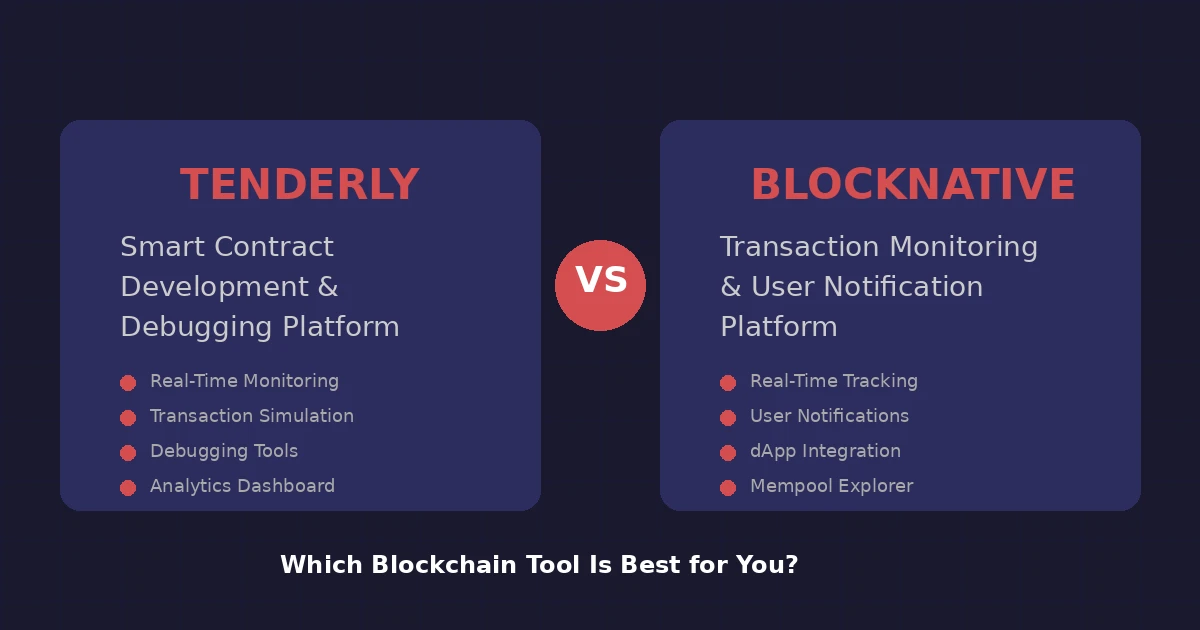
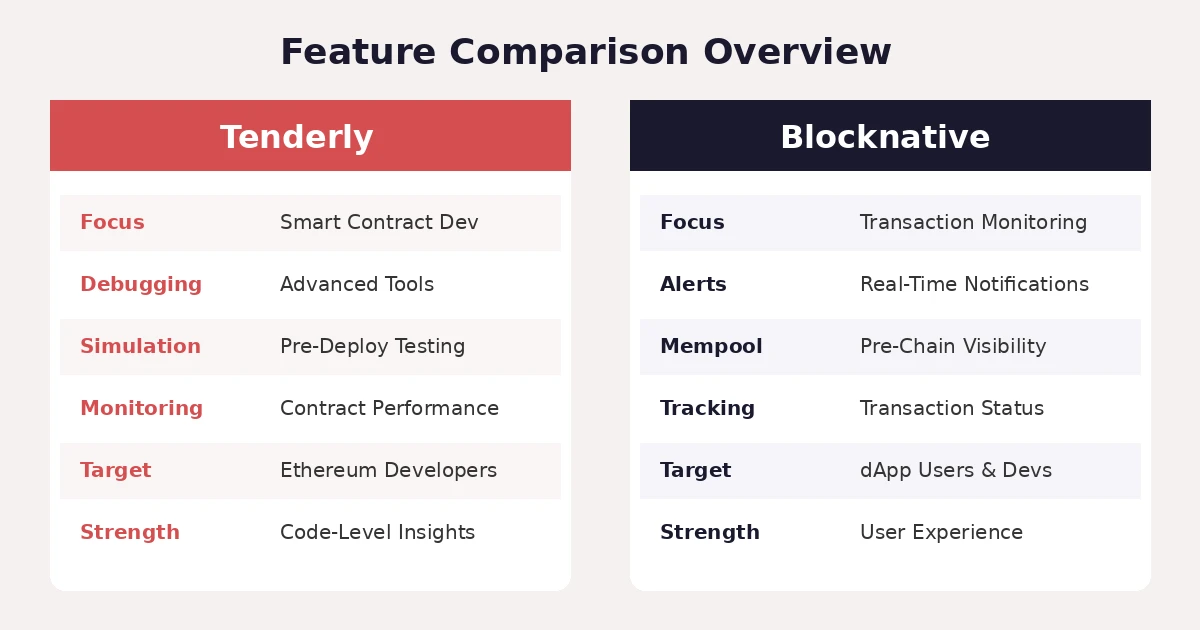
The table below breaks down the primary differences between Tenderly and Blocknative across several important categories. This should give you a quick snapshot of where each tool excels.
| Category | Tenderly | Blocknative |
|---|---|---|
| Primary Focus | Smart contract development and debugging | Transaction monitoring and user notifications |
| Target Audience | Ethereum developers and engineering teams | dApp builders focused on user experience |
| Simulation | Full transaction simulation before deployment | Mempool-level pre-chain visibility |
| Debugging | Advanced step-by-step transaction tracing | Limited debugging capabilities |
| Real-Time Monitoring | Contract performance monitoring | Transaction status tracking across the network |
| User Notifications | Alerting for contract events | Full notification system for end users |
| Analytics | Contract performance analytics | User interaction and transaction pattern analytics |
| Best Use Case | Building, testing, and debugging complex dApps | Improving UX in DeFi and NFT applications |
The Smart Contract Development Lifecycle: Where Each Tool Fits
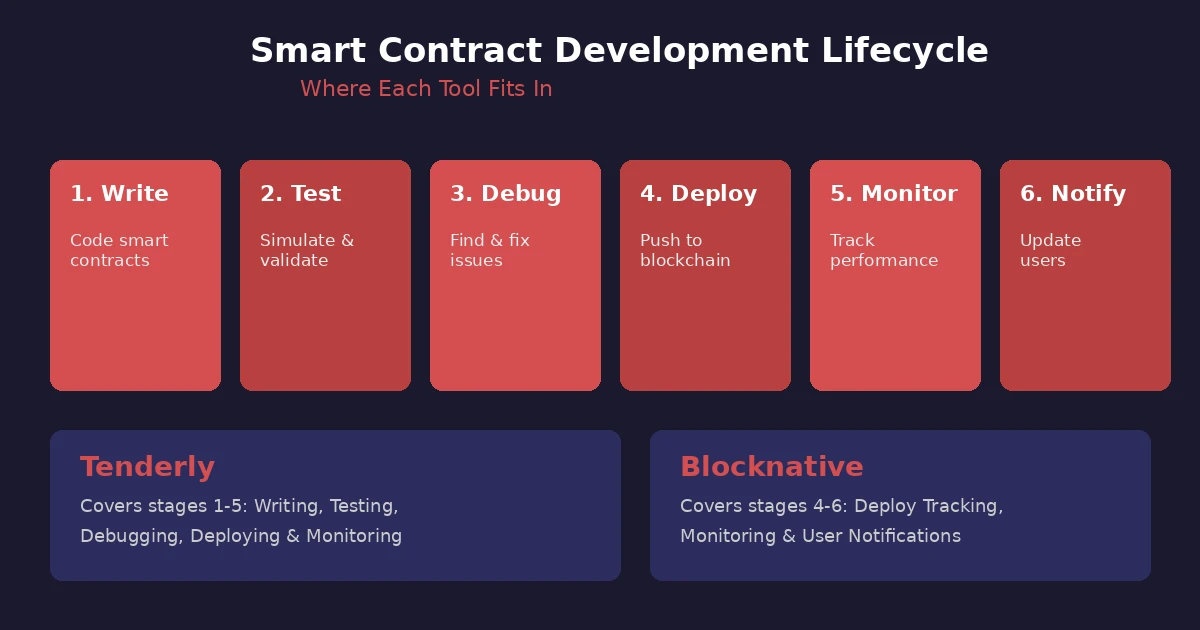
To really understand when to use Tenderly versus Blocknative, it helps to look at the full lifecycle of a blockchain application. Every project goes through a series of stages, and each tool plays its role at different points in that process.
The lifecycle starts with writing the smart contract code. This is where developers define the logic of their application. Next comes the testing phase, where they verify that the code works as expected under different conditions. After testing, the debugging stage catches anything that slipped through. Once the contract is clean and reliable, it gets deployed to the blockchain network. After deployment, the focus shifts to monitoring how the contract performs and keeping users informed about their transactions.
Tenderly covers the first five stages of this lifecycle. It gives developers the tools to write better code, test it in simulated environments, debug problems at a granular level, manage deployments, and monitor contract behavior after launch. Blocknative picks up from stage four onward. It monitors transactions as they move through the network, provides real-time status updates, and sends notifications to users. There is some overlap in the monitoring stage, but each tool approaches it from a different angle. Tenderly monitors contract performance from a technical perspective, while Blocknative monitors transaction status from a user perspective.
This is why many experienced teams use both tools together. They are not competing products in the strictest sense. They are complementary tools that serve different needs in the same development pipeline. If you want to understand more about the technical infrastructure behind these tools, take a look at how real-world data oracles function in blockchain development.
Deep Dive into Tenderly’s Core Capabilities
Let us take a closer look at what Tenderly actually offers under the hood. The platform is structured around a few major capabilities that developers rely on daily.
Transaction Simulation: This is probably the most talked-about feature. Tenderly lets you simulate any transaction against a forked state of the blockchain. You can test what would happen if a specific function were called with certain parameters, without spending gas or affecting the live network. This is invaluable for testing upgrades, parameter changes, or new contract interactions.
Visual Debugger: When a transaction fails, Tenderly provides a visual debugger that walks you through the execution stack. You can see every function call, every state change, and every event that was emitted. This level of detail is hard to get from standard blockchain explorers and is something that saves development teams countless hours.
Alerting System: Tenderly lets you set up alerts based on specific contract events. If a particular function gets called, if a value exceeds a threshold, or if an unusual pattern of activity is detected, you can receive a notification. This is useful for staying on top of things after deployment without having to constantly watch the dashboard.
Gas Profiler: Gas costs are a major concern for any Ethereum developer. Tenderly includes a gas profiler that shows you exactly where gas is being spent during a transaction. This information helps developers optimize their contracts to be more cost-effective for users.
For teams handling enterprise blockchain applications, Tenderly offers the depth and precision needed to manage high-stakes contracts that handle significant value.
Build Smarter Blockchain Applications Today
Need expert help choosing and integrating the right blockchain development tools? Our team can guide you from smart contract design to production-ready deployment.
Deep Dive into Blocknative’s Core Capabilities
Now let us look at what makes Blocknative stand out in its own right.
Mempool Explorer: Blocknative gives you access to what is happening in the mempool, the holding area where transactions wait before being confirmed. This is a powerful feature because it lets you see pending transactions across the network. Developers and traders use this information for gas estimation, frontrunning protection, and understanding network congestion.
Transaction Notifications API: This is the backbone of Blocknative’s value for dApp developers. The notifications API lets you subscribe to specific addresses and receive real-time updates when transactions involving those addresses change status. Whether a transaction is submitted, confirmed, or dropped, your application can react instantly.
Onboard.js: Blocknative offers an open-source library called Onboard.js that simplifies the process of connecting users to blockchain networks. It supports multiple wallets and provides a consistent user experience across different connection methods. This reduces friction for new users and makes it easier for developers to support a wide range of wallets.
Gas Estimator: Accurate gas estimation is tricky, especially during periods of network congestion. Blocknative’s gas estimator uses mempool data to provide more accurate predictions of what gas fees will look like. This helps users submit transactions with appropriate gas prices, reducing the chance of stuck or failed transactions.
Understanding transaction flows becomes even more critical when you consider how mining difficulty affects blockchain transaction processing times and fee structures.
Technical Capabilities: A Detailed Comparison
Beyond the general overview, here is a more technical breakdown of how these two platforms compare on specific capabilities that matter to development teams.
| Technical Capability | Tenderly | Blocknative |
|---|---|---|
| Transaction Simulation | ✅ Full simulation engine | ❌ Not available |
| Mempool Monitoring | ❌ Not a core feature | ✅ Advanced mempool tools |
| Step-by-Step Debugger | ✅ Visual execution tracer | ❌ Not available |
| User Notification API | ⚠️ Limited to contract events | ✅ Full notification system |
| Gas Optimization | ✅ Gas profiler included | ✅ Gas estimator based on mempool |
| Wallet Integration Support | ❌ Not a focus area | ✅ Onboard.js for multi-wallet |
| Multi-Network Support | ✅ Ethereum + EVM chains | ✅ Multiple blockchain networks |
| Contract State Forking | ✅ Fork mainnet for testing | ❌ Not available |
Real-World Examples: How Teams Use These Tools
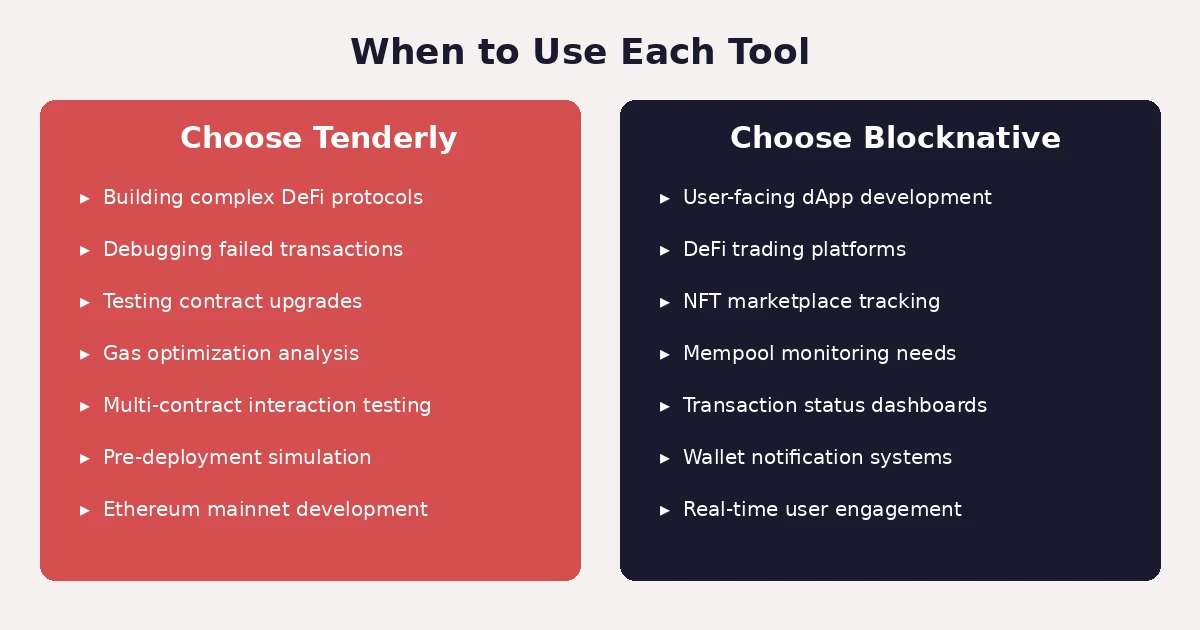
It is one thing to read about features on a comparison chart. It is another thing to see how actual teams put these tools to work. Here are some practical scenarios that illustrate the strengths of each platform.
Scenario 1: A DeFi Lending Protocol
A team building a decentralized lending platform needs to make sure their smart contracts handle deposits, withdrawals, and liquidations correctly. They use Tenderly to simulate liquidation scenarios under different market conditions. Before pushing any changes to the mainnet, the team runs simulations to confirm that the contract behaves as expected when collateral ratios drop. After deployment, they set up alerts in Tenderly to monitor for unusual activity. On the user-facing side, they integrate Blocknative to give borrowers and lenders real-time updates on their transaction statuses. When a user deposits collateral, they immediately see whether the transaction is pending, processing, or confirmed.
Scenario 2: An NFT Marketplace
An NFT platform processes thousands of minting and trading transactions every day. The development team uses Tenderly to debug issues with their auction smart contract, which involves complex timing logic and multiple bidders. They trace failed transactions to identify edge cases where the auction logic breaks. Meanwhile, Blocknative powers the transaction status bar on the marketplace, showing buyers the exact state of their purchase transactions. This reduces the number of support tickets from confused users who do not know if their purchase went through.
Scenario 3: A DAO Governance Application
A decentralized autonomous organization uses smart contracts for proposal submission and voting. The engineering team relies on Tenderly to simulate the impact of governance proposals before they are executed. They want to make sure that a proposal to change protocol parameters will not break anything. After the vote passes and the transaction is submitted, Blocknative notifies all participants when the governance action is confirmed on-chain.
These examples show how both tools address different but equally important aspects of running a blockchain application. The technical depth of Tenderly handles the backend complexity, while Blocknative manages the frontend experience that users interact with. For projects that deal with complex on-chain data, understanding how chain splits impact blockchain operations adds another layer of context to tool selection.
When You Should Pick Tenderly
Tenderly is the right call if your work is primarily technical and focused on the contract layer. Here are the situations where Tenderly is clearly the better option:
You are building smart contracts that involve complex logic, multiple contract interactions, or significant value at stake. The simulation and debugging tools give you confidence that your code will perform correctly before it touches the mainnet. You need detailed analytics on how your contracts are performing after deployment. If gas costs, execution patterns, or state changes are important metrics for your project, Tenderly provides that visibility. Your team needs to test contract upgrades in a safe environment. Forking the mainnet and running simulations against real state data is something Tenderly handles exceptionally well. You are working on a project where security is a top concern, and you need to trace every step of a transaction to verify correct behavior.
When You Should Pick Blocknative
Blocknative makes more sense when your priority is the user experience and transaction visibility. Choose Blocknative when:
Your application needs to keep users informed about what is happening with their transactions in real time. Whether they are swapping tokens, minting NFTs, or placing bids, users expect transparency. You need accurate gas estimation based on current network conditions. Blocknative’s mempool data provides more reliable gas price predictions than static estimates. Your project involves wallet connectivity and you want a clean, consistent experience for users connecting through different wallets. Onboard.js simplifies this significantly. You are building in the DeFi or NFT space where speed and timing are critical, and users cannot afford to be left guessing about the status of their transactions.
Using Both Tools Together: The Combined Approach
The most effective blockchain development teams do not treat this as an either-or decision. They use both tools because each one addresses a different layer of the application stack. Tenderly handles everything from writing the first line of contract code to monitoring that contract in production. Blocknative takes over when it comes to the transaction experience that users see and interact with.
When you combine these tools, you get a development workflow that covers every stage. Contracts are thoroughly tested and debugged before deployment. After launch, contract performance is monitored and any anomalies trigger alerts. On the user side, every transaction is tracked and users receive timely updates about their activity. This creates a feedback loop where developers can spot issues on the contract level through Tenderly and correlate them with user experience issues surfaced by Blocknative.
For organizations working in decentralized finance, this combined approach is not just helpful, it is practically a requirement. The stakes are high, the pace is fast, and both the technical and user-facing sides of the application need to be rock solid. Teams building applications that involve immersive technologies should also consider how AR, VR, and blockchain intersect in the metaverse and what tooling those applications demand.
Quick Decision Guide
| Your Priority | Recommended Tool | Why |
|---|---|---|
| Smart contract debugging | Tenderly | Step-by-step visual debugger with state inspection |
| User transaction updates | Blocknative | Real-time notification API for transaction lifecycle |
| Pre-deployment testing | Tenderly | Transaction simulation on forked mainnet state |
| Gas fee accuracy | Blocknative | Mempool-based gas estimation with live data |
| Full development pipeline | Both Together | Complete coverage from code to user experience |
| Wallet connection experience | Blocknative | Onboard.js supports multi-wallet integration |
| Contract performance monitoring | Tenderly | Dashboards with long-term analytics and alerting |
The Future of These Blockchain Development Tools
The blockchain industry is not slowing down. As more businesses adopt decentralized technology and more users interact with blockchain applications, the demand for reliable development and monitoring tools will keep growing. Both Tenderly and Blocknative are positioned well for this growth, but in different ways.
Tenderly is likely to expand its simulation and testing capabilities as smart contracts become more complex. The introduction of new Ethereum standards, layer-2 solutions, and cross-chain protocols creates new challenges for developers. Tenderly will need to keep pace with these developments to remain the go-to tool for contract-level work. The platform may also move deeper into automated testing and security auditing features, which are becoming more important as the value locked in DeFi protocols continues to grow.
Blocknative, on the other hand, is likely to expand its notification and monitoring infrastructure to cover more blockchain networks and more types of user interactions. As the multi-chain ecosystem matures, users will need visibility into transactions happening across multiple networks simultaneously. Blocknative’s mempool monitoring capabilities could also evolve to support more advanced use cases, like MEV (Maximal Extractable Value) protection and cross-chain transaction tracking.
For teams that want to stay ahead of these trends, partnering with a blockchain company that understands how to use these tools effectively can make a significant difference. The right development partner will know when to use Tenderly, when to use Blocknative, and how to integrate both into a workflow that delivers results.
Ready to Build Your Blockchain Project?
From smart contract development to production monitoring, our team delivers end-to-end blockchain solutions tailored to your business needs.
Pricing and Accessibility Considerations
Both platforms offer tiered pricing that scales with usage. Tenderly provides a free tier that includes basic monitoring and a limited number of simulations per month. For teams that need full access to simulation, debugging, alerting, and advanced analytics, paid plans are available with higher usage limits and priority support. The pricing is structured to accommodate individual developers, small teams, and larger organizations, so you can start small and scale up as your project grows.
Blocknative similarly offers free access to its core APIs for developers who want to experiment with transaction monitoring and gas estimation. The paid plans unlock higher throughput, additional network support, and premium features like advanced mempool analytics. For teams building applications that serve a large number of users, the paid tier is usually necessary to handle the volume of transaction events that need to be tracked.
One thing worth noting is that neither tool locks you into a long-term commitment. Both platforms are accessible through standard API integrations, which means you can add or remove them from your stack without rewriting large portions of your codebase. This flexibility is important for blockchain projects that evolve quickly and may change their tooling as the project matures.
Frequently Asked Questions
Q1.What is the main difference between Tenderly and Blocknative?
Tenderly is a developer-focused platform designed for building, testing, debugging, and monitoring Ethereum smart contracts. Blocknative, on the other hand, specializes in real-time transaction tracking and user notifications. Tenderly helps developers ensure their contract code works correctly before and after deployment. Blocknative helps keep end users informed about the status of their transactions as they move through the network. The two tools address different layers of the blockchain application stack.
Q2.Can I use Tenderly and Blocknative together in the same project?
Yes, many development teams use both tools together because they complement each other. Tenderly handles the smart contract development, testing, and debugging side, while Blocknative manages real-time transaction monitoring and user notifications. Using both gives you complete coverage across the entire development and deployment lifecycle. This combined approach is especially useful for DeFi platforms, NFT marketplaces, and other applications where both contract reliability and user experience matter.
Q3.Is Tenderly only for Ethereum developers?
Tenderly started with a strong focus on Ethereum, but it has expanded its support to include multiple EVM-compatible blockchain networks. This means if you are building on networks like Polygon, Arbitrum, Optimism, or BNB Chain, you can still use Tenderly for simulation, debugging, and monitoring. However, if you are working on non-EVM chains, Tenderly may not be the right fit, and you would need to explore other platform-specific development tools for those networks.
Q4.What is mempool monitoring and why does Blocknative offer it?
The mempool is a temporary holding area where blockchain transactions wait before being confirmed and added to a block. Mempool monitoring lets you see what transactions are pending on the network at any given time. Blocknative offers this feature because it provides valuable insights into network activity, gas prices, and transaction competition. For DeFi traders and application developers, mempool visibility helps with gas estimation, transaction timing, and protecting against MEV attacks.
Q5.Which tool is better for a DeFi application?
For DeFi applications, the best approach is to use both. Tenderly is critical for the development phase because DeFi protocols involve complex smart contract logic that needs thorough testing and debugging. The simulation features let you test liquidation scenarios, oracle interactions, and token swaps without risking real funds. Blocknative is essential for the production phase because DeFi users expect real-time updates on their trades, deposits, and withdrawals. Combining both tools gives your DeFi project the reliability and user experience it needs.
Q6.Are there free versions of Tenderly and Blocknative available?
Both Tenderly and Blocknative offer free tiers that let developers try out their core features without upfront costs. Tenderly provides a free plan with access to basic monitoring, simulation, and debugging features, though advanced features and higher usage limits require a paid subscription. Blocknative also offers free access to some of its APIs and tools. The free tiers are usually sufficient for individual developers or small projects, but teams working on production-level applications will likely need to upgrade to access the full range of capabilities.
Explore Services
Related Services
Reviewed by

Aman Vaths
Founder of Nadcab Labs
Aman Vaths is the Founder & CTO of Nadcab Labs, a global digital engineering company delivering enterprise-grade solutions across AI, Web3, Blockchain, Big Data, Cloud, Cybersecurity, and Modern Application Development. With deep technical leadership and product innovation experience, Aman has positioned Nadcab Labs as one of the most advanced engineering companies driving the next era of intelligent, secure, and scalable software systems. Under his leadership, Nadcab Labs has built 2,000+ global projects across sectors including fintech, banking, healthcare, real estate, logistics, gaming, manufacturing, and next-generation DePIN networks. Aman’s strength lies in architecting high-performance systems, end-to-end platform engineering, and designing enterprise solutions that operate at global scale.