Ai Overview
Choosing the right blockchain for a token project shapes everything, transaction costs, user experience, liquidity access, and long-term scalability. 5%, daily transactions peaked at an all-time high of 31 million, and unique addresses exceeded 700 million with over 4 million daily active users. [1] These numbers reflect a mature ecosystem that offers token creators genuine advantages in cost, speed, security, and market reach.
Choosing the right blockchain for a token project shapes everything, transaction costs, user experience, liquidity access, and long-term scalability. Binance Smart Chain (BSC), now operating under the broader BNB Chain ecosystem, has emerged as one of the most actively used networks for token creation and decentralized finance. In 2025, BNB Chain’s Total Value Locked grew by 40.5%, daily transactions peaked at an all-time high of 31 million, and unique addresses exceeded 700 million with over 4 million daily active users.[1] These numbers reflect a mature ecosystem that offers token creators genuine advantages in cost, speed, security, and market reach.
The benefits of using Binance Smart Chain for token projects extend well beyond low fees. BSC provides full EVM compatibility, access to one of the largest DEX ecosystems through PancakeSwap, institutional-grade security improvements, and a roadmap that continues to push block times below one second. For teams evaluating where to launch their token, understanding these advantages in detail is essential. The development of BSC’s infrastructure over the past year has addressed many of the criticisms previously leveled at the network, making it a stronger candidate than ever for serious token projects.
Key Takeaways
- BSC processes transactions with median gas fees of $0.01 and block times as low as 0.75 seconds after the 2025 Maxwell hardfork upgrade.
- Full EVM compatibility allows developers to deploy Ethereum-based smart contracts and tooling on BSC with minimal modification.
- PancakeSwap dominates BSC’s DEX landscape with 91.8% market share and $2.3 billion in average daily trading volume.
- The Goodwill Alliance reduced sandwich attacks by 95%, making BSC one of the fairest trading environments among major blockchains.
- BNB Chain’s stablecoin market cap doubled to $14 billion in 2025, providing deep liquidity pools for token pairs.
- Over 700 million unique addresses and 4 million daily active users give BSC-listed tokens immediate access to a massive trading audience.
Cost Efficiency and Transaction Speed
Transaction costs remain one of the most practical considerations for any token project. High fees discourage users from trading, interacting with dApps, and participating in the ecosystem. BSC addresses this directly with a fee structure that keeps costs minimal even during periods of heavy network activity.
Median Gas Fees Under One Cent
BSC’s median gas fee dropped to approximately $0.01 in 2025, making it one of the most affordable major blockchains for token transactions.[2] For comparison, Ethereum gas fees can range from $2 to $40 or more during congestion, and even Layer 2 solutions often carry fees of $0.10 to $0.50. This cost advantage means users can trade, stake, and interact with your token frequently without fee friction discouraging engagement. For token projects targeting retail users, gaming tokens, loyalty programs, or micro-transaction applications, these low fees are not merely convenient, they are structurally necessary for viable product economics.
Sub-Second Block Times
Through a series of hardforks in 2025, including Lorentz, Pascal, and Maxwell, BSC significantly reduced block times from 3 seconds to just 0.75 seconds, while achieving finality in 1.875 seconds. This advancement positions BSC ahead of most competing EVM chains and brings its performance closer to the responsiveness typically seen in centralized platforms. Achieving sub second block production required major architectural upgrades such as path based storage optimization, consecutive block production, and enhanced validator synchronization. For token holders, these improvements mean faster trade confirmations, lower slippage during time sensitive swaps, and a smoother, near instant user experience. As a result, businesses and developers seeking a reliable token development solution are increasingly drawn to blockchain networks that deliver high speed without compromising decentralization.
EVM Compatibility and Developer Accessibility
One of the most significant benefits of using Binance Smart Chain is its full compatibility with the Ethereum Virtual Machine (EVM). This compatibility has profound practical implications for token developers at every stage of the project lifecycle.
Deploy Ethereum Contracts Directly on BSC
Smart contracts written in Solidity for Ethereum can be deployed on BSC with little to no modification. This means token projects do not need to learn a new programming language, adopt unfamiliar frameworks, or rewrite existing codebases. Tools like Hardhat, Remix, Truffle, and OpenZeppelin work identically on BSC, and developers can use the same testing suites, audit tools, and deployment pipelines they already know. The development of EVM-compatible infrastructure on BSC has lowered the barrier to entry dramatically, a team that has built for Ethereum can launch on BSC within hours rather than weeks. Understanding the differences between blockchain asset types through a coin and token solution guide helps teams make informed decisions about which chain best fits their contract architecture.
BEP-20 Token Standard
BSC uses the BEP-20 token standard, which mirrors Ethereum’s ERC-20 standard with added functionality for gas optimization and Binance ecosystem integration. BEP-20 tokens are automatically compatible with wallets like MetaMask, Trust Wallet, and Binance Wallet, giving projects immediate access to millions of existing users. The standard also supports advanced features such as minting, burning, pausing, and access control, all familiar patterns for Solidity developers. Projects considering governance features like multi-signature capabilities can implement them using the same OpenZeppelin libraries available on Ethereum.
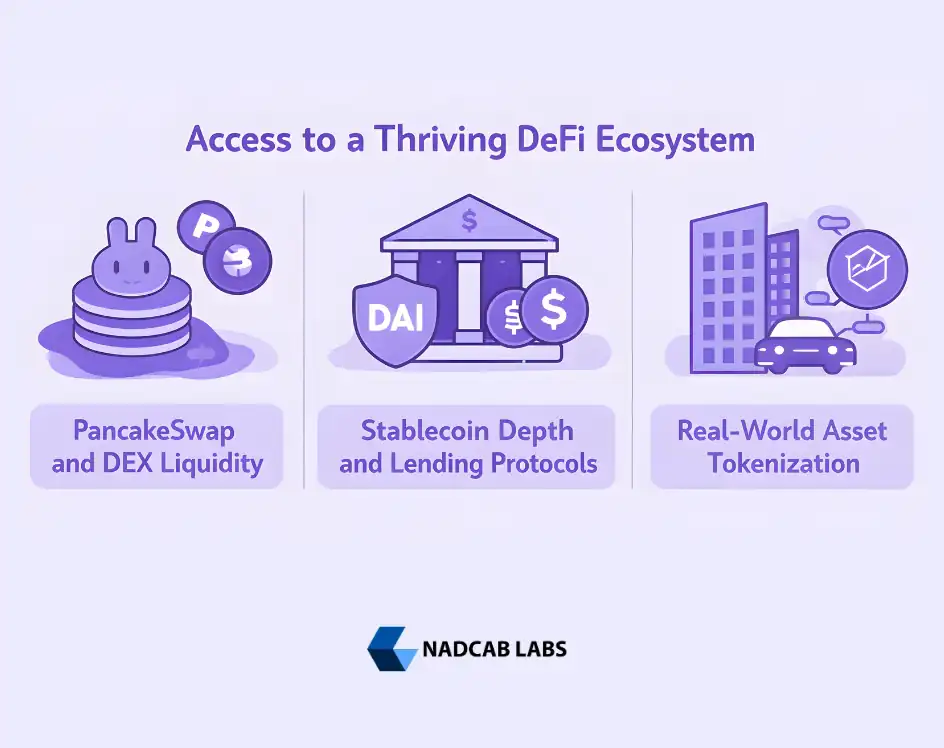
Access to a Thriving DeFi Ecosystem
A token’s value depends partly on where and how it can be traded, staked, lent, and used. BSC hosts one of the largest and most active DeFi ecosystems in the industry, offering token projects immediate access to liquidity and market infrastructure.
PancakeSwap and DEX Liquidity
PancakeSwap remains the dominant decentralized exchange on BSC, accounting for 91.8% of total DEX activity with $2.3 billion in average daily trading volume during Q1 2025.[3] In Q3 2025, PancakeSwap’s TVL reached $2.3 billion, and the platform expanded into tokenized real-world assets through a partnership with Ondo Finance, bringing over 100 tokenized stocks, ETFs, and bonds on-chain. For token creators, listing on PancakeSwap provides immediate access to deep liquidity pools and a massive user base. The development of PancakeSwap’s multi-product suite — including yield farming, prediction markets, and NFT marketplaces, gives BSC tokens multiple utility vectors beyond simple spot trading.
Stablecoin Depth and Lending Protocols
BSC’s stablecoin market cap expanded 32.3% quarter-over-quarter in Q3 2025, reaching $13.9 billion. This growth was driven by USDT expansion, USD1 integration, and rapid scaling of USDe and USDF. Deep stablecoin liquidity is essential for token projects because it provides reliable trading pairs, reduces volatility in pool pricing, and attracts institutional capital that prefers stablecoin-denominated positions. Lending protocols like Venus Finance and Aave on BSC further enhance the utility of listed tokens by enabling collateralized borrowing and lending — features that increase token demand beyond speculative trading.
Real-World Asset Tokenization
One of the fastest-growing sectors on BSC is real-world asset (RWA) tokenization. At its peak in 2025, RWA value on BNB Chain surpassed $1.8 billion, with institutional participants like Franklin Templeton integrating BNB Chain into their Benji platform. For token projects focused on tangible asset representation, real estate, commodities, or securities, BSC’s growing RWA infrastructure provides the regulatory-friendly tooling and institutional liquidity needed to succeed. Documenting these structures clearly in a token white paper helps projects communicate their compliance approach to potential investors and partners.
Security and Network Reliability
Security concerns have historically been one of the criticisms directed at BSC, particularly during the DeFi exploit surge of 2021 and 2022. The network has since made substantial investments in security infrastructure that directly benefit token projects building on the chain.
Goodwill Alliance and MEV Protection
In 2025, BSC launched the Goodwill Alliance, a coordinated effort among block builders, wallet providers, and infrastructure partners to combat malicious MEV extraction. The initiative reduced sandwich attacks by over 95%, with Goodwill Alliance builders now constructing over 90% of all blocks.[4] For token holders and traders, this means significantly fairer trade execution — transactions are processed at the expected price rather than being exploited by front-running bots. The development of ethical MEV practices on BSC addresses one of the most common complaints in DeFi trading and creates a more trustworthy environment for token communities.
Zero-Downtime Operation
Throughout 2025, BSC maintained zero downtime, even during peak demand periods driven by memecoin trading surges and major ecosystem events. At its busiest, the network processed up to 5 trillion gas per day while continuing to confirm transactions reliably. This operational consistency matters for token projects because any period of network unavailability can trigger panic selling, break automated strategies, and damage community trust. The development of BSC’s resilient validator infrastructure ensures that tokens on the network remain tradeable and functional regardless of market conditions.
Community and Ecosystem Support
Technical infrastructure alone does not determine a blockchain’s suitability for token projects. The strength of the surrounding community and support ecosystem plays an equally important role in long-term success.
Builder Programs and Funding
BNB Chain actively supports new projects through structured programs including BNB Hack, the MVB accelerator, Demo Days, and targeted incentive initiatives. Over 300 teams participated in BNB Hack alone in 2025, working across AI, decentralized science, DePIN, and infrastructure categories. These programs provide funding, mentorship, and ecosystem visibility that can be critical for early-stage token projects seeking initial traction. The development of dedicated support tracks for emerging categories like network marketing tokens, gaming tokens, and DeSci tokens reflects BSC’s commitment to supporting diverse project types beyond pure DeFi.
Cross-Chain Interoperability
BSC exists within the broader BNB Chain ecosystem alongside opBNB (a Layer 2 optimistic rollup) and BNB Greenfield (decentralized storage). This multi-chain architecture allows tokens to move between layers depending on their use case, high-frequency gaming transactions can route through opBNB for even lower costs, while data-intensive applications can leverage Greenfield for on-chain storage. Cross-chain bridges and messaging protocols further extend BSC tokens’ reach to Ethereum, Solana, and other major chains, reducing the isolation risk that comes with building on a single network.
Practical Steps for Launching a Token on BSC
Understanding BSC’s advantages is one thing, executing a successful token launch requires specific technical and strategic steps.
Define Tokenomics and Select the Right Standard
Begin by finalizing total supply, distribution allocations, vesting schedules, and utility mechanics. Most fungible tokens on BSC use the BEP-20 standard, while NFT projects use BEP-721 or BEP-1155. The development of clear tokenomics documentation before contract deployment prevents costly post-launch changes and builds credibility with early investors.
Develop, Audit, and Test Smart Contracts
Write your token contract in Solidity using established libraries like OpenZeppelin. Engage at least one independent security auditor, BSC’s lower audit costs compared to Ethereum make professional audits more accessible for smaller projects. Deploy first on the BSC testnet to verify functionality, then proceed to mainnet only after thorough testing.
Establish Liquidity and DEX Presence
Create a PancakeSwap liquidity pool pairing your token with BNB, USDT, or another established asset. The initial liquidity deposit determines your token’s starting price and trading quality. Consider locking liquidity using a trusted locker service to demonstrate commitment and reduce rug-pull concerns among potential buyers.
Final Thoughts
The benefits of using Binance Smart Chain for token projects are grounded in measurable infrastructure advantages, median gas fees of $0.01, block times under one second, over 700 million unique addresses, and a DeFi ecosystem anchored by PancakeSwap’s $2.3 billion in daily trading volume. The development of security measures like the Goodwill Alliance, combined with zero-downtime operation and growing institutional participation through RWA tokenization, positions BSC as a blockchain that has matured well beyond its early reputation. For token creators seeking a combination of low costs, high speed, deep liquidity, and strong developer tooling, BSC remains one of the most compelling platforms available.
Frequently Asked Questions
Q1.What are BSC transaction fees currently?
BSC median gas fees dropped to approximately $0.01 in 2025 after infrastructure upgrades, making it one of the most affordable major blockchains for token transactions, swaps, and smart contract interactions.
Q2.Is BSC compatible with Ethereum contracts?
Yes, BSC is fully EVM-compatible, meaning Solidity smart contracts and standard Ethereum development tools like Hardhat, Remix, and OpenZeppelin work directly on BSC with little to no code modification required.
Q3.How fast are BSC block times?
After the 2025 Maxwell hardfork, BSC block times dropped to just 0.75 seconds with transaction finality reaching 1.875 seconds, making it one of the fastest EVM-compatible blockchains currently in operation.
Q4.What token standard does BSC use?
BSC primarily uses the BEP-20 token standard for fungible tokens, which closely mirrors Ethereum’s ERC-20 standard with added gas optimization and native compatibility with Binance ecosystem wallets and decentralized exchanges.
Q5.How does BSC protect against MEV?
BSC’s Goodwill Alliance reduced sandwich attacks by over 95% through coordinated ethical block building, integrated wallet-level protections, and private RPC services that effectively shield user transactions from malicious front-running bots.
Q6.Can BSC tokens work across multiple chains?
Yes, BSC tokens can bridge to Ethereum, Solana, and other networks through cross-chain messaging protocols and bridges, while also operating across BNB Chain’s Layer 2 solution opBNB for reduced costs.
Explore Services
Related Services
Reviewed by

Aman Vaths
Founder of Nadcab Labs
Aman Vaths is the Founder & CTO of Nadcab Labs, a global digital engineering company delivering enterprise-grade solutions across AI, Web3, Blockchain, Big Data, Cloud, Cybersecurity, and Modern Application Development. With deep technical leadership and product innovation experience, Aman has positioned Nadcab Labs as one of the most advanced engineering companies driving the next era of intelligent, secure, and scalable software systems. Under his leadership, Nadcab Labs has built 2,000+ global projects across sectors including fintech, banking, healthcare, real estate, logistics, gaming, manufacturing, and next-generation DePIN networks. Aman’s strength lies in architecting high-performance systems, end-to-end platform engineering, and designing enterprise solutions that operate at global scale.