Ai Overview
The Bitcoin white paper, published on October 31, 2008, by pseudonymous author Satoshi Nakamoto, was only nine pages long, yetit launched the entire cryptocurrency industry and inspired thousands of subsequent token white papers. 3 million by selling over 60 million ETH tokens at roughly $0. Over 72% of blockchain investors still rely on white papers as their primary source of due diligence before committing capital to a project, according to PwC research cited in industry reports.
Key Takeaways: Token White Paper Development
- The Bitcoin white paper, published on October 31, 2008, by pseudonymous author Satoshi Nakamoto, was only nine pages long, yetit launched the entire cryptocurrency industry and inspired thousands of subsequent token white papers.[1]
- Ethereum’s 2014 ICO raised $18.3 million by selling over 60 million ETH tokens at roughly $0.31 each, making it one of the most successful white paper-backed fundraises in crypto history.[2]
- Over 72% of blockchain investors still rely on white papers as their primary source of due diligence before committing capital to a project, according to PwC research cited in industry reports.
- The EU’s Markets in Crypto Assets Regulation (MiCA) became fully applicable on December 30, 2024, requiring all token issuers to publish a compliant white paper before offering tokens to the public or listing them on exchanges within the EU.[3]
- The global ICO service market was valued at $5.3 billion in 2024 and is projected to grow to $12.5 billion by 2033, reflecting a 10.3% compound annual growth rate and sustained demand for token launch services, including white paper development.[4]
- ICOs with published white papers of 35 or more pages correlated with better fundraising outcomes, while ICOs missing white papers entirely had significantly lower success rates and raised fewer funds overall.[5]
- The global Security Token Offering (STO) development services market was valued at $382 million in 2024 and is projected to reach $1,267 million by 2031, growing at a 20.3% CAGR, showing strong demand for compliance-focused token documentation.[6]
- Projects that published audited smart contracts alongside their white papers raised $1.2 million more on average than those that did not, highlighting how transparency in documentation directly impacts fundraising results.[7]
- Between early 2017 and October 2018, ICOs pulled in roughly $20 billion worldwide, with $7 billion in 2017 and $12 billion in 2018, and the white paper was the primary document investors used to evaluate each opportunity.[8]
- The global security token market size was $1.91 billion in 2024 and is forecast to reach $17.44 billion by 2033 at a 27.3% CAGR, making STO white paper services an increasingly important part of the blockchain documentation landscape.[9]
Understanding Token White Paper Development
The blockchain world runs on trust, and that trust almost always begins with a single document: the white paper. Whether a project is raising funds through an Initial Coin Offering (ICO), a Security Token Offering (STO), or a private placement, the white paper serves as the bridge between an idea and the capital it needs to become real. It is the first thing most investors read, the first thing regulators evaluate, and often the deciding factor behind whether a community rallies around a project or moves on.
Token white paper development is the process of researching, structuring, writing, and designing this foundational document. It goes far beyond putting words on a page. A strong token white paper explains the problem a project aims to solve, the technology behind it, the economics of its token, and the team responsible for execution. Done right, it turns skeptics into believers and curious readers into committed investors.
This blog breaks down every aspect of token white paper development, from its historical roots in the Bitcoin white paper all the way to the regulatory standards that shape how white papers must be written today. Whether you are a founder preparing for a crypto launch or a curious reader who wants to understand what makes a good white paper, this will walk you through everything you need to know.
The Origin Story: How White Papers Became Central to Crypto
The concept of a white paper in the blockchain world traces its roots to a single, remarkable document. On October 31, 2008, a pseudonymous individual or group known as Satoshi Nakamoto published a nine-page paper titled “Bitcoin: A Peer to Peer Electronic Cash System.” That paper outlined how digital transactions could be verified and recorded without relying on banks or any central authority. It introduced proof of work, cryptographic hashing, and the timestamp server concept that would become the backbone of what we now call blockchain technology.
What made Nakamoto’s white paper so powerful was not its length. At just nine pages, it was shorter than most college essays. Its strength lay in how clearly it communicated a novel idea, combined existing cryptographic research from figures like David Chaum and Adam Back, and proposed a working system that anyone could verify. Within a few months of its publication, the first Bitcoin block was mined on January 3, 2009, and a new era in financial technology had begun.
From that point forward, every serious blockchain project followed the same playbook: write a white paper, explain the vision, and let the community decide if the idea has merit. Ethereum’s white paper, authored by Vitalik Buterin, introduced programmable smart contracts and led to an ICO in 2014 that raised $18.3 million. That fundraiser proved the model worked, and within a few years, thousands of projects were launching token sales backed by their own white papers.
Today, the white paper is not just a tradition. Under regulations like the EU’s MiCA framework, it is a legal requirement for many token issuers. What started as one developer’s vision for digital cash has grown into a structured, compliance-driven, and professionally developed document category that sits at the heart of every serious blockchain venture.
What Exactly Is Token White Paper Development?
Token white paper development refers to the complete process of planning, researching, writing, designing, and sometimes legally reviewing the primary document that introduces a blockchain project to investors, regulators, and the broader community. It is much more than drafting a technical paper. It is a multidisciplinary effort that combines technology, economics, legal compliance, and storytelling into a single deliverable.
At its core, a token white paper must answer three fundamental questions. First, what problem does this project solve? Second, how does the technology work? Third, why should anyone participate by purchasing or using the token? The answers to these questions determine whether investors take the project seriously and whether regulators view the token as compliant with applicable laws.
The development process typically involves several specialists working together. Technical writers and blockchain engineers handle the architecture and protocol descriptions. Economists and tokenomics consultants design the token supply, distribution, and utility models. Legal advisors ensure the document meets regulatory requirements for the jurisdictions where the token will be offered. And designers create a polished, readable layout that builds trust at first glance.
Crypto white paper development has evolved significantly since the early days of Bitcoin. In 2017 and 2018, many white papers were little more than loosely assembled promises with colorful charts. Today, investor expectations are far higher. A professionally developed white paper is expected to include thorough technical documentation, independently audited claims where possible, a detailed roadmap with milestones, and transparent information about the founding team.
You may also like:
What Is ERC-1155? Standard, Benefits, Use Cases, and Implementation
Why Token White Papers Matter More Than Ever
There was a time when a blockchain startup could launch a token with nothing more than a one-page summary and a Telegram channel. That time is over. The maturation of the crypto market, combined with increasing regulatory pressure and the growing sophistication of investors, means that white papers now carry more weight than they ever have.
1. Building Investor Confidence
Investors, both retail and institutional, use the white paper as their primary tool for evaluating a project. Research cited in industry analysis shows that over 72% of blockchain investors still rely on white papers as their main source of due diligence before engaging with a project. A well-written white paper that clearly explains the technology, the market opportunity, and the tokenomics tells investors that the team is serious and competent. A poorly written one, or worse, an absent one, signals the opposite.
2. Meeting Regulatory Requirements
Regulation has caught up with the crypto industry. The EU’s Markets in Crypto Assets Regulation (MiCA), which became fully applicable on December 30, 2024, requires token issuers to publish a compliant white paper before offering tokens to the public or listing them on trading platforms within the EU. Similar requirements are emerging in jurisdictions like Singapore (under MAS guidelines), Dubai (under the VARA framework), and in the United States, where the SEC continues to scrutinize token offerings. A white paper is no longer just a marketing asset; it is a legal document with liability attached to its content.
3. Differentiating from Competitors
With thousands of new tokens launching every year, standing out is a genuine challenge. The global ICO service market was valued at $5.3 billion in 2024 and continues to expand. In such a crowded space, the quality of a project’s white paper often serves as the clearest signal of its legitimacy and ambition. A document that is thorough, transparent, and well-structured immediately separates a project from the noise.
4. Guiding Internal Development
While most people think of white papers as external-facing documents, they also play a critical internal role. The process of writing a white paper forces a team to clarify its own thinking, define its roadmap precisely, and identify gaps in its strategy. Many founders have reported that the white paper development process was where they refined their token model, discovered flaws in their initial assumptions, or identified new use cases they had not previously considered.
Core Components of a Token White Paper
A strong token white paper follows a logical structure that guides the reader from problem to solution to opportunity. While different projects may organize their documents slightly differently, the following sections are considered essential across ICO white paper development, STO white paper services, and general blockchain white paper services.
1. Executive Summary
This is the opening section and arguably the most important. It provides a high-level overview of the entire project, covering the problem being addressed, the proposed solution, the token’s role, and the team’s vision. Many readers will decide whether to continue reading based solely on the strength of this summary. It should be clear, jargon-free where possible, and compelling enough to hold attention.
2. Problem Statement
Every successful project begins with a clear understanding of the problem it exists to solve. This section should describe the pain points in the current market, backed by real data and observable trends. Vague problem statements are a common red flag for investors. Specific, well researched problem definitions establish credibility from the start.
3. Proposed Solution and Technology Architecture
This is where the project explains how its technology addresses the stated problem. It covers the blockchain protocol being used (Ethereum, Solana, a custom Layer 1, etc.), the consensus mechanism, smart contract logic, and any unique technical innovations. The level of detail should be sufficient for technical reviewers to evaluate the claim while remaining accessible enough for non technical investors to follow the core narrative.
4. Tokenomics
Tokenomics describes the economic design of the token: how many tokens exist, how they are distributed, what utility they serve within the ecosystem, and what mechanisms (burning, staking, vesting) govern their supply and demand dynamics. This is one of the sections investors scrutinize most closely. Poorly designed tokenomics is cited as a leading cause of project failure, with data suggesting that weak economic design contributed to the downfall of 68% of unsustainable ICO projects.
5. Roadmap
The roadmap lays out the project’s development milestones, typically broken into quarterly or phase based timelines. It should include past achievements (if any), current development status, and future goals. Investors want to see that the team has a realistic, actionable plan, not just ambitions.
6. Team and Advisors
Transparency about the founding team is critical. This section should include professional backgrounds, relevant experience, and links to verifiable profiles (LinkedIn, GitHub, etc.). Projects with larger and more transparent teams have historically shown higher success rates. Data from ICO analysis shows that teams with larger LinkedIn networks are associated with 29% successful project completion compared to 19% for smaller ones.
7. Legal and Compliance Framework
Modern white papers are expected to address the legal structure of the project, jurisdictional considerations, KYC/AML policies, and any regulatory approvals obtained or in progress. Under MiCA, for example, white papers must include mandatory disclosures about sustainability issues, risk factors, and the rights (or lack thereof) associated with holding the token.
8. Risk Disclosure
An honest assessment of risks, ranging from technical vulnerabilities to market volatility to regulatory uncertainty, signals maturity and transparency. Investors are far more likely to trust a team that openly addresses what could go wrong than one that pretends risks do not exist.
Token White Paper vs. Crypto White Paper: Understanding the Difference
While the terms “token white paper” and “crypto white paper” are often used interchangeably, there are meaningful distinctions between the two. Understanding these differences is especially important when selecting blockchain white paper services or engaging a professional team for your project’s documentation.
| Aspect | Token White Paper | Crypto White Paper (Protocol Level) | Regulatory Focus | Primary Audience |
|---|---|---|---|---|
| Primary Purpose | Explain token utility, economics, and fundraising model | Describe a new blockchain protocol or consensus mechanism | Token papers face heavier scrutiny under MiCA and SEC rules | Token: Investors and regulators; Protocol: Developers and researchers |
| Tokenomics Detail | Central focus with supply, distribution, and vesting schedules | May include token model but focuses on protocol mechanics | Tokenomics sections are reviewed closely by compliance teams | Both types require clarity for their respective audiences |
| Technical Depth | Moderate; focuses on application layer and smart contracts | High; includes algorithm design, consensus models, cryptography | Protocol papers may also trigger regulatory review if tokens are involved | Protocol papers target engineers; token papers target a broader group |
| Fundraising Component | Almost always includes ICO, STO, or IDO details | May or may not include a fundraising structure | Token sale documentation carries liability under most frameworks | Fundraising sections are read most carefully by financial backers |
| Use Cases | Describes real world applications, partnerships, and integrations | Describes theoretical and technical possibilities of the protocol | Both may need to classify whether tokens are utilities or securities | Practical use cases appeal to investors; theoretical use cases appeal to builders |
| Length and Format | Typically 20 to 50 pages with visual design and infographics | Can range from 9 pages (Bitcoin) to 100+ pages for complex protocols | MiCA mandates a specific template format for EU listed tokens | Design quality influences first impressions for all reader types |
| Examples | ERC 20 project white papers, DeFi protocol token papers | Bitcoin white paper, Ethereum yellow paper, EOS.IO technical paper | Compliance requirements vary by document type and jurisdiction | Both types are foundational for their respective project categories |
In practice, most modern blockchain projects need elements of both. A DeFi protocol launching its own token will need to describe the underlying protocol mechanics and the token’s economic model. The key is that crypto white paper development for protocol level projects tends to lean more heavily into technical depth, while token white paper writing for fundraising purposes emphasizes investor facing clarity, tokenomics, and legal compliance.
ICO White Paper Development: What Founders Need to Know
Initial Coin Offerings remain one of the most widely used fundraising methods in the blockchain world. In 2025, ICOs accounted for 49% of all token fundraising events, with the average amount raised per ICO reaching $5.4 million. But behind every successful ICO sits a white paper that did the heavy lifting in terms of convincing investors, establishing credibility, and meeting basic compliance expectations.
ICO white paper development carries specific demands that go beyond what a general project overview might require. Here is what founders should focus on when preparing an ICO white paper:
1. Clear Fundraising Structure
The white paper must spell out exactly how the ICO will work. This includes the total number of tokens available for sale, the price structure (fixed or tiered), the currencies accepted (ETH, BTC, stablecoins), and any hard or soft caps. In 2025, 67% of ICOs accepted stablecoins like USDT, USDC, or DAI, reflecting a growing preference among investors for reduced volatility during the purchase process.
2. Transparent Token Allocation
Investors want to see exactly how tokens are being distributed. What percentage goes to public sale participants? What share is reserved for the founding team, advisors, and early backers? Are there vesting schedules or lock up periods? Transparency here is non negotiable. Projects where the team retains an outsized portion without vesting schedules face immediate skepticism.
3. Smart Contract Audit References
Trust in the technical infrastructure is a major factor. Projects that published audited smart contracts alongside their white papers raised $1.2 million more on average than those that did not include any audit information. Referencing a third party audit firm and making the audit report available adds a layer of trust that many investors now consider standard.
4. KYC and AML Compliance
With regulators increasing scrutiny of token sales, ICO white papers need to address how the project handles Know Your Customer and Anti Money Laundering requirements. ICOs with KYC verification performed better in 2025, posting a success rate of 38% compared to 26% for non KYC projects. Including this information in the white paper signals that the project takes compliance seriously.
5. Community Building Strategy
A white paper should also touch on how the project plans to build and engage its community. Data shows that ICOs with a strong social media presence and communities exceeding 50,000 followers raised 30% more on average. While the white paper is not a marketing plan, a section on community development demonstrates that the team understands long term sustainability.
You may also like:
STO White Paper Services: The Compliance Focused Approach
Security Token Offerings represent the regulated side of the token fundraising spectrum. Unlike utility tokens sold through ICOs, security tokens are backed by real world assets such as equity, real estate, debt, or revenue sharing agreements. Because they are classified as securities in most jurisdictions, STO white papers carry a higher burden of legal precision and regulatory compliance.
The global security token market was valued at $1.91 billion in 2024 and is forecast to reach $17.44 billion by 2033, growing at a compound annual growth rate of 27.3%. This rapid expansion means that the demand for specialized STO white paper services is growing in parallel. The STO development services market itself was valued at $382 million in 2024 and is projected to reach $1,267 million by 2031.
Here is what sets STO white paper development apart:
1. Securities Law Compliance
An STO white paper must be structured in a way that meets the requirements of securities regulators. In the United States, this means alignment with SEC guidelines. In the EU, it means compliance with MiFID II and, increasingly, MiCA. The document must clearly state that the token is a security, describe the rights it confers, and include risk disclosures that meet regulatory standards. Any misrepresentation can result in legal liability for the issuer.
2. Asset Backed Documentation
Because security tokens represent ownership or a claim on real assets, the white paper must document what those assets are, how they are valued, and who holds custody. For real estate backed tokens, this might include property appraisals and title records. For equity tokens, it would involve company financial statements and cap table details. This level of documentation goes far beyond what a typical utility token white paper requires.
3. Investor Eligibility and Restrictions
STO white papers typically address investor qualification criteria, such as whether the offering is open only to accredited investors or whether there are geographic restrictions. These details are not optional. They are legally required in most jurisdictions and must be stated clearly in the document.
4. Governance and Dividend Structures
If the token confers voting rights, dividend payments, or profit sharing, the white paper must describe these mechanisms in detail. Smart contracts that automate governance and distributions should be explained, and ideally, their code should be referenced or linked to a public repository for verification.
5. Secondary Market Considerations
One of the ongoing challenges for STOs is liquidity. Only about 15% of issued security tokens traded on secondary platforms in 2024, indicating significant room for growth. A forward thinking STO white paper should address where and how the token will be tradable after the initial offering, including any planned exchange listings or the use of decentralized trading protocols.
The Regulatory Landscape: How MiCA and Global Frameworks Shape White Paper Development
Regulation has fundamentally changed how white papers are written, reviewed, and published. The most significant development in recent years is the EU’s Markets in Crypto Assets Regulation (MiCA), which entered into force in June 2023 and became fully applicable on December 30, 2024. MiCA has set a new global benchmark for what token documentation must contain.
Under MiCA, any person or entity that wishes to offer crypto assets to the public in the EU or seek admission to trading on a crypto asset trading platform must first draw up, notify, and publish a crypto asset white paper. The regulation specifies detailed content requirements, including a description of the issuer, the project, the technology, the rights and obligations attached to the token, the risks involved, and the environmental impact of the consensus mechanism used.
Perhaps most importantly, MiCA introduces the concept of white paper liability. An issuer may be held legally responsible for losses suffered by token holders if the white paper contains information that is “not complete, fair or clear or that is misleading.” This is a dramatic shift from the early days of crypto, when white papers often contained speculative claims with no legal consequences.
Beyond the EU, other jurisdictions are moving in similar directions. Dubai’s Virtual Assets Regulatory Authority (VARA) has established licensing standards that include documentation requirements. Singapore’s Monetary Authority (MAS) enforces guidelines for digital payment tokens and stablecoins. In the United States, while there is no single crypto white paper regulation, the SEC has consistently taken the position that tokens meeting the definition of a security must comply with existing securities laws, which effectively mandates detailed disclosure documentation.
For founders and blockchain white paper services providers, the practical impact is clear: a white paper is now a compliance document as much as it is a communication tool. Teams that treat it as an afterthought or a marketing exercise are exposing themselves to legal risk and limiting their ability to operate in regulated markets.
ICO vs. STO vs. IDO: How White Paper Requirements Differ
The type of token offering a project chooses affects not only its fundraising structure but also the depth, tone, and legal rigor of the white paper. Here is a comparison of how white paper requirements vary across the three most common token sale models.
| Dimension | ICO White Paper | STO White Paper | IDO White Paper | Key Considerations |
|---|---|---|---|---|
| Regulatory Burden | Moderate; depends on jurisdiction and token classification | High; must comply with securities laws in each target market | Low to Moderate; decentralized launch reduces but does not eliminate obligations | MiCA applies to all crypto asset types offered in the EU |
| Tokenomics Detail | Extensive; supply, pricing tiers, and distribution breakdown required | Extensive; must also include asset backing details and investor rights | Moderate; focus on liquidity pool contributions and launch mechanics | Clear tokenomics is the single most scrutinized section across all types |
| Investor Type | Retail and institutional; 72% of ICO investors are retail participants | Primarily accredited and institutional investors | Primarily DeFi community members and crypto native investors | Tone and technical depth should match the primary reader profile |
| Avg. Fundraise (2025) | $5.4 million per project | Varies widely; institutional rounds tend to be larger | $3.7 million per project | Multi chain deployments raised 22% more than single chain projects |
| Time to Launch | Average 3.5 months from announcement to sale | Average 4.2 months due to exchange and regulatory vetting | Average 2.1 months; fastest launch timeline among the three | Faster timelines do not mean less documentation is needed |
| KYC/AML Requirements | 65% of ICOs implemented KYC in 2025 | 92% implemented KYC; highest among all offering types | 51% implemented KYC; lowest among the three models | KYC implementation correlates strongly with fundraising success |
| Scam Incidence | 6.3% of ICO projects flagged as scams in 2025 | Below 1%; exchange due diligence provides strong filtering | 4.9% flagged; moderate risk due to open launchpad access | White paper quality is a primary tool for distinguishing legitimate projects |
The table above illustrates why a one size fits all approach to token white paper writing does not work. Each offering model has its own set of priorities, and the white paper must be tailored accordingly. A team pursuing an STO needs a document that reads more like a securities prospectus, while a team launching an IDO needs a white paper that communicates rapidly and effectively to a decentralized community of participants.
You may also like:
The Token White Paper Development Process: Step by Step
Developing a token white paper is not something that happens overnight. It is a structured process that, when followed properly, produces a document capable of withstanding investor scrutiny, regulatory review, and community critique. Below is a walkthrough of how experienced blockchain white paper services teams approach this work.
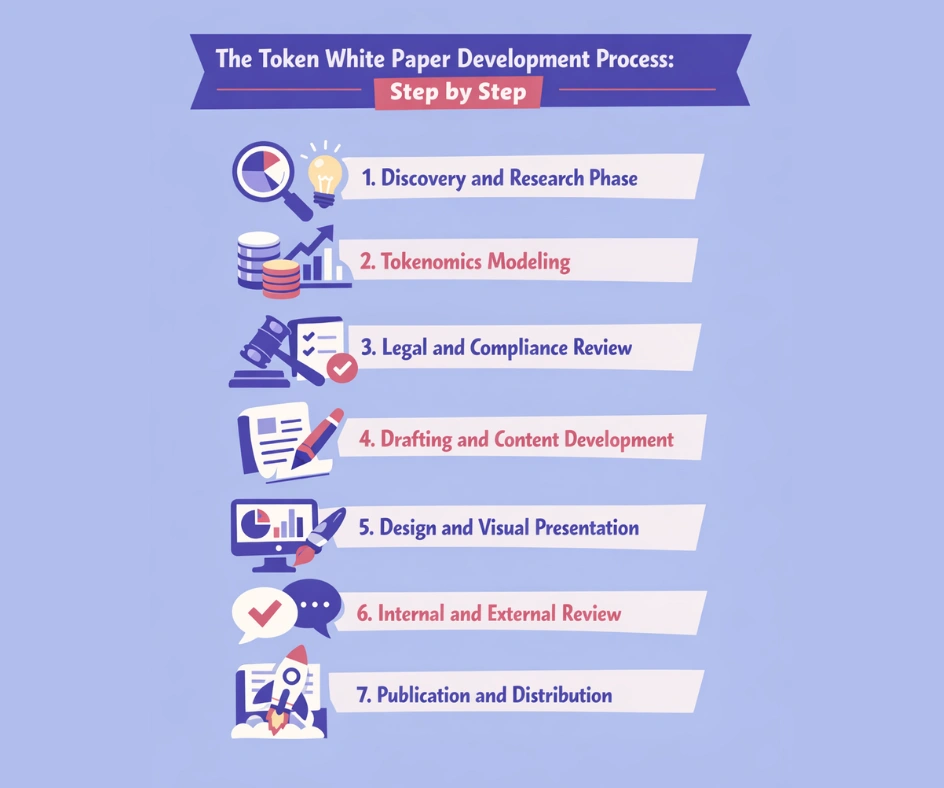
1. Discovery and Research Phase
Everything begins with understanding the project inside and out. This involves extensive interviews with the founding team, a review of the existing technical documentation, market research into the target industry, and competitive analysis of similar projects. The goal is to identify the project’s unique strengths, gaps in its current planning, and the key messages that will resonate with investors.
2. Tokenomics Modeling
Before a single word is written, the token’s economic model needs to be designed or validated. This includes setting the total supply, defining distribution allocations, establishing vesting schedules, and modeling scenarios for different levels of adoption. Tokenomics consultants often use spreadsheet models and simulations to stress test the proposed token economy under various conditions.
3. Legal and Compliance Review
A legal team reviews the token classification (utility vs. security), identifies the regulatory requirements for each target jurisdiction, and advises on what disclosures must be included. For EU focused projects, this includes alignment with MiCA’s mandatory white paper template. For U.S. facing projects, it may involve Reg D, Reg S, or Reg A+ considerations.
4. Drafting and Content Development
With research, tokenomics, and legal guidance in hand, the writing begins. Experienced token white paper writers work section by section, ensuring that the technical content is accurate, the narrative is engaging, and the compliance elements are properly integrated. Multiple drafts and review cycles are standard. The best teams treat the white paper as a living document that evolves as the project matures.
5. Design and Visual Presentation
A professional white paper is not just well written; it is also well designed. Clean layouts, consistent branding, informative diagrams, and clear data visualizations all contribute to the reader’s experience. First impressions matter enormously in a market where investors often review dozens of white papers before committing capital to a single project.
6. Internal and External Review
Before publication, the white paper should go through several rounds of review. The technical team verifies accuracy. The legal team confirms compliance. External advisors or peer reviewers provide feedback from the perspective of the target audience. This quality assurance step is what separates a good white paper from one that could create problems down the road.
7. Publication and Distribution
The final white paper is published on the project’s official website and distributed through community channels, social media, and relevant industry platforms. Under MiCA, the white paper must be available in at least one official language of the relevant EU member state and must be in a downloadable, machine readable electronic format (XHTML). Many projects also share their white papers on platforms like GitHub, crypto forums, and through email campaigns to potential investors.
You may also like:
Common Mistakes in Token White Paper Writing
Even with the best intentions, token white paper writing can go wrong in predictable ways. Awareness of these common pitfalls can save a project significant time, money, and credibility.
1. Vague or Unrealistic Claims
White papers that promise to “revolutionize” an industry without providing concrete evidence or a credible plan to do so immediately lose trust. Investors have seen thousands of these claims, and they know the difference between ambition backed by substance and hype backed by nothing. Every claim in a white paper should be supported by data, technical detail, or a logical argument.
2. Missing or Weak Tokenomics
A white paper without a well developed tokenomics section is like a business plan without financial projections. The token model is what investors use to evaluate whether the economics of the project make sense. Weak tokenomics was identified as a contributing factor in 68% of unsustainable ICO projects, making it one of the leading causes of failure.
3. Lack of Team Transparency
Anonymous or poorly documented teams raise immediate red flags. While privacy is valued in the crypto community, investors need verifiable information about who is building the project and whether they have the skills and experience to deliver on their promises.
4. Ignoring Regulatory Requirements
Projects that skip the legal review process are playing a dangerous game. Regulatory pushback or security classification halted 22% of ICOs in 2025. A white paper that does not address compliance is not just incomplete; it is a liability.
5. Poor Readability and Design
Technical accuracy means nothing if the reader cannot follow the argument. Dense, jargon heavy white papers that lack visual breaks, clear headings, and a logical flow will lose readers quickly. Professional design is not vanity; it is a communication tool.
6. No Clear Differentiation
In a market with thousands of competing projects, a white paper that reads like every other white paper will not generate interest. The document needs to articulate what makes this project different, and it needs to do so early and clearly.
How to Choose Blockchain White Paper Services
Not all white paper development providers are created equal. For founders who are considering outsourcing their token white paper development, here are the key criteria to evaluate.
1. Domain Expertise
The team writing your white paper should have deep familiarity with blockchain technology, tokenomics, and the regulatory environment in your target markets. Ask for samples of previous work and references from past clients. A writer who understands DeFi but has never worked on an STO may not be the right fit for a securities focused project, and vice versa.
2. Legal and Compliance Capability
Given the increasing importance of regulatory compliance, choose a provider that either has in house legal expertise or works closely with blockchain specialized law firms. The ability to produce a white paper that meets MiCA, SEC, or MAS requirements is not a bonus; it is a necessity.
3. End to End Services
The best providers offer more than just writing. Look for teams that can assist with tokenomics modeling, competitive analysis, market research, and visual design. An integrated approach produces a more cohesive document than one assembled from disconnected contributions.
4. Transparency About Process and Pricing
A reputable service provider should be clear about their process, timelines, and pricing structure. White paper development costs vary widely depending on complexity, scope, and geographic location of the service provider. Understanding what you are paying for, and what is included at each stage, prevents surprises later.
5. Post Publication Support
White papers are not static documents. As projects evolve, the white paper may need to be updated to reflect new developments, regulatory changes, or shifts in strategy. Choose a provider that offers post publication support or revision packages.
Launch Your Token with a Professional White Paper
Whether you need ICO white paper development, STO white paper services, comprehensive tokenomics modeling, or compliance aligned documentation for global markets, our experienced team delivers investor ready white papers tailored to your project’s specific needs. We combine deep blockchain expertise with regulatory awareness and professional design to create documents that build trust, attract capital, and stand up to scrutiny.
Final Thoughts
Token white paper development has come a long way from the nine page document that introduced Bitcoin to the world in 2008. What was once an informal tradition among blockchain developers has become a structured, compliance driven discipline that sits at the center of every serious token launch. Whether a project is pursuing an ICO, an STO, or any other form of token based fundraising, the white paper is the document that investors, regulators, and community members turn to first.
The stakes have never been higher. Regulatory frameworks like MiCA have transformed the white paper from a marketing tool into a legal requirement with real liability attached. Investors, burned by the failures and scams of earlier market cycles, now demand deeper documentation, verified claims, and transparent team information before committing capital. And with thousands of projects competing for attention and funding every year, the quality of a white paper can be the deciding factor between success and obscurity.
For founders, the lesson is straightforward: invest in your white paper the way you would invest in your product. Bring in specialists who understand both the technology and the regulatory environment. Build your tokenomics with rigor, not hope. Be transparent about risks and limitations. And design a document that communicates your vision with clarity and authority. The white paper is not just documentation. It is the foundation on which everything else is built.
Frequently Asked Questions
Q1.What is token white paper development?
Token white paper development is the process of researching, writing, designing, and legally reviewing the foundational document for a blockchain project. This document explains the problem the project solves, the technology behind it, the token’s economic model, the team’s background, and the project’s roadmap. It is the primary tool used by investors, regulators, and communities to evaluate a project before participating in its token sale.
Q2.How is an ICO white paper different from an STO white paper?
An ICO white paper focuses on utility tokens and emphasizes the project’s technology, use cases, and fundraising structure. An STO white paper, on the other hand, deals with security tokens backed by real assets and must comply with securities laws. STO white papers include detailed asset documentation, investor eligibility criteria, and legal disclosures that go beyond what a typical ICO white paper requires.
Q3.Does MiCA require a white paper for all crypto tokens in the EU?
Yes, under MiCA, any person or entity offering crypto assets to the public in the EU or seeking to have them admitted to trading on a platform must publish a compliant white paper. There are some exemptions, such as offerings to fewer than 150 persons per member state or those with a total consideration under one million euros over 12 months. However, for most commercial token launches, the white paper requirement applies.
Q4.How long should a token white paper be?
There is no fixed rule, but most effective token white papers range from 20 to 50 pages. Research shows that white papers with 35 or more pages tend to perform better in fundraising outcomes. The length should be driven by the complexity of the project and the need to provide sufficient detail for both technical and non technical readers, rather than by an arbitrary target.
Q5.What role does tokenomics play in a white paper?
Tokenomics is one of the most closely scrutinized sections of any white paper. It covers the total token supply, distribution model, vesting schedules, utility within the ecosystem, and mechanisms for managing supply and demand. Weak tokenomics has been linked to the failure of a significant portion of ICO projects, making it a section that requires careful design and, where possible, independent validation.
Q6.Can I write a token white paper without hiring professionals?
It is technically possible, but not advisable for projects seeking serious investment or planning to operate in regulated markets. A white paper involves technical writing, economic modeling, legal compliance, and professional design. Errors in any of these areas can damage credibility, delay the launch, or create legal exposure. Most successful projects engage specialized blockchain white paper services to ensure the document meets investor expectations and regulatory standards.
Explore Services
Related Services
Reviewed by

Aman Vaths
Founder of Nadcab Labs
Aman Vaths is the Founder & CTO of Nadcab Labs, a global digital engineering company delivering enterprise-grade solutions across AI, Web3, Blockchain, Big Data, Cloud, Cybersecurity, and Modern Application Development. With deep technical leadership and product innovation experience, Aman has positioned Nadcab Labs as one of the most advanced engineering companies driving the next era of intelligent, secure, and scalable software systems. Under his leadership, Nadcab Labs has built 2,000+ global projects across sectors including fintech, banking, healthcare, real estate, logistics, gaming, manufacturing, and next-generation DePIN networks. Aman’s strength lies in architecting high-performance systems, end-to-end platform engineering, and designing enterprise solutions that operate at global scale.