Ai Overview
Cryptocurrency markets have always rewarded projects that solve the inflation problem. A burnable token offers one of the most direct answers to this challenge, it gives projects the ability to permanently remove tokens from circulation, tightening supply in a way that no amount of marketing can replicate. Uniswap’s recent governance proposal follows this model, redirecting a portion of trading fees to buy and burn UNI tokens, with projected annual supply reduction worth approximately $130 million.
Cryptocurrency markets have always rewarded projects that solve the inflation problem. When a token’s supply keeps growing without matching demand, holders watch their share of the ecosystem quietly erode. A burnable token offers one of the most direct answers to this challenge, it gives projects the ability to permanently remove tokens from circulation, tightening supply in a way that no amount of marketing can replicate. The concept is simple, but the mechanics behind effective token burning and its economic consequences are anything but straightforward.
The scale of recent token burns reveals how seriously the industry takes this mechanism. BNB Chain completed its 33rd quarterly auto-burn in late 2025, destroying over 1.44 million BNB worth approximately $1.69 billion, the largest quarterly burn in dollar terms.[1] Around the same time, Uniswap’s governance community voted overwhelmingly to activate protocol fees and implement a burn mechanism for UNI tokens, with over 125 million votes in favor.[2] These are not isolated experiments. They reflect a broader shift in how projects think about long-term token value, and why the development of burnable token standards has become central to modern tokenomics design.
Key Takeaways
- A burnable token includes a smart contract function that permanently removes tokens from circulation by sending them to an inaccessible address.
- Token burning creates deflationary pressure that can counter inflation, tighten supply, and increase each remaining holder’s proportional share of the ecosystem.
- Major projects like BNB Chain and Ethereum use automated burn mechanisms tied to real network activity rather than arbitrary manual burns.
- Effective burn strategies require transparent schedules, verifiable on-chain proof, and genuine ecosystem demand to produce meaningful economic impact.
- Burnable token features are being adopted across DeFi protocols, gaming economies, and NFT platforms as a core element of sustainable tokenomics.
- Not all burns are equal, projects burning tokens without underlying demand or utility often see little lasting price impact despite supply reduction.
What a Burnable Token Actually Is
Token burning has become one of the most discussed concepts in blockchain economics, yet many participants still confuse the mechanics with the outcomes. Understanding what a burnable token is at a structural level matters far more than following burn announcements.
The Core Mechanism Behind Token Burning
A burnable token is any cryptocurrency token whose smart contract includes a function that permanently destroys a specified quantity of tokens by sending them to a wallet address with no private key. Once tokens reach this address, often called a “dead” or “null” address, they cannot be retrieved, spent, or transferred by anyone. The tokens effectively cease to exist within the circulating supply. The development of this capability is written directly into the token’s smart contract at the code level, making it a verifiable and irreversible process that anyone can audit on the blockchain.
The most commonly used burn address across Ethereum-based tokens is 0x000000000000000000000000000000000000dEaD. When a burn transaction executes, the token balance at this address increases, but since no entity holds the corresponding private key, those tokens are permanently locked. Unlike tokens held in a time-bound vault or staking contract, burned tokens are gone forever with no possibility of re-entering circulation.
How Burn Functions Work in Smart Contracts
At the smart contract level, a burn function typically reduces the total supply variable and deducts the burned amount from the caller’s balance. In ERC-20 implementations, this often involves a dedicated burn() method that emits a Transfer event to the zero address, maintaining compatibility with blockchain explorers and analytics tools. Some contracts restrict who can call the burn function, limiting it to the contract owner, a governance multisig, or automated protocol logic, while others allow any token holder to voluntarily burn their own holdings. The development of standardized burn interfaces across token frameworks like OpenZeppelin has made it straightforward for projects to include burn capability from day one.
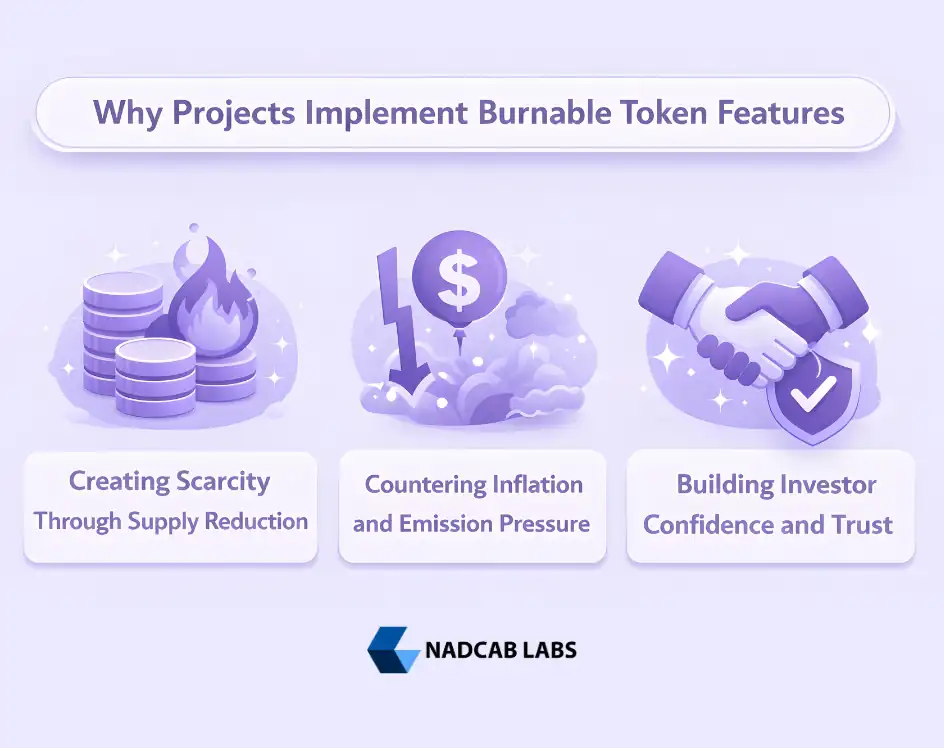
Why Projects Implement Burnable Token Features
The decision to make a token burnable is not merely a technical choice, it is an economic strategy with real consequences for holders, liquidity, and long-term project viability. Projects adopt burn mechanics for distinct but interconnected reasons.
Creating Scarcity Through Supply Reduction
One of the core reasons projects implement token burns is to decrease the circulating supply over time. From a basic economic standpoint, when supply shrinks while demand holds steady or increases, the value of each remaining token tends to rise. This mirrors the principle behind Bitcoin’s fixed 21-million cap, but burnable tokens introduce a more flexible, dynamic form of scarcity instead of relying on a hard limit. For teams building through token development solutions, incorporating a burn mechanism provides founders with a strategic tool to actively manage supply economics even after launch.
Countering Inflation and Emission Pressure
Many blockchain networks issue new tokens continuously, as staking rewards, mining incentives, or ecosystem grants. Without a counterbalancing force, this emission dilutes existing holders. A burnable token addresses this by destroying tokens at a rate that can offset new issuance. Ethereum’s EIP-1559 upgrade demonstrated this powerfully: by burning the base fee portion of every transaction, the network frequently enters deflationary periods where more ETH is destroyed than created. Over 3.5 million ETH has been burned since the mechanism launched, removing billions of dollars worth of supply.[3] The development of similar automated burn systems across other networks reflects how essential this deflationary counterweight has become.
Building Investor Confidence and Trust
Transparent, scheduled token burns signal to the market that a project is serious about protecting holder value. When burn events are verifiable on-chain and follow predictable schedules, investors can model future supply with greater accuracy. This predictability reduces uncertainty, a critical factor in attracting institutional capital. Projects that publish burn schedules in advance consistently build stronger credibility than those relying on surprise announcements. The development of transparent burn dashboards and real-time tracking tools has further enhanced accountability in this area.
Types of Token Burn Mechanisms
Not all burn mechanisms work the same way, and the differences matter for how effectively they achieve their economic goals. Understanding the various approaches helps holders and builders evaluate whether a project’s burn strategy is genuinely impactful or merely performative.
Manual and Scheduled Burns
Manual burns occur when a project team or governance body decides to destroy a specific quantity of tokens at a chosen time. These can be one-time events, such as burning unsold tokens after a fundraising round, or regularly scheduled operations like BNB Chain’s quarterly burns. The advantage is flexibility: teams can adjust burn quantities based on market conditions and community sentiment. The downside is that manual burns require trust in the executing party, since holders must rely on the team to follow through. Exploring how solana token creators approach burn schedules reveals the diversity of strategies across different blockchain ecosystems.
Automated and Transaction-Based Burns
Automated burns remove the need for human intervention by embedding the burn logic directly into protocol operations. Every time a transaction occurs, a percentage of the fee is automatically destroyed. Ethereum’s base fee burn under EIP-1559 is the most prominent example, but many DeFi protocols and layer-1 networks have adopted similar approaches. The key advantage is trustlessness, no individual or committee decides when or how much to burn. The protocol itself enforces the rules, and every participant can verify the process on-chain, creating a natural feedback loop where higher adoption leads to greater scarcity.
Buyback-and-Burn Models
In a buyback-and-burn model, a project uses revenue or treasury funds to purchase its own tokens on the open market and then destroys them. This approach mirrors stock buybacks in traditional finance and has the dual effect of creating buy pressure during the purchase phase and reducing supply during the burn phase. Uniswap’s recent governance proposal follows this model, redirecting a portion of trading fees to buy and burn UNI tokens, with projected annual supply reduction worth approximately $130 million.[4] The development of buyback-and-burn infrastructure has become increasingly sophisticated, with dedicated smart contracts handling the entire process autonomously.
Real-World Applications of Burnable Tokens
Burnable token mechanics have moved far beyond theoretical discussions. They are embedded in production systems across multiple sectors of the blockchain economy, each adapting the concept to specific operational needs.
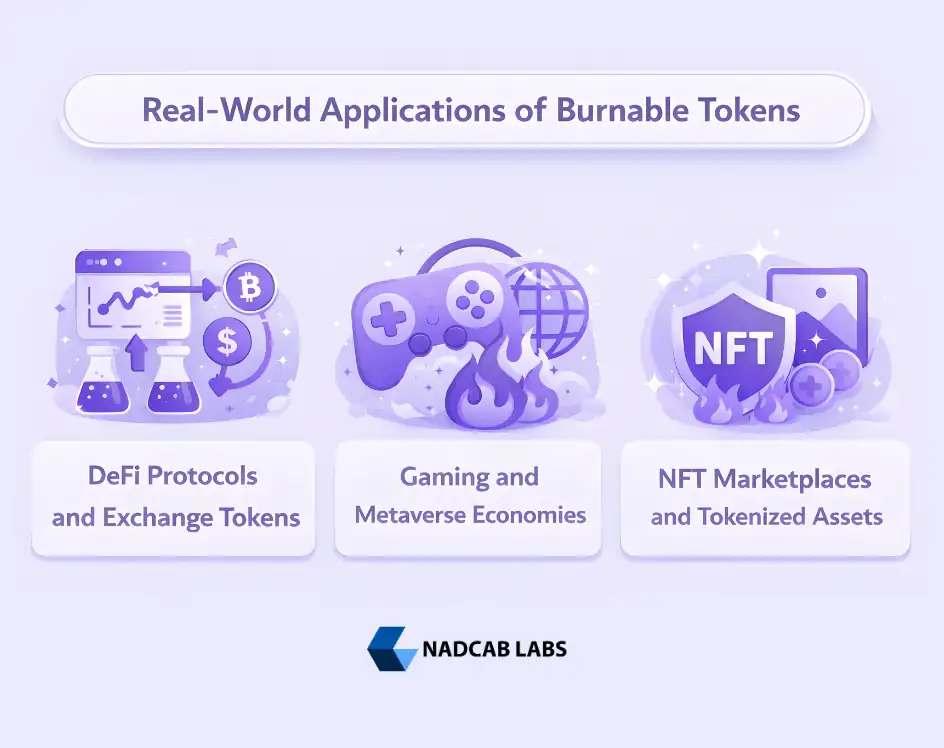
DeFi Protocols and Exchange Tokens
Decentralized finance protocols were among the earliest adopters of systematic token burning. Exchange tokens like BNB and OKB use burn mechanisms to tie platform growth to token scarcity, as trading volume increases, more tokens are destroyed. DEX governance tokens are following the same path, with Uniswap’s UNI burn proposal representing a watershed moment for decentralized exchange tokenomics. For projects pursuing Raydium token listing or similar DEX integrations, building burn mechanics into the token design from the start ensures compatibility with the deflationary expectations of DeFi participants.
Gaming and Metaverse Economies
Blockchain gaming economies face a unique inflation challenge: players constantly earn tokens through gameplay, creating persistent sell pressure if no counterbalancing mechanism exists. Burnable token features solve this by introducing token sinks, in-game purchases, crafting fees, entry costs, and upgrade mechanisms that destroy tokens when used. Well-designed gaming tokenomics tie burn rates to player activity, ensuring that popular games with high engagement also experience the strongest deflationary pressure. The development of sustainable play-to-earn models depends heavily on getting this balance right.
NFT Marketplaces and Tokenized Assets
NFT platforms have integrated burn mechanics in creative ways. Some marketplaces burn a percentage of listing fees or royalty payments, while others allow holders to burn NFTs to receive underlying token reserves. The broader category of Web3 tokens increasingly includes burn functionality as a standard feature rather than an optional add-on. In tokenized assets, burn mechanics also serve a regulatory function: when a real-world asset is redeemed, corresponding tokens must be destroyed to maintain accurate representation of underlying collateral.
Economic Impact and Limitations of Token Burning
While burnable token mechanics offer genuine economic benefits, the relationship between burning and price is more nuanced than simple supply-and-demand theory suggests. Understanding both the power and limitations of token burning is essential for informed decisions.
When Burns Create Real Value
Token burns are most effective when they are tied to genuine ecosystem activity. BNB’s auto-burn formula calculates destruction based on actual network usage and token price, meaning the mechanism responds to real demand rather than arbitrary decisions. Similarly, Ethereum’s fee burn directly correlates with transaction volume, during periods of high DeFi or NFT activity, the burn rate accelerates naturally. These activity-linked burns create a virtuous cycle: more usage leads to more burning, which tightens supply and attracts participants who value deflationary properties. The development of activity-based burn algorithms represents a significant advancement over earlier models that relied on periodic manual interventions.
When Burns Fall Short
Not every burn produces meaningful results. Projects with enormous initial supplies, sometimes in the trillions, can burn hundreds of billions of tokens and still leave so many in circulation that the supply reduction is statistically negligible. Burns also fail when they occur in isolation from genuine demand. A project can reduce its supply by 50%, but if nobody wants to buy or use the remaining tokens, the burn achieves nothing economically. Market sentiment plays a role too: identical burns during bull markets generate excitement, while the same events during downturns may barely register. Effective burnable token strategies must be paired with real utility and transparent communication.
Designing an Effective Burnable Token Strategy
For project teams considering burn mechanics, the implementation decisions made at the smart contract level will shape the token’s economic trajectory for years. Careful planning avoids common pitfalls and maximizes long-term impact.
Define Clear Burn Triggers and Schedules
Every burnable token should have clearly defined conditions under which burns occur. Whether the trigger is a time interval, a transaction threshold, or a governance vote, ambiguity undermines trust. Publishing a burn schedule with verifiable on-chain execution gives holders confidence that the mechanism is real and ongoing, not a one-time marketing gesture.
Balance Burn Rate with Ecosystem Growth
Burning too aggressively can starve the ecosystem of the liquidity it needs to function. If tokens are destroyed faster than new users enter, the remaining supply may become too concentrated or too expensive for the token to serve its utility purpose. The best approaches calibrate burn rates to growth metrics, ensuring that supply reduction keeps pace with adoption without creating artificial bottlenecks.
Ensure Transparency and Verifiability
Every burn event should be traceable on-chain, with the burn address, transaction hash, and quantity publicly accessible. Projects that provide dedicated burn dashboards or integrate with third-party analytics platforms demonstrate accountability. Verifiable burns separate credible projects from those making empty deflationary promises.
Final Thoughts
A burnable token is more than a technical feature, it is a commitment to a deflationary economic model that rewards holders, counters inflation, and ties token value to real-world usage. The mechanism has evolved from simple manual burns into sophisticated automated systems embedded in major blockchain networks. Ethereum burns transaction fees with every block, BNB Chain destroys billions in quarterly events, and DeFi governance communities are voting to implement burn-linked revenue models. The projects that succeed with burn mechanics combine transparent schedules, genuine ecosystem demand, and smart contract development that makes the process trustless and verifiable. Understanding how burnable token mechanics work is fundamental to navigating the economics of modern blockchain.
Frequently Asked Questions
Q1.What exactly is a burnable token?
A burnable token is a cryptocurrency whose smart contract includes a dedicated function to permanently destroy tokens by sending them to an inaccessible wallet address, reducing the total circulating supply irreversibly over time.
Q2.How does token burning affect price?
Token burning reduces the circulating supply, which can increase scarcity and support price appreciation when paired with stable or growing demand from active users, though burns alone never guarantee automatic value increases.
Q3.Can burned tokens ever be recovered?
No, burned tokens are sent to addresses without private keys, making recovery permanently impossible under any circumstances. This complete irreversibility is what distinguishes burning from locking or staking mechanisms in blockchain systems.
Q4.What triggers an automatic token burn?
Automatic token burns are triggered by smart contract logic tied to specific on-chain events such as transactions, fee collection, or protocol revenue thresholds, executing the destruction process without any manual human intervention required.
Q5.Why do DeFi protocols burn tokens?
DeFi protocols burn tokens to create sustained deflationary pressure, link platform revenue directly to token scarcity, reward committed long-term holders, and transform governance-only tokens into genuinely value-accruing economic assets within their ecosystems.
Q6.Is token burning same as staking?
No, staking temporarily locks tokens that can be withdrawn later with earned rewards, while burning permanently destroys them forever. Staking preserves and grows supply, whereas burning irreversibly reduces total token circulation permanently.
Q7.How do buyback-and-burn models work?
Projects use protocol revenue or treasury funds to purchase their own tokens directly from open markets, then permanently destroy those purchased tokens through smart contracts, combining buy-side market pressure with lasting supply reduction.
Explore Services
Related Services
Reviewed by

Aman Vaths
Founder of Nadcab Labs
Aman Vaths is the Founder & CTO of Nadcab Labs, a global digital engineering company delivering enterprise-grade solutions across AI, Web3, Blockchain, Big Data, Cloud, Cybersecurity, and Modern Application Development. With deep technical leadership and product innovation experience, Aman has positioned Nadcab Labs as one of the most advanced engineering companies driving the next era of intelligent, secure, and scalable software systems. Under his leadership, Nadcab Labs has built 2,000+ global projects across sectors including fintech, banking, healthcare, real estate, logistics, gaming, manufacturing, and next-generation DePIN networks. Aman’s strength lies in architecting high-performance systems, end-to-end platform engineering, and designing enterprise solutions that operate at global scale.