Ai Overview
Testing, deployment and on-chain verification represent critical phases transforming smart contract code from development environments to production blockchain networks. These three interconnected processes demand rigorous methodology, as errors discovered post-deployment cannot be corrected without costly migrations or upgradeable contract patterns. Tests should achieve high code coverage, ideally exceeding 90% of executable lines to ensure thorough validation.
Testing, deployment and on-chain verification represent critical phases transforming smart contract code from development environments to production blockchain networks. Comprehensive testing validates contract functionality across expected scenarios and edge cases, deployment executes the irreversible process of publishing code to immutable blockchain ledgers, while on-chain verification enables public code inspection ensuring transparency and building user trust. These three interconnected processes demand rigorous methodology, as errors discovered post-deployment cannot be corrected without costly migrations or upgradeable contract patterns.
Professional blockchain development follows systematic workflows progressing through unit testing, integration testing, testnet deployment, security audits, mainnet deployment, and source code verification. Each stage builds confidence that contracts behave as intended under real-world conditions while exposing vulnerabilities before significant value flows through systems. Understanding the timeline for token and coin launch helps projects allocate adequate time for thorough testing preventing rushed deployments that compromise security or functionality.
Key Takeaways
- Comprehensive Testing Essential: Smart contract testing must cover unit tests validating individual functions, integration tests verifying component interactions, and stress tests assessing performance under extreme conditions before mainnet deployment.
- Testnet Deployment Critical: Deploying contracts to public test networks like Sepolia, Goerli, or Mumbai enables real-world validation with actual blockchain mechanics without risking real funds during final pre-production testing.
- Security Audits Non-Negotiable: Professional third-party audits by specialized firms identify vulnerabilities through manual code review and automated analysis, with findings requiring remediation before production deployment.
- Deployment Irreversible: Mainnet deployment publishes immutable code to production blockchains, requiring careful verification of all parameters, addresses, and configuration before executing deployment transactions.
- Source Verification Builds Trust: Publishing and verifying contract source code on block explorers like Etherscan enables public inspection, facilitates integration, and demonstrates transparency essential for user confidence.
- Gas Optimization Matters: Testing should identify gas-intensive operations enabling optimization before deployment, as high transaction costs directly impact user experience and protocol competitiveness.
- Multi-Environment Strategy: Professional workflows utilize local development networks, private testnets, public testnets, and mainnet staging environments progressing systematically through deployment phases.
- Continuous Monitoring Post-Deployment: Launch monitoring tracks contract interactions, gas consumption, error rates, and unexpected behaviors enabling rapid response to issues discovered in production environments.
Comprehensive Smart Contract Testing
Thorough testing forms the foundation of secure smart contract deployment, validating that code behaves correctly across all scenarios including normal operations, edge cases, and malicious inputs. Testing methodologies progress from isolated unit tests through integrated system tests, with each layer exposing different categories of defects requiring identification and correction.
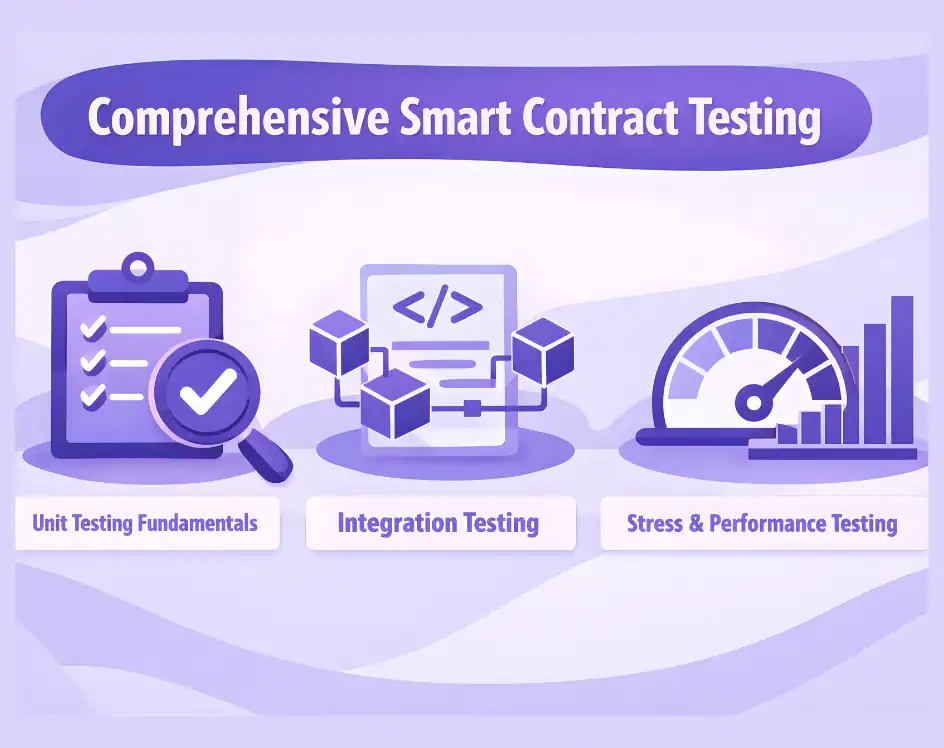
Unit Testing Fundamentals
Unit tests validate individual contract functions in isolation, verifying that each function produces expected outputs given specific inputs. These tests form the base testing layer, providing fast feedback during development as developers iterate on implementation details. Modern frameworks like Hardhat and Foundry enable writing unit tests in JavaScript or Solidity respectively, executing hundreds of tests in seconds.
Effective unit tests cover normal execution paths, boundary conditions where values approach limits, and error conditions triggering reverts or exceptions. For token contracts, unit tests verify transfer functions move correct amounts, approval mechanisms grant appropriate spending rights, and balance queries return accurate values. Tests should achieve high code coverage, ideally exceeding 90% of executable lines to ensure thorough validation.
According to blockchain security research, projects with comprehensive test suites containing over 95% code coverage experience 67% fewer post-deployment vulnerabilities compared to those with minimal testing[1]. This data demonstrates testing’s direct impact on production security and reliability.
Integration Testing
Integration tests validate interactions between multiple contracts and external systems, exposing interface mismatches, incorrect assumptions about external state, and timing dependencies invisible in unit tests. These tests deploy multiple contracts simultaneously, simulating realistic scenarios where token contracts interact with exchanges, lending protocols, or governance systems.
Integration testing proves especially critical for managing crypto token supply across complex ecosystems involving minting, burning, staking, and cross-contract transfers. Tests should verify that total supply remains consistent despite distributed operations, vesting schedules execute correctly, and emergency pause mechanisms function as intended.
Mock contracts and test fixtures enable controlled integration testing without dependencies on external protocol availability. However, testing should also include integration against actual deployed test versions of dependent protocols when possible, validating compatibility with real implementations rather than idealized mocks.
Stress and Performance Testing
Stress testing assesses contract behavior under extreme conditions including maximum user counts, transaction volumes approaching block gas limits, and rapid state changes stressing computational resources. These tests identify scalability bottlenecks, gas consumption issues, and performance degradation affecting user experience at scale.
Gas profiling during testing evaluates the transaction costs of each function, helping identify and optimize expensive operations before deployment. High gas fees can significantly affect usability, as users often compare transaction costs across different protocols when deciding which platform to use. A reliable token development company focuses on thorough gas optimization to ensure efficient performance and maintain competitive transaction costs.
Load testing simulates concurrent transactions testing race conditions, reentrancy vulnerabilities, and state consistency under parallel execution. While blockchain transactions execute sequentially within blocks, testing concurrent scenarios validates that transaction ordering does not create exploitable conditions or inconsistent state.
| Testing Type | Purpose | Tools | Coverage Target |
|---|---|---|---|
| Unit Tests | Validate individual function behavior | Hardhat, Foundry, Truffle | 95%+ code coverage |
| Integration Tests | Verify multi-contract interactions | Hardhat Network, Ganache | All critical workflows |
| Stress Tests | Assess performance under load | Custom scripts, gas profilers | Peak usage scenarios |
| Security Tests | Identify vulnerability patterns | Slither, Mythril, Echidna | Common exploit vectors |
Security Auditing Process
Professional security audits provide independent verification of contract security through systematic analysis by specialized blockchain security firms. Audits identify vulnerabilities through combination of automated scanning, manual code review, and adversarial testing attempting to exploit discovered weaknesses.
Automated Security Analysis
Automated tools scan smart contract code for common vulnerability patterns including reentrancy, integer overflow, unchecked external calls, and improper access controls. Tools like Slither, Mythril, and Securify analyze code statically without execution, while symbolic execution tools like Manticore explore possible execution paths identifying reachable vulnerable states.
These tools provide fast initial screening identifying low-hanging security issues before manual review. However, automated analysis cannot catch all vulnerabilities, particularly business logic errors, economic attack vectors, or context-specific security issues requiring domain expertise to identify. Automated tools complement rather than replace manual audit processes.
Manual Code Review
Experienced security auditors manually review contract code, documentation, and test suites identifying vulnerabilities automated tools miss. Manual review assesses whether code implements intended business logic correctly, validates access controls align with security requirements, and evaluates economic incentive compatibility preventing exploitation.
Auditors examine code for common anti-patterns like unchecked math operations, dangerous delegatecalls, insufficient input validation, and improper error handling. They also assess architecture-level decisions including upgrade mechanisms, governance processes, and external dependencies that could introduce systemic risks.
Audit Report and Remediation
Audit reports classify findings by severity from critical vulnerabilities enabling immediate fund theft through informational suggestions improving code quality. Projects must address critical and high-severity findings before deployment, with medium-severity issues typically requiring remediation and low-severity items considered for future improvements.
Remediation involves fixing identified issues, retesting to verify fixes work correctly, and often engaging auditors for re-review confirming proper resolution. Some projects undergo multiple audit rounds with different firms providing independent verification. Industry data shows projects completing two or more independent audits experience 89% fewer post-deployment exploits.
Choosing the Right Testnet for Your Target Network
Testnet deployment provides final pre-production validation using public blockchain testnets mimicking mainnet conditions without risking real value. This critical step exposes issues invisible in local testing including network latency, block time variability, gas price fluctuations, and interactions with other deployed contracts.
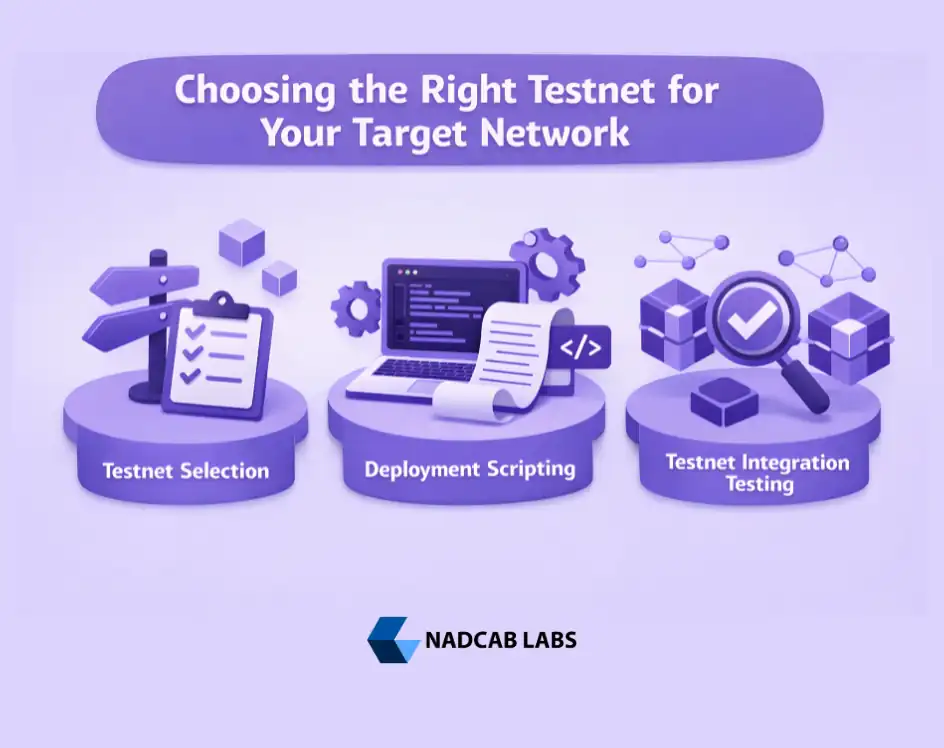
Testnet Selection
Different blockchain networks maintain dedicated testnets for development and testing. Ethereum developers use Sepolia or Goerli testnets, Polygon projects deploy to Mumbai testnet, and Binance Smart Chain uses BSC Testnet. Each testnet provides free test tokens through faucets enabling deployment and transaction testing without real cryptocurrency costs.
Testnet selection should match target mainnet as closely as possible regarding consensus mechanism, block time, and protocol features. Using Sepolia testnet for Ethereum mainnet deployment ensures testing environment mirrors production conditions, while using different networks may hide compatibility issues.
Deployment Scripting
Deployment scripts automate contract deployment, configuration, and initialization ensuring consistent, repeatable deployment processes. Scripts typically deploy contracts, set initial parameters, grant roles or permissions, and verify deployment success through automated checks.
Hardhat and Truffle provide deployment frameworks managing contract compilation, deployment to specified networks, and deployment state tracking. Scripts should be idempotent where possible, allowing rerun without duplicating deployments or corrupting state. Version control for deployment scripts ensures deployment process documentation and reproducibility.
Testnet Integration Testing
Once deployed to testnets, contracts undergo integration testing against actual blockchain infrastructure. Testing should include wallet integration verifying contracts work correctly with MetaMask, Trust Wallet, and other popular wallets. Block explorer integration confirms contracts display properly on Etherscan or similar services.
Testnet deployments enable user acceptance testing where non-technical stakeholders interact with contracts through production-like interfaces, validating user experience and identifying usability issues before mainnet launch. This testing phase often reveals frontend-contract integration issues invisible in backend testing.
Mainnet Deployment Process
Mainnet deployment represents the irreversible step publishing contract code to production blockchain networks where real value will flow. This critical process requires careful preparation, multiple verification steps, and contingency planning for potential issues discovered post-deployment.
Pre-Deployment Checklist
Before initiating mainnet deployment, projects should complete comprehensive checklists verifying all prerequisites are satisfied. This includes confirming security audits are complete with all critical findings remediated, testnet deployment succeeded without issues, deployment scripts are tested and version controlled, and all initialization parameters are documented and verified.
Deployment wallets must be secured with hardware wallets or multi-signature contracts preventing unauthorized deployment or compromised keys enabling post-deployment control seizure. Sufficient native tokens (ETH, BNB, etc.) must be available for deployment gas costs, which can be substantial for complex contracts.
Deployment Execution
Deployment execution follows carefully scripted procedures minimizing human error during critical operations. Deployment typically begins with deploying library contracts if required, followed by main contract deployment, and concluding with configuration transactions setting initial parameters.
Each deployment transaction should be verified in block explorers before proceeding to next steps, confirming contracts deployed to expected addresses with correct bytecode. Deployment wallet private keys should remain offline except during deployment, immediately returning to cold storage after completion minimizing compromise windows.
Post-Deployment Verification
Immediately after deployment, teams should verify contract state matches expectations through read-only function calls checking initialization parameters, permissions, and configuration. Automated monitoring should be established tracking contract interactions, gas usage, error rates, and security-relevant events enabling rapid issue detection.
Initial period following deployment requires heightened monitoring as contracts encounter real-world conditions potentially exposing issues missed during testing. Teams should prepare incident response procedures enabling rapid communication and coordinated response if serious issues arise requiring emergency actions.
| Deployment Phase | Key Activities | Critical Checks |
|---|---|---|
| Pre-Deployment | Checklist completion, wallet preparation, gas estimation | Audit completion, testnet success, parameter verification |
| Deployment | Contract deployment, initialization, configuration | Address verification, bytecode matching, transaction confirmation |
| Post-Deployment | State verification, monitoring setup, documentation | Parameter correctness, permission validation, event monitoring |
On-Chain Source Code Verification
On-chain verification publishes contract source code to block explorers enabling public inspection of deployed bytecode’s original code. This transparency builds user trust, facilitates third-party integration, and enables security researchers to audit production contracts identifying potential vulnerabilities benefiting entire ecosystems.
Verification Process
Source verification involves uploading contract source code, compiler version, optimization settings, and constructor arguments to verification services like Etherscan, which recompile code and compare resulting bytecode against deployed contract bytecode. Matching bytecode confirms provided source accurately represents deployed contract.
Verification can be performed manually through block explorer web interfaces or automated using tools like Hardhat’s verify plugin or Foundry’s forge verify command. Automated verification integrates into deployment scripts ensuring contracts are verified immediately after deployment maintaining transparency from launch.
Multi-file contracts require uploading all imported files or flattening source into single files for verification. Verification services support various submission formats including flattened source, standard JSON input, or source code with metadata. Using consistent compiler versions and settings between development and verification prevents verification failures from bytecode mismatches.
Benefits of Verification
Verified source code enables users to inspect contract logic before interacting, understanding exactly what transactions will execute and whether contracts contain malicious functionality. This transparency proves especially important for financial applications where users deposit significant value trusting contract security.
Developers integrating with verified contracts benefit from accessible source code and ABI (Application Binary Interface) enabling easy interaction without requiring separate documentation. Block explorers provide read and write interfaces for verified contracts, allowing non-technical users to interact directly through web interfaces.
Security researchers monitoring blockchain activity can audit verified contracts identifying vulnerabilities benefiting entire communities. Responsible disclosure of discovered issues enables project teams to deploy fixes before exploits occur. According to analysis by blockchain security firm CertiK, verified contracts receive 3.2x more security researcher attention than unverified contracts, significantly improving community-driven security oversight.
Verification Best Practices
Projects should verify all deployed contracts including libraries, proxies, and implementations. Upgradeable contracts require verifying both proxy and implementation contracts, with implementation verification repeated after each upgrade deploying new implementation bytecode.
Verification metadata including compiler version, optimization runs, and library addresses should be documented in deployment records enabling future re-verification if needed. Automated verification as part of deployment pipelines ensures verification never gets overlooked in manual processes.
For contracts deployed across multiple chains, verification should be completed on every network’s block explorer providing consistent transparency across all deployments. Multi-chain projects benefit from tools automating verification across multiple explorers reducing manual verification burden.
Continuous Monitoring and Incident Response
Post-deployment monitoring provides ongoing visibility into contract operations detecting anomalies, tracking performance metrics, and identifying potential security incidents requiring investigation or response. Professional operations maintain comprehensive monitoring ensuring rapid detection and response to production issues.
Transaction and Event Monitoring
Automated systems should monitor contract transactions and emitted events detecting unusual patterns potentially indicating exploits or system malfunctions. Monitoring platforms like Tenderly, Forta, or custom monitoring solutions track transaction success rates, gas consumption patterns, large transfers, and security-relevant events requiring investigation.
Alert systems notify teams when monitored metrics exceed thresholds, enabling rapid response before issues escalate. For example, detecting abnormal token minting activity could indicate compromised minter roles requiring immediate emergency response activating pause functionality or upgrade mechanisms.
Performance and Cost Tracking
Monitoring gas consumption trends identifies optimization opportunities reducing user costs and improving competitiveness. Tracking average transaction costs over time reveals whether gas optimizations are effective or if protocol usage patterns are changing in ways increasing costs.
Analyzing transaction success and failure rates identifies user experience issues or integration problems affecting adoption. High failure rates for specific functions may indicate frontend bugs, insufficient user guidance, or legitimate contract issues requiring investigation and potential fixes.
Security Incident Response
Despite thorough testing and auditing, production deployments may encounter security incidents requiring rapid coordinated response. Incident response plans should define escalation procedures, communication protocols, technical response capabilities, and decision-making authority enabling effective crisis management.
Response capabilities may include emergency pause mechanisms halting critical functions, upgrade execution deploying fixes for upgradeable contracts, or coordination with exchanges freezing suspicious funds. These capabilities require careful design balancing security responsiveness against centralization risks and user trust considerations.
Deploy Smart Contracts Securely
Partner with experienced blockchain development teams implementing comprehensive testing, secure deployment procedures, and thorough verification processes ensuring production-ready smart contracts.
Testing Framework Comparison
Multiple testing frameworks support smart contract development, each offering different features, performance characteristics, and developer experience trade-offs. Choosing appropriate frameworks depends on project requirements, team expertise, and specific testing needs.
Hardhat Framework
Hardhat provides comprehensive development environment including built-in local blockchain, extensive plugin ecosystem, and JavaScript/TypeScript testing support. Its console.log debugging functionality simplifies development by enabling traditional logging during contract execution, dramatically improving debugging productivity.
Hardhat’s network forking capabilities allow developers to test against mainnet state, validating contract interactions with real deployed protocols without needing local mock implementations. This feature is especially valuable for DeFi projects integrating with platforms like Uniswap or Aave, making it a key advantage in delivering robust and reliable token development services.
Foundry Framework
Foundry offers fast Solidity-native testing enabling developers to write tests in Solidity alongside contract code. This approach provides better tooling integration, faster test execution, and direct access to Solidity features without JavaScript translation layers.
Foundry’s fuzzing capabilities automatically generate random test inputs exploring edge cases developers might not explicitly test. Fuzz testing excels at discovering input combinations triggering unexpected behaviors or vulnerabilities, complementing manually written test cases. Industry benchmarks show Foundry executing test suites 10-50x faster than JavaScript alternatives for comparable test coverage.
Framework Selection
Projects benefit from combining frameworks leveraging each’s strengths. Many teams use Hardhat for development and integration testing while adding Foundry for intensive fuzz testing and gas optimization. This hybrid approach provides comprehensive testing coverage without sacrificing developer productivity or test execution speed.
Final Thoughts
Testing, deployment and on-chain verification represent interconnected processes ensuring smart contracts function correctly, deploy securely, and operate transparently in production environments. Comprehensive testing through unit, integration, and security analysis validates contract functionality while exposing vulnerabilities before real value flows through systems. Professional workflows invest adequate time in thorough testing preventing rushed deployments that compromise security or create user experience issues.
Systematic deployment procedures progressing through testnet validation before mainnet launch provide multiple verification layers catching issues in progressively realistic environments. Testnet deployments expose blockchain-specific behaviors invisible in local testing, while security audits provide independent verification identifying vulnerabilities automated testing misses. Working with experienced coin and token service providers ensures deployment follows industry best practices minimizing risks.
On-chain source verification builds user trust through transparency, facilitates integration by providing accessible source code, and enables community security research strengthening entire ecosystems. Automated verification integrated into deployment pipelines ensures consistent transparency across all contract deployments. Post-deployment monitoring provides ongoing visibility detecting issues requiring investigation or emergency response.
Frequently Asked Questions
Q1.Why is testing smart contracts critical?
Smart contract immutability means deployed code cannot be corrected without migrations or upgradeable patterns. comprehensive testing validates functionality, exposes vulnerabilities, and ensures correct behavior before irreversible mainnet deployment preventing catastrophic post-launch failures.
Q2.What is testnet deployment?
Testnet deployment publishes contracts to public test blockchain networks mimicking mainnet conditions without risking real value. this enables final validation against actual blockchain infrastructure, wallet integration testing, and user acceptance testing.
Q3.How long should testing take?
Testing duration varies by complexity, but professional projects allocate two to six weeks for comprehensive testing including unit tests, integration tests, security audits, and testnet validation before mainnet deployment.
Q4.What is source code verification?
Source verification publishes contract code to block explorers enabling public inspection comparing deployed bytecode against provided source. verification builds trust, facilitates integration, and enables community security research.
Q5.What happens after deployment?
Post-deployment monitoring tracks contract interactions, gas consumption, error rates, and security events enabling rapid issue detection. incident response procedures enable coordinated reactions to discovered vulnerabilities or exploitation attempts.
Q6.Which testing framework is best?
Framework selection depends on project needs. hardhat offers comprehensive javascript ecosystem and debugging tools, while foundry provides faster solidity-native testing with fuzzing. many projects combine both leveraging respective strengths.
Explore Services
Related Services
Reviewed by

Aman Vaths
Founder of Nadcab Labs
Aman Vaths is the Founder & CTO of Nadcab Labs, a global digital engineering company delivering enterprise-grade solutions across AI, Web3, Blockchain, Big Data, Cloud, Cybersecurity, and Modern Application Development. With deep technical leadership and product innovation experience, Aman has positioned Nadcab Labs as one of the most advanced engineering companies driving the next era of intelligent, secure, and scalable software systems. Under his leadership, Nadcab Labs has built 2,000+ global projects across sectors including fintech, banking, healthcare, real estate, logistics, gaming, manufacturing, and next-generation DePIN networks. Aman’s strength lies in architecting high-performance systems, end-to-end platform engineering, and designing enterprise solutions that operate at global scale.