Ai Overview
Getting a token listed on the right decentralized exchange can determine whether a project gains traction or fades into obscurity. Raydium has emerged as one of the most important DEX platforms on the Solana blockchain, processing over $51. 9 billion in trading volume during Q3 2025 alone and capturing roughly 16% of all Solana DEX activity. The Solana DEX landscape has grown dramatically, with annual spot volume reaching approximately $1.
Getting a token listed on the right decentralized exchange can determine whether a project gains traction or fades into obscurity. Raydium has emerged as one of the most important DEX platforms on the Solana blockchain, processing over $51.9 billion in trading volume during Q3 2025 alone and capturing roughly 16% of all Solana DEX activity.[1] For token creators looking to reach an active and growing trading community, Raydium offers deep liquidity, sub-second transaction speeds, and a mature ecosystem that supports everything from spot swaps to perpetual futures. Understanding how Raydium token listing works from smart contract integration to liquidity pool configuration is essential knowledge for any project building on Solana.
The Solana DEX landscape has grown dramatically, with annual spot volume reaching approximately $1.95 trillion in 2025, doubling the previous year’s total.[2] Raydium accounted for the largest share of that volume, processing nearly $642 billion across the year. These numbers reflect genuine demand from traders worldwide, and the development of new features like LaunchLab has further cemented Raydium’s position as a go-to platform for token launches and listings.
Key Takeaways
- Raydium is one of the largest DEX platforms on Solana, processing over $642 billion in annual trading volume with deep liquidity pools and sub-second finality.
- Token listing on Raydium involves smart contract verification, liquidity pool creation, AMM configuration, and ongoing monitoring to ensure healthy trading activity.
- Solana’s low transaction fees and high throughput give Raydium-listed tokens a structural advantage over tokens on congestion-prone networks.
- LaunchLab, Raydium’s token issuance platform, generated $12.7 million in Q3 2025 revenue, offering multiple bonding curve options for new token launches.
- Successful listings require careful attention to liquidity depth, smart contract security, tokenomics design, and community engagement strategies.
- Raydium supports concentrated liquidity through its CLMM pools, enabling more capital-efficient trading for listed tokens.
What Raydium Token Listing Actually Involves
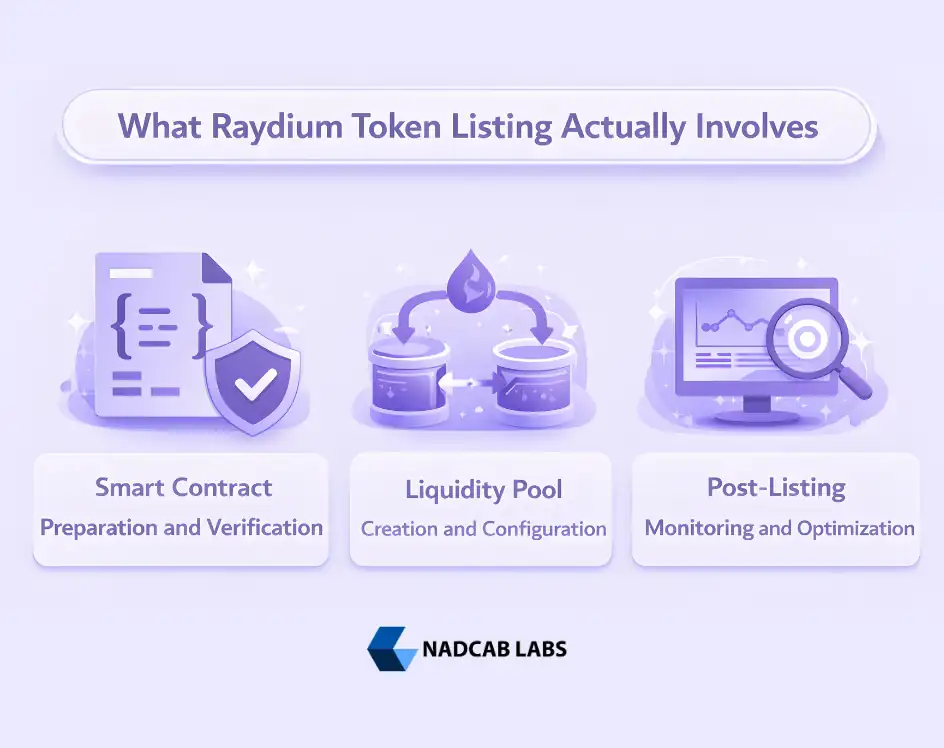
Listing a token on Raydium is not simply a matter of submitting a form. It is a multi-step technical process that requires careful preparation across smart contract architecture, liquidity provisioning, and platform-specific configuration. Understanding each component helps project teams avoid costly mistakes and launch with confidence.
Smart Contract Preparation and Verification
Before a token can trade on Raydium, its underlying smart contract must be properly deployed on the Solana blockchain using the SPL token standard. This includes setting correct parameters for total supply, decimal precision, mint authority, and freeze authority. Projects that retain unchecked mint authority raise red flags among traders, so many teams choose to revoke this authority after initial minting. The development of secure token contracts is the foundation of any credible listing a single vulnerability can drain liquidity pools and destroy trust permanently. Professional teams building through crypto token solutions ensure that contracts undergo thorough auditing before deployment.
Liquidity Pool Creation and Configuration
Raydium operates as an automated market maker (AMM), which means trading happens through liquidity pools rather than traditional order books. To list a token, the project must create a pool pairing its token with an established asset typically SOL or USDC. The initial liquidity deposit determines the starting price and sets the trading range. Raydium offers both standard AMM pools and concentrated liquidity market maker (CLMM) pools, where liquidity providers can allocate capital within specific price ranges for greater efficiency. The development of CLMM technology has significantly improved capital efficiency, allowing smaller liquidity deposits to support deeper order books within targeted price bands.
Post-Listing Monitoring and Optimization
A successful listing does not end when the pool goes live. Ongoing monitoring of trading volume, liquidity depth, price stability, and pool utilization is critical for long-term success. Projects must watch for imbalanced pools, impermanent loss affecting liquidity providers, and unusual trading patterns that might indicate manipulation. Adjusting fee tiers, rebalancing liquidity positions, and responding to market conditions are all part of maintaining a healthy listing. The broader landscape of Web3 tokens shows that projects which actively manage their DEX presence consistently outperform those that treat listing as a one-time event.
Advantages of Listing on Raydium Over Other DEX Platforms
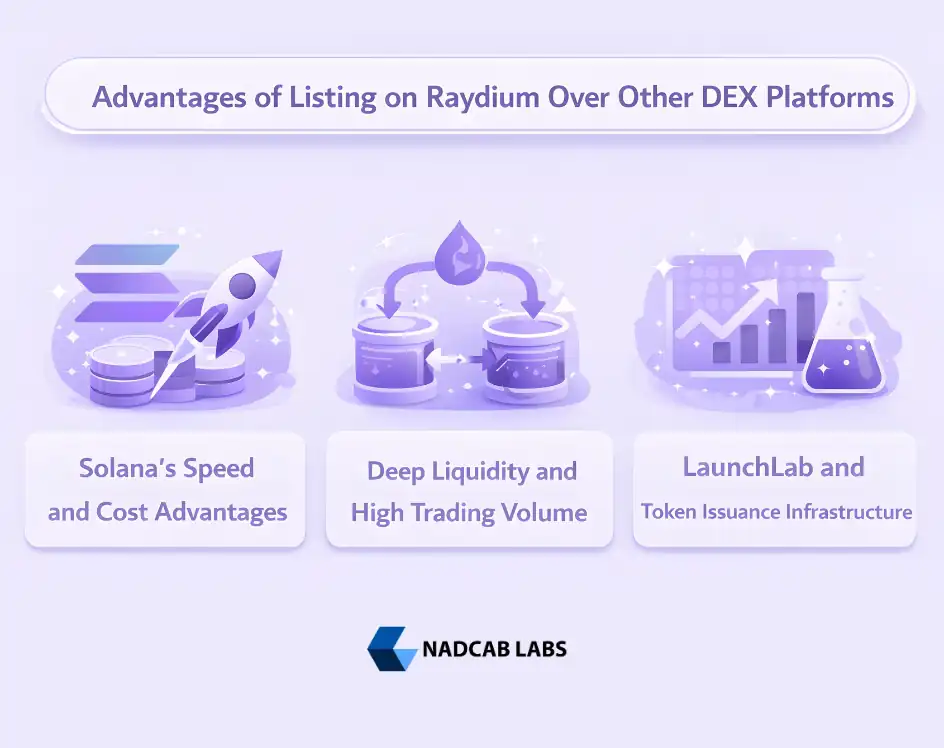
The choice of which DEX to list on carries significant consequences for a token’s trading experience, visibility, and long-term viability. Raydium offers several structural advantages that distinguish it from competing platforms on Solana and across the broader DeFi ecosystem.
Solana’s Speed and Cost Advantages
Raydium inherits all of Solana’s performance characteristics, block times under 400 milliseconds, transaction costs typically below $0.01, and throughput capacity exceeding thousands of transactions per second. For token traders, this translates to near-instant execution, minimal slippage on time-sensitive trades, and negligible gas costs that make frequent trading economically viable. Compared to Ethereum-based DEXs where a single swap can cost $10 to $40 during congestion, Solana’s fee structure removes a major barrier to active trading. The development of high-frequency trading strategies on Solana DEXs has accelerated precisely because the cost of executing trades is so low.
Deep Liquidity and High Trading Volume
Raydium’s position as one of the top three DEX platforms on Solana means listed tokens have access to significant trading infrastructure. The platform hosts over $21 billion in monthly swap trading volume, supplemented by perpetual futures markets that launched in early 2025 through an integration with Orderly Network. With over 8.4 million active users including 600,000 daily active traders, tokens listed on Raydium gain immediate exposure to a substantial audience. The development of aggregator routing means that Raydium’s liquidity is also accessible through third-party platforms like Jupiter, further amplifying reach.
LaunchLab and Token Issuance Infrastructure
Raydium expanded beyond pure DEX functionality in 2025 with the launch of LaunchLab, a dedicated token issuance platform that generated $12.7 million in Q3 revenue alone. LaunchLab offers three types of bonding curves for token pricing and allows third-party interfaces to set their own fee structures.[3] This vertical expansion means projects can now launch and list tokens within a single ecosystem, reducing friction and ensuring seamless liquidity from day one. Understanding the broader differences between coin and token solution architectures helps teams determine whether Raydium’s SPL token framework fits their project requirements.
Critical Steps for a Successful Raydium Listing
A Raydium token listing requires more than technical deployment. The most successful listings combine sound tokenomics, adequate liquidity, security verification, and community readiness into a coordinated launch strategy.
Tokenomics Design and Supply Planning
Before multichain listing, projects must finalize their token supply structure, including total supply, initial circulating supply, allocation pools, and vesting schedules. Tokens that launch with extremely low circulating supply relative to fully diluted valuation often face severe sell pressure as locked tokens vest. Projects should also consider whether their token will include deflationary mechanics, exploring burnable token innovation can help teams design supply reduction strategies that support long-term price stability. The development of well-structured tokenomics is arguably the most important pre-listing decision, as it directly shapes investor confidence and trading behavior.
Security Audits and Contract Verification
Smart contract security is non-negotiable for any serious Raydium listing. Raydium itself has undergone multiple security audits from firms including OtterSec, MadShield, and Halborn, setting a standard that listed projects should aim to match. A professional audit verifies that the token contract contains no exploitable vulnerabilities, that mint and freeze authorities are properly configured, and that the contract logic behaves as documented. Projects that skip this step risk catastrophic pool drains that not only destroy their own token but damage the broader ecosystem’s reputation. The development of comprehensive audit practices across the Solana ecosystem has raised the minimum security bar for credible token launches.
Liquidity Strategy and Initial Pool Sizing
The amount and structure of initial liquidity directly impacts trading quality. Too little liquidity results in extreme price volatility and high slippage, discouraging traders. Too much liquidity relative to market demand can expose providers to significant impermanent loss. Projects must calculate an appropriate initial deposit based on expected trading volume, target price ranges, and the choice between standard AMM pools and CLMM pools. A well-calibrated liquidity strategy ensures that early traders have a positive experience, which builds momentum for organic growth. The development of liquidity modeling tools specific to Solana AMMs has made this planning more accessible to smaller teams.
How Raydium Listing Benefits Token Projects Long-Term
Listing on Raydium is not just about gaining an initial trading venue, it positions a token within one of the most active and interconnected DeFi ecosystems in the industry.
Aggregator Integration and Cross-Platform Visibility
Raydium’s deep integration with DEX aggregators like Jupiter means that listed tokens are automatically discoverable through multiple trading interfaces. When a trader searches for the best price on any Solana token swap, aggregators route through Raydium’s pools whenever they offer competitive rates. This passive discovery mechanism dramatically increases a token’s trading volume beyond what direct Raydium visitors alone would generate. Tokens benefit from network-level visibility without requiring separate listings on every aggregator platform.
Access to Institutional and Retail Traders
Raydium’s user base spans both retail traders attracted by meme coin activity and institutional participants drawn to Solana’s performance characteristics. The platform’s support for concentrated liquidity, perpetual futures, and advanced order types creates an environment where sophisticated trading strategies coexist with simple token swaps. For listed projects, this diversity of participants contributes to more stable and organic price discovery compared to platforms dominated by a single trading demographic.
Ecosystem Growth and Tokenized Asset Expansion
Q3 2025 saw tokenized asset trading on Solana surge from $1.36 million to $262.1 million, with Raydium capturing over 76% of that volume. This explosive growth in real-world asset tokenization represents a new frontier for projects listed on the platform. The development of Raydium’s CLMM allowList framework for permissioned trading enables compliant tokenized assets to access deep liquidity while meeting regulatory requirements. As the tokenized asset category matures, early Raydium-listed projects stand to benefit from this expanding market.
Ready to List Your Token on Raydium?
Launch your Solana token on Raydium with secure smart contracts, optimized liquidity pools, and expert guidance to ensure long-term trading success.
Common Mistakes to Avoid During Raydium Listing
Even well-intentioned projects can undermine their own listings through avoidable errors. Being aware of common pitfalls saves time, capital, and credibility.
Insufficient Initial Liquidity
Launching a pool with too little liquidity creates extreme price swings that scare away legitimate traders. Projects should ensure enough paired assets to support at least moderate trading volumes from day one, even if that means starting with a smaller initial market cap.
Retaining Unchecked Mint Authority
Traders and analytics platforms flag tokens where the deployer retains unlimited minting capability. This represents a rug-pull risk, and many community members will refuse to trade such tokens regardless of the project’s intentions. Revoking or transferring mint authority to a governed multisig is standard practice.
Ignoring Post-Launch Pool Management
Listing a token and walking away is a recipe for stagnant pools and declining volume. Active management, adjusting fee tiers, rebalancing concentrated positions, and responding to market shifts, keeps the trading environment healthy and attractive for ongoing participation.
Final Thoughts
Raydium has established itself as one of the most important token listing destinations in decentralized finance, backed by Solana’s speed, Raydium’s deep liquidity infrastructure, and an expanding product suite that now includes LaunchLab for token issuance and perpetual futures for advanced trading. A successful Raydium token listing requires careful attention to smart contract security, liquidity strategy, tokenomics design, and ongoing pool management. The development of robust listing practices, from pre-launch audits through post-listing optimization, separates projects that build lasting trading communities from those that fade after initial hype. For teams serious about reaching Solana’s active trading ecosystem, Raydium remains one of the strongest platforms available.
Frequently Asked Questions
Q1.What is Raydium token listing exactly?
Raydium token listing is the process of deploying your SPL token’s liquidity pool on Raydium’s decentralized exchange, enabling traders across the Solana ecosystem to buy, sell, and swap your token.
Q2.How much liquidity do listings need?
Initial liquidity requirements depend on expected trading volume and target price stability, but most successful Raydium listings start with enough paired assets to support moderate daily volume without excessive slippage.
Q3.Are Raydium listing fees very high?
Raydium pool creation fees are minimal compared to Ethereum-based DEX platforms. The primary cost involves providing initial liquidity for the trading pair rather than paying significant platform listing fees directly to Raydium.
Q4.What token standard does Raydium require?
Raydium requires tokens built using Solana’s SPL token standard, which is the native token framework for the Solana blockchain, functioning similarly to how the ERC-20 standard operates on the Ethereum network.
Q5.How long does listing process take?
The technical listing process on Raydium can be completed within hours once smart contracts are deployed and liquidity is prepared, though proper pre-launch auditing and testing typically require additional weeks.
Q6.Does Raydium support concentrated liquidity pools?
Yes, Raydium offers CLMM concentrated liquidity pools where providers can allocate their capital within specific price ranges, achieving significantly greater capital efficiency compared to traditional full-range automated market maker pools.
Explore Services
Related Services
Reviewed by

Aman Vaths
Founder of Nadcab Labs
Aman Vaths is the Founder & CTO of Nadcab Labs, a global digital engineering company delivering enterprise-grade solutions across AI, Web3, Blockchain, Big Data, Cloud, Cybersecurity, and Modern Application Development. With deep technical leadership and product innovation experience, Aman has positioned Nadcab Labs as one of the most advanced engineering companies driving the next era of intelligent, secure, and scalable software systems. Under his leadership, Nadcab Labs has built 2,000+ global projects across sectors including fintech, banking, healthcare, real estate, logistics, gaming, manufacturing, and next-generation DePIN networks. Aman’s strength lies in architecting high-performance systems, end-to-end platform engineering, and designing enterprise solutions that operate at global scale.