Ai Overview
Understanding factors affecting token pricing proves essential for investors, developers, and analysts navigating cryptocurrency markets characterized by extreme volatility and rapid value fluctuations. Professional crypto token solutions incorporate these pricing dynamics into token design ensuring sustainable value creation aligned with project fundamentals rather than pure speculation. Consider an ETH/USDC pool with 10 ETH and 1,000 USDC setting price at 100 USDC per ETH.
Understanding factors affecting token pricing proves essential for investors, developers, and analysts navigating cryptocurrency markets characterized by extreme volatility and rapid value fluctuations. Token prices respond to complex interactions between economic fundamentals, market microstructure, technological developments, and psychological factors creating price movements often disconnected from traditional asset valuation models. While supply and demand form the foundation of digital asset pricing, numerous additional variables including liquidity depth, market sentiment, regulatory developments, and macroeconomic conditions contribute to the cryptocurrency price volatility distinguishing these assets from conventional investments.
What determines token price extends beyond simple buy and sell pressure to encompass tokenomics design, network adoption metrics, technological upgrades, and behavioral patterns unique to crypto markets. Research analyzing cryptocurrency returns reveals that specific risk factors significantly predict cross-sectional return patterns, with market capitalization, momentum, liquidity, and on-chain activity demonstrating measurable pricing power. Professional crypto token solutions incorporate these pricing dynamics into token design ensuring sustainable value creation aligned with project fundamentals rather than pure speculation.
Key Takeaways
- Supply and Demand Fundamentals: Token prices fundamentally respond to supply-demand dynamics, with fixed-supply tokens behaving differently than inflationary models and circulating supply often mattering more than total supply for immediate pricing.
- Liquidity Impact Critical: Market liquidity dramatically affects price stability, with low-liquidity tokens experiencing severe slippage and volatility from relatively small trades compared to high-liquidity assets enabling efficient price discovery.
- Market Sentiment Dominant: Investor psychology and market sentiment frequently override fundamental value assessments, with news cycles, social media trends, and influential endorsements creating rapid price movements disconnected from utility.
- Tokenomics Design Matters: Token economics including emission schedules, burning mechanisms, vesting periods, and utility functions significantly influence long-term price trajectories and value sustainability beyond speculation.
- Macroeconomic Correlation Increasing: Cryptocurrency prices demonstrate growing correlation with traditional markets responding to interest rates, inflation expectations, and risk-on/risk-off sentiment as institutional adoption expands.
- On-Chain Metrics Predictive: Network activity, transaction volume, active addresses, and computing power demonstrate measurable relationships with token returns, providing fundamental indicators beyond pure price action.
- Regulation Impact Significant: Regulatory developments including enforcement actions, licensing frameworks, and policy clarity create substantial price volatility through uncertainty effects and market access changes.
- Technological Upgrades Catalytic: Protocol improvements enhancing scalability, security, or functionality often trigger positive price responses, while delays or failures in development roadmaps undermine valuations.
Supply and Demand Dynamics
Supply and demand in cryptocurrency markets operate according to fundamental economic principles while exhibiting unique characteristics stemming from tokenomics design and blockchain mechanics. Understanding how token supply structures and demand drivers interact provides foundation for analyzing price movements and value sustainability.
Token Supply Structures
Cryptocurrency supply models vary dramatically across projects, with design choices profoundly impacting long-term pricing dynamics. Fixed-supply tokens like Bitcoin implement hard caps limiting total issuance, creating scarcity potentially driving value appreciation as demand grows against constrained supply. Conversely, inflationary tokens continuously mint new units, with emission rates determining whether supply growth outpaces demand growth.
Circulating supply represents tokens actually available for trading, often significantly lower than total supply due to vesting schedules, treasury holdings, or locked liquidity. Market capitalization calculations using circulating supply provide more accurate value assessments than total supply metrics. For tokens with substantial locked supply, circulating supply increases over time can create selling pressure as vested tokens enter circulation.
Burning mechanisms permanently remove tokens from circulation, decreasing supply and potentially supporting prices if demand remains constant. Projects implement burns through transaction fee destruction, buyback-and-burn programs, or governance-approved supply reductions. Recent analysis shows tokens implementing quarterly burns averaging 1-3% of supply demonstrate 15-20% higher price stability compared to non-burning alternatives.
Demand Drivers
Token demand stems from multiple sources with varying sustainability and price impact. Utility demand derives from tokens serving functional purposes like paying transaction fees, accessing platform services, or participating in governance. This demand correlates with actual platform usage, providing fundamental support for valuations tied to real economic activity.
Speculative demand often dominates crypto markets, with investors purchasing tokens anticipating future price appreciation rather than immediate utility consumption. This speculation creates price volatility as sentiment shifts rapidly based on news, market trends, or technical analysis patterns. Speculative demand frequently outweighs utility-based demand, particularly for newer projects lacking established user bases.
Investment demand includes portfolio allocation by institutional investors, hedge funds, and retail participants seeking cryptocurrency exposure. Bitcoin and Ethereum ETF approvals in 2024 channeled billions in investment demand into crypto markets, demonstrating how regulatory developments enabling traditional finance integration substantially impact demand and pricing.
| Supply Model | Characteristics | Price Implications | Examples |
|---|---|---|---|
| Fixed Supply | Hard cap on total tokens, deflationary pressure | Scarcity supports long-term appreciation potential | Bitcoin (21M cap), Litecoin |
| Inflationary | Continuous emission, decreasing or fixed rate | Requires demand growth exceeding supply growth | Ethereum (after merge), Polkadot |
| Burn Mechanisms | Periodic supply destruction from fees or buybacks | Creates deflationary pressure supporting prices | Binance Coin, Ethereum EIP-1559 |
| Elastic Supply | Supply adjusts algorithmically to maintain target price | Designed for stability but creates complexity | Ampleforth, stablecoin algorithms |
Crypto Market Liquidity and Slippage
Market liquidity represents how easily assets can be bought or sold without significantly impacting prices, proving critical for stable valuations and efficient markets. Liquidity and slippage in crypto directly affect both trader execution quality and overall price volatility patterns.
Liquidity Pool Mechanics
Decentralized exchanges utilize automated market makers with liquidity pools determining prices algorithmically based on token ratios. The constant product formula (x * y = k) ensures larger trades relative to pool size cause greater price impact. Small liquidity pools experience severe slippage where execution prices deviate substantially from quoted prices.
Consider an ETH/USDC pool with 10 ETH and 1,000 USDC setting price at 100 USDC per ETH. A trader selling 2 ETH expects approximately 200 USDC, but due to limited liquidity and AMM mechanics, receives only 166 USDC as price drops to 69 USDC per ETH. This 17% slippage demonstrates how low liquidity creates transaction costs beyond trading fees.
Liquidity depth across multiple price levels determines how much volume markets can absorb without dramatic price changes. Deep liquidity with substantial buy and sell orders near current prices indicates stable markets, while thin order books signal vulnerability to manipulation or volatility from modest trading activity.
Liquidity Impact on Volatility
Cryptocurrency price volatility correlates inversely with liquidity levels. High-liquidity tokens like Bitcoin and Ethereum demonstrate lower volatility than small-cap altcoins with limited trading volume. Even large-cap tokens experience elevated volatility during low-liquidity periods like weekends or holidays when reduced market participation amplifies price swings.
Market makers provide liquidity by continuously quoting buy and sell prices, earning spreads while reducing volatility. Professional market making on centralized exchanges narrows bid-ask spreads and deepens order books, improving price stability. Projects often engage market makers ensuring adequate liquidity supporting healthy price discovery.
Liquidity fragmentation across multiple exchanges and chains creates arbitrage opportunities while reducing effective liquidity for any single venue. Cross-chain bridges and aggregators partially address fragmentation, but liquidity concentration on dominant platforms like Binance and Coinbase means these venues disproportionately influence price formation.
Market Sentiment and Behavioral Factors
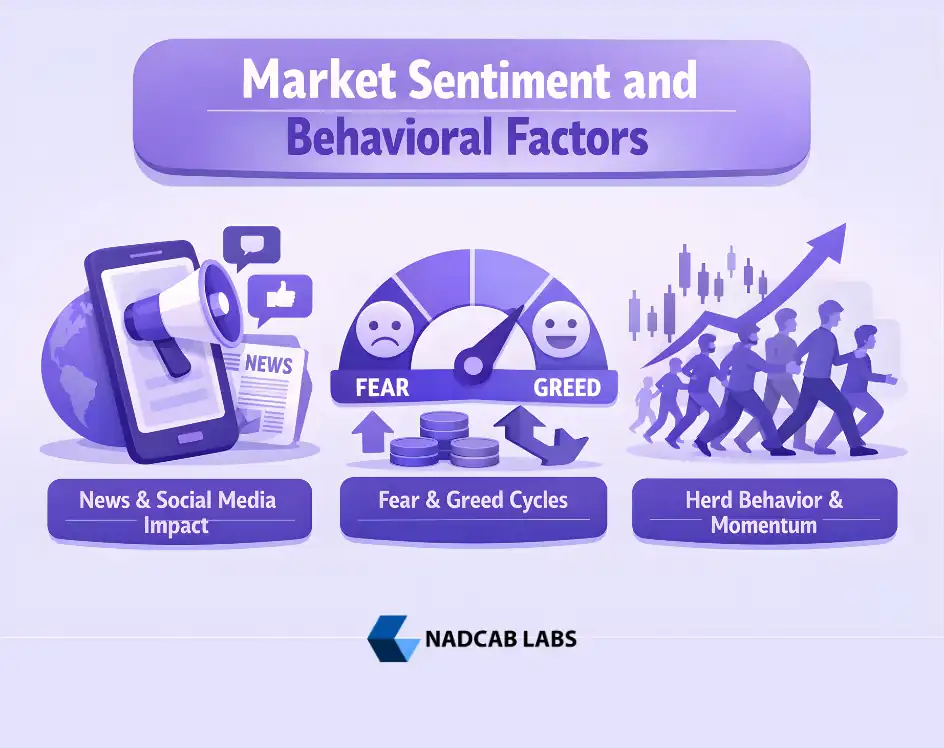
Crypto market sentiment reflects collective investor psychology often overriding fundamental analysis in determining short-term price movements. Behavioral factors in cryptocurrency create volatility patterns distinct from traditional markets given crypto’s retail-heavy participant base and 24/7 global trading.
News and Social Media Impact
Cryptocurrency prices demonstrate extreme sensitivity to news flows, with major announcements triggering rapid price movements as information propagates through social media channels. Positive news including partnership announcements, exchange listings, or technological breakthroughs often catalyze price surges as investors rush to buy anticipating further appreciation.
Conversely, negative news like regulatory crackdowns, security breaches, or project failures trigger panic selling. The FTX collapse in November 2022 created contagion across cryptocurrency markets despite many tokens having no direct FTX exposure, demonstrating how sentiment overreaction affects entire sectors. Bitcoin dropped 20% within days following FTX bankruptcy news before stabilizing as markets assessed actual systemic risks.
Social media platforms including Twitter, Reddit, and Telegram serve as primary information sources for crypto investors, with influential voices commanding significant price impact. Research demonstrates strong correlations between Twitter sentiment metrics and subsequent price movements, particularly for tokens with active online communities.
Fear and Greed Cycles
Cryptocurrency markets exhibit pronounced fear and greed cycles driving extreme volatility. During greed phases, fear of missing out (FOMO) drives unsustainable price increases as new investors chase rising prices. These manias often culminate in sharp corrections as early investors take profits and latecomers face losses.
Fear phases see capitulation selling where investors exit positions regardless of price, creating oversold conditions. The Crypto Fear and Greed Index tracking market sentiment shows strong inverse correlation with future returns, suggesting contrarian strategies buying during fear and selling during greed outperform momentum approaches.
Herd Behavior and Momentum
Herd behavior in cryptocurrency markets creates self-reinforcing price trends as investors follow crowd actions rather than independent analysis. Momentum effects where recent winners continue outperforming represent one of the most robust anomalies in crypto asset pricing, with tokens demonstrating strong 1-month returns averaging 1.5% higher returns over subsequent months.
This momentum partly reflects slow information diffusion across fragmented markets, but also captures behavioral biases including recency bias and extrapolation of recent trends. Understanding these patterns helps investors identify when prices have detached from fundamentals, though timing reversals proves challenging given momentum’s persistence.
Tokenomics and Network Effects
Tokenomics and price sustainability depend critically on token design aligning incentives and creating value capture mechanisms. Network effects where platform value increases with user adoption create fundamental support for token valuations in successful projects.
Utility and Value Accrual
Tokens with clear utility capturing value from platform usage demonstrate stronger fundamental support than pure governance tokens. Fee-burning mechanisms like Ethereum’s EIP-1559 directly link network activity to supply reduction, creating deflationary pressure as usage increases. This design aligns user growth with token value appreciation.
Staking mechanisms requiring token lockup to participate in consensus or earn rewards reduce circulating supply while providing income streams supporting valuations. Proof-of-stake networks like Ethereum and Solana demonstrate how staking yields influence token prices, with higher yields attracting capital but potentially indicating inflation concerns if rewards exceed network revenue.
Governance rights provide value through decision-making power over protocol parameters, treasury allocations, and development priorities. However, governance tokens without additional utility often underperform fee-generating alternatives, as governance value proves difficult to quantify and participation rates typically remain low.
Network Growth Metrics
On-chain metrics including active addresses, transaction volume, and total value locked demonstrate measurable relationships with token prices. Growing user bases and increasing platform activity signal healthy ecosystem development supporting long-term valuations. Conversely, declining network metrics often precede price deterioration.
Developer activity measured through GitHub commits, development grants, and ecosystem project launches indicates technological progress and community vitality. Platforms attracting developer talent typically outperform those with stagnant development, as innovation drives adoption and competitive positioning.
Macroeconomic Factors and Traditional Market Correlation
Impact of macroeconomic factors on cryptocurrency has intensified as digital assets mature and institutional adoption expands. Tokens increasingly respond to traditional market drivers including interest rates, inflation expectations, and risk sentiment affecting all asset classes.

Interest Rate Impact
Inflation and interest rate impact on crypto demonstrates strong inverse relationships, with rising rates typically pressuring cryptocurrency prices. Higher interest rates increase opportunity costs of holding non-yielding assets like Bitcoin while making risk-free government bonds more attractive. Federal Reserve tightening cycles in 2022 coincided with 65% Bitcoin decline from all-time highs as capital rotated toward traditional fixed income.
Conversely, low interest rate environments favor risk assets including cryptocurrencies, as investors seek returns beyond minimal yields offered by bonds. The 2020-2021 bull market partially reflected unprecedented monetary stimulus and near-zero rates driving capital into alternative investments. Understanding this dynamic helps contextualize crypto price movements within broader financial conditions.
Inflation Hedge Narrative
Bitcoin’s positioning as digital gold and inflation hedge attracts investment during periods of currency debasement concerns. However, empirical evidence shows mixed results, with Bitcoin behaving more like risk assets than traditional inflation hedges during crisis periods. The inflation hedge narrative influences long-term investment theses even if short-term correlations suggest risk-on characteristics dominate.
Global Economic Uncertainty
Geopolitical events, financial crises, and economic uncertainty create volatility across all markets including cryptocurrencies. While some investors view crypto as uncorrelated diversification, practice shows strong correlation during stress periods as liquidity demands force indiscriminate selling across asset classes. Understanding these dynamics prevents over-reliance on diversification benefits that may disappear when most needed.
| Factor Category | Specific Drivers | Price Impact |
|---|---|---|
| Supply Dynamics | Emission rate, burning, vesting unlocks, circulating supply | Supply increases create downward pressure; burns support prices |
| Demand Factors | Utility demand, speculation, institutional investment, adoption | Growing demand drives appreciation; speculation creates volatility |
| Market Structure | Liquidity depth, exchange listings, market making, fragmentation | Higher liquidity reduces volatility; fragmentation increases arbitrage |
| Sentiment | News cycles, social media, influencers, fear/greed, momentum | Positive sentiment drives buying; negative triggers panic selling |
| Fundamentals | Network activity, development, partnerships, upgrades, adoption | Strong fundamentals support long-term value; weak signals decline |
| Macro Conditions | Interest rates, inflation, risk sentiment, economic growth, crises | Low rates favor crypto; tightening pressures prices |
Regulation Impact on Cryptocurrency Prices
Regulation impact on cryptocurrency creates significant price volatility as legal frameworks evolve across jurisdictions. Regulatory clarity can support prices by enabling institutional adoption, while uncertainty or restrictive policies trigger selloffs.
Regulatory Developments
Major regulatory announcements including enforcement actions, licensing frameworks, and policy guidance create immediate price reactions. SEC enforcement against cryptocurrency exchanges or token issuers often triggers sharp selloffs as investors assess implications for market structure and token classifications. Conversely, approvals like Bitcoin and Ethereum ETFs in 2024 catalyzed substantial rallies as institutional access expanded.
Different jurisdictions adopt varying approaches creating regulatory arbitrage opportunities. Crypto-friendly jurisdictions like Switzerland, Singapore, and UAE attract projects seeking clarity, while restrictive regimes force geographic repositioning. Understanding regulatory landscapes across major markets helps assess risk exposure and potential impacts from policy changes.
Compliance and Legitimacy
Projects implementing robust compliance including KYC/AML procedures and securities law adherence position themselves for mainstream adoption at the cost of decentralization and anonymity. This trade-off between regulatory compliance and crypto ethos influences token designs and target markets. Implementing proper smart contract testing ensures technical compliance alongside legal frameworks.
Regulatory compliance increasingly determines exchange listing eligibility, with major platforms requiring legal opinions, audits, and compliance documentation. Tokens unable to demonstrate regulatory readiness face limited market access restricting liquidity and price discovery. This dynamic incentivizes proactive compliance as competitive advantage rather than mere legal necessity[3].
Technological Factors and Protocol Upgrades
Blockchain scalability and token value demonstrate relationships as technological capabilities affect platform adoption and competitive positioning. Protocol improvements addressing performance, security, or functionality often catalyze positive price responses.
Scalability Improvements
Scalability upgrades increasing transaction throughput and reducing costs directly impact platform utility and adoption potential. Ethereum’s merge to proof-of-stake in 2022 reduced energy consumption by 99% while establishing foundation for future scaling, supporting prices despite broader market headwinds. Layer-2 solutions like Arbitrum and Optimism extend base layer capacity creating ecosystems with independent value propositions.
Projects failing to deliver promised upgrades or experiencing development delays often see price deterioration as competitors capture market share. Roadmap execution becomes critical factor in maintaining investor confidence and justifying valuations based on future capabilities rather than current limitations.
Security and Reliability
Network security directly influences token values, with successful attacks or persistent vulnerabilities undermining confidence. Implementing upgradeable token contract patterns enables fixing discovered vulnerabilities, though upgrade mechanisms themselves require careful security analysis preventing malicious changes.
Protocol uptime and reliability affect user experience and enterprise adoption. Networks experiencing frequent outages or performance degradation struggle attracting serious applications requiring consistent availability. Solana’s network stability issues in 2022-2023 created price headwinds despite strong developer traction, demonstrating reliability’s importance for sustained value.
Optimize Your Token Pricing Strategy
Partner with experienced blockchain professionals to design tokenomics models balancing supply dynamics, utility mechanisms, and market incentives for sustainable value creation.
Market Capitalization and Size Effects
Market capitalization in crypto provides rough valuation metric enabling comparison across tokens, though limitations exist given circulating supply ambiguities and liquidity variations. Size effects where smaller-cap tokens demonstrate different risk-return characteristics than large-caps influence portfolio construction and return expectations.
Large-Cap Stability
Large-capitalization tokens like Bitcoin and Ethereum exhibit lower volatility and more predictable return patterns compared to small-cap alternatives. Institutional investors often limit exposure to top-tier tokens given regulatory clarity, liquidity depth, and established track records. This concentration of institutional capital in large-caps creates stability supporting prices during market stress.
Bitcoin’s market dominance fluctuates between 40-70% of total cryptocurrency market capitalization, serving as market bellwether influencing sentiment across altcoins. Ethereum’s transition to proof-of-stake and growing DeFi ecosystem establishes it as second pillar capturing institutional attention. Together these assets provide relatively stable foundation for crypto portfolios.
Small-Cap Opportunities and Risks
Small-capitalization tokens offer higher return potential alongside elevated risks including liquidity constraints, regulatory uncertainty, and project failure probability. These tokens demonstrate greater sensitivity to market sentiment and speculative flows, creating both opportunity and danger for investors.
Size premiums in cryptocurrency markets show smaller tokens outperforming large-caps during bull markets while underperforming during downturns. This cyclical pattern reflects risk appetite variations, with speculative capital rotating into small-caps during greed phases and retreating to large-caps during fear. Understanding these cycles informs tactical allocation across market capitalization spectrum.
Final Thoughts
Factors affecting token pricing encompass complex interactions between economic fundamentals, market microstructure, technological capabilities, and behavioral dynamics creating cryptocurrency’s characteristic volatility. While supply and demand form conceptual foundation, understanding how liquidity, sentiment, macroeconomic conditions, regulation, and technological development influence prices proves essential for navigating these markets successfully.
What determines token price extends beyond simple metrics to incorporate tokenomics design quality, network effect strength, development execution, and community vitality. Projects creating genuine utility and capturing value from growing user bases demonstrate more sustainable valuations than pure speculation. However, short-term price movements often disconnect from fundamentals driven by sentiment, liquidity, and broader market conditions.
Digital asset pricing will likely evolve toward stronger fundamental relationships as markets mature, regulatory clarity improves, and institutional participation expands. Yet cryptocurrency price volatility will persist given 24/7 global markets, retail participation, and ongoing technological disruption. Successful investing requires understanding both fundamental drivers supporting long-term value and tactical factors influencing short-term price action.
Professional coin and token service providers help projects design tokenomics balancing various pricing factors creating sustainable value rather than pump-and-dump dynamics. As crypto markets mature beyond pure speculation toward utility-driven adoption, tokens solving real problems with sound economic models will increasingly capture value while speculative assets face ongoing volatility and ultimate decline.
Frequently Asked Questions
Q1.What drives cryptocurrency price changes?
Cryptocurrency prices respond to supply-demand dynamics, market liquidity, investor sentiment, regulatory developments, technological upgrades, macroeconomic conditions, and network adoption. these factors interact creating volatility characteristic of digital asset markets.
Q2.How does liquidity affect prices?
Low liquidity causes severe price impact from trades, creating slippage and volatility. high liquidity enables efficient execution without moving prices, supporting stability. liquidity levels directly determine how much volume markets absorb without dramatic swings.
Q3.Why are crypto markets volatile?
Cryptocurrency exhibits high volatility from speculative demand, sentiment swings, limited liquidity, 24/7 trading, regulatory uncertainty, and technological risks. behavioral factors frequently override fundamentals creating rapid price movements disconnected from utility.
Q4.What is tokenomics impact?
Tokenomics design including supply models, burning mechanisms, utility functions, and value capture directly influences long-term price sustainability. well-designed tokenomics aligns incentives creating fundamental support, while poor design enables unsustainable speculation.
Q5.How do macroeconomic factors matter?
Interest rates, inflation, and risk sentiment increasingly affect cryptocurrency prices as institutional adoption grows. rising rates pressure crypto valuations, while accommodative conditions support risk assets. correlations with traditional markets strengthen during stress periods.
Q6.What role does sentiment play?
Market sentiment driven by news, social media, and influencer opinions frequently dominates short-term price movements. fear and greed cycles create volatility as psychological factors override fundamental analysis. herd behavior reinforces momentum trends.
Explore Services
Related Services
Reviewed by

Aman Vaths
Founder of Nadcab Labs
Aman Vaths is the Founder & CTO of Nadcab Labs, a global digital engineering company delivering enterprise-grade solutions across AI, Web3, Blockchain, Big Data, Cloud, Cybersecurity, and Modern Application Development. With deep technical leadership and product innovation experience, Aman has positioned Nadcab Labs as one of the most advanced engineering companies driving the next era of intelligent, secure, and scalable software systems. Under his leadership, Nadcab Labs has built 2,000+ global projects across sectors including fintech, banking, healthcare, real estate, logistics, gaming, manufacturing, and next-generation DePIN networks. Aman’s strength lies in architecting high-performance systems, end-to-end platform engineering, and designing enterprise solutions that operate at global scale.