Ai Overview
The global gambling industry is undergoing a seismic transformation. According to recent industry data, the global blockchain gaming market is projected to exceed $65 billion by 2027, with crypto casino games accounting for a rapidly growing share. Over 70% of online casino sessions globally now originate from mobile devices. It is a fundamental business requirement that determines whether your platform can access banking partnerships, payment processors, advertising networks, and institutional investment.
Key Takeaways
- Web3 casino game creation requires choosing the right blockchain network for scalability, security, and low transaction fees specific to your target audience.
- Smart contracts are the backbone of provably fair gaming, ensuring transparent and tamper-proof outcomes trusted by players in the USA, UK, UAE, and Canada.
- Play-to-earn mechanics and NFT integration have become critical features that drive user retention and attract the growing crypto gaming ecosystem worldwide.
- KYC and AML compliance are non-negotiable for crypto casino platforms operating in regulated markets, particularly in the UK and Canada.
- A mobile-first, cross-platform UI design strategy is essential for capturing the massive global mobile gambling audience across emerging Web3 gaming platforms.
- Multi-wallet and multi-currency support dramatically boosts adoption, making your blockchain casino platform accessible to a broader international player base.
- Smart contract auditing before launch reduces exploit risk significantly, protecting both operator revenue and player funds from costly vulnerabilities.
- Community-driven marketing through Discord, Telegram, and Web3 influencers has proven far more cost-effective than traditional paid advertising for crypto gaming ecosystems.
- Metaverse casino integration is the next frontier, with VR-enabled gambling environments expected to reshape the online casino game landscape by 2027.
- Agencies with 8+ years of experience in crypto casino game creation deliver superior architecture, compliance frameworks, and go-to-market strategies for competitive markets.
Introduction to Web3 Casino Game Development
The global gambling industry is undergoing a seismic transformation. Traditional online casinos, long dominated by centralized servers and opaque random number generators, are rapidly giving way to a new paradigm: Web3 casino game creation. Powered by blockchain technology, decentralized finance, and smart contracts, this new generation of gaming platforms delivers unprecedented levels of transparency, trust, and player ownership. As a casino game creation company with over 8 years of hands-on expertise, we have witnessed this evolution firsthand and guided clients from the USA, UK, UAE, and Canada through every stage of building world-class blockchain casino platforms.
The crypto gaming ecosystem is no longer a niche experiment. According to recent industry data, the global blockchain gaming market is projected to exceed $65 billion by 2027, with crypto casino games accounting for a rapidly growing share. Players are demanding verifiable fairness, instant crypto payouts, and true ownership of in-game assets. Operators who fail to adapt risk losing market share to agile Web3 gaming platform builders who understand these demands deeply. This guide breaks down every critical step in the process, from market research to metaverse casino creation, giving you a structured roadmap to success.
What Makes Web3 Casino Games Different from Traditional Casinos?
The defining difference between Web3 casino games and their traditional counterparts is verifiable trust. In a conventional online casino, players must simply believe that the house’s RNG is fair. There is no way to independently verify outcomes. Web3 casino games solve this problem at the protocol level: every bet, spin, or card draw is executed by a smart contract on a public blockchain, where any user can audit the result. This is what the industry calls “provably fair” gaming.
Beyond fairness, Web3 casino games introduce true digital asset ownership through NFTs, allowing players to own unique items, characters, and tokens that carry real-world value. Play-to-earn casino games reward participation with cryptocurrency, creating new economic incentives that traditional casinos simply cannot match. The result is a fundamentally more engaging, equitable, and economically dynamic gaming experience that is attracting millions of players globally.
Growing Demand for Blockchain-Based Gambling Platforms
Demand for blockchain-based gambling platforms is accelerating across all major markets. In the USA, where state-level crypto gambling regulations are maturing rapidly, early movers are securing significant competitive advantages. The UK Gambling Commission has begun exploring frameworks for blockchain casino platforms, while the UAE’s progressive tech economy has become a hotspot for crypto gaming ecosystem launches. Canadian players, meanwhile, have embraced crypto betting platforms enthusiastically, driven by faster settlement and lower fees compared to fiat-based alternatives.
The convergence of DeFi, NFTs, and gaming is creating a new category of Web3 gaming solutions that go far beyond simple slot machines. Decentralized poker rooms, on-chain sports betting, and metaverse casino experiences are all entering the mainstream, presenting enormous opportunity for forward-thinking operators and casino game creation companies alike.
Step 1: Understand the Web3 Casino Gaming Market
Before writing a single line of code or designing a single screen, thorough market research is the non-negotiable foundation of any successful Web3 casino game venture. This means understanding who your players are, what blockchain networks they prefer, which game types generate the highestF engagement, and how regulatory conditions differ across your target geographies. Skipping this step is one of the most common and costly mistakes we see from operators entering the crypto gaming ecosystem without adequate preparation.
Current Trends in Crypto Casino Game Development
The most significant trend in crypto casino game creation right now is the rise of play-to-earn mechanics integrated directly into casino game loops. Rather than simply gambling with crypto, players earn token rewards for participation, loyalty, and achievement. NFT-based game assets are another major trend, allowing players to own and trade unique cards, chips, and avatars. Cross-chain interoperability is also gaining traction, enabling assets and balances to move seamlessly between different blockchain networks for maximum flexibility.
Social and multiplayer casino experiences are growing rapidly, particularly in the UAE and Canadian markets where community-driven gaming has strong cultural resonance. Real-time on-chain tournaments with transparent prize pools are attracting high-value players who previously would have been skeptical of online casino fairness.
Popular Blockchain Casino Game Types
On-Chain Card Games
- Provably fair poker and blackjack
- NFT-powered card ownership
- Transparent deck shuffling via smart contracts
- Cross-platform tournament support
Crypto Slots and Dice
- VRF-based random outcomes
- Token reward multipliers
- Progressive jackpot smart contracts
- Low-fee micro-betting support
Crypto Sports Betting
- Decentralized oracle-fed odds
- Instant crypto settlement
- Peer-to-peer betting pools
- Cross-border access without restrictions
Step 2: Choose the Right Blockchain Network
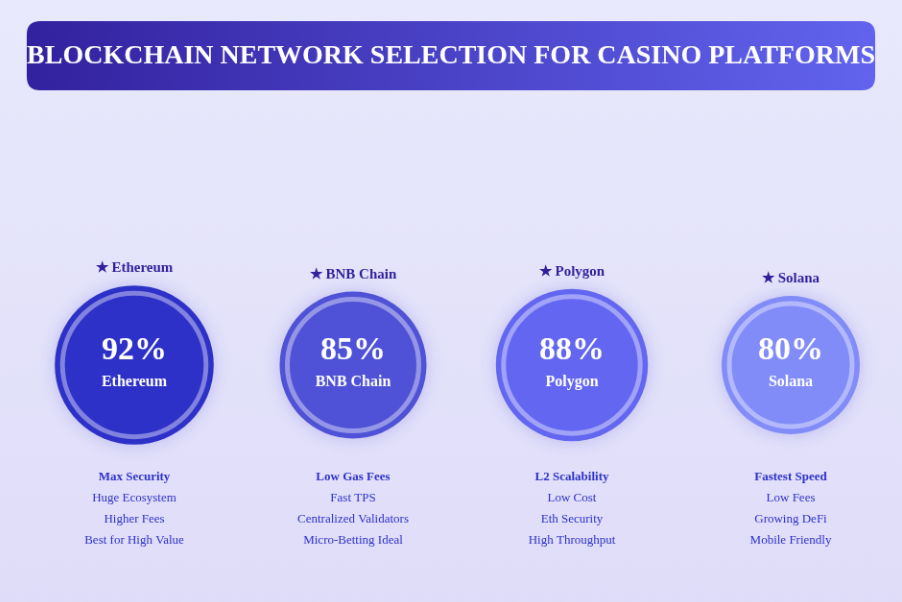
Your choice of blockchain network is arguably the most consequential technical decision in the entire Web3 game creation process. It affects transaction costs, speed, security, the availability of developer tooling, and your players’ wallet compatibility. Different networks serve different use cases, and a decision made in haste here can be extremely costly to reverse later. Our team evaluates four primary dimensions for every client: throughput (TPS), gas costs, security model, and ecosystem maturity.
Factors to Consider for Scalability and Security
Scalability and security must be evaluated together, never in isolation. A blockchain that processes thousands of transactions per second but has a weak validator set is a liability, not an asset. For casino platforms targeting high-volume markets like the USA and UAE, we recommend Layer-2 solutions built on Ethereum (such as Polygon or Arbitrum) as they combine Ethereum’s security with dramatically lower fees and faster confirmations. For platforms targeting cost-sensitive markets or micro-betting use cases, BNB Chain offers a practical balance of speed and affordability, though its more centralized validator structure requires careful consideration for high-value applications.
Step 3: Define Your Casino Game Features
Feature definition is where your Web3 casino game finds its competitive identity. A clear, prioritized feature set guides every subsequent decision: from smart contract architecture to UI/UX design to backend infrastructure. In our experience working with clients across the USA, UK, UAE, and Canada, the platforms that achieve strong traction are those that strike a precise balance between rich feature sets and frictionless user experience. Feature bloat at launch is a common failure mode; strategic feature prioritization is the hallmark of successful crypto casino game creation.
Wallet Integration and Crypto Payments
Seamless wallet integration is the gateway to your crypto gaming ecosystem. Players expect to connect MetaMask, Trust Wallet, WalletConnect, or Coinbase Wallet within seconds, with no lengthy registration forms or identity verification barriers at the entry point. Supporting multiple cryptocurrency payment options, including ETH, BNB, MATIC, USDT, and USDC, dramatically widens your addressable market. Instant on-chain deposits and withdrawals are a fundamental expectation in the Web3 space; platforms that impose withdrawal delays rapidly lose player trust and retention.
Real-world example: Stake.com, one of the world’s largest crypto betting platforms, supports over 20 different cryptocurrencies and processes instant withdrawals, a feature that has been central to its multi-billion-dollar valuation and loyal global player base.
NFTs, Rewards, and Play-to-Earn Features
Play-to-earn casino games have redefined player motivation. Rather than gambling purely for entertainment, players on Web3 gaming platforms earn native tokens, NFT collectibles, and on-chain achievements that carry tangible value. Implementing a tiered loyalty NFT system, where consistent players earn increasingly rare and valuable digital assets, creates powerful retention loops that traditional casino VIP programs cannot replicate. Reward token economies require careful tokenomics design to avoid inflation spirals, but when structured correctly, they become the defining competitive advantage of a blockchain casino platform.
Step 4: Create Smart Contracts for Provably Fair Gaming
Smart contracts are the technical heart of every Web3 casino game. They encode the rules of every game, manage funds, distribute winnings, and guarantee that neither the house nor any player can manipulate outcomes. For crypto casino game creation, the quality of your smart contract code is not merely a technical matter but a fundamental trust signal to your entire player base. A single exploited vulnerability can destroy a platform’s reputation overnight, as multiple high-profile DeFi hacks have demonstrated.
How Smart Contracts Improve Transparency?
Every transaction executed by a smart contract is recorded permanently on the public blockchain. Players can independently verify game outcomes, house edge parameters, and payout histories without relying on the operator’s word. This radical transparency is what draws high-value players who have been burned by opaque centralized platforms. Chainlink VRF (Verifiable Random Function) is the industry-standard oracle solution for generating provably fair randomness in blockchain casino platform environments, used by leading Web3 gaming platforms globally.
Step 5: Design an Engaging User Interface
In the competitive landscape of Web3 gaming solutions, a technically superior backend means little if the user interface is confusing, slow, or visually uninspiring. Casino players, whether in Las Vegas or London, are accustomed to high-quality, immersive gaming environments. Your Web3 casino game must meet this expectation while simultaneously making blockchain interactions, wallet connections, and crypto transactions completely intuitive for players who may be new to the crypto gaming ecosystem.
Importance of User Experience in Web3 Gaming
User experience is the single biggest barrier to Web3 gaming platform adoption among mainstream casino audiences. Complex wallet setup processes, confusing gas fee prompts, and slow transaction confirmations are all friction points that drive players away. The best Web3 gaming solutions abstract blockchain complexity entirely, presenting players with a smooth, familiar casino experience where crypto transactions happen invisibly in the background. Real-world leaders like Decentraland’s casino zone and Rollbit have demonstrated that when UX friction is eliminated, player acquisition and retention improve dramatically.
Mobile-Friendly and Cross-Platform Compatibility
Mobile-first design is not optional for any serious blockchain casino platform in 2024. Over 70% of online casino sessions globally now originate from mobile devices. Your Web3 casino game must be fully responsive, with touch-optimized controls, fast load times on mobile networks, and seamless WalletConnect integration for mobile wallet users. Cross-platform compatibility across iOS, Android, desktop browsers, and eventually VR headsets positions your platform for long-term growth as the metaverse casino creation space matures.
Step 6: Develop the Backend Infrastructure
A robust backend infrastructure is what separates hobbyist Web3 projects from enterprise-grade blockchain casino platforms. The backend must handle real-time game state management, blockchain event monitoring, player session management, analytics pipelines, and administrative tooling, all while maintaining 99.9%+ uptime during peak traffic periods. For casinos targeting the USA and UAE markets, where player expectations for platform reliability are extremely high, infrastructure resilience is a critical competitive factor that cannot be compromised.
Backend Build Lifecycle for Crypto Casino Platforms
Architecture Planning
Define microservices, API gateways, blockchain node connections, and data layer schemas for your Web3 gaming platform.
Node Infrastructure Setup
Deploy dedicated blockchain nodes or integrate with Alchemy/Infura for reliable, low-latency chain data access.
Game Engine Integration
Connect smart contract events to real-time game state engines for instant outcome rendering across all casino game types.
Analytics and Admin Dashboard
Build operator dashboards for real-time revenue tracking, player analytics, and compliance reporting across all markets.
Database and Server Management Essentials
Effective database architecture for a blockchain casino platform requires a hybrid approach: on-chain storage for game outcomes and financial transactions, and off-chain databases (PostgreSQL, MongoDB, or Redis) for player profiles, session data, and high-frequency read operations. Auto-scaling server infrastructure via AWS, Google Cloud, or Azure ensures that your crypto gaming ecosystem can handle sudden traffic spikes during major sporting events or new game launches without downtime or degraded performance.
Step 7: Integrate Crypto Wallets and Payment Gateways
Crypto wallet integration and payment gateway architecture are among the most player-visible technical components of any Web3 casino game. Players judge a platform’s professionalism within the first minute of their wallet connection experience. A clunky, error-prone wallet integration destroys first impressions and drives abandonment before a single bet is placed. Payment infrastructure must support not just deposits and withdrawals, but also fiat on-ramps, stablecoin transactions, and layer-2 payment channels for micro-betting use cases across your crypto betting platform.
Supporting Multiple Cryptocurrency Transactions
A blockchain casino platform that supports only a single cryptocurrency immediately limits its potential market by an order of magnitude. At minimum, your Web3 gaming platform should support ETH, BNB, MATIC, USDT, and USDC at launch. Adding support for popular assets like BTC (via wrapped versions), SOL, and ADA significantly broadens appeal across different player demographics. MoonPay and Transak are leading fiat-to-crypto on-ramp providers that integrate seamlessly with Web3 gaming platforms and are widely trusted in the UK and Canadian markets.
Enhancing Security with Wallet Authentication
Wallet-based authentication via Sign-In with Ethereum (SIWE) eliminates the need for traditional username/password systems entirely, reducing the attack surface for credential theft. Two-factor authentication linked to wallet signatures provides an additional security layer for high-value accounts. Hardware wallet support (Ledger, Trezor) for large depositors is a premium feature that signals platform trustworthiness to serious crypto gaming ecosystem participants and whale players in the UAE and USA markets.
Step 8: Implement Security and Compliance Measures
Compliance is not merely a legal checkbox for blockchain casino platforms operating in 2024 and beyond. It is a fundamental business requirement that determines whether your platform can access banking partnerships, payment processors, advertising networks, and institutional investment. The regulatory landscape for crypto casino game creation is evolving rapidly across the USA, UK, UAE, and Canada, and platforms that build compliance infrastructure proactively gain enormous competitive advantages over those that retrofit it later.
Protecting User Data and Digital Assets
End-to-end encryption for all user data, cold storage for platform funds, and multi-signature wallet controls for operator treasury management are the baseline security measures for any professional blockchain casino platform. Regular third-party security audits, penetration testing, and a clearly communicated responsible disclosure policy build long-term player confidence. GDPR compliance is mandatory for UK-facing platforms, while PIPEDA governs data handling for Canadian players.
Step 9: Test and Launch Your Web3 Casino Game
Testing is the final line of defense before your platform goes live with real player funds at stake. Unlike traditional software, Web3 casino game bugs cannot simply be patched with a hotfix once players’ crypto is involved. A single critical smart contract vulnerability can drain the entire platform treasury in minutes. Our approach to testing involves multiple overlapping layers: automated unit testing, integration testing, adversarial testing, third-party audits, and community beta programs, all before a single dollar of real value enters the system.
Web3 Casino Game Testing Lifecycle
Unit Testing
Test each smart contract function in isolation to verify basic game logic, payout calculations, and state transitions.
Integration Testing
Verify that all contracts, wallets, oracles, and frontend components interact correctly as a unified system.
Third-Party Audit
Engage CertiK, Hacken, or Trail of Bits for independent smart contract security audits before mainnet deployment.
Load and Stress Testing
Simulate peak concurrent player loads to validate infrastructure scalability and identify backend bottlenecks pre-launch.
Beta Launch and Community Feedback
A structured beta launch is the bridge between internal testing and full public release. Invite early community members, crypto influencers, and key stakeholders from your target markets to participate in a limited testnet or incentivized beta phase. Collect structured feedback on UI friction points, game fairness perceptions, transaction speeds, and wallet compatibility across different devices and networks. Use this feedback cycle to iterate rapidly before exposing your blockchain casino platform to the full competitive landscape.
Step 10: Market and Scale Your Web3 Casino Platform
Building a world-class Web3 casino game is only half the battle. Sustainable growth requires a sophisticated go-to-market strategy that combines crypto-native community building with data-driven performance marketing. The Web3 gaming landscape is crowded and competitive. Platforms that win long-term are those that build authentic communities, deliver consistent product improvements, and expand strategically into new markets and game categories over time. As a casino game creation company, we have seen too many technically excellent platforms fail at this stage because marketing was treated as an afterthought.
Web3 Casino Marketing Channels
Community Channels
- Discord server with active moderation
- Telegram announcements and AMA sessions
- Reddit presence in crypto gaming communities
- On-chain governance participation rewards
Influencer Partnerships
- YouTube crypto gaming channels
- Twitter/X Web3 thought leaders
- Twitch live gambling streams
- Podcast sponsorships in crypto space
Growth Programs
- Referral bonus smart contracts
- Token airdrop campaigns
- Affiliate program with crypto payouts
- Tournament and jackpot events
Future Expansion with Metaverse Casino Development
Metaverse casino creation represents the most exciting frontier in the entire Web3 gaming solutions landscape. Platforms like Decentraland, The Sandbox, and Spatial are already hosting virtual casino environments where players use VR headsets or desktop browsers to experience fully immersive gambling environments. Integrating your existing blockchain casino platform with metaverse environments positions you at the cutting edge of what players in the USA, UAE, and beyond will expect from the next generation of online casino game experiences. Early movers in metaverse casino creation are establishing land ownership, brand identity, and player communities that will be extremely difficult for latecomers to replicate.
Benefits of Investing in Web3 Casino Game Development
The business case for investing in Web3 casino game creation has never been stronger. Beyond the obvious opportunity presented by a rapidly growing market, Web3 gaming platforms offer structural business advantages over traditional online casinos that compound over time. Lower operating costs, global reach without traditional banking barriers, and superior player trust create a more durable business model for operators who understand the technology.
Transparency and Decentralization
Decentralization fundamentally changes the trust dynamic between casino operators and players. When every bet is executed on a public blockchain with verifiable outcomes, the persistent suspicion that traditional online casinos are rigged becomes irrelevant. This is particularly powerful in markets like the UK and Canada, where consumer skepticism of online gambling platforms has historically been high. Transparent, decentralized platforms can acquire and retain players more cost-effectively because word-of-mouth trust spreads organically within crypto communities.
Global Accessibility and Faster Transactions
Crypto casino game platforms operate without geographic payment barriers. A player in the UAE can fund their account instantly with USDT, play in real-time against a competitor in Canada, and withdraw winnings to their wallet within minutes, all without touching the traditional banking system. This global accessibility, combined with dramatically faster transaction settlement compared to fiat-based platforms, creates a superior player experience that drives retention and lifetime value metrics far above industry averages for traditional online casinos.
Future of Web3 Gaming Solutions in the Casino Industry
The trajectory of Web3 gaming solutions in the casino industry points toward a future that is dramatically more immersive, intelligent, and decentralized than anything available today. Convergence of artificial intelligence, augmented reality, and blockchain technology is creating possibilities that were unimaginable just five years ago. Operators and casino game creation companies that invest in understanding and building for this future today will hold commanding advantages as these technologies reach mainstream adoption in the late 2020s.
AI and Blockchain Integration in Gaming
AI integration with blockchain casino platforms is already happening in areas like fraud detection, personalized game recommendations, and dynamic odds adjustment for sports betting. The next wave will see AI-generated game content, intelligent NPC dealers in metaverse casino environments, and predictive analytics that identify problem gambling patterns before they escalate. For Web3 gaming platforms, AI-powered smart contract monitoring that detects anomalous betting patterns in real time represents a significant leap forward in both security and responsible gambling compliance, particularly for markets with strict regulatory requirements like the UK.
The Rise of Decentralized Gaming Ecosystems
Decentralized Autonomous Organizations are beginning to govern major Web3 gaming platforms, giving token-holding players a genuine voice in game design, fee structures, and platform strategy. This shift from operator-centric to community-centric governance is profoundly changing the relationship between casinos and their players. DAOs enable truly player-owned casinos where house profits flow back to the community through token distributions. This model, pioneered by platforms like PoolTogether and Augur, is being adapted for full casino gaming ecosystems and represents the most radical evolution in the industry’s history.
Final Thoughts
Web3 casino game creation is one of the most technically demanding, strategically complex, and commercially rewarding undertakings in the digital economy today. This 10-step guide covers the foundational pillars of the process: from rigorous market research and blockchain selection, through smart contract architecture, security, compliance, and user experience, all the way to community-driven marketing and metaverse casino creation. Each step builds on the last, forming an integrated roadmap that, when executed with discipline and expertise, delivers platforms capable of competing at the highest level in global markets.
As a casino game creation company with over 8 years of experience, we have guided dozens of clients through exactly this journey. The players, regulators, and investors in the USA, UK, UAE, and Canada are all paying attention to the Web3 gaming space with increasing intensity. The window to establish a first-mover advantage is narrowing. Whether you are an established casino operator exploring blockchain migration or an entrepreneur building a crypto gaming ecosystem from scratch, the time to act is now. The infrastructure, tooling, regulatory clarity, and player appetite have aligned in a way that makes this the defining moment for Web3 casino game innovation.
Risk Warning
Crypto casino game platforms operate in an evolving regulatory environment. Always consult qualified legal and compliance advisors for your specific jurisdiction before launching. Smart contract vulnerabilities and market volatility represent material financial risks that require professional mitigation strategies.
Ready to Build Your Web3 Casino Platform?
Partner with our 8+ year experienced team to launch a secure, scalable blockchain casino platform tailored to your market.
Frequently Asked Questions
Q1.What is Web3 casino game development and how does it differ from traditional online casinos?
Web3 casino game development refers to building gambling platforms on blockchain networks using smart contracts, decentralized wallets, and cryptographic randomness. Unlike traditional online casinos that rely on centralized servers and opaque RNG systems, Web3 casino games record every outcome permanently on a public blockchain, making them verifiable by anyone. Players retain custody of their funds at all times through non-custodial wallets, and provably fair algorithms eliminate the need to trust the operator. This fundamental shift in architecture creates a higher-trust, more transparent gambling environment.
Q2.Which blockchain is best for crypto casino game development?
The best blockchain for crypto casino game development depends on your priorities. Ethereum offers the strongest security and largest developer ecosystem but carries higher gas fees. Polygon (an Ethereum Layer-2) combines Ethereum-grade security with much lower fees and faster transactions, making it ideal for high-frequency casino games. BNB Chain is popular for micro-betting platforms due to its low cost. Solana offers exceptional throughput. Most experienced casino game creation companies recommend Polygon or BNB Chain for new projects, with Ethereum mainnet reserved for high-value institutional applications.
Q3.How much does it cost to build a Web3 casino platform?
The cost of building a Web3 casino platform varies significantly based on complexity, blockchain choice, and feature set. A basic crypto casino with essential smart contracts, wallet integration, and a few game types typically ranges from $80,000 to $200,000. A full-featured blockchain casino platform with NFTs, play-to-earn mechanics, compliance infrastructure, and custom UI/UX can range from $250,000 to over $600,000. Ongoing costs include smart contract audits ($15,000–$50,000), server infrastructure, licensing fees, and community management, which should be factored into total investment planning.
Q4.What are play-to-earn casino games and why are they popular?
Play-to-earn casino games are blockchain-based gambling experiences that reward player participation with cryptocurrency tokens, NFTs, or other digital assets that hold real-world monetary value. Unlike traditional casinos where losing means losing everything, play-to-earn mechanics create parallel earning streams through loyalty bonuses, tournament prizes, and token distributions. Their popularity stems from the combination of entertainment and genuine economic opportunity. Markets like the USA, UAE, and Canada have seen strong adoption, particularly among younger demographics who are already active in the broader crypto gaming ecosystem.
Q5.What compliance requirements apply to Web3 casino platforms?
Web3 casino platforms must navigate a complex, jurisdiction-specific compliance landscape. In the UK, UKGC licensing and strict AML/KYC requirements apply. Canada requires PIPEDA data compliance and provincial gambling regulations. The USA operates on a state-by-state basis, with different rules in each jurisdiction. The UAE has emerging crypto frameworks under VARA. Across all markets, KYC identity verification, AML transaction monitoring, geo-blocking of restricted territories, and responsible gambling tools (deposit limits, self-exclusion) are increasingly mandatory. Engaging specialized gambling compliance counsel before launch is essential.
Explore Services
Related Services
Reviewed by

Naman Singh
Co-Founder & CEO, Nadcab Labs
Naman Singh is the Co-Founder and CEO of Nadcab Labs, where he drives the company’s vision, global growth, and strategic expansion in blockchain, fintech, and digital transformation. A serial entrepreneur, Naman brings deep hands-on experience in building, scaling, and commercializing technology-driven businesses. At Nadcab Labs, Naman works closely with enterprises, governments, and startups to design and implement secure, scalable, and business-ready Web3 and blockchain solutions. He specializes in transforming complex ideas into high-impact digital products aligned with real business objectives. Naman has led the development of end-to-end blockchain ecosystems, including token creation, smart contracts, DeFi and NFT platforms, payment infrastructures, and decentralized applications. His expertise extends to tokenomics design, regulatory alignment, compliance strategy, and go-to-market planning—helping projects become investor-ready and built for long-term sustainability. With a strong focus on real-world adoption, Naman believes in building blockchain solutions that deliver measurable value, solve practical problems, and unlock new growth opportunities for organizations worldwide.