Ai Overview
The digital economy is undergoing a radical transformation. Web3 Antivirus tools equipped with vulnerability libraries could have flagged the deployment before $160 million in digital assets were lost. Consider the Euler Finance attack of 2023, where a flash loan exploit drained $197 million from the protocol. The Ronin Network bridge hack ($625M), the Wormhole exploit ($320M), and the Nomad bridge attack ($190M) together represent a staggering indictment of bridge security practices.
The digital economy is undergoing a radical transformation. Across the USA, UK, UAE, and Canada, individuals and enterprises are migrating assets, transactions, and identities into decentralized ecosystems at an unprecedented pace. With this migration comes an entirely new category of cyber risk one that traditional security tools simply were not built to handle. [1]
As specialists with over eight years of experience in Web3 cybersecurity and blockchain protection, we have watched the threat landscape evolve from simple phishing attempts into sophisticated, multi-vector attacks targeting smart contracts, DeFi protocols, NFT platforms, and crypto wallets. The answer to these escalating threats is a dedicated solution: Web3 Antivirus a smarter, purpose-built approach to securing digital assets and decentralized applications.
Key Takeaways
- Web3 Antivirus is a specialized cybersecurity layer built to protect decentralized apps, crypto wallets, and blockchain transactions from evolving digital threats.
- Traditional antivirus software cannot detect malicious smart contracts, wallet drainers, or blockchain-based phishing attacks targeting Web3 users.
- Real-time smart contract scanning identifies vulnerabilities in DeFi protocols before users approve potentially harmful transactions.
- AI-powered threat detection enables proactive identification of zero-day exploits within decentralized environments, protecting assets before harm occurs.
- Businesses in the USA, UK, UAE, and Canada deploying Web3 platforms face significant regulatory and reputational risks without proper blockchain-level security.
- Web3 wallet security tools, including multi-factor authentication and transaction simulation, are essential components of comprehensive digital asset protection.
- Cross-chain security gaps remain one of the largest unaddressed vulnerabilities in the Web3 ecosystem, with attackers specifically targeting bridge protocols.
- The future of Web3 cybersecurity lies in autonomous, AI-driven monitoring systems that adapt to emerging threats without requiring manual intervention from security teams.
- Organizations building NFT marketplaces, DeFi platforms, or tokenized asset systems must integrate Web3 Antivirus at the infrastructure level, not as an afterthought.
- Implementing Web3 security best practices, including decentralized authentication and on-chain threat intelligence, builds user trust and ensures platform longevity.
What Is Web3 Antivirus?
Web3 Antivirus is a next-generation cybersecurity solution specifically engineered for the decentralized web. Unlike traditional antivirus programs that scan files and monitor OS processes, Web3 Antivirus operates at the blockchain layer evaluating smart contracts, monitoring on-chain activity, analyzing wallet permissions, and intercepting malicious transactions before they are confirmed on the network. It is the convergence of blockchain intelligence, threat analytics, and real-time intervention built explicitly for the decentralized world.
Across the Web3 ecosystem, threats no longer originate from infected email attachments or compromised operating systems alone. They live on-chain, embedded in smart contract logic, concealed in seemingly legitimate dApps, and embedded within deceptive token approvals. A robust Web3 security framework must be designed from the ground up to address these novel threat vectors — which is precisely what Web3 Antivirus solutions are built to do.
Rising Security Risks in the Web3 Ecosystem
The Web3 ecosystem has seen an explosive growth in security incidents. In 2023 alone, hackers stole over $1.7 billion from DeFi platforms, NFT marketplaces, and cross-chain bridges. Rug pulls, flash loan attacks, oracle manipulation, and phishing scams targeting Web3 users have become increasingly common across major markets including the USA, UK, UAE, and Canada. What makes these threats particularly dangerous is their irreversibility once funds are drained from a crypto wallet or a malicious smart contract is executed, there is no central authority to reverse the damage.
Decentralized Finance protocols are disproportionately targeted because they hold substantial liquidity with code that is publicly readable. Threat actors study protocol logic, identify exploitable edge cases, and execute attacks within a single transaction block. NFT platforms face a different but equally damaging set of risks marketplace exploits, counterfeit asset listings, and metadata manipulation can render entire collections worthless overnight. These escalating risks make a dedicated Web3 Antivirus not just advisable, but essential.
Why Traditional Antivirus Tools Are Not Enough for Web3?
Conventional antivirus solutions even the most advanced enterprise-grade ones are fundamentally misaligned with the Web3 threat landscape. They were engineered to protect centralized computing environments: scanning executable files, monitoring network traffic at the OS level, and detecting known malware signatures. Web3 attacks bypass these defenses entirely by operating through legitimate blockchain infrastructure. A malicious smart contract looks identical to a legitimate one at the network level, making signature-based detection useless.
Furthermore, traditional antivirus cannot evaluate transaction risk before approval, cannot interpret Solidity or EVM bytecode for malicious intent, and has no visibility into on-chain token allowances that drain wallets. When a user in the UK or Canada connects their MetaMask wallet to a compromised dApp and signs a malicious transaction, no traditional antivirus tool intervenes. This is the critical gap that Web3 Antivirus solutions fill delivering real, actionable blockchain-layer protection that legacy tools structurally cannot provide.
How Web3 Antivirus Works in Decentralized Environments?
Web3 Antivirus operates through a multi-layered protection architecture that is deeply integrated with blockchain infrastructure. Before a user approves a transaction, the system simulates its execution and analyzes the outcome flagging unexpected token movements, unauthorized contract interactions, or suspicious permission grants. It cross-references smart contract addresses against curated threat databases, scans contract bytecode for known exploit patterns, and evaluates domain reputation for dApps and Web3 frontends.
The protection layer sits between the user’s wallet and the blockchain network, acting as an intelligent gatekeeper. When a suspicious transaction is detected such as a contract requesting unlimited token approvals or transferring assets to blacklisted addresses the system alerts the user with clear, actionable information before any irreversible action occurs. This pre-confirmation intervention is the foundational differentiator of effective Web3 cybersecurity compared to reactive, post-incident approaches.
Core Technologies Behind Web3 Antivirus Solutions
Core Technologies Powering Web3 Antivirus
Transaction Simulation Engines
- Simulate tx outcomes before signing
- Detect hidden token drains
- Flag unauthorized permissions
- Pre-confirm risk assessment
AI Threat Intelligence
- Machine learning pattern detection
- Zero-day exploit identification
- Behavioral anomaly analysis
- Adaptive threat modeling
On-Chain Threat Databases
- Blacklisted contract registries
- Phishing domain lists
- Known exploit signatures
- Community-sourced threat feeds
Underlying every Web3 Antivirus platform are powerful technologies including static and dynamic smart contract analysis, EVM-compatible bytecode interpretation, decentralized threat intelligence networks, and cryptographic verification of contract authenticity. Static analysis scans contract code for common vulnerability patterns such as reentrancy vulnerabilities, flash loan attack surfaces, and unchecked external calls. Dynamic analysis executes contract logic in sandboxed environments to observe behavior under various inputs before user funds are ever at risk.
How Web3 Antivirus Protects Digital Assets and dApps?
Web3 protection encompasses a broad and deeply interconnected set of security functions. From safeguarding individual crypto wallets holding Bitcoin, Ethereum, or tokenized real-world assets, to monitoring the integrity of enterprise DeFi protocols managing millions in liquidity, effective Web3 Antivirus solutions must operate across multiple layers simultaneously. The goal is not just detection it is prevention, intervention, and education delivered at machine speed.
Securing Crypto Wallets and Digital Assets
Your crypto wallet is your identity and treasury in the Web3 world. Web3 Antivirus solutions provide a critical protective layer around wallet interactions by continuously monitoring approved token allowances, flagging revocable permissions that could expose assets to future exploits, and alerting users when their wallet address appears in known scam databases. For users in the UAE and USA holding significant digital asset portfolios, this level of Web3 wallet security is the difference between financial security and catastrophic loss.
Advanced solutions also implement hardware wallet integration checks, seed phrase exposure monitoring across known data breach repositories, and behavior-based anomaly detection that identifies unusual wallet activity patterns. For instance, if a wallet that has never interacted with a specific DeFi protocol suddenly receives a transaction request from an unverified contract, the Web3 Antivirus system flags this as suspicious and demands explicit user confirmation with full risk disclosure.
Detecting Malicious Smart Contracts and dApps
Smart contracts are the backbone of every dApp, DeFi protocol, and NFT platform. They also represent the primary attack surface for sophisticated Web3 threat actors. Web3 Antivirus solutions scan contract bytecode against extensive libraries of known malicious patterns including backdoors that allow contract owners to drain user funds, upgradeable contract proxies that can silently alter logic after user approval, and honeypot mechanics that prevent users from withdrawing invested assets.
A real-world example that illustrates the value of this technology: the 2022 Wintermute hack resulted from a vulnerability in vanity address generation a flaw detectable through proper smart contract security scanning. Web3 Antivirus tools equipped with vulnerability libraries could have flagged the deployment before $160 million in digital assets were lost. For businesses in the UK and Canada building blockchain applications, pre-deployment smart contract scanning is now considered a non-negotiable security standard.
Preventing Phishing, Wallet Drainers, and Scam Attacks
Phishing remains the most prevalent attack vector in Web3, and it has evolved far beyond fake email links. Web3 phishing now involves counterfeit dApp frontends that pixel-perfectly mimic legitimate platforms, Discord compromises that broadcast malicious mint links to thousands of NFT community members, and search engine manipulation that places fraudulent sites above legitimate ones. Web3 Antivirus solutions counter these threats through real-time domain reputation checking, frontend integrity verification, and browser extension-based warning systems.
Wallet drainer malware represents a particularly insidious threat. These malicious smart contracts, often embedded in NFT minting pages or airdrop claim portals, are designed to extract maximum token value from connected wallets in a single transaction. Advanced Web3 Antivirus systems simulate wallet drainer transactions in isolated environments, identify the characteristic token sweep patterns, and prevent users from signing these transactions entirely.
Essential Features of an Advanced Web3 Antivirus
Not all Web3 security solutions are created equal. Organizations and individual users evaluating Web3 Antivirus platforms need to understand which features constitute a truly comprehensive defense posture. Based on our eight-plus years of experience securing blockchain applications across the USA, UK, UAE, and Canada, we have identified the critical capabilities that separate effective Web3 Antivirus solutions from superficial alternatives.
Real-Time Blockchain Threat Monitoring
Effective Web3 security requires continuous, real-time monitoring of blockchain activity across multiple networks simultaneously. Leading Web3 Antivirus platforms maintain live connections to Ethereum, BNB Chain, Polygon, Solana, Avalanche, and other major networks indexing every new contract deployment, flagging anomalous transaction patterns, and updating threat databases within seconds of new exploits being identified in the wild. This immediacy is critical: blockchain attacks often complete within a single block, meaning second-delayed detection is effectively no detection at all.
For enterprise platforms serving users across multiple geographies, real-time monitoring also provides compliance advantages. Regulatory frameworks in the UK (FCA guidelines), UAE (VARA regulations), and North American markets increasingly require documented evidence of active threat monitoring as part of digital asset custody and exchange licensing requirements. Web3 Antivirus platforms that provide audit-ready monitoring logs satisfy both security and regulatory needs simultaneously.
Smart Contract Security Scanning
Smart Contract Security Scanning Lifecycle
Step 1: Static Bytecode Analysis
Scan contract bytecode against known vulnerability signatures including reentrancy, integer overflow, and delegatecall misuse.
Step 2: Dynamic Sandbox Execution
Execute contract logic in a sandboxed EVM environment to observe runtime behavior and identify hidden malicious functions.
Step 3: Permission & Ownership Audit
Verify contract ownership structures, admin key controls, and upgrade mechanisms that could allow post-deployment manipulation.
Step 4: Cross-Reference Threat Intelligence
Compare contract addresses and deployer wallets against global blacklists and community-sourced threat intelligence databases.
Step 5: Risk Score Assignment
Assign a quantitative security score to each contract, providing users and platforms with clear, actionable risk assessments.
Step 6: Continuous Monitoring Post-Deploy
Maintain ongoing monitoring of deployed contracts for unusual activity, governance changes, or exploit attempts after launch.
Web3 Wallet Security and Authentication
Web3 wallet security is the cornerstone of digital asset protection. Modern Web3 Antivirus platforms enhance wallet security through layered authentication mechanisms that go beyond simple seed phrase custody. Biometric authentication integration, hardware security module (HSM) compatibility, and cryptographic signature verification ensure that only authorized users can initiate transactions. Multi-signature wallet support adds an additional governance layer, requiring consensus from multiple authorized parties before high-value transactions are executed.
Web3 authentication standards are also evolving significantly. Sign-In With Ethereum (SIWE) protocols, when properly implemented alongside Web3 Antivirus monitoring, create a robust identity layer that eliminates password vulnerabilities while maintaining the decentralized nature of Web3 identity. For enterprise users across the UAE and USA managing treasury wallets holding institutional-grade digital assets, these authentication capabilities are critical security requirements, not optional enhancements.
AI-Powered Threat Detection for Decentralized Platforms
Artificial intelligence has fundamentally transformed the capability ceiling for Web3 cybersecurity. Where rule-based systems require known attack signatures to trigger alerts, AI-powered threat detection models learn from historical exploit data, identify subtle behavioral deviations, and flag suspicious activities that no predefined rule would catch. Graph neural networks map transaction relationships across wallets and contracts, identifying money laundering patterns and sybil attack coordination that would be invisible to traditional monitoring systems.
Natural language processing models analyze smart contract source code and documentation for semantic inconsistencies for example, contracts claiming to be yield-farming protocols but containing logic that restricts withdrawals. These AI capabilities enable Web3 Antivirus platforms to deliver proactive cryptocurrency security rather than reactive incident response. The speed advantage is measurable: AI-driven systems can analyze and score a new contract within milliseconds of deployment, compared to hours or days for manual security review.
Web3 Antivirus Solution Selection Criteria
Step 1: Evaluate Chain Coverage
- Does it cover your target blockchains (ETH, BNB, Solana)?
- Cross-chain bridge monitoring included?
- Multi-network threat intelligence feeds?
Step 2: Assess Detection Capabilities
- AI vs rule-based detection models?
- Transaction simulation before signing?
- Zero-day exploit identification rate?
Step 3: Verify Compliance Alignment
- Audit log generation for regulators?
- Alignment with FCA, VARA, SEC guidance?
- Data privacy compliance (GDPR, PDPA)?
Why Businesses and Users Need Web3 Antivirus?
The business case for Web3 Antivirus is not abstract it is grounded in real financial losses, regulatory pressure, and competitive necessity. Organizations building DeFi platforms, NFT marketplaces, tokenized asset systems, and Web3 gaming infrastructure face an existential security imperative. A single significant security incident can eliminate user trust, trigger regulatory investigation, and destroy years of brand equity. The cost of prevention is always less than the cost of breach response.
Protecting DeFi, NFT, and Blockchain Applications
DeFi platforms present unique security challenges because their complexity creates numerous attack surfaces. A sophisticated Web3 Antivirus solution must simultaneously protect against flash loan attacks, oracle price manipulation, governance vote exploits, and liquidity drain mechanics. NFT marketplaces require different but equally critical protections: metadata integrity verification, royalty smart contract auditing, and front-running prevention to ensure fair market conditions. Blockchain application security cannot be approached with a one-size-fits-all solution it requires protocol-specific intelligence combined with universal blockchain-layer monitoring.
Consider the Euler Finance attack of 2023, where a flash loan exploit drained $197 million from the protocol. A properly configured Web3 Antivirus system with pre-transaction simulation capabilities would have detected the anomalous fund movement pattern and triggered an emergency alert before the attack could be completed. This real-world example illustrates why reactive security is insufficient the blockchain does not offer a chargeback mechanism, and prevention is the only effective protection strategy.
Building Trust and Security in Web3 Platforms
Trust is the ultimate currency in Web3. Users interacting with DeFi protocols, NFT platforms, or blockchain-based financial services are making decisions about where to entrust their digital assets with minimal regulatory backstop. Platforms that visibly demonstrate robust Web3 security practices through published security audits, real-time monitoring dashboards, and transparent incident disclosure policies consistently attract higher user adoption and larger transaction volumes than those that treat security as an afterthought.
Our experience working with blockchain platforms in London’s fintech hub, Dubai’s DIFC district, Toronto’s blockchain corridor, and across major US blockchain markets confirms this pattern: security certification and verifiable Web3 Antivirus integration directly correlate with faster regulatory approval, better institutional partnership opportunities, and stronger user retention metrics. Security is not just a technical requirement it is a strategic business differentiator in competitive Web3 markets.
Challenges in Web3 Security and Threat Prevention
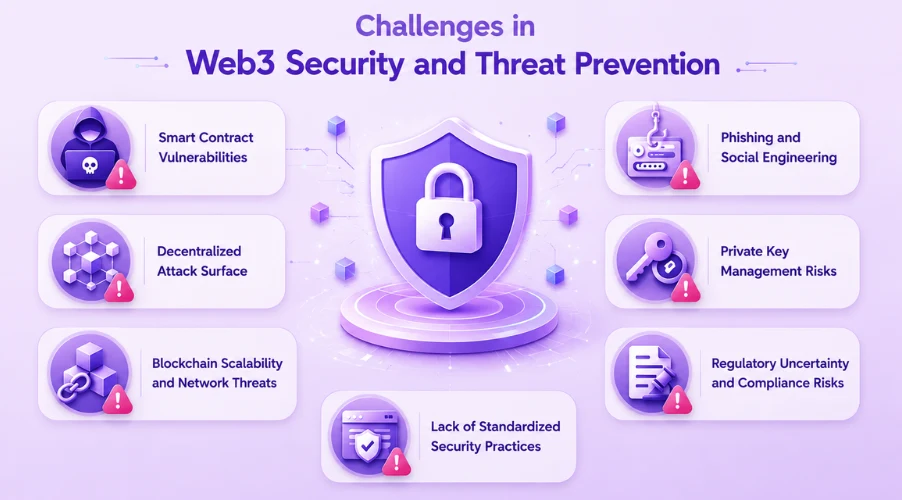
Despite significant advances in Web3 cybersecurity tooling, the threat landscape continues to evolve at a pace that challenges even the most sophisticated security teams. Understanding the structural limitations and emerging vulnerabilities in Web3 security is essential for building resilient protection strategies that remain effective as attacker capabilities grow.
Evolving Cyber Threats in Decentralized Applications
The sophistication of attacks targeting decentralized applications is accelerating rapidly. Modern attackers combine on-chain technical exploits with sophisticated social engineering to create hybrid attack vectors that challenge even experienced security teams. For example, governance attacks where adversaries accumulate protocol voting power to pass malicious governance proposals require Web3 security systems to monitor not just transaction-level activity but also governance participation patterns across multiple protocols simultaneously.
Layer 2 scaling solutions introduce additional complexity. Optimistic rollups, zero-knowledge proofs, and state channel implementations each have unique security properties and potential failure modes that require specialized Web3 Antivirus coverage. As the ecosystem expands into areas like decentralized identity, tokenized real-world assets, and on-chain gaming, entirely new attack surfaces emerge that current security tools may not fully address without continuous adaptation and intelligence updates.
Security Gaps in Cross-Chain and Web3 Transactions
Cross-chain bridge protocols represent the single most dangerous security gap in the current Web3 ecosystem. Bridges lock assets on one chain and mint equivalent representations on another — creating concentrated liquidity pools that are prime targets for sophisticated attackers. The Ronin Network bridge hack ($625M), the Wormhole exploit ($320M), and the Nomad bridge attack ($190M) together represent a staggering indictment of bridge security practices. These attacks succeeded precisely because the bridge contracts lacked proper Web3 security monitoring and transaction validation.
The decentralized nature of Web3 transactions also creates accountability gaps. When a security incident occurs on a centralized exchange, there is a corporate entity responsible for incident response and user communication. On decentralized platforms, security responsibility is distributed across protocol teams, smart contract auditors, and individual users creating coordination challenges that attackers can exploit. Web3 Antivirus solutions must therefore provide not just technical detection capabilities but also clear user communication frameworks that enable rapid coordinated response during active security incidents.
The Future of Web3 Antivirus and Decentralized Cybersecurity
The trajectory of Web3 Antivirus solutions points toward increasingly autonomous, intelligent, and comprehensive security systems. As the global Web3 economy matures with institutional adoption accelerating in financial centers across the USA, UK, UAE, and Canada the expectations for blockchain security sophistication will rise proportionally. The next generation of Web3 cybersecurity will be defined by proactive threat prevention rather than reactive detection, powered by technologies that are just beginning to reach production maturity.
AI and Automation in Web3 Threat Detection
The future of Web3 security lies in autonomous AI agents that continuously monitor blockchain ecosystems, identify emerging threat patterns, and automatically deploy protective countermeasures without requiring human intervention. Reinforcement learning models trained on historical exploit data will be capable of predicting novel attack vectors before they are deployed in the wild shifting the security paradigm from detection to prevention at unprecedented scale.
Decentralized security networks will also play an increasingly important role. By distributing threat intelligence across multiple nodes each contributing detection data, attack signatures, and behavioral insights decentralized Web3 Antivirus platforms can achieve a collective intelligence capability that centralized systems cannot match. Privacy-preserving threat sharing, enabled by zero-knowledge proofs, will allow organizations to contribute security data to shared networks without exposing sensitive operational information, accelerating the collective security posture of the entire Web3 ecosystem.
The Growing Importance of Blockchain Security Solutions
Regulatory momentum is accelerating the mainstream adoption of formalized blockchain security solutions. In the UK, the Financial Conduct Authority has signaled increased scrutiny of digital asset custody security practices. The UAE’s Virtual Asset Regulatory Authority (VARA) mandates documented security frameworks for licensed virtual asset service providers. In the USA, SEC and CFTC guidance increasingly touches on the security obligations of digital asset platforms. Canadian regulatory bodies mirror these trends with their own AML and cybersecurity requirements for crypto-adjacent businesses.
This regulatory pressure, combined with the continued growth of institutional digital asset allocation, will drive significant investment in professional Web3 security infrastructure over the coming years. Organizations that build robust Web3 Antivirus capabilities now will be positioned to meet regulatory requirements, attract institutional users, and navigate the increasingly complex Web3 security landscape with confidence. The blockchain security solutions market is projected to grow exponentially, and the organizations that invest in proper Web3 protection today will define industry standards for the next decade.
Secure Your Web3 Platform Before the Next Attack
Partner with our Web3 cybersecurity experts to implement enterprise-grade protection for your digital assets and blockchain applications.
Final Thoughts
Web3 Antivirus is not a luxury or an optional add-on for blockchain platforms it is the foundational security requirement of the decentralized internet era. As digital asset values continue to grow and Web3 adoption expands across enterprise and consumer markets in the USA, UK, UAE, Canada, and beyond, the financial and reputational stakes of security failures rise accordingly. Traditional cybersecurity tools are structurally incapable of providing the blockchain-layer protection that modern Web3 ecosystems demand.
Purpose-built Web3 security solutions combining transaction simulation, AI-powered threat detection, smart contract security scanning, and real-time blockchain monitoring represent the only viable path to sustainable digital asset protection. Organizations and individuals who invest in comprehensive Web3 Antivirus capabilities protect not just their immediate assets, but their long-term participation in the blockchain economy.
Our team has spent over eight years at the intersection of blockchain innovation and cybersecurity practice. We have seen firsthand how security-first architecture separates thriving Web3 platforms from those consumed by preventable incidents. The message is clear: in the decentralized web, Web3 Antivirus is the smartest investment you can make for the protection of your digital future.
People Also Ask
Q1.What is Web3 Antivirus and how does it differ from traditional antivirus software?
Web3 Antivirus is a specialized cybersecurity solution designed specifically for decentralized environments. Unlike traditional antivirus programs that scan files and OS processes for malware signatures, Web3 Antivirus operates at the blockchain layer evaluating smart contracts, simulating transactions before approval, monitoring on-chain activity, and intercepting wallet-draining operations. Traditional tools have no visibility into smart contract logic or blockchain-level threats, making Web3 Antivirus an entirely distinct and necessary security category.
Q2.How does Web3 Antivirus protect crypto wallets and digital assets?
Web3 Antivirus protects crypto wallets by continuously monitoring approved token allowances, detecting unlimited approval requests that expose assets to future exploits, and alerting users when their wallet appears in known scam databases. It also provides pre-transaction risk analysis, flagging suspicious contracts before any signing occurs. Hardware wallet compatibility checks and behavior-based anomaly detection add additional layers, ensuring users in markets like the USA, UK, and UAE can hold and transact digital assets with significantly reduced risk.
Q3.Can Web3 Antivirus detect malicious smart contracts automatically?
Yes. Advanced Web3 Antivirus solutions scan smart contract bytecode against libraries of known malicious patterns including backdoors, reentrancy vulnerabilities, honeypot mechanics, and flash loan attack surfaces. Dynamic execution in sandboxed environments reveals hidden functions that static analysis might miss. Automated detection capabilities mean users receive real-time risk scores for any contract they interact with, without needing technical blockchain expertise to interpret the underlying code structure.
Q4.What are the biggest Web3 security threats facing DeFi and NFT platforms?
DeFi platforms face flash loan attacks, oracle price manipulation, governance takeovers, and liquidity drain exploits. NFT platforms are targeted through counterfeit minting sites, metadata manipulation, marketplace front-running, and fake airdrop phishing campaigns. Cross-chain bridge protocols face the most severe risk, as demonstrated by attacks like the $625M Ronin Network hack. Web3 Antivirus solutions must address all these threat categories simultaneously to provide genuine comprehensive protection.
Q5.Why is traditional cybersecurity insufficient for Web3 protection?
Traditional cybersecurity tools were engineered for centralized computing environments and detect threats through file scanning, network traffic monitoring, and malware signature matching. Web3 attacks occur at the blockchain layer — through malicious smart contract logic, deceptive token approval requests, and front-end phishing that targets wallet connections. These attack vectors are completely invisible to conventional antivirus software. A crypto wallet interaction with a malicious dApp triggers no traditional security alert, making purpose-built Web3 cybersecurity the only effective protection.
Q6.How does AI improve Web3 threat detection capabilities?
AI dramatically expands Web3 threat detection beyond known attack signatures. Machine learning models trained on historical exploit data identify subtle behavioral anomalies in transaction patterns that no rule-based system would flag. Graph neural networks map wallet and contract relationship networks to detect money laundering and coordinated sybil attacks. Natural language processing analyzes contract documentation for semantic inconsistencies. Collectively, AI capabilities enable proactive identification of zero-day exploits before they are widely deployed, shifting Web3 security from reactive to preventive.
Explore Services
Related Services
Reviewed by

Naman Singh
Co-Founder & CEO, Nadcab Labs
Naman Singh is the Co-Founder and CEO of Nadcab Labs, where he drives the company’s vision, global growth, and strategic expansion in blockchain, fintech, and digital transformation. A serial entrepreneur, Naman brings deep hands-on experience in building, scaling, and commercializing technology-driven businesses. At Nadcab Labs, Naman works closely with enterprises, governments, and startups to design and implement secure, scalable, and business-ready Web3 and blockchain solutions. He specializes in transforming complex ideas into high-impact digital products aligned with real business objectives. Naman has led the development of end-to-end blockchain ecosystems, including token creation, smart contracts, DeFi and NFT platforms, payment infrastructures, and decentralized applications. His expertise extends to tokenomics design, regulatory alignment, compliance strategy, and go-to-market planning—helping projects become investor-ready and built for long-term sustainability. With a strong focus on real-world adoption, Naman believes in building blockchain solutions that deliver measurable value, solve practical problems, and unlock new growth opportunities for organizations worldwide.