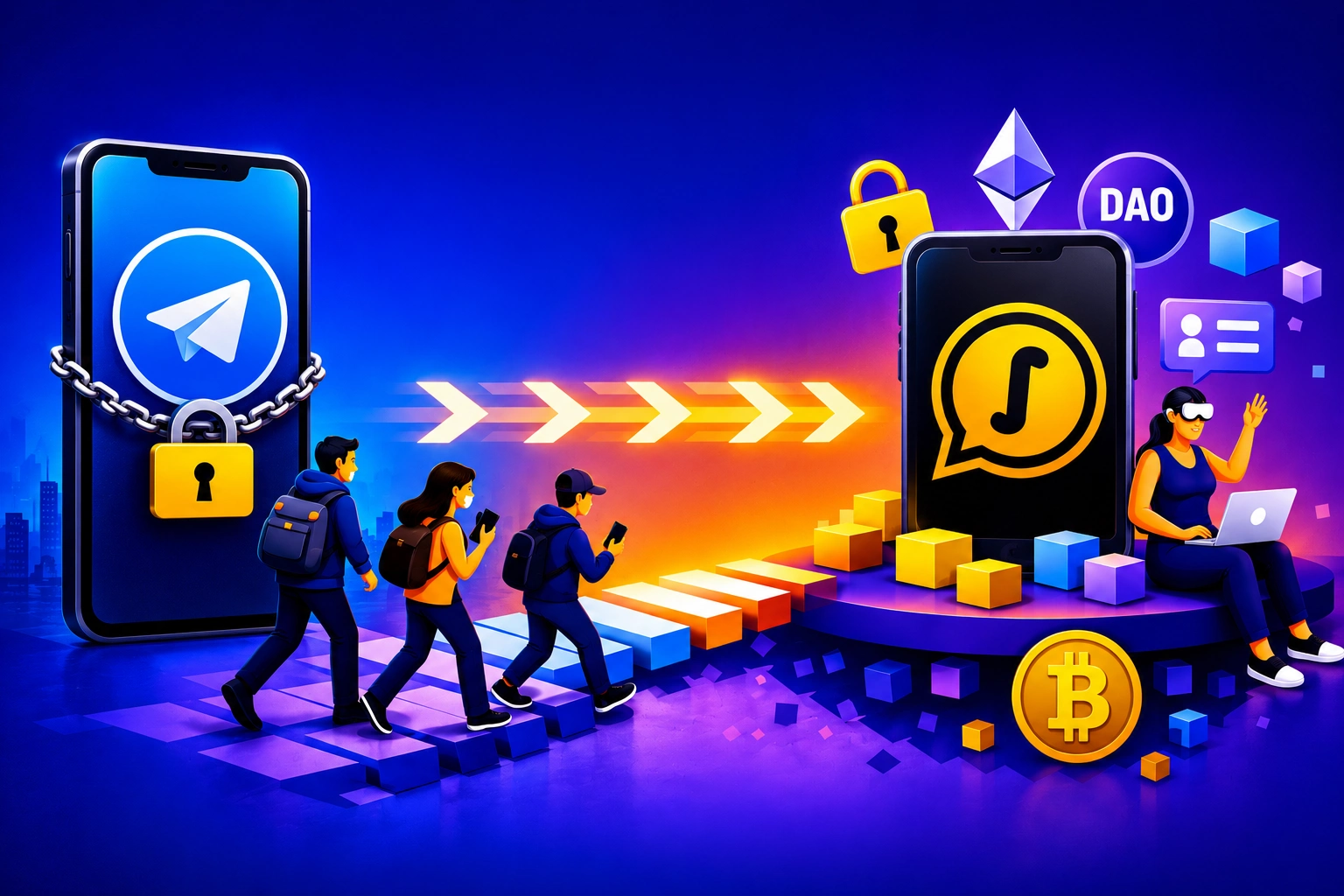
Telegram has over one billion users and is the default communication tool for most crypto communities. It is fast, supports large groups, and its bot ecosystem is deeply integrated into how crypto projects communicate. But Telegram is a centralized platform. It stores user data on its servers, requires a phone number to sign up, can be compelled by legal orders to share user data, and gives community administrators no on-chain control over group membership or access. As Web3 users become more aware of these limitations, a clear shift is happening toward decentralized messaging platforms that align with the principles of the ecosystem they are already part of. This blog explains exactly what those limitations are, what decentralized alternatives provide, and why apps like sudochat represent a genuinely different model for Web3 communication.
Key Takeaways
- Telegram Is Centralized: Despite its privacy reputation, Telegram stores messages on its servers, requires phone number registration, and can comply with legal data requests from authorities.
- Wallet-Based Identity: Decentralized messaging apps like Sudo use your crypto wallet as your identity, no phone number, no email, no personally identifiable information required to sign up or message.
- End-to-End Encryption as Default: Web3 messaging platforms encrypt all messages using cryptographic keys derived from wallet addresses, meaning only the sender and recipient can read conversations.
- Smart Contract Groups: Group membership in apps like Sudo is managed by smart contracts, meaning token-gated access, NFT-verified entry, and on-chain governance of community membership are all possible natively.
- No Central Server to Hack: Decentralized messaging stores no data on a single server. Messages are distributed across blockchain infrastructure, eliminating the central point of failure that makes centralized platforms a target.
- Message Mining Rewards: Sudo includes a message mining feature that rewards active participants with tokens for their communication activity, a native Web3 engagement model that Telegram cannot replicate.
- Escrow-Enabled Transactions: Sudo incorporates smart contract escrow within the messaging interface, allowing peer-to-peer transactions, freelance agreements, and marketplace settlements to occur directly in chat.
- dApp Live Chat Integration: Sudo offers a live chat widget that decentralized applications can embed for real-time, wallet-verified customer support, a feature with no equivalent in Telegram’s infrastructure.
- The Shift Is Already Happening: Projects requiring censorship resistance, token-gated community access, and verifiable wallet identity are actively migrating portions of their community infrastructure to decentralized alternatives.
What Is a Web3 Messaging App?
A Web3 messaging app is a decentralized communication platform where your crypto wallet serves as your identity instead of a phone number or email address. When you sign in, you authenticate with your wallet, MetaMask, Trust Wallet, or any compatible wallet, and the app uses your wallet’s public-private key pair for both identity verification and message encryption. Your messages are encrypted with cryptographic keys that only you and your recipient hold. No central server stores your messages in a readable format.
This model inverts the architecture of every centralized messaging app. In Telegram, WhatsApp, or Signal, the platform controls the server, stores the data, and grants itself the technical ability to access or hand over user data under legal compulsion. In a wallet-based messaging app, the platform never holds readable messages or personal data. The cryptographic keys stay with the users, and identity is provable on-chain without revealing personal information. Understanding the full architecture of Web3 communication explains how decentralized messaging protocols handle encryption, identity, and data storage at the infrastructure level.
The category includes platforms like Status (built on the Waku protocol), XMTP (an open interoperability protocol for wallet-to-wallet messaging), Session (using onion routing for metadata privacy), and Sudo (developed by Nadcab Labs, combining wallet login, smart contract groups, escrow, and message mining in one interface). Each takes a different technical approach, but all share the core principle: communication infrastructure where the user, not the platform, controls identity and data.[1]
Why Telegram Is Not Enough for Web3 Communities
Centralized Data Storage
Telegram stores messages in the cloud on its own servers. This is what enables Telegram’s cross-device sync, you can pick up a conversation on any device because the messages are on Telegram’s servers. The same feature means Telegram holds your communication history in a central location that can be accessed by Telegram employees, subpoenaed by courts, or exposed in a data breach. Telegram’s founder Pavel Durov was arrested in France in August 2024 and charged with allowing criminal activity to propagate on the platform. Following this, Telegram updated its policies to allow sharing user IP addresses and phone numbers with authorities in response to valid legal requests. This was a direct and public demonstration that Telegram’s centralized model creates compliance obligations that can affect user privacy.[2]
Phone Number Registration Compromises Pseudonymity
Telegram requires a phone number to create an account. In the Web3 context, this is a significant problem. Many participants in crypto communities, traders, developers, NFT holders, DeFi users, operate under pseudonymous wallet identities as a deliberate privacy choice. Requiring a phone number to participate in a community undermines this pseudonymity and creates a linkage between on-chain wallet activity and real-world identity that users specifically chose to avoid. A non-custodial messaging app that authenticates through wallet signatures rather than phone numbers preserves the pseudonymous identity model that Web3 users already use on-chain.
No On-Chain Group Governance
Telegram group administrators have platform-level permissions granted by Telegram’s central server. There is no mechanism for token-gated access, requiring holders of a specific token or NFT to join a group automatically, or for on-chain voting on community decisions. Decentralized social apps built on smart contracts can enforce these rules natively. Group membership conditions are defined in code, executed by the blockchain, and cannot be overridden by any platform administrator.[3]
Censorship Vulnerability
Telegram can ban users, delete groups, and restrict communities at the platform level. In jurisdictions where Telegram is legally pressured, entire topic areas can be censored. Decentralized messaging platforms that run on peer-to-peer networks or blockchain infrastructure have no central authority that can receive a takedown request. This censorship resistance is not merely theoretical, it is a functional requirement for communities in regulatory environments where crypto discussions face platform-level restrictions. Building platforms with these security properties requires applying the security practices for building Web3 apps that distinguish decentralized architectures from their centralized equivalents.
Telegram vs Decentralized Web3 Messaging Apps: Key Differences
| Feature | Traditional Messaging Apps | Web3 Messaging Platforms |
|---|---|---|
| Identity | Phone number required | Wallet address, no personal data required |
| Message Encryption | Cloud messages not E2E by default | End-to-end encrypted by default via wallet keys |
| Data Storage | Centralized Telegram servers | Distributed blockchain / decentralized nodes |
| Legal Data Compliance | Can share IP and phone with authorities | No personal data held to share |
| Group Access Control | Admin permission via platform | Smart contract-enforced, token-gated |
| Censorship Risk | Platform can ban groups or users | No central authority to issue takedowns |
| In-Chat Transactions | Limited (TON wallet integration) | Native smart contract escrow in chat |
| dApp Integration | Bot-based, not wallet-verified | Wallet-verified live chat for dApps |
| Message Ownership | Platform holds data | User holds cryptographic keys |
| Engagement Incentives | None | Message mining token rewards |
What Sudo Messenger Offers That Telegram Cannot
Sudo Messenger, developed by Nadcab Labs, is a decentralized Web3 messaging platform built specifically for the needs of crypto communities, dApp users, and Web3 businesses. It is not a general-purpose messaging app with crypto features added on top. It is a blockchain-native communication platform where every core function reflects Web3 architecture principles.
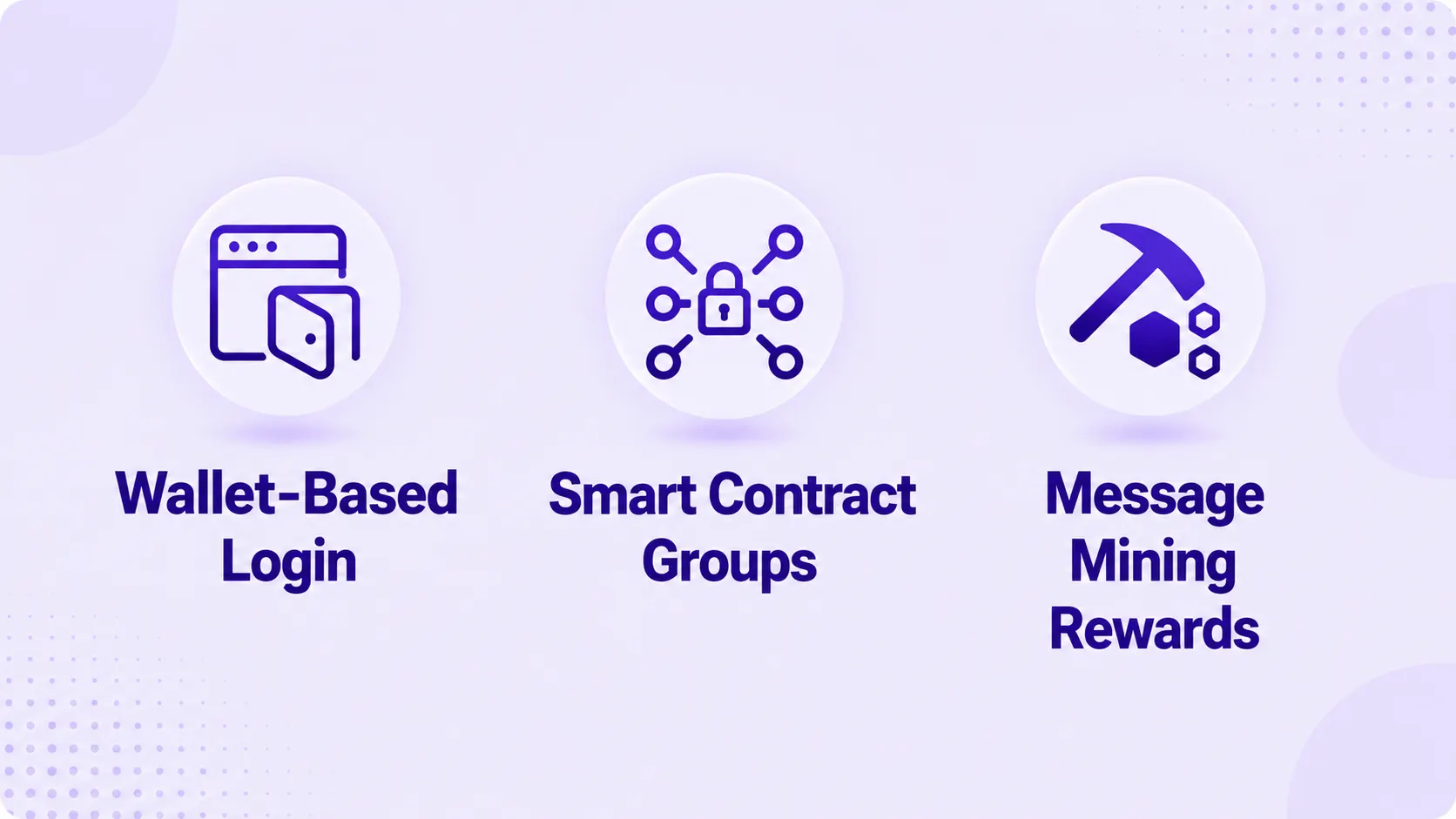
Wallet-Based Login with No Personal Data
Users authenticate through MetaMask, Trust Wallet, or SafePal. No phone number, email, or government-issued ID is required. Your wallet address is your identity. This preserves the pseudonymous model Web3 users already operate under and gives communities the ability to verify wallet credentials, token balances, NFT ownership, on-chain history, without requiring members to reveal real-world identity.[4]
Smart Contract-Synced Groups
Group creation and membership in Sudo is managed by smart contracts. A community can define access conditions, hold a minimum number of a specific token, own a specific NFT, or meet any on-chain criteria, and the smart contract enforces those conditions automatically. This enables token-gated community access that updates in real time as wallets meet or lose the qualifying conditions, without any administrator manually managing membership. Users who want to download Sudo Messenger and experience this model directly can do so through the platform’s download page.
Message Mining Rewards
Sudo includes a message mining feature that distributes token rewards to active participants based on their communication activity. This creates a native incentive layer for community engagement that aligns with Web3’s token economy model. Communities can use this mechanism to reward active contributors, encourage meaningful participation, and build engaged user bases rather than passive follower counts.
Escrow-Enabled In-Chat Transactions
Sudo integrates a smart contract escrow system directly into the messaging interface. Funds are locked by the smart contract until predefined conditions are met, making peer-to-peer payments, freelance arrangements, and marketplace transactions settable directly within a chat conversation without requiring a separate escrow service or trust in a third party.[5]
dApp Live Chat Widget
Sudo offers a live chat widget that decentralized applications can embed in their interfaces for real-time, wallet-verified support. When a user connects to a dApp and needs assistance, they can initiate a support conversation through Sudo that authenticates their wallet identity immediately, giving support teams the ability to verify the user’s on-chain context without asking for personal information.
Other Decentralized Messaging Apps Worth Knowing
Sudo is not the only option in this space. Several other platforms take different technical approaches to decentralized Web3 communication.
Status
Status is a mobile interface combining a private messenger, crypto wallet, and Web3 browser. It uses the Waku protocol, a family of peer-to-peer communication protocols, to route messages without centralized servers. It requires no phone number or email and supports token-gated communities through its SNT governance token.
XMTP
XMTP (Extensible Message Transport Protocol) is an open interoperability protocol that allows wallet-to-wallet messaging across different dApp interfaces. Users on a DeFi dashboard can message users on a social dApp through a shared protocol layer. It is best understood as infrastructure rather than a consumer app, developers build XMTP-compatible interfaces on top of the protocol.
Session
Session uses onion routing through a network of service nodes to ensure anonymity. It generates a unique Session ID for each user with no phone number or email requirement and routes messages through multiple nodes to prevent metadata analysis. It is focused primarily on individual privacy rather than community or dApp integration features.
Trend to Watch (2025–2026)
Token-gated community management is emerging as the primary reason crypto projects are adding decentralized messaging infrastructure alongside Telegram rather than instead of it. NFT projects, DAOs, and DeFi protocols are building wallet-verified community layers where holding a qualifying token automatically grants access to private channels, governance discussions, and contributor networks. Telegram cannot enforce these conditions natively. As the number of token-gated communities grows in 2026, the demand for blockchain chat apps that can enforce on-chain membership conditions in real time is increasing faster than the broader decentralized messaging category. Businesses building these community tools can explore the full development scope through a Web3 development company that specializes in wallet-integrated communication infrastructure.
Build Your Own Web3 Messaging Platform
Nadcab Labs develops decentralized messaging applications with wallet-based authentication, smart contract group management, end-to-end encryption, escrow systems, and dApp live chat integration, built for crypto communities, DAOs, and Web3 businesses.
Frequently Asked Questions
Why are Web3 users leaving Telegram?
Web3 users are moving away from Telegram because it requires a phone number for registration, stores messages on centralized servers, can share user data with authorities under legal request, and provides no on-chain group governance or token-gated access control. These limitations directly conflict with the privacy, pseudonymity, and decentralization principles that most Web3 users operate under in their on-chain activity.
What is a decentralized messaging app exactly?
A decentralized messaging app uses your crypto wallet as your identity instead of a phone number or email. Messages are encrypted using your wallet’s cryptographic keys so only you and the recipient can read them. Data is stored on distributed blockchain infrastructure rather than a central server, meaning no single company controls your communication data or can be compelled to hand it over.
What makes Sudo different from Telegram?
Sudo uses wallet-based login with no personal data required, encrypts all messages end-to-end by default, manages group membership through smart contracts with token-gated access, includes message mining rewards for active participants, and provides smart contract escrow directly within chat. None of these features are available natively in Telegram. Sudo is built specifically for Web3 users, not adapted from a general-purpose messaging platform.
Is Telegram actually private and secure?
Telegram is more private than WhatsApp for group chats but is not end-to-end encrypted by default for cloud messages. Regular Telegram messages are stored on Telegram’s servers and accessible to Telegram. Following Pavel Durov’s arrest in France in 2024, Telegram updated its policies to allow sharing user IP addresses and phone numbers with authorities under valid legal requests, directly demonstrating the limits of its privacy model for users requiring true data sovereignty.
What is wallet-based messaging app login?
Wallet-based login means you authenticate using your crypto wallet — MetaMask, Trust Wallet, or similar, by signing a cryptographic message that proves you own the wallet address. No phone number, email, or password is required. Your wallet address becomes your messaging identity. This preserves pseudonymity and allows apps to verify on-chain credentials (token balances, NFT ownership) without requiring personal information.
Can decentralized apps replace Telegram entirely?
Not yet for mass adoption. Telegram has one billion users, deep bot ecosystems, and is the default communication layer for most crypto projects. Decentralized alternatives currently serve users with specific needs: token-gated communities, censorship-resistant communication, dApp-integrated support, and wallet-verified identity. The most realistic near-term scenario is hybrid infrastructure, Telegram for broad community announcements and decentralized apps for access-controlled, wallet-verified community layers.
Reviewed by

Aman Vaths
Founder of Nadcab Labs
Aman Vaths is the Founder & CTO of Nadcab Labs, a global digital engineering company delivering enterprise-grade solutions across AI, Web3, Blockchain, Big Data, Cloud, Cybersecurity, and Modern Application Development. With deep technical leadership and product innovation experience, Aman has positioned Nadcab Labs as one of the most advanced engineering companies driving the next era of intelligent, secure, and scalable software systems. Under his leadership, Nadcab Labs has built 2,000+ global projects across sectors including fintech, banking, healthcare, real estate, logistics, gaming, manufacturing, and next-generation DePIN networks. Aman’s strength lies in architecting high-performance systems, end-to-end platform engineering, and designing enterprise solutions that operate at global scale.