Ai Overview
USA securities law applies the Howey Test analyzing whether tokens represent investment contracts based on common enterprise, expectation of profits, and reliance on third-party efforts regardless of technological implementation. USA Regulation Crowdfunding under Title III of JOBS Act permits offerings up to $5 million annually with individual investment caps calculated based on investor income and net worth.
Key Takeaways
- Tokenized real estate investor rules vary significantly across USA, UK, UAE, and Canadian jurisdictions requiring careful navigation of securities laws and registration requirements.
- Accredited investor thresholds establish minimum wealth and income standards protecting sophisticated participants while limiting retail access to private placement offerings.
- Private placement exemptions under Regulation D, Regulation S, and similar frameworks enable unregistered token sales with specific investor qualification and disclosure obligations.
- Transfer restrictions embedded in smart contracts enforce holding periods, secondary market limitations, and investor eligibility requirements preventing unauthorized token circulation.
- KYC and AML verification standards mandate comprehensive identity confirmation, source of funds documentation, and ongoing transaction monitoring for compliance assurance.
- SPV structures provide legal isolation between underlying property assets and tokenized real estate investor rules securities enabling bankruptcy remoteness and clear ownership documentation.
- Smart contracts can automate investor eligibility enforcement through programmatic compliance checks verifying accreditation status and jurisdictional permissions before transfers.
- Marketing restrictions prohibit general solicitation and advertising for private placements requiring pre-existing relationships or qualified purchaser targeting in promotional activities.
- Disclosure obligations encompass property details, financial projections, risk factors, and management backgrounds providing investors with material information for informed decisions.
- Governance rights attached to real estate tokens determine voting authority, information access, and participation mechanisms in property management and disposition decisions.
Tokenized real estate investor rules represent the critical legal framework governing who can participate in digital property offerings, under what conditions, and with what protections across global markets. The convergence of real estate tokenization with traditional securities regulation creates complex compliance requirements balancing innovation against investor protection, market integrity, and regulatory oversight objectives. Understanding these rules proves essential for platforms issuing tokens, investors evaluating opportunities, and legal practitioners structuring compliant offerings across USA, UK, UAE, and Canadian jurisdictions where regulatory approaches diverge significantly despite shared policy goals. This comprehensive analysis examines twenty critical dimensions of tokenized real estate investor rules drawing on eight years of hands-on experience navigating securities compliance, structuring digital property offerings, and advising institutional and retail participants across international markets.
10:30 AM
Jurisdictional Classification of Tokenized Real Estate Securities
Jurisdictional classification of tokenized real estate investor rules securities establishes the foundational legal framework determining applicable investor rules, registration requirements, and regulatory oversight across different markets. USA securities law applies the Howey Test analyzing whether tokens represent investment contracts based on common enterprise, expectation of profits, and reliance on third-party efforts regardless of technological implementation. The SEC consistently treats fractional property tokens as securities requiring registration or exemption compliance. UK FCA frameworks classify property tokens as specified investments under Financial Services and Markets Act subjecting offerings to prospectus requirements or exemption qualification. UAE authorities through DFSA in Dubai and ADGM in Abu Dhabi regulate crypto-assets including property tokens under dedicated digital asset frameworks requiring platform licensing and investor categorization. Canadian provincial securities commissions apply securities definitions capturing most tokenized real estate investor rules offerings under provincial acts requiring registration or exemption utilization.
The classification complexity amplifies when offerings span multiple jurisdictions triggering overlapping regulatory regimes with potentially conflicting requirements. A Delaware SPV holding London property with Dubai-based issuer marketing to Canadian investors simultaneously implicates USA, UK, UAE, and Canadian securities laws each asserting authority over different transaction aspects. Tokenized real estate investor rules must satisfy the most restrictive applicable jurisdiction creating compliance complexity and legal costs. Classification disputes arise where issuers characterize tokens as utility assets, commodities, or property interests while regulators assert securities classification based on economic reality rather than labeling. The ambiguity creates enforcement risks where good-faith compliance attempts prove insufficient under regulatory interpretation. Progressive jurisdictions including Wyoming, Switzerland, and Singapore provide clearer classification guidance for digital assets though comprehensive harmonization remains distant requiring careful multi-jurisdictional analysis for cross-border tokenized real estate investor rules offerings serving international investor bases.
Accredited Investor Thresholds in Digital Property Offerings
Accredited investor thresholds represent the primary gatekeeper restricting tokenized real estate investor rules participation to individuals and entities meeting minimum financial sophistication and capacity standards. USA SEC Regulation D defines accredited investors as individuals earning $200,000 annually or $300,000 jointly for two consecutive years with reasonable expectation of continuation, or possessing net worth exceeding $1 million excluding primary residence value. The 2020 amendments expanded qualification to include holders of Series 7, Series 65, and Series 82 securities licenses plus knowledgeable employees of private funds. Entity accreditation requires $5 million in assets for corporations, partnerships, and LLCs, while trusts must exceed $5 million and be directed by sophisticated persons. These thresholds establish presumed financial capacity to absorb losses and sophistication to evaluate risks without comprehensive regulatory protections provided to retail investors.
UK FCA categorizes investors as retail, high-net-worth, sophisticated, or professional clients with property tokens generally restricted to non-retail classifications. High-net-worth certification requires annual income exceeding £100,000 or net assets above £250,000 excluding primary residence and insurance policies. Sophisticated investor status derives from professional experience or investment activity demonstrating market knowledge. UAE DFSA establishes professional client standards including minimum portfolios of $500,000 and understanding of relevant investments. Canadian accredited investor definitions under National Instrument 45-106 mirror USA thresholds with CAD currency conversions. The verification burden falls on issuers who must obtain written certifications, financial statements, or third-party confirmations establishing investor qualification. Self-certification proves insufficient in many jurisdictions demanding objective evidence supporting claimed status. The thresholds exclude substantial populations from tokenized real estate investor rules opportunities despite potential benefits of fractional property ownership, creating tension between investor protection and financial inclusion objectives across global markets.
Accredited Investor Threshold Comparison
| Jurisdiction | Income Threshold | Net Worth Threshold | Entity Requirements |
|---|---|---|---|
| USA (SEC) | $200K individual / $300K joint annually | $1M excluding primary residence | $5M assets minimum for entities |
| UK (FCA) | £100K annual income for high-net-worth | £250K investable assets excluding residence | Professional client minimum £1M |
| UAE (DFSA) | No specific income threshold specified | $500K investment portfolio minimum | Professional client certification required |
| Canada (NI 45-106) | CAD $200K individual / $300K joint | CAD $1M excluding primary residence | CAD $5M assets for entity qualification |
Retail Participation Limits Under Modern Securities Laws
Retail participation limits establish maximum investment amounts non-accredited investors can commit to tokenized real estate investor rules offerings utilizing crowdfunding or Regulation A+ exemptions enabling broader market access. USA Regulation Crowdfunding under Title III of JOBS Act permits offerings up to $5 million annually with individual investment caps calculated based on investor income and net worth. Investors earning less than $124,000 annually or with net worth below that threshold can invest greater of $2,500 or 5% of lesser of income or net worth. Those exceeding $124,000 thresholds can invest 10% of lesser of income or net worth with absolute maximum of $124,000 per 12-month period across all crowdfunding investments. These limits aim preventing unsophisticated investors from concentrating excessive capital in high-risk private offerings lacking liquidity and regulatory oversight.
Regulation A+ establishes two tiers with different investor limits and disclosure requirements. Tier 1 offerings up to $20 million face state Blue Sky review with no federal preemption while Tier 2 offerings between $20-75 million preempt state registration but impose 10% investment limits for non-accredited investors. UK FCA restricts retail access to high-risk investments including property tokens through appropriateness assessments and 10% net investable assets caps. EU MiCA frameworks introduce retail investor protections for crypto-assets with specific disclosure and marketing requirements. The participation limits reflect regulatory balancing between democratizing investment access and protecting unsophisticated participants from potentially catastrophic losses. Critics argue limits patronize retail investors and perpetuate wealth inequality by restricting lucrative opportunities to already-wealthy accredited investors. Proponents counter that retail participants lack sophistication, resources, and risk capacity to properly evaluate complex tokenized real estate investor rules investments requiring protection through participation constraints even when excluding them from potentially profitable opportunities available to institutional and accredited investors across global markets.[1]
Private Placement Exemptions in Real Estate Token Sales
Private placement exemptions enable tokenized real estate investor rules offerings to avoid full SEC registration through Regulation D safe harbors establishing specific conditions for unregistered securities sales. Rule 506(b) permits unlimited capital raises from accredited investors plus up to 35 sophisticated but non-accredited investors without general solicitation or advertising. Issuers must have pre-existing substantive relationships with investors or rely on registered broker-dealers for introductions. The exemption requires Form D filing within 15 days of first sale listing offering details, issuer information, and use of proceeds. Rule 506(c) eliminates the 35 non-accredited investor allowance while permitting general solicitation provided all purchasers are accredited with reasonable verification steps including income documentation, tax returns, financial statements, or third-party confirmation from attorneys, CPAs, or registered advisers. Both exemptions impose one-year holding periods through restricted legend requirements prohibiting immediate resale.
Rule 506 offerings represent the dominant exemption for tokenized real estate investor rules private placements given unlimited raise potential, nationwide reach, and state preemption from additional registration requirements. Regulation A provides alternative pathway combining elements of registered and exempt offerings through mini-registration process with SEC review, ongoing reporting requirements, and qualification to trade on secondary markets. Tier 2 Regulation A+ offerings up to $75 million can sell to both accredited and non-accredited investors subject to 10% investment caps for non-accredited participants. The process demands audited financial statements, offering circular preparation similar to registration statement, and annual and semiannual reporting. Regulation A benefits include ability to test waters gauging investor interest before commitment, federal preemption of state securities laws, and qualification for immediate secondary trading without restricted legend periods. The choice between Regulation D and Regulation A depends on capital targets, investor composition, compliance costs, and liquidity objectives influencing tokenized real estate investor rules governing participation across different exemption structures.
Reg D, Reg S, and Cross-Border Token Compliance
Regulation S provides safe harbor for offshore offerings exempting securities sales occurring outside USA to foreign investors from SEC registration requirements provided specific conditions are met. Category 1 offerings in non-USA jurisdictions with minimal US market interest require no specific selling restrictions beyond offshore transaction requirements. Category 2 offerings for non-reporting foreign issuers impose 40-day restricted distribution compliance periods prohibiting resales into USA. Category 3 offerings for USA issuers or foreign issuers with substantial US market interest demand one-year restricted periods. Regulation S commonly combines with Regulation D enabling simultaneous offerings to USA accredited investors domestically and foreign investors internationally through coordinated exemption utilization. The combined approach enables global capital raises accessing both domestic and international investor bases subject to respective compliance requirements.
Cross-border tokenized real estate investor rules compliance demands navigation of multiple jurisdictional requirements simultaneously. Offerings to UK investors require prospectus preparation or exemption qualification under UK prospectus regulation. UAE sales necessitate DFSA or ADGM approval depending on emirate. Canadian offerings implicate provincial securities acts requiring registration or exemption compliance in each province where sales occur. The complexity multiplies when property location differs from issuer domicile and investor residence creating three separate jurisdictional touchpoints. International offerings typically employ Delaware or Cayman Islands SPV structures holding properties globally while limiting securities offerings to compliant jurisdictions. Geo-blocking technologies and IP address screening prevent inadvertent sales into prohibited jurisdictions while KYC processes verify investor locations before accepting subscriptions. Legal opinions from counsel in each target jurisdiction confirm exemption availability and compliance requirements. The multi-jurisdictional complexity substantially increases legal costs and structural complexity but enables access to global capital pools otherwise unavailable through domestic-only offerings serving tokenized real estate investor rules investor rules across international markets.
Tokenized Real Estate Investor Onboarding Lifecycle
Initial Registration and Profile Creation
Investor creates account providing basic contact information, email verification, and agreement to platform terms establishing initial relationship.
Identity Verification and KYC Completion
Government-issued ID upload, facial recognition biometrics, address confirmation, and sanctions screening against OFAC and international watchlists.
Accreditation Status Determination
Documentation submission including tax returns, financial statements, brokerage confirmations, or professional certifications establishing qualified investor status.
Source of Funds and AML Verification
Bank statements, employment verification, transaction history analysis ensuring legitimate fund sources without criminal proceeds or sanctioned origins.
Investment Suitability Assessment
Risk tolerance questionnaire, investment objectives clarification, and portfolio concentration analysis ensuring appropriate investment recommendation.
Subscription Agreement Execution
Legal agreement acceptance acknowledging risks, representations about investor status, and commitment to purchase specified token quantity at offering price.
Payment Processing and Token Allocation
Wire transfer or cryptocurrency payment acceptance, funds verification, and digital token issuance to investor wallet or custodial account.
Ongoing Compliance and Monitoring
Periodic re-verification of investor status, transaction monitoring for suspicious activity, and annual accreditation renewal maintaining compliant investor base.
MiCA and EU Rules for Real Estate Token Distribution
Markets in Crypto-Assets Regulation (MiCA) establishes comprehensive EU-wide framework for crypto-asset offerings including tokenized real estate investor rules creating harmonized rules replacing fragmented national approaches. MiCA categorizes crypto-assets into electronic money tokens, asset-referenced tokens, and other crypto-assets with most property tokens falling under the third category absent stablecoin characteristics. Public offerings and admission to trading require white paper publication approved by national competent authorities containing detailed information about issuers, offering terms, rights attached to tokens, and underlying technology. The white paper demands risk warnings, financial information, and governance structure disclosure enabling informed investor decisions. Small offerings under €1 million over 12 months or limited to qualified investors enjoy exemptions from white paper requirements though still subject to general legal framework.
MiCA imposes ongoing obligations including operational requirements, governance arrangements, and investor protection mechanisms for crypto-asset service providers operating exchanges or custodial services. Authorization requirements demand capital adequacy, management competence, and operational risk management systems. Marketing communications must be fair, clear, and not misleading with explicit risk warnings. Tokenized real estate investor rules under MiCA provide retail investor access subject to appropriateness assessments and enhanced protections compared to wholesale markets. The regulation’s passport mechanism enables firms authorized in one member state to operate across EU without additional approvals subject to notification procedures. MiCA effectiveness begins phased implementation through 2024-2025 creating transition period where existing national frameworks apply alongside emerging harmonized rules. UK post-Brexit maintains separate regime though likely mirrors many MiCA principles given integrated European financial markets and shared policy objectives around investor protection, market integrity, and financial stability across tokenized real estate investor rules asset markets serving international investor bases.
Transfer Restrictions and Secondary Market Lockups
Transfer restrictions embedded in tokenized real estate investor rules securities prevent immediate resale protecting exemption reliance and ensuring compliance with holding period requirements under applicable securities laws. Regulation D Rule 506 offerings impose minimum one-year holding periods before resale can occur into public markets, with restricted legend requirements notifying subsequent purchasers of transfer limitations. Smart contracts programmatically enforce these restrictions by rejecting transaction attempts from addresses holding tokens less than required duration. The blockchain immutability combined with automated enforcement provides superior compliance assurance compared to paper certificates relying on transfer agent policing. Secondary market transfers after restriction expiration still require recipient qualification verification ensuring only accredited or otherwise eligible investors acquire tokens in subsequent transactions maintaining compliant ownership base.
Right of first refusal provisions common in private real estate investments translate to token restrictions requiring sellers to offer tokens to existing holders or issuers before external sales. These preferential rights protect existing investor interests and issuer control over ownership composition. Lock-up agreements extending beyond regulatory minimums prove common in institutional offerings preventing sales for 18-24 months aligning investor commitment with long-term property strategy. Geographic restrictions prevent transfers to investors in jurisdictions where offerings were not qualified or exempted blocking inadvertent violations of foreign securities laws. Regulatory changes contemplated by SEC include potential safe harbor for secondary trading platforms facilitating compliant token transfers between eligible investors. Until implemented, secondary liquidity remains severely constrained creating practical illiquidity despite technological transferability. The restriction limitations drive ongoing debates about tokenization’s liquidity benefits with skeptics arguing that regulatory constraints negate technological advantages while proponents maintain that evolution toward regulated secondary markets will eventually deliver promised liquidity improvements for tokenized real estate investor rules investor participants.
KYC, AML, and Source of Funds Verification Standards
Know Your Customer verification standards for tokenized real estate investor rules require comprehensive identity confirmation through government-issued documentation, biometric authentication, and address verification meeting Bank Secrecy Act and international anti-money laundering requirements. Platforms must collect and verify full legal names, dates of birth, physical addresses, tax identification numbers, and citizenship information creating detailed customer profiles. Enhanced due diligence applies to politically exposed persons, residents of high-risk jurisdictions, and transactions exceeding $10,000 reporting thresholds. Third-party identity verification services including Jumio, Onfido, and Sumsub provide automated document authentication, facial recognition matching, and liveness detection preventing synthetic identity fraud. Ongoing monitoring screens customers against OFAC sanctions lists, international watchlists, and adverse media databases flagging potential terrorist financing or criminal connections.
Source of funds verification demands documentation establishing legitimate origins of investment capital through bank statements, employment letters, business ownership proof, or inheritance documentation. Large transactions typically trigger enhanced scrutiny requiring detailed transaction history, wealth source explanations, and supporting documentation trail. Cryptocurrency sources require blockchain analysis through Chainalysis or Elliptic demonstrating clean fund history without taint from darknet markets, ransomware, or sanctioned entities. The verification intensity scales with transaction size and customer risk profile balancing compliance obligations against user experience friction. USA FinCEN regulations, UK Money Laundering Regulations, UAE AML laws, and Canadian FINTRAC requirements establish overlapping compliance frameworks with criminal penalties and civil liability for willful violations. Platforms serving international investor bases implement global compliance programs meeting highest applicable standards across jurisdictions. The comprehensive verification requirements add onboarding friction and operational costs but prove essential for regulatory compliance and risk management protecting platforms from liability exposure across tokenized real estate investor rules investor transactions.
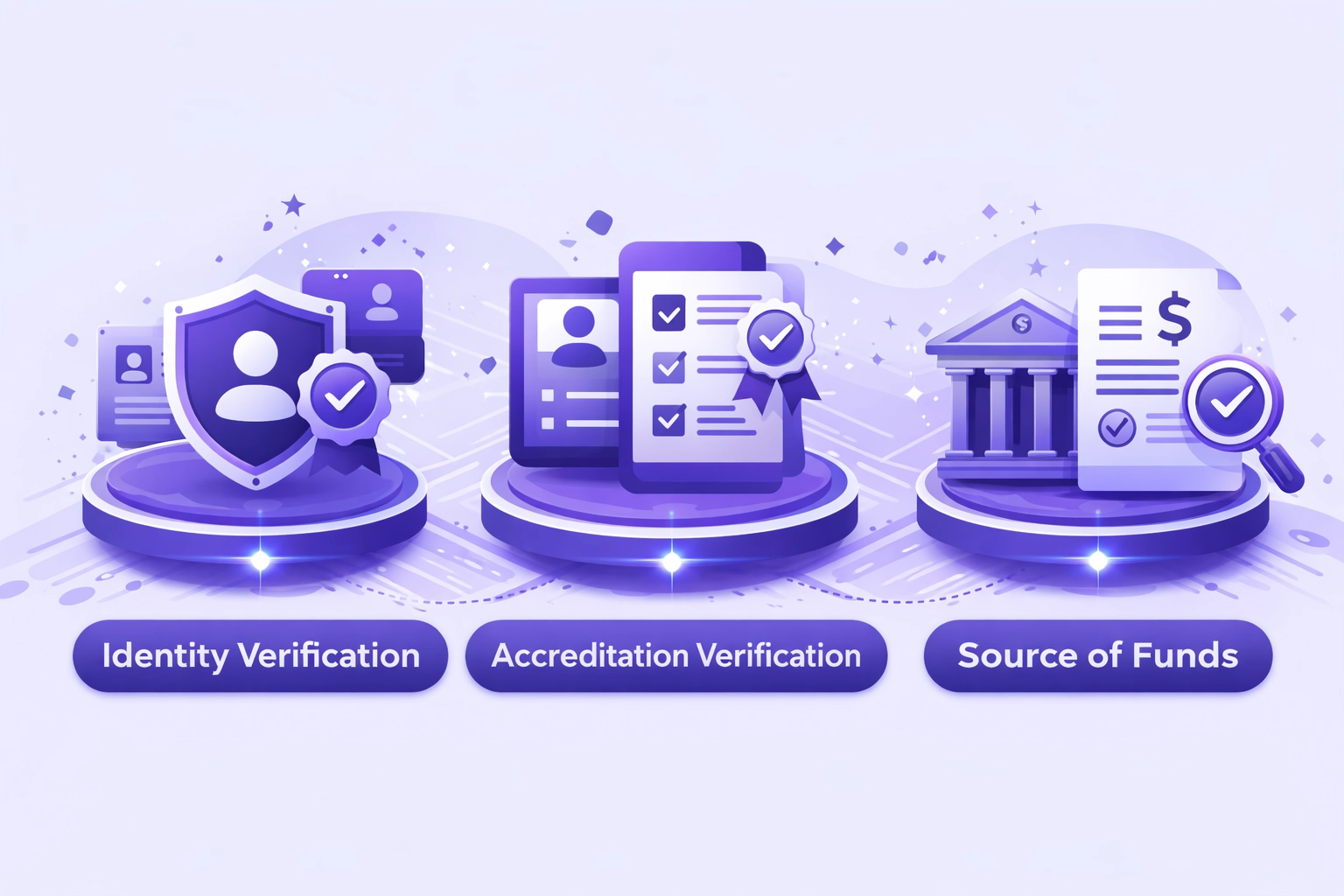 Required Verification Documentation by Category
Identity Verification
- Government-issued photo ID (passport or driver’s license)
- Facial recognition biometric matching
- Utility bill or bank statement for address confirmation
- Tax identification number verification
Accreditation Verification
- Previous two years tax returns showing income
- Brokerage statements demonstrating net worth
- CPA or attorney letter certifying status
- Professional securities license documentation
Source of Funds
- Bank statements showing fund accumulation
- Employment verification and income documentation
- Business ownership records and financial statements
- Cryptocurrency transaction history and blockchain analysis
Custodial vs Non-Custodial Holding Compliance Risks
Custodial holding arrangements where third-party platforms maintain control of private keys create regulatory obligations under securities custody rules requiring licensing, insurance, segregated accounts, and periodic audits. USA Investment Advisers Act Rule 206(4)-2 imposes strict custody requirements when advisers have access to client assets demanding qualified custodians, client account statements, and surprise audits. Tokenized real estate platforms offering custody must register as broker-dealers or investment advisers subject to comprehensive regulatory oversight including capital requirements, bonding, and SIPC insurance where applicable. The custody arrangement provides user convenience eliminating private key management complexity but introduces counterparty risk where platform insolvency or security breaches threaten investor asset access. Bankruptcy proceedings may classify custodied tokens as platform assets rather than segregated customer property creating substantial recovery risks.
Non-custodial models where investors control private keys in personal wallets avoid custody regulations but introduce technical complexity and security risks for unsophisticated users. Lost private keys result in permanent asset loss without recovery mechanisms unlike traditional custodial arrangements offering account recovery processes. The non-custodial approach better aligns with blockchain self-sovereignty principles but proves impractical for many retail investors lacking technical expertise and security infrastructure. Hybrid models employing multi-signature schemes requiring both platform and user authorization for transfers balance security against convenience while potentially avoiding custody classification. Smart contract-based custody through decentralized protocols like Gnosis Safe provides non-custodial security through programmable access controls. Regulatory clarity remains incomplete around custody classification for various tokenized real estate investor rules asset holding arrangements. Tokenized real estate investor rules increasingly demand clear disclosures about custody arrangements, associated risks, and platform responsibilities enabling informed decisions about asset holding methods across different security and convenience trade-offs serving diverse investor preferences and risk tolerances.
Smart Contract Enforcement of Investor Eligibility
Smart contract enforcement of investor eligibility revolutionizes compliance through programmatic rules automatically executing transfer restrictions, holding periods, and qualification requirements without manual intervention. ERC-1404 and similar token standards embed compliance logic directly into token contracts enabling automated enforcement of securities regulations. Whitelist mechanisms maintain approved investor addresses verified through KYC and accreditation processes rejecting transactions involving non-whitelisted recipients. Time-lock features prevent transfers before specified dates automatically implementing Regulation D holding periods or contractual lock-ups. Jurisdiction filtering blocks transfers to IP addresses or wallet addresses associated with prohibited countries preventing inadvertent violations of geographic restrictions. The automation provides superior enforcement certainty compared to paper-based systems relying on transfer agent verification and manual compliance procedures.
Polymath, Harbor, and Securitize protocols provide compliance infrastructure for security token issuance embedding sophisticated eligibility rules into smart contracts. These platforms integrate identity verification services, accreditation verification, and transaction monitoring creating comprehensive compliance frameworks. Cap table limitations preventing excessive shareholder concentration can enforce automatically through smart contracts monitoring ownership distribution. Investment limits for non-accredited investors in Regulation A+ offerings can calculate and enforce programmatically based on declared income and net worth. The technical enforcement eliminates human error risks and provides real-time compliance assurance versus periodic manual reviews. Implementation challenges include smart contract upgrade requirements when regulations change, oracle dependencies for off-chain data verification, and technical complexity requiring specialized expertise. Progressive regulators recognize programmatic compliance potential through safe harbor proposals and guidance accommodating technology-enabled enforcement mechanisms. The smart contract approach represents fundamental innovation in securities compliance enabling tokenized real estate investor rules enforcement with unprecedented accuracy and efficiency across global digital asset markets.
Cap Table Digitization and On-Chain Share Registry Laws
Cap table digitization through blockchain-based share registries transforms ownership record-keeping from centralized ledgers to distributed immutable databases providing transparent real-time ownership tracking. Traditional cap tables maintained by transfer agents or corporate secretaries create information asymmetries, reconciliation challenges, and update delays as ownership changes. Blockchain registries provide single sources of truth accessible to all authorized participants with cryptographic proof of ownership eliminating disputes about current stakeholder composition. Smart contracts automatically update ownership records upon transfer execution without manual data entry reducing administrative overhead and error risks. The digitization enables instantaneous beneficial ownership reporting to issuers facilitating dividend distributions, governance communications, and regulatory filings requiring current shareholder information.
Legal recognition of blockchain share registries remains evolving with Delaware, Wyoming, and several international jurisdictions explicitly authorizing distributed ledger use for corporate records. Delaware General Corporation Law amendments permit corporations to maintain share registries on blockchain networks subject to specific technical and procedural requirements. Wyoming’s Decentralized Autonomous Organization Act recognizes blockchain-based membership records for new entity types. UK Companies House explores distributed ledger integration for company registries. However, most jurisdictions still require traditional paper or centralized digital records as official documentation with blockchain serving as supplementary record-keeping. The legal uncertainty around blockchain registry enforceability during disputes creates risks where courts may not recognize chain-of-custody arguments absent traditional supporting documentation. Tokenized real estate offerings typically maintain parallel traditional and blockchain records during transition period until clear legal frameworks establish blockchain registries as authoritative sources. The digitization trajectory suggests eventual full legal recognition as technology matures and regulatory comfort increases enabling seamless integration of tokenized real estate investor rules investor records with traditional corporate governance and securities law frameworks across jurisdictions.
Compliance Obligation Comparison Framework
| Obligation Type | Issuer Requirements | Investor Requirements | Enforcement Mechanism |
|---|---|---|---|
| Investor Verification | Reasonable steps to verify accreditation status | Provide documentation proving qualification | Whitelist-based smart contract access control |
| Transfer Restrictions | Implement holding periods and eligibility checks | Comply with lockup and qualification requirements | Time-lock and eligibility verification in code |
| Disclosure Obligations | Provide offering materials and ongoing updates | Review materials and acknowledge receipt | Digital signature confirmation on blockchain |
| Ongoing Reporting | Annual financials and material event notices | Maintain current contact and status information | Automatic distribution through platform portals |
| Tax Reporting | Issue K-1 or 1099 forms for distributions | Report income and gains on personal returns | Automated calculation from on-chain transactions |
Disclosure Obligations in Fractional Property Tokens
Disclosure obligations for fractional property tokens encompass comprehensive information provision enabling investors to make informed decisions about risks, returns, and material facts affecting investment value. Private placement memorandums or offering circulars must detail property descriptions including location, square footage, age, condition, and current use. Financial information includes purchase price, debt financing terms, projected cash flows, expense assumptions, and exit strategies with underlying assumptions clearly stated. Management backgrounds, compensation structures, conflicts of interest, and related-party transactions require full disclosure. Risk factors must address property-specific issues like tenant concentration, deferred maintenance, environmental liabilities, plus general risks including illiquidity, regulatory uncertainty, technology risks, and platform dependence. The disclosure standard demands plain English explanations accessible to target investor sophistication levels avoiding technical jargon obscuring material information.
Ongoing disclosure obligations continue post-offering through periodic financial statements, material event notifications, and annual reports updating investors on property performance and significant developments. Quarterly or annual financial statements provide operating results, occupancy rates, rental income, expenses, and net operating income trends. Material events requiring prompt disclosure include property damage, tenant defaults, regulatory actions, management changes, or refinancing transactions. The disclosure burden increases for Regulation A+ offerings requiring audited financials, MD&A sections, and continuous SEC reporting similar to public companies. Blockchain transparency provides supplementary disclosure through on-chain transaction visibility enabling investors to independently verify distributions, ownership composition, and smart contract execution. However, on-chain data alone proves insufficient for securities law compliance requiring traditional formatted disclosures addressing financial condition, business operations, and risk factors. Tokenized real estate investor rules demand issuers balance comprehensive disclosure against information overload, providing material information without overwhelming investors with immaterial details across regulatory frameworks governing USA, UK, UAE, and Canadian markets.
Marketing Restrictions for Tokenized Real Estate Deals
Marketing restrictions for private placement tokenized real estate investor rules offerings prohibit general solicitation and advertising protecting exemption reliance under Regulation D Rule 506(b). General solicitation includes any advertisement, article, notice, or communication published in newspapers, magazines, television, radio, or websites reaching general public without pre-qualification. Social media posts, email campaigns to non-verified recipients, and public presentations constitute prohibited solicitation absent Rule 506(c) election permitting advertising with enhanced accreditation verification. Pre-existing substantive relationships established before offering commencement enable solicitation-free investor contact. Registered broker-dealers can introduce issuers to prospective investors without violating solicitation prohibitions. The restriction aims preventing unscrupulous promoters from advertising risky unregistered offerings to unsophisticated public investors lacking resources to evaluate complex private placements.
Rule 506(c) offerings permit general solicitation including online advertising, social media campaigns, and public investor events provided all purchasers are accredited with reasonable verification steps confirming status. This pathway enables broader marketing reaching accredited investors without pre-existing relationships while maintaining investor protection through qualification requirements. Regulation A+ offerings allow full advertising similar to public offerings though subject to specific content requirements and filing with SEC. Testing the waters provisions permit issuers to gauge interest before formal offering commencement through limited communications. UK financial promotion rules restrict marketing to certified sophisticated, high-net-worth, or professional investors with specific disclosure requirements for promotional materials. Marketing violations jeopardize exemption reliance potentially requiring rescission offers to all investors with significant liability exposure. Tokenized real estate platforms must carefully structure marketing compliance balancing investor acquisition needs against regulatory constraints across jurisdictions where offerings occur serving diverse international investor populations seeking property token opportunities.
Blue Sky Laws and State-Level Filing Requirements
Blue Sky laws represent state-level securities regulations imposing additional filing requirements and merit review beyond federal exemptions in some jurisdictions. Despite Regulation D federal exemption reliance, historically many states required notice filings, consent to service of process, and filing fees before securities sales to state residents. The National Securities Markets Improvement Act of 1996 preempted state registration for Rule 506 offerings though preserving state authority for notice filings and fraud enforcement. Form D filing must occur with both SEC and applicable state securities regulators within 15 days of first sale in each state where investors reside. Filing fees range from $0-$1,000 per state creating administrative burden and costs for multi-state offerings. Some states like California, New York, and Texas maintain stricter requirements including legend disclosures, supplemental information requests, and longer response times.
Blue Sky compliance complexity increases substantially for Regulation A+ Tier 1 offerings subject to full state merit review requiring registration or exemption qualification in every state where sales occur. State regulators may impose additional conditions, limit compensation arrangements, or deny registration based on fairness determinations. The burden often makes Tier 1 offerings impractical compared to Tier 2 offerings federally preempting state registration requirements. State enforcement actions can proceed despite federal exemption compliance where state law violations occur through fraud, filing failures, or procedural non-compliance. The fragmented state regulatory landscape creates compliance challenges for tokenized real estate investor rules offerings serving nationwide investor bases. Platforms typically limit offerings to residents of states with streamlined processes or substantial investor populations justifying compliance costs. Reform proposals advocate further state preemption reducing duplicative regulation, though states resist surrendering authority to protect local investors. Tokenized real estate investor rules must navigate this federal-state regulatory patchwork ensuring compliance at both levels for offerings serving USA markets across multiple state jurisdictions.
Critical Investor Protection Standards
Standard 1: Verify all investor accreditation status through documentation review before token sale approval ensuring qualification under applicable exemption frameworks.
Standard 2: Implement comprehensive KYC and AML procedures screening investors against sanctions lists and verifying legitimate fund sources.
Standard 3: Provide comprehensive disclosure documents addressing property details, financial projections, risks, and management backgrounds enabling informed decisions.
Standard 4: Enforce transfer restrictions through smart contracts automatically preventing unauthorized sales violating holding periods or eligibility requirements.
Standard 5: Maintain accurate ownership records through blockchain registries providing transparent real-time cap table information to authorized participants.
Standard 6: Deliver ongoing reporting including financial statements, property performance updates, and material event notifications satisfying information rights.
Standard 7: Establish clear governance mechanisms defining voting rights, information access, and decision-making processes protecting investor interests.
Standard 8: Conduct regular compliance audits reviewing investor verification procedures, transfer enforcement, and disclosure compliance across jurisdictions.
Tax Reporting Duties for Tokenized Property Investors
Tax reporting duties for tokenized real estate investor rules investors depend on legal structure with direct property ownership, partnership interests, or REIT shares each creating distinct obligations. SPV structures holding properties typically elect partnership taxation under IRS check-the-box regulations requiring Schedule K-1 issuance to token holders reporting proportional shares of income, deductions, and credits. Investors must report K-1 items on personal returns with passive activity loss limitations potentially restricting current deduction of rental losses. Alternative minimum tax considerations may apply for certain deductions and credits. Foreign investors face FIRPTA withholding on USA real estate dispositions with Form 1040-NR filing requirements. UK investors report property income and gains through self-assessment with potential treaty benefits reducing double taxation. UAE residents benefit from zero personal income tax though corporate structures face new tax regimes. Canadian investors report worldwide income including foreign property holdings with foreign tax credit availability.
Token transactions create additional reporting complexity with sales generating capital gains or losses based on holding period classification and adjusted basis calculations. Crypto-to-crypto exchanges disposing of property tokens for other digital assets constitute taxable events requiring fair market value determination at transaction dates. Foreign financial account reporting under FBAR and FATCA may apply when token holdings exceed $10,000 thresholds. State tax obligations arise based on property locations with multi-state SPVs requiring composite returns or individual state filing. The reporting burden proves substantial for investors holding diversified property token portfolios across multiple offerings and jurisdictions. Tax preparation software rarely accommodates tokenized asset reporting requiring manual calculations and specialized tax adviser assistance. Platforms increasingly provide tax reporting tools calculating gains, losses, and income distributions from on-chain transaction data though accuracy depends on proper transaction categorization. Tokenized real estate investor rules demand clear tax guidance and documentation enabling investors to satisfy reporting obligations across complex international tax frameworks applicable to digital property holdings.
SPV Structures and Legal Isolation of Real Assets
Special purpose vehicle structures provide legal isolation between underlying real estate assets and tokenized securities creating bankruptcy remoteness and clear ownership documentation essential for investor protection. Delaware statutory trusts, limited liability companies, and limited partnerships serve as common SPV entities holding title to properties while issuing tokens representing beneficial interests. The separation protects property assets from operating company liabilities, platform insolvency, and token issuer bankruptcy creating structural protection for investor claims on real estate value. Proper SPV structuring demands independent management, arm’s-length transactions, separate accounting, and adequate capitalization preventing substantive consolidation during bankruptcy proceedings. Non-recourse financing limiting lender claims to specific properties rather than SPV general assets enhances protection. The isolation proves particularly critical when platforms operate multiple property SPVs preventing cross-contamination where one property’s problems affect others.
SPV operating agreements or trust declarations establish governance rules, distribution priorities, and investor rights defining legal relationships between token holders and property assets. Carefully drafted provisions ensure bankruptcy remoteness survives judicial scrutiny during insolvency proceedings where courts may disregard corporate separateness finding entities operate as single economic units. Special purpose limitations restrict SPV activities to holding and managing specific properties preventing unrelated business activities that could introduce liability risks. Independent director requirements or trust protector provisions provide oversight ensuring SPV operations comply with structural requirements. The complexity and costs of proper SPV structuring prove substantial requiring specialized legal counsel familiar with bankruptcy law, securities regulation, and real estate transactions. Offshore SPVs in Cayman Islands, British Virgin Islands, or similar jurisdictions offer tax advantages and flexible governance though potentially complicating USA securities law compliance and investor understanding. Tokenized real estate investor rules demand transparent SPV documentation enabling investors to understand legal structures, evaluate bankruptcy remoteness quality, and assess actual ownership rights in underlying property assets across different jurisdictional frameworks.
Governance Rights Attached to Real Estate Tokens
Governance rights attached to real estate tokens define investor participation in property management decisions, information access, and control mechanisms balancing democratic ownership against operational efficiency. Voting rights typically provide proportional influence based on token holdings with one-token-one-vote structures common in decentralized models. Major decisions requiring investor approval include property sales, significant renovations exceeding capital expenditure thresholds, refinancing transactions, and management company changes. Routine operational matters remain with appointed managers or property management companies avoiding impractical direct democracy for day-to-day decisions. Supermajority requirements protecting minority interests often apply to fundamental changes like asset sales requiring 66% or 75% approval preventing bare majority from forcing unfavorable transactions. Voting occurs through blockchain-based governance platforms enabling remote participation without physical meetings though notice requirements and minimum quorum thresholds apply ensuring legitimate decision-making processes.
Information rights entitle token holders to periodic financial statements, property inspection opportunities, and material information affecting investment value. Quarterly or annual reports detail rental income, operating expenses, occupancy rates, and capital expenditures providing performance transparency. On-chain data supplements traditional reporting enabling holders to independently verify distributions, ownership composition, and transaction history. Redemption rights rarely exist in tokenized offerings given illiquidity challenges though some structures allow forced buybacks under specific circumstances like platform termination or extended holding periods. Minority protection mechanisms including tag-along rights, drag-along provisions, and oppression remedies balance majority control against minority exploitation. Advisory boards or investor committees provide input on strategy and oversight without binding authority maintaining management flexibility while addressing investor concerns. The governance design reflects tension between fractional ownership democracy and practical property management efficiency requiring careful balancing across tokenized real estate investor frameworks serving diverse participant populations with varying sophistication, engagement levels, and control preferences.
Voting Rights on Major Decisions
Token holders vote proportionally on property sales, major renovations, refinancing, and management changes requiring supermajority approval for fundamental transactions.
Information Access Rights
Holders receive periodic financial statements, property performance reports, and on-chain transaction transparency enabling independent verification of operations.
Distribution Rights
Proportional claims on rental income, sale proceeds, and refinancing distributions after operating expenses, reserves, and management fees deduction.
Inspection Rights
Physical property inspection opportunities and document review rights enabling holders to verify asset condition and financial record accuracy.
Minority Protections
Tag-along and drag-along rights, oppression remedies, and supermajority requirements preventing majority abuse of minority holders.
Advisory Participation
Advisory board membership or investor committee participation providing strategic input without binding authority on management decisions.
Investor Protection Mechanisms in Digital REIT Models
Investor protection mechanisms in digital REIT models incorporate traditional real estate investment trust safeguards adapted for tokenized structures addressing diversification, governance, income distribution, and transparency requirements. REIT status under USA tax law requires 90% of taxable income distribution to shareholders, at least 75% of assets invested in real estate, and diversified ownership preventing five or fewer individuals from controlling more than 50% of value during last half of tax year. These requirements provide structural investor protections ensuring income distribution rather than retention, property focus rather than diversification into unrelated businesses, and ownership dispersion limiting concentrated control. Digital REITs implement these protections through smart contracts automatically distributing income quarterly, enforcing asset allocation limits, and monitoring ownership concentration triggering compliance alerts when thresholds approach.
Additional protections include independent board oversight, external management arrangements limiting conflicts of interest, and fair valuation methodologies for illiquid holdings ensuring accurate net asset value calculations. Regulated exchanges or alternative trading systems provide price discovery and liquidity monitoring protecting against manipulation. Custody arrangements with qualified custodians prevent management self-dealing and asset diversion. Investor redemption rights at NAV quarterly or annually provide exit mechanisms though often subject to gates limiting total redemptions during stress periods. The digital structure enables enhanced protections through transparent on-chain distributions, real-time portfolio visibility, and automated compliance monitoring impossible in traditional REIT structures. However, regulatory uncertainty around digital REIT classification, tax treatment ambiguities, and technology risks create novel challenges requiring careful structuring. Tokenized real estate investor rules governing digital REITs remain evolving as regulators, issuers, and investors gain experience with hybrid structures combining REIT benefits with blockchain innovation across USA, UK, UAE, and Canadian markets where REIT-equivalent frameworks exist.
Compliance Automation Through Embedded Legal Logic
Compliance automation through embedded legal logic represents the frontier of tokenized real estate investor rules implementation where smart contracts encode regulatory requirements executing automatically without manual oversight. RegTech integration connects identity verification, accreditation confirmation, and transaction monitoring systems to token smart contracts enabling real-time compliance enforcement. Whitelist functions maintain approved investor addresses verified through KYC and accreditation processes automatically rejecting transactions involving non-whitelisted parties. Time-lock mechanisms enforce holding period restrictions calculating elapsed time from purchase dates preventing transfers before regulatory minimums expire. Investment limit calculations for non-accredited investors in Regulation A+ offerings track aggregate purchases across 12-month periods automatically blocking transactions exceeding 10% thresholds based on declared net worth or income. Geographic restrictions filter transactions based on IP addresses or declared residences preventing sales into prohibited jurisdictions.
The automation extends to ongoing compliance monitoring including AML transaction analysis, sanctions screening, and suspicious activity detection triggering alerts for human review. Shareholder counting for REIT qualification purposes occurs automatically through on-chain ownership tracking flagging when diversification requirements face jeopardy. Income distribution requirements calculate automatically from rental receipts and expense payments executing quarterly distributions satisfying REIT mandates. Regulatory reporting automation extracts data from blockchain transactions generating Form D filings, Blue Sky notices, and annual reports without manual data entry. The embedded logic reduces compliance costs, eliminates human errors, and provides continuous real-time enforcement superior to periodic manual reviews. Implementation challenges include smart contract upgrade requirements when regulations change, technical complexity requiring specialized expertise, and regulatory uncertainty around legal validity of automated enforcement. Progressive regulators increasingly recognize programmatic compliance benefits through safe harbor proposals and no-action letters accommodating technology-enabled rule enforcement. The automation trajectory suggests eventual widespread adoption as platforms, regulators, and investors gain confidence in smart contract compliance capabilities across tokenized real estate markets globally.
Enforcement Trends in Digital Asset Real Estate Markets
Enforcement trends in digital asset real estate markets demonstrate increasing regulatory scrutiny as authorities apply traditional securities laws to tokenized offerings while developing novel approaches for blockchain-specific issues. SEC enforcement actions against unregistered token offerings establish that digital assets meeting Howey Test investment contract criteria require registration or exemption compliance regardless of technology employed. Notable cases involving ICOs and token sales create precedents applicable to real estate tokenization emphasizing substance over form in securities classification. Enforcement priorities focus on fraud prevention, investor protection, and market integrity rather than targeting legitimate compliance efforts. However, aggressive enforcement creates chilling effects where marginal cases face action despite good-faith compliance attempts creating uncertainty discouraging innovation. International coordination through IOSCO and bilateral agreements enables cross-border enforcement where offerings span multiple jurisdictions creating complex coordination challenges.
Regulatory trends suggest movement toward principles-based frameworks rather than rigid rules-based approaches accommodating technological innovation while maintaining core investor protections. UK FCA regulatory sandboxes, UAE ADGM RegLab, and similar programs provide supervised testing environments for novel structures enabling regulatory learning and industry innovation simultaneously. USA SEC Strategic Hub for Innovation and Financial Technology provides informal guidance and no-action letters for compliant approaches though formal rulemaking remains pending. Enforcement sophistication increases as regulators develop blockchain analysis capabilities tracking token flows, identifying unregistered offerings, and pursuing fraudulent schemes with greater efficiency. The maturation trend suggests regulatory frameworks will evolve toward clear rules specifically addressing tokenized securities rather than applying analogies from traditional markets. Tokenized real estate investor rules will likely achieve greater clarity and certainty as enforcement actions, regulatory guidance, and legislative reforms accumulate establishing stable frameworks supporting legitimate innovation while punishing fraud across USA, UK, UAE, Canadian, and international markets seeking balanced approaches protecting investors without stifling beneficial financial technology applications.
Navigate Tokenized Real Estate Compliance with Expertise
Partner with experienced legal and compliance specialists to structure compliant tokenized real estate offerings meeting investor protection standards across jurisdictions.
People Also Ask
Q1.1. What qualifies an investor as accredited for tokenized real estate purchases?
Accredited investor status for tokenized real estate requires meeting income thresholds of $200,000 individually or $300,000 jointly for two consecutive years, or possessing net worth exceeding $1 million excluding primary residence under USA SEC regulations. UK FCA frameworks recognize high-net-worth individuals with annual income above £100,000 or investable assets exceeding £250,000. UAE DFSA and ADGM categorize professional clients based on portfolio values above $500,000 and financial industry experience. Canadian provinces apply similar wealth and income standards through provincial securities commissions. Entity investors including corporations, trusts, and funds require minimum asset thresholds typically ranging from $5-25 million depending on jurisdiction. Verification demands financial statements, tax returns, and professional certifications confirming eligibility before token purchase approval.
Q2.2. Can non-accredited retail investors participate in tokenized real estate offerings?
Non-accredited retail investors can participate in tokenized real estate through specific exemption pathways including Regulation A+ offerings in USA enabling up to $75 million raises from general public with investment limits of 10% net worth or annual income. Regulation CF crowdfunding accommodates smaller offerings under $5 million with investment caps based on income and net worth calculations. UK retail investors access tokens through FCA-authorized platforms under financial promotion rules. EU MiCA frameworks establish retail investor protections for crypto-asset offerings including property tokens. However, most private placement tokenizations exclude retail participants due to regulatory complexity, minimum investment thresholds, and sophisticated investor requirements creating predominantly accredited-only markets across major jurisdictions.
Q3.3. What are the main transfer restrictions on tokenized real estate securities?
Transfer restrictions on tokenized real estate securities typically include holding period lockups ranging from 6-12 months under Regulation D Rule 506 preventing immediate resale. Smart contracts programmatically enforce these restrictions rejecting unauthorized transactions attempting early transfers. Secondary market trading requires platform registration with securities regulators and compliance with applicable exemptions. Investor qualification verification occurs before each transfer ensuring recipients meet accreditation or jurisdiction requirements. Right of first refusal provisions favor existing holders or issuers before external sales. Geographic restrictions prevent sales to prohibited jurisdictions including embargoed countries or non-qualified foreign investors. These limitations balance liquidity desires against regulatory compliance obligations protecting both issuers and investors from enforcement actions.
Q4.4. How do KYC and AML requirements apply to tokenized property investments?
KYC and AML requirements for tokenized property investments mandate comprehensive identity verification through government-issued identification documents, residential address confirmation, and biometric authentication where applicable. Financial institutions conducting offerings must verify beneficial ownership, source of funds, and politically exposed person status. Enhanced due diligence applies to high-risk jurisdictions and large transactions exceeding reporting thresholds. Blockchain platforms integrate identity verification services like Chainalysis, Elliptic, and ComplyAdvantage screening investors against sanctions lists and adverse media databases. Ongoing monitoring detects suspicious transaction patterns including rapid trading, unusual fund sources, or connections to criminal activity. Documentation retention requirements span 5-7 years depending on jurisdiction. Non-compliance exposes platforms to regulatory penalties, criminal prosecution, and reputational damage.
Q5.5. What governance rights do tokenized real estate investors typically receive?
Tokenized real estate investors typically receive proportional voting rights on major decisions including property sales, significant renovations, refinancing, and management changes encoded in smart contracts or SPV operating agreements. Token holders may participate in quarterly or annual meetings voting remotely through blockchain-based governance platforms. Information rights provide access to financial statements, property performance metrics, and material disclosures. Some structures offer advisory rights without binding authority where management retains operational control. Dividend rights entitle token holders to proportional distributions from rental income and sale proceeds minus expenses and management fees. Redemption rights may exist allowing forced buybacks under specific circumstances though typically limited to protect liquidity. Minority protections prevent oppression by majority holders through supermajority requirements for fundamental changes and inspection rights enabling oversight of asset management.
Explore Services
Related Services
Reviewed by

Aman Vaths
Founder of Nadcab Labs
Aman Vaths is the Founder & CTO of Nadcab Labs, a global digital engineering company delivering enterprise-grade solutions across AI, Web3, Blockchain, Big Data, Cloud, Cybersecurity, and Modern Application Development. With deep technical leadership and product innovation experience, Aman has positioned Nadcab Labs as one of the most advanced engineering companies driving the next era of intelligent, secure, and scalable software systems. Under his leadership, Nadcab Labs has built 2,000+ global projects across sectors including fintech, banking, healthcare, real estate, logistics, gaming, manufacturing, and next-generation DePIN networks. Aman’s strength lies in architecting high-performance systems, end-to-end platform engineering, and designing enterprise solutions that operate at global scale.