Ai Overview
Understanding this regulatory landscape is essential for platforms launching tokenization offerings, investors evaluating compliance risks, and jurisdictions developing frameworks balancing innovation with investor protection. The 18-month registration process required extensive legal work, financial audits, compliance system implementation, and ongoing reporting obligations costing over $2 million.
Key Takeaways
- Real estate tokenization regulations treat tokenized property interests as securities in virtually all major jurisdictions including USA, UK, UAE, and Canada, triggering comprehensive regulatory frameworks covering registration, disclosure, transfer restrictions, and ongoing compliance obligations that platforms must satisfy before launching offerings.
- Securities law compliance represents the foundational regulatory requirement with US SEC applying Regulation D for private placements, Regulation A+ for mini-public offerings, UK FCA requiring prospectus approval, UAE VARA and DFSA implementing digital asset security frameworks, and Canadian provinces enforcing National Instrument requirements.
- KYC and AML obligations for tokenization platforms match or exceed traditional financial services requirements mandating customer identification, beneficial ownership verification, sanctions screening, suspicious activity monitoring, and comprehensive record-keeping with violations resulting in criminal prosecution and substantial civil penalties.
- Cross-border tokenization creates jurisdictional complexity requiring compliance with securities laws in all countries where tokens are offered or traded with limited safe harbors like US Regulation S for offshore transactions, making geographic restrictions and multi-jurisdictional compliance essential for international platforms.
- Smart contracts implementing transfer restrictions, KYC verification, and distribution automation must be legally enforceable while maintaining regulatory compliance requiring careful design balancing code automation with legal requirements, comprehensive testing, and legal review confirming smart contract terms satisfy applicable securities and contract laws.
- Licensing requirements for tokenization platforms vary significantly by jurisdiction and business model with secondary trading platforms typically requiring broker-dealer or Alternative Trading System registration, custodial services needing qualified custodian status, and issuers potentially requiring investment adviser registration depending on services offered.
- Taxation of tokenized real estate follows traditional property tax principles in most jurisdictions with token holders subject to capital gains tax on appreciation, income tax on distributions, and property-level taxes flowing through ownership structures, though specific treatment varies and requires professional tax advice.
- Regulatory non-compliance creates existential platform risks beyond financial penalties including forced shutdown orders, investor rescission rights requiring buybacks at original prices, criminal prosecution of executives, permanent industry bars, and cascading investor lawsuits that can destroy platform value regardless of underlying property quality.
- Emerging regulatory frameworks in UAE and other progressive jurisdictions provide clearer pathways for compliant tokenization while maintaining investor protections, demonstrating regulatory evolution toward accommodating digital securities within established legal frameworks rather than creating entirely new regulatory categories.
- Global regulatory harmonization remains limited despite international coordination efforts requiring platforms to implement highest common standards across all operating jurisdictions, maintain flexible compliance systems adapting to regulatory changes, and engage proactively with regulators establishing enforcement precedents shaping industry development.
Introduction to Real Estate Tokenization Regulations
Real estate tokenization regulations represent the complex intersection of traditional property law, securities regulation, digital asset frameworks, anti-money laundering requirements, and cross-border legal considerations that collectively govern how property ownership interests can be digitized, offered to investors, and traded on blockchain infrastructure. Understanding this regulatory landscape is essential for platforms launching tokenization offerings, investors evaluating compliance risks, and jurisdictions developing frameworks balancing innovation with investor protection.
The regulatory treatment of tokenized real estate has evolved significantly since early experimental implementations in 2017-2018 when legal uncertainty dominated and many platforms operated without clear regulatory authorization. Today, regulators across the USA, UK, UAE, and Canada have established that tokenized property interests constitute securities subject to comprehensive regulatory oversight, ending debates about whether blockchain technology creates novel asset categories exempt from traditional securities laws. This regulatory clarity, while imposing compliance burdens, provides legal certainty enabling institutional participation and mainstream adoption.
Our experience structuring 150+ compliant tokenization implementations across multiple jurisdictions reveals that successful regulatory navigation requires understanding both letter and spirit of applicable laws, engaging proactively with regulators establishing enforcement precedents, implementing robust compliance programs exceeding minimum requirements, and maintaining operational flexibility adapting to regulatory evolution. Platforms viewing compliance as checkbox exercise rather than core operational requirement inevitably face enforcement actions destroying value for all stakeholders.
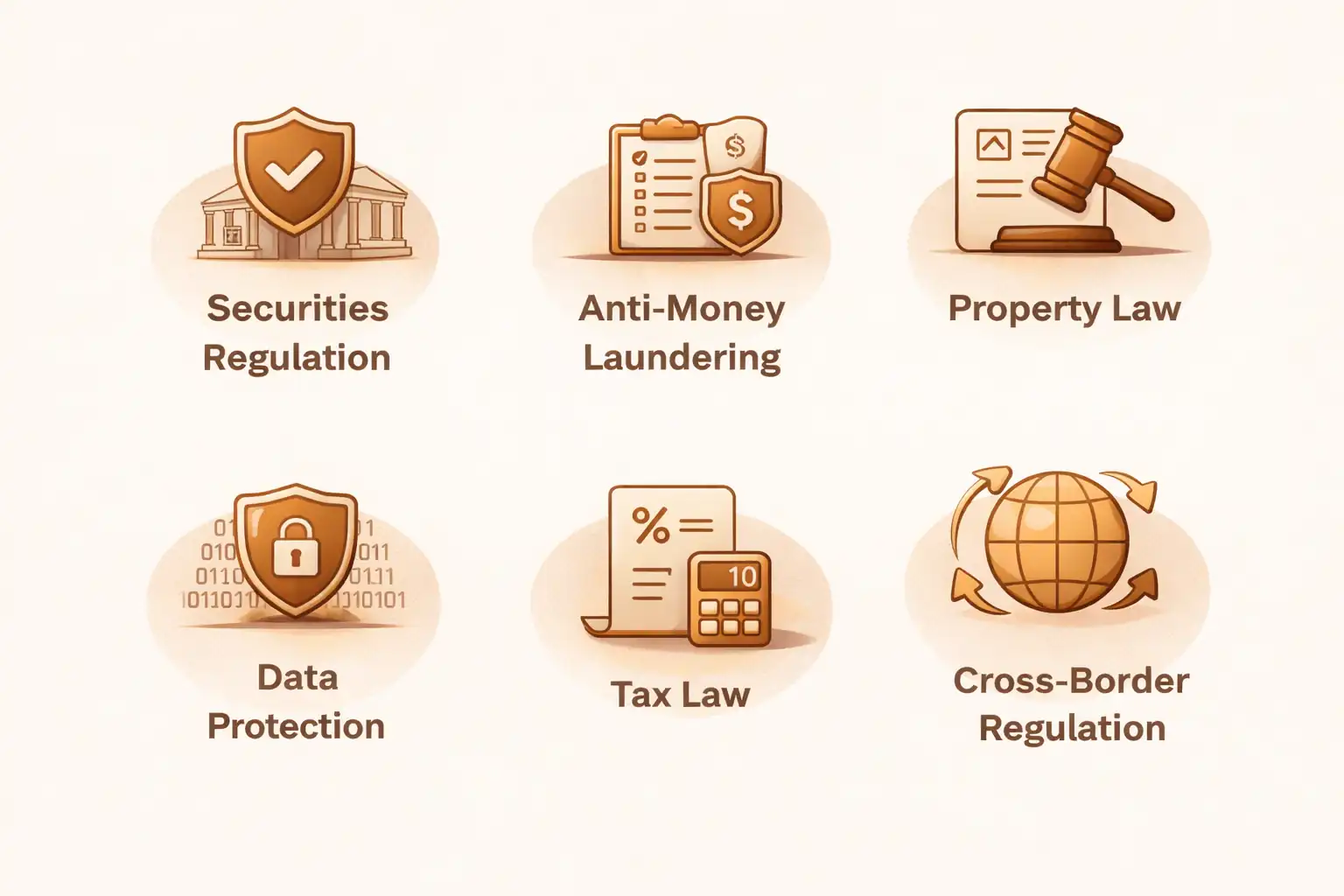
Core Regulatory Domains Governing Real Estate Tokenization Regulations
Securities Regulation
Registration requirements, disclosure obligations, exemption qualifications, transfer restrictions, ongoing reporting, anti-fraud provisions, and broker-dealer regulations governing how tokenized property interests are offered, sold, and traded as investment securities.
Anti-Money Laundering
Customer identification, beneficial ownership verification, sanctions screening, transaction monitoring, suspicious activity reporting, and record retention requirements preventing tokenization platforms from facilitating money laundering, terrorist financing, or sanctions evasion.
Property Law
Real estate ownership structures, title recording, lien priorities, foreclosure procedures, landlord-tenant regulations, zoning compliance, and property tax obligations that continue applying to underlying properties regardless of tokenized ownership representation.
Data Protection
GDPR in EU/UK, PIPEDA in Canada, state privacy laws in USA, and UAE data protection regulations governing collection, processing, storage, and deletion of investor personal information collected through KYC procedures and platform operations.
Tax Law
Capital gains taxation, income tax on distributions, depreciation pass-through, transfer taxes, withholding obligations, international tax treaties, and reporting requirements affecting token holders, issuers, and underlying property entities across multiple jurisdictions.
Cross-Border Regulation
Jurisdictional conflicts, extraterritorial enforcement, international cooperation agreements, cross-border offering restrictions, foreign investment regulations, and currency controls affecting platforms operating across USA, UK, UAE, Canada, and other markets simultaneously.
The regulatory complexity of real estate tokenization regulations stems from its hybrid nature combining traditional property ownership with digital securities infrastructure and blockchain technology. Each regulatory domain brings established requirements developed over decades for traditional markets that must be interpreted and applied to novel tokenization structures. This interpretation process involves regulatory guidance, no-action letters, enforcement actions, and court decisions gradually establishing how existing laws apply to digitized property ownership.
Regulatory approaches vary significantly across jurisdictions, with some like UAE actively creating progressive frameworks specifically designed for digital securities, while others like USA apply existing securities laws developed in 1930s to modern blockchain implementations. These divergent approaches create compliance challenges for international platforms that must satisfy the strictest applicable requirements across all operating jurisdictions rather than selecting most permissive regulatory environments.
Regulatory Philosophy: Real estate tokenization regulations should be understood not as obstacles to innovation but as investor protection frameworks ensuring market integrity, preventing fraud, and maintaining public confidence in property markets. Successful platforms embrace compliance as competitive advantage demonstrating professionalism, protecting investors, and building trust with institutional participants requiring regulatory certainty. The platforms that thrive long-term are those viewing regulatory compliance as core value proposition rather than burdensome cost, investing appropriately in legal counsel, compliance systems, and ongoing regulatory engagement establishing industry best practices.
This comprehensive regulatory guide examines each major regulatory domain affecting real estate tokenization regulations, analyzes specific requirements in USA, UK, UAE, and Canada, provides practical compliance strategies based on our operational experience, and explores emerging regulatory developments shaping the future of digitized property ownership. Understanding these regulations is essential for anyone involved in tokenization, from platforms seeking to launch compliant offerings to investors evaluating regulatory risks in their investment decisions.
Why Regulatory Clarity Matters in Real Estate Tokenization Regulations
Regulatory clarity represents the foundational prerequisite for mainstream real estate tokenization regulations adoption, with clear legal frameworks enabling institutional investment, reducing compliance costs, preventing enforcement actions, and facilitating secondary market development that realizes tokenization’s liquidity promise. Conversely, regulatory uncertainty creates existential platform risks where business models potentially violate laws, compliance investments prove insufficient, investor protection remains unclear, and enforcement actions can instantly destroy years of development effort and billions in investor capital.
The transformation from regulatory uncertainty in 2017-2018 to increasing clarity today has enabled exponential growth in compliant tokenization implementations. Early platforms operated in legal gray areas, hoping regulators would create novel frameworks exempting blockchain-based securities from traditional regulation. This hope proved misguided as regulators consistently affirmed that tokenization doesn’t change fundamental legal character of investment securities, requiring comprehensive compliance with existing laws regardless of underlying technology.
Regulatory clarity benefits all market participants through multiple mechanisms. For platforms, clear regulations enable confident investment in compliance systems knowing requirements won’t retroactively change, support fundraising from institutional investors requiring regulatory certainty, facilitate partnerships with banks and traditional financial institutions, and reduce legal risk enabling long-term business planning. For investors, regulatory frameworks provide legal protections including disclosure requirements, anti-fraud provisions, and enforcement mechanisms addressing misconduct.
| Stakeholder | Benefits of Regulatory Clarity | Risks of Regulatory Uncertainty |
|---|---|---|
| Tokenization Platforms | Confident compliance investment, reduced legal risk, institutional partnerships, long-term business planning, clear operational boundaries | Enforcement actions, wasted compliance investment, inability to attract capital, partnership failures, business model invalidity |
| Investors | Legal protections, disclosure requirements, anti-fraud provisions, enforcement mechanisms, clear tax treatment, exit rights | Investment loss through enforcement, unclear legal rights, inadequate disclosures, fraud vulnerability, tax ambiguity |
| Institutional Participants | Fiduciary compliance certainty, risk management clarity, audit trail requirements, regulatory approval for participation | Participation prohibition, fiduciary breach risks, audit failures, regulatory scrutiny, reputational damage |
| Regulators | Market oversight capability, investor protection enforcement, fraud prevention, market integrity maintenance, tax collection | Regulatory arbitrage, enforcement challenges, investor harm, market integrity threats, tax evasion facilitation |
| Property Owners/Sellers | Access to tokenization liquidity, clear exit strategies, regulatory compliance confidence, broader investor base | Tokenization unavailability, legal liability, transaction invalidity, limited buyer pool, regulatory complications |
The economic impact of regulatory clarity extends beyond individual platform success to enable entire ecosystem development. Secondary markets for tokenized real estate require regulatory frameworks governing trading venues, custody arrangements, and transfer restrictions. Institutional custody providers need clear rules about fiduciary obligations and liability. Traditional financial institutions considering tokenization partnerships require regulatory certainty before allocating resources. Insurance companies offering coverage for tokenization risks need predictable legal frameworks for underwriting decisions. For readers following broader discussions around digital innovation and modern technology ecosystems, we are IU also provides useful perspective on how emerging trends are influencing industries beyond traditional finance.
Historical examples from cryptocurrency markets demonstrate regulatory uncertainty’s destructive impact. The 2017 ICO boom saw hundreds of projects raise billions in capital through token offerings operating without clear regulatory authorization. Subsequently, SEC enforcement actions determined most ICOs constituted unregistered securities offerings, resulting in forced refunds, civil penalties, and criminal prosecutions that destroyed many projects and harmed investors. Real estate tokenization regulations learns from this history by proactively seeking regulatory compliance rather than hoping for regulatory exemptions.
Case Study: Regulatory Clarity Enabling Institutional Adoption
In 2021, a US-based real estate tokenization regulations completed comprehensive SEC-registered offering under Regulation A+, becoming one of first platforms achieving full securities registration rather than relying on private placement exemptions. The 18-month registration process required extensive legal work, financial audits, compliance system implementation, and ongoing reporting obligations costing over $2 million.
However, this regulatory compliance enabled partnerships with major institutional investors, pension funds, and insurance companies that cannot invest in exempt offerings. The platform subsequently raised $500 million from institutional investors requiring registered securities, demonstrating how regulatory compliance costs represent investments rather than expenses. Institutional capital flow enabled platform scaling, professional management implementation, and secondary market development benefiting all investors.
This case illustrates how regulatory clarity, while imposing compliance costs, creates competitive advantages for compliant platforms through institutional access, investor confidence, and long-term sustainability. Platforms attempting regulatory arbitrage through minimal compliance face existential risks from enforcement actions and miss institutional capital opportunities available only to fully compliant offerings.
Regulatory engagement represents another dimension where clarity matters significantly. Proactive dialogue with regulators establishing enforcement precedents, participating in regulatory comment periods on proposed rules, and collaborating with industry associations developing best practices all contribute to clearer regulatory frameworks. Our experience demonstrates that regulators welcome constructive engagement from platforms genuinely seeking compliance guidance rather than viewing regulators as obstacles to circumvent.
The path forward requires continued regulatory evolution balancing innovation accommodation with investor protection. Progressive jurisdictions like UAE demonstrate how clear digital asset frameworks specifically designed for tokenization can attract international business while maintaining robust investor safeguards. Other jurisdictions can learn from these models, adapting principles to their legal traditions and policy priorities while providing clarity enabling compliant market development.
Legal Definition of Tokenized Real Estate Assets
The legal definition of tokenized real estate assets determines which regulatory frameworks apply, what rights token holders possess, and how courts will interpret disputes involving digitized property ownership. Across USA, UK, UAE, and Canada, legal systems consistently define tokenized real estate as digital representations of ownership interests in real property or property-holding entities, where the token serves as evidence of ownership rather than constituting property itself. This distinction proves critical for regulatory classification and legal enforceability.
In legal terminology, tokenized real estate assets represent hybrid instruments combining characteristics of traditional securities with blockchain-based digital assets. The underlying legal structure typically involves a special purpose vehicle (SPV) or trust owning physical property, with tokens representing fractional ownership interests, profit participation rights, or debt obligations secured by property. Token holders’ rights derive from governing legal documents including operating agreements, trust deeds, or subscription agreements rather than from blockchain code alone, though smart contracts may automate rights enforcement.
Courts and regulators across jurisdictions have rejected arguments that blockchain technology creates novel legal categories exempt from traditional property and securities law. Instead, legal analysis focuses on economic substance over technological form, examining what rights tokens convey and how those rights function economically. This substance-over-form approach ensures investors receive consistent legal protections regardless of whether ownership interests are represented through paper certificates, electronic book entries, or blockchain tokens.
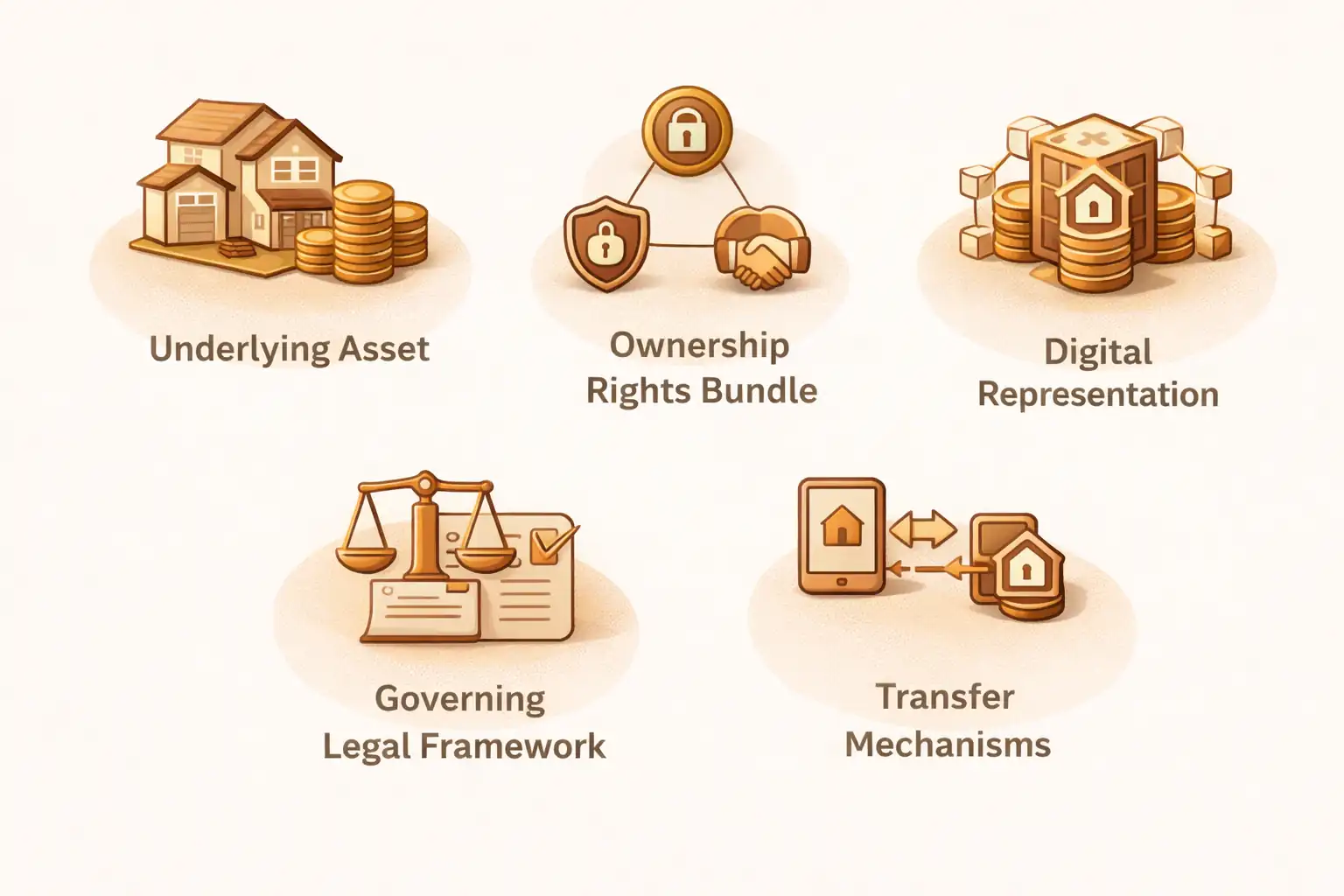
Components of Legal Definition for Tokenized Real Estate
Underlying Asset
Physical real property or property-holding legal entity constituting the tangible asset that token ownership represents. This may be direct property ownership through trust structures or indirect ownership through corporate entities, limited partnerships, or other vehicles. Legal definition must clearly identify the specific property and ownership structure creating token holders’ interests.
Ownership Rights Bundle
Specific rights tokens convey including voting rights in property decisions, profit distribution rights, liquidation preference, transfer restrictions, governance participation, and information access. Legal documents must enumerate these rights explicitly as smart contract code alone provides insufficient legal specification. Rights bundle determines whether tokens constitute equity securities, debt instruments, or hybrid structures affecting regulatory treatment.
Digital Representation
Blockchain token serving as digital certificate evidencing ownership rights, enabling transfers, and potentially automating certain rights exercise through smart contracts. Legal definition must clarify that token represents ownership interest rather than constituting the interest itself, similar to how stock certificates evidence corporate ownership without being the ownership. This distinction matters for property law and bankruptcy considerations.
Governing Legal Framework
Jurisdiction whose laws govern token holder rights, dispute resolution, and legal interpretation. Most tokenization structures specify governing law in offering documents, typically choosing jurisdictions where property is located or where issuing entity is organized. Choice of law provisions must be valid under conflict of laws principles and enforceable in relevant jurisdictions where disputes might arise.
Transfer Mechanisms
Procedures for token transfer including blockchain transactions, registry updates, compliance verification, and legal effectiveness timing. Legal definition must address whether blockchain transfer alone suffices for legal ownership transfer or whether additional formalities like registry amendments or issuer notifications are required. Transfer mechanism design affects liquidity, regulatory compliance, and practical enforceability.
Regulatory implications of legal definitions vary across jurisdictions but share common principles. In the USA, SEC applies functional analysis under Howey Test examining whether token holders invest money in common enterprise with expectation of profits from others’ efforts. This analysis typically concludes tokenized real estate constitutes securities regardless of whether called “tokens,” “coins,” or other terminology. UK FCA applies similar functional analysis under Financial Services and Markets Act frameworks determining whether instruments constitute specified investments requiring regulation.
UAE regulatory authorities in DFSA and VARA have adopted explicit definitions for security tokens and investment tokens that clearly encompass tokenized real estate. These definitions provide greater clarity than jurisdictions relying solely on functional analysis of decades-old statutes, though ultimate regulatory treatment remains substantially similar. Canadian provincial securities regulators apply investment contract analysis reaching conclusions consistent with US and UK approaches despite different legal frameworks.
| Legal Element | Proper Definition | Common Misconception | Legal Impact |
|---|---|---|---|
| Token Nature | Evidence of ownership interest in property or entity | Token itself is the property or confers independent value | Determines bankruptcy treatment, attachment points for liens, and property law application |
| Rights Source | Legal documents (operating agreements, trust deeds) define rights | Smart contract code alone defines legally enforceable rights | Determines court interpretation in disputes and enforceability of automated terms |
| Transfer Effect | Blockchain transfer plus issuer registry update effects legal ownership change | Blockchain transaction alone completes legal transfer | Affects perfection of security interests, priority disputes, and legal ownership determination |
| Regulatory Status | Security subject to comprehensive securities regulation | Novel digital asset exempt from traditional securities laws | Determines registration requirements, disclosure obligations, and enforcement risk |
| Jurisdictional Scope | Subject to laws of all jurisdictions where offered, sold, or held | Only governed by blockchain protocol rules or single jurisdiction choice | Creates multi-jurisdictional compliance obligations and extraterritorial enforcement exposure |
Practical implications of legal definitions require careful documentation and structure. Tokenization platforms must draft comprehensive legal agreements clearly defining token holder rights, property ownership structures, governance mechanisms, and dispute resolution procedures. These documents must withstand legal scrutiny in multiple jurisdictions, satisfy regulatory requirements, and remain enforceable through traditional legal processes if smart contract failures or disputes arise. Technology alone cannot substitute for proper legal documentation establishing rights and obligations.
Definitional Principle: Legal definitions for tokenized real estate must prioritize substance over form, clearly articulating economic rights, legal relationships, and regulatory status rather than focusing on technological implementation details. Courts and regulators will analyze tokenization structures based on their economic function and investor protections regardless of terminology or blockchain sophistication. Platforms must ensure legal documentation comprehensively defines all material aspects of token holder relationships with underlying properties and issuing entities, recognizing that smart contract code provides automation and efficiency but cannot substitute for proper legal framework establishing enforceable rights and obligations across all relevant jurisdictions.
How Securities Laws Apply to Tokenized Real Estate
Securities laws represent the primary regulatory framework governing real estate tokenization regulations across USA, UK, UAE, and Canada, with regulatory authorities consistently determining that tokens representing property ownership interests constitute investment securities subject to comprehensive registration, disclosure, anti-fraud, and ongoing compliance requirements. Understanding how securities laws apply to tokenized real estate is essential for platforms structuring compliant offerings and investors evaluating legal protections available through regulatory frameworks.
The application of securities laws to tokenized real estate stems from functional analysis of economic substance rather than technological form. US Supreme Court’s Howey Test, established in 1946 and applied consistently to novel investment vehicles including tokenized assets, defines investment contracts as securities when they involve investment of money in common enterprise with expectation of profits derived primarily from efforts of others. Tokenized real estate clearly satisfies all Howey elements: investors contribute capital, properties operate as common enterprise pooling investor funds, and expected returns derive from property management, appreciation, and rental income generated through others’ efforts.
Once tokenized real estate qualifies as securities, comprehensive regulatory frameworks apply including registration requirements mandating SEC (USA), FCA (UK), VARA/DFSA (UAE), or provincial securities commission (Canada) approval before offering tokens to investors. Exemptions from registration exist through private placement rules, mini-public offering frameworks, and offshore safe harbors, but each exemption imposes specific conditions and limitations that platforms must satisfy. No exemption eliminates anti-fraud provisions, requiring truthful disclosures and prohibiting material misrepresentations regardless of offering structure.
Core Securities Law Requirements for Tokenized Real Estate
Registration or Exemption
Securities offerings must either register with regulatory authorities providing comprehensive disclosures reviewed for completeness and accuracy, or qualify for specific exemptions limiting offering scope, investor types, or resale restrictions. US Regulation D private placements, Regulation A+ mini-IPOs, Regulation S offshore offerings, and Regulation CF crowdfunding each provide different pathways with distinct requirements, limitations, and compliance obligations.
Disclosure Obligations
Issuers must provide investors with material information necessary for informed investment decisions including property details, financial projections, management backgrounds, fee structures, conflicts of interest, risk factors, and use of proceeds. Disclosure standards vary by exemption but always require truthful, complete information with liability for material omissions or misrepresentations. Ongoing disclosure updates investors about material developments affecting investments.
Anti-Fraud Provisions
Securities Act Section 17(a) in USA, similar provisions in other jurisdictions, prohibit fraudulent statements, material omissions, and manipulative practices in connection with securities offers and sales. These anti-fraud rules apply regardless of registration status or exemption qualification, creating liability for misleading marketing, inflated valuations, undisclosed conflicts, or other deceptive practices. Violations support regulatory enforcement and private investor lawsuits seeking damages.
Transfer Restrictions
Most securities exemptions impose transfer restrictions preventing immediate resale, requiring holding periods from 6-12 months, limiting transfers to qualified purchasers, or mandating issuer approval. Smart contracts must implement these restrictions programmatically, preventing non-compliant transfers while enabling legitimate secondary trading once restrictions lapse. Violations of transfer restrictions can void exemptions retroactively, converting offerings into illegal unregistered public offerings.
Broker-Dealer Requirements
Entities facilitating securities transactions typically must register as broker-dealers or operate as registered alternative trading systems, requiring comprehensive licensing, capital requirements, operational standards, and ongoing supervision. Tokenization platforms enabling secondary trading generally need broker-dealer registration or must partner with registered entities. Exemptions exist for issuers selling own securities and certain limited activities, but most platforms providing liquidity require registration.
Ongoing Reporting
Registered securities and certain exempt offerings require ongoing financial reporting, material event disclosures, and updated risk factor descriptions keeping investors informed about investment performance and developments. Reporting frequency and detail depend on offering type, with fully registered offerings requiring quarterly and annual reports similar to public companies, while exempt offerings may have reduced reporting obligations but still must provide material information to investors.
Specific securities law exemptions commonly used for tokenized real estate vary significantly in their requirements and limitations. US Regulation D Rule 506(b) permits offerings to unlimited accredited investors plus up to 35 sophisticated non-accredited investors without general solicitation, imposing no dollar limit but requiring Form D filing and transfer restrictions. Rule 506(c) allows general solicitation but requires all investors be accredited with reasonable verification, attracting platforms seeking wider marketing. Regulation A+ enables offerings up to $75 million annually with lighter disclosure than full registration, permitting general solicitation and non-accredited investors, but requiring SEC qualification and ongoing reporting.
Get Help With Tokenization Rules!
We help platforms follow real estate tokenization regulations in USA, UK, UAE, and Canada. 8+ years experience. Make compliance simple and stress-free today.
UK financial promotion rules govern marketing of tokenized real estate, restricting communications to certified sophisticated investors, high net worth individuals, or investment professionals unless prospectus approval obtained. FCA authorization requirements apply to platforms facilitating securities trading, custody, or providing investment advice. UAE VARA regulations require platforms to obtain virtual asset service provider licenses covering different activities, while DFSA in Dubai International Financial Centre applies comprehensive financial services regulation including prospectus requirements for public offerings.
Securities Law Compliance Lifecycle
Structure Analysis
Analyze proposed tokenization structure under securities laws, apply Howey Test and jurisdictional equivalents, determine security status, identify applicable exemptions or registration requirements
Offering Preparation
Prepare offering documents meeting disclosure requirements, engage legal counsel for review, obtain financial audits if required, draft marketing materials complying with solicitation rules, implement investor qualification procedures
Regulatory Filing
File required forms with securities regulators (Form D, Regulation A offering statement, registration statement), respond to regulator comments, obtain qualifications or exemption confirmations, maintain filing records
Token Issuance
Conduct offering in compliance with exemption limitations, verify investor qualifications, provide required disclosures, accept investments, issue tokens with transfer restrictions properly implemented in smart contracts
Ongoing Compliance
Provide ongoing disclosures and reports, monitor secondary trading compliance, update investors on material developments, maintain transfer restrictions, respond to regulator inquiries, adapt to regulatory changes
Enforcement consequences for securities law violations demonstrate why compliance represents non-negotiable requirement. SEC enforcement actions against non-compliant tokenization platforms have resulted in millions in civil penalties, disgorgement of profits, cease and desist orders, and requirements to offer rescission to all investors enabling them to demand return of investment at original price plus interest. Criminal prosecution for willful violations can result in imprisonment. Beyond regulatory enforcement, securities law violations create private rights of action enabling investors to sue platforms and executives personally for damages.
Securities Law Reality: No technological innovation, including blockchain and tokenization, exempts investment securities from comprehensive securities regulation. Regulators globally have consistently affirmed that securities laws apply to tokenized real estate based on economic substance rather than technological form. Platforms must abandon hopes for regulatory exemptions based on blockchain novelty and instead embrace securities law compliance as foundational operating requirement. The path to sustainable tokenization success runs through full regulatory compliance, not around it through claimed technological exceptionalism. Investors should demand comprehensive evidence of securities law compliance before participating in tokenized real estate offerings, recognizing that non-compliant platforms face existential enforcement risks threatening total investment loss.
Asset Classification: Security Tokens vs Utility Tokens in Real Estate
The classification of tokens as securities versus utilities represents critical regulatory determination affecting which laws apply, what compliance obligations exist, and whether offerings require registration or qualify for lighter regulatory treatment. In real estate tokenization regulations context, this classification question has been decisively resolved in favor of security token classification across all major jurisdictions, with utility token arguments consistently rejected by regulators and courts when tokens represent property ownership interests or investment returns.
Security tokens represent investment securities in digital form, conveying ownership rights, profit participation, debt obligations, or other financial interests in underlying assets or enterprises. Tokenized real estate clearly falls within security token category as tokens provide investors with property ownership interests, rental income distributions, appreciation participation, and governance rights in property decisions. These characteristics satisfy securities law tests across USA, UK, UAE, and Canada regardless of whether platforms label tokens as securities, investments, or use alternative terminology attempting regulatory avoidance.
Utility tokens theoretically provide access to products, services, or networks without conveying investment returns or ownership interests. Pure utility tokens escaping securities classification might include tokens redeemable for specific property usage rights, prepaid rent tokens, or access tokens for property-related services. However, even tokens with utility features constitute securities when they also convey investment characteristics, with courts applying multi-factor analysis examining economic reality rather than token labels or intended future utility.
| Characteristic | Security Token | Utility Token | Real Estate Application |
|---|---|---|---|
| Primary Purpose | Investment return, ownership rights, profit participation | Access to services, consumptive use, network participation | Tokenized real estate serves investment purpose conveying property ownership and income rights |
| Value Source | Underlying asset performance, property appreciation, rental income | Utility value for service access, consumptive use value | Property token value derives from property performance rather than consumptive utility |
| Rights Conveyed | Ownership, voting, distributions, liquidation preference | Service access, network usage, consumptive benefits | Property tokens convey ownership and financial rights characteristic of securities |
| Regulatory Status | Subject to comprehensive securities regulation | Consumer protection, potentially lighter regulation if non-security | Property tokenization clearly subject to securities laws across all jurisdictions |
| Transfer Restrictions | Securities law transfer restrictions, holding periods, qualified purchaser limits | Freely transferable generally, limited only by platform terms | Property tokens face securities transfer restrictions requiring programmatic enforcement |
| Disclosure Requirements | Comprehensive securities disclosures, financial statements, risk factors | Product/service descriptions, terms of use, consumer disclosures | Property tokenization requires securities-level comprehensive disclosures |
| Secondary Markets | Broker-dealer or ATS registration required for trading platforms | General marketplace regulation, consumer protection standards | Property token secondary trading requires securities exchange licensing |
Historical attempts to classify investment tokens as utilities to avoid securities regulation have universally failed when challenged by regulators. SEC enforcement actions against ICO issuers in 2018-2020 established that tokens sold as investments with expectation of profits constitute securities regardless of purported future utility. Even tokens with genuine utility features face securities classification when investment characteristics predominate, with courts applying substance-over-form analysis examining economic reality rather than marketing claims.
For real estate specifically, utility token classification proves particularly implausible as property ownership interests clearly constitute investment securities under centuries of legal precedent. Attempts to recharacterize property tokens as utility tokens through creative structuring like “platform access tokens” or “governance tokens” that coincidentally provide property returns fail securities law analysis. Regulators and courts examine economic substance, recognizing that calling investment securities by alternative names doesn’t change their fundamental character or applicable legal requirements.[1]
Classification Test: Howey Analysis for Real Estate Tokens
Element 1: Investment of Money
Token purchasers invest capital (cryptocurrency, fiat currency) to acquire property tokens. This element is clearly satisfied in all real estate tokenization regulations structures where investors contribute funds expecting returns.
Element 2: Common Enterprise
Investor funds pool into property acquisitions with proportional interests and shared outcomes. All token holders’ returns depend on same underlying property performance, establishing horizontal commonality satisfying common enterprise requirement.
Element 3: Expectation of Profits
Investors purchase tokens expecting rental income distributions, property appreciation, and investment returns. Marketing materials, offering documents, and economic structure all demonstrate profit expectation rather than consumptive use or utility value.
Element 4: Efforts of Others
Returns derive from platform operators’, property managers’, and service providers’ efforts in property management, tenant relations, maintenance, refinancing, and eventual disposition. Token holders remain passive investors rather than active property operators, satisfying efforts of others requirement.
Practical implications of security token classification require comprehensive securities law compliance including registration or exemption qualification, disclosure document preparation, transfer restriction implementation, anti-fraud rule adherence, and ongoing reporting. Platforms cannot avoid these requirements through utility token labeling or creative structuring attempting securities law circumvention. Regulatory enforcement against non-compliant platforms demonstrates that claimed utility status provides no protection when economic substance reveals investment securities.
Classification Warning: Real estate tokenization regulations platforms should abandon utility token classification strategies as they provide no regulatory protection and create false compliance confidence potentially resulting in catastrophic enforcement actions. Every credible legal analysis concludes tokenized property interests constitute securities requiring full regulatory compliance. Platforms claiming utility token status for property ownership interests demonstrate either profound legal misunderstanding or intentional investor deception. Investors should immediately reject platforms asserting utility token classification for real estate tokens, recognizing such claims as red flags indicating likely regulatory non-compliance and elevated investment risk. The question of security versus utility classification for real estate tokenization regulations has been definitively resolved in favor of security status across all major jurisdictions.
Ownership Rights and Investor Protection in Tokenized Properties
Ownership rights in tokenized real estate require careful legal structuring to ensure token holders possess enforceable claims to underlying properties, receive appropriate investor protections, and maintain rights equivalent to traditional property investors despite digital representation. The legal architecture connecting blockchain tokens to physical property ownership determines whether tokenization provides genuine ownership or merely creates speculative digital assets disconnected from property interests investors believe they’re purchasing.
Proper tokenization structures typically employ special purpose vehicles (SPVs), trusts, or other legal entities owning physical properties, with tokens representing fractional ownership interests, membership units, beneficial interests, or debt obligations of these entities. This layered structure ensures tokens convey legally enforceable rights under established property and corporate law frameworks rather than relying solely on blockchain technology for ownership claims. Legal documentation including operating agreements, trust deeds, and subscription agreements defines specific rights tokens convey and mechanisms for exercising those rights.
Investor protections in tokenized real estate derive from multiple sources including securities laws requiring comprehensive disclosures and prohibiting fraud, corporate or trust law establishing fiduciary duties of managers toward token holders, property law governing underlying real estate interests, and contract law enforcing token holder agreement terms. These overlapping legal protections provide multiple enforcement mechanisms when platforms breach obligations, managers engage in self-dealing, or disputes arise over property decisions or distributions.
Essential Ownership Rights in Tokenized Real Estate
Economic Rights: Income and Appreciation
Token holders must possess enforceable rights to proportional shares of rental income, property appreciation, and disposition proceeds. Legal documentation should specify distribution calculations, payment timing, expense deductions, reserve requirements, and priority structures. Smart contracts may automate distributions but cannot substitute for legally documented economic rights enforceable through courts if automation fails or disputes arise over proper distribution amounts.
Governance Rights: Voting and Participation
Major property decisions including sales, refinancing, significant capital expenditures, manager replacement, and structural changes should require token holder approval through voting mechanisms. Governance structures must balance operational efficiency against investor protection, typically granting day-to-day management authority to professional operators while reserving fundamental decisions for token holder votes. Voting procedures should accommodate blockchain-based voting while maintaining legal enforceability and preventing manipulation.
Information Rights: Transparency and Disclosure
Token holders need access to property financial statements, operational reports, management decisions, and material developments affecting investments. Information rights should include periodic reporting (quarterly, annually), major event notifications, inspection rights for financial records, and access to property information enabling informed voting and investment decisions. Blockchain transparency supplements but doesn’t replace required formal disclosures meeting securities law standards.
Transfer Rights: Liquidity and Exit Options
While securities law transfer restrictions limit immediate resale, token structures should provide eventual liquidity through secondary markets, issuer redemption rights, or property disposition. Transfer mechanisms must balance investor liquidity interests against regulatory compliance, platform operational requirements, and avoiding unlimited transferability creating regulatory complications. Smart contract implementation of transfer restrictions should include exception procedures for estate planning, divorce settlements, or legitimate business needs.
Protection Rights: Anti-Dilution and Priority
Token holders should possess protections against dilution through additional token issuance, priority in liquidation scenarios, anti-self-dealing provisions preventing manager conflicts of interest, and legal recourse through dispute resolution procedures. These protections prevent platforms from extracting value through subsequent offerings, ensure fair treatment in bankruptcy or property sales, and provide enforcement mechanisms when breaches occur.
Fiduciary duties represent critical investor protection mechanism in tokenized real estate, with platform operators, property managers, and controlling token holders owing duties of care and loyalty to minority investors. Duty of care requires reasonable business judgment and informed decision-making in property management. Duty of loyalty prohibits self-dealing, requires disclosure of conflicts of interest, and mandates fair dealing in related-party transactions. These fiduciary obligations exist under corporate law, trust law, or partnership law depending on entity structure, providing legal basis for challenging manager misconduct.
Securities law protections supplement entity-level fiduciary duties through anti-fraud provisions, disclosure requirements, and enforcement mechanisms. Securities Act Section 17(a) and Rule 10b-5 prohibit fraudulent statements and material omissions in connection with securities transactions, creating liability for platforms making false claims, inflating valuations, or concealing material information. These anti-fraud rules apply regardless of exemption status, providing baseline investor protection even in private placements with sophisticated investors.
| Protection Mechanism | Legal Source | Rights Provided | Enforcement Method |
|---|---|---|---|
| Securities Regulation | Securities Act, Exchange Act, jurisdictional equivalents | Disclosure requirements, anti-fraud protections, transfer restrictions, regulatory oversight | SEC enforcement, private lawsuits under Rule 10b-5, rescission rights |
| Fiduciary Duties | Corporate law, trust law, partnership law | Duty of care in management, duty of loyalty prohibiting self-dealing, fair dealing requirements | Derivative actions, breach of fiduciary duty lawsuits, injunctive relief |
| Contract Rights | Subscription agreements, operating agreements, token holder agreements | Specific contractual promises, distribution rights, governance procedures, dispute resolution | Breach of contract lawsuits, specific performance, arbitration per agreement terms |
| Property Law | Real property statutes, landlord-tenant law, foreclosure law | Ownership interests in underlying property, priority in liens, foreclosure protections | Property law actions, quiet title suits, foreclosure defense |
| Consumer Protection | Consumer protection statutes, unfair practices laws | Protection against deceptive practices, unfair contract terms, adequate disclosures | State attorney general enforcement, consumer protection lawsuits, FTC actions |
Bankruptcy and insolvency protections require special attention in tokenized real estate structures. If platform operators become insolvent, token holders should possess direct claims to underlying properties rather than being treated as unsecured creditors of bankrupt entities. Proper structuring isolates property assets in bankruptcy-remote SPVs owned by token holders, preventing platform creditors from reaching properties. Trust structures provide additional protection as trust assets remain separate from trustee’s personal assets and creditors cannot reach trust property for non-trust debts.
Dispute resolution mechanisms should provide efficient, cost-effective procedures for addressing conflicts between token holders, between holders and managers, or involving property operations. Arbitration clauses in token holder agreements can mandate binding arbitration for disputes, potentially reducing litigation costs and providing faster resolution than court proceedings. However, arbitration clauses cannot waive securities law protections or preclude regulatory enforcement, with courts invalidating arbitration provisions attempting to eliminate statutory investor protections.
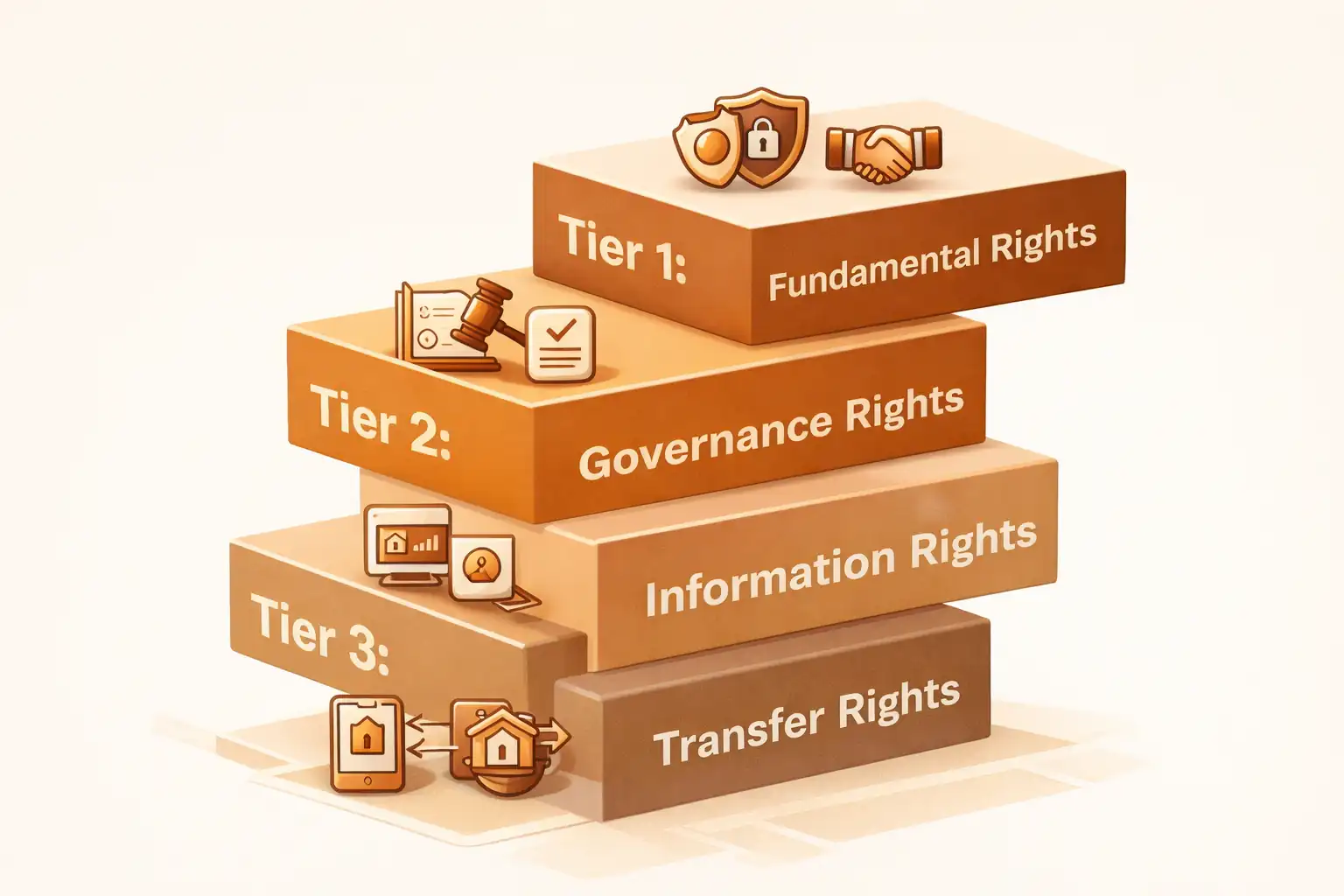
Model Ownership Rights Framework
Tier 1: Fundamental Rights
- Proportional economic interests
- Vote on major decisions (sale, refinancing)
- Fiduciary duty protections
- Anti-fraud protections
- Bankruptcy-remote asset ownership
Tier 2: Governance Rights
- Manager replacement voting
- Amendment approval for major terms
- Conflict transaction approval
- Budget and reserve approvals
- Professional service provider selection
Tier 3: Information Rights
- Quarterly financial statements
- Annual audited financials
- Material event notifications
- Management reports and analysis
- Inspection rights for records
Tier 4: Transfer Rights
- Secondary market trading (post-restriction)
- Estate planning transfers
- Gift and family transfers
- Redemption rights in certain events
- Tag-along rights in control sales
Practical enforcement of ownership rights requires clear procedures, accessible mechanisms, and realistic costs. Token holder agreements should specify how rights are exercised including voting procedures, information request processes, dispute resolution steps, and enforcement actions. Blockchain-based governance can facilitate voting and information distribution but must integrate with traditional legal enforcement mechanisms when automation fails or disputes require judicial resolution. Platforms should maintain accessible customer service, clear communication channels, and responsive management addressing token holder concerns proactively.
Ownership Rights Principle: Tokenization technology should enhance rather than diminish investor protections compared to traditional real estate investment structures. Token holders must possess legally enforceable ownership rights equivalent to traditional investors including economic interests, governance participation, information access, and legal recourse when rights are violated. Smart contracts automate certain rights exercise but cannot substitute for comprehensive legal documentation establishing enforceable claims to underlying properties through established property, securities, and corporate law frameworks. Investors should thoroughly review token holder agreements, operating agreements, and legal opinions confirming ownership rights before investing, demanding clarity on enforcement mechanisms and practical procedures for exercising rights throughout investment lifecycle.
Role of Smart Contracts Under Real Estate Tokenization Regulations
Smart contracts play dual roles in regulated tokenized real estate serving as both technical infrastructure automating operational processes and as legal instruments potentially creating enforceable obligations between parties. Understanding how regulations treat smart contracts, what legal requirements they must satisfy, and how they interact with traditional legal documentation is essential for compliant platform design and effective investor protection implementation.
From regulatory perspective, smart contracts in tokenized real estate primarily serve compliance enforcement functions implementing transfer restrictions required by securities exemptions, automating KYC verification before token transfers, enforcing holding periods preventing premature resale, calculating and distributing income in accordance with legal obligations, and executing governance decisions according to token holder votes. These compliance functions make smart contracts valuable regulatory tools when properly designed and implemented, though their use doesn’t reduce overall compliance obligations.
Legal enforceability of smart contracts varies across jurisdictions with most legal systems recognizing smart contracts as enforceable agreements when they satisfy traditional contract formation requirements including offer, acceptance, consideration, capacity, and lawful purpose. However, smart contract code alone often proves insufficient for legal enforceability, requiring accompanying written agreements explaining contract terms, parties’ intentions, and legal interpretations of code execution. This dual documentation approach using both smart contracts and traditional legal agreements provides technical automation benefits while maintaining judicial enforceability.
Regulatory Functions of Smart Contracts in Tokenized Real Estate
Transfer Restriction Enforcement
Smart contracts programmatically implement securities law transfer restrictions including holding period requirements, accredited investor verification, volume limitations, and qualified purchaser restrictions. Code checks compliance conditions before allowing transfers, preventing regulatory violations through automated enforcement. Platforms must design exception mechanisms for legitimate transfers requiring manual review like estate settlements.
KYC and AML Compliance
Smart contracts can verify token transfer participants completed KYC procedures, check against sanctions lists, enforce transaction monitoring limits, and prevent transfers to prohibited jurisdictions. Integration with off-chain KYC databases through oracles enables automated compliance while maintaining privacy for sensitive personal information not stored on public blockchains.
Distribution Automation
Rental income and proceeds distributions can automate through smart contracts calculating proportional shares, withholding taxes as required, implementing waterfall priorities, and executing payments to all token holders simultaneously. Automation reduces administrative costs, eliminates distribution errors, and provides transparent auditable records. However, calculations must match legal distribution formulas specified in operating agreements.
Governance Implementation
Voting on property decisions, manager elections, and major transactions can occur through blockchain-based governance with smart contracts tallying votes, implementing vote thresholds, enforcing quorum requirements, and executing approved decisions automatically. Transparent on-chain governance provides audit trails and prevents vote manipulation, though must accommodate off-chain voter participation for accessibility.
Regulatory Reporting
Smart contracts generate data for regulatory reports including transaction logs, token holder registries, distribution records, and governance activities. Blockchain transparency enables regulators accessing records directly, reducing reporting burdens while enhancing oversight. Platforms must ensure smart contract data meets regulatory reporting format and content requirements.
Emergency Controls
Pause functions enable platforms halting token transfers during security incidents, regulatory investigations, or technical failures. Circuit breakers limit transaction sizes or velocities preventing exploitation. Emergency controls must balance security needs against investor rights, implementing appropriate governance and time limitations preventing abuse of emergency powers.
Regulatory challenges with smart contracts include immutability creating difficulties fixing bugs or adapting to regulatory changes, code complexity making legal review challenging for regulators and judges, oracle dependencies introducing off-chain trust assumptions, and upgrade mechanisms potentially creating centralization concerns. Platforms must address these challenges through comprehensive testing, formal verification where possible, transparent upgrade governance, and clear documentation explaining smart contract functionality to non-technical regulators and investors.
Legal framework integration requires smart contracts complement rather than replace traditional legal documentation. Token holder agreements should explicitly incorporate smart contract terms, specify which provisions automate through code versus require manual execution, establish code interpretation rules for ambiguities, and provide dispute resolution procedures when smart contract execution produces unintended outcomes. This approach ensures smart contracts enhance operational efficiency while maintaining legal enforceability through traditional judicial systems when necessary.
| Smart Contract Element | Regulatory Requirement | Implementation Approach |
|---|---|---|
| Transfer Restrictions | Securities exemptions require holding periods, investor qualification checks, volume limits | Whitelist approved addresses, check timestamps against holding requirements, verify accreditation status through oracle, enforce percentage ownership caps |
| KYC Verification | AML laws require customer identification, sanctions screening, ongoing monitoring | Integration with off-chain KYC database through oracle, address whitelisting after verification complete, blocking transfers to unverified addresses |
| Distribution Calculations | Operating agreements specify distribution formulas, priorities, reserve requirements | On-chain calculation implementing legal formulas, proportional allocation based on token balances, waterfall priorities for different token classes |
| Governance Voting | Corporate/trust law requires proper voting procedures, quorums, vote thresholds | Proposal submission mechanisms, voting period enforcement, quorum calculations, super-majority requirements for major decisions, vote delegation options |
| Upgrade Mechanisms | Platforms need ability to fix bugs, adapt to regulatory changes, add features | Proxy patterns enabling logic updates, time-locked upgrades with notice periods, multi-signature approval requirements, governance votes for major upgrades |
Auditing and testing requirements for regulatory smart contracts exceed typical software quality assurance given their role in compliance enforcement and potential financial impact of failures. Multiple independent security audits should review code for vulnerabilities, formal verification should prove critical functions behave correctly, comprehensive test coverage should verify compliance logic under all scenarios, and bug bounty programs should incentivize ongoing security review. Regulatory comfort with smart contract implementations depends on demonstrating rigorous quality assurance processes.
Jurisdictional differences in smart contract legal treatment create challenges for international platforms. USA generally recognizes smart contracts as enforceable under Uniform Electronic Transactions Act and state equivalents, though contract interpretation disputes apply traditional principles. UK law reform recognizes smart contracts can create legally binding obligations when parties intend legal relations. UAE has enacted specific smart contract legislation providing legal recognition. However, enforcement mechanisms, interpretation standards, and regulatory acceptance vary requiring platforms to structure smart contracts considering all relevant jurisdictions.
Smart Contract Regulatory Principle: Smart contracts provide powerful tools for automating regulatory compliance in tokenized real estate but cannot substitute for comprehensive legal frameworks, proper documentation, and traditional enforcement mechanisms. Platforms must design smart contracts as compliance tools supplementing rather than replacing legal obligations, ensuring code implements regulatory requirements accurately while maintaining flexibility for manual intervention when circumstances require human judgment. The most effective regulatory approach combines smart contract automation of routine compliance functions with traditional legal documentation establishing enforceable rights, dispute resolution procedures, and interpretive guidance enabling courts to adjudicate conflicts when automation fails or produces unintended results. Regulatory acceptance of smart contracts depends on demonstrating they enhance rather than undermine investor protections and regulatory oversight.
KYC and AML Requirements for Tokenized Real Estate Platforms
Know Your Customer (KYC) and Anti-Money Laundering (AML) requirements represent critical regulatory obligations for tokenized real estate platforms, with comprehensive customer identification, beneficial ownership verification, sanctions screening, and transaction monitoring mandated across USA, UK, UAE, and Canada to prevent platforms from facilitating money laundering, terrorist financing, sanctions evasion, or other illicit financial activities. Real estate’s historical association with money laundering intensifies regulatory scrutiny of tokenization platforms, requiring institutional-grade compliance programs meeting or exceeding traditional financial services standards.
KYC procedures verify investor identities through government-issued identification documents, validate addresses through utility bills or bank statements, confirm dates of birth and nationalities, and establish individuals’ identities with sufficient certainty to prevent identity fraud or synthetic identity schemes. Enhanced due diligence applies to politically exposed persons, high-risk jurisdictions, and large transactions, requiring additional documentation and increased scrutiny. Beneficial ownership identification pierces through corporate structures, trusts, and nominee arrangements identifying natural persons ultimately controlling or benefiting from investments.
AML obligations extend beyond initial identity verification to ongoing monitoring of customer transactions, screening against sanctions lists maintained by OFAC (USA), UN, EU, and national authorities, analyzing transaction patterns for suspicious activities potentially indicating money laundering or terrorist financing, filing Suspicious Activity Reports (SARs) or Suspicious Transaction Reports (STRs) when required thresholds met, and maintaining comprehensive records for 5-7 years supporting regulatory examinations and investigations.
Comprehensive KYC/AML Framework for Tokenization Platforms
Customer Identification Program (CIP)
Collect identifying information including full legal name, date of birth, residential address, identification number (SSN, passport, national ID), and nationality. Verify information through government-issued photo identification, independent database checks, or documentary verification. For corporate investors, obtain formation documents, identification of authorized representatives, and beneficial ownership information. Document verification procedures and maintain records of identification documents and verification steps performed.
Beneficial Ownership Identification
For legal entity investors, identify natural persons owning 25% or more equity interests, exercising control through other means, or holding senior officer positions. Pierce through nominee shareholders, trusts, or complex corporate structures identifying ultimate beneficial owners. FinCEN (USA) beneficial ownership requirements effective 2024 mandate collection of beneficial ownership information for most corporate entities. Maintain certified beneficial ownership documentation updated when ownership changes occur.
Sanctions Screening
Screen all customers against OFAC Specially Designated Nationals (SDN) list, UN sanctions lists, EU sanctions, and relevant national lists before account opening and periodically thereafter. Check names, addresses, dates of birth, and identification numbers against sanctions databases. Implement automated screening systems with appropriate fuzzy matching to catch close name matches while minimizing false positives. Block transactions involving sanctioned parties and file required reports with authorities.
Enhanced Due Diligence (EDD)
Apply heightened scrutiny to politically exposed persons (PEPs) including government officials, their family members, and close associates. Screen for PEP status using commercial databases, obtain senior management approval for PEP accounts, understand source of wealth and purpose of relationship, and conduct ongoing enhanced monitoring. EDD also applies to customers from high-risk jurisdictions, unusual transaction patterns, or transactions involving significant funds without clear legitimate business purpose.
Transaction Monitoring
Monitor customer transactions for patterns indicating potential money laundering including rapid movement of funds, structuring transactions below reporting thresholds, transactions inconsistent with stated business purpose, involvement of high-risk jurisdictions, or other suspicious patterns. Implement automated transaction monitoring systems with rules calibrated to platform risk profile. Investigate alerts, document investigation findings, and escalate to compliance officers when suspicious activity identified.
Suspicious Activity Reporting
File Suspicious Activity Reports (SARs) with FinCEN in USA, Suspicious Transaction Reports with relevant authorities in other jurisdictions when transactions involve known or suspected criminal activity, appear designed to evade BSA requirements, lack apparent lawful purpose, or involve use of platform to facilitate criminal activity. SAR filing thresholds vary by jurisdiction but generally apply to transactions over $5,000-$10,000 involving suspicious activity. Maintain confidentiality of SAR filings prohibited from disclosure to subjects.
Regulatory frameworks governing KYC/AML vary across jurisdictions though share common principles. USA Bank Secrecy Act and implementing FinCEN regulations require comprehensive AML programs for financial institutions including tokenization platforms facilitating securities transactions. UK Money Laundering Regulations and FCA guidance impose similar requirements. UAE Federal Decree-Law No. 20 of 2018 on Anti-Money Laundering and Combating the Financing of Terrorism establishes comprehensive framework, with VARA implementing specific requirements for virtual asset service providers. Canadian FINTRAC regulations under Proceeds of Crime (Money Laundering) and Terrorist Financing Act establish reporting requirements and compliance obligations.
Technology solutions for KYC/AML compliance include specialized service providers like Jumio, Onfido, Sumsub, and Chainalysis offering identity verification, document authentication, sanctions screening, and blockchain transaction monitoring. These solutions combine AI-powered document verification, biometric liveness detection, database cross-referencing, and ongoing monitoring reducing manual review burdens while improving accuracy. However, platforms retain ultimate responsibility for KYC/AML compliance regardless of third-party reliance, requiring vendor due diligence and performance monitoring.
| Jurisdiction | Primary Regulatory Authority | Key AML Requirements | Penalties for Non-Compliance |
|---|---|---|---|
| USA | FinCEN, SEC (for securities), State regulators | Written AML program, CIP procedures, ongoing monitoring, SAR filing, CTR filing for cash transactions over $10K, recordkeeping 5 years | Civil penalties up to $1M per violation, criminal prosecution up to 10 years imprisonment, license revocation |
| UK | FCA, NCA (National Crime Agency), HMRC | Risk assessment, customer due diligence, enhanced DD for high-risk, ongoing monitoring, STR filing, record retention 5 years | Unlimited fines for firms, up to 14 years imprisonment for individuals, FCA enforcement actions, license suspension/revocation |
| UAE | CBUAE (Central Bank), VARA, DFSA, Financial Intelligence Unit | AML compliance program, customer identification, beneficial ownership, STR filing, risk-based approach, screening against UN/national lists | Fines up to AED 5 million, imprisonment up to 10 years, license revocation, asset freezing |
| Canada | FINTRAC, Provincial securities regulators | Compliance program, customer identification, beneficial ownership determination, STR filing for amounts $10K+, record retention 5 years, ongoing monitoring | Administrative monetary penalties up to $100K per violation, criminal prosecution for willful violations, provincial securities sanctions |
Privacy considerations create tension with KYC requirements as platforms must collect sensitive personal information while complying with data protection laws like GDPR, PIPEDA, and state privacy statutes. Best practices include collecting minimum necessary information, implementing strong data security, providing privacy notices explaining data usage, enabling data subject access rights, limiting data retention to regulatory minimums, and using encryption and access controls protecting stored information. Zero-knowledge proof technologies may eventually enable privacy-preserving KYC though current implementations remain experimental.
Ongoing compliance program maintenance requires dedicated resources including compliance officer appointment, regular risk assessments updating program for evolving threats, employee training ensuring staff understand AML obligations, independent testing validating program effectiveness, and responding promptly to regulatory inquiries or examination findings. Platforms should budget appropriately for compliance, typically allocating 5-15% of operational budgets to KYC/AML functions depending on transaction volumes, customer base complexity, and jurisdictional scope.
KYC/AML Compliance Warning: Real estate tokenization regulations platforms cannot treat KYC/AML requirements as optional or implement minimal checkbox compliance given severe enforcement consequences including criminal prosecution, multi-million dollar penalties, and license revocation. Real estate’s historical association with money laundering creates heightened regulatory scrutiny requiring platforms to demonstrate institutional-grade compliance programs equivalent to banks and securities firms. Platforms must invest appropriately in KYC technology, compliance personnel, and ongoing program maintenance, recognizing that inadequate AML controls create existential regulatory risks. Investors should verify platform KYC/AML compliance through independent assessment, demanding evidence of comprehensive procedures, technology solutions, compliance staffing, and clean regulatory examination history before entrusting platforms with investments.
Cross-Border Challenges in Real Estate Tokenization Regulations
Cross-border real estate tokenization regulations presents complex regulatory challenges as platforms operating internationally must navigate conflicting legal requirements, jurisdictional enforcement, transfer restrictions, tax obligations, and regulatory coordination across USA, UK, UAE, Canada, and other markets simultaneously. The inherently borderless nature of blockchain technology conflicts with territorial regulatory frameworks, creating compliance complexity requiring sophisticated legal structuring and operational controls preventing regulatory violations in any operating jurisdiction.
Jurisdictional scope issues arise from questions about which country’s laws apply to token offerings, secondary trading, and investor protections. Most jurisdictions assert regulatory authority over offerings targeting their residents regardless of platform location, creating potential concurrent jurisdiction where offerings must comply with multiple regulatory frameworks simultaneously. US securities laws apply to offers to US persons regardless of where platforms operate. UK financial promotion rules restrict marketing to UK residents. UAE VARA regulations govern virtual asset activities within UAE. Canadian provinces regulate offerings to their residents.
Regulatory arbitrage temptations lead some platforms to structure operations in permissive jurisdictions hoping to avoid stricter regulatory oversight in major markets. However, regulators increasingly coordinate internationally, share information through memoranda of understanding, and exercise long-arm jurisdiction over foreign platforms serving their residents. Attempting regulatory arbitrage creates significant enforcement risk as regulators demonstrate willingness to pursue foreign platforms, freeze assets, block platforms from their markets, and coordinate with international law enforcement for serious violations.
Key Cross-Border Regulatory Challenges
Concurrent Jurisdiction and Conflicting Laws
When platforms offer tokens to investors across multiple countries, each jurisdiction may assert regulatory authority creating concurrent jurisdiction where compliance requires satisfying all applicable frameworks simultaneously. Conflicts arise when jurisdictions impose contradictory requirements such as disclosure standards that conflict between jurisdictions, transfer restriction differences, or taxation approaches creating double taxation. Platforms must identify all jurisdictions with potential regulatory authority, analyze requirements in each, and structure offerings satisfying strictest applicable standards while documenting compliance rationale for each jurisdiction.
Extraterritorial Enforcement and Long-Arm Jurisdiction
Regulators increasingly exercise extraterritorial enforcement authority over foreign platforms serving their residents. SEC regularly pursues foreign cryptocurrency platforms offering securities to US persons without proper registration. UK FCA takes action against overseas platforms conducting regulated activities with UK customers. These enforcement actions include cease and desist orders, asset freezes, platform blocking, and coordination with foreign authorities for criminal prosecution. Platforms cannot assume foreign location provides immunity from enforcement by jurisdictions where investors are located.
Transfer Restrictions and Resale Limitations
Securities exemptions often restrict resales to qualified purchasers, impose holding periods, or limit transfers to specific jurisdictions. Cross-border secondary trading must navigate these restrictions across multiple jurisdictions where tokens might trade. US Regulation S provides safe harbor for offshore offerings excluding US persons but requires implementation of procedures preventing flowback to US markets during restricted periods. Platforms must implement smart contract controls preventing prohibited cross-border transfers while enabling legitimate international secondary trading post-restriction periods.
Tax Withholding and Reporting Obligations
Cross-border real estate investments trigger complex tax obligations including withholding requirements on distributions to foreign investors, transfer pricing considerations for related-party transactions, permanent establishment risks creating unexpected tax nexus, and reporting obligations in multiple jurisdictions. US FIRPTA imposes withholding on foreign investment in US real property. Tax treaties between countries may reduce withholding rates but require proper documentation. Platforms must implement systems tracking investor tax residence, applying appropriate withholding, and providing required tax documentation across jurisdictions.
Data Localization and Privacy Requirements
Some jurisdictions require personal data storage within national borders or restrict international data transfers. EU GDPR limits transfers to countries without adequate data protection unless appropriate safeguards implemented. China and Russia maintain strict data localization requirements. Blockchain’s distributed nature conflicts with data localization mandates as transaction data propagates across global node networks. Platforms must structure KYC data storage complying with localization requirements, implement appropriate transfer mechanisms like Standard Contractual Clauses, and minimize personal data recorded on public blockchains.
Practical strategies for managing cross-border regulatory complexity include geographic restrictions limiting offerings to jurisdictions where platforms obtain proper authorization, staged international expansion entering markets sequentially after establishing compliance infrastructure, partnership models working with local regulated entities in target jurisdictions, and regulatory technology solutions automating jurisdiction-specific compliance requirements. Platforms should prioritize quality over quantity, operating compliantly in fewer jurisdictions rather than attempting global reach without adequate compliance resources.
Regulation S safe harbor provides important pathway for US platforms conducting offshore offerings excluding US persons. Proper Regulation S compliance requires implementing procedures preventing US person participation during restricted periods, conducting offerings outside USA, avoiding directed selling efforts in USA, and restricting resales preventing flowback to US markets. Category 3 Regulation S offerings (most common for real estate tokenization regulations) impose 40-day restricted periods during which securities cannot transfer to US persons. Smart contracts should enforce these restrictions programmatically while maintaining flexibility for compliant transfers post-restriction.
| Cross-Border Challenge | Regulatory Risk | Mitigation Strategy |
|---|---|---|
| Offering to Multiple Jurisdictions | Concurrent regulatory authority requiring compliance with multiple frameworks, potential conflicts, higher compliance costs | Geographic restrictions, sequential market entry, local partnerships, legal counsel in each jurisdiction, compliance documentation for all relevant regulators |
| Secondary Market Trading | Transfer restrictions varying by jurisdiction, resale registration requirements, broker-dealer licensing in multiple countries | Regulation S compliance, smart contract transfer controls, geofencing, qualified purchaser verification, ATS registration where required |
| Tax Withholding | Withholding obligations on foreign investors, treaty rate applications, reporting requirements, penalties for non-compliance | Automated withholding systems, tax residence verification, W-8 form collection, treaty benefit documentation, qualified intermediary status |
| AML Compliance | Different KYC standards, sanctions list variations, reporting thresholds, customer due diligence requirements across countries | Highest common standard compliance, comprehensive sanctions screening, enhanced due diligence for high-risk jurisdictions, global KYC provider |
| Data Protection | GDPR, PIPEDA, localization requirements, transfer restrictions, right to deletion conflicting with blockchain immutability | Off-chain KYC storage, Standard Contractual Clauses, data minimization, encryption, regional data centers, privacy-by-design architecture |
International regulatory cooperation through organizations like IOSCO (International Organization of Securities Commissions), FATF (Financial Action Task Force), and bilateral memoranda of understanding between regulators facilitate information sharing and coordinated enforcement. While limited harmonization exists currently, these cooperation mechanisms enable regulators identifying platforms violating local laws, sharing enforcement actions, and collectively addressing cross-border regulatory evasion. Platforms should assume regulators communicate and coordinate rather than expecting jurisdictional gaps enabling non-compliance.
For investors, cross-border tokenization creates additional complexity in understanding applicable protections, tax obligations, and legal recourse. Investors should verify platforms comply with regulations in their home jurisdiction regardless of platform location, understand tax obligations including potential foreign withholding, confirm legal documentation specifies governing law and dispute resolution in accessible jurisdictions, and maintain records supporting tax reporting requirements across relevant countries. International investments require enhanced due diligence given increased complexity and potentially limited legal recourse if disputes arise.
Cross-Border Compliance Principle: Tokenization platforms operating internationally must abandon hopes that blockchain’s borderless nature exempts them from territorial regulatory requirements or enables regulatory arbitrage through favorable jurisdiction selection. Regulators increasingly assert extraterritorial jurisdiction over foreign platforms serving their residents and coordinate internationally to address cross-border violations. Sustainable international operations require comprehensive compliance with all jurisdictions where platforms offer tokens, facilitate trading, or serve investors. Platforms should implement geographic restrictions when unable to comply fully with jurisdiction-specific requirements, engage qualified local legal counsel in operating markets, and budget appropriately for multi-jurisdictional compliance complexity. The path to successful international tokenization runs through comprehensive regulatory compliance across all operating jurisdictions, not around regulations through jurisdiction shopping or perceived regulatory gaps.
Regulatory Frameworks in the United States for Real Estate Tokenization Regulations
The United States maintains one of the most comprehensive and strictly enforced regulatory frameworks for real estate tokenization regulations, with SEC (Securities and Exchange Commission) asserting authority over token offerings as securities, FinCEN imposing AML obligations, CFTC potentially regulating certain derivative tokens, state securities regulators enforcing blue sky laws, and IRS establishing tax treatment. Understanding US regulatory requirements is essential for platforms serving American investors given SEC’s aggressive enforcement posture and strict liability standards that hold platforms accountable for violations regardless of intent or good faith efforts.
SEC regulatory framework centers on securities law application through Securities Act of 1933 governing initial offerings and Securities Exchange Act of 1934 regulating secondary trading. Nearly all tokenized real estate constitutes securities under Howey Test requiring registration with SEC or qualifying for specific exemptions. Registration process involves comprehensive disclosure document preparation, financial audits, legal review, and SEC staff comments consuming 6-18 months and costing $500,000 to $2+ million. Most platforms pursue exemptions rather than full registration given cost and complexity.
Primary exemption pathways for US real estate tokenization regulations include Regulation D providing private placement exemptions, Regulation A+ enabling mini-public offerings, Regulation CF facilitating crowdfunding, and Regulation S for offshore offerings. Each exemption imposes specific conditions, limitations, and ongoing obligations that platforms must satisfy precisely as exemption violations can retroactively convert offerings into illegal unregistered public offerings triggering severe consequences including investor rescission rights enabling forced buybacks at original investment amounts plus interest.
US Securities Law Exemptions for Real Estate Tokenization Regulations
Regulation D Rule 506(b)
Investor Limits: Unlimited accredited investors plus up to 35 sophisticated non-accredited investors
Marketing: No general solicitation or advertising permitted
Amount Limit: No dollar limit on offering size
Filing: Form D within 15 days of first sale
Best For: Platforms with existing investor networks, high-value properties targeting accredited investors without general marketing
Regulation D Rule 506(c)
Investor Limits: Unlimited accredited investors only
Marketing: General solicitation permitted
Verification: Reasonable steps to verify accredited status required
Amount Limit: No dollar limit
Best For: Platforms seeking broad marketing to accredited investors, online platforms, tokenization marketplaces
Regulation A+ (Tier 2)
Investor Limits: Non-accredited investors permitted with individual investment limits
Marketing: General solicitation permitted after SEC qualification
Amount Limit: Up to $75 million in 12-month period
Reporting: Ongoing semi-annual and annual reports required
Best For: Larger platforms seeking access to non-accredited investors, willing to undergo SEC review and ongoing reporting
Regulation Crowdfunding
Investor Limits: Non-accredited investors with investment limits based on income/net worth
Platform: Must use registered funding portal or broker-dealer
Amount Limit: Up to $5 million in 12-month period
Reporting: Annual reports and financial statements required
Best For: Smaller offerings targeting retail investors, platforms willing to partner with registered intermediaries
Secondary trading of real estate tokens in USA typically requires broker-dealer registration or operation as Alternative Trading System (ATS) under SEC Regulation ATS. Broker-dealer registration involves comprehensive application process, capital requirements, FINRA membership, compliance infrastructure, and ongoing supervision creating substantial operational complexity. ATS registration provides alternative pathway for platforms facilitating secondary trading with lighter requirements than full exchange registration but still demanding significant compliance infrastructure. Platforms can avoid registration by limiting activities to issuer sales of own securities without facilitating secondary trading among investors.
State securities regulation adds layer of complexity as platforms must comply with blue sky laws in states where tokens are offered. Some exemptions like Rule 506 provide federal preemption of state registration requirements but not state notice filing obligations or anti-fraud provisions. Platforms must file notice filings and pay fees in states where offers occur, analyze state-specific exemption availability, and ensure compliance with state anti-fraud and disclosure requirements. Non-compliance with state securities laws creates separate enforcement exposure beyond federal SEC violations.
| Regulatory Requirement | Applicable Authority | Key Obligations | Enforcement Consequences |
|---|---|---|---|
| Securities Registration/Exemption | SEC, State securities regulators | Registration statement or exemption qualification, comprehensive disclosures, financial audits, ongoing reporting | Cease and desist, disgorgement, civil penalties, investor rescission rights, criminal prosecution for willful violations |
| Broker-Dealer/ATS Registration | SEC, FINRA | Registration application, capital requirements, compliance infrastructure, supervision systems, regular examinations | Operating unregistered broker-dealer charges, monetary penalties, disgorgement, permanent industry bars, criminal prosecution |
| AML/BSA Compliance | FinCEN, SEC | Written AML program, CIP procedures, SAR filing, CTR filing, ongoing monitoring, recordkeeping | Civil monetary penalties up to $1M per violation, criminal prosecution, license revocation, personal liability for officers |
| Investment Adviser Registration | SEC or State regulators | Form ADV filing, disclosure brochures, fiduciary duties, custody rules, compliance procedures | SEC enforcement, disgorgement, civil penalties, fiduciary breach liability, state sanctions |
| Tax Reporting | IRS | Form 1099 issuance, backup withholding, FIRPTA compliance for foreign investors, information reporting | Penalties for incorrect or late reporting, tax deficiency assessments, interest, potential fraud prosecution |
Recent SEC enforcement actions demonstrate aggressive posture toward non-compliant tokenization. SEC has brought cases against numerous token issuers for conducting unregistered securities offerings, operating unregistered exchanges, and violating anti-fraud provisions. Settlements typically require disgorgement of all proceeds, substantial civil penalties, cease and desist orders, and offering rescission to investors. Criminal referrals to Department of Justice occur in cases involving intentional fraud or willful violations. These enforcement actions establish that SEC views tokenization through traditional securities law lens rather than creating special treatment for blockchain-based offerings.
Looking forward, SEC has signaled continued focus on cryptocurrency and tokenization enforcement through specialized Crypto Assets and Cyber Unit, ongoing rulemakings addressing digital asset custody and trading, and public statements from commissioners emphasizing securities law application. Platforms operating in US market should expect heightened scrutiny, regular examinations for registered entities, and enforcement actions against non-compliant platforms regardless of size or stated intent to comply. Proactive compliance represents only viable strategy for sustainable US operations.
US Regulatory Reality: United States maintains strictest enforcement posture globally for securities regulation with SEC demonstrating consistent willingness to pursue tokenization platforms regardless of location when serving US investors. Platforms seeking US market access must implement comprehensive securities law compliance meeting institutional standards, obtain qualified legal counsel experienced in SEC regulation, budget appropriately for ongoing compliance costs, and prepare for regular regulatory examinations. Attempting to serve US market without proper compliance creates severe enforcement risk including multi-million dollar penalties, criminal prosecution, and permanent market exclusion. For platforms committed to US operations, full regulatory compliance represents non-negotiable foundation for sustainable business rather than optional enhancement. Investors should demand evidence of comprehensive US securities law compliance before investing in platforms offering tokens to American residents.
European Union Regulations Impacting Tokenized Real Estate
The European Union regulatory landscape for real estate tokenization regulations operates through combination of harmonized EU-level frameworks and national implementations across member states, with Markets in Crypto-Assets Regulation (MiCA) creating comprehensive crypto-asset framework, Prospectus Regulation governing securities offerings, MiFID II regulating investment services, 5th and 6th Anti-Money Laundering Directives establishing AML requirements, and GDPR imposing strict data protection obligations. UK maintains similar though increasingly divergent frameworks post-Brexit under FCA supervision and domestic legislation.
MiCA regulation, fully effective from 2024-2025, establishes EU-wide framework for crypto-assets including utility tokens, asset-referenced tokens, and e-money tokens, though explicitly excludes financial instruments already regulated under existing securities laws. Since tokenized real estate typically constitutes financial instruments (securities), MiCA exclusion means tokenization remains primarily governed by securities law frameworks including Prospectus Regulation and MiFID II rather than benefiting from MiCA’s novel regulatory approach. However, MiCA establishes regulatory foundations for crypto-asset service providers that may apply to platform activities beyond pure securities offerings.
Prospectus Regulation requires approval and publication of prospectus for public offerings of securities exceeding certain thresholds, with detailed disclosure requirements, regulatory approval process, and passporting enabling use across EU member states. Exemptions exist for offerings to qualified investors, offerings below €1 million, and offerings between €1-8 million qualifying for simplified prospectus requirements. National discretion allows member states imposing additional requirements or providing specific exemptions within EU framework, creating implementation variations across countries despite harmonization efforts.[2]
Key EU Regulatory Frameworks for Real Estate Tokenization Regulations
Prospectus Regulation (EU) 2017/1129
Governs public offerings and admission to trading on regulated markets within EU. Requires prospectus approval by competent authority containing comprehensive disclosures about issuer, securities, and offering. Prospectus passporting enables use across member states after single approval. Exemptions apply for offers to qualified investors, total consideration below €1 million, or simplified prospectus for offers €1-8 million. Most tokenized real estate offerings structure as private placements avoiding prospectus requirements or qualifying for exemptions given typical investor bases and offering sizes.
MiFID II (Markets in Financial Instruments Directive)
Regulates investment firms providing services including reception and transmission of orders, execution of orders, portfolio management, investment advice, and operating multilateral trading facilities. Platforms facilitating secondary trading of real estate tokens likely require MiFID authorization from national competent authorities. Requirements include capital adequacy, organizational standards, conduct of business rules, client asset protection, and transaction reporting. National implementations vary across member states creating compliance complexity for cross-border platforms.
5AMLD and 6AMLD (Anti-Money Laundering Directives)
Establish AML/CFT requirements for obliged entities including virtual asset service providers. Customer due diligence requirements include identity verification, beneficial ownership identification for legal entities, and enhanced due diligence for high-risk situations. Transaction monitoring, suspicious transaction reporting, and record retention for 5 years required. 6AMLD expands predicate offenses, introduces criminal liability for legal persons, and harmonizes penalties across member states. Real estate tokenization regulations platforms must implement comprehensive AML programs meeting directive requirements as implemented in operating member states.
GDPR (General Data Protection Regulation)
Imposes comprehensive data protection obligations including lawful basis for processing, data minimization, purpose limitation, storage limitation, security measures, and data subject rights including access, rectification, erasure, and portability. Platforms collecting KYC information must comply with GDPR including providing privacy notices, obtaining consent where required, implementing security safeguards, and enabling data subject rights exercise. Blockchain immutability creates tensions with right to erasure requiring off-chain personal data storage or pseudonymization techniques. Non-compliance faces penalties up to €20 million or 4% of global revenue.
MiCA (Markets in Crypto-Assets Regulation)
Establishes EU-wide framework for crypto-assets not constituting financial instruments under existing securities laws. While tokenized real estate typically falls outside MiCA scope as securities, regulation establishes licensing and operational requirements for crypto-asset service providers that may apply to certain platform activities. Provides regulatory clarity and harmonization across EU reducing fragmentation of national approaches. Platforms should analyze whether any activities fall under MiCA alongside securities law compliance for tokenized real estate offerings.
UK regulatory approach post-Brexit maintains substantial similarity to EU frameworks while increasingly diverging in specific implementations. FCA (Financial Conduct Authority) regulates securities offerings through prospectus rules, financial promotions restrictions, and investment firm authorizations. Financial promotions regime restricts marketing of securities to retail investors unless approved by authorized persons, issued to high net worth or sophisticated investors, or satisfying specific exemptions. This creates practical marketing constraints for tokenization platforms seeking UK retail investor participation.
Progressive developments in certain EU and UK jurisdictions demonstrate regulatory openness to tokenization within proper frameworks. Malta, Liechtenstein, and Gibraltar have established specific blockchain and digital asset regulations providing clarity. FCA regulatory sandbox and innovation hub programs enable firms testing novel business models under regulatory supervision. These progressive approaches balance innovation accommodation with investor protection, providing models other jurisdictions may follow as tokenization matures.
| Jurisdiction | Regulatory Approach | Key Requirements |
|---|---|---|
| UK (FCA) | Securities law application, financial promotion restrictions, FCA authorization for regulated activities | Prospectus approval or exemption, financial promotion compliance, FCA authorization for investment services, AML compliance under MLR 2017 |
| Germany (BaFin) | Securities prospectus requirements, banking license potentially required for certain activities, strict investor protection | Prospectus under national securities law, potential banking/financial services licensing, comprehensive disclosures, ongoing reporting |
| France (AMF) | Securities regulation through AMF, optional PSAN license for digital asset service providers | Prospectus approval for public offerings, AMF authorization for investment services, PSAN license for crypto services, AML compliance |
| Malta (MFSA) | Progressive blockchain framework, Virtual Financial Assets Act, securities law for financial instruments | Classification determination (VFA vs security), appropriate regulatory pathway, MFSA authorization, ongoing compliance with applicable framework |
Cross-border passporting within EU enables authorized firms operating across member states after single authorization, though MiFID passporting faces Brexit complications for UK firms. European Single Access Point initiative aims creating centralized access to public company information including prospectuses facilitating cross-border investing. However, language requirements, national discretions, and implementation variations continue creating frictions despite harmonization efforts, requiring platforms to engage local counsel in target member states rather than assuming uniform implementation.
EU Regulatory Perspective: European Union regulatory approach to tokenized real estate emphasizes harmonization across member states while maintaining investor protection standards equivalent to traditional securities. MiCA regulation demonstrates EU willingness to develop crypto-asset-specific frameworks though real estate tokens remain primarily under securities law given financial instrument classification. Platforms operating in EU must navigate combination of harmonized EU regulations and national implementations, obtaining appropriate authorizations in operating member states. UK post-Brexit maintains similar frameworks though increasingly diverges in specific implementations. Progressive jurisdictions within EU demonstrate openness to tokenization innovation within proper regulatory frameworks. Sustainable EU operations require comprehensive understanding of both EU-level harmonized rules and national implementation specifics across target markets.
Asia-Pacific Regulatory Landscape for Real Estate Tokenization Regulations
The Asia-Pacific region presents diverse regulatory approaches to real estate tokenization regulations ranging from progressive frameworks actively facilitating digital asset innovation in Singapore and Hong Kong to restrictive environments prohibiting certain cryptocurrency activities in China, with Japan, Australia, South Korea, and emerging Southeast Asian markets developing intermediate approaches balancing innovation with investor protection. This regulatory diversity requires platforms operating across Asia-Pacific to customize compliance strategies for each jurisdiction rather than applying uniform regional approaches.
Singapore has emerged as leading Asia-Pacific hub for tokenization through Monetary Authority of Singapore (MAS) progressive yet robust regulatory framework. MAS applies securities laws to tokenized real estate under Securities and Futures Act, requiring prospectus approval or exemption compliance, licensing for intermediaries, and comprehensive AML/CFT obligations. Payment Services Act regulates digital payment token services including certain crypto-asset activities. MAS sandbox programs enable firms testing innovative models under regulatory supervision, demonstrating regulatory openness to tokenization innovation within proper frameworks.
Hong Kong Securities and Futures Commission (SFC) regulates virtual assets including security tokens under existing securities laws. SFC licensing regime for virtual asset trading platforms imposes comprehensive requirements including capital adequacy, custody standards, KYC/AML procedures, and investor protections. Recent regulatory developments establish clearer frameworks for tokenized securities trading, professional investor restrictions, and platform operational standards. Hong Kong positions itself as regulated virtual asset hub complementing traditional financial center status.
Major Asia-Pacific Jurisdictions for Real Estate Tokenization Regulations
Singapore (MAS)
Progressive regulatory framework applying securities laws to tokenized real estate. Securities and Futures Act governs offerings requiring prospectus or exemptions. Capital Markets Services license required for intermediaries. Payment Services Act regulates certain crypto activities. Comprehensive AML/CFT requirements. Regulatory sandbox enables innovation testing. Clear guidance and enforcement create certainty attracting international platforms.
Hong Kong (SFC)
Licensing regime for virtual asset trading platforms with comprehensive requirements. Security tokens regulated under Securities and Futures Ordinance. Professional investor restrictions for certain activities. Custody standards, insurance requirements, governance frameworks mandated. Recent regulatory developments provide clarity on tokenized securities. Positioning as regulated virtual asset hub within Greater China context.
Japan (FSA)
Comprehensive crypto-asset regulations under Payment Services Act and Financial Instruments and Exchange Act. Security tokens require registration, custody requirements, and investor protections. Virtual asset service providers need FSA registration with capital, operational, and security standards. Conservative approach prioritizing investor protection. Real estate tokenization regulations must navigate both securities and crypto-asset regulations.
Australia (ASIC)
Securities law applies to tokenized real estate as managed investment schemes or financial products. Prospectus or exemption compliance required. AFS license needed for intermediaries. AUSTRAC registration for AML/CTF compliance. Regulatory guidance on digital assets and ICOs provides clarity. Balanced approach enabling innovation within investor protection frameworks.
South Korea (FSC)
Virtual Asset User Protection Act establishes comprehensive framework. Security tokens regulated under Capital Markets Act. Real-name verification requirements for crypto trading. Strict AML requirements and transaction monitoring. Conservative regulatory approach with focus on investor protection and market integrity. Accreditation requirements limit retail participation in certain offerings.
Thailand (SEC)
Digital Asset Business Decree regulates crypto-assets including security tokens. SEC Thailand license required for tokenization platforms. Securities law applies to investment tokens. Portal license for token offerings. Comprehensive disclosure, custody, and operational requirements. Emerging regulatory clarity attracting regional interest.
Japan’s Financial Services Agency (FSA) maintains comprehensive crypto-asset regulations under Payment Services Act amendments and Financial Instruments and Exchange Act. Security tokens require registration with strict custody, operational security, and investor protection requirements. Virtual asset service providers need FSA registration demonstrating financial soundness, security measures, and governance systems. Japan’s conservative approach prioritizes investor protection following historical exchange hacks, creating robust though demanding regulatory environment.
Australia’s ASIC (Australian Securities and Investments Commission) applies managed investment scheme regulations to tokenized real estate, requiring registered scheme compliance, responsible entity licensing, or exemption qualification. Prospectus requirements, disclosure standards, and ongoing obligations follow traditional investment product frameworks. AUSTRAC registration addresses AML/CTF compliance. Australian approach balances innovation enablement with established investor protections developed through decades of managed investment regulation.
China maintains restrictive approach prohibiting certain cryptocurrency activities while exploring blockchain applications in controlled contexts. Real estate tokenization regulations serving Chinese investors faces significant regulatory barriers given crypto trading restrictions and capital controls. However, Hong Kong’s separate regulatory framework under “one country, two systems” provides avenue for China-related tokenization within properly regulated environment. Platforms must carefully navigate China-Hong Kong regulatory distinctions and capital control regulations.
| Regulatory Approach | Characteristics | Example Jurisdictions | Platform Implications |
|---|---|---|---|
| Progressive Innovation-Friendly | Clear regulatory frameworks, sandbox programs, guidance documents, regulatory dialogue | Singapore, Hong Kong, Thailand | Favorable for platform establishment, clarity reduces compliance uncertainty, still requires comprehensive compliance |
| Balanced Investor Protection | Applying existing securities laws, comprehensive investor protections, licensing requirements | Australia, Japan, South Korea | Established legal frameworks provide certainty, higher compliance costs, institutional-grade requirements |
| Restrictive/Cautious | Limited crypto-asset activity, strict capital controls, prohibition of certain activities | China, India (evolving) | Challenging or impossible for tokenization platforms, alternative structures required, compliance complexity |
| Developing/Emerging | Evolving frameworks, regulatory uncertainty, limited guidance, potential future clarity | Vietnam, Philippines, Indonesia | Higher regulatory risk, unclear compliance pathways, potential first-mover advantages as regulations develop |
Southeast Asian emerging markets including Thailand, Malaysia, Philippines, and Indonesia are developing regulatory approaches at various stages. Thailand SEC has established digital asset regulations providing clarity. Malaysia and Philippines are exploring frameworks balancing innovation and protection. These developing regulations create opportunities for early entry but require careful monitoring of regulatory developments and flexibility adapting to evolving requirements.
Cross-border challenges in Asia-Pacific include language barriers, cultural differences in business practices, varying legal traditions (common law vs civil law), capital control restrictions in certain jurisdictions, and limited regulatory harmonization compared to EU. Platforms must engage local legal counsel, adapt compliance programs to jurisdiction-specific requirements, and structure offerings considering capital flow restrictions and currency regulations affecting cross-border real estate investment.
Asia-Pacific Strategic Guidance: Real estate tokenization regulations platforms targeting Asia-Pacific markets should prioritize jurisdictions with clear regulatory frameworks like Singapore, Hong Kong, and Australia where comprehensive compliance enables sustainable operations. Emerging markets present opportunities but require careful regulatory monitoring and flexibility adapting to evolving requirements. Restrictive markets like China mainland create challenges demanding alternative structures or market exclusion. Regional diversity prevents uniform compliance approaches, requiring jurisdiction-specific strategies, local partnerships, and dedicated resources for each target market. Successful Asia-Pacific expansion demands patient market-by-market approach prioritizing regulatory compliance and long-term sustainability over rapid expansion across multiple markets simultaneously.
Middle East and Emerging Markets: Regulatory Readiness
The Middle East, particularly United Arab Emirates, has emerged as global leader in progressive real estate tokenization regulations through comprehensive frameworks specifically designed for digital assets while maintaining robust investor protections. UAE’s multi-jurisdictional regulatory structure with federal oversight, DFSA (Dubai Financial Services Authority) in DIFC, VARA (Virtual Assets Regulatory Authority) in Dubai, and ADGM (Abu Dhabi Global Market) provides multiple pathways for compliant tokenization with varying approaches and requirements suitable for different business models.
VARA, established in 2022, represents world’s first comprehensive regulator dedicated exclusively to virtual assets. VARA regulations cover virtual asset issuance, exchange, custody, advisory, and other services with licensing requirements, operational standards, capital adequacy, and consumer protection provisions. Real estate security tokens fall under VARA jurisdiction when issued or serviced within Dubai proper, requiring platforms to obtain appropriate licenses demonstrating compliance with comprehensive regulatory framework including technology governance, cybersecurity, and AML standards.
DFSA in Dubai International Financial Centre provides alternative regulatory pathway through established financial services framework. Investment tokens including tokenized real estate constitute securities under DFSA regulations, requiring prospectus approval for offerings, authorization for investment business conduct, and compliance with conduct of business rules. DFSA’s established regulatory approach appeals to institutions seeking familiar regulatory structure within international financial center context. Platforms can choose between VARA and DFSA pathways depending on business model and target market preferences.
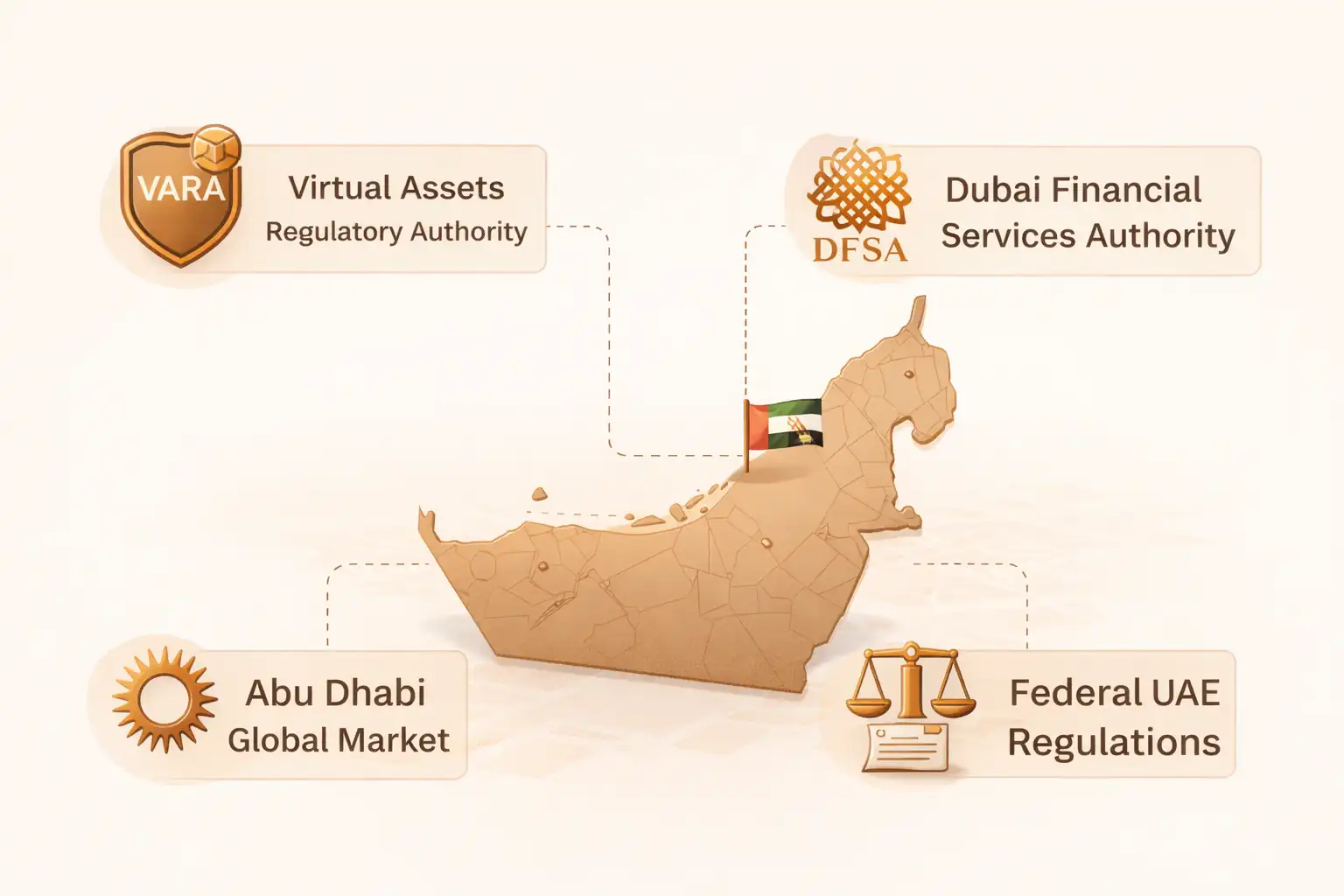
UAE Regulatory Framework for Real Estate Tokenization Regulations
VARA (Virtual Assets Regulatory Authority)
Comprehensive virtual asset regulation covering issuance, trading, custody, advisory, and other services. Licensing regime with multiple license types addressing different activities. Technology governance requirements including cybersecurity, business continuity, and operational resilience. Consumer protection provisions including disclosure standards, complaint handling, and dispute resolution. AML/CFT requirements aligned with FATF standards. Marketing and promotion rules governing advertising. Innovative regulatory approach specifically designed for digital assets providing clarity unavailable in many jurisdictions.
DFSA (Dubai Financial Services Authority)
Regulates financial services in Dubai International Financial Centre including securities offerings and investment business. Investment tokens constitute securities requiring prospectus or private placement compliance. Authorization needed for regulated activities including dealing, advising, managing, or arranging investments. Comprehensive conduct of business rules including client classification, disclosure requirements, and best execution. Prudential requirements including capital adequacy and financial resources. Established regulatory framework familiar to international financial institutions.
ADGM (Abu Dhabi Global Market)
Abu Dhabi’s international financial center with independent regulatory authority FSRA. Virtual asset framework established in 2018 with updated guidance. Investment tokens regulated as securities or collective investment schemes. Licensing for virtual asset activities including exchange, custody, and advisory services. Regulatory sandbox enabling innovation testing. Progressive approach complementing Dubai frameworks providing alternative UAE jurisdiction for tokenization platforms.
Federal UAE Regulations
Federal laws including AML/CFT regulations, commercial companies law, and property ownership regulations apply across UAE. Securities and Commodities Authority (SCA) regulates mainland UAE securities activities. Real estate specific regulations governing foreign ownership, property registration, and landlord-tenant relationships continue applying to underlying properties regardless of tokenization. Platforms must coordinate compliance across applicable federal, emirate-level, and free zone regulations depending on structure and operations.
Saudi Arabia is developing regulatory framework for digital assets through Capital Market Authority with recent guidance on crypto-asset regulation and tokenization. Bahrain Financial Harbor maintains progressive approach with regulatory sandbox and crypto-asset licensing. Qatar Financial Centre provides regulated environment though crypto-asset regulations remain developing. Broader GCC (Gulf Cooperation Council) region shows increasing interest in tokenization with varying regulatory maturity requiring market-specific analysis.
Emerging markets in Latin America, Africa, and other regions present diverse regulatory landscapes. Some jurisdictions like El Salvador have embraced cryptocurrency adoption including Bitcoin legal tender status. Others maintain restrictive approaches or regulatory vacuums. Brazil, Mexico, and Argentina are developing crypto-asset regulations. African jurisdictions including South Africa, Nigeria, and Kenya show varying approaches from progressive frameworks to cautious observation. These markets present long-term opportunities but currently involve elevated regulatory uncertainty.
| Region/Jurisdiction | Regulatory Maturity | Key Considerations | Tokenization Viability |
|---|---|---|---|
| UAE (Dubai/Abu Dhabi) | High – Comprehensive frameworks through VARA, DFSA, ADGM | Multiple regulatory pathways, clear licensing requirements, progressive approach, international business hub | Excellent – Leading global jurisdiction for tokenization with clear pathways |
| Saudi Arabia | Developing – CMA providing guidance, regulations evolving | Large market potential, Vision 2030 modernization, developing framework, capital market depth | Moderate – Opportunities emerging as regulations develop |
| Bahrain | Moderate-High – Crypto-asset licensing, sandbox programs | Progressive approach, smaller market, regional financial hub aspirations | Good – Clear pathway for compliant operations |
| Latin America | Variable – Brazil developing frameworks, others emerging or restrictive | High crypto adoption, regulatory uncertainty, economic volatility, varying approaches by country | Moderate – Long-term potential with current challenges |
| Africa | Early Stage – Most jurisdictions lack comprehensive frameworks | Growing interest, limited regulatory clarity, infrastructure challenges, South Africa most developed | Limited Currently – Future opportunities as regulations and infrastructure develop |
Regulatory readiness assessment for emerging markets requires analyzing multiple factors including existence of clear legal frameworks, regulatory authority capacity and expertise, government policy toward innovation, economic and political stability, infrastructure quality including internet connectivity and payment systems, legal system effectiveness and contract enforceability, and investor base sophistication. Markets scoring well across these dimensions present viable opportunities while those with significant gaps require patience as foundations develop.
UAE’s success in attracting international tokenization platforms demonstrates value of clear, comprehensive regulatory frameworks specifically designed for digital assets. Progressive regulation combined with business-friendly policies, strong infrastructure, international connectivity, and commitment to innovation creates environment where platforms can operate compliantly while accessing growing regional and international investor bases. This model provides blueprint other emerging markets can adapt to their contexts.
Emerging Markets Strategy: Real estate tokenization regulations platforms evaluating emerging markets should prioritize UAE as leading jurisdiction combining comprehensive digital asset regulations, robust investor protections, and progressive innovation approach. Other Middle Eastern markets present growing opportunities as regulations develop though require patient market-by-market assessment. Latin American and African markets offer long-term potential but currently involve elevated regulatory uncertainty and infrastructure challenges. Successful emerging market strategy requires careful regulatory monitoring, local partnerships, flexibility adapting to evolving frameworks, and realistic timelines recognizing that market development requires years not months. Platforms should avoid premature market entry before regulatory clarity sufficient to support sustainable operations, learning from UAE success that clear regulations attract rather than repel serious tokenization businesses.
Taxation Rules for Tokenized Real Estate Transactions
Taxation of tokenized real estate transactions follows traditional property and securities tax principles in most jurisdictions, with token holders subject to capital gains taxation on appreciation, income taxation on distributions, property-level taxes flowing through ownership structures, and potential transfer taxes on token sales depending on jurisdiction. However, tokenization introduces complexities including determining taxable events from token transfers versus traditional sales, characterizing distributions as dividends versus rental income, applying depreciation and other deductions through digital ownership structures, and navigating international tax treaties for cross-border investments.
US tax treatment of tokenized real estate generally follows partnership taxation principles when tokens represent interests in entities taxed as partnerships or LLCs. Token holders report proportional shares of property income, gains, losses, and deductions on personal tax returns. Capital gains on token sales receive long-term treatment if held over one year. Distributions constitute return of capital to extent of basis then capital gains. Section 1031 like-kind exchange treatment potentially applies to certain property-for-property token swaps though specific guidance remains limited. FIRPTA withholding applies to foreign investors in US real property interests requiring platforms implementing appropriate withholding procedures.
UK taxation treats tokenized real estate as property interests with Capital Gains Tax applying to appreciation and Income Tax on rental distributions. Non-resident investors face UK tax on UK property regardless of holding structure. Stamp Duty Land Tax potentially applies depending on transaction structure. Corporate wrappers create additional tax layers. Annual Tax on Enveloped Dwellings (ATED) applies to high-value residential properties held through corporate structures. UK tax complexity for tokenized real estate requires professional tax advice navigating property tax, corporate tax, and capital gains considerations.
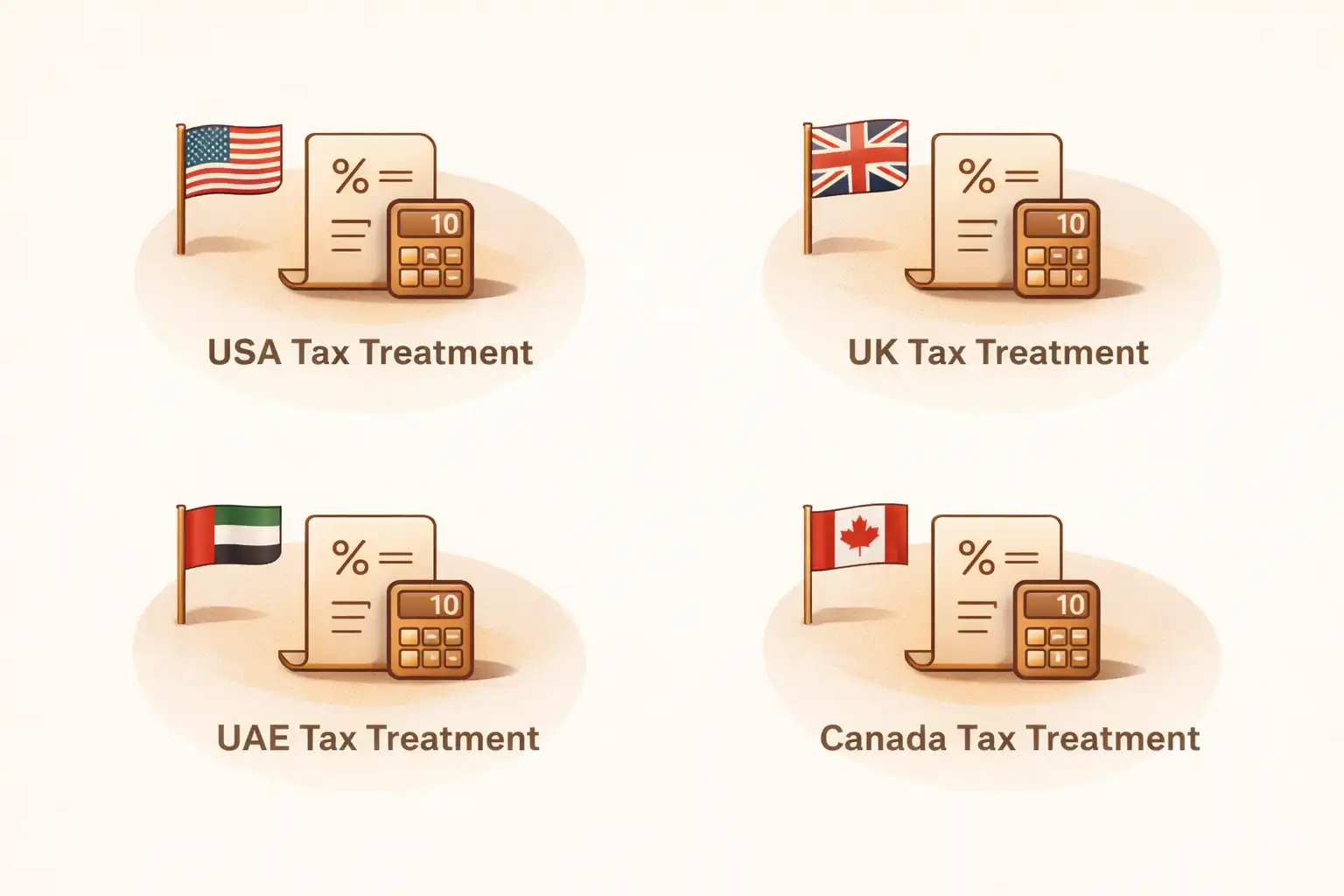
Tax Considerations for Tokenized Real Estate by Jurisdiction
USA Tax Treatment
Token interests typically taxed as partnership interests with pass-through taxation. Capital gains on token sales (long-term if held over 1 year). Ordinary income on rental distributions. Depreciation and expense deductions pass through to token holders. Section 1031 potentially applicable though guidance limited. FIRPTA withholding 15% on foreign investor dispositions of US real property interests. State and local taxes apply based on property location. Self-employment tax generally not applicable for passive investors. Qualified Business Income deduction potentially available. Comprehensive information reporting through Form 1099 required for distributions and sales.
UK Tax Treatment
Capital Gains Tax on appreciation with annual exemption (£6,000 for 2023/24). Income Tax on rental distributions at marginal rates. Non-residents pay CGT on UK property disposals. Stamp Duty Land Tax potentially applicable depending on structure. Annual Tax on Enveloped Dwellings for high-value residential in corporate structures. Inheritance Tax considerations for UK properties. Corporate wrappers face corporation tax plus shareholder taxation. Offshore structures scrutinized under anti-avoidance rules. Professional advice essential navigating complex interaction of property, corporate, and capital gains taxation.
UAE Tax Treatment
No capital gains tax in most UAE jurisdictions creating significant advantage. No personal income tax on rental distributions for most investors. Corporate income tax introduced in 2023 at 9% applying to certain business income. Free zone entities may qualify for exemptions. Property transfer fees (typically 2-4%) apply to real estate transactions. VAT applies to certain commercial property transactions at 5%. Withholding tax generally not applicable. Tax residency rules determine whether UAE or foreign tax applies to individual investors. Simple tax structure compared to most jurisdictions makes UAE attractive for tokenization though international investors remain subject to home country taxation.
Canada Tax Treatment
Capital gains tax at 50% inclusion rate (half of gains taxable at marginal rates). Rental income taxed as ordinary income. Principal residence exemption generally not available for tokenized fractional interests. Non-resident withholding tax 25% on rental income (potentially reduced under tax treaties). Provincial taxes apply in addition to federal. Partnership or trust structures common with flow-through taxation. Foreign property reporting requirements for holdings exceeding CAD $100,000. GST/HST considerations for commercial properties. Tax treaties with many countries reduce withholding rates for qualifying investors.
International tax considerations create additional complexity for cross-border tokenized real estate investments. Tax treaties between countries may reduce withholding rates on distributions, prevent double taxation through foreign tax credits, and establish rules determining which country has primary taxing authority. However, treaty benefits typically require specific documentation and procedures. Permanent establishment risks arise when property ownership creates tax nexus in property location jurisdiction. Transfer pricing rules apply to related-party transactions between entities in different jurisdictions. Platforms must implement systems tracking investor tax residence, applying appropriate withholding, and providing tax documentation supporting treaty benefits and foreign tax credit claims.
Information reporting obligations require platforms issuing Form 1099 in USA, providing tax certificates in UK, and satisfying equivalent reporting requirements in other jurisdictions. Failure to provide required tax reporting exposes platforms to penalties and creates compliance headaches for investors. Comprehensive tax reporting systems tracking distributions, sales, basis adjustments, and foreign withholding represent necessary infrastructure for compliant tokenization platforms serving international investor bases.
| Tax Event | Tax Treatment (General) | Documentation Required |
|---|---|---|
| Token Purchase | Establishes cost basis for future gain/loss calculation, generally not taxable event | Purchase confirmation, amount paid, date of acquisition |
| Rental Income Distribution | Ordinary income taxed at marginal rates, potential deductions for allocable expenses and depreciation | Distribution statement, K-1 or equivalent, allocation of income/deductions |
| Token Sale | Capital gain/loss (long-term if held over 1 year in most jurisdictions), sale price minus adjusted basis | Form 1099-B or equivalent, original purchase documentation, basis adjustments |
| Property Sale/Liquidation | Capital gain allocated to token holders, potential recapture of depreciation, liquidation proceeds | Final K-1, liquidation statement, allocation of gains and recapture |
| Return of Capital Distribution | Reduces basis, not immediately taxable unless exceeding basis (then capital gain) | Distribution classification, basis tracking, documentation of non-dividend character |
Tax optimization strategies for tokenized real estate investors include timing token sales to optimize long-term capital gains treatment, tax-loss harvesting through strategic sale timing, utilizing available deductions including mortgage interest and depreciation pass-throughs, structuring holdings in tax-advantaged accounts where permitted, and leveraging tax treaty benefits for international investments. However, tax optimization must occur within legal boundaries avoiding abusive tax shelters or aggressive positions lacking substantial authority.
Investors should engage qualified tax professionals with expertise in real estate, securities, and international taxation before tokenized real estate investments, during holding periods for tax planning, and at disposition for proper reporting. Tax complexity of cross-border real estate investment through digital securities demands professional guidance rather than DIY approaches risking costly errors, penalties, or audit exposure. Platforms should provide comprehensive tax information and guidance about reporting obligations though cannot provide personalized tax advice requiring CPA or tax attorney consultation.
Tax Compliance Imperative: Tokenized real estate taxation follows complex rules combining property, securities, and international tax principles requiring professional guidance for proper compliance. Token holders remain fully responsible for tax reporting and payment regardless of whether platforms provide tax documents. Failure to report income, capital gains, or foreign holdings subjects investors to penalties, interest, and potential criminal prosecution for willful evasion. Investors should maintain comprehensive records of all token purchases, distributions, basis adjustments, and sales supporting tax return reporting. International investors face home country taxation plus potential foreign withholding creating multi-jurisdictional compliance obligations. Tax planning should begin before investment rather than at tax filing time. The apparent simplicity of clicking “buy tokens” masks substantial tax complexity requiring same professional attention as traditional real estate investment despite digital representation.
Custody, Escrow, and Compliance Obligations for Token Issuers
Custody and escrow arrangements for tokenized real estate assets create critical investor protection mechanisms, with proper custody ensuring secure storage of digital tokens, escrow protecting investor funds during offering periods, and compliance obligations requiring platforms implementing comprehensive safeguards meeting regulatory standards across USA, UK, UAE, and Canada. Inadequate custody arrangements represent significant regulatory violations and create catastrophic loss risks if tokens are stolen, lost, or misappropriated through poor security practices or fraudulent operators.
Qualified custody in United States follows SEC custody rules under Investment Advisers Act requiring registered investment advisers to maintain client assets with qualified custodians including banks, broker-dealers, and registered trust companies. While not all tokenization platforms require investment adviser registration, custody standards developed for traditional securities provide appropriate framework for tokenized assets. Key custody requirements include segregation of client assets from platform assets, regular reconciliation and verification, appropriate insurance coverage, independent audits confirming custody controls, and clear documentation of custody arrangements and responsibilities.
Self-custody options where investors maintain direct control of private keys provide maximum sovereignty but place full security responsibility on individual token holders. For retail investors lacking cybersecurity expertise, self-custody creates elevated risks of private key loss, theft through malware or phishing, or inadvertent exposure through poor operational security. Institutional investors generally require qualified custodial solutions meeting fiduciary standards and providing insurance protection, professional security practices, and regulatory compliance documentation supporting their own compliance obligations.
Custody Models for Tokenized Real Estate
Qualified Custodian Model
Structure: Third-party qualified custodian (bank, trust company, registered broker-dealer) holds tokens on behalf of investors
Security: Professional custody practices, insurance coverage, regulatory oversight, institutional-grade security
Compliance: Satisfies SEC custody rule requirements, enables institutional investment, provides audit trail
Best For: Institutional investors, large holdings, platforms requiring regulatory compliance with custody rules
Platform Custody Model
Structure: Tokenization platform maintains custody of investor tokens through platform-controlled wallets
Security: Platform security practices determine safety, requires multi-signature wallets, hardware security modules, comprehensive controls
Compliance: May require qualified custodian status or specific licensing depending on jurisdiction and activities
Best For: Smaller retail platforms with robust security, convenience-focused investors, integrated platform experience
Hybrid Custody Model
Structure: Combination of platform custody for operational convenience and qualified custodian for bulk holdings or institutional assets
Security: Tiered approach balancing convenience for small holders with institutional-grade custody for large positions
Compliance: Satisfies regulatory requirements for qualified custody while maintaining user experience
Best For: Platforms serving diverse investor bases, balancing regulatory compliance with operational flexibility
Self-Custody Model
Structure: Investors maintain direct control of private keys through hardware wallets or personal wallet software
Security: Investor fully responsible for key security, backup procedures, operational security practices
Compliance: Platform not providing custody avoids certain regulatory obligations but must ensure proper investor education
Best For: Sophisticated investors with security expertise, maximizing sovereignty, avoiding custodian counterparty risk
Escrow arrangements during token offering periods protect investor funds ensuring they’re only released when offering successfully closes and tokens are issued. Escrow provides investor protection against platform insolvency or fraudulent operators collecting funds without delivering tokens. Regulatory frameworks in many jurisdictions require escrow or similar protective arrangements for securities offerings, with funds held by independent third parties releasing capital only when offering conditions satisfied. Smart contract-based escrow can automate certain aspects though legal escrow arrangements with qualified escrow agents provide additional protections.
Insurance coverage represents additional investor protection layer with qualified custodians typically maintaining comprehensive insurance including crime insurance covering employee theft, cybersecurity insurance protecting against hacking losses, errors and omissions insurance for professional mistakes, and custody-specific insurance covering various loss scenarios. Insurance limits should be appropriate to assets under custody with major custodians maintaining hundreds of millions in coverage. Platforms providing custody should disclose insurance coverage details enabling investors assessing protection adequacy.
| Custody Obligation | Requirement Details | Regulatory Source |
|---|---|---|
| Asset Segregation | Client assets must be segregated from platform/custodian assets, preventing commingling, enabling clear identification of ownership | SEC Custody Rule, FCA CASS rules, MiFID II, VARA custody requirements |
| Regular Reconciliation | Periodic verification that custody records match actual token holdings, identifying discrepancies promptly | Generally accepted custody practices, regulatory examination standards |
| Independent Verification | Third-party audits confirming custody controls effectiveness, asset existence, and record accuracy | SEC custody rule surprise examination requirement, SOC 2 Type II audits |
| Insurance Coverage | Appropriate insurance protecting against theft, loss, hacking, errors, and other custody-related risks | Regulatory expectations, industry best practices, institutional investor requirements |
| Security Controls | Multi-signature wallets, hardware security modules, access controls, monitoring, incident response procedures | Cybersecurity frameworks (NIST, ISO 27001), regulatory guidance, prudent practice standards |
Operational compliance for custody providers includes maintaining comprehensive policies and procedures documenting custody practices, implementing robust internal controls preventing unauthorized access or transactions, conducting regular audits and compliance reviews, maintaining clear records of all custody activities and transactions, providing regular statements to clients confirming holdings, and establishing incident response procedures addressing potential security breaches or operational failures. These operational requirements ensure custody arrangements function effectively protecting investor assets.
For platforms issuing tokens, custody obligations extend to ensuring proper custody arrangements exist before token issuance, providing clear disclosure about custody models and associated risks, facilitating investor choice between custody options where applicable, maintaining accurate token holder registries reflecting current ownership, and coordinating with custodians for distributions, corporate actions, and other events affecting token holders. Platforms cannot abdicate custody responsibilities simply by enabling self-custody, as proper investor education and risk disclosure remain essential.
Custody Compliance Principle: Proper custody arrangements represent non-negotiable investor protection mechanism for tokenized real estate with qualified custodial solutions preferred for institutional investments and substantial retail holdings. Platforms must implement custody standards meeting or exceeding regulatory expectations including asset segregation, regular reconciliation, independent verification, appropriate insurance, and robust security controls. Self-custody options should be available for sophisticated investors desiring maximum sovereignty but require comprehensive risk disclosures and investor education about private key security responsibilities. Investors should verify custody arrangements before investing, preferring platforms using qualified custodians with transparent insurance coverage, independent audits, and proven track records. The convenience of digital tokens cannot reduce custody standards below those applicable to traditional securities, as digital representation increases rather than decreases custody risks requiring elevated attention and professional management.
Licensing Requirements for Real Estate Tokenization Platforms
Licensing requirements for real estate tokenization regulations platforms vary significantly based on business activities, jurisdictions of operation, and investor types served, with platforms potentially requiring securities licenses, broker-dealer registration, Alternative Trading System authorization, investment adviser registration, money transmission licenses, or virtual asset service provider licenses depending on specific services offered. Understanding which licenses apply to platform activities is essential for regulatory compliance, with operating without required licenses creating severe enforcement risks including criminal prosecution, substantial penalties, and permanent market exclusion.
Start Your Compliant Platform Today!
Our experts handle all real estate tokenization regulations for you. Securities laws, licenses, and compliance made easy. Trusted by 150+ successful platforms.
Securities licensing in United States centers on broker-dealer registration for entities facilitating securities transactions between buyers and sellers. Tokenization platforms operating secondary markets typically require SEC broker-dealer registration plus FINRA membership, involving comprehensive application process demonstrating financial soundness, qualified personnel, compliance infrastructure, and operational capabilities. Alternative Trading System (ATS) registration under Regulation ATS provides pathway for platforms matching orders without full exchange registration, though still requires broker-dealer foundation plus additional ATS-specific requirements including Form ATS filing, fair access provisions, and capacity/integrity/security standards.
Investment adviser registration applies when platforms provide investment advice, manage client portfolios, or exercise discretionary authority over client assets. Real estate tokenization regulations platforms offering portfolio construction recommendations, property selection guidance, or managed investment services likely require SEC or state investment adviser registration depending on assets under management and client types. Registration involves Form ADV filing, disclosure brochure preparation, compliance program implementation, and ongoing reporting obligations. Fiduciary duties attach to registered investment advisers requiring best interest standards exceeding suitability obligations.
Licensing Requirements by Platform Activity
Primary Issuance Platform
Activities: Issuing tokens representing property ownership, conducting offerings, accepting investments
US Licensing: Generally no broker-dealer license required for issuer selling own securities, but transfer agent registration may apply
UK Licensing: FCA authorization potentially required depending on involvement level
UAE Licensing: VARA or DFSA license for virtual asset issuance services
Canada: Prospectus or exemption compliance, potentially dealer registration if distribution activities
Secondary Trading Platform
Activities: Operating marketplace for token trading, matching buyers and sellers, facilitating transactions
US Licensing: Broker-dealer registration required, plus ATS registration if operating alternative trading system, FINRA membership
UK Licensing: FCA authorization as investment firm, potentially MTF or OTF designation
UAE Licensing: VARA exchange license or DFSA authorization for operating multilateral trading facility
Canada: Dealer registration, potentially ATS or exchange recognition
Advisory/Portfolio Management
Activities: Providing investment recommendations, portfolio construction advice, property selection guidance
US Licensing: Investment adviser registration (SEC or state depending on AUM), Form ADV filing, compliance program
UK Licensing: FCA authorization for investment advice or portfolio management
UAE Licensing: VARA advisory license or DFSA authorization for investment advice
Canada: Advising registration, potentially portfolio manager registration for discretionary management
Custody Services
Activities: Holding tokens on behalf of investors, maintaining custody wallets, providing security
US Licensing: Qualified custodian status (bank, trust company, registered broker-dealer) for RIA custody rule compliance
UK Licensing: FCA authorization for safeguarding and administration, CASS compliance
UAE Licensing: VARA custody license or DFSA authorization for custody services
Canada: Trust company license or registered dealer providing custody services
Integrated Platform (Multiple Services)
Activities: Combining issuance, trading, advisory, custody in single platform
US Licensing: Multiple licenses potentially required (broker-dealer, investment adviser, qualified custodian) or strategic partnerships
UK Licensing: Comprehensive FCA permissions covering all activities
UAE Licensing: Multiple VARA licenses or comprehensive DFSA authorization
Canada: Multiple registrations (dealer, adviser, etc.) or integrated exempt market dealer registration
Money transmission licensing becomes relevant when platforms accept fiat currency for token purchases, process distributions in fiat, or provide currency exchange services. Most US states require money transmitter licenses with varying requirements, capital bonds, and ongoing compliance obligations. FinCEN registration as money services business applies at federal level. UK FCA authorization as payment institution or e-money institution may be required. These licensing requirements add complexity when platforms handle fiat currency, leading some platforms to cryptocurrency-only models avoiding money transmission licensing.
Virtual asset service provider (VASP) licensing in progressive jurisdictions like UAE VARA, Singapore MAS, Hong Kong SFC, and others establishes comprehensive frameworks specifically for crypto-asset businesses. VASP licenses typically cover multiple activities including issuance, exchange, custody, advisory, and transfer services related to virtual assets. Requirements include capital adequacy, governance standards, technology controls, cybersecurity measures, AML compliance, and consumer protection provisions. VASP frameworks provide clearer pathways than adapting traditional financial services licensing to tokenization though still demand comprehensive compliance infrastructure.
| License Type | Typical Requirements | Approximate Cost/Timeline | Ongoing Obligations |
|---|---|---|---|
| US Broker-Dealer | SEC Form BD, FINRA membership, qualified principals, compliance infrastructure, net capital requirements | $100K-$500K cost, 6-12 months timeline | Annual audits, net capital maintenance, FINRA examinations, ongoing reporting, supervision systems |
| US Investment Adviser | Form ADV, Part 2 brochure, compliance program, CCO designation, custody rule compliance if applicable | $25K-$100K cost, 3-6 months timeline | Annual updating amendments, compliance reviews, Form ADV updates, SEC examinations for SEC-registered |
| UK FCA Authorization | Application demonstrating competence, financial resources, appropriate permissions, approved persons | £50K-£250K cost, 6-12 months timeline | Annual fees, regulatory returns, conduct rules compliance, FCA supervision, regular reporting |
| UAE VARA License | Application per license type, business plan, technology governance, compliance framework, qualified personnel | $50K-$200K cost, 3-6 months timeline | Annual license fees, ongoing compliance, reporting obligations, VARA supervision, regular audits |
| Canada Dealer Registration | Provincial registration, proficiency requirements, compliance system, adequate insurance, capital requirements | $50K-$150K cost, 4-8 months timeline | Annual renewal, financial reporting, compliance reviews, provincial examination programs |
Strategic licensing decisions for tokenization platforms involve assessing which activities are essential versus nice-to-have, evaluating licensing costs and timelines against business plans, considering partnership alternatives where platforms partner with licensed entities rather than obtaining licenses directly, analyzing competitive advantages from comprehensive licensing versus licensing minimization strategies, and planning phased licensing obtaining initial licenses enabling launch then adding licenses as business scales.
Partnership models provide alternatives to direct licensing with platforms partnering with licensed broker-dealers for secondary trading, registered investment advisers for advisory services, or qualified custodians for custody services. Partnerships reduce licensing burdens but introduce dependencies, revenue sharing obligations, and potential conflicts. Partnership agreements must clearly allocate responsibilities, define revenue splits, establish service level expectations, and address termination scenarios. Due diligence on partners is essential as partner misconduct can create reputational and regulatory risks for platforms.
Licensing Compliance Imperative: Operating without required licenses represents severe regulatory violation resulting in enforcement actions, criminal prosecution, substantial penalties, and permanent market exclusion. Platforms must accurately identify all licensing requirements based on actual activities conducted rather than claimed business models, recognizing that substance matters more than labels. The complexity and cost of obtaining necessary licenses reflects genuine investor protection value these licensing regimes provide through regulatory oversight, operational standards, and professional competence requirements. Platforms should plan licensing strategy from inception, budgeting appropriately for license acquisition and ongoing compliance costs. Attempting to avoid licensing through creative structuring or regulatory arbitrage creates substantial enforcement risk. Investors should verify platforms possess all required licenses before investing, viewing licensing status as essential due diligence checkpoint indicating platform commitment to regulatory compliance and professional operation standards.
Common Regulatory Risks and How to Mitigate Them
Real estate tokenization regulations platforms face numerous regulatory risks that can threaten business viability, create substantial financial liability, and harm investors if not properly identified and mitigated. Common regulatory risks include securities law violations from unregistered offerings or inadequate disclosures, AML compliance failures enabling money laundering, unlicensed activities conducting regulated business without proper authorization, cross-border violations offering tokens in prohibited jurisdictions, custody failures losing or misappropriating investor assets, and tax compliance gaps creating liability for platforms and investors. Proactive risk identification and comprehensive mitigation strategies represent essential components of sustainable tokenization operations.
Securities registration violations represent highest-severity regulatory risk given potential consequences including investor rescission rights enabling forced buybacks at original prices plus interest, substantial civil penalties potentially reaching millions of dollars, disgorgement of all offering proceeds, cease and desist orders halting operations, and criminal prosecution for willful violations. Mitigation requires obtaining qualified legal counsel experienced in securities regulation, conducting thorough Howey analysis confirming regulatory status, properly structuring offerings under valid exemptions or completing registration, implementing comprehensive disclosure meeting securities law standards, and maintaining transfer restrictions preventing exemption violations through premature resales.
AML compliance failures create criminal liability exposure beyond civil penalties, with prosecutions possible for platforms facilitating money laundering or terrorist financing through inadequate controls. Historical cases demonstrate regulators willingness to pursue criminal charges against executives whose platforms enabled illicit financial flows through negligent or inadequate AML programs. Mitigation demands implementing comprehensive KYC procedures meeting regulatory standards, maintaining robust transaction monitoring systems identifying suspicious patterns, filing required reports when thresholds met, conducting regular AML training for all relevant personnel, and engaging qualified AML compliance consultants ensuring program adequacy.
Regulatory Risk Mitigation Framework
Phase 1: Risk Identification and Assessment
Conduct comprehensive analysis identifying all applicable regulatory requirements based on platform activities, operating jurisdictions, and investor types. Assess likelihood and severity of each identified risk. Engage qualified legal counsel in all operating jurisdictions analyzing specific requirements. Document risk assessment conclusions and legal analysis supporting compliance positions. Update risk assessments regularly as regulations evolve and platform activities expand. Priority ranking determines resource allocation focusing on highest-severity risks requiring immediate attention.
Phase 2: Compliance Program Design
Develop comprehensive compliance programs addressing identified risks through policies, procedures, controls, and monitoring systems. Securities compliance program includes offering structure, disclosure document preparation, exemption compliance, transfer restrictions, and ongoing reporting. AML program encompasses KYC procedures, sanctions screening, transaction monitoring, SAR filing, and recordkeeping. Technology compliance ensures smart contracts implement regulatory requirements. Governance structure assigns compliance responsibilities, establishes escalation procedures, and ensures accountability throughout organization.
Phase 3: Implementation and Training
Implement compliance programs through operational integration ensuring procedures actually followed rather than existing only on paper. Deploy necessary technology systems supporting compliance functions including KYC platforms, transaction monitoring, regulatory reporting tools. Conduct comprehensive training for all employees on compliance obligations, escalation procedures, and individual responsibilities. Test compliance systems validating effectiveness before launch. Document implementation activities demonstrating good faith compliance efforts if questions arise.
Phase 4: Monitoring and Testing
Conduct ongoing monitoring ensuring compliance programs function effectively identifying and addressing violations promptly. Regular compliance reviews examine policies, procedures, and controls adequacy. Transaction testing validates that controls operate as designed. Independent audits provide objective assessment of program effectiveness. Respond promptly to identified deficiencies through remediation plans. Document all monitoring activities creating audit trail demonstrating continuous compliance attention.
Phase 5: Continuous Improvement and Adaptation
Maintain flexibility adapting compliance programs to regulatory changes, enforcement developments, and business evolution. Monitor regulatory guidance, enforcement actions, and industry developments informing necessary program updates. Engage with regulators through comment letters, no-action letter requests, and regulatory dialogue when appropriate. Update programs proactively rather than waiting for regulatory pressure. Document rationale for all compliance decisions supporting positions if challenged. Cultivate compliance culture where regulatory adherence valued throughout organization rather than viewed as burdensome obstacle.
Cross-border regulatory risks require special attention given potential for platforms violating multiple jurisdictions’ laws simultaneously. Geographic restrictions represent conservative mitigation approach limiting offerings to jurisdictions where platforms obtain proper authorization and implement full compliance. Geofencing through IP blocking, investor verification, and transfer restrictions prevents token access from prohibited jurisdictions. However, VPN usage and technological workarounds create enforcement challenges. Comprehensive terms of service prohibiting unauthorized jurisdictional access provides legal protection though doesn’t eliminate practical risks.
Custody risks mitigation combines qualified custodian selection, comprehensive insurance coverage, robust operational controls, and clear documentation of custody arrangements and responsibilities. Due diligence on custodians includes verifying licensing status, reviewing audit reports, confirming insurance coverage adequacy, assessing security practices, and checking regulatory examination history. Escrow arrangements protect investor funds during offering periods. Regular reconciliation between custody records and actual token holdings identifies discrepancies requiring investigation. Incident response procedures address custody breaches promptly minimizing loss and demonstrating responsible management.
| Regulatory Risk | Potential Consequences | Key Mitigation Measures |
|---|---|---|
| Unregistered Securities Offering | SEC enforcement, investor rescission rights, civil penalties, criminal prosecution, platform shutdown | Qualified securities counsel, proper exemption structure, comprehensive disclosures, transfer restrictions, Form D filing |
| AML Compliance Failure | Criminal prosecution, civil penalties up to $1M per violation, license revocation, personal liability for executives | Comprehensive KYC procedures, transaction monitoring, SAR filing, AML training, qualified compliance officer |
| Unlicensed Broker-Dealer Activity | SEC enforcement, disgorgement, monetary penalties, permanent industry bars, criminal charges | Proper licensing or partnership with licensed entities, limiting activities to permitted functions, legal analysis of activities |
| Cross-Border Violations | Multiple jurisdiction enforcement, asset freezes, international coordination against platform, investor lawsuits | Geographic restrictions, multi-jurisdictional compliance, local counsel in operating markets, Regulation S compliance |
| Custody/Escrow Failures | Investor losses, regulatory enforcement, civil liability, reputational destruction, criminal fraud charges if willful | Qualified custodians, comprehensive insurance, robust security controls, regular audits, clear documentation |
Insurance as risk mitigation tool provides financial protection against certain regulatory and operational risks. Directors and officers (D&O) insurance protects executives against personal liability from investor lawsuits or regulatory actions. Errors and omissions (E&O) insurance covers professional mistakes in platform operations. Cyber insurance addresses hacking losses and data breaches. Crime insurance protects against employee theft. While insurance doesn’t prevent regulatory violations, it provides financial resources for legal defense, settlement payments, and business continuity during regulatory proceedings or litigation.
Regulatory examination preparedness ensures platforms can respond effectively when regulators conduct inspections, request information, or investigate potential violations. Preparation includes maintaining organized records enabling prompt document production, establishing internal protocols for regulatory communication and escalation, engaging legal counsel experienced in regulatory examinations, conducting mock examinations identifying potential issues before actual regulatory contact, and training staff on appropriate conduct during examinations. Cooperative, professional responses to regulatory inquiries often result in better outcomes than defensive or adversarial postures.
Risk Mitigation Philosophy: Regulatory risks in real estate tokenization regulations cannot be eliminated but must be managed to acceptable levels through comprehensive compliance programs, qualified professional guidance, ongoing monitoring, and adaptive improvement. Platforms should budget appropriately for compliance, typically allocating 10-20% of operational costs to legal, compliance, and risk management functions. Risk mitigation represents investment protecting long-term viability rather than cost to be minimized. Proactive compliance creates competitive advantages through investor confidence, institutional access, and operational sustainability versus reactive platforms facing enforcement actions. Investors should assess platform risk management through compliance program review, regulatory examination history, insurance coverage verification, and legal counsel quality rather than accepting compliance claims without verification. Effective risk mitigation differentiates professional platforms building sustainable businesses from ventures destined for regulatory collapse.
Future of Real Estate Tokenization Regulations and Global Harmonization
The regulatory future for real estate tokenization regulations points toward continued evolution with increasing clarity, emerging international harmonization efforts, technology-specific frameworks complementing traditional securities laws, and maturing enforcement approaches distinguishing legitimate platforms from fraudulent schemes. While complete regulatory harmonization remains distant goal given sovereign regulatory authority and divergent policy priorities, gradual convergence around core principles including investor protection, AML standards, and disclosure requirements creates more navigable global regulatory landscape enabling serious platforms to operate compliantly across multiple jurisdictions.
Regulatory trends suggest movement toward explicit digital asset frameworks purpose-built for tokenization rather than forcing novel technologies into decades-old securities law constructs. UAE VARA regulations, EU MiCA, Singapore MAS frameworks, and similar initiatives demonstrate regulatory willingness to develop modern frameworks addressing blockchain-specific characteristics while maintaining traditional investor protections. These frameworks provide regulatory clarity reducing uncertainty that has hindered mainstream adoption while establishing professional standards separating legitimate platforms from bad actors exploiting regulatory gaps.
International coordination through organizations like IOSCO, FATF, and bilateral regulatory cooperation agreements gradually creates baseline standards for crypto-asset regulation including tokenized real estate. IOSCO principles for crypto-asset regulation, FATF travel rule for virtual asset transfers, and similar initiatives establish common expectations regulators globally will implement through their respective frameworks. While implementation details vary, core principles around KYC, AML, disclosure, custody, and market integrity converge creating more consistent baseline standards than existed historically.
Emerging Regulatory Developments Shaping Tokenization Future
Digital Asset Frameworks
Purpose-built regulations specifically for crypto-assets including security tokens. Examples include UAE VARA, EU MiCA, Singapore Payment Services Act amendments. Provide clearer pathways than adapting traditional securities laws. Establish licensing, operational standards, and consumer protections tailored to digital assets. Enable innovation within appropriate guardrails.
Smart Contract Legal Recognition
Legislative initiatives recognizing smart contracts as legally enforceable agreements. Wyoming, Arizona, and other jurisdictions enacting smart contract laws. Provides legal certainty for automated token functions. Courts developing precedents interpreting smart contract disputes. Balance between code automation and legal enforceability clarifying over time.
DeFi and Decentralization Challenges
Regulators addressing truly decentralized platforms lacking identifiable operators. Questions about applying traditional regulation to protocols without central parties. Potential protocols and founders liability for subsequent use. Evolution toward regulating interfaces, developers, and service providers around core protocols. Ongoing debates about decentralization degree affecting regulatory treatment.
Institutional Participation Frameworks
Regulatory accommodations enabling institutional investment in tokenized assets. Qualified custody rules adapting to digital assets. Prime brokerage for security tokens developing. Regulatory clarity supporting pension funds, insurance companies, endowments participating. Traditional financial institution integration with tokenization infrastructure.
Regulatory Sandboxes and Innovation Hubs
Programs enabling firms testing innovative models under regulatory supervision with limited licenses or exemptions. FCA sandbox, MAS fintech regulatory sandbox, DFSA innovation testing license, and similar programs globally. Enable learning through experimentation without full regulatory burden. Successful tests inform permanent regulatory frameworks. Balance innovation encouragement with appropriate safeguards.
Cross-Border Coordination
International regulatory cooperation increasing through memoranda of understanding, information sharing agreements, and coordinated enforcement. IOSCO principles, FATF standards creating baseline expectations. EU passporting potentially extending to digital assets. Bilateral agreements enabling cross-border platform operations. Gradual movement toward mutual recognition frameworks.
Technology developments including zero-knowledge proofs enabling privacy-preserving compliance, decentralized identity systems reducing KYC friction while maintaining verification, layer-2 scaling solutions reducing transaction costs, and improved smart contract security will influence regulatory approaches. Regulators must balance accommodating technological innovation against maintaining investor protections and market integrity. Progressive regulators engage with technologists understanding capabilities and limitations while conservatives emphasize risks requiring caution. This tension drives regulatory evolution as experience accumulates demonstrating what works and what creates unacceptable risks.
Enforcement maturation differentiates between genuine compliance efforts and willful violations, between good faith interpretation differences and fraud. Early enforcement often painted broadly catching questionable and legitimate players together. Maturing enforcement increasingly distinguishes platforms making reasonable compliance efforts within uncertain regulatory environments from those deliberately evading clear requirements or perpetrating fraud. This nuanced enforcement enables compliant platforms operating sustainably while eliminating bad actors harming investors and industry reputation.
For real estate tokenization regulations specifically, regulatory trajectory suggests continued application of securities laws to property tokens with increasing recognition that tokenization enhances rather than undermines investor protections through transparency, automated compliance, and reduced intermediation costs. Regulators increasingly view tokenization as beneficial innovation requiring appropriate regulation rather than inherent threat warranting prohibition. This evolution creates favorable conditions for compliant platforms demonstrating value propositions while maintaining robust investor protections.
Future Outlook: Real estate tokenization regulations environment will continue evolving toward greater clarity, purpose-built frameworks, and international coordination while maintaining core investor protection principles. Platforms should anticipate continued regulatory evolution requiring adaptive compliance programs, proactive engagement with regulators, and patient approach recognizing that regulatory frameworks develop over years not months. The platforms that thrive long-term will be those embracing regulation as necessary framework enabling mainstream adoption rather than viewing compliance as obstacle to work around. Investors should favor platforms demonstrating commitment to regulatory compliance and transparency over those claiming innovation exempts them from traditional protections. The future belongs to compliant professional platforms building sustainable businesses within evolving but increasingly clear regulatory frameworks, not to regulatory arbitrageurs seeking gaps enabling unsustainable operations destined for enforcement actions.
Navigating real estate tokenization regulations across USA, UK, UAE, and Canada requires comprehensive legal expertise, proactive compliance commitment, and ongoing adaptation to evolving regulatory frameworks. Success demands treating regulatory compliance as strategic advantage and investor protection mechanism rather than burdensome cost.
Our eight years of experience structuring compliant tokenization platforms demonstrates that properly regulated offerings attract institutional capital, build investor confidence, and create sustainable businesses. The path to mainstream real estate tokenization regulations adoption runs through comprehensive regulatory compliance, not around it.
People Also Ask
Q1.What are the main regulations governing real estate tokenization globally?
Real estate tokenization is primarily governed by securities laws in most jurisdictions, treating tokenized property interests as securities requiring registration or exemptions. In the USA, SEC Regulation D, Regulation A+, and Regulation S apply. The UK operates under FCA prospectus rules and financial promotion regulations. UAE’s VARA and DFSA provide digital asset frameworks. Canada applies provincial securities laws through National Instruments. Additionally, anti-money laundering regulations, data protection laws, and real estate-specific regulations apply across all jurisdictions.
Q2.Do tokenized real estate investments count as securities in the USA?
es, tokenized real estate investments almost universally qualify as securities under US law. The SEC applies the Howey Test, which examines whether there is an investment of money in a common enterprise with expectation of profits derived from efforts of others. Real estate tokens meet all criteria, triggering comprehensive securities regulation including registration requirements, disclosure obligations, transfer restrictions, and investor protections. Platforms must comply with federal securities laws and often state blue sky laws governing securities offerings.
Q3.What KYC and AML requirements apply to real estate tokenization platforms?
Real estate tokenization platforms must implement comprehensive Know Your Customer and Anti-Money Laundering programs under Bank Secrecy Act (USA), Money Laundering Regulations (UK), FINTRAC requirements (Canada), and UAE AML laws. Requirements include customer identification and verification, beneficial ownership determination, sanctions screening against OFAC and international lists, politically exposed persons checks, ongoing transaction monitoring, suspicious activity reporting, and record retention for 5-7 years. Platforms must appoint compliance officers and conduct regular audits.
Q4.Can real estate tokens be traded internationally without restrictions?
No, international trading of real estate tokens faces significant regulatory restrictions. Each jurisdiction maintains securities laws governing offerings to its residents, requiring platforms to either comply with all applicable jurisdictions or restrict access geographically. US Regulation S provides safe harbor for offshore offerings excluding US persons. EU prospectus requirements apply across member states. Transfer restrictions often prohibit immediate resale, requiring holding periods. Platforms must implement geofencing, investor verification, and compliance with cross-border securities regulations in all operating jurisdictions.
Q5.How does the UAE regulate real estate tokenization in Dubai?
Dubai regulates real estate tokenization through multiple frameworks depending on jurisdiction. The Dubai Financial Services Authority (DFSA) in DIFC governs digital securities offerings requiring prospectus approval and ongoing compliance. The Virtual Assets Regulatory Authority (VARA) in Dubai proper regulates virtual asset service providers including tokenization platforms, requiring licensing, capital requirements, and operational standards. ADGM in Abu Dhabi provides similar frameworks. UAE regulations are progressive, providing clear pathways for compliant tokenization while maintaining investor protections.
Q6.What are the tax implications of investing in tokenized real estate?
Tax treatment of tokenized real estate varies by jurisdiction but generally follows traditional real estate taxation. In the USA, tokens representing property ownership face capital gains tax on appreciation, ordinary income tax on distributions qualifying as dividends, and potential qualified business income deductions. Property-level taxes including income tax, depreciation, and state taxes flow through to token holders. UK applies Capital Gains Tax and Income Tax. UAE offers tax advantages with no capital gains tax in most emirates. Transfer taxes may apply to token sales depending on jurisdiction.
Q7.Do real estate tokenization platforms need broker-dealer licenses?
Yes, platforms facilitating secondary trading of real estate tokens typically require broker-dealer registration in the USA under Securities Exchange Act, or must partner with registered broker-dealers. Alternative Trading System (ATS) registration provides another pathway for compliant secondary markets. UK platforms need FCA authorization as investment firms or multilateral trading facilities. UAE requires virtual asset service provider licenses. Exceptions exist for private placements without general solicitation, but most platforms offering liquidity need comprehensive licensing meeting securities exchange regulations.
Q8.How do smart contracts comply with real estate tokenization regulations?
Smart contracts must implement regulatory requirements programmatically while maintaining legal enforceability. Key compliance features include transfer restrictions preventing unauthorized trades, KYC verification requirements before token transfers, distribution automation following securities laws, governance mechanisms enabling regulatory updates, and pause functionality for emergency compliance actions. Legal frameworks in most jurisdictions recognize smart contracts as enforceable agreements when meeting contract formation requirements. However, code errors don’t excuse regulatory violations, requiring comprehensive testing and legal review before deployment.
Q9.What happens if a real estate tokenization platform violates securities laws?
Securities law violations result in severe consequences including SEC cease and desist orders, civil monetary penalties potentially reaching millions, disgorgement of profits, investor rescission rights enabling forced buybacks at original prices plus interest, criminal prosecution for willful violations, personal liability for executives and directors, platform shutdowns, and permanent industry bars. Recent enforcement actions demonstrate regulators actively pursue non-compliant tokenization platforms. Violations also trigger investor lawsuits seeking damages, creating compounding legal and financial liability threatening platform viability.
Q10.Are there international standards harmonizing real estate tokenization regulations?
Limited international harmonization exists currently, though efforts are progressing. IOSCO (International Organization of Securities Commissions) provides guidance on crypto-asset regulation applicable to tokenization. FATF (Financial Action Task Force) establishes AML standards for virtual assets. EU’s Markets in Crypto-Assets Regulation (MiCA) creates regional harmonization. However, significant divergence remains across jurisdictions in securities classification, licensing requirements, and investor protections. Global platforms must navigate fragmented regulatory landscape, complying with strictest applicable standards in each operating jurisdiction until greater international coordination develops.
Explore Services
Related Services
Reviewed by

Aman Vaths
Founder of Nadcab Labs
Aman Vaths is the Founder & CTO of Nadcab Labs, a global digital engineering company delivering enterprise-grade solutions across AI, Web3, Blockchain, Big Data, Cloud, Cybersecurity, and Modern Application Development. With deep technical leadership and product innovation experience, Aman has positioned Nadcab Labs as one of the most advanced engineering companies driving the next era of intelligent, secure, and scalable software systems. Under his leadership, Nadcab Labs has built 2,000+ global projects across sectors including fintech, banking, healthcare, real estate, logistics, gaming, manufacturing, and next-generation DePIN networks. Aman’s strength lies in architecting high-performance systems, end-to-end platform engineering, and designing enterprise solutions that operate at global scale.