Ai Overview
Property token compliance begins with understanding how different jurisdictions classify tokenized real estate assets. The UK’s Financial Conduct Authority (FCA) similarly treats tokens representing investment returns as specified investments under existing financial regulations. The choice between equity tokens, debt tokens, and revenue-share tokens carries distinct Property Token Compliance implications.
Key Takeaways
- Property token compliance requires navigating securities laws across the USA, UK, UAE, and Canada with jurisdiction-specific strategies for each market.
- KYC and AML enforcement embedded within smart contracts automates investor verification while satisfying global anti-money laundering obligations.
- Tokenized real estate offerings must comply with SEC Regulation D, FCA guidelines, VARA frameworks, and CSA provincial requirements simultaneously.
- Smart contract design with embedded Property Token Compliance controls enables automated transfer restrictions and real-time regulatory reporting for token issuers.
- Investor accreditation verification is mandatory for most property token issuances under securities exemptions across North America and Europe.
- Custody and escrow structures must demonstrate verifiable asset backing to maintain investor confidence and satisfy regulatory audit requirements.
- Cross-border distribution of property tokens introduces overlapping regulatory obligations that require multi-jurisdictional legal architecture from launch.
- Secondary market trading of property-backed tokens requires licensed alternative trading systems and Property Token Compliance transfer agent infrastructure.
- Tax implications of property token transfers vary significantly by jurisdiction, impacting capital gains treatment and dividend distribution structures.
- Future regulatory trends point toward harmonized global frameworks, with MiCA in Europe and the Clarity Act in the USA shaping 2026 Property Token Compliance standards.
Legal Classification of Property Tokens Across Global Jurisdictions
Property token compliance begins with understanding how different jurisdictions classify tokenized real estate assets. In the United States, the SEC applies the Howey Test to determine whether property tokens qualify as securities, and in most cases, they do. The UK’s Financial Conduct Authority (FCA) similarly treats tokens representing investment returns as specified investments under existing financial regulations. Real estate tokenization platforms must classify their tokens accurately before launching any offering to avoid severe legal consequences.
Dubai’s Virtual Asset Regulatory Authority (VARA) has created a forward-looking framework that recognizes tokenized property as a distinct asset class, offering clearer guidance for issuers operating in the UAE. Canada’s provincial securities commissions coordinate through the CSA to provide a fragmented but navigable regulatory landscape for property tokens. Each jurisdiction imposes unique classification criteria that determine registration requirements, investor protections, and trading restrictions.
Our agency has navigated these classification challenges for over eight years, helping clients across North America, Europe, and the Middle East structure their token offerings to align with local requirements. Misclassification remains the single largest Property Token Compliance risk in property tokenization, often resulting in enforcement actions, investor lawsuits, and permanent market exclusion.
Structuring Tokenized Property to Avoid Unregistered Securities Risk
Proper legal structuring is the foundation of property token compliance. Most successful tokenized real estate projects use Special Purpose Vehicles (SPVs) to isolate property assets and issue tokens that represent equity or debt interests in the SPV rather than direct property ownership. This structure provides clear legal standing and aligns with existing securities frameworks across the USA, UK, and Canada.
The choice between equity tokens, debt tokens, and revenue-share tokens carries distinct Property Token Compliance implications. Equity tokens representing ownership stakes face the strictest regulatory scrutiny, while debt instruments may benefit from alternative exemptions in certain jurisdictions. Revenue-share models used by platforms operating in Dubai and the UAE offer hybrid approaches that can simplify cross-border distribution.
Failure to structure offerings correctly before launch has been the primary cause of enforcement actions against tokenized real estate projects. Our team has seen firsthand how rushing token issuance without proper legal architecture leads to securities violations, investor rescission rights, and platform shutdowns that destroy years of effort.
Regulatory Due Diligence Frameworks for Tokenized Real Estate Assets
Regulatory due diligence is the systematic process of evaluating legal requirements before launching a property token offering. This process must cover securities classification, real estate licensing, anti-money laundering obligations, and data privacy requirements in every target jurisdiction. For platforms targeting the USA, UK, UAE, and Canada simultaneously, due diligence becomes a complex multi-layered exercise requiring coordination across legal teams and Property Token Compliance professionals.
| Jurisdiction | Primary Regulator | Key Exemptions | Filing Timeline |
|---|---|---|---|
| USA | SEC / FINRA | Reg D 506(b), 506(c), Reg A+, Reg S | 15 days post-sale (Form D) |
| United Kingdom | FCA | Prospectus exemptions, FSMA s.86 | Pre-approval required |
| UAE (Dubai) | VARA / DFSA / SCA | VARA licensing, DIFC sandbox | 60 to 90 day approval cycle |
| Canada | CSA / Provincial | NI 45-106, Accredited Investor | Varies by province |
Cross-Border Property Token Compliance Challenges in Property Token Distribution
Distributing property tokens across borders introduces overlapping regulatory requirements that multiply Property Token Compliance complexity exponentially. A single tokenized offering targeting investors in the USA, UK, UAE, and Canada must simultaneously satisfy four distinct securities regimes, each with different registration requirements, investor qualification standards, and marketing restrictions. This creates a compliance matrix that demands careful coordination across all participating jurisdictions.
Geofencing technology embedded in smart contracts provides a technical solution by restricting token purchases and transfers based on investor location and verified accreditation status. Platforms must implement wallet-level controls that enforce jurisdiction-specific rules automatically, preventing non-compliant transactions from executing on-chain. This approach has become industry standard for property token Property Token Compliance in 2026.
The practical challenge lies in maintaining compliance as regulations evolve across jurisdictions. A rule change in one country can instantly affect investor eligibility and transfer restrictions globally. Platforms must build regulatory monitoring capabilities into their operations and maintain relationships with local counsel in every market they serve.
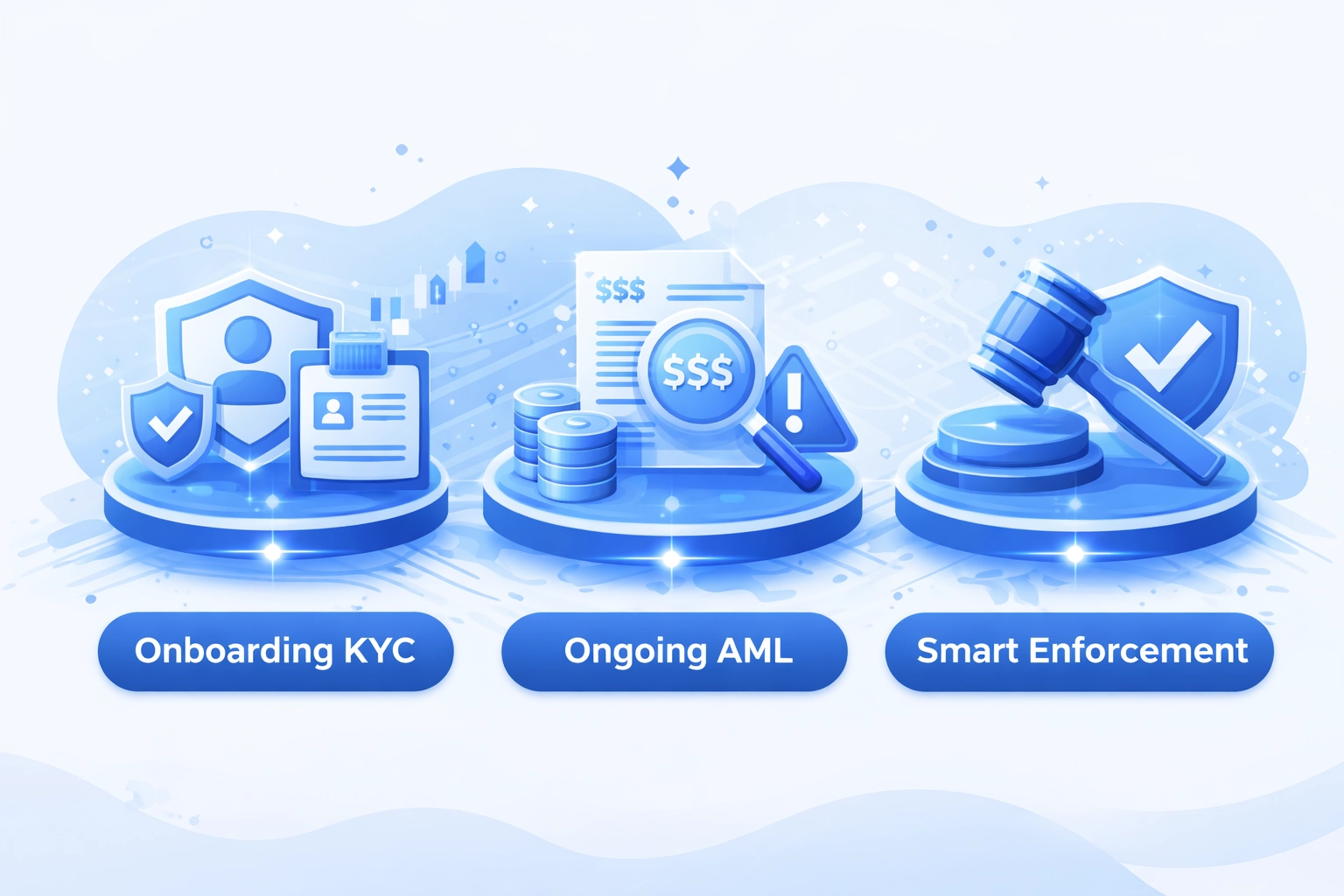 KYC and AML Enforcement Models for Tokenized Real Estate Platforms
Property token compliance demands robust identity verification and anti-money laundering controls at every stage of the investor lifecycle.
Onboarding KYC
- Identity document verification
- Proof of address validation
- Sanctions and PEP screening
- Accreditation status checks
Ongoing AML
- Transaction monitoring systems
- Suspicious activity reporting
- Periodic identity re-verification
- Wallet address risk scoring
Smart Enforcement
- On-chain whitelist management
- Automated transfer restrictions
- Jurisdiction-based blocking
- Real-time compliance oracles
Investor Accreditation Rules in Property Token Issuance Models
Accreditation requirements form a critical gate in property token compliance, particularly for offerings relying on private placement exemptions. In the USA, accredited investors must meet income thresholds of $200,000 individually (or $300,000 jointly) or demonstrate a net worth exceeding $1 million excluding primary residence. Regulation D 506(c) offerings require issuers to take reasonable steps to verify accreditation, going beyond simple self-certification.
The UK uses the categories of certified high net worth individuals and self-certified sophisticated investors under different financial thresholds. Canada applies the accredited investor exemption under NI 45-106, with specific income and asset requirements that vary by province. Dubai’s frameworks under VARA establish professional investor categories with qualification criteria tailored to the UAE market.
Automating accreditation verification through integrated Property Token Compliance technology reduces friction while maintaining regulatory standards. Third-party verification services connected to smart contract whitelists create seamless workflows that prevent unqualified investors from participating in restricted offerings, protecting both issuers and investors across global markets.
Custody, Escrow, and Asset Backing Requirements for Property Tokens
Property token compliance mandates that every issued token is backed by verifiable real-world assets held through regulated custody arrangements. Custody models for tokenized real estate typically involve qualified custodians who hold legal title to properties on behalf of token holders, with trust structures providing additional investor protection. In the USA, SEC rules require broker-dealers handling security tokens to maintain custody through qualified institutions.
Escrow mechanisms protect investor funds during the initial token offering phase. Smart contract-based escrow releases funds to property acquisition only after minimum funding thresholds are met, providing automatic refund mechanisms if offerings fail to reach their targets. This programmatic approach reduces counterparty risk and builds investor confidence across all markets.
Asset backing verification requires periodic proof-of-reserves audits that confirm the relationship between issued tokens and underlying property assets. Independent appraisals, title insurance verification, and on-chain attestation mechanisms create layers of assurance that regulators in Dubai, London, and Toronto expect from Property Token Compliance platforms.
Disclosure Standards and Transparency Obligations in Token Offerings
Transparency obligations in property token Property Token Compliance require issuers to provide comprehensive information about the underlying assets, risk factors, fee structures, and governance mechanisms. Private Placement Memorandums (PPMs) remain the standard disclosure document for Regulation D offerings in the USA, while the UK requires FCA-compliant offering documents that detail material risks and conflicts of interest.
On-chain transparency through blockchain provides an additional layer of disclosure that traditional real estate investments cannot match. Token holders can verify ownership records, distribution histories, and governance decisions through immutable on-chain data. This programmable transparency aligns with regulatory objectives while reducing the burden of manual reporting for issuers and platform operators.
Ongoing disclosure obligations extend beyond the initial offering. Property valuation updates, rental income reports, capital expenditure documentation, and material event notifications must reach token holders in a timely manner. Platforms serving investors across multiple countries must deliver disclosures that satisfy the most stringent requirements among all applicable jurisdictions.[1]
Taxation Implications of Property Token Transfers and Dividends
Tax treatment of property tokens varies significantly by jurisdiction and directly impacts investor returns and issuer reporting obligations. Property token Property Token Compliance requires clear understanding of capital gains treatment, dividend taxation, withholding requirements, and reporting standards across every target market. The complexity multiplies for cross-border transactions involving investors from different tax jurisdictions.
| Tax Element | USA | UK | UAE | Canada |
|---|---|---|---|---|
| Capital Gains | 15-20% (long-term) | 10-20% CGT | 0% (no CGT) | 50% inclusion rate |
| Dividend Tax | 0-20% qualified | 8.75-39.35% | 0% (no income tax) | Eligible dividend credit |
| Withholding | 30% FIRPTA | 20% non-resident | 0% | 25% non-resident |
| Reporting | Form 1099, K-1 | Self-assessment | VAT returns | T3/T5 slips |
Governance Structures for Compliant Tokenized Real Estate Projects
Effective governance structures ensure that tokenized real estate projects maintain compliance throughout their operational lifecycle. Property token compliance demands clear decision-making frameworks that define authority over property management, capital allocation, distributions, and regulatory responses. On-chain governance mechanisms enable transparent voting on material decisions while maintaining audit trails that regulators require.
The governance structure must balance token holder rights with practical management requirements. Most compliant projects establish a managing member or general partner with day-to-day authority, while reserving major decisions like property dispositions and refinancing for token holder votes. This hybrid approach satisfies fiduciary duty requirements across the USA, UK, and Canada.
Advisory boards and independent directors provide additional governance layers that regulators view favorably. These bodies offer oversight on conflicts of interest, related-party transactions, and valuation methodologies. Projects targeting institutional investors from Dubai, London, and New York consistently include independent governance committees as a trust-building measure.
Secondary Market Trading Rules for Property-Backed Tokens
Secondary market trading of property tokens requires compliance with trading venue regulations, transfer agent requirements, and hold period restrictions. In the USA, security tokens must trade on registered Alternative Trading Systems (ATS) operated by broker-dealers, with Regulation D tokens subject to a one-year hold period under Rule 144 before unrestricted resale. Property token compliance in secondary markets demands infrastructure that enforces these restrictions automatically.
| Market Requirement | USA | UK | UAE |
|---|---|---|---|
| Trading Venue | Registered ATS | FCA-authorized MTF | VARA-licensed exchange |
| Hold Period | 12 months (Rule 144) | Varies by exemption | As per VARA terms |
| Transfer Agent | SEC-registered required | CREST or equivalent | Licensed custodian |
| Investor Limits | Accredited only (506c) | Professional investors | Qualified investors |
Regulatory Reporting Obligations for Property Token Issuers
Property token compliance demands structured reporting workflows from pre-issuance through ongoing operations.
1. Pre-Offering Filing
Submit Form D (SEC), prospectus documentation (FCA), or VARA application before marketing the offering publicly.
2. Investor Verification Logs
Maintain detailed records of KYC verification, accreditation checks, and AML screening for all participants.
3. Transaction Monitoring Reports
Generate suspicious activity reports and file with relevant financial intelligence units as required by law.
4. Quarterly Financial Statements
Publish audited financial reports covering property performance, income, expenses, and net asset values.
5. Distribution Records
Document all dividend and income distributions with tax withholding calculations per jurisdiction served.
6. Annual Tax Filings
Issue investor tax documents (1099, K-1, T3/T5) and file entity-level returns in all operating jurisdictions.
7. Regulatory Audit Submissions
Respond to regulatory inquiries with organized documentation of compliance controls and transaction records.
8. Material Event Disclosures
Notify token holders and regulators of significant events affecting property value or operational status.
Legal Enforcement Mechanisms for Token Holder Rights
Token holder rights enforcement requires both on-chain mechanisms and off-chain legal remedies working together. Smart contracts can enforce dividend distribution schedules, voting rights, and transfer restrictions automatically. However, disputes involving property management decisions, valuation disagreements, or breach of fiduciary duty require traditional legal enforcement channels that vary by jurisdiction.
Operating agreements and subscription documents must clearly specify dispute resolution mechanisms, governing law, and jurisdiction for legal proceedings. Arbitration clauses are common in cross-border property token offerings, providing neutral forums for resolving disputes between parties from different countries. Projects targeting investors from the USA, UK, UAE, and Canada must consider the enforceability of dispute resolution clauses across all jurisdictions.
Regulatory enforcement provides an additional layer of investor protection. Securities regulators can investigate complaints, impose penalties on non-compliant issuers, and mandate corrective actions. Token holders benefit from understanding both their contractual rights under offering documents and their regulatory protections under applicable securities laws.
Adapting Token Models to Evolving Real Estate Regulations
Selecting the right compliance model requires evaluating the regulatory landscape, investor base, and operational complexity for long-term viability.
Assess Jurisdiction Mix
Map all target investor jurisdictions and identify overlapping regulatory requirements to create a unified compliance matrix.
Select Token Standard
Choose ERC-3643 for on-chain compliance enforcement or ERC-1400 for partitioned securities with flexible transfer controls.
Design Legal Wrapper
Structure the SPV, trust, or DAO framework with operating agreements that reference smart contract logic as binding terms.
Embed Compliance Logic
Program transfer restrictions, accreditation gates, and reporting triggers directly into the smart contract architecture.
Implement Monitoring
Deploy real-time regulatory monitoring dashboards tracking compliance status, investor eligibility, and reporting deadlines.
Build Upgrade Pathways
Design modular smart contract architecture enabling compliance rule updates without disrupting existing token holder positions.
Future Regulatory Trends Impacting Property Token Compliance
These emerging standards and regulatory shifts will define property token compliance requirements in 2026 and beyond.
Trend 1: The EU MiCA framework creates harmonized digital asset regulation that will influence global property token compliance standards and cross-border offerings.
Trend 2: The USA Clarity Act expected in 2026 will provide definitive guidance on how tokenized real estate securities are classified and regulated federally.
Trend 3: On-chain identity standards like ERC-3643 will become mandatory for all regulated property token offerings across major financial jurisdictions.
Trend 4: Interoperable compliance protocols will enable cross-border property token transfers with automated multi-jurisdictional verification and settlement.
Trend 5: RegTech automation tools will reduce compliance costs by up to 60% through AI-powered regulatory monitoring and reporting systems.
Trend 6: Central bank digital currencies will integrate with property token settlement systems, streamlining fiat-to-token conversion and distribution processes.
Trend 7: Institutional-grade custody standards will become legally required for all property token platforms managing assets exceeding $10M in value.
Trend 8: Zero-knowledge proof technology will enable privacy-compliant KYC verification without exposing personal investor data on public blockchains.
Property Token Compliance Governance Checklist
Legal Structure
- SPV formation documented
- Securities exemptions filed
- Operating agreements executed
Investor Protection
- KYC/AML procedures verified
- Accreditation confirmed
- Disclosure documents distributed
Technical Controls
- Smart contract audited
- Transfer restrictions active
- Geofencing controls enabled
Ongoing Operations
- Reporting schedules maintained
- Tax documents issued
- Regulatory monitoring active
Launch Your Compliant Property Token Offering with Confidence
Our team brings 8+ years of property token compliance expertise across the USA, UK, UAE, and Canada to build legally sound tokenized real estate projects.
Frequently Asked Questions
Q1.1. What is property token compliance in real estate tokenization?
Property token compliance refers to the legal and regulatory obligations that tokenized real estate issuers must satisfy when offering, distributing, and managing property-backed digital tokens. This includes securities registration or exemption filings, KYC and AML verification, investor accreditation checks, disclosure requirements, and ongoing reporting to regulators across jurisdictions like the USA, UK, UAE, and Canada. Non-compliance can result in enforcement actions, token freezes, and investor rescission rights.
Q2.2. Which regulations govern property tokens in the United States?
In the United States, property tokens are primarily governed by federal securities laws enforced by the SEC. Most tokenized real estate offerings rely on Regulation D (Rule 506b or 506c) for private placements or Regulation A+ for wider distribution. Issuers must file Form D within 15 days of the first sale, implement accredited investor verification, and comply with anti-fraud provisions. FINRA rules apply to broker-dealers facilitating token sales on registered platforms.
Q3.3. How do smart contracts enforce property token compliance automatically?
Smart contracts embed compliance rules directly into the token logic, automating enforcement without manual intervention. They maintain on-chain whitelists of verified investors, restrict transfers to approved wallets only, enforce hold period requirements under Rule 144, and block transactions from restricted jurisdictions through geofencing. ERC-3643 and ERC-1400 token standards provide modular compliance architectures specifically designed for regulated security tokens in real estate.
Q4.4. What are the KYC and AML requirements for tokenized real estate platforms?
Tokenized real estate platforms must implement robust Know Your Customer and Anti-Money Laundering procedures to satisfy financial regulations globally. This includes verifying investor identities, screening against sanctions lists and politically exposed persons databases, monitoring transactions for suspicious activity, and filing reports with financial intelligence units. Platforms serving the USA, UK, UAE, and Canada must satisfy jurisdiction-specific AML requirements while maintaining a unified compliance infrastructure.
Q5.5. How does cross-border compliance affect property token distribution?
Cross-border distribution of property tokens requires simultaneous compliance with securities regulations in every country where investors reside. This creates overlapping requirements for registration, disclosure, investor qualification, and transfer restrictions. Issuers must implement geofencing controls, jurisdiction-specific accreditation gates, and localized marketing restrictions within their smart contracts and platform interfaces to prevent non-compliant transactions across multiple regulatory regimes.
Explore Services
Related Services
Reviewed by

Aman Vaths
Founder of Nadcab Labs
Aman Vaths is the Founder & CTO of Nadcab Labs, a global digital engineering company delivering enterprise-grade solutions across AI, Web3, Blockchain, Big Data, Cloud, Cybersecurity, and Modern Application Development. With deep technical leadership and product innovation experience, Aman has positioned Nadcab Labs as one of the most advanced engineering companies driving the next era of intelligent, secure, and scalable software systems. Under his leadership, Nadcab Labs has built 2,000+ global projects across sectors including fintech, banking, healthcare, real estate, logistics, gaming, manufacturing, and next-generation DePIN networks. Aman’s strength lies in architecting high-performance systems, end-to-end platform engineering, and designing enterprise solutions that operate at global scale.