Ai Overview
They are built on specific architectural models that define how information flows, how decisions are made, and how tasks are executed. Architecture models for AI Copilot Platforms essentially answer three foundational questions: What triggers the system to act? AI Copilot Platforms are intelligent systems that assist professionals in executing complex workflows, and the architecture sitting beneath them determines how well they perform under real-world pressure.
Key Takeaways
Event driven AI Copilot Platforms respond to real-time data triggers and are ideal for reactive, high-frequency operational workflows across industries.
Agent based AI Copilot Platforms use autonomous reasoning agents that plan, prioritize, and execute multi-step tasks without constant human oversight.
Hybrid architecture merges both models, enabling AI Copilot Platforms to handle reactive triggers and autonomous reasoning within a single unified system.
Businesses in the US, UAE, and India must evaluate latency, compliance, scalability, and integration depth before selecting an AI copilot architecture model.
AI copilot workflow efficiency depends heavily on which architecture is chosen, as each model has distinct performance strengths under different load conditions.
Agent based systems in AI Copilot Platforms support memory, tool usage, and contextual decision-making, making them suitable for knowledge-intensive enterprise tasks.
AI copilot integration success relies on choosing an architecture that aligns with your existing data infrastructure and operational complexity.
The best AI architecture model for any organization depends on the nature of tasks being automated, the volume of data events, and the level of autonomous action required.
What Are AI Copilot Platforms Architecture Models?
AI Copilot Platforms are not monolithic systems. They are built on specific architectural models that define how information flows, how decisions are made, and how tasks are executed. Architecture models for AI Copilot Platforms essentially answer three foundational questions: What triggers the system to act? How does it reason through a task? And what does it do with the outcome?
Over the past eight years, our team has worked across enterprise automation projects in the US, UAE (Dubai), and India, and one question keeps surfacing at every boardroom table: which architecture model should power your artificial intelligence Copilot? The answer is not simple, and it should not be. AI Copilot Platforms are intelligent systems that assist professionals in executing complex workflows, and the architecture sitting beneath them determines how well they perform under real-world pressure.
In our eight years of building intelligent automation systems for enterprises across the US, UAE, and India, we have consistently seen that the wrong architecture choice leads to platforms that are either too rigid for complex tasks or too slow for real-time needs. Two architectural models dominate the AI copilot system design landscape today: event driven architecture and agent based architecture. Each has strengths, trade-offs, and ideal use cases.
Event Driven Architecture
Reacts to data events and triggers instantly. Built for speed and responsiveness in high-frequency environments.
Agent Based Architecture
Uses autonomous agents that plan, reason, and act. Built for complex, multi-step tasks requiring contextual intelligence.
Hybrid Architecture
Combines both models. Ideal for enterprise AI Copilot Platforms that need both reactivity and deep reasoning.
What is Event Driven Architecture in AI Copilot Platforms?
Event driven architecture in AI Copilot Platforms is a design model where the system listens for specific triggers, known as events, and responds to them in real time. An event can be anything from a form submission, an incoming API call, a database change, a user message, or a sensor reading. When the event occurs, the copilot fires a pre-configured or dynamically computed response.
This model is inherently reactive. The AI copilot system design does not sit idle deciding what to do. It waits for something to happen, and then it acts. This makes event driven AI Copilot Platforms extremely fast and resource-efficient for scenarios where the trigger conditions are well-defined and the response logic is predictable.
In practice, businesses across India and the US use event driven AI Copilot Platforms to power customer support automation, real-time fraud detection, order management triggers, and notification systems. The key advantage is that these systems scale horizontally, meaning they handle more events by adding more processing capacity, not by rethinking the architecture.
How Event Driven AI Copilot Systems Work?
Understanding the mechanics of event driven AI Copilot Platforms helps in evaluating whether this model fits your operational needs. The flow is linear, transparent, and fast. Here is how it operates in a real enterprise environment:
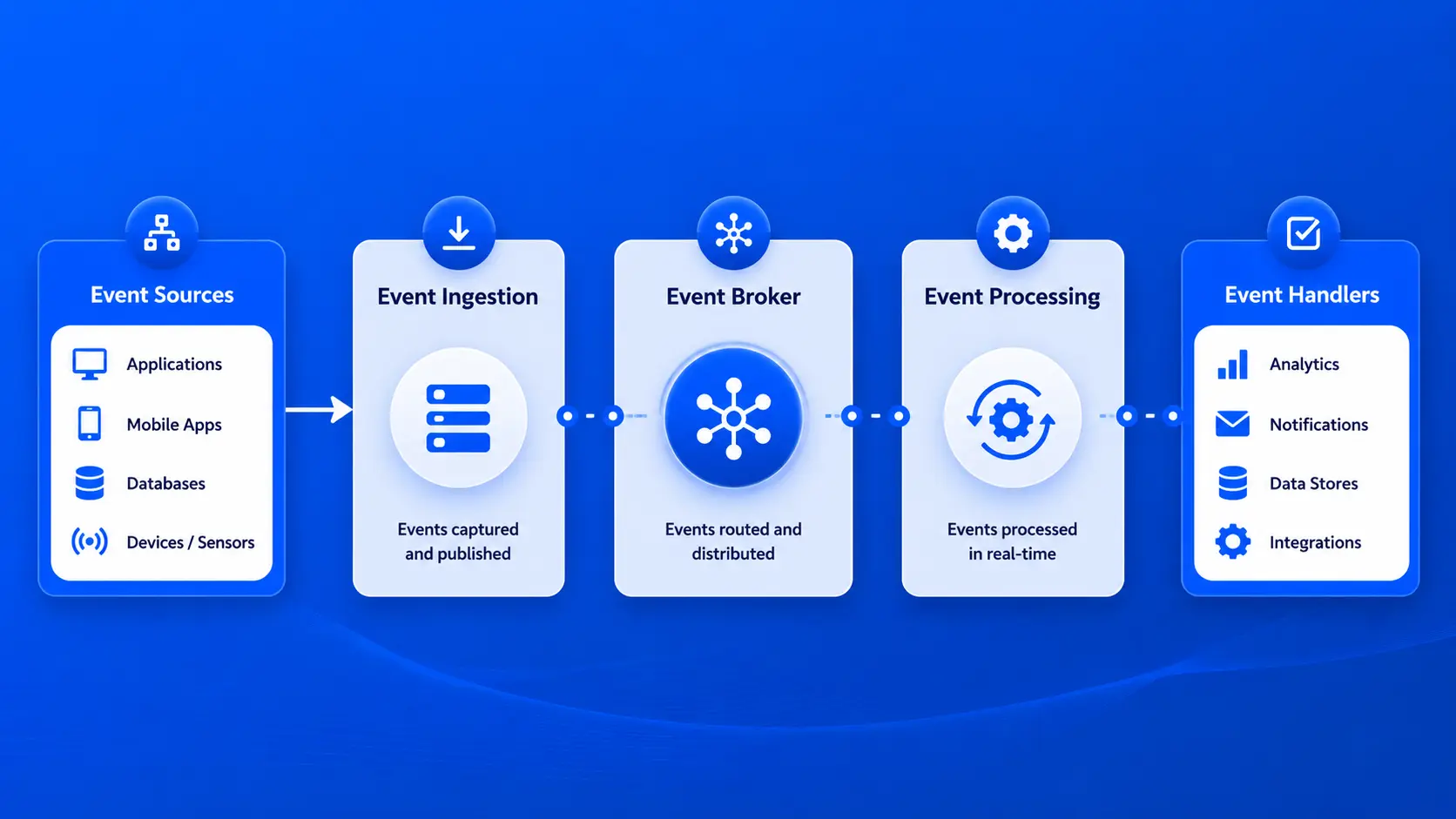
The event trigger initiates the entire chain. This could be a customer query, a system alert, a scheduled task, or a change in a database record. The event bus receives the trigger and routes it to the appropriate handler. The AI copilot processes the event using predefined logic or a trained model, then delivers the response back to the system or user. A feedback loop captures outcomes for continuous improvement.
Core Components of Event Driven Architecture?
Every effective event driven AI Copilot Platform is built on a consistent set of structural components. These components define how reliably and efficiently your copilot system handles live operational data.
Event Producers
Sources that generate events, including user interfaces, APIs, IoT sensors, CRM systems, and third-party webhooks integrated into your AI copilot workflow.
Event Bus / Broker
The central routing layer, often built on Kafka, RabbitMQ, or AWS EventBridge, that manages event distribution across the AI Copilot Platform components.
Event Consumers
Handlers that receive events and trigger the appropriate AI copilot automation logic, such as response generation, data processing, or external API calls.
Event Store
A persistent log of all events, enabling replay, auditing, and retrospective analysis that improves the overall AI copilot system design over time.
Schema Registry
Ensures all events follow consistent data formats, preventing integration errors across multiple microservices within the AI Copilot Platform.
Monitoring Layer
Tracks event throughput, handler latency, and failure rates to maintain performance reliability in live production AI copilot environments.
What is Agent Based Architecture in AI Copilot Platforms?
Agent based architecture in AI Copilot Platforms operates on a fundamentally different principle. Instead of waiting for a trigger and reacting to it, agent based systems deploy intelligent, autonomous entities called agents that perceive their environment, reason through a goal, and take a series of actions to complete it.
Each agent in an AI Copilot Platform has its own memory, reasoning capability, tool access, and task scope. Agents can collaborate with other agents, call external services, interpret feedback, and revise their approach mid-task. This level of autonomy makes agent based AI Copilot Platforms far more suited to knowledge-intensive, multi-step, and non-deterministic tasks.
For businesses in Dubai building intelligent contract review systems, or enterprises in India automating legal compliance workflows, agent based AI Copilot Platforms offer a level of cognitive depth that event driven systems simply cannot replicate. The best AI architecture model for complex reasoning is, in most cases, an agent based one.
How Agent Based AI Copilot Systems Work?
Agent based AI Copilot Platforms follow a more complex and iterative execution cycle. Rather than a simple trigger-to-response chain, agents engage in a perceive-plan-act-reflect loop that continues until the task goal is met or a stopping condition is reached.
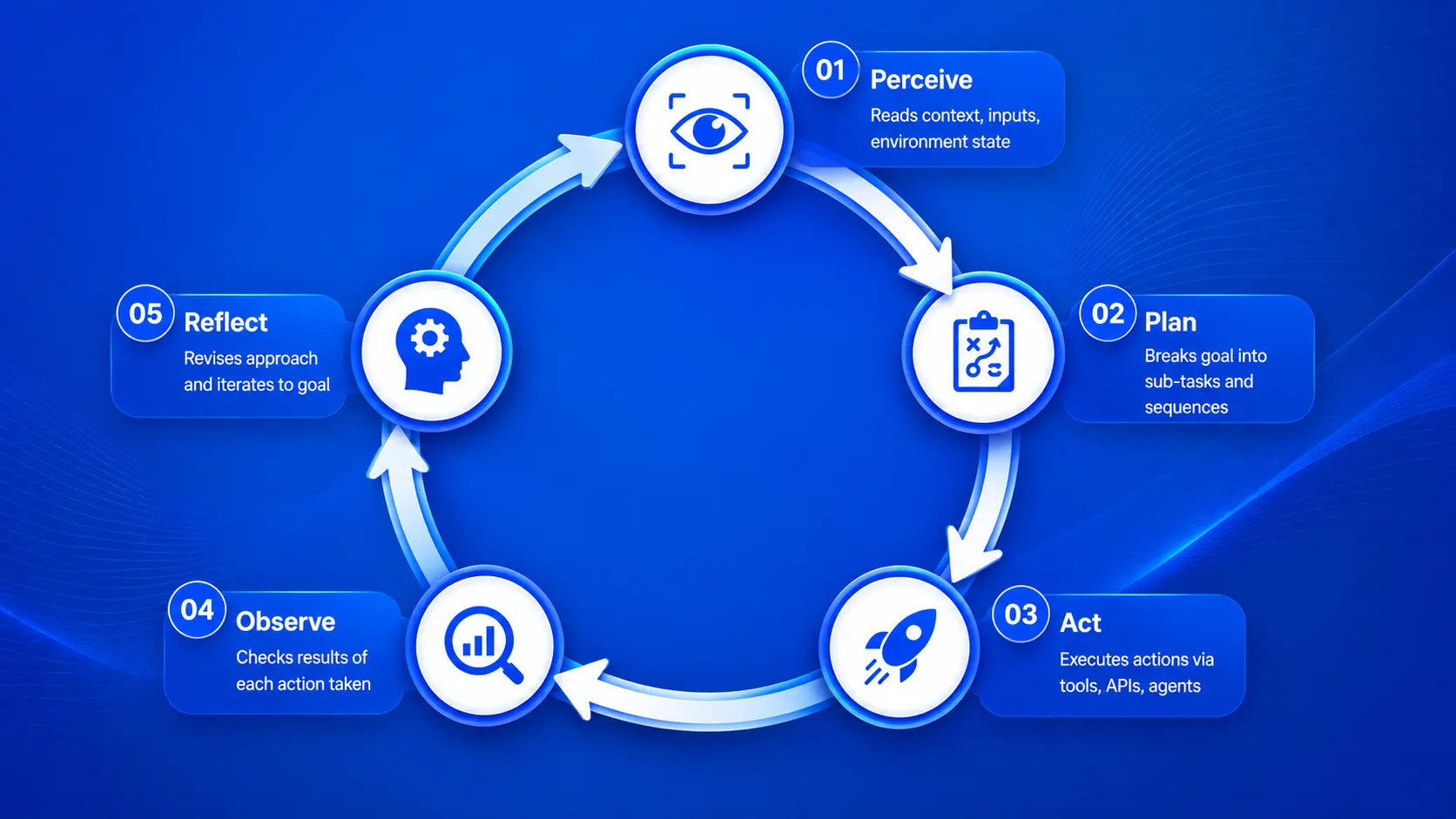
This loop continues dynamically until the agent completes the assigned goal or determines it cannot proceed without human input. The AI copilot automation layer is not a one-shot response but a persistent, intelligent collaborator. This is what makes agent based AI Copilot Platforms so valuable for enterprise knowledge work.
Core Components of Agent Based Architecture
The internal structure of agent based AI Copilot Platforms is more layered than event driven systems. Each component contributes to the agent’s ability to reason, remember, and act intelligently over time.
LLM Reasoning Core
The language model that powers the agent’s ability to understand goals, plan steps, and generate intelligent, context-aware responses within the AI Copilot Platform.
Memory Module
Short-term and long-term memory stores that allow agents to retain session context, past interactions, and learned preferences during the AI copilot workflow.
Tool Access Layer
Enables agents to call external APIs, search databases, execute scripts, and interact with enterprise systems as part of their AI copilot integration task flow.
Orchestrator
Coordinates multiple agents, manages task delegation, monitors progress, and handles exceptions when sub-agents fail or require human escalation during AI copilot automation.
Knowledge Base
A structured repository of domain-specific information that agents retrieve in real time to enhance reasoning quality and provide accurate, grounded outputs.
Feedback Evaluator
Assesses the quality of agent outputs, flags low-confidence responses, and routes tasks for human review or self-correction loops within the AI Copilot Platform.
Event Driven vs Agent Based Key Differences
Selecting between these architectures for AI Copilot Platforms requires a clear-eyed comparison across the dimensions that matter most to enterprise operations. The table below highlights where each model excels and where it falls short.
Event driven and agent based architectures represent two fundamentally different philosophies in AI design. Event driven systems respond to what happens. Agent based systems decide what to do next. Understanding this distinction is not a technical luxury. It is a strategic necessity for any business building or buying AI Copilot Platforms in 2025 and beyond. [1]
| Dimension | Event Driven Architecture | Agent Based Architecture |
|---|---|---|
Trigger Type |
External events and system signals | Goal-based user or system intent |
Response Time |
Milliseconds (sub-second latency) | Seconds to minutes (multi-step reasoning) |
Task Complexity |
Simple, pre-defined, predictable | Complex, adaptive, multi-step |
State Management |
Stateless or minimal state | Stateful with persistent memory |
Autonomy Level |
Low, rule or condition based | High, self-directed with goal reasoning |
Scalability |
Excellent, horizontal scaling | Good, scales with orchestration layer |
Best For |
Notifications, fraud detection, alerts | Research, planning, complex decisions |
Implementation Complexity |
Moderate | High |
Data Flow in Event Driven AI Copilot Platforms
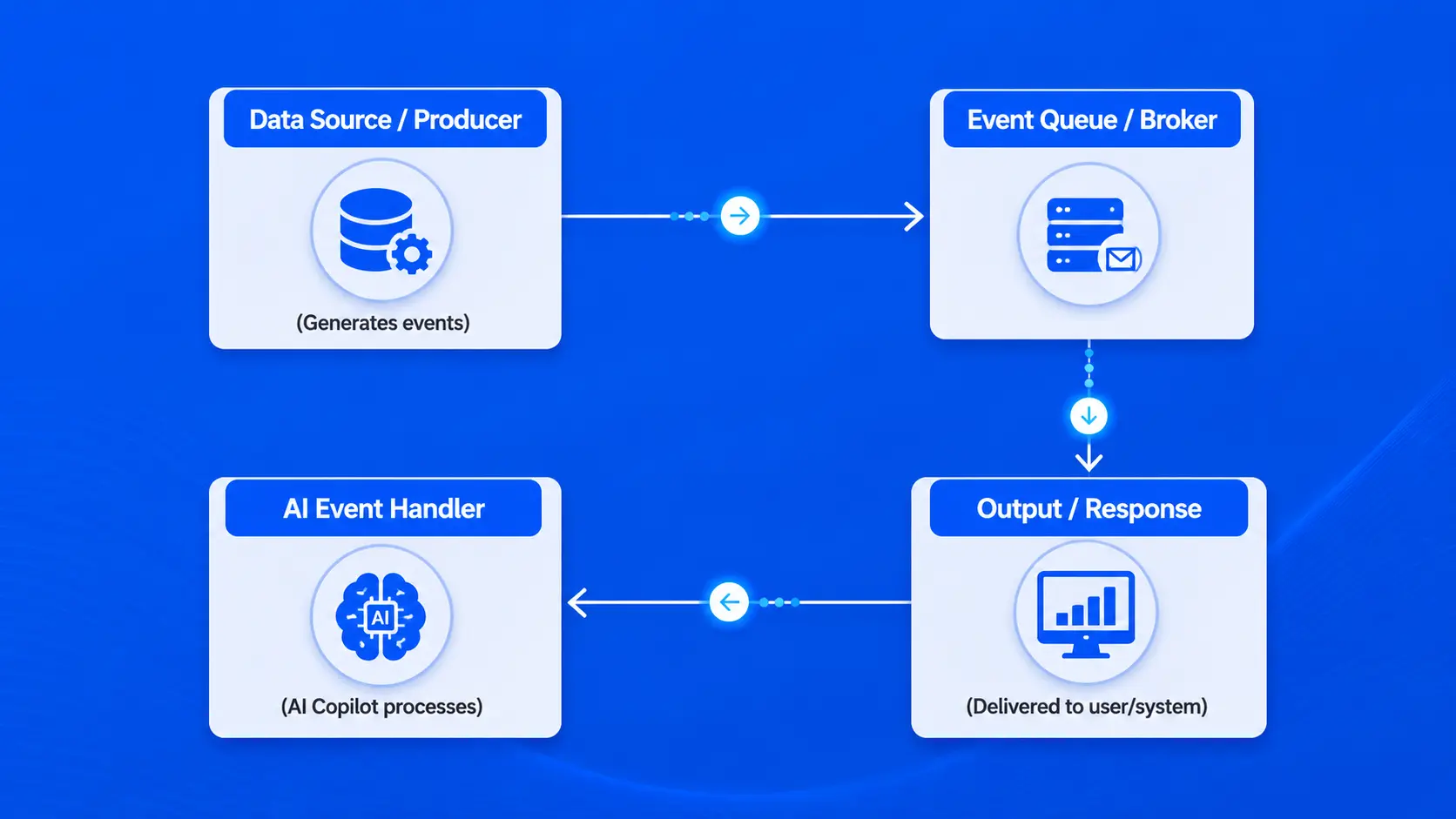
The way data moves through event driven AI Copilot Platforms is fundamentally asynchronous. This means that different parts of the system can process events at different speeds without blocking each other. When a new event enters the system, it is placed into a queue, consumed by the appropriate handler, processed by the AI copilot automation layer, and the result is dispatched to the required output channel.
This asynchronous data flow is a major strength for high-volume environments. An enterprise customer support AI Copilot Platform in India handling thousands of simultaneous queries benefits enormously from event driven data flow because each query is handled as an independent event without creating system-wide bottlenecks.
The data flow also enables event replay, which is the ability to reprocess historical events to test new AI copilot system design configurations. For compliance-heavy markets like the UAE, this provides a powerful auditing mechanism where every system action can be traced back to its originating event.
Performance and Scalability Differences
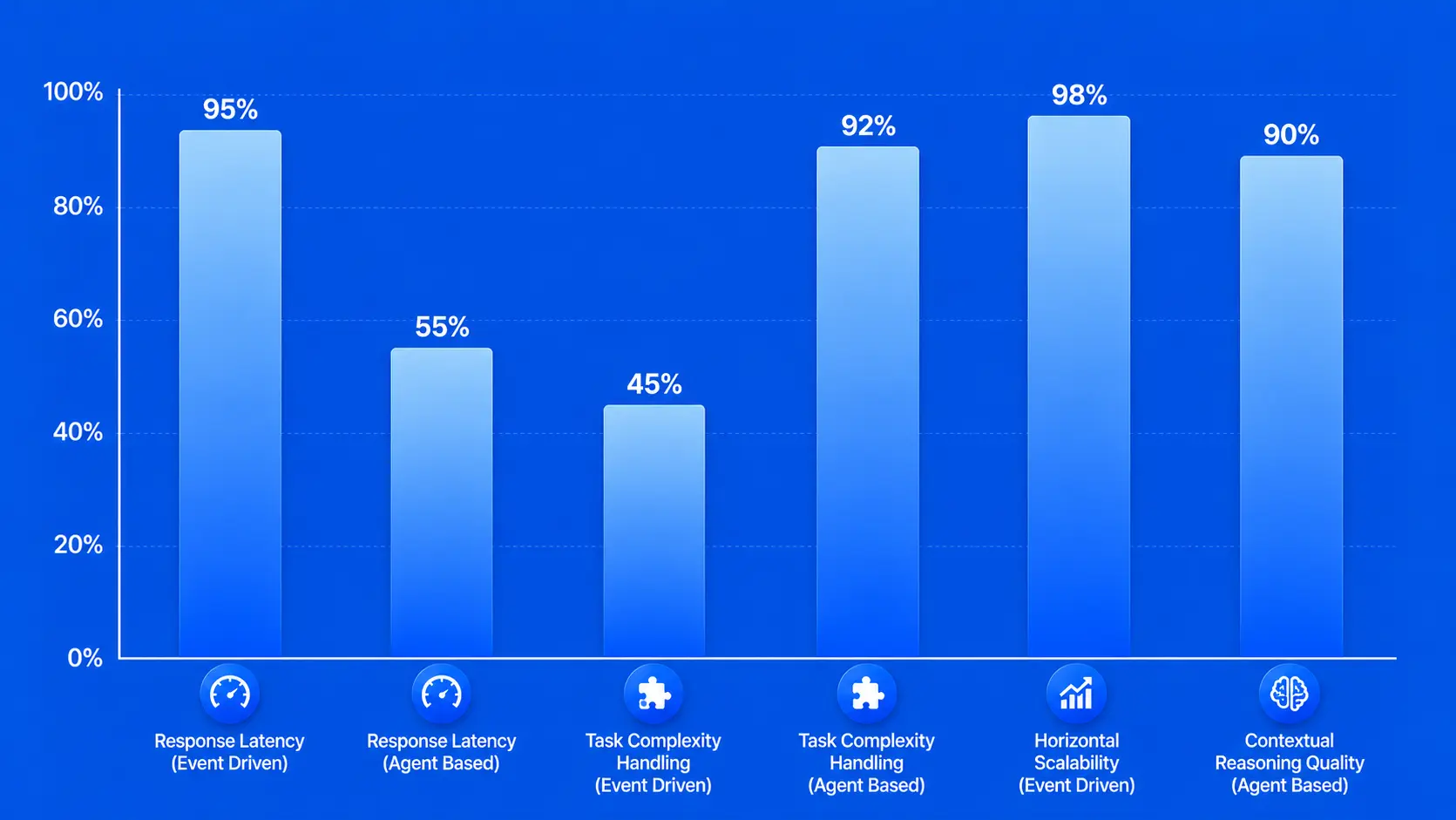
When evaluating AI Copilot Platforms for enterprise use, performance and scalability are among the most critical technical considerations. Each architecture handles load, concurrency, and growth differently.
Event driven AI Copilot Platforms excel at horizontal scalability. Because each event is processed independently and the system is stateless by default, adding more processing nodes directly increases throughput. This makes event driven systems well-suited for businesses in the US managing millions of daily automated interactions, such as financial transaction alerts or e-commerce order pipelines.
Agent based AI Copilot Platforms introduce more overhead per task due to multi-step reasoning, memory retrieval, and tool orchestration. However, they handle quality of output at a level that event driven systems cannot match. For a business in Dubai running an AI copilot for legal document review or strategic planning, the few extra seconds of processing time is a worthwhile trade for vastly superior cognitive output.
Hybrid Architecture in AI Copilot Platforms
The most capable AI Copilot Platforms being built today do not choose between event driven and agent based architecture. They combine both into a hybrid model that captures the speed of event driven systems and the intelligence of agent based ones.
In a hybrid AI copilot architecture, event driven triggers handle the real-time, high-frequency layer of operations. When a trigger requires more than a simple lookup or rule-based response, it escalates the task to an agent based reasoning layer. The agent then takes over, processes the full context, executes multi-step actions, and returns the result back into the event flow.
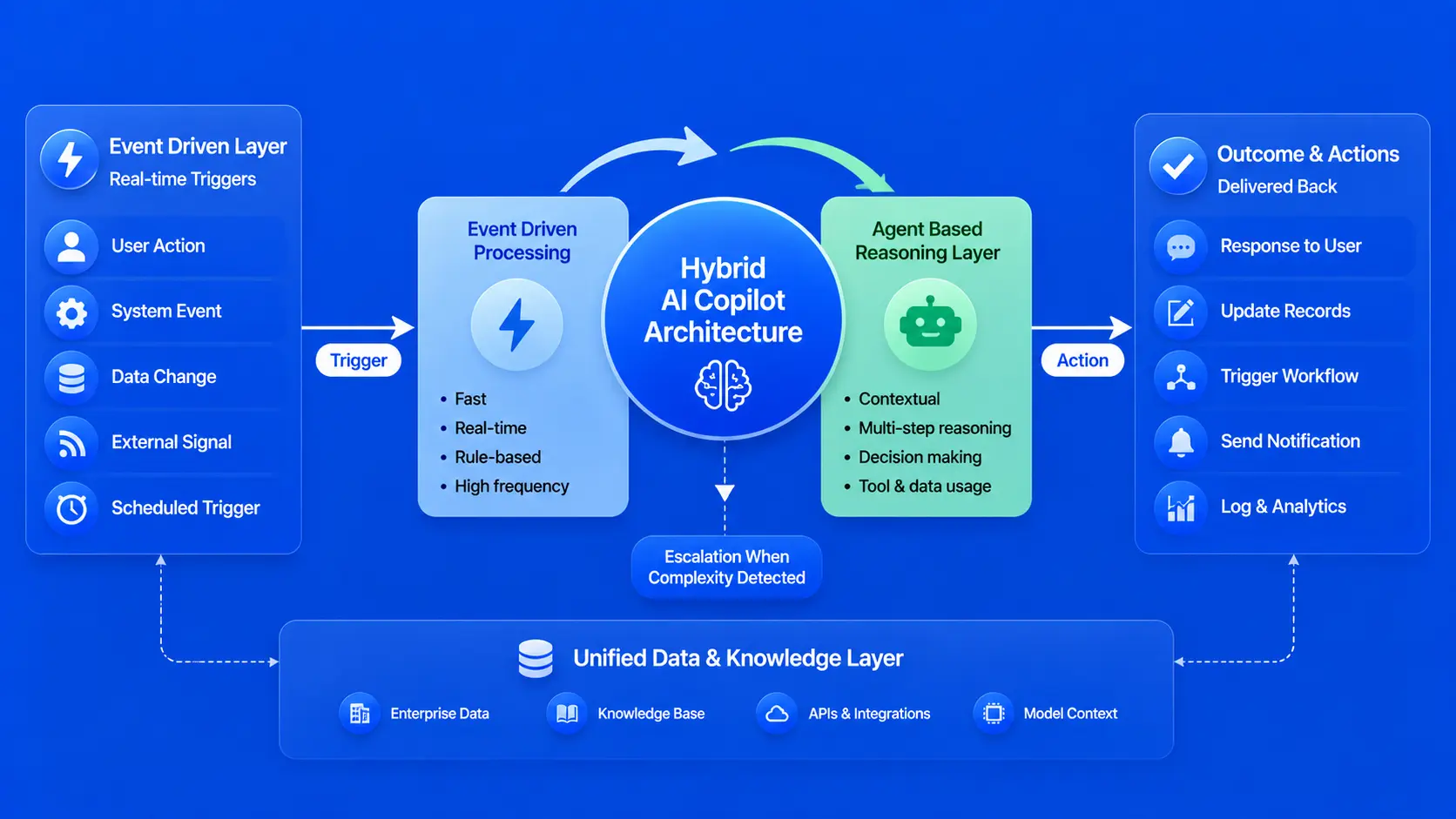
This is particularly powerful for enterprises in India that need fast customer-facing AI copilot automation while simultaneously running complex back-office reasoning tasks. The hybrid AI copilot architecture model allows both layers to operate in parallel without conflict.
Which Architecture Fits AI Copilot Platforms Best?
There is no universal answer to this question, but there is a structured way to arrive at the right one for your organization. In our eight years of working with AI Copilot Platforms across multiple verticals in the US, UAE, and India, we have developed a decision framework built around three core variables: task nature, operational volume, and cognitive depth required.
If your primary use case involves reacting to large volumes of real-time data, executing simple pre-defined logic, and delivering speed above everything else, event driven architecture is your best AI architecture model. This applies to customer notification systems, real-time fraud scoring, order processing triggers, and operational monitoring dashboards.
If your copilot needs to handle ambiguous requests, synthesize information from multiple sources, make judgment calls, execute sequences of actions, and remember what happened earlier in a session, agent based architecture is the appropriate choice. This applies to research assistants, legal review copilots, financial analysis platforms, and strategic planning tools.
If your enterprise requires both, which is true for most mature businesses today, the hybrid approach gives you the best of both worlds. The AI copilot integration layer routes tasks intelligently, ensuring speed where speed matters and intelligence where intelligence is non-negotiable.
Architecture Selection Guide for AI Copilot Platforms
| Business Scenario | Recommended Architecture | Reason |
|---|---|---|
| High-volume customer support alerts | Event Driven | Speed and horizontal scaling priority |
| Legal document analysis and review | Agent Based | Deep reasoning and multi-step execution |
| Real-time fraud detection | Event Driven | Sub-second response is critical |
| Strategic research and planning | Agent Based | Context retention and adaptive reasoning |
| Enterprise automation with mixed workloads | Hybrid | Combines speed and intelligence |
| Healthcare workflow and patient triage | Hybrid | Reactive alerts with deep clinical reasoning |
Building the Right Foundation for Your AI Copilot Platform
Choosing between event driven and agent based architecture for AI Copilot Platforms is not a decision to make lightly. It shapes how your copilot behaves, how it scales, how it integrates with existing systems, and ultimately how much value it delivers to your business over time.
Businesses in the US benefit from the horizontal scalability of event driven systems when managing massive data pipelines. Enterprises in Dubai rely on agent based intelligence for knowledge-intensive knowledge tasks in regulated sectors. Organizations across India increasingly turn to hybrid AI copilot architecture to serve both rapid consumer-facing automation and sophisticated back-office workflows simultaneously.
The best AI architecture model is the one that aligns with your actual operational challenges, not the one that is currently trending. As a team with deep hands-on experience building AI Copilot Platforms across all three of these architectural models, we have seen firsthand how the right foundation transforms a copilot from a basic automation tool into a genuine competitive advantage.
What the Right AI Copilot Architecture Delivers?
Faster Operations
Real-time event processing reduces operational latency and accelerates business decisions across the workflow.
Smarter Decisions
Agent based reasoning enables nuanced, context-aware decisions that simple rule systems cannot replicate.
Infinite Scalability
Proper AI Copilot Platforms architecture scales to handle growth without redesigning the core system.
Full Auditability
Event logs and agent traces provide complete visibility into every copilot action for compliance and review.
Team Productivity
AI copilot automation handles repetitive tasks, freeing human teams to focus on higher-value strategic work.
Enterprise Security
Architecture-level security controls protect sensitive data and ensure AI copilot integration meets regulatory standards.
Ready to Build Your AI Copilot Platform?
From architecture selection to full-scale AI copilot integration, our team delivers enterprise-grade solutions for US, UAE, and Indian markets.
Frequently Asked Questions
Q1.1. What are AI Copilot Platforms and why does their architecture matter for businesses?
AI Copilot Platforms are intelligent systems that assist humans in completing complex tasks using real-time reasoning and automation. Their architecture determines how fast, scalable, and reliable these systems perform across US, UAE, and Indian enterprise environments.
Q2.2. What is the difference between event driven and agent based architecture in AI Copilot Platforms?
Event driven architecture in AI Copilot Platforms reacts to data triggers in real time, while agent based architecture uses autonomous agents that plan, reason, and act independently. Choosing the right model directly impacts your copilot’s responsiveness and decision-making depth.
Q3.3. Which AI Copilot Platforms architecture is better for large-scale enterprise automation?
For large-scale enterprise automation in markets like the US and Dubai, agent based architecture in AI Copilot Platforms is often preferred because it supports multi-step reasoning, parallel task execution, and adaptive decision-making without constant human input.
Q4.4. How do AI Copilot Platforms use event driven architecture in real-time workflows?
AI Copilot Platforms using event driven architecture listen to incoming data streams and trigger automated responses instantly. This is ideal for real-time monitoring, alerts, and reactive workflows where immediate action on events is critical for business performance.
Q5.5. Can AI Copilot Platforms combine both event driven and agent based architectures?
Yes, many advanced AI Copilot Platforms use a hybrid approach that combines event driven triggers with agent based reasoning. This gives businesses the speed of reactive systems and the intelligence of autonomous agents working together seamlessly.
Q6.6. What industries benefit most from agent based AI Copilot Platforms?
Industries like finance, healthcare, legal, and logistics benefit significantly from agent based AI Copilot Platforms. These sectors require multi-step reasoning, contextual decisions, and autonomous execution, all of which agent based systems are specifically built to handle.
Q7.7. How do AI Copilot Platforms built on event driven architecture handle high-volume data?
AI Copilot Platforms with event driven architecture use message brokers, event queues, and asynchronous processing to manage high-volume data efficiently. This ensures systems remain responsive and stable even during traffic spikes common in Indian and US enterprise environments.
Q8.8. Are AI Copilot Platforms with agent based architecture secure enough for regulated industries?
Agent based AI Copilot Platforms can be made highly secure through sandboxing, access controls, and audit logging. For regulated industries in the UAE and India, these platforms must comply with local data protection frameworks to ensure safe autonomous operations.
Q9.9. How long does it take to implement an AI Copilot Platform with event driven or agent based architecture?
Implementation timelines vary by complexity. A basic event driven AI Copilot Platform can be set up in weeks, while full agent based AI Copilot Platforms with custom workflows and integrations typically take two to four months depending on the business scope and existing infrastructure.
Q10.10. What should businesses in India, UAE, and the US consider before choosing an AI Copilot Platform architecture?
Businesses should evaluate their workflow complexity, real-time data needs, compliance requirements, and budget. In markets like India and Dubai, scalability and integration with existing systems are key. The right AI Copilot Platforms architecture must align with long-term operational goals.
Explore Services
Related Services
Reviewed by

Wazid Khan
Director & Co-Founder
Wazid Khan is the Director & Co-Founder of Nadcab Labs, a forward-thinking digital engineering company specializing in Blockchain, Web3, AI, and enterprise software solutions. With a strong vision for innovation and scalable technology, Wazid has played a key role in building Nadcab Labs into a trusted global technology partner. His expertise lies in strategic planning, business development, and delivering client-centric solutions that drive real-world impact. Under his leadership, the company has successfully delivered numerous projects across industries such as fintech, healthcare, gaming, and logistics. Wazid is passionate about leveraging emerging technologies to create secure, efficient, and future-ready digital ecosystems for businesses worldwide.