Ai Overview
At its simplest, the data marketplace refers to a digital platform that facilitates the buying, selling, and sharing of data between multiple parties. This turns data from an idle asset into an active revenue stream, which is why the subscription revenue model alone accounted for over 52% of data marketplace platform revenue in 2024, according to Grand View Research.
Key Takeaways
- The global data marketplace platform market was valued at USD 1.49 billion in 2024 and is projected to grow to USD 5.73 billion by 2030, expanding at a compound annual growth rate of 25.2% from 2025 to 2030.
[1] - North America held over 35% of the global data marketplace platform market share in 2024, driven by widespread adoption of IoT solutions and deployment of advanced technologies like AI and machine learning.
[2] - The B2B data marketplace platforms segment dominated the overall industry with a revenue share of over 58% in 2024, while the subscription revenue model accounted for more than 52% of market revenue in the same year.
[3] - In 2024, 78% of enterprises prioritized real-time data infrastructure, with 65% increasing investments in privacy-compliant analytics, driven by regulatory pressures and AI adoption across finance, healthcare, and retail.
[4] - Financial services led the end-user segments with a revenue share of 18.5% in 2024, followed by healthcare, retail, and technology, with each vertical using data marketplaces to power decision-making and innovation.
[5] - The platform component dominated over the services segment with more than 62% revenue share in 2024, as organizations increasingly turned to cloud-based data marketplace platforms for self-service access to structured and unstructured datasets.
[6] - Major public data marketplaces such as Snowflake Marketplace, AWS Data Exchange, and Databricks Marketplace now host thousands of datasets across industries, including finance, healthcare, marketing, and artificial intelligence development.
[7] - In 2024, 68% of organizations delayed participation in data marketplaces due to concerns over GDPR and CCPA compliance, while average data breach costs reached USD 4.45 million, according to IBM, raising caution around data sharing.
[8] - Blockchain-powered data marketplaces use smart contracts to automate transactions between buyers and sellers, record every exchange on a tamper-proof ledger, and give data owners full control over who accesses their information and under what conditions.
[9] - Enterprise adoption of data marketplace platforms is projected to accelerate through 2030 and beyond, with the large enterprises segment holding nearly 57% of the market share in 2024, reinforcing the growing role of external data in AI model training and business intelligence.
[10]
Every day, the world generates an astronomical amount of data. Businesses capture customer behavior, hospitals log patient records, financial institutions process millions of transactions, and IoT devices collect readings from sensors spread across cities, farms, and factories. All of this data holds tremendous value, but only if the right people can access it, understand it, and put it to use.
That is where the concept of a data marketplace comes in. Think of it as a meeting point, a platform where data providers and data consumers come together to exchange information in a structured, governed, and often monetized way. Just like a farmers’ market connects local growers with hungry shoppers, a data marketplace platform connects those who have data with those who need it. Whether a startup is looking for consumer behavior insights to train an AI model or a pharmaceutical company needs anonymized patient data for clinical research, data marketplaces create the bridge.
This blog takes a deep look at the purpose of data marketplace platforms, what they actually are, how they function, who benefits from them, and where the entire industry is headed. We will also explore the types of data marketplaces that exist today, walk through real-world use cases across multiple industries, and examine the challenges that still need to be addressed.
What Is a Data Marketplace?
At its simplest, the data marketplace refers to a digital platform that facilitates the buying, selling, and sharing of data between multiple parties. A data marketplace acts as an intermediary that brings structure to data transactions. It gives data providers a channel to distribute their datasets to a wider audience, while data consumers get access to information that might otherwise be extremely difficult, expensive, or time-consuming to collect on their own.
So what is a data marketplace in practice? It is a platform, typically cloud-based, that hosts a catalog of datasets. These datasets can include anything from demographic information and financial reports to weather data, satellite imagery, social media analytics, and more. Buyers browse this catalog, evaluate what is available through previews or sample data, and then purchase or subscribe to the datasets they need.
A well-built data marketplace platform does much more than simply list datasets for sale. It includes tools for data governance, quality validation, access control, usage tracking, and often integrates directly with analytics or AI/ML pipelines. Think of platforms like Snowflake Marketplace, AWS Data Exchange, and Databricks Marketplace. Each of these hosts thousands of datasets from hundreds of providers, covering industries as diverse as finance, healthcare, retail, and artificial intelligence development.
One of the defining characteristics of modern data marketplaces is that they support multiple data sharing models. Some operate on a subscription basis, where buyers pay a recurring fee for ongoing access. Others work through one-time purchases, pay-per-use models, or even free tiers supported by governments and nonprofit research institutions. The flexibility in business models makes data marketplace platforms accessible to organizations of all sizes, from large enterprises looking for real-time market feeds to small startups hunting for training data for their first AI product.
Recommended Reading:
The Core Purpose of a Data Marketplace
Understanding the purpose of data marketplace platforms requires looking beyond the surface-level idea of just buying and selling data. These platforms exist to solve a collection of interconnected problems that organizations face when trying to work with data at scale.
1. Bridging the Gap Between Data Providers and Data Consumers
One of the primary purposes of a data marketplace is to connect the people who generate and collect data with those who need it. Before data marketplaces became widespread, acquiring external data typically involved direct negotiations, custom contracts, long procurement cycles, and significant legal overhead. A company that wanted consumer spending data, for example, would need to identify a provider, negotiate pricing, draft a data sharing agreement, and set up a technical pipeline to receive the data. This process could take weeks or months.
A data marketplace platform simplifies all of this by creating a centralized hub where both sides can find each other. Providers list their datasets with descriptions, pricing, and usage terms. Buyers search, compare, preview, and purchase, often with just a few clicks. The marketplace handles billing, access management, and sometimes even the technical delivery of data directly into the buyer’s cloud environment.
2. Enabling Data Monetization
Many organizations sit on vast stores of data that could be valuable to others but have no mechanism to distribute or monetize it. A transportation company, for instance, might collect detailed traffic flow data across hundreds of cities, data that would be gold for urban planners, logistics firms, or advertising companies. Without a data marketplace, that data stays locked inside the organization’s systems, generating no additional revenue.
Data marketplaces unlock this value by providing the infrastructure for data providers to package, price, and distribute their datasets. This turns data from an idle asset into an active revenue stream, which is why the subscription revenue model alone accounted for over 52% of data marketplace platform revenue in 2024, according to Grand View Research.
3. Powering AI and Machine Learning Development
Artificial intelligence models are only as good as the data they are trained on. Organizations developing AI products need massive, diverse, and high-quality datasets. Collecting all of this data internally is rarely feasible. A healthcare AI startup, for example, cannot wait years to build its own patient dataset before training a diagnostic model.
Data marketplace platforms fill this gap by offering curated, ready-to-use datasets specifically designed for AI and machine learning workflows. Platforms like Databricks Marketplace go beyond raw data to include notebooks, pre-built models, and solution accelerators. As of recent data, Databricks Marketplace features more than 1,200 listings from over 150 providers across industries, including financial services, healthcare, manufacturing, and media.
4. Reducing Data Acquisition Costs and Time
Building data pipelines, running surveys, deploying sensors, and hiring research firms are all expensive and slow ways to acquire data. A data marketplace dramatically reduces both cost and time. Instead of investing months and thousands of dollars in data collection, an organization can subscribe to a dataset on a marketplace and start working with it the same day.
According to Alation, organizations using data marketplace platforms have seen up to 90% faster implementation of new use cases by reusing existing data products, along with approximately 30% reduction in total cost of ownership by focusing on curated, valuable data products instead of managing millions of raw assets internally.
5. Supporting Regulatory Compliance and Data Governance
In a world where data privacy regulations like GDPR and CCPA are becoming more stringent, organizations cannot afford to treat data handling casually. A well-designed data marketplace platform bakes compliance directly into the transaction process. It tracks data lineage, enforces usage agreements, manages consent, and ensures that both providers and consumers adhere to applicable laws.
This governance layer is critical. In 2024, 68% of organizations delayed their participation in data marketplaces specifically because of concerns around GDPR and CCPA compliance. Meanwhile, the average cost of a data breach reached USD 4.45 million, according to IBM. These numbers show just how important the governance and compliance features of data marketplace platforms really are.
How a Data Marketplace Works
The mechanics of a data marketplace are straightforward in concept, even though the underlying technology can be quite complex. Here is how the process generally flows.
A data provider, which could be a company, a research institution, a government agency, or even an individual, packages their data into a dataset. This involves cleaning the data, adding metadata (descriptions, categories, usage terms), setting a price or licensing model, and uploading it to the marketplace. Some providers also add sample data so buyers can evaluate quality before committing.
On the other side, a data consumer logs into the data marketplace platform, searches for the type of data they need, filters results by category, industry, geography, format, or price, and reviews the available options. Once they find a suitable dataset, they purchase it, subscribe to it, or request access (depending on the marketplace model). The platform handles payment processing, access control, and data delivery.
In many modern platforms, data is not actually “moved” or “copied” to the buyer. Instead, the buyer gets live access to the data within the marketplace’s cloud environment. This approach, used by platforms like Snowflake Marketplace, eliminates the need for complex ETL (Extract, Transform, Load) processes and ensures that consumers always work with the most current version of the data. When the provider updates their dataset, the consumer automatically has access to the latest information without any additional steps.
Types of Data Marketplaces
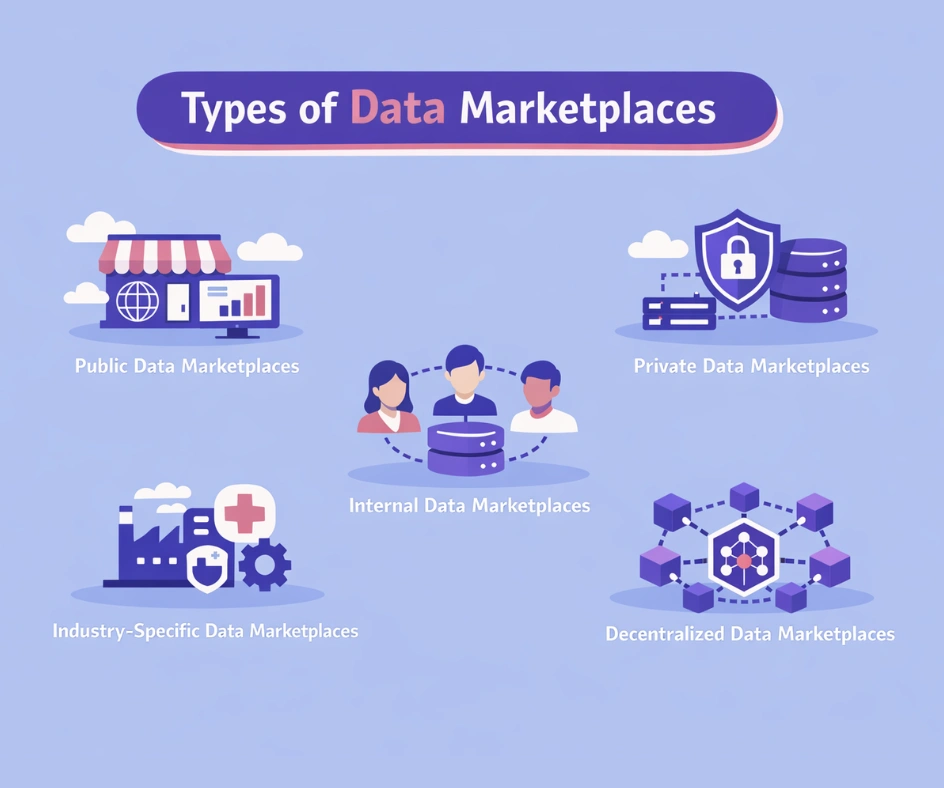
Not all data marketplaces are created equal. They can be categorized based on ownership models, the types of data they host, and the audiences they serve. Understanding these categories is important for choosing the right platform for a specific business need.
1. Public Data Marketplaces
These are open platforms accessible to any buyer and seller. They host a wide variety of datasets across multiple industries, from market research and business intelligence to demographic data and advertising analytics. Examples include AWS Data Exchange, Snowflake Marketplace, and Databricks Marketplace. Public data marketplaces are the most common type and often the first entry point for organizations exploring external data sourcing.
2. Private Data Marketplaces
These operate as closed ecosystems where only authorized participants can buy and sell data. They are commonly used by enterprises, government agencies, or industry-specific groups that need stricter control over data sharing and compliance. A consortium of banks, for example, might create a private data marketplace to share anonymized fraud detection data among members without exposing it to the public.
3. Internal Data Marketplaces
Large organizations with multiple departments, subsidiaries, or global offices often struggle with data silos, where one team has data that another team desperately needs but cannot easily access. An internal data marketplace platform solves this problem by creating a governed, self-service layer that allows different teams within the same organization to discover, request, and use each other’s data. This promotes collaboration, reduces duplication of effort, and breaks down organizational barriers.
4. Industry-Specific Data Marketplaces
Some marketplaces cater exclusively to a particular sector. TriNetX, for instance, focuses on healthcare, providing researchers with access to de-identified clinical data from healthcare organizations worldwide. Bloomberg Enterprise Access Point serves the financial services industry with curated financial and alternative datasets. These niche data marketplaces offer deeper, more specialized datasets than general-purpose platforms and often include industry-specific compliance and governance features.
5. Decentralized Data Marketplaces
Built on blockchain technology, decentralized data marketplaces allow data providers and consumers to transact directly without relying on a central authority. Smart contracts handle the terms of the exchange, and every transaction is recorded on a tamper-proof ledger. Platforms like Ocean Protocol are examples of this model, which is gaining traction as organizations look for ways to exchange data with greater transparency, privacy, and control.
Types of Data Marketplaces at a Glance
| Type of Data Marketplace | Who Uses It | Notable Examples |
|---|---|---|
| Public Data Marketplace | Any buyer or seller across industries | AWS Data Exchange, Snowflake Marketplace, Databricks Marketplace |
| Private Data Marketplace | Enterprises, government agencies, industry consortiums | Banking data exchanges, healthcare industry platforms |
| Internal Data Marketplace | Teams and departments within large organizations | Custom enterprise platforms built on tools like Alation or Collibra |
| Industry Specific Data Marketplace | Professionals in healthcare, finance, energy, or marketing | TriNetX (healthcare), Bloomberg Enterprise Access Point (finance), Veracity (energy) |
| Decentralized Data Marketplace | Privacy-focused organizations, blockchain ecosystem participants | Ocean Protocol, Nadcab Labs Web3 Data Marketplace |
The Data Marketplace Industry by the Numbers
The growth of the data marketplace industry is not a matter of speculation. Multiple market research firms have published detailed studies showing consistent and rapid expansion. Here are the numbers that tell the story.
According to Grand View Research, the global data marketplace platform market was valued at USD 1.49 billion in 2024 and is projected to reach USD 5.73 billion by 2030, growing at a compound annual growth rate (CAGR) of 25.2%. North America led the market with a share exceeding 35% in 2024, driven by widespread technology adoption and a strong digital infrastructure.
A separate report by SNS Insider valued the market at USD 1.81 billion in 2025 and projects it to reach USD 9.96 billion by 2033, with a CAGR of 23.87%. And yet another analysis from Precedence Research highlights that the BFSI (Banking, Financial Services, and Insurance) segment alone held 25% of the end-user market share in 2024, while the healthcare and life sciences segment is expected to grow at the highest CAGR through 2034.
The platform component (as opposed to services) dominated with over 62% revenue share in 2024. Large enterprises accounted for nearly 57% of the market. And the B2B data marketplace platforms segment held more than 58% revenue share, underscoring the fact that the majority of data marketplace activity is business-to-business.
These numbers paint a clear picture. The purpose of data marketplace platforms is being validated by organizations across the world that are actively investing in them. The question is no longer whether data marketplaces are needed, but rather how to build and use them most effectively.
Recommended Reading:
Leading Data Marketplace Platforms in the Market
Several major technology companies operate data marketplace platforms that serve as foundational tools for data commerce across industries. Each platform has its own strengths, target audience, and technical approach. Here is a closer look at the most prominent ones.
1. Snowflake Marketplace
Snowflake Marketplace is one of the most widely recognized names in the data marketplace space. It hosts over 1,700 datasets from more than 360 providers and is available globally across AWS, Google Cloud, and Microsoft Azure. What makes Snowflake stand out is its live data sharing model. Rather than copying data, consumers access the provider’s data directly within the Snowflake environment. When the provider updates their dataset, those changes are instantly available to the consumer. This eliminates the need for ETL pipelines and ensures that users always work with fresh information.
2. AWS Data Exchange
Amazon Web Services offers a data marketplace where users can subscribe to and integrate third-party datasets directly into their AWS environments. AWS Data Exchange supports file-based, API based, and Redshift-ready data delivery methods. It provides access to thousands of datasets from providers spanning finance, healthcare, AI, and more. For organizations already operating within the AWS cloud ecosystem, the platform offers deep integration with services like Amazon S3, Amazon Redshift, and Amazon SageMaker.
3. Databricks Marketplace
Built on the Databricks Lakehouse Platform, this data marketplace goes beyond traditional data sets. It enables discovery and access to live datasets, notebooks, applications, solution accelerators, and even AI models. As mentioned earlier, it features over 1,200 listings from 150+ providers. Databricks Marketplace uses Delta Sharing, an open protocol for cross-platform data sharing, which means consumers are not locked into the Databricks ecosystem and can access data across clouds, regions, and platforms.
4. Google Cloud Marketplace
Google Cloud Platform’s marketplace provides access to datasets that support big data analytics, AI development, and business intelligence applications. It also functions as a broader software marketplace where organizations can deploy third-party applications alongside data products. The integration with Google BigQuery and other GCP services makes it a natural choice for organizations already invested in Google’s cloud infrastructure.
5. Oracle Data Marketplace
Oracle operates a centralized data marketplace platform that acts as an intermediary, managing transactions and enforcing data quality standards. It provides additional services like analytics, compliance verification, and customer support, making it suitable for enterprise customers who need a managed experience.
Industry Use Cases for Data Marketplaces
The purpose of data marketplace platforms becomes most tangible when you look at how specific industries are using them. Data is not a one-size-fits-all resource. Different sectors have unique data needs, compliance requirements, and use cases. Here are some of the most active industries.
1. Financial Services
Finance was one of the earliest and most active adopters of data marketplaces. Banks, hedge funds, insurance companies, and fintech startups use marketplace data for fraud detection, credit scoring, risk analysis, algorithmic trading, and regulatory compliance. Bloomberg Enterprise Access Point, for instance, provides curated financial and alternative data to institutions that need fast, structured access to market intelligence. The financial services segment held an 18.5% revenue share in the data marketplace platform market in 2024, the largest among all end-user segments.
2. Healthcare and Life Sciences
Healthcare organizations use data marketplace platforms to access de-identified patient records, clinical trial data, genomic information, and medical imaging datasets. This data powers research into new treatments, supports personalized medicine, improves diagnostics, and enables population health management. Platforms like TriNetX specialize in providing researchers with real-world clinical data from healthcare organizations worldwide. The healthcare and life sciences segment is projected to grow at one of the highest CAGRs through 2034.
3. Retail and E-Commerce
Retailers rely on data to understand customer behavior, forecast demand, manage inventory, and optimize pricing. Data marketplaces provide access to consumer spending patterns, purchasing trends, social media sentiment, and competitive intelligence. This external data, when combined with a retailer’s own internal data, creates a much richer picture of the market landscape and enables faster, better-informed decisions.
4. Advertising and Marketing
The advertising industry has long been a heavy consumer of third-party data. Data marketplace platforms offer datasets on audience demographics, browsing behavior, content preferences, and cross-channel engagement. Platforms like LiveRamp specialize in identity resolution and cross-platform activation, helping advertisers target audiences with greater precision while maintaining privacy compliance.
5. Government and Public Sector
Government agencies both produce and consume data through marketplaces. Open data initiatives make government-collected information (census data, weather data, transportation data, environmental monitoring) available to the public through free or open data marketplaces. At the same time, government bodies purchase external data for smart city planning, crime pattern analysis, disaster response, and public health surveillance.
6. Manufacturing and Supply Chain
Manufacturers use data marketplace datasets related to supply chain logistics, raw material pricing, equipment performance, and market demand forecasting. IoT sensor data available through data marketplaces helps with predictive maintenance, reducing downtime, and optimizing production cycles. The growing adoption of Industry 4.0 principles is accelerating this trend.
Data Marketplace Platform Market Breakdown (2024)
| Market Segment | Revenue Share in 2024 | Key Details |
|---|---|---|
| Platform Component | Over 62% | Driven by cloud platform adoption and self-service data access tools |
| B2B Marketplace Type | Over 58% | Business-to-business data exchange remains the dominant marketplace type |
| Subscription Revenue Model | Over 52% | Recurring revenue model preferred by both providers and consumers |
| Large Enterprises | Nearly 57% | Large organizations lead marketplace adoption for AI, analytics, and strategic planning |
| Financial Services (End User) | 18.5% | Largest end user segment, using data for trading, risk, and compliance |
| North America (Region) | Over 35% | Led by U.S. tech infrastructure, AI investment, and enterprise data maturity |
| Structured Data Type | Approximately 45% | High usability and easy integration with enterprise systems make it dominant |
Sources: Grand View Research, SNS Insider, Precedence Research (2024 data)
Benefits of Data Marketplaces for Businesses
The purpose of data marketplace platforms can also be understood through the tangible benefits they deliver to both data providers and data consumers. Here are the most significant advantages.
1. Faster Access to Diverse Datasets
Instead of spending months collecting data through surveys, partnerships, or internal systems, organizations can browse a data marketplace and access the datasets they need in hours or even minutes. This speed is critical in competitive markets where being first with insights can translate to real business advantages.
2. New Revenue Streams for Data Providers
Companies that generate valuable data but have no way to sell it can turn idle assets into recurring revenue. A weather data company, a logistics firm with route optimization data, or a research institution with survey results can all package and monetize their data through a data marketplace platform.
3. Improved Decision Making
Access to external data enriches an organization’s own internal data, leading to more complete and accurate analyses. A retailer that combines its own sales data with external consumer sentiment data from a data marketplace can make pricing and inventory decisions with much higher confidence.
4. Enhanced AI Model Training
AI and machine learning models require diverse, representative datasets to perform well. Data marketplaces offer curated datasets specifically designed for AI training, covering everything from image recognition and natural language processing to financial forecasting and medical diagnostics. This makes it significantly easier for AI teams to find the data they need without building collection infrastructure from scratch.
5. Governance and Compliance Built In
Good data marketplace platforms include data governance features such as lineage tracking, usage monitoring, access controls, and compliance checks. This reduces the legal and regulatory risk associated with data sharing and makes it safer for organizations to participate in the data economy.
6. Global Market Access
A data provider in Germany can list datasets on a data marketplace and have them purchased by a company in Japan or the United States. Likewise, a startup in India can access financial datasets from a provider in London. This global reach opens up cross-border collaboration and makes the data economy truly international.
Recommended Reading:
How to Build an NFT Marketplace? Architecture, Tech Stack, and Workflow
Challenges Facing Data Marketplaces
Despite their clear benefits and strong growth trajectory, data marketplaces still face several challenges that need to be addressed for the industry to reach its full potential.
1. Data Quality and Standardization
Not all datasets are created equal. Data from different providers can vary wildly in structure, completeness, accuracy, and metadata quality. Inconsistent labeling, incomplete documentation, and non-uniform schemas make it difficult for buyers to compare and integrate purchased data with their existing systems. The absence of universal data standards remains one of the biggest barriers to broader data marketplace adoption.
2. Privacy and Regulatory Concerns
As mentioned earlier, 68% of organizations delayed their data marketplace participation due to concerns around GDPR and CCPA compliance in 2024. Data privacy is not just a legal issue; it is a trust issue. Companies worry about reputational damage, legal penalties, and the misuse of sensitive information. These concerns are particularly acute in sectors like healthcare and finance, where data regulations are most stringent.
3. Vendor Lock In
Many of the leading data marketplace platforms operate within their own cloud ecosystems. Snowflake Marketplace works best within Snowflake, AWS Data Exchange integrates most deeply with AWS services, and so on. This can create situations where organizations become dependent on a single vendor, making it difficult to switch platforms or use data across multiple cloud environments. Open protocols like Delta Sharing (used by Databricks) aim to address this, but vendor lock-in remains a concern.
4. Pricing Complexity
Pricing data is inherently difficult. Unlike physical goods, data does not “run out” when shared. The same dataset can be sold to thousands of buyers simultaneously, but its value may decrease as it becomes more widely available. Setting the right price, whether through subscriptions, one-time purchases, or usage-based models, is a constant balancing act for data providers. Many still struggle to determine the fair market value of their datasets.
5. Building Trust Between Parties
Buyers need assurance that the data they purchase is accurate, up to date, and compliant with regulations. Providers need confidence that buyers will use the data in ways that align with the agreed terms. This mutual trust takes time to build and requires robust governance mechanisms, transparent reviews, and clear enforcement of usage policies within the data marketplace.
The Role of Blockchain in Data Marketplaces
Blockchain technology is beginning to play a notable role in the evolution of data marketplaces, particularly for organizations that prioritize transparency, control, and decentralization. A blockchain-based data marketplace platform uses distributed ledger technology to record every transaction, smart contracts to automate data exchange agreements, and cryptographic techniques to protect data integrity and ownership.
In a decentralized data marketplace, data providers retain full control over who can access their data and under what conditions. There is no central authority that manages or governs the exchange. Instead, the rules are encoded into smart contracts that execute automatically when predetermined conditions are met. This removes the need for intermediaries, lowers transaction costs, and increases transparency because every exchange is recorded on an immutable ledger that anyone on the network can verify.
Web3 data marketplaces take this further by incorporating tokenized incentives, community governance, and decentralized storage solutions like IPFS. Providers can earn tokens for contributing high-quality data, and buyers can participate in governance decisions about the marketplace’s operation. This model appeals to organizations that are wary of centralized control and want a more democratic approach to data commerce.
Data Marketplace and Decentralized Exchange Implementations in the Real World
The following projects reflect how blockchain-based data exchange and marketplace architecture is already being applied across telecom, privacy-first e-commerce, and AI computing. Each implementation showcases the same distributed infrastructure principles discussed throughout this article, from smart contract-driven transactions and token governance to tamper-proof data records and community-driven participation.
🛒
XHYPE: Zero Data Privacy Marketplace
Built a decentralized marketplace that transforms traditional e-commerce by prioritizing user privacy and data protection. The platform uses blockchain technology and Zero Knowledge Proofs to enable anonymous, crypto-based transactions for global experiences. Users buy, sell, and transact without surrendering personal data, directly demonstrating how data marketplaces can prioritize privacy by design.
🤖
Athene Network: Decentralized AI Data Sharing Platform
Created a decentralized mining platform for AI development and deployment where researchers, developers, and users securely share AI models, data, and services. The platform uses Proof of Stake consensus and token holder governance, enabling community-driven AI infrastructure. Athene demonstrates how a data marketplace model can be applied to an AI asset exchange without centralized control.
Build Your Data Marketplace Platform Today:
We bring 8+ years of blockchain and platform development expertise to data marketplace solutions. Our specialized team handles everything from smart contract architecture and decentralized data exchange protocols to multi-cloud integration and governance frameworks, ensuring your platform is built for growth, privacy, and enterprise-grade performance. Whether you need a B2B data exchange or a Web3 data marketplace, we deliver solutions that work.
The Future of Data Marketplaces
The trajectory of the data marketplace industry points toward continued and accelerating growth. Several trends are shaping what comes next.
1. AI-Driven Data Discovery
Future data marketplace platforms will increasingly use AI to help buyers find the right datasets faster. Instead of manually searching through catalogs, users will describe what they need in natural language, and AI algorithms will recommend the most suitable datasets based on context, past usage patterns, and quality metrics.
2. Real-Time Data as a Premium Product
With the rise of IoT and 5G, the volume of real-time data is exploding. Industries like logistics, healthcare, smart cities, and energy are willing to pay a premium for live data feeds, such as real-time traffic patterns, sensor readings, or patient monitoring data, delivered through data marketplaces.
3. Cross-Industry Data Collaboration
One of the most promising opportunities is cross-industry data sharing. Imagine healthcare organizations sharing anonymized patient data with pharmaceutical companies and AI researchers, or financial institutions sharing fraud signals with retailers. Data marketplace platforms will serve as the trusted infrastructure layer that enables these collaborations while maintaining governance and compliance. In this evolving ecosystem, Walmart Scraper supports the collection of structured retail data that can be integrated into data marketplaces, enriching shared datasets while maintaining consistency and compliance standards.
4. Data Mesh Architecture Integration
The data mesh concept, where data is treated as a decentralized product owned by different teams, aligns naturally with the data marketplace model. In January 2024, Zeenea launched its Enterprise Data Marketplace, specifically designed to support data mesh architectures, enabling the discovery, publishing, and procurement of data products across decentralized teams.
5. Growing Emphasis on Data Sovereignty
As more countries introduce data localization laws, data marketplace platforms will need to support region-specific compliance. This means offering data storage and processing in specific geographic locations, adhering to local privacy laws, and providing transparency into where data is stored and who has access to it.
Final Thoughts
The purpose of a data marketplace extends far beyond creating a simple platform for buying and selling information. These platforms represent a fundamental shift in how organizations access, share, and create value from data. They bridge the gap between data providers and consumers, enable companies to monetize idle data assets, power AI and machine learning initiatives with diverse training datasets, reduce the cost and time associated with data acquisition, and enforce governance and compliance standards that protect all parties involved.
With the global data marketplace platform market valued at USD 1.49 billion in 2024 and projected to grow to USD 5.73 billion by 2030, the numbers confirm that this is not a passing trend. Industries from financial services and healthcare to retail, manufacturing, and government are actively investing in data marketplace platforms to gain competitive advantages and drive innovation.
The rise of blockchain-based decentralized data marketplaces adds another layer to this story, offering transparency, privacy, and community governance that centralized models cannot match. Whether an organization chooses a public marketplace like AWS Data Exchange, a specialized platform like TriNetX, or a decentralized solution built on Web3 principles, the underlying purpose remains the same: to make data more accessible, more valuable, and more responsibly managed for everyone involved.
As data continues to grow in volume, variety, and importance, the role of data marketplace platforms will only become more central to how businesses operate, compete, and innovate. Understanding what a data marketplace is, how it works, and why it matters is no longer optional knowledge. It is essential for any organization that wants to thrive in a data-driven world.
Frequently Asked Questions
Q1.What is a data marketplace in simple terms?
A data marketplace is a digital platform where data providers can list their datasets and data consumers can browse, evaluate, and purchase or subscribe to those datasets. Think of it as an online store for data. Providers set the terms and pricing, buyers search for what they need, and the platform handles the transaction, delivery, and governance. It simplifies the entire process of acquiring external data that would otherwise require lengthy negotiations and custom agreements.
Q2.How does a data marketplace platform make money?
Data marketplace platforms typically earn revenue through subscription fees charged to data consumers, commissions on each transaction between buyers and sellers, premium listing fees for data providers who want better visibility, and value-added services like analytics, compliance tools, and customer support. The subscription model was the dominant revenue approach in 2024, accounting for over 52% of market revenue according to Grand View Research.
Q3.What types of data can I find on a data marketplace?
Data marketplaces offer an extremely wide variety of datasets. Common categories include demographic and consumer behavior data, financial market and trading data, healthcare and clinical trial data, weather and environmental data, geospatial and location data, advertising and marketing analytics, IoT sensor data, social media sentiment data, and AI training datasets. Some marketplaces are general-purpose and cover multiple categories, while others specialize in a single industry like healthcare or finance.
Q4.What is the difference between a data marketplace and a data exchange?
While the terms are sometimes used interchangeably, there is a distinction. A data marketplace is typically a public or semi-public platform where multiple providers list datasets for multiple buyers, similar to an open market. A data exchange, on the other hand, is usually a private arrangement between a single provider and a small number of recipients, with stricter governance and compliance protocols. Some platforms like Snowflake and AWS combine both marketplace and exchange functionalities within the same ecosystem.
Q5.How do decentralized data marketplaces differ from traditional ones?
Decentralized data marketplaces use blockchain technology to remove the need for a central authority managing the platform. Transactions are handled by smart contracts that execute automatically when conditions are met. Every exchange is recorded on an immutable ledger, giving both parties full transparency. Data providers retain complete control over their data and can set specific conditions for access. This approach reduces costs by eliminating intermediaries and builds trust through transparency, though it is still a newer model compared to centralized platforms.
Q6.Is it safe to buy data from a data marketplace?
Safety depends on the platform you choose. Reputable data marketplace platforms include built-in governance features like data lineage tracking, usage monitoring, access controls, encryption, and compliance with regulations like GDPR and CCPA. They also verify data providers and enforce usage agreements. However, risks do exist, particularly around data quality, privacy compliance, and breach exposure. It is important to evaluate the governance and security features of any data marketplace platform before making purchases, and to ensure that datasets comply with the legal requirements of your industry and region.
Explore Services
Related Services
Reviewed by

Aman Vaths
Founder of Nadcab Labs
Aman Vaths is the Founder & CTO of Nadcab Labs, a global digital engineering company delivering enterprise-grade solutions across AI, Web3, Blockchain, Big Data, Cloud, Cybersecurity, and Modern Application Development. With deep technical leadership and product innovation experience, Aman has positioned Nadcab Labs as one of the most advanced engineering companies driving the next era of intelligent, secure, and scalable software systems. Under his leadership, Nadcab Labs has built 2,000+ global projects across sectors including fintech, banking, healthcare, real estate, logistics, gaming, manufacturing, and next-generation DePIN networks. Aman’s strength lies in architecting high-performance systems, end-to-end platform engineering, and designing enterprise solutions that operate at global scale.