Ai Overview
Before writing any code or designing the interface, the most important decision is choosing the marketplace model. This decision affects everything, including smart contracts, backend logic, platform fees, NFT custody, and how users interact with your NFT marketplace. For a deeper breakdown of architecture, security, cost, and compliance considerations, explore our NFT Marketplace Development. They ensure that creators are compensated, the platform earns revenue, and buyers can transact safely.
Key Takeaways
- Choosing the right marketplace model defines scalability, fees, and user experience.
- List & Buy with lazy minting offers the best balance of cost efficiency and performance.
- Smart contracts must manage ownership, transfers, payments, and royalties on-chain.
- Separating on-chain and off-chain data improves speed without losing trust.
- Indexing services are essential for fast search, filtering, and real-time updates.
- Decentralized storage with CDN caching ensures reliable NFT media delivery.
- Transparent fee and royalty distribution builds creator and buyer confidence.
- Strong contract security prevents fraud, exploits, and fund loss.
- A modern, scalable tech stack supports long-term marketplace growth.
- Smooth minting, listing, and buying flows drive user adoption.
NFTs have changed the way digital assets are created, owned, and traded. From digital art and music to gaming items and collectibles, NFT marketplaces have become the backbone of the NFT ecosystem. If you are planning to launch your own NFT platform, it is important to understand that building an NFT marketplace is not just about design—it requires the right technical structure, smart contracts, backend systems, and user flow.
In this blog, we will explain how to build an NFT marketplace in a clear and structured way. We will follow a real-world development approach used by professional NFT marketplace solution, so the information is practical and useful. This guide will help you understand how a modern NFT marketplace, or even a white label NFT marketplace is built from the ground up.
Decide the NFT Marketplace Model First
Before writing any code or designing the interface, the most important decision is choosing the marketplace model. This decision affects everything, including smart contracts, backend logic, platform fees, NFT custody, and how users interact with your NFT marketplace.[1]
There are three main marketplace models used today. Each model works differently and is suitable for different business goals.
A. “List & Buy” NFT Marketplace (Most Common Model)
The “List & Buy” model is the most widely used structure in modern NFT marketplaces. In this model, NFTs always stay inside the user’s wallet. The marketplace does not take custody of the NFT during listing, which makes the platform more decentralized and user-friendly.
When a user lists an NFT, they either sign a message off-chain or create an on-chain listing. This listing simply gives permission to sell the NFT under certain conditions. The actual transfer of the NFT happens only when a buyer completes the purchase.
How this model works:
- NFT remains in the seller’s wallet
- Listing is created using a signed order or on-chain transaction
- Buyer purchase triggers NFT transfer and payment payout
- Lower gas cost and better scalability
This model is used by most large NFT platforms because it is cost-efficient and secure. It is ideal for building a scalable NFT marketplace solution with high user activity.
B. Escrow-Based NFT Marketplace
In an escrow marketplace, the NFT is transferred to a marketplace-controlled smart contract at the time of listing. This means the marketplace temporarily holds the NFT until it is sold or the listing is cancelled.
This model provides stronger guarantees that the NFT is available for sale, but it requires users to trust the marketplace contract with custody of their assets.
Key characteristics of escrow marketplaces:
- NFT is locked in escrow during listing
- Buyer purchase releases NFT from escrow to buyer
- Seller receives payment automatically
- Higher trust requirements for the platform
Escrow models are often used in private or curated NFT platforms where control and certainty are more important than decentralization.
C. Lazy Mint NFT Marketplace
Lazy minting is a popular feature in modern NFT marketplaces, especially for creators. In this model, the NFT is not minted at the time of listing. Instead, the NFT is minted only when a buyer purchases it.
This approach reduces upfront costs for creators and makes it easier to create mintable NFT collections without paying gas fees in advance.
How lazy minting works:
- Creator lists NFT metadata without minting
- Buyer purchase triggers mint + transfer in one transaction
- Gas cost is paid at the time of purchase
- Ideal for NFT art marketplaces and creator platforms
Many platforms combine the List & Buy model with optional lazy minting because it offers the best balance between scalability, cost savings, and user experience.
Which Model Should You Choose?
Most modern NFT marketplaces use:
- List & Buy model as the base
- Lazy minting as an optional feature
This combination works best for public NFT platforms, NFT marketplace lists, and large-scale NFT art marketplaces, as it supports high traffic and keeps transaction costs low.[2]
High-Level Architecture of an NFT Marketplace
To understand how to build an NFT marketplace, it is important to know that a marketplace is not just one system. It is a combination of smart contracts, backend services, and a frontend interface. Each part has a specific role, and all parts must work together smoothly to create a reliable NFT platform.
For a deeper breakdown of architecture, security, cost, and compliance considerations, explore our NFT Marketplace Development
A well-designed NFT marketplace solution is usually divided into three main layers:
- On-chain components
- Off-chain backend infrastructure
- Frontend application
Let us understand each layer clearly.
On-Chain Components (Smart Contracts)
Smart contracts are the core of any NFT marketplace. They live on the blockchain and handle ownership, transfers, payments, and rules. Anything related to trust and asset movement must happen on-chain.
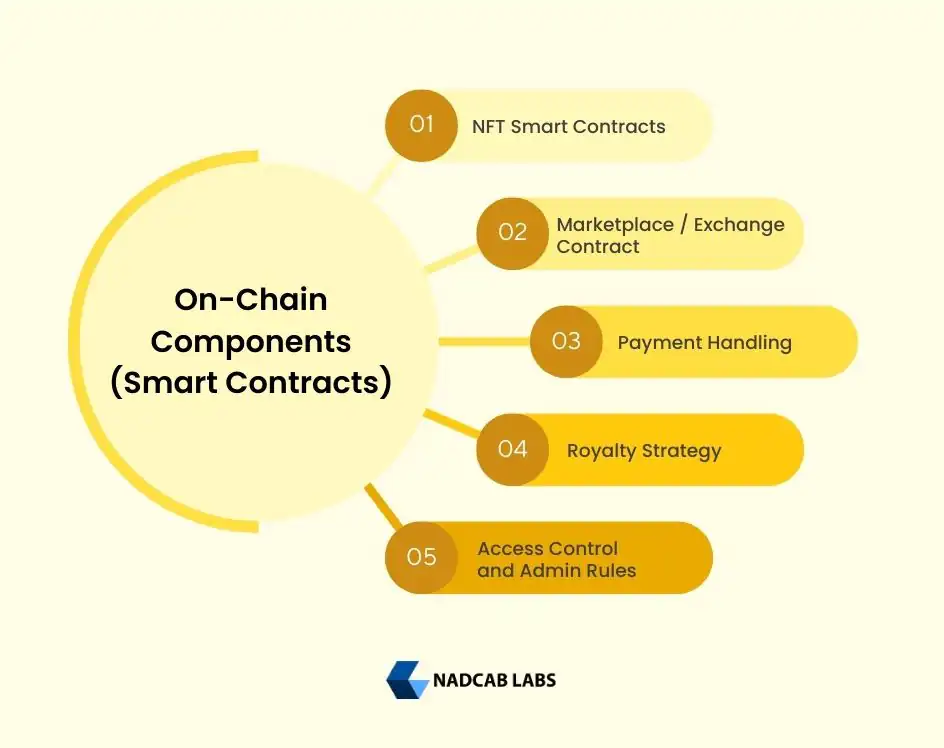
1. NFT Smart Contracts
NFT contracts define how NFTs are created, owned, and transferred. These contracts follow standard formats so that wallets and marketplaces can recognize them easily.
NFT contracts are responsible for storing the token ID, owner address, and metadata reference (token URI).
Key responsibilities of NFT contracts:
- Use ERC-721 or ERC-1155 standards (or equivalent on other chains)
- Store metadata URI (IPFS, Arweave, or HTTP)
- Handle minting and transfers
- Support single or multiple copies of NFTs
These contracts enable mintable NFT creation and are the foundation of any NFT art marketplace.
2. Marketplace / Exchange Contract
The marketplace contract controls how NFTs are bought and sold. It does not create NFTs but manages transactions between buyers and sellers. This contract ensures that every sale is secure, verified, and executed correctly in one atomic transaction.
Main functions of the marketplace contract:
- Validate listings and user signatures
- Execute NFT purchases safely
- Handle payment distribution
- Route platform fees and royalties
This contract is the heart of how to build an NFT marketplace that users can trust.
3. Payment Handling
An NFT marketplace must support payments in different formats. Most platforms allow payments using the blockchain’s native coin or popular tokens.
Payment handling logic ensures correct transfers without errors or manipulation.
Payment-related features include:
- Native coin payments (ETH, MATIC, SOL, etc.)
- ERC-20 or SPL token support
- Optional wrapped native tokens
- Automatic fund distribution
This flexibility is important for modern NFT marketplace solutions.
4. Royalty Strategy
Royalties allow creators to earn from secondary sales. This is a critical feature for artists and creators using an NFT platform. Royalties can be enforced directly in the marketplace contract or read from NFT contracts using standard methods.
Royalty handling options:
- EIP-2981 royalty support
- Custom royalty registry (optional)
- Creator payout routing during sales
If royalties are supported, they must be transparent and correctly implemented.
5. Access Control and Admin Rules
Every NFT marketplace needs administrative controls to manage platform-level settings. These controls are usually protected by role-based access.
Admin features include:
- Platform fee updates
- Fee recipient configuration
- Pause and unpause marketplace
- Emergency controls
These features help maintain long-term stability in a white label NFT marketplace or custom NFT platform.
Off-Chain Components (Backend & Infrastructure)
Off-chain systems do not control ownership, but they make the marketplace usable. Without these systems, the NFT marketplace would feel slow, incomplete, and difficult to navigate.
1. Indexing Service
Blockchains are not designed for search or filtering. An indexing service listens to blockchain events and converts them into structured data.
This service builds a database view of the marketplace while respecting the blockchain as the source of truth.
Indexer responsibilities:
- Track mint, transfer, sale, and listing events
- Store token ownership history
- Update marketplace activity in real time
Indexing is essential for building a fast and reliable NFT marketplace list experience
2. Metadata Pipeline
NFT metadata is usually stored off-chain. The marketplace must fetch, process, and cache this metadata efficiently.
This system ensures NFTs display correctly with images, traits, and animations.
Metadata pipeline tasks:
- Fetch tokenURI from NFT contract
- Resolve IPFS, Arweave, or HTTP links
- Cache images and previews
- Extract traits and attributes
This improves performance for users browsing an NFT art marketplace.
3. API Layer
The API connects the frontend with the backend systems. It allows users to search, filter, and explore NFTs easily.
Common API features:
- Search and filter NFTs
- Collection and user data
- Sales history and rankings
- Marketplace analytics
A strong API layer is critical when learning how to build an NFT marketplace that scales.
4. Orderbook Service (For Off-Chain Listings)
If your marketplace uses signed listings, an orderbook service is required. This service stores and manages off-chain orders.
Orderbook functions include:
- Store signed listings and offers
- Track expiry and cancellation
- Validate order status
This approach reduces gas costs and improves performance.
5. User Authentication and Notifications
NFT platforms usually use wallet-based login instead of usernames and passwords.
Supporting services include:
- Wallet-based authentication
- Activity notifications
- Sale and listing alerts
- Optional anti-fraud checks
These features improve trust and usability in an NFT marketplace.
Frontend Layer (Web or App Interface)
The frontend is what users see and interact with. It should be simple, fast, and easy to understand, especially for first-time users.
Frontend Features Include:
- Wallet connection
- NFT minting and listing flow
- Buying and selling interface
- Search and browsing tools
- Transaction status tracking
A clean frontend turns complex blockchain logic into a smooth NFT marketplace experience.
NFT Marketplace Data Architecture (On-Chain vs Off-Chain)
When learning how to build an NFT marketplace, one of the most important decisions is data architecture. Not all data should live on the blockchain. Some information must stay on-chain for trust and security, while other data is better handled off-chain for speed and usability.
A successful NFT marketplace solution follows one clear rule:
Blockchain is the source of truth, and the database is only a readable view.
This balance makes the NFT platform reliable, fast, and scalable.
Why Data Separation Matters
Blockchains are secure but slow and expensive for storing large amounts of data. Searching, filtering, and sorting directly on-chain is not practical. That’s why marketplaces use databases to organize and display blockchain data efficiently.
This approach improves user experience while keeping ownership and transactions fully decentralized.
What Data Should Stay On-Chain
On-chain data is permanent and verifiable by anyone. This data defines ownership and financial transactions, so it must be stored on the blockchain.
Ownership of NFTs is always recorded on-chain. This ensures that no one can fake or manipulate who owns a token. Transfers between wallets are also recorded as blockchain events, making the history transparent.
Sales execution must also happen on-chain. When an NFT is sold, the blockchain handles the transfer of the NFT, the seller payment, platform fee, and royalty distribution in one transaction. This guarantees fairness for all parties.
On-chain data typically includes:
- NFT ownership and transfers
- Minting events
- Sale execution and settlement
- Platform fee collection
- Royalties (if enforced by contracts)
Storing this data on-chain makes the NFT marketplace reliable and trustless.
What Data Should Be Stored Off-Chain
Off-chain data focuses on usability and performance. This data helps users explore NFTs easily but does not affect ownership or security.
Searching NFTs directly on the blockchain is not practical. That is why off-chain databases are used to store searchable and sortable data. This makes browsing an NFT marketplace list fast and smooth.
Metadata like images, traits, and descriptions is also handled off-chain. The blockchain only stores a reference (URI), while the actual content is fetched and cached separately.
Off-chain data usually includes:
- NFT metadata and media URLs
- Traits and attributes for filtering
- Collection statistics (floor price, volume)
- Rankings and trending NFTs
- User profiles (optional)
- Signed listings and offers
This setup allows an NFT marketplace solution to scale without sacrificing performance.
How the Indexer Connects On-Chain and Off-Chain Data
An indexer acts as a bridge between the blockchain and the database. It listens to blockchain events and updates the off-chain database in real time. Whenever an NFT is minted, transferred, listed, or sold, the indexer captures the event and stores it in a structured format. This allows users to instantly see changes on the marketplace UI.
Without a proper indexing system, even the best NFT art marketplace will feel slow and broken.
Core NFT Marketplace User Flows
Understanding the main flows in an NFT marketplace is essential to make it user-friendly and reliable. These flows define how users interact with your platform—from creating NFTs to buying and canceling listings. A well-designed flow ensures smooth operations and builds trust among users.
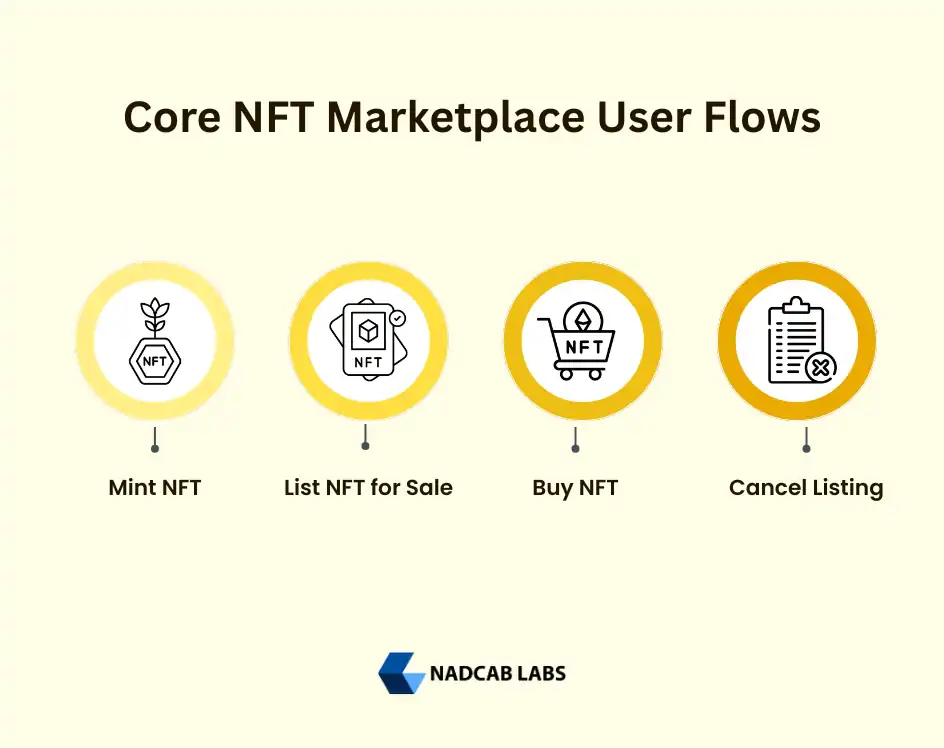
Flow A: Mint NFT
Minting is the process of creating a new NFT. It converts digital content into a blockchain asset that can be owned, sold, or transferred.
Steps involved in minting:
- User uploads media files (images, videos, or audio)
- Metadata JSON is created and stored on IPFS, Arweave, or another storage solution
- Frontend calls the NFT contract to mint the token
- Blockchain emits a Transfer event (0x0 → user)
- Indexer captures the event and fetches metadata
- Metadata is processed and cached for UI display
Once this is done, the NFT appears in the marketplace and can be listed or shared.
Minting can be done immediately or via lazy minting, where minting occurs only after a buyer purchases the NFT.
Flow B: List NFT for Sale
After minting, the NFT must be listed to be sold. There are two common listing methods:
- Off-Chain Signed Listing (Recommended)
- Frontend creates an “order” object containing token info, price, expiry, and a nonce
- User signs the order using their wallet (no gas required)
- Backend stores the signed order in a database (orderbook)
- The UI shows the NFT as “listed”
- When a buyer purchases, the contract verifies the signature and executes the transfer and payment
- On-Chain Listing
- User calls createListing() on the marketplace smart contract
- Contract stores the listing directly on-chain
- Indexer reads the event and updates the database
- Buyer purchases referencing the listing ID
Both methods are used in modern NFT marketplace solutions, depending on performance and user needs.
Flow C: Buy NFT
Buying is the most critical flow, as it involves payment and NFT transfer. It must be safe, atomic, and verifiable.
Buying process includes:
- Frontend checks that the NFT is still listed and not expired
- Verifies that the seller still owns the NFT
- Ensures necessary approvals exist
- Buyer sends a transaction to the marketplace contract
The contract performs the following:
- Validates the signature authenticity
- Checks nonce, ownership, approval, and price
- Executes the transfer atomically: NFT goes to buyer, payment goes to seller, platform fee is deducted, royalty is paid if applicable
After the transaction:
- Indexer updates sale and transfer events
- Marketplace UI reflects new ownership and sale history
- Collection stats and rankings are updated
This ensures a smooth and trustworthy buying experience for users.
Flow D: Cancel Listing
Sellers may want to remove NFTs from sale. Cancellation works differently depending on the listing method.
Off-Chain Listing:
- User signs a cancel request or submits an on-chain cancel nonce
On-Chain Listing:
- User calls cancelListing(listingId) on the contract
Cancellation immediately updates ownership visibility and prevents purchases. Proper cancellation logic avoids disputes and maintains marketplace trust.
NFT Marketplace Smart Contracts & Security Architecture
Smart contracts are the backbone of an NFT platform. They define how NFTs are created, transferred, and sold. A well-structured contract ensures smooth transactions, security, and flexibility for future upgrades.
In every NFT marketplace, the marketplace contract is the core module. It handles buying, selling, listing, fee distribution, and royalty payouts. Proper design of these modules reduces errors and ensures trust among users.
Marketplace Contract (Minimum Required Functions)
A basic marketplace contract should include the following capabilities:
- buy(order, signature) – Executes the purchase transaction atomically
- cancel(order) or cancelNonce(nonce) – Allows users to cancel listings
- setFeeBps() – Updates platform fee percentage
- setFeeRecipient() – Designates where fees are sent
- pause() / unpause() – Temporarily halt marketplace operations
These functions provide the essential operations needed for any NFT marketplace list.
Security Requirements
Security is critical because NFTs represent real value. Poor contract security can lead to theft or lost funds. Use multiple layers of protection:
- Reentrancy Guard – Prevents repeated calls that could exploit transfers
- EIP-712 Signature Verification – Ensures off-chain orders are authentic
- Nonce Management – Prevents replay attacks for signed orders
- Strict Execution Checks – Verify:
- Ownership at execution
- Token approval
- Listing expiry
- Payment correctness
Proper security ensures that transactions are executed correctly and safely.
Admin Controls
Admin functions are necessary for maintaining the marketplace but must be handled carefully to avoid abuse. Recommended practices include:
- Role-based access for admin operations
- Fee and royalty updates with timelock
- Emergency pause/unpause functionality
This allows platform operators to manage the marketplace while maintaining transparency and fairness.
Why Smart Contract Design Matters
Even with a great frontend, if contracts are poorly designed, the marketplace will fail. Well-written contracts ensure:
- Secure asset transfers
- Proper fee and royalty distribution
- Compatibility with wallets and marketplaces
- Future-proofing for new features or blockchain upgrades
Investing time in smart contract design upfront prevents major problems later.
Indexing and Search Architecture
A fully functional NFT marketplace is more than smart contracts and frontend—it needs an efficient indexing and search system. Without it, users will struggle to find NFTs, filter collections, or explore trending items. This layer creates the real “marketplace experience.”[3]
The main purpose of the indexing and search architecture is to process blockchain events, fetch metadata, and organize it into a searchable format for users.
Indexer Service
The indexer listens to blockchain events in real-time and converts them into structured data for the database. It ensures that ownership, listings, and transactions are accurately reflected in the marketplace.
Key tasks of the indexer:
- Monitor events such as mint, transfer, sale, listing, and cancellation
- Normalize data into database tables for tokens, owners, transfers, and sales
- Ensure database updates are consistent with on-chain state
This allows the frontend to display accurate NFT ownership and sales history immediately.
Metadata Workers
NFT metadata often contains images, animations, or other media. Metadata workers fetch, process, and cache this data efficiently so users can browse quickly without delays.
Metadata tasks include:
- Fetch tokenURI from NFT contracts
- Resolve content stored on IPFS, Arweave, or HTTP
- Extract traits and attributes
- Generate thumbnails or preview images
By pre-processing metadata, the marketplace avoids slow page loads and improves user experience, especially in NFT art marketplaces.
Search and Filtering
The search layer allows users to explore collections, find trending NFTs, and filter items by traits, price, or rarity. Efficient search and caching are key to a responsive marketplace.
- Use ElasticSearch or MeiliSearch for fast filtering
- Cache popular queries with Redis for quicker results
- Rank trending NFTs based on sales, floor price, or user engagement
A good search system turns raw blockchain data into a smooth browsing experience, which is essential for attracting collectors and artists.
NFT Media Storage Architecture
NFTs often include images, videos, animations, or other digital files. Proper storage of these media files is crucial because it affects availability, performance, and the overall reliability of the marketplace. Without a well-planned storage solution, users may face broken links or slow-loading NFTs, which hurts the platform’s credibility.[4]
Decentralized Storage Options
Decentralized storage ensures that NFT media remains accessible even if one server goes down. The most popular solutions are:[5]
- IPFS (InterPlanetary File System):
Stores content using a unique hash, making files immutable and decentralized. Use pinning services like Pinata or Web3.Storage to keep content permanently available. - Arweave:
Known for permanent storage, it is ideal for premium NFT collections where longevity is critical.
These options prevent a single point of failure and maintain the integrity of digital assets.
CDN Caching for Performance
Even with decentralized storage, fetching content directly from IPFS or Arweave can sometimes be slow. To improve user experience, content delivery networks (CDNs) are used to cache media closer to users.
- Cache thumbnails, preview images, and animations
- Reduce load time for NFT browsing
- Ensure smooth display across devices
CDN caching complements decentralized storage without compromising decentralization benefits.
Best Practices for Media Storage
When designing storage architecture for an NFT platform, follow these practices:
- Store only content hashes and URIs on-chain
- Never rely on a single gateway for fetching media
- Use asynchronous metadata workers to pre-fetch and cache media
- Ensure all NFT media is pinned or replicated for reliability
This approach guarantees that mintable NFT content remains accessible and trustworthy for buyers, sellers, and collectors.
Ready to Build Your NFT Marketplace?
Ready to launch your own NFT marketplace? Get expert guidance on architecture, smart contracts, and scalable infrastructure. Build a secure, high-performance NFT platform tailored to your business goal.
Payments, Platform Fees & Royalty Distribution
Payments, fees, and royalties are key components of an NFT marketplace. They ensure that creators are compensated, the platform earns revenue, and buyers can transact safely. Mismanaging any of these can harm trust and platform adoption.
Payment Handling
NFT marketplaces often support multiple payment methods. A flexible system improves usability and attracts more buyers.
- Accept native blockchain coins like ETH, SOL, or MATIC
- Support ERC-20 or SPL tokens for additional payment options
- Optional wrapped native tokens for smoother transactions
Proper payment handling ensures every transaction is atomic, secure, and transparent.
Platform Fees
Fees help maintain the marketplace and fund ongoing development. They are usually calculated in basis points (bps) and deducted during each sale.
- Set a clear percentage for platform fees
- Fees are automatically routed to the designated wallet
- Can vary for different NFT collections or premium listings
Transparent fees build trust with users and creators.
Royalty Distribution
Royalties allow creators to earn from secondary sales. Ensuring accurate royalty distribution increases confidence among artists and encourages high-quality submissions.
- Follow EIP-2981 standard for automatic royalty info
- Optional custom royalty registry for advanced setups
- Clearly display royalty details to buyers before purchase
Royalties should always be enforced reliably to maintain credibility for NFT art marketplaces.
Common Pitfalls to Avoid
Even with the right setup, marketplaces can face issues if payments or royalties are not implemented correctly.
- Not enforcing royalties in smart contracts but claiming “royalty guaranteed”
- Failing to validate payment amounts during transactions
- Missing fee distribution logic
Proper testing and careful smart contract design prevent these problems and build user trust.
Minimal Tech Stack Blueprint
Choosing the right technology stack is crucial for building a scalable, fast, and reliable NFT platform. The tech stack determines how smoothly your marketplace will run, how easy it is to maintain, and how well it can grow with more users and NFTs. A carefully selected stack also reduces development time and ensures long-term sustainability.
A minimal but effective tech stack focuses on frontend, backend, indexing/search, storage, and cache layers. Let’s break this down.
Frontend Layer
The frontend is the user-facing part of your NFT platform. It needs to be fast, intuitive, and responsive across all devices. Users should be able to browse collections, mint NFTs, list them for sale, and complete purchases without friction.
Frontend stack recommendations:
- Next.js / React: Modern framework for building fast, responsive web applications
- Wagmi / Viem (EVM) or Wallet-Adapter (Solana): For wallet connectivity and blockchain interactions
- Handles minting flow, listing, buying, and transaction tracking
- Provides a smooth UI/UX for browsing NFT collections
The frontend communicates with the backend and blockchain, providing real-time updates about ownership, sales, and NFT metadata.
Backend Layer
The backend manages off-chain logic, APIs, and database interactions. It is responsible for indexing events, storing metadata, processing orders, and serving data to the frontend.
Backend stack recommendations:
- Node.js (NestJS / Express): For scalable server-side APIs
- PostgreSQL: Reliable relational database for storing marketplace data, user info, orders, and metadata
- BullMQ / Worker Queues: Manage asynchronous tasks like metadata fetching and image processing
- Handles off-chain listings, notifications, and other platform-specific features
A strong backend ensures the NFT platform can handle high traffic and complex transactions without lag.
Indexer & Search Layer
The indexer listens to blockchain events and transforms them into a searchable format. It is essential for NFT discovery, filtering, and sorting in real time.
- Custom indexer or The Graph (EVM): Reads mint, transfer, sale, and listing events
- Normalizes data into tables like tokens, owners, transfers, sales, and offers
- Supports search, filters, trending collections, and floor prices
- Uses ElasticSearch or MeiliSearch for fast queries
- Redis cache for popular queries to reduce load and improve performance
This layer makes the marketplace interactive, enabling users to find NFT art marketplace items quickly.
Storage Layer
NFT media must be stored efficiently to ensure availability and reliability. Storage architecture is critical for user experience.
- IPFS: For decentralized storage of images, videos, and metadata
- Arweave: Permanent storage for premium or important NFTs
- CDN caching: Ensures faster loading for previews and thumbnails
- Metadata workers fetch and process content asynchronously, keeping the frontend fast
The right storage setup ensures that minted NFTs are always accessible, secure, and resilient.
Additional Tools and Integrations
A complete tech stack also includes additional components for smooth operations:
- Wallet integration: Connect user wallets securely for authentication and transactions
- Notifications: Email, push, and webhooks for sales, offers, or bids
- Security modules: Protect against scams, fake NFTs, or stolen assets
- Monitoring & logging: Track system health and errors in real time
Using these tools enhances the reliability, safety, and usability of your NFT marketplace.
Final Thoughts
Launching an NFT marketplace requires careful planning, from choosing the right marketplace model and smart contract architecture to building a robust backend and intuitive frontend. Proper storage, indexing, and search systems ensure NFTs and metadata are always accessible, while payment, fee, and royalty management protect creators and users alike. Combining decentralized blockchain components with efficient off-chain infrastructure creates a fast, secure, and scalable NFT platform.
To succeed, focus on usability, transparency, and reliability. Implement thorough testing for smart contracts, ensure smooth metadata handling, and provide clear instructions for minting, listing, and buying NFTs. Whether you are building a white label NFT marketplace or a custom NFT art marketplace, following these best practices will help create a trustworthy, high-performing platform that attracts creators, collectors, and users.
Frequently Asked Questions
Q1.What is an NFT marketplace?
An NFT marketplace is a platform where digital assets like art, music, and collectibles are created, listed, bought, and sold using blockchain technology, smart contracts, and secure payment methods.
Q2.Which NFT marketplace models exist?
There are three main models: List & Buy, Escrow-based, and Lazy Minting. Each model differs in NFT custody, payment flow, user trust requirements, and suitability for various marketplace goals.
Q3.How does the List & Buy model work?
NFTs remain in the user’s wallet, and listing involves a signed order. The transfer occurs only when a buyer completes the purchase, reducing gas costs and improving scalability.
Q4.What is an escrow-based NFT marketplace?
In escrow models, NFTs are temporarily held in a smart contract during listing. Buyers trigger transfers, and payments are automatically distributed, providing higher trust but requiring users to trust the platform.
Q5.Explain lazy minting in NFT marketplaces.
Lazy minting allows creators to list NFTs without immediate minting. The NFT is minted and transferred only after purchase, saving upfront costs and gas fees for creators.
Q6.Why are smart contracts important for NFT marketplaces?
Smart contracts manage NFT creation, ownership, transfer, payments, and royalties on-chain. They enforce rules automatically, ensuring secure, transparent, and trustless operations between buyers, sellers, and the platform.
Q7.What off-chain components exist in marketplaces?
Off-chain systems include indexing services, metadata pipelines, APIs, orderbooks, and authentication services. These improve speed, usability, and browsing experience without affecting ownership or security.
Q8.Which storage solutions are recommended for NFTs?
Decentralized options like IPFS and Arweave ensure permanent NFT media storage. CDN caching and metadata workers enhance performance, reliability, and fast access for users browsing NFT collections.
Q9.How are payments and royalties handled?
Marketplaces support native coins and tokens for payment. Platform fees and creator royalties are automatically distributed according to smart contract rules, ensuring transparency and trust for creators and buyers.
Q10.What is key for a successful NFT platform?
Success depends on usability, clear user flows, proper smart contract design, scalable backend, secure storage, real-time indexing, and transparent payment, fee, and royalty management for creators and buyers.
Explore Services
Related Services
Reviewed by

Aman Vaths
Founder of Nadcab Labs
Aman Vaths is the Founder & CTO of Nadcab Labs, a global digital engineering company delivering enterprise-grade solutions across AI, Web3, Blockchain, Big Data, Cloud, Cybersecurity, and Modern Application Development. With deep technical leadership and product innovation experience, Aman has positioned Nadcab Labs as one of the most advanced engineering companies driving the next era of intelligent, secure, and scalable software systems. Under his leadership, Nadcab Labs has built 2,000+ global projects across sectors including fintech, banking, healthcare, real estate, logistics, gaming, manufacturing, and next-generation DePIN networks. Aman’s strength lies in architecting high-performance systems, end-to-end platform engineering, and designing enterprise solutions that operate at global scale.