Ai Overview
Early NFT platforms were built for small, enthusiast communities. Ethereum powers approximately 62% of all NFT contracts, while Solana holds about 18%, Polygon around 11%, and BNB Chain approximately 6%. Over 80% of NFT creators now use royalty-enforcing smart contracts. Polygon’s throughput exceeds 65,000 transactions per second, making it one of the most widely used Layer-2 options for NFT marketplaces.
Key Takeaways
- Polygon’s throughput exceeds 65,000 transactions per second, making it one of the leading Layer-2 choices for NFT marketplaces that need low fees and high transaction speed without leaving the Ethereum ecosystem.[1]
- Immutable X has become a core Layer-2 infrastructure for Web3 gaming in 2025, enabling gas-free NFT minting, with Gods Unchained surpassing 2 million NFT trades in early 2025 due to this infrastructure.[2]
- IPFS gateways are now considered essential infrastructure for NFT marketplaces in 2025, as public gateways often suffer from slow load times and rate limits that hurt user engagement and platform conversions.[3]
- Leading NFT marketplaces like OpenSea and Blur combine off-chain infrastructure for speed with on-chain blockchain settlement for transparency, using dedicated RPC providers like Infura and Alchemy to reduce latency.[4]
Building an NFT marketplace is not just about putting a “buy” and “sell” button on a webpage. The real work happens underneath, in the decisions about how the platform handles thousands of users at once, how fast transactions go through, and whether the system holds up when trading volumes spike overnight.
The global NFT market was valued at USD 43.08 billion in 2024 and is projected to reach USD 61.01 billion in 2025, with forecasts pointing toward USD 247.41 billion by 2029. This is no longer a niche corner of the internet. It has become a serious digital economy touching art, gaming, music, real estate, ticketing, and brand loyalty programs. As the market grows, the gap between platforms that were built to handle growth and those that were not becomes very clear very fast. This is why choosing the right NFT marketplace development company has become a critical decision for businesses planning to enter the space with a scalable and future-ready platform.
This blog goes through the architecture choices, scaling strategies, performance design decisions, and real infrastructure that separate a marketplace that works from one that crashes under pressure.
Recommended Reading:
Why NFT Marketplace Scalability Is Not Optional Anymore
Early NFT platforms were built for small, enthusiast communities. When a popular drop happened, networks choked, gas fees spiked, and users faced failed transactions. This was not just inconvenient; it cost real money and damaged trust.
A high-performance NFT marketplace today needs to handle sudden spikes in traffic without slowing down. When a famous artist drops a collection or a gaming platform announces a limited asset launch, the platform might need to process ten times its normal volume in a very short window. If the architecture is not ready for that, users move to competitors immediately.
NFT marketplace scalability is about more than just adding more servers. It covers how the blockchain layer handles transactions, how smart contracts are structured, how media files are stored and delivered, and how the backend manages real-time data across thousands of concurrent users.
The Core Layers of NFT Marketplace Architecture
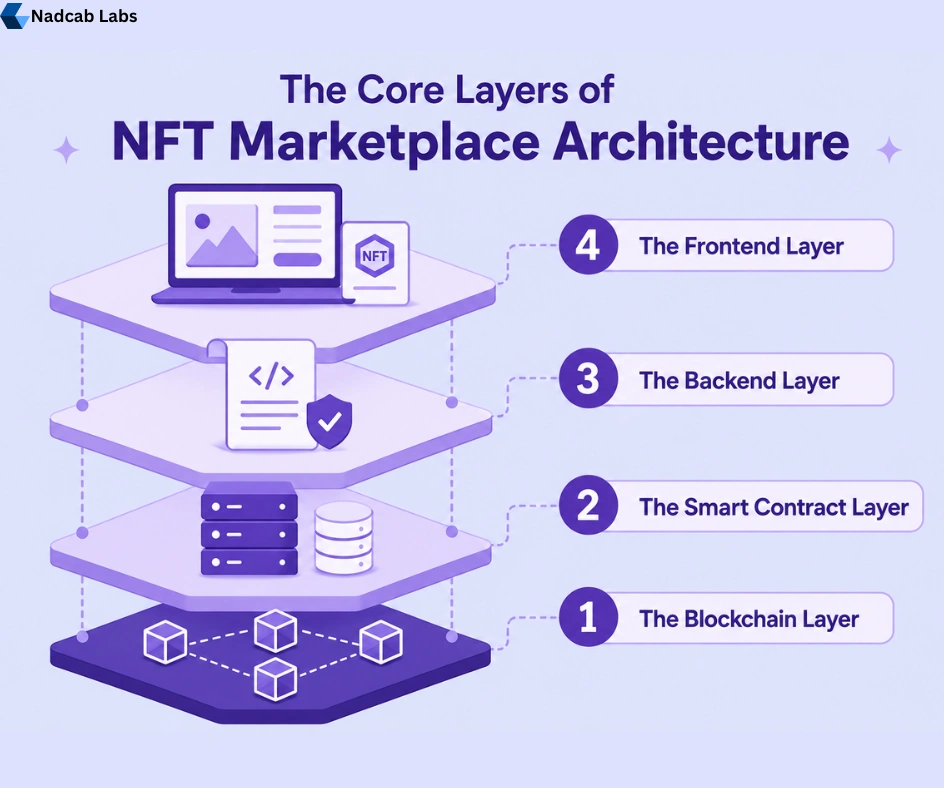
Every high-performance NFT marketplace rests on four connected layers. Understanding each one helps you see where bottlenecks happen and how to fix them.
1. The Blockchain Layer
This is where ownership records live, transactions are validated, and smart contracts execute. The blockchain layer choice affects everything: transaction speed, cost, and how many users you can realistically serve. Ethereum powers approximately 62% of all NFT contracts, while Solana holds about 18%, Polygon around 11%, and BNB Chain approximately 6%. Each chain has different transaction speeds and fee structures. Ethereum is trusted and has deep developer tooling, but it can get expensive during busy periods. Solana is faster and cheaper per transaction, which makes it well-suited for gaming and high-volume trading. The choice here is not about what sounds best but about what your users actually need.
2. The Smart Contract Layer
Smart contracts are the automated rulebooks that run on the blockchain. They handle every step of an NFT transaction without needing a human to approve anything. When a buyer sends payment, the smart contract moves the NFT to the buyer’s wallet, sends funds to the seller, and automatically distributes royalty percentages to the original creator, all within seconds. Over 80% of NFT creators now use royalty-enforcing smart contracts. For NFT marketplace architecture, this layer needs to be both efficient and thoroughly tested. A flaw in a smart contract cannot be patched after deployment, the way you would update a website. It requires careful development, rigorous testing, and professional security audits before launch.
3. The Backend Layer
The backend handles everything that happens between what users see and what goes on the blockchain. This includes the APIs that connect the front end to blockchain networks, order matching for auction systems, transaction history management, notification services, and integration with multiple wallets. Leading platforms like OpenSea and Blur use a hybrid approach where trade finalization happens on-chain for transparency, while order books and metadata are stored off-chain for speed. They also use dedicated RPC providers like Infura and Alchemy to reduce latency when communicating with blockchain nodes. This hybrid model is now the standard approach for any high-performance NFT marketplace.
4. The Frontend Layer
This is what users actually see. A well-built frontend needs to handle browsing large collections, real-time auction updates, wallet connections, and NFT previews without lagging. Frontend frameworks like React.js are commonly used because they handle dynamic data updates efficiently. For performance, teams use lazy loading so NFT metadata is only fetched when a user actually scrolls to it, optimized image formats like WebP to reduce file sizes, and content delivery networks to serve media from servers close to each user’s location. Mobile-first design is also a core requirement now, not an afterthought.
Layer-2 Scaling Solutions That Actually Work for NFT Marketplaces
The biggest challenge with building on Ethereum directly is that high demand leads to network congestion and expensive gas fees. Layer-2 scaling solutions sit on top of Ethereum and handle transactions off the main chain, then settle the final results on Ethereum. This gives you the speed and cost savings of a faster chain with the trust and security of Ethereum underneath.
1. Polygon
Polygon’s throughput exceeds 65,000 transactions per second, making it one of the most widely used Layer-2 options for NFT marketplaces. Major platforms, including OpenSea and Rarible, use Polygon’s solutions. Brands like Starbucks and Nike have also used Polygon for their NFT programs. Polygon became the first Ethereum scaling solution to be integrated into AWS Blockchain Node Service in early 2025, and Immutable zkEVM, powered by Polygon, went live in February 2025, onboarding 85 game developers within its first month.
2. Immutable X
Immutable X was built specifically for NFTs and gaming. It offers zero gas fees for minting and trading, processes thousands of transactions per second, and maintains Ethereum’s security through zero-knowledge rollup technology. In 2025, it will become the go-to infrastructure for Web3 gaming studios. Gods Unchained, a blockchain card game built on Immutable X, surpassed 2 million NFT trades in early 2025. For marketplaces focused on gaming assets, Immutable X is one of the strongest choices available.
3. Arbitrum and Optimism
These two rollup-based Layer-2 solutions together account for approximately 9% of NFT transaction volume. Arbitrum Nova is particularly suited for gaming because of its low latency and cost. Optimism can process transactions up to 26 times faster than Ethereum’s mainnet. Both offer strong EVM compatibility, meaning existing Ethereum smart contracts can be deployed on them with minimal changes.
Recommended Reading:
Storage Strategy for NFT Marketplaces: IPFS, CDN, and Off-Chain Data
Storing NFT data properly is one of the most overlooked performance decisions in marketplace development. The actual image, video, or audio file that an NFT represents cannot practically live on the blockchain itself because writing large files on-chain is extremely expensive. Instead, the NFT token contains a pointer, usually an IPFS URL, that points to where the file is stored.
1. Why IPFS Matters
The InterPlanetary File System (IPFS) is a decentralized storage protocol where files are stored across many nodes and identified by their content rather than their location. This means that as long as any node on the network holds a file, it can be retrieved. For NFT marketplaces, this is important because it ensures that the file tied to an NFT remains accessible even if any single server goes offline. IPFS is widely used for storing art, photographs, music, and metaverse assets across NFT platforms. It also reduces operational costs compared to keeping everything on-chain.
2. The Gateway and CDN Layer
While IPFS handles storage well, it was not originally designed for the fast delivery speeds that modern users expect. Public IPFS gateways often suffer from slow load times, rate limits, and occasional downtime. For production NFT marketplaces in 2025, private or optimized IPFS gateways backed by a Content Delivery Network (CDN) are now considered essential infrastructure, not a nice extra. A CDN serves files from servers located close to each user, reducing the distance data has to travel and delivering faster load times. When you combine IPFS storage with a CDN layer on top, you get a decentralized backend with the delivery speed users expect from centralized platforms.
3. Off-Chain Metadata Management
Beyond the media files, every NFT has metadata: name, description, attributes, and other details. Storing and serving this efficiently matters for how quickly collection pages and individual NFT pages load. Best practice includes IPFS caching layers for faster metadata access, lazy loading so metadata is only fetched when needed, and sharding metadata across different servers to distribute load and reduce latency. Using efficient image formats like WebP instead of PNG can also reduce file sizes significantly, which directly improves page load times and user experience.
Blockchain Performance Comparison for NFT Marketplaces
| Blockchain | Transaction Speed (TPS) | Gas Fees | Best Use Case |
|---|---|---|---|
| Ethereum (L1) | ~15 TPS | High, variable | High-value art, trusted settlements |
| Polygon (L2) | 65,000+ TPS | Very low | General NFT marketplaces, brand programs |
| Immutable X (L2) | 9,000+ TPS | Zero gas fees | Gaming NFTs, high-frequency trading |
| Solana | 65,000 TPS | Very low | Music, sports, NFTs, fast consumer apps |
| BNB Chain | ~2,000 TPS | Low | DeFi-NFT hybrid platforms |
| Arbitrum / Optimism | 4,000 TPS (Optimism) | Low | Gaming assets, general marketplace scaling |
Smart Contract Design for NFT Marketplace Performance
Smart contracts are the engine inside every NFT transaction. They run automatically when conditions are met, removing the need for any middleman. But how they are written has a direct impact on the speed and cost of every trade on your platform.
1. Choosing the Right Token Standard
ERC-721 is the standard for unique, one-of-a-kind NFTs. It is ideal for digital art where each piece is distinct. ERC-1155 supports both fungible and non-fungible tokens in a single contract, which makes it much more efficient for gaming platforms that need to mint thousands of identical or semi-identical items at once. Choosing ERC-1155 for gaming reduces the number of contract calls and, therefore, lowers gas costs and speeds up minting significantly compared to using ERC-721 for every item.
2. Lazy Minting to Reduce Upfront Costs
Lazy minting is a technique where NFTs are not actually minted on the blockchain until someone buys them. The creator signs a voucher off-chain, and the actual blockchain transaction happens only when a purchase occurs. This removes the cost and friction of minting for creators, which is a major barrier for non-crypto-native users. Platforms that support lazy minting and gasless transactions using relayer services are significantly better positioned to onboard creators who are not familiar with paying gas fees upfront.
3. Writing Efficient Contract Code
Every operation inside a smart contract costs gas. Poorly written contracts that repeat storage reads, use loops where they are not needed, or store data on-chain that could live off-chain will make every transaction more expensive for users. Good smart contract development involves writing lean code, using established libraries like OpenZeppelin, and running professional security audits before deployment. Contracts cannot be changed once deployed on most chains, so getting the code right the first time is critical.
Recommended Reading:
Multi-Chain NFT Marketplace Development
In 2025, single-chain NFT marketplaces are increasingly rare among major platforms. Users hold assets on different chains and do not want to manage separate wallets or pay bridging fees just to trade on a particular platform. Multi-chain marketplace architecture allows users to trade NFTs from Ethereum, Solana, Polygon, and other networks all in one place.
Building multi-chain support means handling cross-chain communication, which involves bridges or cross-chain messaging protocols. Over 3 million NFTs were bridged cross-chain in 2025 alone, which shows just how active this area has become. The architectural challenge is making all of this feel simple to the user, even though the backend is managing connections to multiple different blockchains simultaneously.
Multi-chain design also means that your indexing, API layer, and database schema need to handle data from different chains without mixing up ownership records or transaction histories. This requires careful architecture planning from the start, because retrofitting multi-chain support into a single-chain system is significantly harder than designing for it upfront.
NFT Marketplace Development Costs
| Development Component | Cost Range | Key Considerations |
|---|---|---|
| Basic Platform Features | $30,000 – $50,000 | User authentication, NFT minting, buying/selling functionality, basic wallet integration |
| Advanced Platform Features | $100,000 – $150,000+ | Custom smart contracts, multi-chain support, advanced analytics, decentralized storage, royalty management |
| UI/UX Design | $5,000 – $20,000 | Simple interface vs. custom-branded design with detailed visual elements |
| Blockchain Integration | $10,000 – $20,000 | Ethereum most common; Solana or BNB Chain options may vary in cost |
| Smart Contract Development | Included in platform costs | Token standards (ERC-721, ERC-1155), security audits, testing |
| Security Implementation | $5,000 – $15,000 | Encryption, multi-factor authentication, and regular security audits |
| Ongoing Maintenance | $1,000 – $5,000/month | Server hosting, updates, customer support, security monitoring |
Performance Design Decisions That Define User Experience
Performance in an NFT marketplace is about how users feel when they use it. Even if everything works correctly on the backend, if pages take too long to load or bids take three seconds to confirm, users will leave. Here are the performance design decisions that matter most.
1. Off-Chain Order Books with On-Chain Settlement
Major platforms store bids, offers, and listings off-chain in traditional databases and only write to the blockchain when a trade actually completes. This means browsing, filtering, and managing listings happen at regular web speed rather than blockchain speed. OpenSea’s Seaport protocol uses this approach, balancing on-chain execution with off-chain order storage. Blur goes even further in using off-chain systems for speed while maintaining blockchain transparency for actual trade settlement.
2. Indexing and Database Design
Blockchain data is not structured the way a database is. Raw blockchain data needs to be indexed so it can be queried quickly. Tools like The Graph allow platforms to build indexed APIs from blockchain data that can answer queries like “show me all NFTs owned by this wallet” almost instantly. Without proper indexing, these queries would require scanning the entire blockchain, which would make the platform extremely slow.
3. Caching Strategies
Caching stores frequently accessed data in a fast-access layer, so it does not have to be fetched fresh every time. NFT collection data, trait rarity scores, and price history are good candidates for caching since they do not change every second. Distributed caching tools speed up user interfaces significantly and reduce the load on backend servers during traffic spikes.
4. Load Testing Before Launch
One of the most overlooked steps in NFT marketplace development is load testing. This involves simulating large numbers of users hitting the platform simultaneously to identify where the system slows down or breaks. Running unit tests, security audits, and load testing at every stage of development ensures the platform stays stable even under heavy traffic. A platform that has never been load tested before a major NFT drop is a platform that has probably never been stress-tested at all.
Recommended Reading:
Performance Design Across Different NFT Marketplace Types
Different types of NFT marketplaces have different performance demands. A one-size solution does not exist. Here is how the design changes depending on what the platform is built for.
1. Art and Collectible Marketplaces
These platforms handle fewer transactions overall but often face sudden, intense spikes during drops. The biggest performance challenges are media delivery (high-resolution images and videos that need to load quickly) and queue management when thousands of people try to buy at the same time. Ethereum or Polygon works well here, and the emphasis on architecture is CDN performance, smart queuing, and preventing failed transactions during high demand.
2. Gaming NFT Platforms
Gaming NFTs now represent a market valued at approximately $471.90 billion in 2024, projected to reach $942.58 billion by 2029. Players make dozens of small in-game transactions that need to feel instant. Transaction speed and cost matter more here than anywhere else. Immutable X, Solana, and WAX are strong choices because they handle high-frequency, low-value transactions without burdening players with gas fees. ERC-1155 is preferred over ERC-721 for bulk item minting.
3. Event Ticketing Platforms
Event ticketing NFTs now represent 5.3% of ticket sales across major US venues in 2025. These platforms have strict time-sensitivity requirements: tickets must be validated quickly at entry points, and time-locked NFTs that expire after an event must function correctly. The architecture needs strong QR code generation, reliable mobile interfaces, and smart contracts that enforce transfer restrictions to prevent scalping.
4. Real-World Asset Platforms
Real-world asset NFTs now represent 11% of the total NFT market share, covering tokenized property, luxury goods, and physical assets. These platforms need KYC and AML compliance tools built into the onboarding flow. They also need legal-ready smart contracts that can represent fractional ownership and, in some jurisdictions, transfer legal title. The performance focus here shifts from raw transaction speed to compliance process efficiency and data integrity.
NFT Marketplace and Blockchain Infrastructure: Real Projects Built by Nadcab Labs
The following projects show how NFT marketplace architecture and scalable blockchain infrastructure are being applied in the real world across gaming, decentralized finance, and multi-chain development. Each project reflects the same design principles covered throughout this blog, from smart contract automation and token standards to multi-chain integration and high-throughput infrastructure.
🎮
RoninChain: Gaming-Focused Layer-1 Blockchain for NFT Transactions
Nadcab Labs built RoninChain, a gaming-focused Layer-1 blockchain designed to handle millions of NFT transactions at low cost. The platform moved from Proof of Authority to Delegated Proof of Stake consensus, giving token holders the power to elect validators and participate in governance. This directly addresses the high-throughput, low-fee requirements that gaming NFT platforms need to function effectively at scale.
🏦
BendDAO: NFT Liquidity and Marketplace with DeFi Integration
Nadcab Labs developed BendDAO, a scalable NFT marketplace that combines digital asset trading with lending features, allowing users to use their NFTs as collateral. The platform was built for secure trading, easy user accessibility, and long-term scalability. This project demonstrates how NFT marketplace development services can merge trading infrastructure with DeFi mechanics in a single, performance-ready platform.
Build Your NFT Marketplace Platform Today:
Nadcab Labs brings deep blockchain expertise to NFT marketplace development. Our team handles everything from smart contract creation to multi-chain integration, ensuring your platform is built for growth, platform security, and user experience. Whether you need a curated art marketplace, a gaming NFT platform, or a real-world asset trading system, we deliver solutions built to handle real traffic and real volume.
Final Thoughts
NFT marketplace scalability and performance design are not areas where you can cut corners and fix things later. The decisions made at the architecture stage, which blockchain to use, whether to implement Layer-2 solutions, how smart contracts are written, how media is stored and delivered, and how the backend handles load, all shape whether a platform can grow with its users or collapse under pressure.
The NFT market has grown past the point where a basic platform can compete. With the global NFT market projected toward USD 247.41 billion by 2029, the platforms that will attract users and trading volume are those that were built to handle it. That means investing in the right blockchain, the right storage strategy, the right smart contract structure, and the right scaling infrastructure from day one.
Whether you are building for art, gaming, ticketing, or real-world assets, the fundamentals of good NFT marketplace architecture apply across all of them. Fast, reliable, and well-structured platforms are not just technically better. They build user trust, reduce friction, and give creators and collectors a reason to come back.
Frequently Asked Questions
Q1.What does NFT marketplace scalability actually mean?
It refers to how well an NFT marketplace handles increasing numbers of users, transactions, and data over time. A scalable marketplace can process high volumes during peak activity without slowing down, failing transactions, or crashing. It involves decisions across the blockchain layer, smart contract design, backend infrastructure, and storage systems.
Q2.Which blockchain is best for a high-performance NFT marketplace?
It depends on your use case. Ethereum is the most trusted and widely used, but Layer-2 solutions like Polygon and Immutable X offer much higher transaction speeds and lower fees while still using Ethereum for final settlement. Gaming platforms tend to benefit most from Immutable X or Solana, while general-purpose marketplaces often do well on Polygon. There is no single best answer; the right choice depends on your users and what they need.
Q3.How does IPFS improve NFT marketplace performance?
IPFS stores NFT media files in a decentralized way so they remain accessible even if any single server goes offline. When combined with a CDN layer and private IPFS gateways, it allows platforms to deliver high-resolution images and metadata quickly to users anywhere in the world. Without proper IPFS gateway setup, platforms rely on public gateways that often have slow load times and rate limits.
Q4.What is lazy minting, and why does it matter for NFT platforms?
Lazy minting delays the actual blockchain minting of an NFT until a buyer purchases it. The creator signs a voucher off-chain, and the NFT is only written to the blockchain at the point of sale. This removes the upfront cost for creators and makes it easier to onboard people who are not familiar with paying gas fees before they even make a sale.
Q5.How much does it cost to build a scalable NFT marketplace?
A basic NFT marketplace with standard minting, buying, and selling features typically costs between $30,000 and $50,000 to build. Advanced platforms with multi-chain support, custom smart contracts, analytics, and decentralized storage can range from $100,000 to over $150,000. Ongoing maintenance adds $1,000 to $5,000 per month, depending on the platform’s size and features.
Q6.Why is multi-chain support important for NFT marketplace development?
Users hold assets on multiple blockchains and do not want to use separate platforms for each one. Multi-chain support allows them to trade NFTs from Ethereum, Solana, Polygon, and other networks all from one place. In 2025, over 3 million NFTs were bridged cross-chain, reflecting strong demand for interoperability. Building with a multi-chain architecture from the start is far more practical than trying to add it to a single-chain platform later.
Explore Services
Related Services
Reviewed by

Aman Vaths
Founder of Nadcab Labs
Aman Vaths is the Founder & CTO of Nadcab Labs, a global digital engineering company delivering enterprise-grade solutions across AI, Web3, Blockchain, Big Data, Cloud, Cybersecurity, and Modern Application Development. With deep technical leadership and product innovation experience, Aman has positioned Nadcab Labs as one of the most advanced engineering companies driving the next era of intelligent, secure, and scalable software systems. Under his leadership, Nadcab Labs has built 2,000+ global projects across sectors including fintech, banking, healthcare, real estate, logistics, gaming, manufacturing, and next-generation DePIN networks. Aman’s strength lies in architecting high-performance systems, end-to-end platform engineering, and designing enterprise solutions that operate at global scale.