Ai Overview
Before comparing the two models, it helps to understand what NFT marketplace architecture actually means. Beeple’s famous $69 million NFT, for example, is recorded on Ethereum but the actual image lives on MakerPlace’s private gateway. Gas fees on Ethereum can be expensive during peak activity, sometimes exceeding $100 per transaction, making it unsuitable for low-value NFTs or high-volume gaming scenarios.
Key Takeaways
- The global NFT market reached $48.7 billion in 2025, showing a strong recovery from previous volatility, with projections suggesting growth toward $247 billion by 2029, driven by broader adoption and real-world utility use cases.
- OpenSea maintains market dominance with 90 percent of Ethereum NFT trading volume as of October 2024, hosting over 80 million NFTs and generating approximately $14.68 billion in 2024 trading volume.
- NFT marketplace development costs range from $30,000 to $150,000+, depending on features, with basic platforms costing $30,000 to $50,000 and advanced platforms with custom smart contracts and multi-chain support reaching $150,000 or more.[1]
- Gaming NFTs represent a massive market valued at approximately $471.90 billion in 2024, with forecasts projecting growth to $942.58 billion by 2029, with trading volume concentrated heavily in PFP assets at 37 percent and gaming at 25 percent.[2]
- Smart contracts automate NFT transactions by handling cryptocurrency transfers, NFT delivery to buyers, royalty distributions to creators, and permanent blockchain recording without intermediaries.[3]
- Virtual real estate NFTs are predicted to grow at a compound annual growth rate of 27.4 percent, with platforms like Decentraland and The Sandbox enabling users to buy, develop, and monetize digital property.[4]
- Security challenges remain significant, with over $100 million worth of NFTs stolen from July 2021 to July 2022, with scammers averaging around $300,000 per incident, making strong security measures essential.
If you are building or planning to build an NFT marketplace, the most important decision you will make is not what you will sell or how you will price it. It is how your platform is built at its core. The architecture you choose shapes everything from how users log in and trade to how their assets are stored, how transactions are processed, and who has control over the platform when something goes wrong.
The global NFT market was valued at USD 43.08 billion in 2024 and is projected to reach USD 61.01 billion in 2025, growing at a compound annual growth rate of 41.6 percent. Forecasts point toward USD 247.41 billion by 2029. This growth is being driven not just by rising interest in digital art and collectibles, but also by the increasing demand for NFT marketplace development solutions that support expanding use cases in gaming, event ticketing, virtual real estate, and real-world asset tokenization.
Yet, despite this scale, many builders jump into development without fully understanding the structural difference between a centralized NFT marketplace and a decentralized one. This blog breaks down both types of NFT marketplace architecture in plain language, covers what actually goes on under the hood, and helps you understand which path makes sense for your goals.
NFT Marketplace Development Guide
What Is NFT Marketplace Architecture?
Before comparing the two models, it helps to understand what NFT marketplace architecture actually means. In simple terms, it refers to the technical structure that holds an NFT platform together. This includes where data is stored, how transactions are processed, who controls user accounts and listings, how smart contracts are set up, and what happens when something goes wrong on the platform.
Think of it like the foundation of a building. You may not see it when you walk in, but everything above ground depends on how well it was built. A weak or poorly chosen architecture creates problems at scale, including slow transactions, loss of user data, unfair censorship of listings, or even the loss of the digital assets users thought they owned.
In the NFT world, architecture directly affects whether a buyer truly owns their NFT, whether a creator gets their royalties automatically, whether a seller can trust the platform not to disappear overnight, and whether a developer can add new features without breaking everything.
NFT marketplace architecture typically includes these layers working together:
1. The Frontend Layer
This is what users see and interact with. It includes the browsing interface, collection pages, bidding screens, wallet connection buttons, and the minting flow. Most NFT platforms use frameworks like React.js or Next.js to build fast, responsive interfaces that can handle heavy NFT image and video data without slowing down. In a centralized marketplace, this layer connects to company-owned backend servers. In a decentralized one, it connects directly to blockchain nodes and smart contracts.
2. The Smart Contract Layer
Smart contracts are self-executing programs that run on blockchains like Ethereum. They handle the core logic of an NFT marketplace: when a buyer sends payment, the smart contract confirms it, records the ownership transfer on the blockchain, delivers the NFT to the buyer’s wallet, and automatically sends any creator royalties to the original artist. No human needs to approve this. It happens by code. Most NFT smart contracts use token standards like ERC-721 for unique one-of-a-kind assets or ERC-1155 for collections that include both unique and semi-fungible items like in-game weapons or limited edition prints.
3. The Storage Layer
An NFT itself is just a record on a blockchain that says who owns a particular item. The actual image, video, or audio file is usually too large to store directly on-chain. This is why storage architecture matters so much. Platforms using centralized storage put these files on private servers like AWS or Google Cloud. If those servers go offline or the company shuts down, the actual content behind the NFT disappears even though the ownership record remains on the blockchain. Platforms using decentralized storage rely on systems like IPFS (InterPlanetary File System) or Arweave, which distribute files across many nodes so no single point of failure can erase the content. A 2022 study found that only about 10 percent of NFTs are stored fully on-chain, about 50 percent rely on IPFS, and the rest sit on private servers at real risk of loss.
4. The Backend and Database Layer
This handles everything that keeps the platform running smoothly: user profiles, transaction histories, search indexing, notifications, order matching, and analytics. In centralized platforms, this layer is fully managed by the company and sits on its own servers. In decentralized platforms, parts of this layer are replaced by on-chain data and indexing tools like The Graph, though some off-chain databases are still needed for speed and user experience.
5. The Wallet and Authentication Layer
Centralized marketplaces let users sign up with an email and password, which lowers the barrier to entry for people new to crypto. Decentralized platforms authenticate users through their crypto wallets, like MetaMask for Ethereum or Phantom for Solana. No username or password is needed because ownership of a private key is the identity. This is fundamentally different from how traditional websites work, and it has major consequences for who controls what on the platform.
Centralized NFT Marketplace Architecture: How It Works
A centralized NFT marketplace is built and operated by a single company. The backend, database, user data, and NFT metadata all live on servers controlled by that company. Think of it like Amazon or eBay for digital assets. The company decides what is listed, who can use the platform, what fees are charged, and how disputes are resolved.
Platforms like Binance NFT and Nifty Gateway follow this model. They offer polished user experiences, customer support teams, and fast transactions because they are not waiting for blockchain confirmations at every step. Many of their operations happen off-chain, meaning on their own internal systems, and are only settled to the blockchain when necessary.
1. How Transactions Are Processed
In a centralized system, when a user buys an NFT, the platform processes the transaction internally first and updates its own database before anything is written to the blockchain. This speeds things up considerably. The user sees an almost instant confirmation rather than waiting for a block to be mined and confirmed by network validators. For platforms with millions of users trading simultaneously, this architecture can handle volume far more easily than a purely blockchain-based system.
2. User Onboarding and Account Management
Centralized platforms make it easy to get started. New users sign up with an email address, create a password, complete a KYC (Know Your Customer) check if required, and can often use a credit card or fiat currency to buy NFTs. This removes the friction of getting a crypto wallet, buying cryptocurrency, understanding gas fees, and connecting a Web3 wallet that many beginners find overwhelming. For platforms trying to reach mainstream audiences, this is a real advantage.
3. Content Moderation and Compliance
Because the platform operator has full control, they can remove listings, ban users, freeze accounts, and comply with legal regulations from governments. This is both an advantage and a risk. The advantage is that illegal content, scams, and fake NFTs can be taken down quickly. The risk is that the company can also remove content or restrict users without any appeal process, which runs counter to the ideals many in the blockchain community hold about open access and censorship resistance.
4. Asset Custody and Ownership
This is perhaps the biggest hidden issue in centralized NFT marketplace architecture. Even though NFTs are supposed to represent true digital ownership, many users on centralized platforms do not have full custody of their assets. The platform manages wallets on behalf of users, similar to how a bank holds your money. This means the company, not the user, holds the private keys that actually prove ownership. If the platform shuts down, gets hacked, or freezes a user’s account, the user may have no way to access their NFTs.
A concrete example of what centralized dependency looks like in practice: when MetaMask and Twitter failed to display NFT images from OpenSea in 2022, it traced back to an OpenSea database outage that shut down their image-loading API. This froze all services that depended on it, showing that even platforms claiming decentralization can have very centralized failure points.
5. Revenue and Fee Structure
Centralized platforms typically charge a transaction fee ranging from 2.5 percent to 15 percent of each sale, plus any minting or listing fees. These fees fund the servers, the team, the customer support, and the ongoing development of the platform. Curated platforms like SuperRare charge up to 15 percent because they offer a more selective, prestigious environment. Platforms like Binance NFT use their existing exchange user base to drive liquidity and can afford competitive fees as a result.
Decentralized NFT Marketplace Architecture: How It Works
A decentralized NFT marketplace operates on smart contracts and blockchain technology without a central authority managing transactions or user data. No single company can decide to remove your listing, freeze your account, or change the fee structure without the consensus of the community or a code-level update to the smart contracts.
Platforms like OpenSea (which is partially decentralized in its trading contracts), Rarible, Zora, and LooksRare use this approach. Users connect their non-custodial wallets directly to the platform. Their NFTs stay in their own wallets at all times. Smart contracts handle every transaction automatically according to pre-written rules.
1. Smart Contract-Driven Transactions
Every buy, sell, bid, and transfer on a fully decentralized platform goes through a smart contract on the blockchain. When a seller lists an NFT at a fixed price, a smart contract holds the terms. When a buyer sends payment, the contract checks the conditions, transfers the NFT to the buyer’s wallet, sends the payment to the seller, and routes any royalty to the original creator, all in one atomic transaction. No human approves this. It just happens by code. This creates a level of trust that does not depend on whether the platform company is honest, solvent, or even still operational.
2. Non-Custodial Wallet Integration
In a decentralized marketplace, users connect their own wallets like MetaMask, Coinbase Wallet, or WalletConnect-compatible options. These are non-custodial, meaning only the user holds the private key that controls the wallet. The platform never takes custody of the assets. Even if the platform website goes offline, the user’s NFTs remain in their wallet and can be accessed or traded through any other platform that supports the same blockchain. This is true ownership in the way that NFT technology originally promised.
3. Decentralized Storage with IPFS and Arweave
Fully decentralized marketplaces pair their smart contract layer with distributed storage systems. IPFS (InterPlanetary File System) stores files across a network of nodes and assigns each file a unique content hash, so the file can be retrieved from any node that has a copy rather than depending on one server. Arweave goes further by offering permanent storage through a one-time payment model, meaning files are preserved forever without ongoing hosting costs. When an NFT’s image is stored on IPFS or Arweave rather than a private server, the content behind the token cannot disappear even if the original platform shuts down.
4. Community Governance
Some decentralized marketplaces go further by giving their communities direct control over platform decisions. Rarible introduced the RARI token, which allows holders to vote on fee changes, feature updates, and platform policies. This model replaces the typical corporate board structure with a community of stakeholders who have a financial interest in the platform’s success. It also aligns incentives differently: power users and long-term holders gain a say in how the platform evolves.
5. Interoperability Across Protocols
Because decentralized platforms operate on open protocols rather than closed systems, they integrate more easily with other blockchain protocols. A user’s NFT on a decentralized marketplace can be used as collateral in a DeFi lending protocol like BendDAO, displayed in a virtual world like Decentraland, or traded across multiple platforms simultaneously. This composability is a defining advantage of decentralized architecture and one that centralized platforms cannot fully replicate without redesigning their core systems.
What is Treasure NFT? Is it Real or Fake?
The Hidden Problem Most Blogs Do Not Tell You About
Most comparisons of centralized vs decentralized NFT marketplace architecture stop at surface-level pros and cons. But there is a much deeper issue that affects nearly every NFT marketplace currently operating, and it is called disguised centralization.
In March 2021, developer Jonty Wareing examined a large number of existing NFTs and found that most of them pointed to either a standard Web2 URL or an IPFS hash stored on a private gateway. This means the NFT token exists on the blockchain, but the actual image or file it represents lives on a centralized server. Beeple’s famous $69 million NFT, for example, is recorded on Ethereum but the actual image lives on MakerPlace’s private gateway. If that gateway ever goes offline, the buyer would have ownership of a record pointing to nothing.
This is the uncomfortable reality behind many NFT marketplaces that brand themselves as decentralized. The blockchain record is decentralized. The asset it represents is not. Understanding this distinction is essential for anyone building or investing in an NFT marketplace platform design that is meant to last.
True decentralization requires both decentralized transaction settlement through smart contracts AND decentralized asset storage through systems like IPFS or Arweave. Platforms that do only one without the other offer partial decentralization at best.
Centralized vs Decentralized NFT Marketplace: Architecture Comparison
| Feature | Centralized NFT Marketplace | Decentralized NFT Marketplace |
|---|---|---|
| Control | Single company or entity | Smart contracts and/or community governance |
| Transaction Speed | Very fast (off-chain processing) | Slower (depends on blockchain speed and congestion) |
| Asset Storage | Typically on private servers (AWS, etc.) | IPFS, Arweave, Filecoin (distributed) |
| User Onboarding | Easy (email, password, fiat payment) | Complex (requires crypto wallet setup) |
| Asset Custody | The platform holds keys on behalf of users | User holds their own private keys at all times |
| Censorship | The company can remove listings or ban accounts | No central authority to impose restrictions |
| Royalties | Enforced by platform policy | Enforced by smart contract code automatically |
| Transparency | Limited (internal database, not publicly visible) | Full (every transaction visible on the blockchain) |
| Interoperability | Limited to the platform ecosystem | High (works with DeFi, metaverse, other protocols) |
| Failure Risk | Single point of failure (company servers) | No single point of failure across nodes |
Blockchain Choices and Their Impact on NFT Marketplace Platform Design
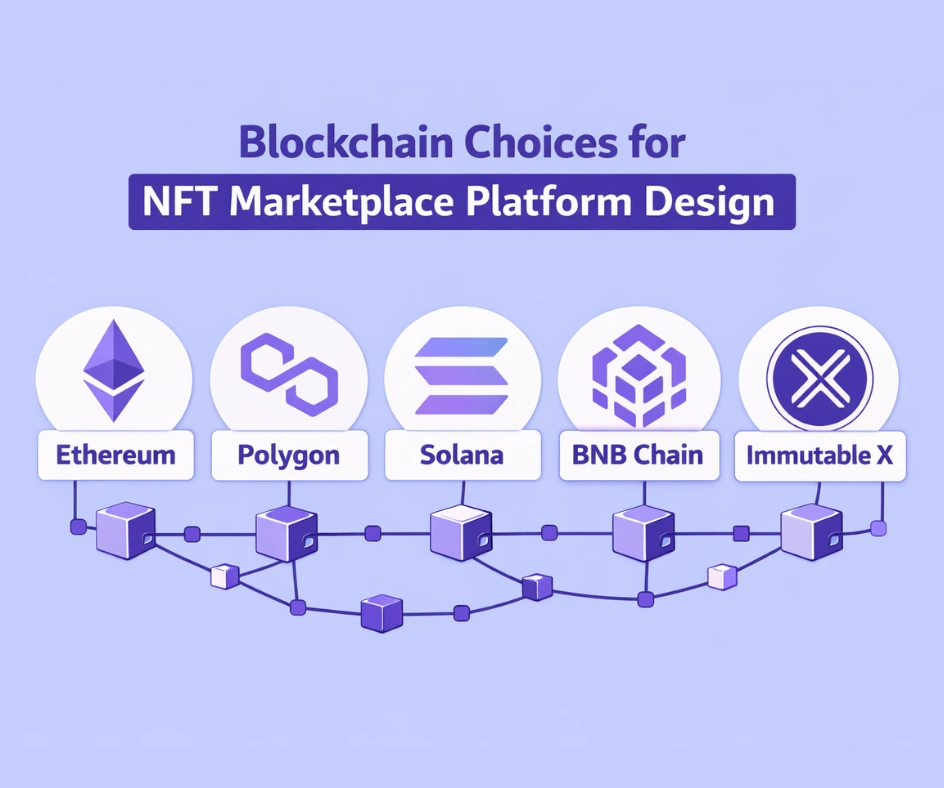
Whether you are building a centralized or decentralized NFT marketplace, your blockchain selection has a direct impact on the architecture. Different blockchains make different trade-offs between speed, cost, decentralization, and ecosystem maturity. Here is what each major chain actually brings to an NFT marketplace:
1. Ethereum
Ethereum powers approximately 62 percent of all NFT contracts. It has the largest existing NFT user base, the most mature developer tooling, and the highest liquidity. OpenSea, which accounts for 90 percent of Ethereum NFT trading volume as of October 2024, runs on Ethereum. The main trade-off is cost. Gas fees on Ethereum can be expensive during peak activity, sometimes exceeding $100 per transaction, making it unsuitable for low-value NFTs or high-volume gaming scenarios.
2. Polygon
Polygon is a Layer-2 network built on top of Ethereum. It processes transactions much faster and at a fraction of the cost while maintaining full compatibility with Ethereum smart contracts. It holds about 11 percent of NFT activity and is particularly strong for mainstream and gaming NFT platforms. Brands like Starbucks and Nike have chosen Polygon for their NFT initiatives because of this cost efficiency.
3. Solana
Solana processes transactions at high speed and very low cost using its Proof of History mechanism. It handles around 18 percent of NFT activity and is the leading chain for gaming NFTs and fast-moving trading environments. The trade-off is a smaller collector base than Ethereum, different programming requirements using Rust instead of Solidity, and some historical network stability issues.
4. BNB Chain
Binance Smart Chain, now called BNB Chain, holds about 6 percent of NFT activity. It offers low fees and fast transactions and benefits from Binance’s large existing user base. The trade-off is a more centralized validator set compared to Ethereum, which matters for platforms prioritizing full decentralization.
5. Immutable X
Immutable X is a Layer-2 solution built specifically for NFTs. It offers gas-free trading while maintaining Ethereum’s security. It is particularly popular for gaming NFT marketplaces, where users make many small transactions and cannot afford gas fees on every action.
NFT Marketplace Development Costs
| Development Component | Cost Range | Key Considerations |
|---|---|---|
| Basic Platform Features | $30,000 – $50,000 | User authentication, NFT minting, buying/selling functionality, basic wallet integration |
| Advanced Platform Features | $100,000 – $150,000+ | Custom smart contracts, multi-chain support, advanced analytics, decentralized storage, royalty management |
| UI/UX Design | $5,000 – $20,000 | Simple interface vs. custom-branded design with intricate elements |
| Blockchain Integration | $10,000 – $20,000 | Ethereum most common, alternatives like Solana or BSC may vary |
| Smart Contract Development | Included in platform costs | Token standards (ERC-721, ERC-1155), security audits, testing |
| Security Implementation | $5,000 – $15,000 | Encryption, multi-factor authentication, and regular security audits |
| Ongoing Maintenance | $1,000 – $5,000/month | Server hosting, updates, customer support, security monitoring |
Understanding the cost structure of NFT marketplace development helps you plan your build more accurately. Costs vary significantly depending on whether you are building a centralized or decentralized platform, which blockchain you use, what features you include, and how much custom work is needed versus using existing tools and templates.
Security Considerations in NFT Marketplace Architecture
Security is one of the most critical factors in NFT marketplace platform design, and the risks differ significantly between centralized and decentralized models. More than $100 million worth of NFTs were stolen between July 2021 and July 2022, with scammers averaging around $300,000 per incident. This number makes security planning a non-negotiable part of any NFT marketplace build.
1. Centralized Platform Security Risks
The main risk for centralized platforms is server-side attacks. Because all user data, private keys, and asset metadata live on company-controlled infrastructure, a single successful breach can expose millions of users at once. Historical examples from centralized crypto exchanges, where billions of dollars have been stolen in single attacks, show that this architecture creates a concentrated target for bad actors. Centralized platforms must invest heavily in server security, data encryption, multi-factor authentication, and regular penetration testing to mitigate these risks.
2. Decentralized Platform Security Risks
Decentralized platforms eliminate the single server attack surface, but they introduce a different kind of risk: smart contract vulnerabilities. Because smart contracts handle funds and ownership transfers automatically without human oversight, a bug in the contract code can be exploited by an attacker to drain funds or manipulate ownership records. Unlike a company server that can be patched quickly, a deployed smart contract is immutable on most blockchains, which means errors are permanent unless the team has built in upgrade mechanisms from the start. This is why professional smart contract audits are not optional for any serious decentralized marketplace build.
3. Phishing and Social Engineering Attacks
Across both platform types, phishing attacks targeting users are a growing problem. Fake marketplace websites, fraudulent airdrop offers, and deceptive wallet connection requests trick users into signing malicious transactions that drain their wallets. Building user education, warning systems for suspicious contract interactions, and domain verification into the platform architecture reduces these risks considerably.
4. Royalty and Ownership Manipulation
On centralized platforms, royalty enforcement depends entirely on whether the company chooses to honor creator agreements. Platform policy can change. On fully decentralized platforms, royalties are written into smart contracts and executed automatically. Over 80 percent of NFT smart contracts now include automated royalty enforcement, with Ethereum creators earning more than $1.8 billion in cumulative royalties through this system. Smart contract-enforced royalties are more reliable than policy-based ones because they cannot be overridden without changing the contract code.
Real-World Use Cases Driving NFT Marketplace Architecture Decisions
The architecture you choose should match the use case your platform is designed for. Different NFT categories have different needs, and understanding these helps you make a better structural decision.
1. Digital Art and Collectibles
High-value digital art platforms benefit from decentralized architecture because buyers paying six or seven figures for a piece want proof that the ownership record is on an immutable ledger no company can alter. Platforms like Foundation and SuperRare use decentralized smart contracts for ownership but have curated, semi-centralized listing processes to maintain quality. This hybrid approach reflects how the market actually operates rather than fitting neatly into one category.
2. Gaming NFTs
The gaming NFT sector represents a market valued at approximately $471.90 billion in 2024, with forecasts pointing to $942.58 billion by 2029. Gaming platforms need low-cost, high-speed transactions because players interact with their assets constantly, buying, selling, equipping, and trading items during gameplay. This pushes gaming NFT marketplaces toward Layer-2 solutions like Immutable X or Polygon, where transactions cost a fraction of a cent and confirm in seconds. The architecture also needs to support asset interoperability so items can potentially move between games.
3. Event Ticketing
NFT ticketing now represents 5.3 percent of ticket sales across major US venues in 2025. Tickets issued as NFTs offer verifiable authenticity, fraud prevention, and programmable resale restrictions that prevent scalping beyond a set price. For this use case, platforms need a mix of user-friendly centralized onboarding so non-crypto-native event attendees can buy tickets easily, combined with blockchain-verified ownership so the ticket cannot be duplicated or counterfeited.
4. Virtual Real Estate
Virtual real estate NFTs are predicted to grow at a compound annual growth rate of 27.4 percent. Platforms like Decentraland and The Sandbox use decentralized architecture to let users buy, develop, and monetize digital land. Because virtual land is a long-term asset rather than a short-term trade, users need confidence that the ownership record will outlast any individual company. Decentralized storage and on-chain ownership records are particularly important here.
5. Music and Intellectual Property Rights
Musicians are using NFTs to sell direct ownership stakes in songs, albums, and royalty streams. This use case requires smart contracts that automatically distribute revenue fractions to multiple rights holders every time a transaction occurs. Centralized platforms can do this manually, but decentralized smart contract systems do it automatically and transparently, making them a better long-term fit for complex rights management scenarios.
How to Choose the Right NFT Marketplace Architecture for Your Project
There is no single correct answer to whether you should build a centralized or decentralized NFT marketplace. The right choice depends on your target audience, your use case, your technical resources, and your long-term goals. Here is a practical way to think through the decision:
1. Who Are Your Users?
If you are targeting mainstream consumers with no crypto experience, a centralized architecture with email login, fiat payment options, and customer support will convert far better. If your audience is already crypto-native and values ownership and transparency, a decentralized architecture will earn more trust and long-term loyalty.
2. What Is Your Compliance Environment?
If you are operating in a jurisdiction with strong KYC, AML, or securities regulations, a centralized architecture gives you the admin controls needed to enforce compliance requirements. Decentralized platforms are harder to bring into compliance with certain regulatory frameworks because there is no central party to receive regulatory instructions.
3. What Transaction Volume Do You Expect?
If you anticipate millions of small transactions, like in a gaming marketplace, you need a high-throughput, low-cost blockchain like Solana or a Layer-2 solution. If your platform handles a smaller number of high-value transactions, like a curated art marketplace, Ethereum’s higher security and liquidity may be worth the cost.
4. How Important Is Asset Permanence?
If you are selling assets that buyers expect to own indefinitely, decentralized storage is not optional. Buyers paying significant amounts for NFTs need assurance that the content will not disappear if your company faces trouble. Building with IPFS or Arweave from day one is the right approach for any platform with long-term ambitions.
5. Do You Want a Hybrid Approach?
Many successful platforms use a hybrid model: centralized user accounts and customer service combined with decentralized smart contracts for ownership and decentralized storage for assets. This approach captures the usability advantages of centralized architecture while giving users the ownership guarantees of a decentralized system. OpenSea, for example, maintains centralized servers for its user interface and search functions while using decentralized smart contracts for actual trading.
Custodial vs Non-Custodial NFT Marketplaces
Decentralized NFT Marketplace Implementation in the Real World
The following project shows how decentralized and blockchain-based NFT marketplace architecture is already being applied across gaming, digital ownership, and token-governed platforms. Each project reflects the same core principles discussed throughout this blog, from smart contract automation and non-custodial ownership to community governance and multi-chain trading.
🏦
BendDAO: NFT Liquidity and Decentralized Lending
Developed a decentralized marketplace where users can borrow ETH instantly using blue-chip NFTs as collateral without selling them. The platform runs on smart contracts that handle approvals, repayments, and liquidation protections automatically. This shows how decentralized NFT marketplace architecture can extend beyond simple trading into DeFi-native financial products built on blockchain ownership records.
Launch Your NFT Marketplace Platform Today:
We bring deep blockchain expertise to NFT marketplace development. Our specialized team handles everything from smart contract creation to multi-chain integration, ensuring your platform is built for growth, strong security, and user experience. Whether you need a curated art marketplace or a gaming NFT platform, we deliver solutions that work.
Final Thoughts
Choosing between centralized and decentralized NFT marketplace architecture is not a matter of one being better than the other in every situation. It is about understanding what each model does well, where each one creates risks, and which fits the specific platform you are trying to build.
Centralized architecture offers speed, ease of use, strong customer support, and straightforward regulatory compliance. It works well for platforms targeting general consumers, brands launching NFT campaigns, or projects that need a fast time-to-market with predictable infrastructure. The trade-offs are real: users do not hold their own assets, the platform can censor content, and a single server failure can bring everything down.
Decentralized architecture offers genuine ownership, transparent transactions, automated smart contract enforcement, censorship resistance, and interoperability with the broader blockchain ecosystem. It works well for platforms where user trust and long-term asset permanence matter most, including high-value art, gaming assets, virtual real estate, and rights management. The trade-offs are also real: user onboarding is harder, transactions can be slower and more expensive depending on the chain, and smart contract vulnerabilities require careful security auditing.
Most successful platforms today do not sit entirely in one camp. They borrow the best elements of both models, using centralized infrastructure where it improves user experience and decentralized infrastructure where it protects user interests. As the NFT market continues to grow toward the projections of $247 billion by 2029, the platforms that will thrive are those built with a clear architectural strategy from the beginning rather than those that patch problems as they arise.
If you are planning to build an NFT marketplace, start with the architecture decision before anything else. Get that right, and every other piece of the platform becomes easier to build well.
Frequently Asked Questions
Q1.What is the main difference between centralized and decentralized NFT marketplace architecture?
The main difference is who controls the platform and where the data lives. In a centralized NFT marketplace, a single company manages the backend, stores user data on its own servers, and can modify or restrict the platform at will. In a decentralized NFT marketplace, smart contracts on a public blockchain handle transactions, users hold their own assets in non-custodial wallets, and no single party can unilaterally change the rules or block access. This affects everything from how ownership is recorded to how disputes are resolved.
Q2.Can an NFT be permanently lost if a centralized marketplace shuts down?
The blockchain record of ownership typically remains even if a centralized platform shuts down, but the actual content behind the NFT, the image, video, or file it represents, can disappear if it was stored on the platform’s private servers. This is why storage architecture matters. NFTs backed by content on IPFS or Arweave retain their content regardless of whether the original platform survives. Always check where an NFT’s underlying file is stored before purchasing high-value assets.
Q3.Which blockchain is best for building an NFT marketplace?
There is no single best answer because it depends on your use case. Ethereum is the most trusted and liquid network for high-value NFTs and established art collections. Polygon is strong for mainstream and brand-focused platforms due to lower costs and Ethereum compatibility. Solana is the top choice for gaming and high-speed trading environments. Immutable X works well for NFT-specific platforms that want gas-free trading with Ethereum-level security. Most new platforms today design their architecture to support at least two chains from launch and add more as user demand grows.
Q4.Are smart contract audits really necessary for an NFT marketplace?
Yes, they are essential and not optional for any platform handling real financial value. Smart contracts are immutable once deployed on most blockchains, which means a bug or vulnerability cannot simply be patched with a server update. If an attacker finds an exploit in an unaudited contract, they can drain funds or manipulate ownership records permanently. Professional security audits by firms that specialize in blockchain smart contract review identify vulnerabilities before deployment and give users confidence that the platform’s code is trustworthy. The cost of an audit is far smaller than the cost of a breach.
Q5.What is a hybrid NFT marketplace architecture?
A hybrid NFT marketplace uses centralized infrastructure for some functions and decentralized infrastructure for others. A common version combines centralized user accounts and customer service with decentralized smart contracts for trading and decentralized storage for NFT content. OpenSea is a well-known example: it has centralized servers powering its user interface and search functions, but trading is executed through decentralized smart contracts on Ethereum. This approach lets platforms offer an easy user experience while still giving users genuine ownership and transparent transaction records.
Q6.How much does it cost to build an NFT marketplace in 2026?
Development costs depend heavily on the features and complexity you need. A basic NFT marketplace with core functionality like user authentication, minting, buying, selling, and wallet integration typically costs between $30,000 and $50,000. An advanced platform with custom smart contracts, multi-chain support, decentralized storage integration, royalty management, and advanced analytics can reach $150,000 or more. UI/UX design adds $5,000 to $20,000, depending on the level of customization. Ongoing maintenance and hosting run $1,000 to $5,000 per month after launch. Planning your architecture early helps avoid costly rebuilds as the platform grows.
Explore Services
Related Services
Reviewed by

Aman Vaths
Founder of Nadcab Labs
Aman Vaths is the Founder & CTO of Nadcab Labs, a global digital engineering company delivering enterprise-grade solutions across AI, Web3, Blockchain, Big Data, Cloud, Cybersecurity, and Modern Application Development. With deep technical leadership and product innovation experience, Aman has positioned Nadcab Labs as one of the most advanced engineering companies driving the next era of intelligent, secure, and scalable software systems. Under his leadership, Nadcab Labs has built 2,000+ global projects across sectors including fintech, banking, healthcare, real estate, logistics, gaming, manufacturing, and next-generation DePIN networks. Aman’s strength lies in architecting high-performance systems, end-to-end platform engineering, and designing enterprise solutions that operate at global scale.