Ai Overview
If you are building a blockchain project, one of the smartest moves you can make is getting your chain listed on a well-known crypto wallet. Trust Wallet, which is backed by Binance and used by tens of millions of people around the world, sits right at the top of that list. It gives users a simple way to store, send, and receive crypto without handing over control of their private keys. That matters a lot in a space where security and self-custody are becoming non-negotiable for users.
Key Takeaways
- Trust Wallet supports over 70 blockchains and millions of tokens, making it one of the most versatile decentralized wallets available today.
- Adding a new blockchain to Trust Wallet involves technical API integration, documentation, compliance checks, and thorough security audits.
- The entire process typically takes 4 to 12 weeks depending on the complexity of the blockchain and its consensus mechanism.
- Security remains the top priority during integration. Encryption protocols, smart contract audits, and key management must meet strict standards.
- Working with a specialized blockchain development partner like Nadcab Labs, which has 8+ years of hands-on experience, can significantly speed up the process and reduce common errors.
- Successful Trust Wallet listing can expose your project to over 60 million active users worldwide, boosting visibility and adoption.
- Every blockchain must pass through a defined lifecycle from planning to deployment before it goes live on Trust Wallet.
Introduction
If you are building a blockchain project, one of the smartest moves you can make is getting your chain listed on a well-known crypto wallet. Trust Wallet, which is backed by Binance and used by tens of millions of people around the world, sits right at the top of that list. It gives users a simple way to store, send, and receive crypto without handing over control of their private keys. That matters a lot in a space where security and self-custody are becoming non-negotiable for users.
But how do you actually go about adding a new blockchain to Trust Wallet? It is not as simple as filling out a form and waiting. There is a proper technical process involved. You need to handle API integrations, prepare documentation, run security audits, and make sure your blockchain meets the wallet’s standards. For teams without deep blockchain development experience, this can feel overwhelming.
That is exactly where having the right partner helps. At Nadcab Labs, we have spent over 8 years working on blockchain development and integration projects. We have guided multiple projects through the Trust Wallet listing process from start to finish. In this guide, we will break down every step of that journey so you know what to expect and how to prepare.
What is Trust Wallet and Why Does It Matter?
Trust Wallet is a mobile-first, non-custodial cryptocurrency wallet. Non-custodial means that the wallet does not hold your private keys for you. You are in full control of your funds at all times. This is a significant difference compared to centralized exchanges like Binance or Coinbase, where the platform manages your keys on your behalf.
According to Wikipedia, Trust Wallet was founded in 2017 and later acquired by Binance in 2018. Since then, it has grown into one of the most popular decentralized wallets globally. The wallet supports a huge range of blockchains and tokens, and it also includes a built-in DApp browser that lets users interact with decentralized applications directly from their phones.
For blockchain projects, getting listed on Trust Wallet is not just about visibility. It is about meeting your users where they already are. When your blockchain is available on Trust Wallet, anyone using the app can interact with your tokens, participate in your ecosystem, and explore the DApps built on your chain. That kind of access can be a turning point for adoption.
Also Read: Enterprise Blockchain Applications Guide
Why Should You Add a New Blockchain to Trust Wallet?
There are practical reasons behind this decision, and they go beyond marketing hype. Let us look at what you actually gain.
First, Trust Wallet has a massive user base. We are talking about 60 million plus active users across the globe. That is an instant audience for your blockchain project. Even if only a small percentage of those users interact with your tokens, the numbers add up fast.
Second, it builds credibility. When a blockchain project is listed on a reputable wallet like Trust Wallet, it signals to investors and users that the project has gone through a legitimate vetting process. It shows that the technical infrastructure is solid enough to be supported by one of the largest wallets in the market.
Third, it simplifies the user experience. Instead of asking your users to set up custom RPC endpoints or manually add network configurations, they can simply find your blockchain within Trust Wallet and start using it. That reduction in friction can have a direct impact on user retention and engagement. Understanding how different cryptographic protocols on blockchain systems work can give you a better picture of what Trust Wallet evaluates before supporting a new chain.
How Trust Wallet Blockchain Integration Actually Works
The integration process is not a single event. It is a series of carefully coordinated steps that involve development, documentation, review, and testing. Let us walk through what happens behind the scenes.
Trust Wallet is open source. Its core code is available on GitHub, and contributions from blockchain projects are welcome. The standard path for adding a new blockchain involves submitting a pull request to the Trust Wallet Assets repository. But the real work happens before that submission. Your blockchain must have a functioning mainnet, a stable node infrastructure, proper block explorer support, and well-documented API endpoints.
At Nadcab Labs, we start every integration project with a thorough assessment. We evaluate the blockchain’s consensus mechanism, its transaction format, how it handles addresses, and the overall architecture. This assessment helps us identify potential compatibility issues early so we can address them before they become blockers.
The reason this matters is simple. Trust Wallet needs to reliably query your blockchain for balances, transaction histories, and network status. If any of those queries fail or return inconsistent data, the integration will not pass review. Our team’s experience with over 200 blockchain projects means we know exactly what Trust Wallet’s reviewers are looking for.
The Integration Lifecycle: From Planning to Deployment
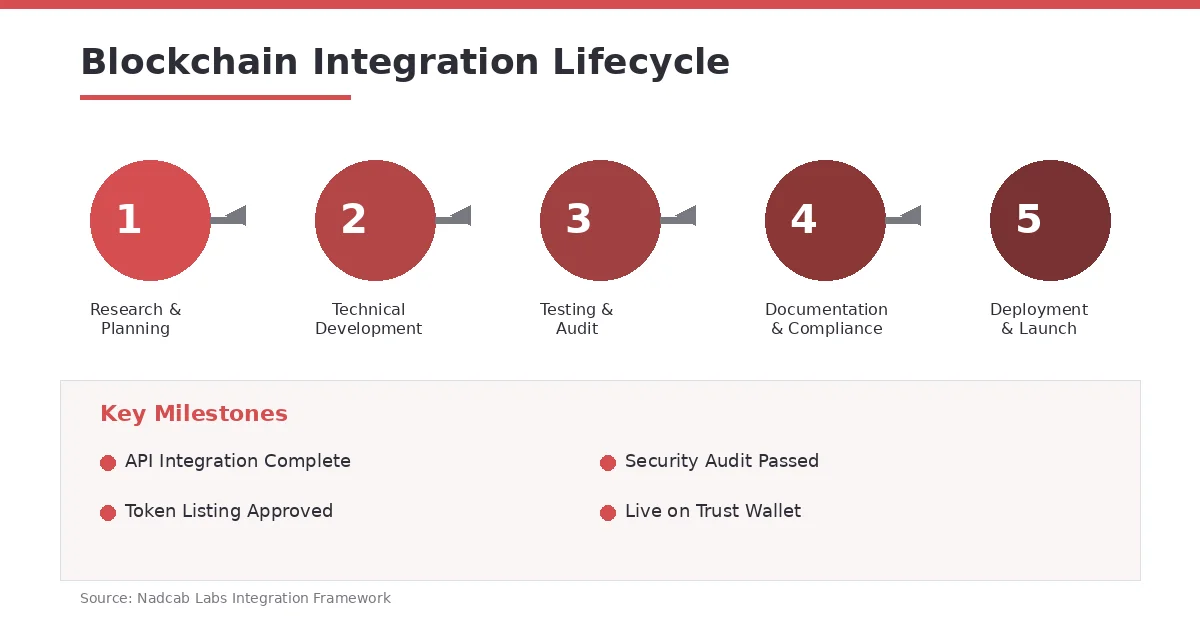
Every blockchain goes through a defined lifecycle before it appears on Trust Wallet. Understanding this lifecycle helps you plan your timeline and allocate resources properly. Here is how it breaks down:
| Phase | Activities | Typical Duration |
|---|---|---|
| Research and Planning | Evaluate blockchain specs, consensus type, address format, and Trust Wallet compatibility | 1 to 2 weeks |
| Technical Development | Build API integrations, configure RPC nodes, set up block explorer connectivity | 2 to 4 weeks |
| Testing and Audit | Run testnet transactions, verify balance queries, stress-test node responses | 1 to 3 weeks |
| Documentation and Compliance | Prepare network specs, token details, logo assets, and compliance paperwork | 1 to 2 weeks |
| Deployment and Launch | Submit PR to Trust Wallet GitHub, address review feedback, go live | 1 to 2 weeks |
The total timeline usually falls between 4 and 12 weeks. Projects with well-documented code and stable mainnets tend to move through faster. Projects that are still working out bugs in their node software or have inconsistent block times often face delays during the review stage.
One thing we always tell our clients at Nadcab Labs is this: preparation is everything. The more polished your technical stack is before we begin the integration, the smoother the entire process will be. Our team handles the heavy lifting, but having a stable foundation to build on makes a real difference.
Step-by-Step Process to Add Your Blockchain to Trust Wallet
Let us get into the specific steps involved. This is the process we follow at Nadcab Labs for every Trust Wallet integration project.
Step 1: Blockchain Readiness Assessment
Before anything else, we check whether your blockchain is ready for integration. This means verifying that your mainnet is live and stable, your nodes are publicly accessible, your block explorer is functional, and your transaction format is well-defined. If you are running a blockchain based on a Delegated Proof of Stake (DPoS) mechanism, there are specific node requirements that need to be met. We check all of these upfront.
Step 2: Fork and Configure the Trust Wallet Core Library
Trust Wallet uses an open-source library called Wallet Core. To add support for a new blockchain, you need to fork this library and add the chain-specific logic. This includes defining the address derivation path, transaction signing methods, and serialization formats. Our developers have contributed to dozens of Wallet Core forks, so we know the codebase inside and out.
Step 3: API and Node Integration
Trust Wallet needs to communicate with your blockchain. That means setting up reliable RPC endpoints or REST APIs that can handle balance queries, transaction broadcasting, and history retrieval. Node reliability is critical here. If your nodes go down or respond slowly, the wallet experience suffers. We help projects set up redundant node infrastructure so there is always a fallback. This is closely related to how node synchronization in blockchain networks works, and why getting it right is essential for wallet integrations.
Step 4: Asset Repository Submission
Once the technical integration is ready, the next step is adding your blockchain and token information to the Trust Wallet Assets repository on GitHub. This includes your chain’s logo, token logos, network details, and metadata. Everything has to follow Trust Wallet’s formatting guidelines exactly. A small mistake in the JSON file or an incorrectly sized logo can result in a rejected pull request.
Step 5: Testing on Testnet and Mainnet
We run extensive tests before submitting anything for review. This includes sending and receiving transactions on both testnet and mainnet, checking balance accuracy across multiple wallets, and verifying that the DApp browser can interact with smart contracts on your chain. If you are wondering how testnets fit into this picture, you might find it useful to read about the 7 popular testnets for blockchain development and how they are used in real-world projects.
Step 6: Review and Iteration
After submission, the Trust Wallet team reviews your pull request. They may request changes, ask for clarifications, or flag issues with your implementation. This back-and-forth is normal. Our team at Nadcab Labs stays on top of every review cycle, responding quickly and making the necessary adjustments. This is where having an experienced integration partner really pays off. We know the common pitfalls and can address feedback faster than teams doing this for the first time.
Step 7: Go Live
Once your pull request is merged, your blockchain is officially available on Trust Wallet. Users can now see your chain in the wallet, add custom tokens, and interact with your DApps through the built-in browser. It is a big milestone, and it usually comes with a noticeable bump in user activity and token transactions.
Get Your Blockchain Listed on Trust Wallet
Ready to put your blockchain in front of 60M+ users? Nadcab Labs handles the entire integration process, from technical development to final deployment.
Technical Requirements for Trust Wallet Integration
Trust Wallet does not accept just any blockchain. There are specific technical requirements that your project must meet. Here is a breakdown of the most important ones:
| Requirement | Details | Why It Matters |
|---|---|---|
| Live Mainnet | Your blockchain must be fully operational with a public mainnet | Trust Wallet will not list testnets or pre-launch chains |
| Public RPC/API Endpoints | Accessible and reliable endpoints for querying the chain | The wallet relies on these to show balances and process transactions |
| Block Explorer | A working block explorer that users can verify transactions on | Transparency and user trust depend on transaction verification |
| Token Standard | ERC-20, BEP-20, SPL, or your chain’s native standard must be well defined | Proper token standards ensure wallet compatibility |
| Logo and Branding Assets | High-resolution PNG logos (256×256) in the correct format | Required for the asset repository and user-facing display |
| Documentation | Complete network specs, coin type registration, and protocol documentation | Reviewers use this to evaluate your submission |
One area where we see projects struggle is with token standards. If your blockchain uses a custom token standard that is not widely known, you will need extra documentation to explain how it works. Interestingly, newer standards like ERC-433 for better blockchain transactions are starting to gain traction, though Trust Wallet currently focuses on established standards.
How Trust Wallet Compares to Other Wallets for Integration
Before committing to a wallet integration, it helps to understand how Trust Wallet stacks up against other popular options. Each wallet has its own strengths and limitations, and your choice should depend on where your target audience actually is.
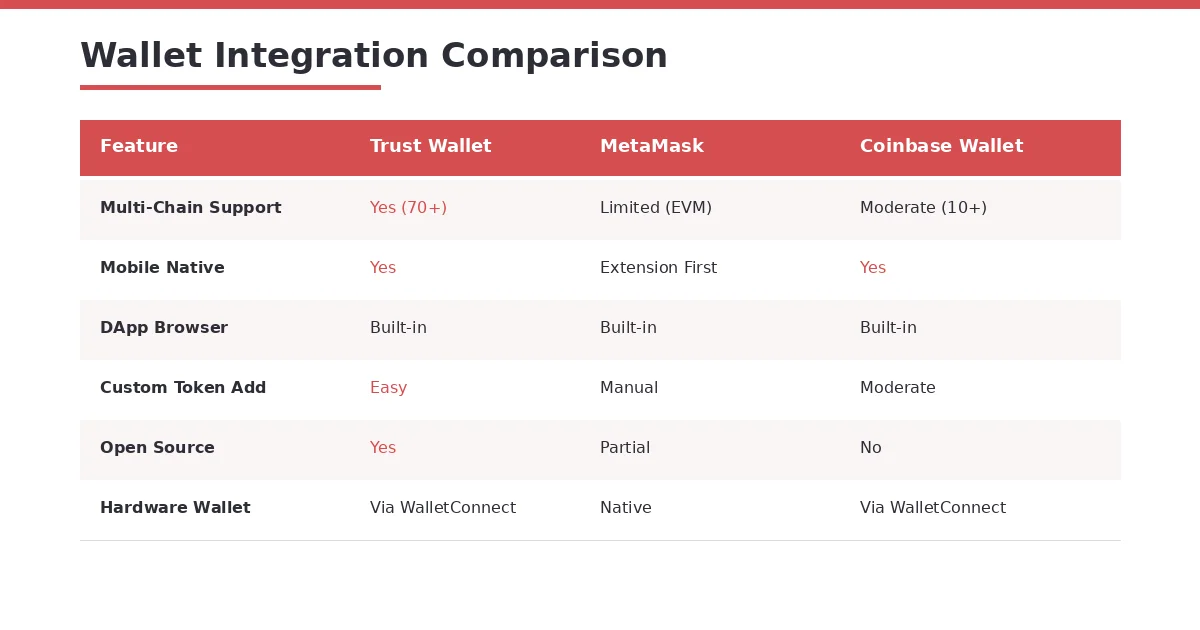
| Parameter | Trust Wallet | MetaMask | Coinbase Wallet |
|---|---|---|---|
| Multi-Chain Support | 70+ blockchains | EVM chains only | 10+ blockchains |
| Platform Focus | Mobile first | Browser extension first | Mobile and extension |
| Integration Complexity | Moderate (GitHub PR-based) | Low for EVM, high for non-EVM | Partnership-based |
| DApp Browser | Built-in | Built-in | Built-in |
| Open Source | Yes, fully open source | Partially open source | No |
| User Base | 60M+ active users | 30M+ active users | 10M+ active users |
Trust Wallet clearly wins on multi-chain support and user base size. If your blockchain is not EVM-compatible, Trust Wallet is especially attractive because MetaMask does not natively support non-EVM chains. The open-source nature of Trust Wallet also means you have full visibility into how your blockchain will be integrated, which is a big plus for transparency.
Many of the blockchain projects we work with at Nadcab Labs need integration across multiple wallets. We often start with Trust Wallet because it offers the broadest reach, and then extend to other wallets based on the project’s target markets.
Security Considerations When Adding a Blockchain to Trust Wallet
Security is not something you add at the end of the integration process. It has to be baked in from day one. Trust Wallet takes this seriously, and so do we.
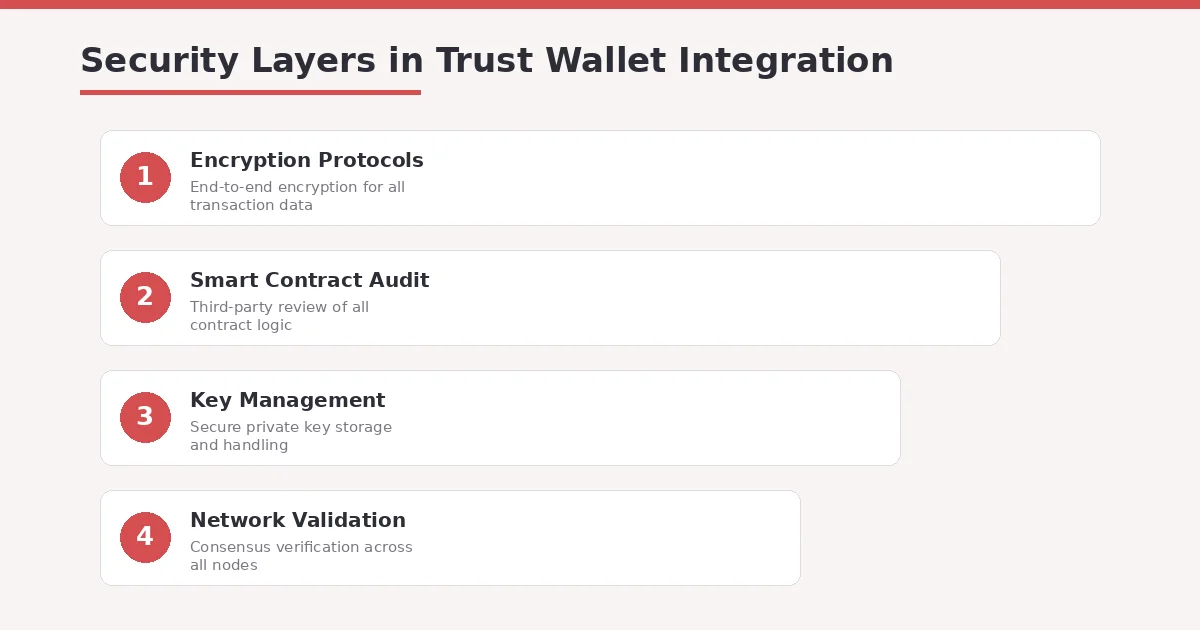
When we integrate a new blockchain into Trust Wallet, there are four main security areas we focus on.
Private Key Management: Trust Wallet generates and stores private keys locally on the user’s device. When adding a new blockchain, the key derivation path must follow BIP-44 standards or whatever standard your chain uses. Any deviation must be thoroughly documented and tested to make sure keys are generated correctly and consistently.
Transaction Signing: Every transaction on your blockchain needs to be signed locally on the device before being broadcast to the network. The signing logic has to be airtight. A bug in the transaction signing code could lead to lost funds, which is the worst possible outcome for any wallet integration.
Smart Contract Audit: If your blockchain supports smart contracts, and most do these days, those contracts need to be audited by a reputable third party. Trust Wallet’s review team will want to see audit reports before approving your integration. This is especially important if your blockchain uses techniques like Plasma in blockchain for scaling, since those add another layer of complexity that must be verified.
Network Security: Your blockchain’s network must be robust enough to resist common attacks. This includes 51% attacks, Sybil attacks, and DDoS attempts. Trust Wallet does not want to list a chain that could suffer a catastrophic failure, as that would reflect poorly on the wallet itself. A solid understanding of how sidechain pegs in blockchain function can be particularly relevant if your project involves cross-chain bridges or interoperability layers.
At Nadcab Labs, our security team has handled audits and security reviews for over 150 blockchain projects. We know what vulnerabilities to look for and how to fix them before they become problems during the Trust Wallet review process.
Common Challenges and How to Overcome Them
No integration project is completely smooth. There are always bumps along the way. Here are some of the most common challenges we have seen over the years and how we address them.
Inconsistent Node Responses: This is probably the number one issue. If your RPC nodes return slightly different data for the same query, it creates problems for the wallet’s balance display and transaction history. The fix is straightforward but requires attention: set up multiple nodes behind a load balancer and make sure they are all synced to the same block height. If you want to dig deeper into this topic, our guide on node synchronization in blockchain covers the technical details.
Non-Standard Address Formats: Some blockchains use address formats that do not follow common conventions. While this is fine from a technical standpoint, it means extra work during integration. The address validation logic in Wallet Core needs to be customized, and the checksum algorithm has to be implemented correctly.
Slow Block Times: If your blockchain has unusually long block times, users may experience delays when checking balances or waiting for transaction confirmations. We work with projects to optimize their node configurations and sometimes suggest caching strategies to improve the wallet’s responsiveness.
Incomplete Documentation: Trust Wallet’s review team relies on your documentation to understand your blockchain. If it is incomplete or unclear, the review process stalls. We have seen projects lose weeks because their documentation was missing basic details like coin type numbers or address encoding specifications. Our documentation team at Nadcab Labs prepares everything from scratch when needed, following Trust Wallet’s exact formatting requirements.
Projects that have dealt with orphan blocks in their blockchain know how frustrating chain reorganizations can be. During Trust Wallet integration, we specifically test how the wallet handles orphan blocks and chain reorgs to make sure user balances are always displayed accurately.
The Role of Blockchain Scalability in Wallet Integration
Scalability is another factor that directly affects how well your blockchain works within Trust Wallet. A blockchain that can handle a high volume of transactions per second provides a better experience for wallet users. Slow transaction processing leads to long confirmation times, which frustrates users.
This is where newer scaling solutions come into play. Layer 3 blockchains are starting to offer interesting approaches to scalability that could make wallet integration even smoother in the future. By offloading specific application-level transactions to a dedicated layer, these chains can maintain high throughput without congesting the base layer.
At Nadcab Labs, we always evaluate a blockchain’s scalability profile before starting the integration process. If we identify potential bottlenecks, we work with the project team to address them. This might involve optimizing block sizes, adjusting gas parameters, or implementing state pruning to keep node storage requirements manageable.
The connection between scalability and wallet integration is straightforward. The more transactions your blockchain can process efficiently, the better the experience will be for Trust Wallet users. And a good user experience drives adoption, which is the whole point of getting listed in the first place.
Real-World Use Cases: Blockchain Integration Beyond Crypto
Trust Wallet integration is not just about cryptocurrency trading. The use cases are expanding rapidly. Blockchains focused on supply chain management, decentralized identity, and even smart cities using blockchain for energy management are now seeking wallet listings to give their users easy access to native tokens.
For example, a blockchain project focused on decentralized energy trading might issue tokens that represent energy credits. By listing on Trust Wallet, users in participating smart cities could easily store and transfer these credits from their phones. The wallet becomes the gateway to a real-world utility, not just a tool for speculation.
We have worked with projects across multiple verticals at Nadcab Labs. From DeFi platforms and NFT marketplaces to enterprise blockchain solutions, the integration process follows the same core principles. What changes is the specific configuration and the documentation that supports it.
Why Nadcab Labs is the Right Partner for Trust Wallet Integration
We have been in the blockchain space for over 8 years. In that time, we have worked on more than 200 blockchain projects, including dozens of wallet integrations. That experience gives us something that is hard to replicate: pattern recognition. We know what works, what does not, and where most projects run into trouble.
Here is what sets us apart:
Direct Integration Experience: Our developers have hands-on experience with Trust Wallet’s Wallet Core library, its Assets repository, and its review process. We do not learn on your project. We bring proven expertise from day one.
End-to-End Service: We handle everything from the initial readiness assessment to the final deployment. You do not need to coordinate between multiple vendors or manage the technical details yourself.
Ongoing Support: Integration is not a one-time event. Blockchains evolve, Trust Wallet updates its requirements, and new features need to be supported. We provide ongoing maintenance and support to keep your integration running smoothly.
Transparent Communication: We keep you informed at every stage. You will always know where your integration stands, what is coming next, and if there are any issues that need your attention.
If you are looking for a blockchain company with real-world Trust Wallet integration experience, Nadcab Labs is a solid choice. We take pride in delivering results that speak for themselves.
Frequently Asked Questions
Q1.How long does it take to add a new blockchain to Trust Wallet?
The timeline depends on the readiness of your blockchain. If your mainnet is stable, your documentation is complete, and your nodes are reliable, the process usually takes between 4 and 12 weeks. The majority of that time goes into technical development and testing. Projects that have incomplete documentation or unstable node infrastructure often face delays during the Trust Wallet review stage. Working with an experienced partner like Nadcab Labs can help you avoid common bottlenecks and keep the process on track from start to finish.
Q2.What are the minimum requirements for getting a blockchain listed on Trust Wallet?
Your blockchain needs a live mainnet, publicly accessible RPC or API endpoints, a working block explorer, and proper documentation that covers network specifications and token standards. You will also need to provide branding assets like high-resolution logos in the correct dimensions. Trust Wallet will not consider blockchains that are still in testnet phase or do not have a proven track record of uptime and security. If your chain uses a non-standard consensus mechanism, additional documentation explaining how it works may also be required.
Q3.Can any blockchain be added to Trust Wallet, or are there restrictions?
Not every blockchain qualifies. Trust Wallet has technical and compliance standards that must be met. The blockchain must have a functioning mainnet, reliable infrastructure, and proper security measures in place. Additionally, the project behind the blockchain needs to demonstrate legitimacy and a real use case. Scam tokens or chains with questionable practices will be rejected. Trust Wallet also gives preference to blockchains with active developer communities and clear roadmaps, as these are more likely to be maintained long-term.
Q4.Do I need a security audit before integrating with Trust Wallet?
While Trust Wallet does not always mandate a third-party security audit for every integration, it is strongly recommended. Projects that can show audit reports from reputable firms tend to move through the review process faster. If your blockchain supports smart contracts, an audit becomes even more important because vulnerabilities in contract logic can lead to fund losses. At Nadcab Labs, we include security review as a standard part of our integration process to make sure your submission meets Trust Wallet standards.
Q5.What is the cost of adding a blockchain to Trust Wallet?
The cost varies depending on the complexity of your blockchain and the scope of work required. Factors that influence pricing include the consensus mechanism used, the level of customization needed for Wallet Core, the state of your existing documentation, and whether a security audit is required. Trust Wallet itself does not charge a listing fee for open-source contributions, but the development work involved can range from a few thousand to tens of thousands of dollars. Nadcab Labs provides detailed cost estimates upfront.
Q6.Can Nadcab Labs help with listing tokens on Trust Wallet, not just blockchains?
Yes. Nadcab Labs handles both blockchain integration and individual token listing on Trust Wallet. Token listing is a simpler process compared to adding a full blockchain, as it typically involves adding your token’s contract address, logo, and metadata to the Trust Wallet Assets repository. However, the token must be deployed on a blockchain that Trust Wallet already supports. If your token runs on a custom chain that is not yet listed, we handle the full integration, including the blockchain and all associated tokens, as a complete package.
Explore Services
Related Services
Reviewed by

Aman Vaths
Founder of Nadcab Labs
Aman Vaths is the Founder & CTO of Nadcab Labs, a global digital engineering company delivering enterprise-grade solutions across AI, Web3, Blockchain, Big Data, Cloud, Cybersecurity, and Modern Application Development. With deep technical leadership and product innovation experience, Aman has positioned Nadcab Labs as one of the most advanced engineering companies driving the next era of intelligent, secure, and scalable software systems. Under his leadership, Nadcab Labs has built 2,000+ global projects across sectors including fintech, banking, healthcare, real estate, logistics, gaming, manufacturing, and next-generation DePIN networks. Aman’s strength lies in architecting high-performance systems, end-to-end platform engineering, and designing enterprise solutions that operate at global scale.