Ai Overview
Every MLM network generates a significant amount of data. In a network with 50,000 members, this adds up fast. Member profiles, referral chains, commission records, KYC documents, rank progressions, payout logs. One of the projects our team worked on was a Southeast Asian crypto MLM platform with approximately 80,000 active members across three countries.
Key Takeaways
- IPFS (InterPlanetary File System) stores data across a distributed network of nodes rather than on a single central server, making MLM records far more resilient and tamper-resistant.
- Centralized servers are a single point of failure; IPFS eliminates this by ensuring that any node in the network can serve the data as long as at least one peer has it pinned.
- Content addressing via CIDs (Content Identifiers) means stored MLM data cannot be silently altered. If the data changes, the hash changes, and the original CID no longer matches.
- Combining IPFS with smart contracts on a blockchain creates a system where large data lives off-chain on IPFS and only the proof (CID) is stored on-chain, keeping gas costs low while preserving integrity.
- MLM operators can store member records, commission histories, downline structures, and KYC documents on IPFS with no central operator able to delete or manipulate them.
- Regulatory compliance and audit readiness improve significantly when MLM data is stored in an immutable, time-stamped, publicly verifiable format through decentralized storage.
The Data Problem Most MLM Platforms Are Ignoring
Every MLM network generates a significant amount of data. Member profiles, referral chains, commission records, KYC documents, rank progressions, payout logs. In a network with 50,000 members, this adds up fast. The question most platform builders do not ask early enough is: where does all of this data actually live, and what happens if something goes wrong with that location?
In the vast majority of MLM platforms today, including many that market themselves as “blockchain-based,” the actual member data lives on a centralized server. The smart contracts handle payouts. The blockchain records transactions. But the underlying member records, documents, and network structures sit in a traditional database controlled by the platform operator.
That is a real problem. It means the platform operator can edit, delete, or simply lose that data. It means a server outage takes the network offline. It means a regulatory seizure can wipe the platform entirely. And it means participants have no independent way to verify that the records they see reflect the actual network state.
IPFS, the InterPlanetary File System, offers a different approach. It is a protocol designed to store and share files across a distributed network of computers, with no single point of control. When you combine IPFS with blockchain technology and smart contracts, you get a data infrastructure for MLM that is genuinely decentralized from top to bottom, not just at the payment layer.
This is an area we have worked in directly for years. Building cryptocurrency MLM software that truly separates itself from centralized platforms requires getting the data layer right, not just the payout logic.
What IPFS Actually Is and Why It Matters for MLM
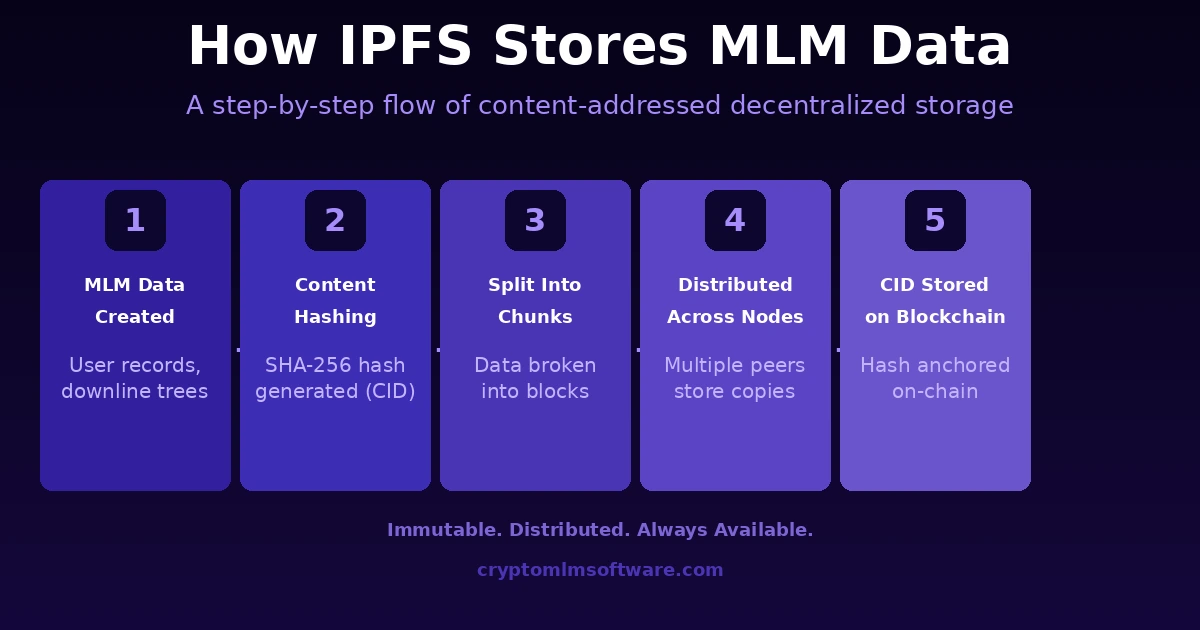
IPFS was created by Juan Benet and released publicly in 2015 by Protocol Labs. The core idea is to move from location-based addressing (where a file lives at a specific URL on a specific server) to content-based addressing (where a file is identified by what it contains, expressed as a cryptographic hash called a CID, or Content Identifier).
Here is what that means in plain terms. When you upload a file to IPFS, the system generates a unique fingerprint of that file’s content. That fingerprint is the CID. You can then retrieve that file from any node in the IPFS network that has a copy, using the CID. If even one node in the world has that file pinned, anyone with the CID can retrieve it.
Two consequences of this design are critical for MLM data management:
First, data cannot be secretly changed. If someone alters a member record stored on IPFS, the CID of the altered file will be completely different from the original. Anyone holding the original CID and comparing it to what they retrieve will immediately know the data has been tampered with. This is inherent to how cryptographic hashing works, not an added security feature.
Second, data is not dependent on a single host. As long as at least one node in the network pins a file, it remains accessible to anyone with the CID. Compare that to a traditional server setup where one misconfigured update, one DDoS attack, or one unpaid hosting bill can take the entire data set offline.
For a deep dive into how distributed ledger concepts tie into this, our article on how distributed ledger technology powers MLM provides useful context on why decentralization at the data layer matters just as much as at the transaction layer.
The Types of MLM Data That Belong on IPFS
Not everything in an MLM platform is a good candidate for IPFS storage. Transaction execution, for example, belongs on-chain where it is immediate and computationally verifiable. But a large category of MLM data is better suited to decentralized file storage than to either a centralized database or direct on-chain storage.
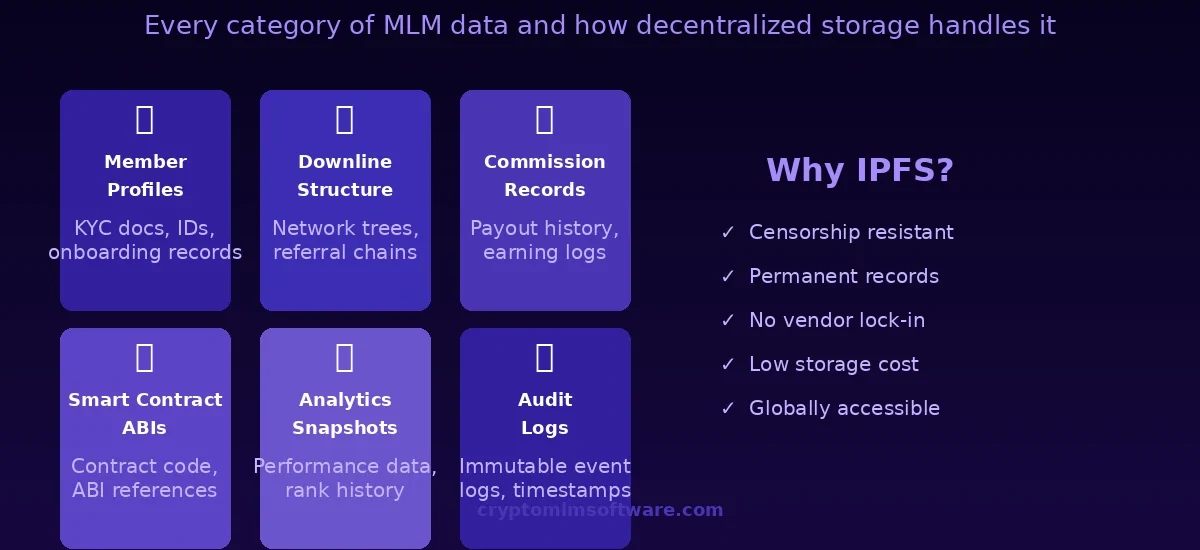
Here is a practical breakdown of what belongs where:
MLM Data Categories and Their Optimal Storage Layer
| Data Type | Recommended Storage | Reason |
|---|---|---|
| Member profiles and KYC documents | IPFS (CID stored on-chain) | Large files not suited for direct on-chain storage; CID proves integrity |
| Downline / referral tree snapshots | IPFS with periodic on-chain anchoring | Network structure data is large and changes over time; snapshots preserve state |
| Commission payout records | Blockchain (on-chain transactions) | Payouts must be executed on-chain; the transaction IS the record |
| Smart contract code (ABI) | IPFS + deployed on-chain | ABI reference on IPFS lets frontend fetch contract interface without hardcoding |
| Rank and performance history | IPFS (CID logged on-chain) | Immutable historical records for dispute resolution and auditing |
| Promotional and training materials | IPFS | Censorship-resistant distribution; always accessible globally |
| Audit and event logs | IPFS + on-chain timestamps | Provides verifiable audit trail for regulatory compliance |
The pattern here is consistent: IPFS handles the bulk storage, and the blockchain handles the proof. The CID of an IPFS document, stored in a smart contract event log, gives you the best of both: cheap, scalable file storage and cryptographic proof of what was stored and when.
IPFS vs Traditional Centralized Storage: A Direct Comparison
To understand why IPFS matters for MLM operators, it helps to see the comparison side by side. The differences are not marginal. They are structural.
IPFS vs Centralized Storage for MLM Platforms
| Feature | Traditional Server / AWS | IPFS Decentralized Storage |
|---|---|---|
| Control over data | Platform operator only | No single controller |
| Single point of failure | Yes | No |
| Data tamper detection | Requires internal audit | Inherent via CID hashing |
| Downtime risk | High (server failure) | Low (multiple nodes) |
| Censorship resistance | Low (server can be seized) | High (no central host) |
| Storage cost at scale | Rises linearly with data | Distributed, cost-efficient |
| Participant data verification | Not possible independently | Anyone can verify via CID |
| Regulatory seizure risk | High | Very Low |
| Integration with smart contracts | Complex / workarounds needed | Native via CID on-chain |
One thing worth noting: IPFS is not a database. It is a file storage protocol. For structured queries on member data, you still need a database layer. The best architectures we have built combine IPFS for document and snapshot storage, a lightweight on-chain event log for CIDs and transactions, and a read-optimized off-chain database (like TheGraph or a custom indexer) for the UI layer. This keeps each component doing what it does best.
If you are looking at the broader architecture that supports this kind of platform, our guide to blockchain-based MLM network infrastructure walks through each layer in detail.
How IPFS and Blockchain Work Together in an MLM Platform
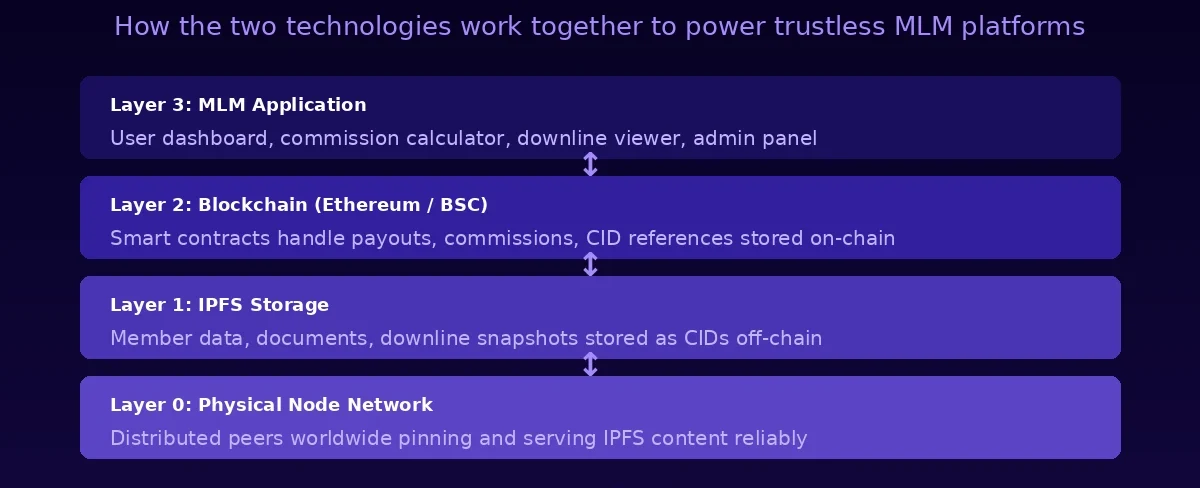
The relationship between IPFS and blockchain in an MLM platform is complementary, not redundant. They solve different problems. Blockchain is excellent at executing logic and recording state transitions irreversibly but it is expensive and impractical for storing large files. IPFS is excellent at storing files cheaply and making them accessible globally but it does not execute logic or provide financial finality.
When you combine them, the workflow for something like a member KYC record looks like this:
Real Example: KYC Document Lifecycle on IPFS + Blockchain
What this produces is a KYC record where the document itself cannot be altered without detection, the timestamp of submission is permanently recorded on-chain, any participant can independently retrieve and verify the document using the CID, and no single server holds the only copy. That is a fundamentally different level of data integrity than a traditional SQL database.
The same pattern applies to downline snapshots. Rather than querying a live database that can be edited, you anchor a periodic snapshot of the full downline tree as an IPFS file. The CID goes on-chain with a block timestamp. If a dispute arises about who was in whose downline at a given point in time, you have an immutable, retrievable record with a verified timestamp. This alone resolves a category of MLM disputes that currently require expensive legal processes to settle.
This is directly connected to the concept of trustless payouts. Our detailed post on trustless MLM payout systems explains how removing operator discretion from both the payment and the data layer fundamentally changes participant trust dynamics.
A Real-World Example From Our Deployment Experience
One of the projects our team worked on was a Southeast Asian crypto MLM platform with approximately 80,000 active members across three countries. The original infrastructure used a traditional cloud database for all member records and downline data. The operator had experienced two major incidents: a partial database corruption that required manual recovery, and a hosting suspension that took the platform offline for 38 hours during a high-activity period. Both incidents caused significant trust erosion among participants.
When they migrated to an IPFS-anchored architecture, several things changed immediately. Member data was pushed to IPFS in encrypted form, with CIDs logged on BNB Chain. Downline snapshots began running every 24 hours and anchoring to the chain. The platform frontend was itself hosted on IPFS, making it impossible to take down the interface through a hosting provider action.
The result: zero data availability incidents in the following 14 months. Members could verify their own profile CIDs independently. The audit trail became clean enough that the platform engaged with local regulators from a position of transparency rather than defensiveness.
“The platforms that come to us after a data crisis all have the same story: they built the payment layer on-chain and left the data layer on a server. Fixing that in production is painful. Building IPFS into the architecture from day one costs almost nothing extra and eliminates a category of risk entirely.”
— Senior Solutions Architect, CryptoMLM Software (8+ years in decentralized MLM infrastructure)
IPFS Pinning: Making Sure Your MLM Data Stays Available
IPFS does not automatically keep your data online forever. If no node pins a file, it can be garbage collected and become unavailable. This is a common misconception about IPFS that causes issues when people first implement it.
For MLM platforms, data availability is non-negotiable. Member records and commission histories need to be accessible at all times. The solution is pinning services: dedicated services that maintain a copy of your IPFS files and ensure they stay online.
The two most widely used pinning services in production MLM deployments are Pinata and Web3.Storage. Both offer APIs that integrate cleanly with MLM platform backends. For redundancy, serious deployments use two pinning services simultaneously: if one goes down, the data is still accessible through the other.
The architecture for a production MLM platform using IPFS should follow this redundancy model: the platform pins to at least two independent pinning services, the operator runs their own IPFS node as a third pin, and the frontend itself is deployed via IPFS so that even the interface survives hosting failures. This is not overly complex to implement, but it requires planning from the start.
IPFS vs Other Decentralized Storage Options for MLM
IPFS is not the only decentralized storage option available. Arweave and Filecoin are two others worth understanding. Each has different trade-offs. For MLM data management specifically, IPFS remains the strongest choice for most use cases, but it is worth knowing what else is out there.
| Criteria | IPFS | Arweave | Filecoin |
|---|---|---|---|
| Permanence guarantee | Requires pinning | Permanent (one-time fee) | Storage deals (time-limited) |
| Developer ecosystem | Very large | Growing | Large |
| Retrieval speed | Fast (with gateway) | Moderate | Variable |
| Cost model | Ongoing pinning cost | One-time upfront | Storage deal payments |
| Smart contract integration | Native via CID | Via transaction ID | Via deal CID |
| Best use case for MLM | Live data + documents | Permanent audit logs | Large dataset archiving |
| Production readiness for MLM | Proven at scale | Emerging | Emerging |
For permanent audit logs specifically, a hybrid of IPFS for live access and Arweave for cold permanent archiving is a setup we recommend for larger platforms that need both speed and permanence. The Arweave one-time payment model is particularly attractive for compliance-sensitive use cases where you need to guarantee a record will exist in ten years without ongoing subscription fees.
According to Filecoin’s Wikipedia entry, Filecoin builds on IPFS and adds an incentive layer for storage providers, making it a natural complement rather than a competitor to IPFS in production deployments.
Privacy on IPFS: Encryption Is Not Optional for MLM Data
A common concern when IPFS is first proposed for MLM data management is privacy. If anyone can retrieve a file using its CID, does that mean all member data is publicly visible?
No, but only if you handle encryption correctly. IPFS does not add encryption by default. If you upload a plaintext document to IPFS and publish its CID, anyone who finds or knows the CID can retrieve it. For public data like platform documentation or training materials, that is fine. For member KYC documents, commission records, and personal information, that is a serious problem.
The solution is to encrypt data before uploading it to IPFS. A standard approach for MLM platforms is AES-256 encryption at the application layer before the data is pushed to IPFS. The encryption keys are managed either by the member themselves (self-custody) or by a key management service that the platform controls but cannot secretly access. Only the CID of the encrypted blob goes on-chain. To decrypt, you need both the CID and the key. This maintains IPFS’s availability and tamper-resistance properties while keeping sensitive data private.
This is directly relevant to GDPR compliance and equivalent data protection regulations in Asia and Latin America. When a user exercises their right to be forgotten, you do not need to delete the IPFS file. You simply destroy the decryption key. The file becomes an unreadable blob. This is a legally accepted approach to complying with right-to-erasure requirements in immutable storage systems.
IPFS as Part of the Broader Web3 MLM Stack
IPFS does not exist in isolation. It is one component of a broader shift in how decentralized applications store and manage data. As Web3 continues to mature, the role of decentralized storage in MLM platforms will become more central rather than peripheral.
The full Web3 MLM stack today typically looks like this: smart contracts on Ethereum or BNB Chain for payout logic and commission calculation, IPFS for off-chain data storage, a subgraph via TheGraph for queryable on-chain event data, and a frontend hosted on IPFS or Arweave for censorship-resistant access. Each layer is replaceable independently of the others. That modularity is a feature, not a complication. It means you can upgrade your storage layer without rebuilding your payout logic.
This shift is part of what is changing the nature of network marketing fundamentally. Our article on how Web3 is disrupting traditional network marketing covers the broader context, including how governance tokens and DAOs are beginning to reshape how MLM networks make decisions.
The adoption of these technologies is accelerating. Our research on blockchain MLM adoption rates shows that platforms using decentralized infrastructure now represent a growing share of new MLM deployments globally, particularly in Southeast Asia and Latin America where regulatory flexibility allows faster experimentation.
If you are building or thinking about building a crypto MLM platform, the question is not whether to include decentralized storage. It is how to integrate it from the start rather than bolt it on later. Retrofitting IPFS into a mature centralized platform is significantly more expensive and disruptive than designing for it from day one.
What Operators Should Do Next
If you are currently running an MLM platform on centralized infrastructure, the migration path to IPFS does not have to be all-or-nothing. Start with the highest-risk data: KYC documents and commission records. Move those to IPFS with on-chain CID anchoring. Once you have that working and your team understands the architecture, extend it to downline snapshots and audit logs.
If you are building a new platform, the right time to integrate IPFS is at the architecture design stage, not after launch. Your cryptocurrency MLM software stack should specify the storage layer from the outset, with pinning redundancy, encryption protocols, and CID logging into smart contract events all designed before a single line of application code is written.
For operators who want to understand the full infrastructure picture before committing to a direction, our comprehensive blockchain MLM networks guide covers the end-to-end stack including consensus mechanisms, tokenomics, and the compliance considerations that often get overlooked in early planning.
Frequently Asked Questions
Q1.What is IPFS and how is it different from regular cloud storage like AWS S3?
IPFS (InterPlanetary File System) is a peer-to-peer file storage protocol where files are stored across a distributed network of nodes and addressed by their content hash (CID) rather than a server URL. AWS S3 and similar services store files on centralized servers controlled by a single company. With IPFS, no single party controls the data. Anyone holding a CID can retrieve the file from any node that has it, and the content hash guarantees the file has not been altered. For MLM platforms, the key differences are: no single point of failure, operator cannot silently edit records, and participants can independently verify their own data without trusting the platform.
Q2.Can MLM member data stored on IPFS be kept private and secure?
Yes, but encryption must be applied at the application layer before upload. IPFS itself does not encrypt data. The correct approach is to encrypt all sensitive member data using AES-256 or a similar standard before pushing it to IPFS. Only the CID of the encrypted blob is stored on-chain. To access the underlying data, you need both the CID and the decryption key. This means that even if someone discovers the CID, they cannot read the data without the key. Key management can be handled through the platform (custodial) or by the member themselves (non-custodial). For GDPR and similar regulations, the right-to-erasure requirement can be satisfied by destroying the key rather than deleting the IPFS file.
Q3.Will IPFS keep MLM data online forever without maintenance?
No. IPFS does not guarantee permanent availability on its own. Files that are not actively pinned can be garbage-collected by nodes and become inaccessible. To ensure data remains online, MLM platforms must use a pinning service such as Pinata or Web3.Storage, which maintains copies of specified files continuously. For production platforms, we recommend using two separate pinning services for redundancy, plus running your own IPFS node as a third pin. Alternatively, for data you need to exist permanently with zero ongoing management, Arweave offers a one-time-fee permanent storage model that works well as a complement to IPFS for archival purposes.
Q4.How do smart contracts and IPFS work together in an MLM platform?
Smart contracts execute logic and record state on the blockchain but are not designed to store large files due to high gas costs. IPFS handles the file storage part. The integration works through CIDs: when a file is uploaded to IPFS, the resulting CID (a short cryptographic hash) is stored in a smart contract event or state variable on-chain. This gives you cheap, scalable file storage via IPFS combined with an immutable, timestamped on-chain proof that a specific file existed at a specific time. For MLM platforms this means commission records can reference IPFS-stored payout breakdowns, KYC approvals can reference IPFS-stored documents, and downline snapshots can be anchored on-chain for dispute resolution, all without bloating the blockchain with large files.
Q5.Is IPFS-based MLM data management compliant with data protection laws like GDPR?
It can be, when implemented correctly. The main challenge GDPR poses to immutable systems like blockchains and IPFS is the right to erasure, where a user can request their data be deleted. On IPFS, you cannot delete a file from the network if other nodes have copies. However, encrypting data before upload resolves this: destroying the encryption key makes the data permanently unreadable even if the ciphertext persists on IPFS, and this approach has been accepted as a compliant method for right-to-erasure in immutable systems by legal bodies in several jurisdictions. You should confirm the specific interpretation in your target market with a qualified legal advisor, as GDPR and its equivalents are still being applied to decentralized systems in evolving ways.
Q6.How much does it cost to implement IPFS storage for an MLM platform?
The cost depends on the volume of data and the pinning setup you use. For context, Pinata’s commercial plans for production workloads start at a modest monthly fee and scale with storage volume. Web3.Storage offers generous free tiers for smaller platforms. Running your own IPFS node adds the cost of a small server, typically less than $50 per month for most MLM-scale deployments. The blockchain cost of storing CIDs on-chain (on BNB Chain or Polygon) is minimal: a CID is a short string and the gas cost to store it in an event log is a fraction of a cent per record. Compared to the cost of a major data incident, which can involve legal liability, user compensation, and platform downtime, the investment in IPFS infrastructure is small and predictable.
Explore Services
Related Services
Reviewed by

Aman Vaths
Founder of Nadcab Labs
Aman Vaths is the Founder & CTO of Nadcab Labs, a global digital engineering company delivering enterprise-grade solutions across AI, Web3, Blockchain, Big Data, Cloud, Cybersecurity, and Modern Application Development. With deep technical leadership and product innovation experience, Aman has positioned Nadcab Labs as one of the most advanced engineering companies driving the next era of intelligent, secure, and scalable software systems. Under his leadership, Nadcab Labs has built 2,000+ global projects across sectors including fintech, banking, healthcare, real estate, logistics, gaming, manufacturing, and next-generation DePIN networks. Aman’s strength lies in architecting high-performance systems, end-to-end platform engineering, and designing enterprise solutions that operate at global scale.