Ai Overview
Every time a new block gets added to a blockchain, something remarkable happens behind the scenes. The node that created the block broadcasts it to all the other nodes it is connected to. Within seconds, the information spreads across thousands of machines worldwide. Each node that receives a new block does not simply accept it blindly.
Key Takeaways
- Node synchronization ensures all computers in a blockchain network maintain identical copies of the ledger, which is fundamental to blockchain reliability.
- Consensus mechanisms like Proof of Work and Proof of Stake help nodes agree on valid transactions and resolve conflicts between different chain versions.
- Proper synchronization prevents double-spending attacks and fraud by maintaining a consistent transaction history across the entire network.
- Gossip protocols and peer-to-peer networks allow nodes to share data quickly without relying on central servers.
- Fault tolerance through synchronization means the network continues operating even when individual nodes fail or go offline.
When you hear about blockchain technology, most discussions focus on cryptocurrencies or smart contracts. But there is a less talked about process that makes all of this possible. Node synchronization is the backbone of every blockchain network. Without it, the entire system would fall apart.
Think of a blockchain network as a group of thousands of computers spread across the world. Each computer, called a node, keeps its own copy of every transaction that has ever happened on that network. Now here is the challenge. When someone sends Bitcoin or executes a smart contract, how do all these computers agree on what actually happened? How do they all update their records at the same time?
This is where node synchronization comes in. It is the process that keeps every node on the same page. And getting it right is one of the biggest technical challenges in blockchain integeration.
What Actually Happens During Node Synchronization
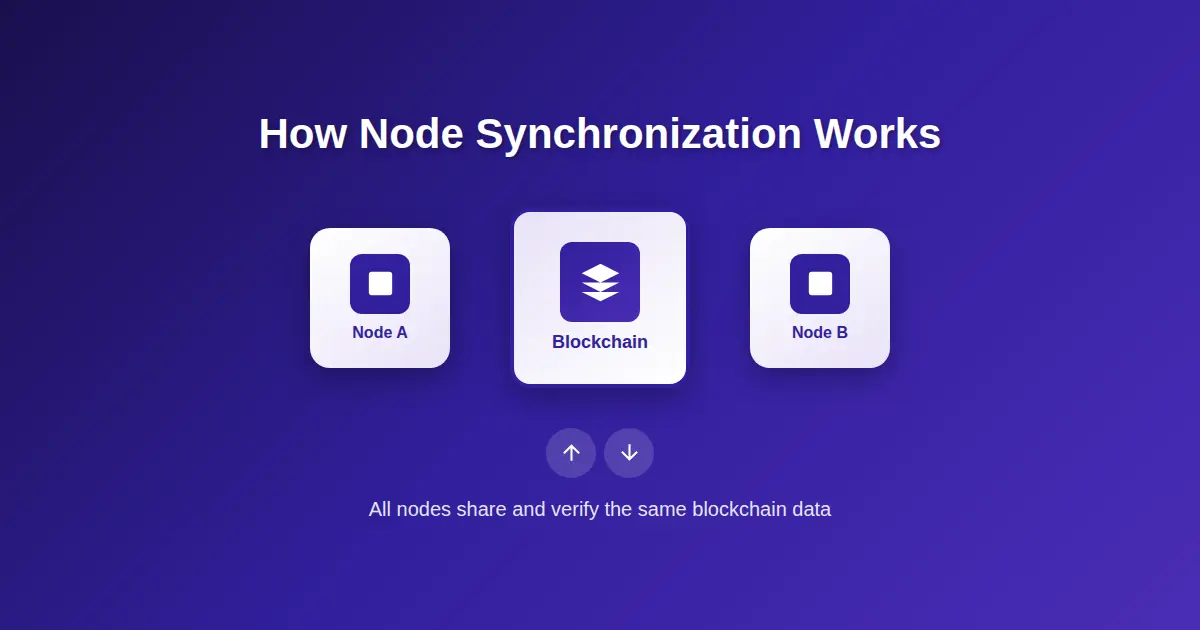 Every time a new block gets added to a blockchain, something remarkable happens behind the scenes. The node that created the block broadcasts it to all the other nodes it is connected to. Those nodes then pass it along to their connections. Within seconds, the information spreads across thousands of machines worldwide.
But broadcasting is just the first step. Each node that receives a new block does not simply accept it blindly. It runs through a verification process. The node checks whether the block follows all the rules of that particular blockchain. It verifies that the cryptographic hash is correct. It confirms that all the transactions inside the block are valid and that no one is trying to spend money they do not have.
According to Wikipedia, a blockchain is a distributed ledger with growing lists of records that are securely linked together via cryptographic hashes. This linking mechanism is what makes verification possible and tampering extremely difficult.
Only after passing all these checks does a node add the block to its local copy of the blockchain. This independent verification by thousands of nodes is what gives blockchain its security. No single node has special authority. Everyone checks everyone else.
Types of Nodes and Their Synchronization Roles
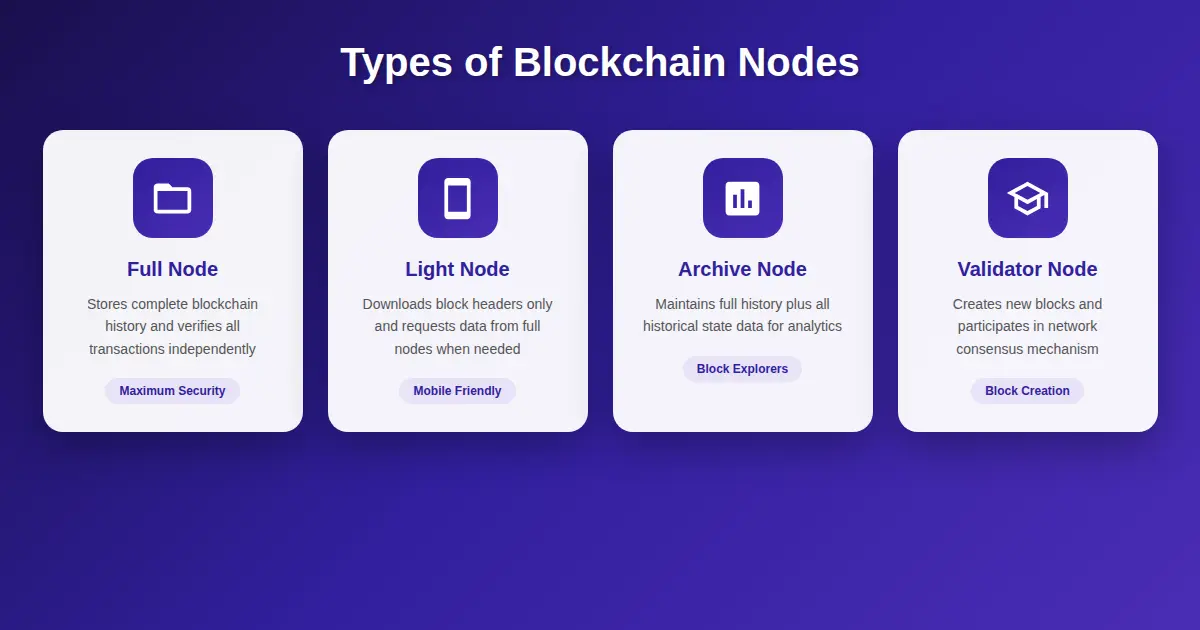
Not all nodes are created equal. Different types of nodes serve different purposes in maintaining network synchronization. Understanding these differences matters if you are building or working with blockchain systems.
| Node Type | Data Stored | Synchronization Requirement | Best Use Case |
|---|---|---|---|
| Full Node | Complete blockchain history | Downloads and verifies every block | Maximum security and independence |
| Light Node | Block headers only | Requests specific data from full nodes | Mobile wallets, limited storage devices |
| Archive Node | Full history plus all historical states | Complete synchronization with state data | Block explorers, analytics platforms |
| Mining/Validator Node | Full blockchain plus pending transactions | Real-time sync with mempool | Block creation and validation |
| RPC Node | Varies based on configuration | Must stay current to serve accurate data | Application interfaces, API endpoints |
Full nodes do the heavy lifting. They store the entire blockchain and verify every transaction independently. When you run a full node, you do not need to trust anyone else. You can confirm everything yourself. The tradeoff is that full nodes require significant storage space and bandwidth.
Light nodes take a different approach. They only download block headers, which are small summaries of each block. When a light node needs to verify a specific transaction, it asks a full node for proof. This makes light nodes perfect for smartphones and devices with limited resources.
How Consensus Mechanisms Drive Synchronization
Synchronization would be meaningless without a way for nodes to agree on which transactions are valid. This is the job of consensus mechanisms. They are the rules that determine how the network reaches agreement.
Proof of Work, used by Bitcoin, requires nodes to solve complex mathematical puzzles. The first node to solve the puzzle gets to add the next block. Other nodes verify the solution is correct before accepting the block. This process is energy-intensive but has proven extremely secure over more than a decade of operation.
Proof of Stake works differently. Instead of competing through computational power, nodes are selected to create blocks based on how much cryptocurrency they have locked up as collateral. If they try to cheat, they lose their stake. This approach uses far less energy while still maintaining security.
To understand how blockchain technology works at a deeper level, you need to grasp how these consensus mechanisms coordinate thousands of independent nodes into a single coherent system.
Comparison of Consensus Mechanisms and Synchronization
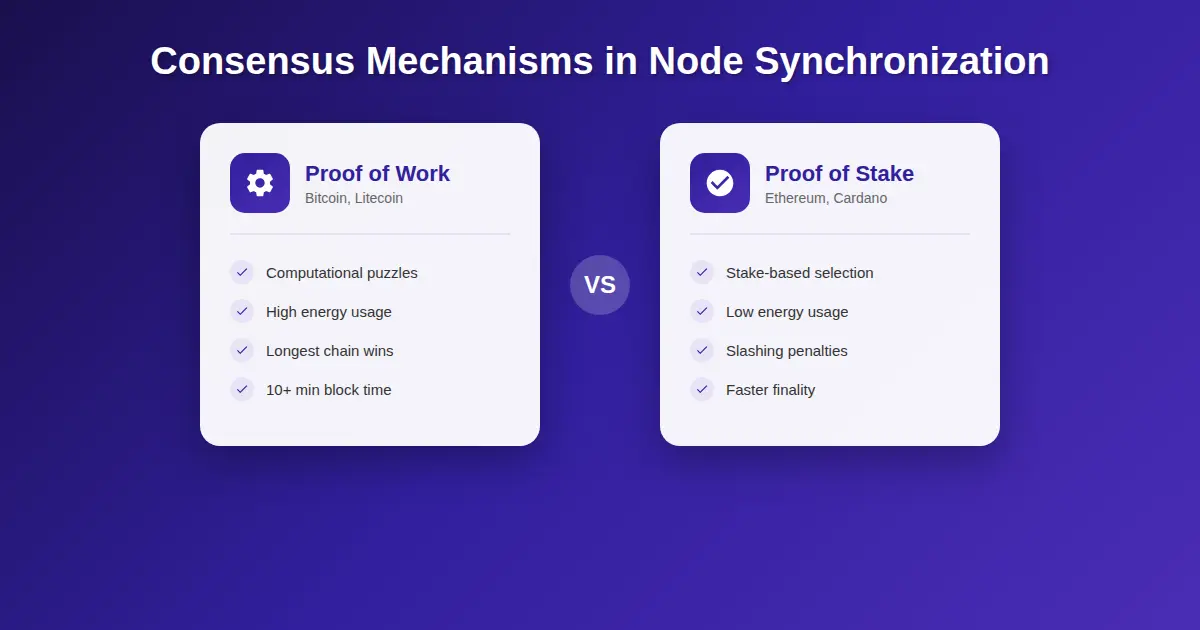
| Factor | Proof of Work | Proof of Stake | Delegated Proof of Stake |
|---|---|---|---|
| Sync Speed | Slower (10+ minutes per block) | Faster (seconds to minutes) | Very fast (few seconds) |
| Energy Usage | High | Low | Very low |
| Finality | Probabilistic (more confirmations = more secure) | Often deterministic | Near instant |
| Fork Resolution | Longest chain wins | Various slashing mechanisms | Elected validators decide |
| Decentralization | High (anyone can mine) | Medium (wealth concentration risk) | Lower (limited validators) |
The Gossip Protocol: How Data Actually Spreads
Blockchain networks use something called a gossip protocol to spread information. The name comes from how gossip spreads in real life. One person tells two friends, those friends each tell two more people, and before long everyone knows.
When a node receives a new transaction or block, it does not broadcast to every other node directly. That would be incredibly inefficient and would not scale. Instead, it sends the data to a handful of nodes it is connected to. Those nodes verify the data and pass it along to their connections.
This peer-to-peer approach has several advantages. There is no central server that could become a bottleneck or point of failure. The network can handle nodes joining and leaving at any time. And because data takes multiple paths through the network, it is resilient against network problems or attacks.
The gossip protocol also includes mechanisms to prevent nodes from being flooded with duplicate data. Once a node has seen a particular transaction or block, it remembers and does not request it again. This keeps bandwidth usage reasonable even on large networks.
Why Synchronization Matters for Security
Synchronization is not just about keeping data consistent. It is a critical security feature. Without proper synchronization, blockchain networks would be vulnerable to various attacks.
Double spending is the classic example. Imagine someone tries to spend the same Bitcoin twice by sending it to two different people at the same time. Without synchronization, different parts of the network might accept different transactions, leading to chaos.
Proper synchronization prevents this. When both transactions propagate through the network, nodes recognize that one spends money that was already spent by the other. Only the first transaction to be included in a valid block gets accepted. The other is rejected by the entire network.
The history of blockchain includes several attempts at double-spend attacks on smaller networks. In each case, the attacks succeeded only because those networks had weak synchronization or insufficient mining power to resist reorganization attacks.
Build Secure and Reliable Blockchain Networks
Need a blockchain solution with rock-solid synchronization? Our team designs networks that stay consistent, secure, and performant at any scale.
The Node Synchronization Lifecycle
Understanding the full lifecycle of node synchronization helps developers build better systems. Here is what happens from the moment a new node joins a network until it becomes a fully synchronized participant.
Stage 1Discovery
The new node connects to the network and finds other nodes to communicate with. This usually involves connecting to known bootstrap nodes or using a peer discovery protocol.
Stage 2Initial Block Download
The node requests and downloads all historical blocks from its peers. For mature blockchains like Bitcoin or Ethereum, this can mean downloading hundreds of gigabytes of data.
Stage 3Verification
Each downloaded block is verified independently. The node checks cryptographic signatures, validates all transactions, and ensures the chain follows all protocol rules.
Stage 4State Building
The node builds its local state database by processing all historical transactions. This allows it to know current account balances and smart contract states.
Stage 5Catching Up
While the node was downloading and verifying old blocks, new blocks were being created. The node must download and process these as well.
Stage 6Full Participation
Once fully synced, the node participates in real-time consensus. It receives new transactions, validates them, and propagates valid blocks to its peers.
Challenges in Node Synchronization
Building synchronization systems that work reliably is harder than it sounds. Developers face several significant challenges.
Network latency is one issue. Information takes time to travel around the world. A node in Tokyo might receive a block milliseconds after a node in London. During those milliseconds, both nodes might be working with different views of the blockchain.
Network partitions are even more problematic. Sometimes groups of nodes get cut off from each other due to internet outages or routing problems. During a partition, each group might continue processing transactions and creating blocks. When the partition heals, the network must reconcile these different versions.
Scalability presents ongoing challenges. As more nodes join a network and transaction volumes increase, the amount of data that needs to be synchronized grows. Finding ways to keep synchronization fast and efficient at scale requires careful engineering.
Common Synchronization Problems and Solutions
| Problem | Cause | Solution |
|---|---|---|
| Sync stuck at certain block | Corrupted local data or peer issues | Clear local database and resync from scratch |
| Extremely slow synchronization | Limited bandwidth or slow storage | Use SSD storage, increase peer connections |
| Node keeps falling behind | Hardware cannot process blocks fast enough | Upgrade CPU and memory, optimize database |
| Fork detected after sync | Connected to nodes on wrong chain | Verify checkpoint hashes, connect to trusted peers |
| High bandwidth consumption | Too many peer connections or duplicate data | Limit peer count, enable bloom filters |
Real World Example: Ethereum’s Synchronization Modes
Ethereum provides a good case study in synchronization options. The network offers multiple sync modes that make different tradeoffs between speed, security, and resource usage.
Full sync downloads and verifies every block and transaction since the beginning. This is the most secure option but can take days or even weeks depending on hardware. It requires hundreds of gigabytes of storage.
Fast sync downloads all blocks but only fully verifies recent ones. For older blocks, it downloads the state directly from peers rather than computing it from transactions. This is much faster but requires trusting peers for historical state data.
Snap sync is an even faster option introduced more recently. It downloads the current state in chunks and can get a node operational in hours rather than days. The node then backfills historical data in the background.
These options exist because different users have different needs. A casual user running a node at home might be fine with snap sync. An exchange processing millions of dollars in transactions might insist on full sync for maximum security.
The Role of Communication in Network Health
Effective node communication goes beyond just sharing blocks and transactions. Nodes constantly exchange information about network conditions, peer availability, and potential issues.
Health monitoring happens continuously. Nodes track which peers respond quickly and reliably. They drop connections to peers that consistently provide bad data or respond slowly. This self-healing behavior helps the network route around problems automatically.
Version negotiation ensures compatibility. When nodes connect, they exchange information about which protocol versions they support. This allows the network to upgrade gradually. New features can be rolled out without requiring all nodes to upgrade simultaneously.
Error detection and reporting help maintain data integrity. If a node receives a block that fails validation, it does not just reject it silently. It may notify the peer that sent it and potentially disconnect from that peer if problems persist. This feedback loop helps identify and isolate malfunctioning or malicious nodes.
Building Fault Tolerant Systems Through Synchronization
One of the most valuable properties of blockchain synchronization is fault tolerance. The network can continue operating correctly even when individual nodes fail.
If a node crashes, other nodes do not even notice except for the loss of one peer connection. They continue operating with their other connections. When the crashed node comes back online, it simply syncs up to the current state and resumes participation.
Even if a large percentage of nodes go offline simultaneously, the network survives. As long as enough nodes remain to maintain consensus, transactions continue to be processed. When offline nodes return, they sync up and rejoin.
This resilience is possible because every node maintains its own complete copy of the data. There is no single point of failure. No central database that could be destroyed. The data exists everywhere and nowhere, distributed across thousands of independent machines.
Expert Blockchain Development for Reliable Networks
Building blockchain systems with proper synchronization requires deep expertise. The technical challenges are significant, and the consequences of getting it wrong can be severe. Lost funds, network failures, and security breaches have all resulted from synchronization problems in poorly designed systems.
Nadcab Labs brings over 8 years of experience in blockchain development to these challenges. The team has designed and implemented synchronization strategies for networks across various industries. Their expertise spans multiple consensus mechanisms, network architectures, and scaling solutions.
What sets experienced developers apart is understanding the tradeoffs. There is no single best approach to synchronization. The right solution depends on the specific requirements of each project. Transaction volume, security needs, decentralization goals, and user experience requirements all factor into the design.
Nadcab Labs works with clients to understand these requirements and design synchronization systems that meet them. They handle the complex engineering of peer-to-peer networking, consensus integration, and state management. The result is blockchain networks that stay synchronized reliably under real-world conditions.
Continuous monitoring and optimization are also part of the equation. Network conditions change over time. Transaction volumes grow. New nodes join while others leave. Maintaining optimal synchronization requires ongoing attention and adjustment.
Looking Ahead: The Future of Node Synchronization
Synchronization technology continues to evolve. Researchers and developers are working on new approaches that could make blockchain networks faster and more efficient without sacrificing security.
Sharding is one promising direction. Instead of every node storing the entire blockchain, the network is divided into smaller pieces called shards. Each node only needs to synchronize with its shard, dramatically reducing requirements. Cross-shard communication protocols handle transactions that span multiple shards.
Layer 2 solutions take a different approach. They move most transaction processing off the main blockchain while using it as a settlement layer. This reduces the amount of data that needs to be synchronized on the base layer while still benefiting from its security.
Zero-knowledge proofs offer another path forward. These cryptographic techniques allow nodes to verify that computations were performed correctly without having to repeat them. This could allow nodes to stay synchronized with much less data and processing.
Whatever direction the technology takes, synchronization will remain fundamental. The core challenge of keeping distributed computers in agreement about shared data does not go away. It just gets solved in new ways.
Final Thoughts
Node synchronization might not be the most glamorous topic in blockchain, but it is one of the most important. Without reliable synchronization, nothing else works. Smart contracts cannot execute correctly. Cryptocurrencies cannot transfer securely. Decentralized applications cannot function.
Understanding how nodes stay in sync gives you insight into what makes blockchain technology actually work. It is not magic. It is careful engineering of communication protocols, consensus mechanisms, and data verification procedures working together.
For anyone building blockchain systems, getting synchronization right should be a top priority. The investment in proper design and implementation pays off in reliability, security, and user trust. Cutting corners here leads to problems that are expensive and difficult to fix later.
The technology will continue evolving, but the fundamental importance of keeping distributed nodes synchronized will remain. It is the foundation that everything else builds upon.
Frequently Asked Questions
Q1.What is node synchronization in blockchain?
Node synchronization is the process where all computers in a blockchain network update their records to match each other. When someone makes a transaction, every node must add this information to its copy of the blockchain. This keeps the entire network consistent. Without proper synchronization, different nodes would have different transaction histories, which could lead to errors, fraud, or double spending. Synchronization happens automatically through peer-to-peer communication protocols.
Q2.Why is node synchronization important for blockchain security?
Node synchronization prevents fraud and double spending attacks on blockchain networks. When all nodes have the same transaction records, no one can spend the same cryptocurrency twice. If someone tries to cheat, synchronized nodes will reject the fraudulent transaction because it conflicts with their records. This distributed verification makes blockchain extremely difficult to hack. An attacker would need to compromise majority of nodes simultaneously, which is practically impossible on large networks.
Q3.How do blockchain nodes communicate with each other?
Blockchain nodes communicate using a gossip protocol over peer-to-peer networks. When one node receives new data, it shares this information with connected nodes. Those nodes verify the data and pass it to their connections. This spreads information across the entire network within seconds. Nodes also use RPC or Remote Procedure Call methods for application interfaces. This decentralized communication ensures no single point of failure exists and the network remains operational even if some nodes go offline.
Q4.What is the difference between full nodes and light nodes?
Full nodes download and store the complete blockchain history and verify every transaction independently. They need significant storage space but offer maximum security. Light nodes only download block headers, which are small data summaries. When light nodes need transaction details, they request proof from full nodes. Light nodes work well for mobile wallets and devices with limited storage. Full nodes are better for exchanges, businesses, or anyone needing complete verification without trusting third parties.
Q5.How long does it take to synchronize a blockchain node?
Synchronization time depends on the blockchain, your hardware, and sync method chosen. For Bitcoin, full synchronization can take several days with good hardware. Ethereum full sync may take weeks, while fast sync reduces this to hours. Factors affecting speed include internet bandwidth, storage type, CPU power, and number of peer connections. Using SSD storage instead of HDD significantly improves sync speed. Newer sync methods like snap sync on Ethereum can get nodes operational within a few hours.
Q6.What happens when blockchain nodes fall out of sync?
When nodes fall out of sync, they may have different versions of the blockchain temporarily. The consensus mechanism resolves this by following specific rules. In Proof of Work systems, the longest valid chain wins and other nodes switch to it. Nodes that were on shorter chains reorganize their records to match. This usually happens automatically without user intervention. If a node stays offline for extended periods, it simply downloads missed blocks when reconnecting and catches up to the current state.
Explore Services
Related Services
Reviewed by

Aman Vaths
Founder of Nadcab Labs
Aman Vaths is the Founder & CTO of Nadcab Labs, a global digital engineering company delivering enterprise-grade solutions across AI, Web3, Blockchain, Big Data, Cloud, Cybersecurity, and Modern Application Development. With deep technical leadership and product innovation experience, Aman has positioned Nadcab Labs as one of the most advanced engineering companies driving the next era of intelligent, secure, and scalable software systems. Under his leadership, Nadcab Labs has built 2,000+ global projects across sectors including fintech, banking, healthcare, real estate, logistics, gaming, manufacturing, and next-generation DePIN networks. Aman’s strength lies in architecting high-performance systems, end-to-end platform engineering, and designing enterprise solutions that operate at global scale.