Ai Overview
A security token is a physical or digital device providing additional authentication layers beyond traditional username-password combinations, verifying user identity through multi-factor authentication mechanisms. These tokens generate time-sensitive codes, store cryptographic keys, or provide hardware-based verification ensuring only authorized users access protected systems, networks, or digital assets. 9% of automated account attacks targeting cloud services [1].
What is security token represents one of the most fundamental questions in modern cybersecurity and digital authentication systems. A security token is a physical or digital device providing additional authentication layers beyond traditional username-password combinations, verifying user identity through multi-factor authentication mechanisms. These tokens generate time-sensitive codes, store cryptographic keys, or provide hardware-based verification ensuring only authorized users access protected systems, networks, or digital assets.
Security tokens have evolved from simple physical devices into sophisticated authentication tools spanning hardware keys, mobile applications, smart cards, and blockchain-based digital assets. Understanding how security tokens work proves essential for organizations implementing robust cybersecurity frameworks and individuals protecting sensitive accounts from unauthorized access. Professional token development services providers help businesses implement secure authentication systems across both traditional IT infrastructure and blockchain-based platforms.
Key Takeaways
- Security Token Definition: Physical or digital authentication devices providing multi-factor verification beyond passwords, generating time-sensitive codes or storing cryptographic credentials ensuring authorized system access and network security.
- Two-Factor Authentication Core: Security tokens serve as second authentication factor requiring users prove identity through something they possess (hardware token) or something they receive (OTP code) beyond password knowledge.
- Multiple Token Types: Authentication tokens include connected hardware devices, disconnected OTP generators, contactless wireless tokens, programmable code generators, smart cards, and single sign-on software tokens serving diverse security needs.
- Enhanced Security Benefits: Tokens significantly reduce phishing attack effectiveness, password cracking vulnerabilities, and unauthorized access risks by requiring physical device possession or time-sensitive code generation impossible for remote attackers obtaining.
- Blockchain Security Tokens: Cryptocurrency ecosystem utilizes security tokens representing ownership rights, asset values, or investment instruments recorded on blockchain networks subject to securities regulations unlike utility tokens.
- Implementation Considerations: Effective security token deployment requires compatibility verification with existing infrastructure, user convenience balancing with security requirements, cost-benefit analysis, and comprehensive testing before organizational rollout.
- Loss and Theft Risks: Physical security tokens face replacement challenges when lost or stolen potentially granting unauthorized access requiring immediate deactivation protocols and backup authentication methods.
- Regulatory Compliance Support: Many industry regulations and security standards mandate multi-factor authentication implementation making security tokens essential compliance tools for financial services, healthcare, government, and enterprise sectors.
What is Security Token?
Security token authentication provides additional verification layers protecting user accounts and sensitive systems from unauthorized access attempts. Unlike single-factor authentication relying solely on passwords, security tokens implement multi-factor authentication (MFA) requiring users prove identity through multiple independent credentials.
In cybersecurity contexts, what is a security token encompasses both physical devices and digital applications generating temporary authentication codes. These tokens produce unique passwords valid for single login sessions or limited timeframes, ensuring even if attackers obtain static passwords, they cannot access protected resources without corresponding token-generated codes.
The fundamental principle behind security token systems involves separating authentication factors into distinct categories: something you know (password), something you have (physical token or mobile device), and something you are (biometric data). Security tokens specifically address the “something you have” category, creating authentication requirements impossible for remote attackers satisfying without physical device access.
According to cybersecurity research, organizations implementing security token authentication experience 99.9% reduction in account compromise incidents compared to password-only systems[1]. This dramatic security improvement stems from eliminating password-based attack vectors including phishing, credential stuffing, and brute force attempts.
How Security Tokens Work
Understanding how security tokens work requires examining the authentication workflow connecting users, tokens, and authentication servers through cryptographic verification processes.
Basic Authentication Process
Security token authentication follows structured verification sequences ensuring legitimate user identity confirmation. When users initiate login attempts, systems first validate username-password combinations through traditional credential checking. Upon successful password verification, systems request additional authentication through security token-generated codes.
Users then access their security tokens—whether hardware devices, mobile applications, or smart cards—obtaining time-sensitive verification codes. These codes typically expire within 30-60 seconds, requiring immediate input into login prompts. Authentication servers verify submitted codes match expected values generated using shared cryptographic keys, granting access only when codes validate correctly.
Cryptographic Foundation
Security token technology relies on cryptographic algorithms generating pseudo-random number sequences from shared secret keys. Both authentication tokens and verification servers maintain synchronized copies of secret keys enabling independent code generation producing identical results.
Time-based one-time password (TOTP) algorithms generate codes using current timestamps combined with secret keys, ensuring codes change every 30 seconds. HMAC-based one-time password (HOTP) algorithms instead use counter values incremented with each authentication, generating unique codes sequentially regardless of time passage.
This cryptographic approach eliminates storing actual passwords on authentication servers. Even if attackers compromise server databases, extracted information proves useless without corresponding physical tokens or secret keys. Understanding mainnet security principles helps contextualize how blockchain networks apply similar cryptographic verification protecting decentralized systems.
Two-Factor Authentication Token Integration
Two factor authentication token systems combine password knowledge with token possession creating layered security impossible for single attack vectors compromising. Users enter passwords for knowledge-based authentication, then provide codes sent via an sms api or generated by an app proving physical device possession.
This dual-factor requirement means successful attacks require both password theft AND physical token theft or cloning—significantly raising attack difficulty and resource requirements. Most opportunistic cybercriminals focus on easier single-factor targets rather than investing effort required for multi-factor breaches.
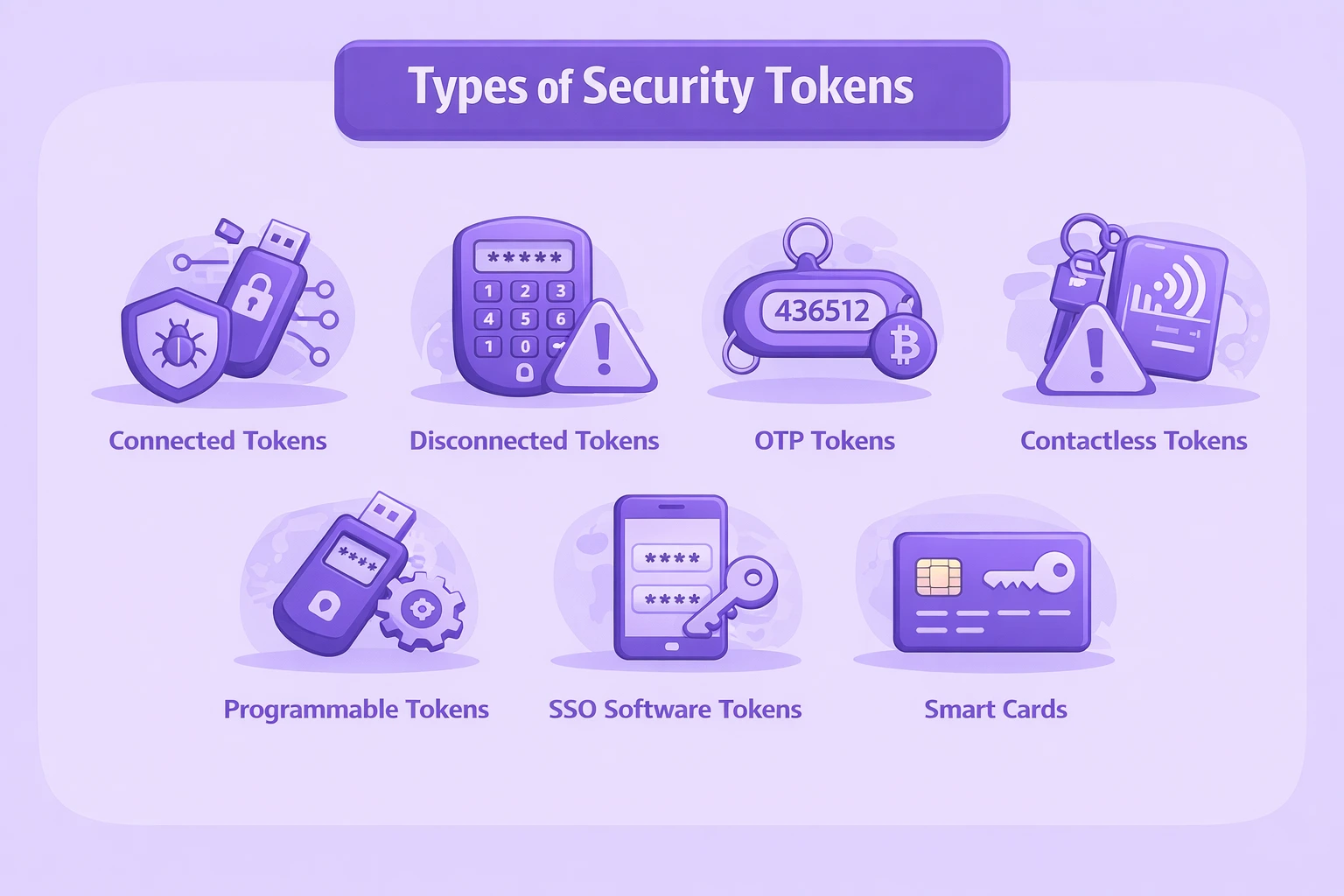
Types of Security Tokens
Security token implementations span diverse form factors and operational models serving different organizational requirements, user preferences, and security contexts.
Connected Tokens
Connected tokens physically attach to computers or authentication readers through USB ports, smart card slots, or other direct connection interfaces. These hardware security token devices establish direct communication channels with authentication systems transferring cryptographic credentials or generating verification codes.
YubiKey represents the most recognized connected token, supporting multiple authentication protocols including FIDO2, U2F, OTP, and smart card standards. Users insert YubiKeys into USB ports or tap NFC-enabled devices, with tokens automatically providing authentication responses without manual code entry requirements.
Connected tokens offer superior phishing resistance because authentication occurs through direct hardware communication rather than user-entered codes potentially intercepted by malicious websites. However, they require compatible hardware readers and physical proximity to authentication devices.
Disconnected Tokens
Disconnected tokens operate independently without physical connections to authentication systems. These security token devices generate one-time passwords displayed on built-in screens or transmitted through separate communication channels including SMS messages, email, or push notifications.
Pocket-sized key fobs displaying rotating numeric codes exemplify classic disconnected tokens. Users read displayed codes manually entering them into login prompts. Mobile authenticator applications like Google Authenticator, Microsoft Authenticator, and Authy function as software-based disconnected tokens generating TOTP codes on smartphones.
Disconnected tokens provide flexibility supporting authentication across multiple devices and locations without requiring specialized hardware readers. They prove particularly valuable for remote access scenarios and mobile workforce authentication requirements.
One-Time Password (OTP) Tokens
One-time password tokens generate unique authentication codes valid for single login sessions, automatically invalidating after initial use regardless of whether authentication succeeds. This security token example prevents code reuse attacks where attackers intercept valid codes attempting replay attacks.
OTP generation algorithms combine secret keys with time-based or counter-based values producing codes predictable only to parties possessing shared secrets. Authentication servers independently calculate expected OTP values comparing them against user-submitted codes, granting access only when values match within acceptable time windows.
Hardware OTP tokens, software authenticator apps, SMS-delivered codes, and email-transmitted passwords all implement OTP principles varying primarily in delivery mechanisms and security characteristics. Understanding crypto regulation frameworks helps businesses navigate compliance requirements around authentication security standards.
Contactless Tokens
Contactless tokens establish wireless communication with authentication systems through technologies including Bluetooth, NFC (Near Field Communication), or RFID (Radio Frequency Identification). These tokens provide convenient authentication without requiring physical insertion or cable connections.
Contactless smart cards enable proximity-based access control for physical security systems and logical network access. Users simply wave cards near readers triggering authentication exchanges. Mobile devices supporting NFC function as contactless tokens for payment systems, access control, and identity verification.
While contactless tokens offer convenience advantages, wireless communication introduces potential interception risks requiring encryption and anti-relay attack protections ensuring secure authentication.
Programmable Tokens
Programmable security tokens generate rotating authentication codes on fixed time intervals, typically every 30 seconds, ensuring continuous code refreshment preventing extended validity windows. These tokens display current codes on built-in screens or mobile application interfaces.
AWS Security Token Service exemplifies programmable token implementations providing temporary security credentials for cloud resource access. Microsoft Authenticator generates programmable TOTP codes for Microsoft accounts and third-party services supporting standard authentication protocols.
Programmable tokens balance security and usability by maintaining short code validity periods limiting attack windows while generating codes automatically without requiring user-initiated actions.
Single Sign-On (SSO) Software Tokens
Single sign-on software tokens store authentication credentials enabling users accessing multiple systems and services through single authentication events. SSO tokens eliminate repeatedly entering passwords across different platforms while maintaining centralized security controls.
Enterprise SSO solutions issue software tokens after initial authentication, presenting these tokens automatically to connected applications and services. Users experience seamless access across entire application portfolios without managing separate credentials for each system.
SSO token security depends on robust initial authentication, secure token storage, and limited token validity periods preventing unauthorized access if tokens become compromised.
Smart Cards
Smart cards resemble traditional credit cards but contain embedded computer chips storing cryptographic keys, digital certificates, and authentication credentials. These sophisticated security token devices support complex authentication protocols including PKI (Public Key Infrastructure) and multi-factor schemes.
Government agencies, financial institutions, and enterprises deploy smart cards for physical access control, network authentication, digital signatures, and secure transaction authorization. Smart cards can self-destruct when tampering detected, protecting stored credentials from extraction attempts.
Smart card implementations often combine card possession with PIN entry creating two-factor authentication, with some systems adding biometric verification for three-factor security.
Security Token Authentication Benefits
Implementing security token systems delivers measurable security improvements and operational advantages justifying deployment investments and user training requirements.
Dramatically Reduced Account Compromise
Security tokens eliminate password-only vulnerabilities responsible for majority of account breaches. Attackers obtaining passwords through phishing, data breaches, or keylogging cannot access protected accounts without corresponding token possession.
Microsoft research demonstrates multi-factor authentication using security tokens prevents 99.9% of automated account attacks targeting cloud services[1]. This extraordinary effectiveness stems from requiring physical device access impossible for remote attackers achieving regardless of password knowledge.
Phishing Attack Resistance
Traditional phishing attacks trick users into entering credentials on fraudulent websites capturing passwords for unauthorized access. Security tokens, particularly hardware-based implementations, resist phishing because authentication occurs through cryptographic challenges requiring genuine authentication servers rather than user-entered codes.
FIDO2 and U2F protocol security tokens communicate directly with authentication systems verifying server identities before responding to authentication requests. Fake phishing websites cannot successfully complete these cryptographic exchanges even if users attempt authentication.
Regulatory Compliance Support
Industry regulations including PCI DSS, HIPAA, SOX, and GDPR mandate strong authentication controls for protecting sensitive data and financial systems. Security token implementation helps organizations satisfy multi-factor authentication requirements demonstrating due diligence in cybersecurity practices.
Financial services, healthcare providers, government agencies, and enterprises handling regulated data deploy security tokens ensuring compliance while protecting against enforcement actions and breach liabilities. Understanding crypto rewards mechanisms helps contextualize how token-based systems incentivize security participation.
Improved User Accountability
Security tokens create clear accountability by requiring unique physical devices or personal mobile applications for authentication. Unlike shared passwords potentially used by multiple individuals, token-based authentication definitively identifies specific users accessing systems.
Audit trails recording security token authentication events provide forensic evidence for investigating security incidents, demonstrating compliance during audits, and attributing actions to individual users.
Reduced Password Management Burden
Organizations implementing security tokens can relax password complexity requirements and extend password rotation periods because token-based second factors compensate for simpler passwords. This improves user experience while maintaining security postures.
Some advanced implementations eliminate passwords entirely, relying on security tokens combined with biometric authentication for passwordless authentication experiences reducing help desk password reset costs and user frustration.
Security Token Vulnerabilities and Risks
While security tokens significantly improve authentication security, they introduce specific vulnerabilities and operational challenges requiring mitigation strategies.
Physical Loss and Theft
Hardware security tokens face loss or theft risks potentially granting unauthorized access if attackers obtain both tokens and corresponding passwords. Organizations must implement immediate token deactivation procedures and backup authentication methods enabling legitimate users regaining access.
Token replacement processes require balancing security with user convenience. Overly restrictive replacement requiring in-person verification frustrates users, while excessively permissive procedures enable social engineering attacks where attackers impersonate legitimate users requesting token replacements.
SMS Interception Attacks
SMS-delivered OTP codes face interception risks through SIM swapping attacks, SS7 protocol vulnerabilities, and mobile network compromises. Attackers convincing mobile carriers transferring victim phone numbers to attacker-controlled SIM cards receive authentication codes enabling account takeover.
Cybersecurity experts increasingly recommend against SMS-based authentication favoring hardware tokens or authenticator applications immune to telecommunications infrastructure attacks[2].
Malware and Man-in-the-Middle Attacks
Sophisticated malware infecting user devices can intercept security token-generated codes in real-time, forwarding them to attackers who immediately use codes before expiration. These advanced attacks require malware persistence on victim devices during authentication attempts.
Man-in-the-middle attacks position attackers between users and authentication systems, relaying credentials and token codes in real-time creating appearance of legitimate authentication while granting attackers simultaneous access.
User Convenience Challenges
Security tokens add authentication steps potentially frustrating users accustomed to simple password-only access. Users forgetting hardware tokens at home, experiencing dead smartphone batteries, or losing authenticator app access face authentication failures disrupting productivity.
Organizations must provide backup authentication methods, user training, and technical support ensuring security token benefits outweigh usability costs. Poor user experience leads to security workarounds undermining entire authentication frameworks.
Security Tokens in Cryptocurrency and Blockchain
Beyond traditional authentication contexts, security token terminology extends into cryptocurrency and blockchain domains representing digital assets with specific regulatory and functional characteristics.
Blockchain Security Tokens Defined
In cryptocurrency contexts, security tokens represent digital assets embodying ownership rights, profit-sharing arrangements, or investment contract characteristics subject to securities regulations. Unlike utility tokens providing access to blockchain platforms or services, security tokens function as investment instruments similar to traditional stocks or bonds.
Security token offerings (STOs) enable companies raising capital by issuing blockchain-based securities to investors. These tokenized securities provide fractional ownership, dividend distributions, and voting rights recorded immutably on blockchain networks. Exploring Solana token ecosystems demonstrates how blockchain platforms support diverse token types including both utility and security classifications.
Regulatory Framework
The U.S. Securities and Exchange Commission applies the Howey Test determining whether digital assets qualify as securities requiring regulatory compliance. Tokens meeting Howey Test criteria—representing investment contracts with profit expectations derived from others’ efforts—fall under securities regulations regardless of technological implementation.
Security token issuers must register offerings with SEC or qualify for exemptions, provide investor disclosures, and comply with ongoing reporting requirements similar to traditional securities. This regulatory framework protects investors while establishing legal clarity for blockchain-based financial instruments[3].
Security Token vs Utility Token
Understanding security token versus utility token distinctions proves critical for compliance and investment decisions. Security tokens represent ownership or profit rights requiring securities regulation compliance, while utility tokens grant access to platform services or functions operating outside securities frameworks.
Bitcoin and Ethereum primarily function as utility tokens despite investment characteristics, because they enable peer-to-peer payments and smart contract execution rather than representing ownership claims in enterprises. Tokenized real estate, equity tokens, and debt instruments clearly qualify as security tokens under regulatory definitions.
Authentication vs Cryptocurrency Security Tokens
| Characteristic | Authentication Security Token | Cryptocurrency Security Token |
|---|---|---|
| Primary Purpose | User identity verification | Investment instrument, ownership rights |
| Form Factor | Hardware device, mobile app, smart card | Digital blockchain-based asset |
| Technology Base | Cryptographic algorithms, TOTP/HOTP | Blockchain, smart contracts |
| Regulatory Status | Cybersecurity compliance requirement | Securities regulation, SEC oversight |
| Value Proposition | Enhanced security, access control | Investment returns, ownership representation |
| User Base | Employees, account holders, system users | Investors, asset owners, traders |
Security Token Implementation Best Practices
Successfully deploying security token systems requires strategic planning, technical preparation, and organizational change management ensuring security benefits realize without creating operational disruptions.
Assessment and Planning
Organizations should begin security token implementations by defining authentication requirements, identifying protected resources requiring enhanced security, and determining appropriate token types matching use cases. Financial systems and administrative interfaces warrant hardware tokens providing maximum security, while general user accounts may suffice with mobile authenticator applications.
Cost-benefit analyses should consider token procurement expenses, deployment labor, user training requirements, and ongoing support costs against breach risk reductions and compliance benefits. Hardware tokens cost $20-50 per unit, while software authenticator applications provide free alternatives sacrificing some security for cost savings.
Compatibility Verification
Security tokens must integrate seamlessly with existing authentication infrastructure including identity management systems, VPN gateways, cloud services, and enterprise applications. Organizations should verify token compatibility with target platforms before large-scale deployments avoiding costly integration failures.
Standard protocols including TOTP, HOTP, FIDO2, and SAML enable broad compatibility across authentication systems. Proprietary token implementations may offer enhanced features but limit flexibility and create vendor lock-in risks.
Pilot Testing
Conducting pilot deployments with limited user groups identifies technical issues, usability problems, and training gaps before organization-wide rollouts. Pilot participants provide feedback refining procedures, documentation, and support resources improving full deployment outcomes.
Testing should encompass diverse user scenarios including remote access, mobile device usage, token loss procedures, and backup authentication methods ensuring comprehensive readiness.
User Training and Support
Effective security token deployments require user education explaining authentication procedures, troubleshooting common issues, and understanding security benefits motivating compliance. Training should provide hands-on practice with token enrollment, code generation, and backup recovery processes.
Technical support teams need training addressing token-related help desk inquiries, performing token replacements, and assisting users experiencing authentication difficulties. Clear escalation procedures ensure complex issues receive appropriate technical resolution.
Backup Authentication Methods
Organizations must establish backup authentication methods enabling legitimate users accessing systems when primary tokens become unavailable. Backup codes, alternative token devices, or administrator-assisted authentication provide failsafe access while maintaining security controls.
Backup procedures should balance accessibility with security, preventing attackers exploiting recovery mechanisms while ensuring legitimate users face minimal disruption from token issues.
Implement Secure Authentication Systems
Partner with experienced security professionals to deploy robust multi-factor authentication infrastructure, integrate hardware and software security tokens, and build comprehensive identity management solutions protecting organizational assets.
Future of Security Token Technology
Security token technology continues evolving toward passwordless authentication, biometric integration, and blockchain-based identity systems reshaping digital authentication paradigms.
Passwordless Authentication
Modern security token implementations increasingly eliminate passwords entirely, relying on biometric authentication combined with hardware tokens. FIDO2 WebAuthn standards enable passwordless login experiences where users authenticate through fingerprint recognition, facial scanning, or hardware token possession without password entry.
Passwordless systems eliminate password-related vulnerabilities including weak credentials, password reuse, and phishing attacks while improving user experience through simplified authentication workflows[4].
Decentralized Identity
Blockchain-based decentralized identity systems utilize security tokens representing verifiable credentials enabling users controlling personal identity data rather than relying on centralized identity providers. These self-sovereign identity frameworks allow sharing verified attributes without exposing underlying personal information.
Adaptive Authentication
Next-generation authentication systems dynamically adjust security requirements based on risk assessments analyzing user behavior, device characteristics, network context, and access patterns. Low-risk scenarios may require only token-based authentication, while high-risk activities trigger additional verification through biometrics or administrator approval.
Final Thoughts
What is security token encompasses both traditional authentication devices protecting system access through multi-factor verification and blockchain-based digital assets representing investment securities under regulatory frameworks. Authentication security tokens dramatically reduce account compromise risks by requiring physical device possession or time-sensitive code generation impossible for remote attackers obtaining passwords alone.
Organizations implementing security token systems experience measurable security improvements including 99.9% reduction in automated attack success rates, enhanced regulatory compliance, improved user accountability, and reduced password management burdens. While tokens introduce considerations around physical loss risks, user convenience, and implementation costs, security benefits overwhelmingly justify deployment investments for protecting sensitive systems and data.
The evolution from simple password authentication toward passwordless systems combining biometrics with hardware tokens, decentralized identity frameworks, and adaptive authentication reflects ongoing security innovation addressing sophisticated threat landscapes. As cyber attacks grow increasingly advanced, security token technology provides essential defense layers ensuring only authorized users access protected resources regardless of password compromise.
For businesses seeking robust authentication solutions, understanding security token types, implementation best practices, and integration requirements enables strategic deployments maximizing security improvements while maintaining user productivity. Whether protecting enterprise networks, cloud services, financial systems, or blockchain platforms, security tokens represent fundamental components of comprehensive cybersecurity strategies.
Frequently Asked Questions
Q1.What is security token in cybersecurity?
Security token in cybersecurity refers to physical or digital device providing multi-factor authentication beyond passwords, generating time-sensitive codes or storing cryptographic credentials verifying user identity during system access attempts.
Q2.How do security tokens work in authentication?
Security tokens work by generating unique one-time passwords using cryptographic algorithms synchronized with authentication servers. users enter token-generated codes proving physical device possession complementing password knowledge for two-factor verification.
Q3.What are types of security tokens?
Security token types include connected hardware devices, disconnected otp generators, mobile authenticator applications, sms-delivered codes, smart cards, contactless nfc tokens, programmable code generators, and single sign-on software tokens.
Q4.What is two factor authentication token?
Two factor authentication token provides second verification factor beyond passwords requiring users prove identity through something they possess like hardware device or mobile app generating temporary authentication codes.
Q5.Are security tokens safe from phishing?
Hardware security tokens using fido2 or u2f protocols resist phishing attacks through cryptographic challenges verifying authentication server identities before responding. attackers cannot intercept or replay these cryptographic exchanges on fake websites.
Q6.What is difference between security and utility tokens?
Security tokens in cryptocurrency represent investment instruments with ownership rights requiring securities regulation compliance, while utility tokens provide access to blockchain platform services operating outside securities frameworks without investment contract characteristics.
Q7.What happens if security token is lost?
Lost security tokens require immediate deactivation preventing unauthorized access followed by replacement token issuance. organizations maintain backup authentication methods enabling legitimate users regaining access during replacement processes.
Explore Services
Related Services
Reviewed by

Aman Vaths
Founder of Nadcab Labs
Aman Vaths is the Founder & CTO of Nadcab Labs, a global digital engineering company delivering enterprise-grade solutions across AI, Web3, Blockchain, Big Data, Cloud, Cybersecurity, and Modern Application Development. With deep technical leadership and product innovation experience, Aman has positioned Nadcab Labs as one of the most advanced engineering companies driving the next era of intelligent, secure, and scalable software systems. Under his leadership, Nadcab Labs has built 2,000+ global projects across sectors including fintech, banking, healthcare, real estate, logistics, gaming, manufacturing, and next-generation DePIN networks. Aman’s strength lies in architecting high-performance systems, end-to-end platform engineering, and designing enterprise solutions that operate at global scale.