Ai Overview
Crypto rewards are incentives or benefits distributed in cryptocurrency form to users for specific actions including staking digital assets, providing liquidity, participating in lending protocols, completing transactions, or engaging with blockchain platforms. Major centralized exchanges including Coinbase, Binance, and Kraken offer simplified staking services handling technical complexities while charging service fees typically 5-25% of earned rewards.
What are crypto rewards represents one of the most searched questions among cryptocurrency enthusiasts and investors seeking to maximize returns beyond simple price appreciation. Crypto rewards are incentives or benefits distributed in cryptocurrency form to users for specific actions including staking digital assets, providing liquidity, participating in lending protocols, completing transactions, or engaging with blockchain platforms. These rewards fundamentally transform passive cryptocurrency holdings into active income-generating assets through various mechanisms built into blockchain protocols and decentralized finance applications.
The cryptocurrency rewards ecosystem has evolved dramatically from simple mining rewards to sophisticated yield-generating opportunities across staking, lending, liquidity provision, and loyalty programs. Understanding how to earn crypto rewards through different mechanisms enables investors to maximize portfolio returns while supporting blockchain network security and decentralized finance protocol operations. Professional token development services providers help projects design sustainable reward mechanisms aligned with tokenomics and community growth objectives.
Key Takeaways
- Crypto Rewards Definition: Cryptocurrency incentives distributed to users for specific actions including staking assets, providing liquidity, lending tokens, completing transactions, or engaging with blockchain platforms generating passive income opportunities.
- Staking Rewards Dominant: Crypto staking rewards represent primary earning mechanism where users lock tokens supporting proof-of-stake networks earning 3-20% annual yields depending on blockchain protocol and staking duration.
- Multiple Earning Methods: Investors earn crypto rewards through staking, DeFi lending protocols, liquidity provision, yield farming, CeFi platforms, stablecoin holdings, referral programs, and blockchain-based loyalty systems.
- Stablecoin Advantages: Holding stablecoins like USDC, DAI, or USDT generates 2-8% annual yields through lending platforms while eliminating cryptocurrency volatility risks common with native token staking.
- DeFi Higher Returns: Decentralized finance lending and liquidity provision offers 5-25% yields exceeding traditional staking but carrying increased smart contract risks, impermanent loss exposure, and protocol security dependencies.
- Tax Implications Critical: Crypto rewards constitute taxable income in most jurisdictions valued at fair market price upon receipt, with subsequent sales triggering capital gains requiring comprehensive transaction record-keeping.
- Security Considerations Essential: Reward programs employ blockchain security, multi-signature wallets, two-factor authentication, cold storage, encryption, and regular audits protecting user assets from unauthorized access and hacking attempts.
- Industry Adoption Expanding: Crypto reward systems deployed across finance, gaming, e-commerce, DeFi platforms, content creation, loyalty programs, and enterprise applications driving mainstream cryptocurrency adoption and engagement.
What are Crypto Rewards?
Crypto rewards refer to incentives or benefits provided in cryptocurrency tokens or digital assets form distributed to individuals for specific actions, behaviors, achievements, or participation in blockchain ecosystems. These rewards represent fundamental value transfer mechanisms enabling users converting passive cryptocurrency holdings into active income-generating assets through various protocol participation methods.
Unlike traditional reward programs distributing fiat currency, points, or physical goods, crypto rewards leverage blockchain technology enabling instant global transfers, transparent distribution, programmatic automation through smart contracts, and potential appreciation as underlying cryptocurrency values increase. This creates unique value propositions combining immediate utility with long-term investment potential.
Cryptocurrency incentive programs operate across multiple mechanisms including proof-of-stake validation rewards, decentralized finance lending yields, liquidity provision fees, transaction rebates, referral bonuses, loyalty program distributions, and content creation compensation. Understanding DeFi tokens helps contextualize how reward mechanisms integrate with decentralized financial applications.
The global crypto rewards ecosystem has matured significantly since early Bitcoin mining rewards, now encompassing sophisticated yield strategies across hundreds of blockchain networks, thousands of protocols, and diverse application categories. Market data indicates crypto staking alone generated over $20 billion in rewards distributed to participants in 2025, demonstrating massive value creation through decentralized incentive alignment.
What are Crypto Staking Rewards?
Crypto staking rewards are incentives earned by participants who lock or “stake” their cryptocurrency in blockchain networks supporting network operations including transaction validation and network security. In return for staking assets contributing to consensus mechanisms, users receive additional cryptocurrency rewards similar to earning interest on savings accounts but with blockchain-specific characteristics.
Staking emerged as dominant consensus mechanism alternative to energy-intensive proof-of-work mining, with proof-of-stake networks including Ethereum, Cardano, Polkadot, Solana, and Cosmos distributing billions in annual staking rewards. The mechanism aligns incentives between network security and token holder participation, creating sustainable economic models supporting decentralized infrastructure.
How Staking Rewards Work
Staking processes vary by blockchain but generally follow consistent patterns. Users deposit cryptocurrency into staking contracts or validators, tokens become locked for specified periods (ranging from no lock-up to multi-year commitments), staked tokens participate in network consensus validating transactions, and rewards distribute proportionally based on stake size and duration.
Reward rates fluctuate based on multiple factors including total network stake participation (higher participation typically reduces individual yields), inflation rates programmed into protocol tokenomics, transaction fee volumes generating additional rewards, and network security requirements determining minimum viable stake thresholds.
Ethereum staking following the Merge to proof-of-stake offers approximately 3-5% annual yields, Cardano provides 4-6% staking returns, Polkadot delivers 10-14% rewards, while smaller networks sometimes offer 15-20% annual percentage yields attracting early adopters though with correspondingly higher risks. Understanding ROI in crypto helps evaluate whether staking returns justify opportunity costs and lock-up periods.
Staking Risk Considerations
While staking generates passive income, several risks require consideration. Market volatility means staked cryptocurrency values can decline offsetting reward earnings, lock-up periods prevent accessing funds during market downturns, validator slashing penalties punish protocol violations reducing staked amounts, and protocol changes might alter reward structures unexpectedly.
Smart investors diversify staking across multiple networks, understand lock-up terms before committing funds, research validator track records avoiding those with slashing histories, and size positions appropriately relative to overall portfolio risk tolerance[2].
Crypto Reward Earning Methods Comparison
| Method | Typical APY | Risk Level | Best For |
|---|---|---|---|
| Staking (Major Networks) | 3-6% | Low-Medium | Long-term holders, conservative investors |
| Staking (Smaller Networks) | 10-20% | Medium-High | Risk-tolerant investors, early adopters |
| Stablecoin Lending (CeFi) | 2-8% | Low-Medium | Risk-averse, stable yield seekers |
| DeFi Lending | 5-15% | Medium-High | DeFi-savvy users, protocol researchers |
| Liquidity Provision | 8-25% | High | Advanced users, impermanent loss aware |
| Yield Farming | 15-50%+ | Very High | Experienced DeFi users only |
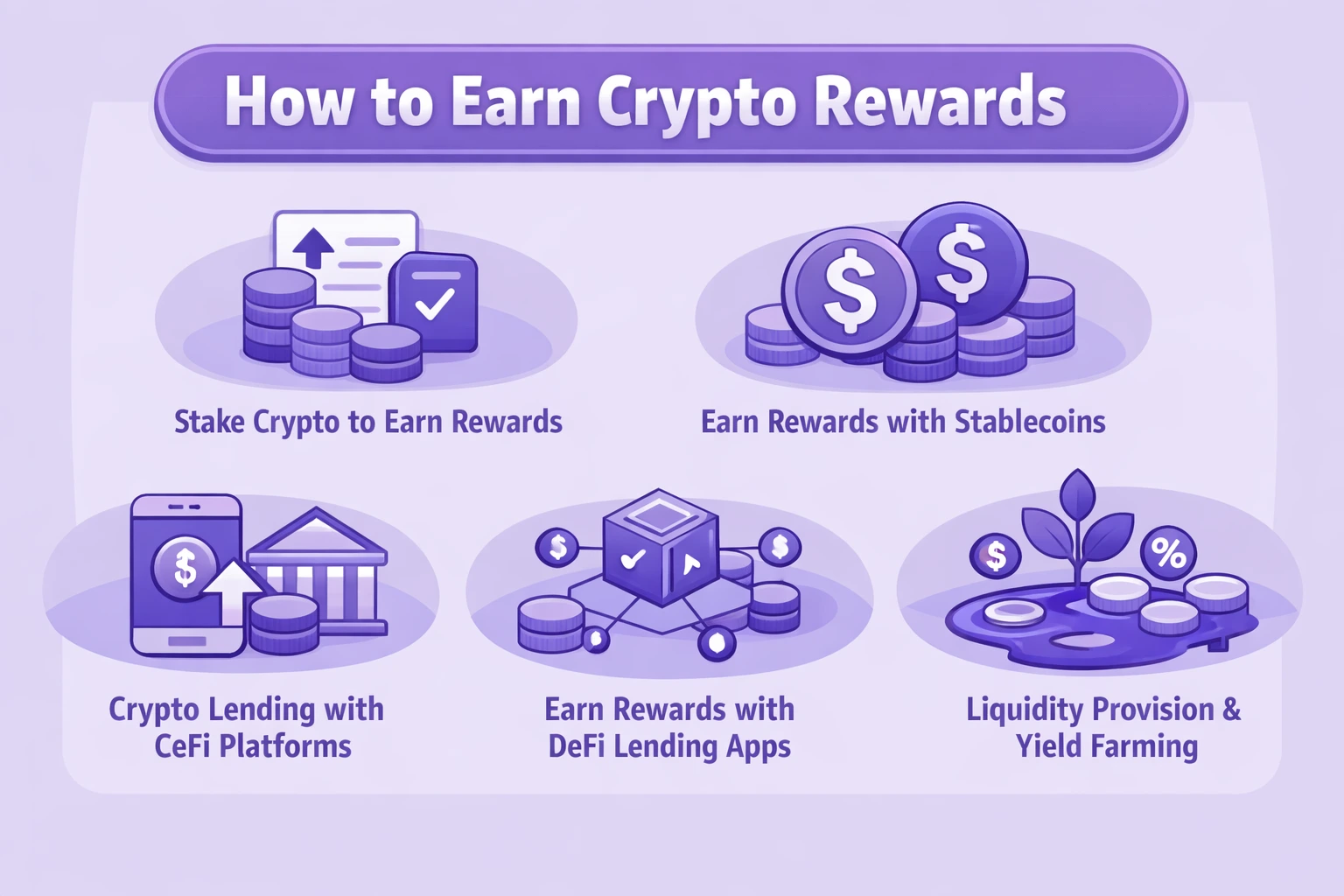
How to Earn Crypto Rewards
Understanding how to earn crypto rewards requires knowledge of multiple mechanisms each offering distinct risk-reward profiles, technical requirements, and strategic considerations.
Stake Crypto to Earn Rewards
Staking remains the most straightforward method for earning crypto rewards requiring minimal technical knowledge. Users select blockchain networks supporting proof-of-stake consensus, choose between native staking (running validators) or delegated staking (using staking pools), deposit minimum required amounts, and earn proportional rewards automatically distributed.
Major centralized exchanges including Coinbase, Binance, and Kraken offer simplified staking services handling technical complexities while charging service fees typically 5-25% of earned rewards. Decentralized staking through wallets like Ledger or protocols like Lido provides greater control and potentially higher yields but requires more technical understanding.
Best practices include researching network fundamentals before staking, understanding lock-up periods and withdrawal timelines, diversifying stake across multiple validators reducing slashing risks, and monitoring reward rates adjusting strategies as network conditions change.
Earn Rewards with Stablecoins
Stablecoin rewards offer unique advantages combining cryptocurrency infrastructure benefits with fiat currency stability. Holders of USDC, USDT, DAI, or BUSD can earn yields through centralized lending platforms, decentralized lending protocols, or simply holding in specific exchange accounts automatically distributing interest.
Centralized platforms like BlockFi, Celsius (pre-bankruptcy), and exchange savings products historically offered 4-8% annual yields on stablecoin deposits. Following 2022 industry consolidation, current rates range 2-6% with established platforms emphasizing security and regulatory compliance. Understanding crypto regulation helps evaluate platform legitimacy and consumer protection frameworks.
Stablecoin yields derive from lending to institutional borrowers, market makers requiring inventory, or DeFi protocols utilizing deposits for liquidity provision. The stability eliminates cryptocurrency volatility concerns while generating returns significantly exceeding traditional savings accounts.
Crypto Lending with CeFi Platforms
Centralized finance platforms enable users lending cryptocurrency to borrowers earning interest through intermediary matching. These platforms operate similarly to traditional banks accepting deposits, lending to qualified borrowers at higher rates, and distributing portion of interest margin to depositors.
Leading CeFi lending platforms include established exchanges offering lending products, specialized lending companies like Nexo and Ledn, and institutional-grade services from Genesis and BlockFi (subject to ongoing restructuring). Rates vary by asset with Bitcoin typically earning 1-3% annually, Ethereum 2-5%, and stablecoins 3-8%.
CeFi advantages include user-friendly interfaces, customer support, insurance coverage on some platforms, and regulatory compliance in certain jurisdictions. Disadvantages encompass counterparty risk requiring trust in platform solvency, lack of transparency into lending practices, and potential regulatory actions affecting operations[3].
Earn Rewards with DeFi Lending Apps
Decentralized finance lending protocols including Aave, Compound, and MakerDAO enable peer-to-peer lending without intermediaries through smart contracts. Users deposit cryptocurrency into liquidity pools, borrowers access funds by providing collateral, and lenders earn variable interest rates determined by supply-demand dynamics.
DeFi lending typically offers higher yields than CeFi ranging 3-15% for major assets and 5-25% for stablecoins during high-demand periods. Rates fluctuate continuously based on borrowing demand, total liquidity supplied, and protocol incentive programs distributing governance tokens as additional rewards.
DeFi advantages include transparency with all transactions visible on blockchain, non-custodial control maintaining asset ownership, and composability enabling sophisticated yield strategies. Risks encompass smart contract vulnerabilities potentially draining protocol funds, regulatory uncertainty surrounding decentralized platforms, and technical complexity requiring blockchain literacy.
Advanced users employ yield aggregators like Yearn Finance automatically optimizing deposits across multiple protocols maximizing returns, though adding additional smart contract interaction risks requiring thorough research.
Liquidity Provision and Yield Farming
Providing liquidity to decentralized exchanges like Uniswap, SushiSwap, or PancakeSwap generates rewards from trading fees plus liquidity mining incentives. Users deposit token pairs into liquidity pools, receive LP tokens representing pool ownership share, and earn proportional fees from trades plus protocol token rewards.
Liquidity provision introduces impermanent loss risk where token price divergence relative to initial deposit creates unrealized losses offsetting fee earnings. Successful liquidity providers select stable pair combinations, monitor impermanent loss exposure, and ensure fee revenue plus incentives exceed potential losses.
Yield farming involves strategically rotating capital across protocols maximizing reward token accumulation then compounding or selling earnings. This active management requires constant monitoring, gas fee consideration, and sophisticated understanding of DeFi mechanics making it suitable only for experienced users.
Benefits of Crypto Rewards
Crypto reward programs deliver multiple advantages over traditional incentive systems benefiting individuals, businesses, and broader cryptocurrency ecosystems.
For Individual Users
Instant global transactions enable immediate reward receipt regardless of geographic location eliminating wire transfer delays or banking restrictions. Lower transaction costs minimize fees compared to traditional payment processing saving both distributors and recipients money.
Direct ownership and control mean users maintain custody of reward assets without intermediary dependencies reducing counterparty risks. Portfolio diversification opportunities allow accumulating various cryptocurrencies creating potentially appreciating reward portfolios beyond simple cash equivalents.
Passive income generation transforms idle cryptocurrency holdings into productive assets earning yields comparable to or exceeding traditional investment vehicles. Understanding non-fungible token economics provides context for how different digital asset types generate value and rewards.
For Businesses and Organizations
Programmatic automation through smart contracts enables transparent, error-free reward distribution reducing administrative overhead and manual processing costs. Blockchain-based systems provide immutable audit trails simplifying compliance reporting and verification.
Global accessibility reaches users worldwide including underbanked populations lacking traditional financial access expanding potential customer and employee bases. Innovation signaling demonstrates technological sophistication appealing to digitally-native demographics and competitive differentiation.
Customer loyalty enhancement through crypto rewards creates engagement exceeding traditional points programs due to cryptocurrency investment potential and novel redemption options. Partner ecosystem development enables cross-platform reward integration and collaboration opportunities.
Industries Using Crypto Rewards
Cryptocurrency reward programs have expanded beyond early adopter communities into mainstream industries recognizing blockchain incentive alignment benefits.
Finance and Banking
Fintech companies offer cryptocurrency rewards for account sign-ups, transaction volumes, or using specific financial products. Crypto.com, Gemini, and BlockFi historically provided cashback programs rewarding card usage with Bitcoin or native platform tokens incentivizing engagement.
Gaming and NFTs
Play-to-earn games distribute cryptocurrency rewards for achievements, time investment, or competitive performance. Axie Infinity pioneered models where players earn tokens tradable for fiat currency, with games like The Sandbox and Decentraland rewarding virtual world participation through token economies.
E-commerce and Retail
Online retailers implement crypto cashback programs providing percentage returns on purchases in cryptocurrency form. Lolli browser extension rewards Bitcoin for shopping at partner merchants, while Fold offers Bitcoin rewards for gift card purchases creating circular crypto economies.
Decentralized Finance Platforms
DeFi protocols distribute governance tokens rewarding liquidity provision, borrowing activity, or protocol usage. Compound pioneered liquidity mining distributing COMP tokens to users, establishing models replicated across hundreds of DeFi platforms incentivizing early adoption and network effects.
Content Creation and Social Media
Decentralized platforms reward content creators with cryptocurrency for producing valuable content. Brave browser distributes Basic Attention Token (BAT) to users viewing privacy-respecting ads, while platforms like Steemit reward blog posts and social engagement with native tokens.
Crypto Rewards Security Measures
| Security Measure | Purpose | Implementation |
|---|---|---|
| Blockchain Security | Prevent unauthorized tampering | Decentralization, cryptographic encryption |
| Cold Wallet Storage | Reduce online hacking risk | Offline storage of private keys |
| Multi-Signature Wallets | Require multiple approvals | Multiple private keys for authorization |
| Two-Factor Authentication | Add access security layer | Dual identification requirement |
| Encryption | Protect data privacy | Secure communication channels |
| Regular Security Audits | Identify vulnerabilities | Periodic infrastructure assessment |
Are Crypto Rewards Taxable?
Tax implications represent critical consideration for anyone earning crypto rewards, as most jurisdictions classify cryptocurrency rewards as taxable income requiring proper reporting and compliance.
Tax Treatment Fundamentals
Receiving crypto rewards constitutes taxable event in many jurisdictions with participants required reporting earnings to tax authorities. The fair market value of received tokens at receipt time determines taxable income amount, with subsequent sales triggering capital gains calculations based on cost basis and sale price difference.
United States treats crypto rewards as ordinary income subject to income tax rates ranging 10-37% federally depending on total income. When selling rewarded cryptocurrency, capital gains tax applies with short-term rates (assets held under one year) matching ordinary income rates and long-term rates (over one year holding) benefiting from preferential 0-20% taxation.
Staking rewards, lending interest, liquidity provision fees, and airdropped tokens all constitute taxable income at receipt time even if not immediately sold. This creates tax obligations potentially exceeding available liquidity if cryptocurrency values subsequently decline before tax payments due.
Record Keeping Requirements
Comprehensive transaction documentation proves essential for accurate tax reporting and audit protection. Users should maintain detailed records including reward receipt dates, cryptocurrency types and quantities received, fair market values at receipt timestamps, wallet addresses involved, and platforms or protocols distributing rewards.
Specialized cryptocurrency tax software including CoinTracker, Koinly, and TaxBit integrate with exchanges and wallets automatically importing transaction data, calculating cost basis, and generating tax reports simplifying compliance. Manual spreadsheet tracking remains viable for users with limited transaction volumes.
Reporting Crypto Rewards on Taxes
United States taxpayers report crypto reward income on Form 1040 Schedule 1 as “other income” with amounts determined by fair market value at receipt. Subsequent sales report on Schedule D as capital gains or losses using original receipt value as cost basis.
Accurate reporting requires determining reward types (staking, lending, airdrops, etc.), recording fair market values at receipt in local currency, calculating capital gains when selling using appropriate cost basis methods, and utilizing proper tax forms per jurisdiction requirements.
International tax treatment varies significantly with some jurisdictions treating crypto rewards more favorably. Germany exempts long-term cryptocurrency holdings from capital gains taxation, Portugal historically provided tax-free cryptocurrency trading (subject to recent changes), and Singapore offers favorable treatment for individual investors versus traders.
Consulting qualified tax professionals specializing in cryptocurrency ensures compliance with evolving regulations and optimizes tax positions through legal strategies including tax-loss harvesting, strategic timing of reward realizations, and proper entity structuring for substantial crypto activity[4].
Maximize Your Crypto Rewards
Partner with experienced blockchain professionals to design sustainable reward mechanisms, integrate staking infrastructure, and build engaging crypto incentive programs driving user adoption and community growth.
Challenges and Risks of Crypto Reward Programs
While crypto rewards offer compelling benefits, several challenges require consideration before participating in reward programs or implementing them for businesses.
Volatility and Price Risk
Cryptocurrency price volatility creates uncertainty around reward values with tokens potentially depreciating significantly between earning and liquidation. Staking rewards denominated in native tokens subject holders to full price exposure potentially negating yield if underlying cryptocurrency values decline substantially.
Regulatory Uncertainty
Evolving cryptocurrency regulations create compliance challenges for reward program operators and participants. Securities classification questions surround some reward tokens, tax treatment continues developing across jurisdictions, and platform licensing requirements vary creating operational complexity.
Technical Complexity
Managing cryptocurrency wallets, understanding gas fees, navigating decentralized protocols, and securing private keys present barriers for mainstream adoption. User education becomes critical but requires significant investment in documentation and support resources.
Smart Contract Risks
DeFi reward programs depend on smart contract security with vulnerabilities potentially enabling fund theft or protocol exploitation. Even audited contracts face risks from complex interactions, economic attacks, or unforeseen edge cases requiring due diligence before depositing significant funds.
Platform Solvency Concerns
Centralized platforms offering rewards face bankruptcy risks as demonstrated by Celsius, BlockFi, and FTX collapses. Users maintaining custody with centralized services accept counterparty risks potentially resulting in total loss during insolvency proceedings.
Final Thoughts
What are crypto rewards encompasses understanding diverse cryptocurrency incentive mechanisms transforming passive digital asset holdings into active income-generating opportunities. From proof-of-stake staking rewards to DeFi lending yields, liquidity provision fees to blockchain-based loyalty programs, the crypto rewards ecosystem offers multiple pathways for earning returns beyond simple price appreciation.
Successful participation requires balancing opportunity against risk through comprehensive understanding of staking mechanics, lending protocol security, tax implications, and regulatory compliance requirements. Conservative investors may prefer established network staking or stablecoin lending offering predictable yields with lower volatility, while experienced users might pursue higher DeFi returns accepting corresponding smart contract and impermanent loss risks.
The evolution from simple mining rewards to sophisticated yield generation demonstrates cryptocurrency ecosystem maturation with institutional participation, regulatory clarity, and infrastructure development supporting sustainable reward mechanisms. As blockchain adoption accelerates across industries, crypto reward programs will increasingly serve as bridges connecting traditional finance with decentralized alternatives.
For individuals, crypto rewards enable portfolio diversification, passive income generation, and participation in cutting-edge financial infrastructure. For businesses, reward programs offer customer engagement tools, employee incentive mechanisms, and competitive differentiation through technological innovation. Understanding how to earn crypto rewards strategically positions participants capitalizing on blockchain’s fundamental value proposition—aligning incentives through transparent, automated, and globally accessible reward distribution.
Explore Services
Related Services
Reviewed by

Aman Vaths
Founder of Nadcab Labs
Aman Vaths is the Founder & CTO of Nadcab Labs, a global digital engineering company delivering enterprise-grade solutions across AI, Web3, Blockchain, Big Data, Cloud, Cybersecurity, and Modern Application Development. With deep technical leadership and product innovation experience, Aman has positioned Nadcab Labs as one of the most advanced engineering companies driving the next era of intelligent, secure, and scalable software systems. Under his leadership, Nadcab Labs has built 2,000+ global projects across sectors including fintech, banking, healthcare, real estate, logistics, gaming, manufacturing, and next-generation DePIN networks. Aman’s strength lies in architecting high-performance systems, end-to-end platform engineering, and designing enterprise solutions that operate at global scale.